
My book The Track is now out of print but I have one spare copy I would like to gift to a reader who leaves a comment here or on my social media pages. Thanks Mary Cresswell for the review!
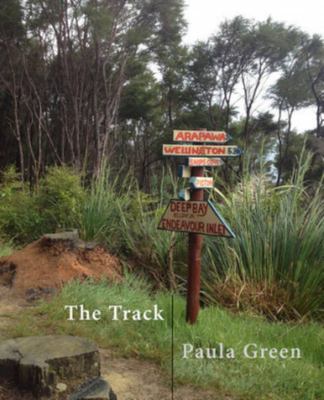
The Track, Paula Green
Seraph Press, 2019
This extraordinary collection starts out in the well-known natural beauty of the Queen Charlotte Track and ends up turning nature poetry on its head. The poet begins a three-day walk at Ship Cove:
The day’s brightness screams
of utter beauty.
It hurts to look.
I can’t stop looking.
from ‘Resolution Bay‘
And farther along:
I can’t control thoughts
in the middle of nowhere.
Am I true to myself
in the middle of walking
carrying the lightness of beauty
like a body craving flight?
from ‘Endeavour Inlet to Big Bay’
And then:
on the last day the longest day walking/ into four hours of storm [ …]
my foot breaks once the rage then twice
no sign of promised beauty
from ‘Queen Charlotte Track’
Beauty is out the window and pain takes over, as Green begins, not a four-hour walk on the final day, but a ten-hour shamble to safety and medical help.
Her language changes from laid back and descriptive to disconnected babbling that fuels her ability to stay conscious and moving. The broad beauty of the environment is taken over by a detailed recording of the minutiae of pain:
For ten hours don’t take your eyes off
leaves amulet beds orange saffron red
it’s electric art beneath leaf stone leaf
dragging dredging yes patterns cling to this
from ‘The Track’
Sue Wootton, who is both poet and medical professional, has reviewed the language of this collection from the angle of pain and its effects on the poet’s consciousness. It’s fascinating (though too short), and there’s nothing I could possibly add to it. What is also interesting is what poetic form this pain-racked language lends itself to.
Green used composing the poems to hold herself together those last hours of the walk. Later she collected and polished them, but at the time her consciousness of simply Writing A Poem Step By Bloody Step kept her going. When you’re drowning, you grab for a lifeline – the lifeline here is not the abstract idea of poetry but the most basic rope she is able to hang on to: the alphabet.
Alphabet poems have been around a long time – the original Hebrew 119th Psalm is an example. But they tend to hide in children’s books and don’t always get a fair press, acrostics in general often being considered a bit frivolous. Over a third of the pages in this collection are “abecedarians” (one name for them); they list animals, cities, food, novels, movie directors, musicians, children’s books, colours, random whatevers, with decreasing coherence. They are all run together, the earlier ones with line breaks, the later ones not bothering even with that.
‘Counting Animals’ has a pattern centring on doubles: impudent iguana, jolly jackal, tiny tiger, but it isn’t easy:
the yawn and the yak I’ve got to count
croak it’s my throat two three must keep the zoo
a foothold of zebras go count for miles and miles
and ‘Counting Cities’ is similar: emblems of Edinburgh, grandmother’s Glasgow, and by the end things are getting messy:
Venice a jig in the streets the Warsaw of fiction Tiananmen Square
in China weep and put the lid on the teapot green steaming
have carried a flask old York still drinking tea midstream walking.
‘Counting Food’ and ‘Counting Novels’ degenerate further, and the order starts to skip around. There are no entries for the letter X, barring its inclusion in the middle of the odd word. (It’s not a very imagination-inducing letter anyway – or perhaps the prospect of multiple X-rays at the end of the walk makes it too boring.) ‘Counting Novels’ is a worry, about structure and the poet’s state of mind, as she is now having trouble holding on to the most common letter of the alphabet:
Dante David Copperfield in a steady river of pip pip models be damned
slatter writing pip pip shower E E showering from glades in my reading from leaf above to blue cheek eight hours slashed
And so it goes. Suddenly we have a brief break, 16 words on an untitled page of their own: “a drop of sky/ a drop of dream/ a drop of leaf/ a drop of blue” (p 44). These are a welcome respite in the pain, a hope of seeing a different pattern; they are also an example of Seraph Press’ excellent habit of reminding us that typography is a member of the family, not just a last-minute visitor.
Green and her foot finally make it to Tōrea Saddle, long after the last alphabet poem has lost any obvious structure, and the poem that ends the book says:
Now breathing in millponds and good views
the morning blue cracks the storm and
I let the poem go
from ‘Portage Bay’
The collection is remarkable in the way that, instead of expanding to merge with the glorious outdoors, we go in the opposite direction. There’s a tighter and tighter focus on small things, images popping up at random from the poet’s memory, rather than virtually requiring spiritual processing of new experience, admirable as that may be. Instead of communion with Nature, we have a totally self-obsessed human consciousness doing its best to get from A to B, all ten awful hours of it.
And the book that has come out of it? Definitely a bonus.
Mary Cresswell
Mary Cresswell is from Los Angeles and lives on the Kapiti Coast. Retiring after a career as a science editor, she took up poetry in her old age.


I have a background in palliative care (and personal pain as have most people) as well as poetry and I have never read such an authentic description of pain. The foot becomes its own malignant entity like the unseen animal in one of Stephen King’s earlier novels following her every step of the way through the forest. Poetry that makes you hold your breath.
LikeLike
What a deeply considered review – I love it, and the generous glimpses of your book it offers. Will reblog it & share on Bluesky xx
LikeLike
https://gannetink.home.blog/2026/11/06/an-example-of-the-best-kind-of-poetry-book-review/
LikeLike