
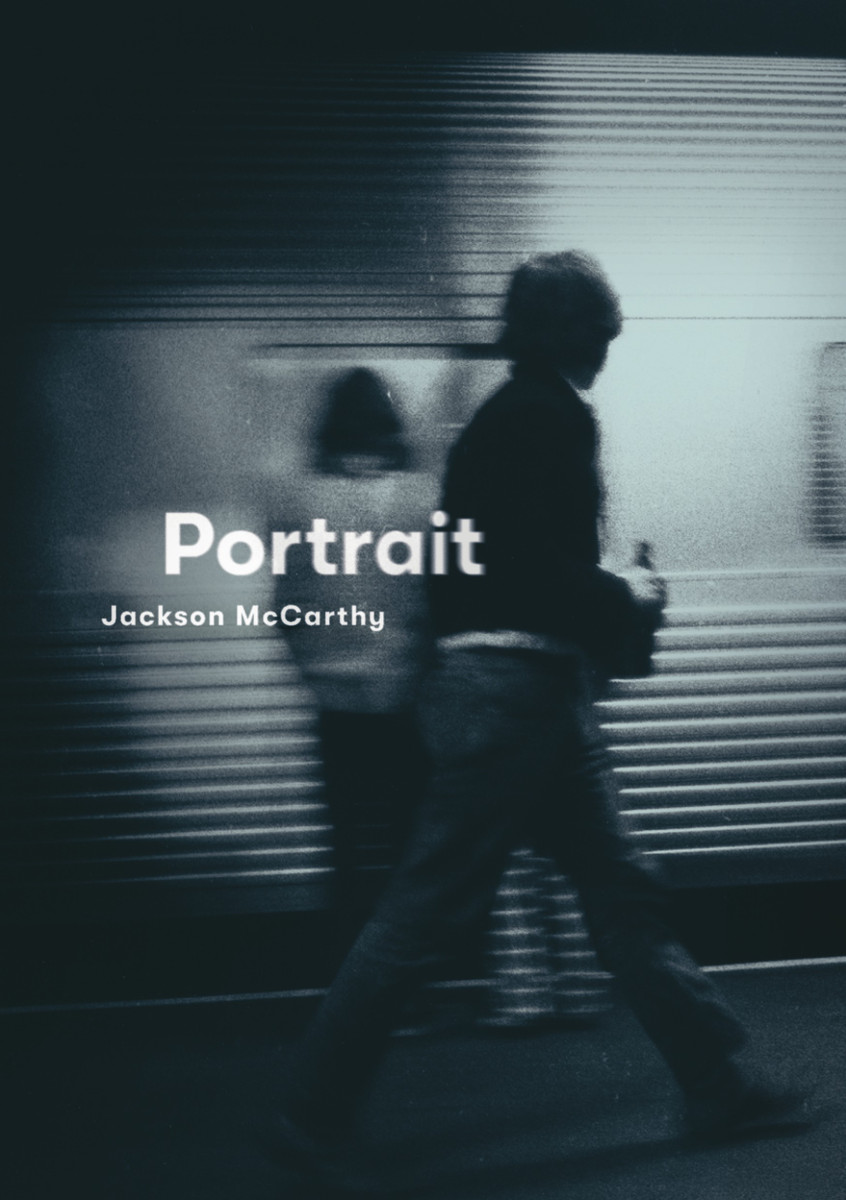
Portrait, Jackson McCarthy
Auckland University Press, 2026
To celebrate Jackson McCarthy’s sublime debut collection, Portrait, Jackson and I embarked upon a conversation about poetry, and in particular his new book. The conversation is interspersed with readings from the collection.
Paula: Reading a new poetry collection so often widens and shifts what poetry can be and do. I find myself opening rather closing the pores of a poem, I find myself feeling thinking breathing intuiting listening. Not wanting to explain. Wanting to share how and why it clicks with me so very deeply.
That’s me as a reader — what verbs signal you as poet, writer of your debut collection?
Jackson: I like your verbs, Paula! I like “thinking” especially. There’s a lot of mental preparation that goes on before I sit down and write a poem. I write quite quickly; or, if a poem is taking too long, I drop it and come back to it later, sometimes weeks or months later. Each time I return, I touch things up quite fast and then let the changes settle. Often you can’t get a real sense for the picture until the paint dries. All the meanwhile, though, I’m thinking — as well as feeling, breathing, intuiting, listening — and so I consider that the main constitution of my practice: being alive.
‘No art’
Paula: Yes! Being alive in the poem. Listening is key to me as both reader and writer of poetry. I am listening to your deft lyricism, every word-note pitch perfect: “We sit / in the quiet of waiting” (from ‘Mahuika as a boy’). Like listening to the aural dexterity of ‘No art’. This is the first deep satisfaction, the lyricism of the line. How important is poetry as lyricism for you?
Jackson: Well, for me, it’s probably the essential thing. Poems are silent, fixed, complete on the page. Yet everything about poetic technique (metre, rhyme, enjambment, and so on) aspires to the status of voice. And so the poem lives a double life. It’s both something static on the page and something enacted in the process of reading; something that reveals itself to us line by line almost spontaneously, each time as if for the very first time. It’s both a typographic object and a verbal performance. So the poem mystifies or lives in the gap between stasis and process, and between (why not say it all?) the dead and the living.
If this is a limited view — which it is; I don’t know if I’ve properly accounted for visual poetry — it’s at least a generative constraint. I’m not in the business of giving definitions, saying what poetry is or isn’t. But if I were to say that painting consists in the application of paint to a surface, surely that definition, while limited, is wide enough to encompass many spectacular things. Those are some thoughts about lyricism and listening, and the relationship between silence and sound, which many types of poetry and surely some prose too can evoke. I’m grateful that you’ve spent time “listening” to my book in this way. Then there’s lyric, as a genre — and I do think of my poems as lyric poems, generically speaking, as well.
And, further, I have to say that the songwriters have been a big influence. I mentioned lyricism (an effect), lyric (a genre), but lyrics (as in, lyrics to songs)… they can be wild. You’ll get the most abstract and wonky piece of verse; the syntactic relationships will be so densely recombinable — the kind of lines that would be flagged as rather oblique if they were presented as poetry — and then a whole stadium of people will place those words in their mouths and sing them as their own: “O life is bigger / It’s bigger than you, and you are not me / The lengths that I will go to / The distance in your eyes” (“Losing My Religion”, R.E.M.). If you reckon people aren’t interested in difficult and abstract verbal constructions, then you haven’t been paying close enough attention to songs. That relationship between the singable, shareable line and the density of meaning that travels under its music… it’s a very very special thing, and poets should look there for energy. Then, of course, you get the songwriters of extraordinary, winning, straightforward eloquence: “In my head / I play a supercut of us / All the magic we gave off / All the love we had and lost” (“Supercut”, Lorde).
Paula: Are there other poets who you especially admire for their lyricism?
Jackson: Auden is king, but I would never have approached him or probably poetry at all if it weren’t for Frank O’Hara. O’Hara’s early poems display a French influence and are certainly his most lyric in the genre sense of the word. But I like the relaxed, fluent, chatty later style, too. The studied naturalness of those later poems is very special — and I think weird and weirder for how it’s self-reflexively “casual”, rendered, and so not casual at all.
‘Adam’
Paula: The opening poem, ‘Prelude’ is the perfect stepping stone into a collection that cares as much for the invisible as for the visible, for space and quiet and hollows.
And for self. For intimate self. Hollow self. Thinness of self. Emptying out and taking in. Fabrication. Pronouns on the move. We readers are gathering to listen. Some poets hold self at a distance when they write, while others venture into the super confessional, or poetic fictions.
[….] Well, I too could be mean,
possessive, obsessed with my own thinness —
for a crowd had gathered like black water
to hear these: my innermost thoughts.
from ‘Adam’
‘Uniform’
I find your collection the most original navigation and weave of self I have encountered in ages. So many lines to quote! How important was and is self as these poems came into being, whether hollow or present or imagined?
Jackson: I’m not sure I was thinking directly about “self” per-se. I think a lot of the poems are sort of tricksy about the presentations of self they contain. I suppose I went to some pains to show how an author might construct a poem’s speaker, as in my poem “Uniform”. The mode is confession, but the poems are not me. Still, they’re an expression of my thinking, my emotions, my taste — maybe something about all the posing and posturing in the book is merely contradictory, then. But I hope instead that binaries such as “author/speaker” and “self/not-self” are thrown into some sort of counterpoint, melodically independent but harmonically dependent on one another, a complication rather than a contradiction. Thank you for your comment about “weave” — I think that signals that what I was going for worked for you, which is good to hear.
The next book, I reckon, will be placed more directly on what readers (and me too, if you catch me on a good day) will call “my” voice and “my” persona than some of the poems in this book. But I always allow myself to extend or fictionalise when I need to. I remember my friend Cadence Chung told me that she finished a poetry reading once and somebody came up to her and told her how brave she was. She accepted the compliment, but thought privately to herself, “Well, it would have been brave if I had read you my diary entry or cried on stage, but instead I crafted a work of poetry and then edited it and then rehearsed and performed it.” Whenever we set down words as writers, we mark a fissure in time; every time we write “I”, that typed object which we think describes our changing selves we render fixed. The poems bare me — they hold me up — but they are not me, largely because I am a person, and they are poems.
‘Music’
Paula: On my second reading of the book, I became even more scratched and moved by the appearance of (upper case) Death and (lower case) death.
that there’s always a distant cliffside
called Death
and somebody saying No on it,
refusing life;
that there are always those
fabricates of memory
that lacerate the present
with reminder of the past —
from ‘Music’
Past present and maybe future rubbing against each other, with tendrils in grief, whether fabrications or memory, with tendrils in death. I so ache as I read ‘Night train’, offering past or death, getting lost in the blue.
Tell me about the recurring ache arrival of Death death.
Jackson: Thank you for noting that turn of phrase in “Night train”: one way is the past and the other way (the future, extrapolated to its extreme) is death. It’s easy to think that death is the only certainty; the only real thing, realer than life. But, as Ben Lerner reminds us, “there’s too much piety in despair” — and love, of course, is “more avant-garde than shame / or the easy distances” (“No Art”). Sometimes in the book I capitalise Death because I mean for him to be my enemy and among us, personified, or out there in the landscape. Other times, I refer more generally to the bodily phenomenon known as death. Probably that’s all I meant by the distinction, but I’m not sure. Some people say that death is the great mystery, but I don’t think so. I think life is the mystery.
‘Night train’
Paula: Indeed. If there are the stutter echoes of death, there are also the equally affecting and connecting strands of love desire body touch sensuality.
Poetry’s not pinned down here. It’s physical and it’s longings.
Jackson: I love that physical aspect you mention. I’m thinking back to my comments about lyricism, lyric, and lyrics here… what’s important about those aspects of writing is that they induce embodied effects in the reader, whether subvocalising in the head or reading aloud. In that way the poetry is evocative of what it means to have a body, and indeed to have sex or go out dancing or take drugs — those things people do that make them feel embodied. The longing follows naturally, because we know that the high can’t last forever; because all things and this body too will go; and because when we come, we also come apart, in “the pale light that each upon the other throws” (Wallace Stevens).
Paula: I adore your visual tropes, the power of the metaphor and similes to infuse a poem visually and, in doing so, offer ideas and feelings an uplift. I jotted down so many beauties.
“My life has since continued to devolve into a succession of windowless rooms, and at the door of each a guest is greeted and enters.”
Do you have any favourites? Something that falls into your writing ink and it’s surprise and it’s skin-prickling delight?
Jackson: I’m always surprised by what I write. Honestly, I’m just grateful that there’s something there (when there’s something there, that is!). At the moment, I quite like my poem “Happiness” for its straightforward, civic speechiness — and I like its ending image: “Take me out down the streets / of my mind and just look / at the people’s sudden faces”. “Happiness” was the last poem I wrote for the book, and it’s seemed to have dropped me into a new style and swagger, a new directness, which I feel ready for. But I worry that it includes a line I feel sometimes but don’t hold to be true: “I don’t believe that life is real”.
Paula: I love the presence of other poets, poetry books, on writing poems, on being a poem, on thinking about other poets, on sleeping with a poetry book under the pillow. What poets have nourished you over the past couple of years?
Jackson: Let me give you a list! While I was writing the book, I loved Dickinson, Auden, Glück, Frank O’Hara, James Tate, Ben Lerner, Hera Lindsay Bird, Tayi Tibble, Eliot, Carl Phillips, Li-Young Lee, Coleridge’s conversation poems, Alex Dimitrov, Bill Manhire, Maia Armistead, Sam Hunt, Cadence Chung, Jake Arthur, and Henri Cole. More recently, since finishing the manuscript, I’ve been loving Kate Camp, James Schuyler, Keats, Glück (still), and O’Hara (again).
‘Aubade’
Paula: When you were writing this collection, did you make writing discoveries? Like what mattered to you in creating a poem? And also in gathering a whole collection with its echoes and knitted strands and quietness?
Jackson: With this book, a lot of the poems I had endings for first — sometimes choice phrases, sometimes just general notions of where the poem needed to go. So a lot of the time, I was writing teleologically, hurtling toward a foregone conclusion, and that was the discovery: What conditioned or brought to my mind such a phrase as “you don’t have to be ashamed anymore” (from my poem “Aubade”)? What happens before I can allow myself this line? Conversely, in my new work I’ve found myself with some very beautiful opening stanzas but fudging the endings. This is dangerous work, and I fear for myself.
As for arranging the book… Thankfully, the echoes and motifs were more or less accidental. I was just in a particular moment as a writer, with my pet subjects and figures and turns of phrase. I think if I knew the book’s design from the start I’d be so intimidated I wouldn’t write anything at all. I just worked on a poem at a time, and eventually had the sense that they were talking to each other in generative ways, and then arranged them in an order that best sparks and reveals those ways. But it took a while for the book to come to form — some stuff is from when I was sixteen. The best you can do is put your head down and hope. What do you think I wished for? I wished for what I always wish for. I wished for another poem. (Glück)
‘Song’
Paula: I read ‘Song’, the final poem again and I am holding my breath. How do we write? How do we read? How do we continue to write poems when the world is so awry and bombs are being dropped. This being so personal for you with your Beirut familial connections.
My cousins in Beirut can feel
the terror in the air, I go on
with so little left to speak; listen
to my heart, these songs
of loss I write while I
cannot hear the bombs.
from ‘Song’
I feel the book itself is the reply. This incredible book that was first dreamed up at Dark Sky Cottage in 2024. More hollows. More writing as going on. What do you think? Or should I be using the word feel, this book I feel so intently?
Jackson: It’s easy here to retreat into cliche. Don’t worry, you won’t find me rhapsodising about how “urgent” or “necessary” my own poetry is. Poetry probably isn’t necessary, strictly speaking. It doesn’t happen because somebody thought it financially viable or ethically responsible or somehow socially vital. But in the bombed cities, the wasted homes, the dishevelled places, poems are still being written; poems are still being written in Palestine. And so one of the reasons that artmaking remains radical is that its existence alone suggests, or even speaks into reality, however briefly, an alternative system of value. In this I’m something of an old-school progressive. Poetry goes on in the sense that it just happens — despite violence; motivated by nothing; needed, but less than shelter; heralded by no dollar, poets continue their work. Poetry also goes on in the sense that its aesthetic conception of value chafes with a world in extreme turmoil, ruled by monied interests, in which a genocide is unfolding on our phone screens; it figures by negation another, better world of no violence. For poetry makes nothing happen: it survives (Auden). And so we go on. In which direction? Ake, ake, ake; onwards.
Thanks again, Paula, for your kind words.
Jackson McCarthy is a poet based in Te-Whanganui-a-Tara Wellington. He is of Lebanese, Māori, and Pākehā descent. His poetry has been published widely in Aotearoa literary journals, including Landfall Tauraka, Ōrongohau | Best New Zealand Poems, The Spinoff, Starling, and Sweet Mammalian. Portrait (Auckland University Press, 2026) is his first book.
Auckland University Press page


Pingback: Poetry Shelf Weekend Reading Listening and an Invitation | NZ Poetry Shelf