Monthly Archives: December 2025

Poetry Shelf cafe readings: Sue Wootton

Poet and novelist Sue Wootton’s most recent poetry collection is The Yield (Otago University Press, 2017), which was a finalist in the 2018 Ockham New Zealand book awards. She has held the Robert Burns Fellowship, the NZSA Beatson Fellowship and the Katherine Mansfield Menton Fellowship. In 2025 she was awarded the Kathleen Grattan Prize for a Sequence of Poems, for a suite of sonnets called ‘Holding Patterns: Seven songs of pots, jars, bowls and vases’. Sue lives in Ōtepoti Dunedin, and is the publisher at Otago University Press. 

Poetry Shelf goes hiking: Te Araroa poems by Jillian Sullivan

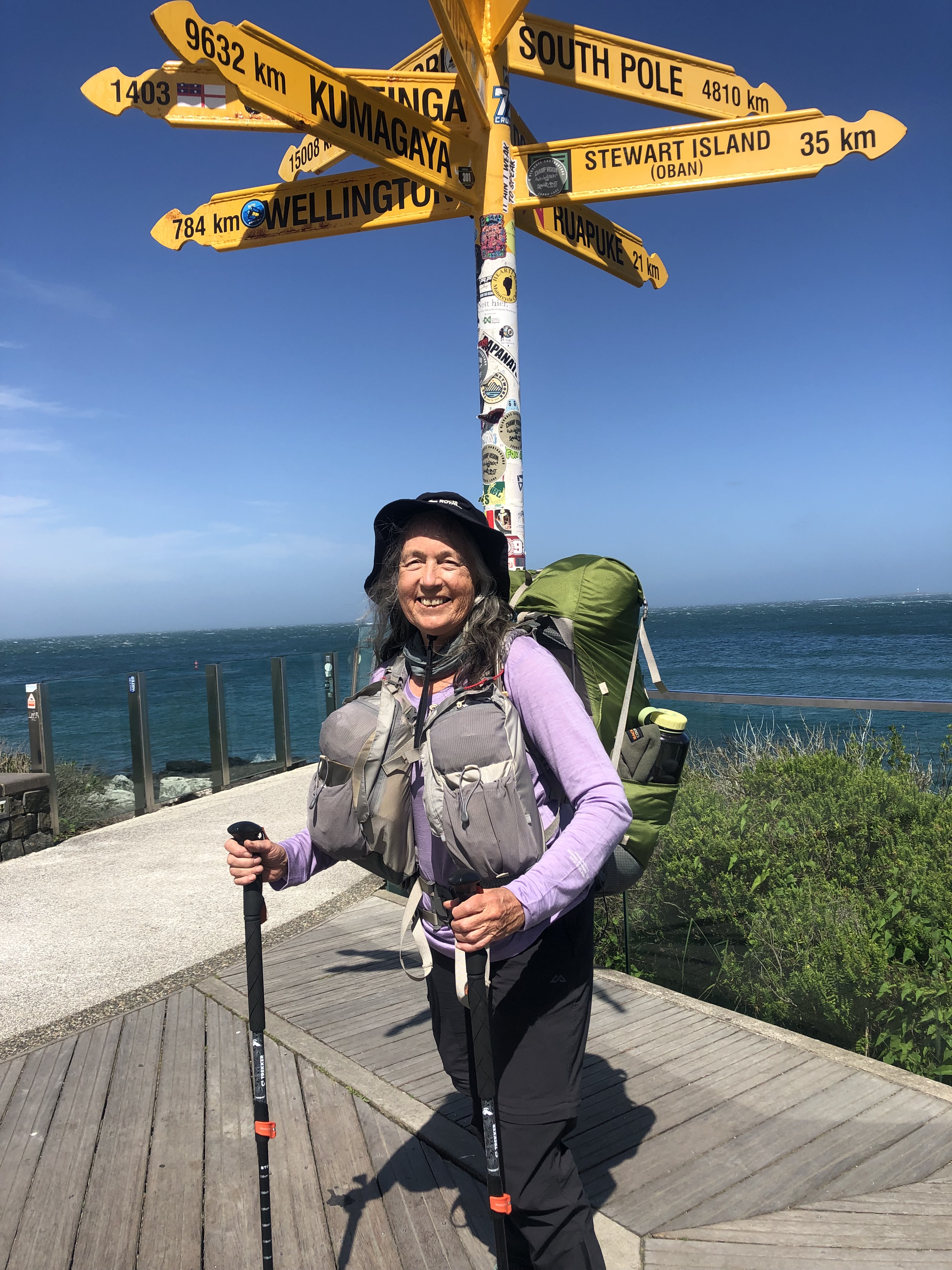
Jillian at the Bluff signpost

Jillian Sullivan has just started walking the South Island section of the Te Araroa trail. I invited her to send poems whenever she felt inspired to do so, internet access permitting.

Friends are why we come home

Friends around the table and all
the glorious food and laughter.
Sometimes I yearned to run away
from here, I told Graeme. But I didn’t

want to leave this. He guessed the weight
of my pack closest, at 14 kilos. Some
said 17. It was 13. Achievable,
then.

The gifts they gave me of their eyes.
The gifts they gave me of their selves,
who know me. And so we said
goodbye. And so it is true

I am going. Margaret took a photo, as pack
on back I walked down the white line
of the empty road running through our village.
A metaphorical photo.

Now it is a thrush singing outside
my window. Bach, Ave Maria,
black coffee. The gentle easing into
leaving this life, for when I come

back, who will I be? Someone
dissolved into trees and rocks and sky?

It’s always Wednesday

It’s always Wednesday, it’s always
eight am,        it’s always.

One last morning in the hut, figuring
the right thing to do. What would you do?

Your younger, thoughtful look,
considering. You would tell me to listen.

The final walk along the stream
bearing the heavy pack. The final call in

at Gilchrists Store for the mail. The apples
outside my window growing into their appleness

after such a winter. A sparrow riding high
on the pale green under a grey sky.

The last morning I won’t be hanging onto
every word of the weather forecast.

The last morning casually making coffee
looking around at my books which are

everywhere. Yesterday two more shelves,
already full. The last morning

I will count the weeks to the ten months
you’ve been gone. There is ease in this world

of a physical kind, but then I will learn
how to keep walking. You said it first. Keep on.

While I’m away the sun will take all this
green and lushness and turn it gold, the hay

cut, dried, stacked. A whole season over.
Like another Wednesday.

That tramper

Yes, I am now that tramper
who, after the first day

bent under weight in rambunctious
wind, unpacks the pack, examines,

holds, casts away, takes back, casts
away. Gone: rescue remedy,

extra shirt, my darling’s hat, also,
his book of poems. I will have to cleave

them closer. My daughter laughs when I say
I packed a nighty for the huts. Now

I know I am a grandmother. Ok, gone
the nighty, the togs, the jar of magnesium pills,

also, the merino jersey. The wind held me
down and I was hardly a leaf. The photo

at the yellow signpost of Bluff – I’m not
staunch. My legs aren’t even

straight. My body saying,
“You’re going to do what?”

No regrets

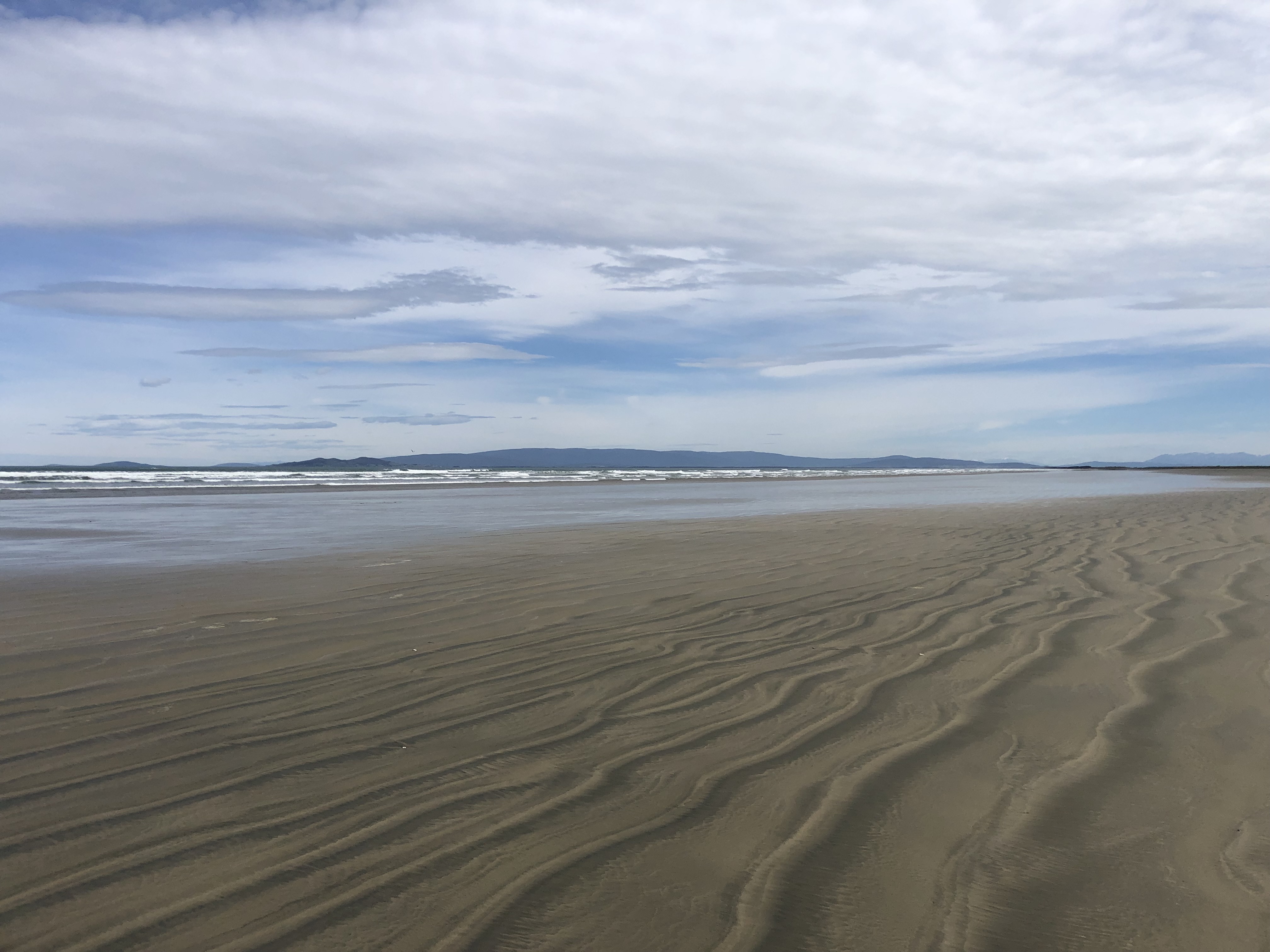
The beach is a long wing, of course
you like it; the waves blue, white crests
blown apart by wind, the sand
tawny and firm. But now you have to
walk it as if this is a sentence,
for seven hours, actually, until you turn
from the jauntiness of one step after another,
like hope in the future, which is possibly
why you’re doing this, until about the|
six hour point it all becomes pain.
The thigh bone connected to the|
knee bone, intimately. There is nothing
to be done about the future now, except
keep walking. No-one will save you. Only
the memory at five hours when the young
tattooed builder from Western Australia,
who has caught up to your stride,
stops to swim in the lolloping waves.
You are longing, you are longing to, also.
You won’t regret it, he says. You
take off your clothes on a public beach.
You don’t regret it.

Jillian Sullivan

Oreti Beach

Jillian Sullivan lives and writes in Central Otago, New Zealand. She is published in a wide variety of genres and teaches workshops on creative non-fiction and fiction in New Zealand and America. Once the drummer in a woman’s originals band, and now grandmother of eleven, her passion is natural building. She finished a Masters degree in Creative writing in her 50s, and became builder’s labourer and earth plasterer nearing 60. Now home is the tussock lands, the tor-serrated dry hills and the white flanked mountains of the Ida Valley, where she has 20 acres bordering the Ida Burn, and plenty of room to store clay and sand for future earth projects. Her books include the creative non-fiction book, Map for the Heart – Ida Valley Essays (Otago University Press 2020).

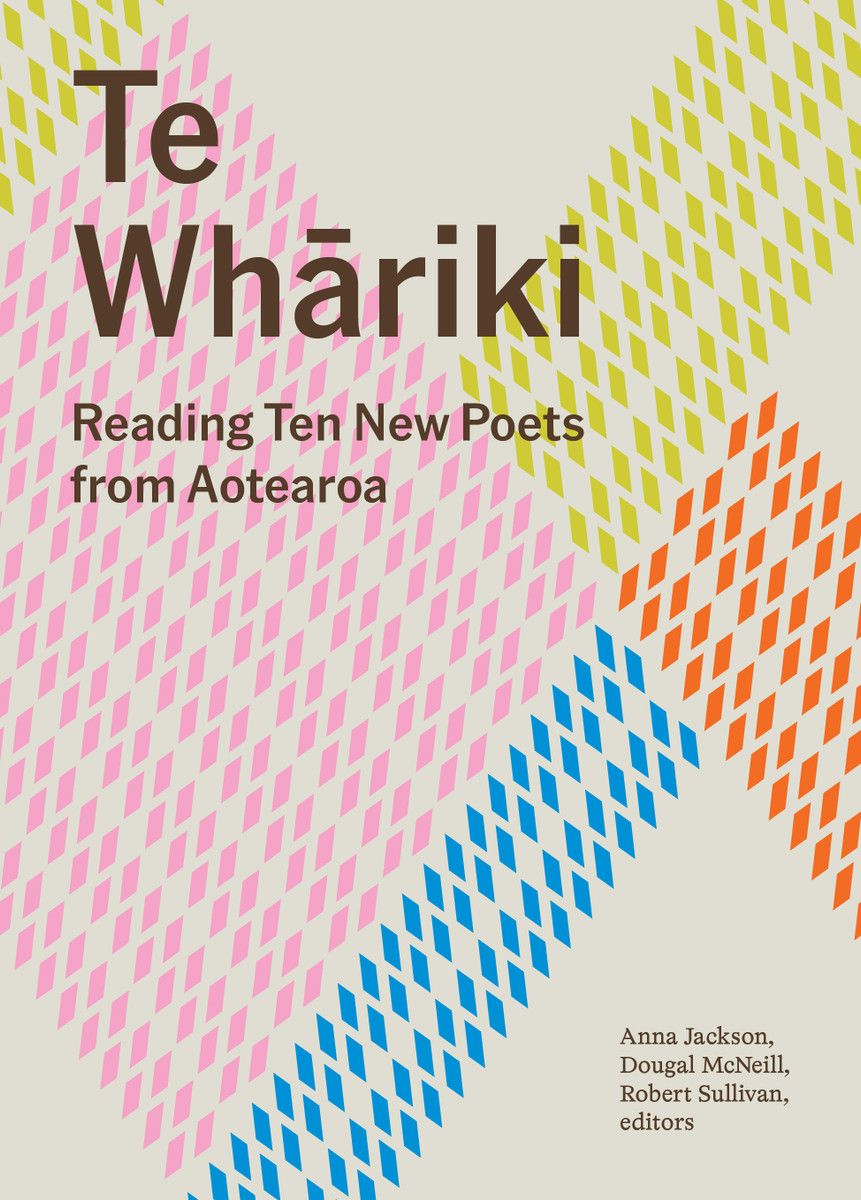
Poetry Shelf celebrates Te Whāriki: Reading Ten New Poets from Aotearoa

Te Whāriki: Reading Ten New Poets from Aoteatoa
edited by Anna Jackson, Dougal McNeill and Robert Sullivan
Auckland University Press, 2025


Auckland University Press page

The poets: Sam Duckor-Jones, Tayi Tibble, Claudia Jardine, essa may ranapiri, Rebecca Hawkes, Chis Tse, Oscar Upperton, Joanna Cho, Ruby Solly and Nafanua Purcell Kersel

The critics: Amy Marguerite, Tru Paraha, Anna Jackson, Robert Sullivan, Mark Masterson, Stephanie Burt, Dani Yourukova, Dougal McNeill, Sophie van Waardenberg, Brigid Quirke, Robin Peters and David Eggleton

a collage celebration

“To read is almost to travel: to time travel, to move locations, to change who we are for a moment in time. And as Joy Harjo says, ‘Every poem has ancestors.’ Robin has done a beautiful job in her essay of bringing forth some of the whakapapa of my work, some of those people who put their hands gently on my shoulders while I move the pen. There is a weight to writing for Māori. We know so much of what it is to be perceived before we are known. I want Māori readers of my work to feel the opposite. I want them to feel that these pieces know them, deeply. I want my reader not to feel seen but to feel held. I hope one day I’ll get there. And I’m looking forward to one day just being a gentle hand on the shoulder of the next generation. Listen out for me, I will be the tipuna who sings.”

Ruby Solly

It is not often an introduction stalls me in my tracks and electrifies how I feel about reading and writing and sharing poetry. But the introduction to Te Whāriki: Reading Ten New Poets from Aoteatoa does exactly that. The three editors, Anna Jackson, Dougal McNeill and Robert Sullivan, sat in Robert’s lounge and crafted the piece over the course of two days. In a book delivering multiple weavings, the introduction is itself is a welcome mat, woven so thoughtfully with strands of aroha, experience, acumen, intuition. Yes, the metaphor perfectly encapsulates the width and depth of the book, but also offers a productive way of viewing poetry in Aotearoa. It mirrors exactly why I strive hard to be an ambassador for poetry and why poetry has helped me through the toughest year of my life.

The editors rightly acknowledge that ‘[p]oetry always renews itself’, that writers fossick in past traditions, writing with or against the grain of their discoveries. Across centuries, writers have experimented, paid homage, felt inspired, challenged and have written outside the status quo, questioned expectations, rules and regulations, and most importantly, damaging hierarchies. I sometimes wonder if an invisible torch is passed from one generation to the next, an ongoing flame to recondition the new, to absorb and respond to and with and against contemporary and past circumstances. It felt like this in the 1960s and 1970s when young men and women were experimenting with what poems could do, when women were moving out of the canon’s shadows, bringing the domestic and the personal with them if that was their desire.

Ah. This book’s introduction. We read in the first paragraph that, just as a whāriki is crafted from multiple strands, so to is contemporary poetry, its tendrils reaching into the past, invigorated by the present, foreshadowing the future. The editors like the idea of community building, with Te Whāriki boosting connections among readers, writers, teachers, students, critics, listeners, performers, bloggers.

This year I have witness the connectedness of poetry on the page, but also (by word of mouth) in myriad performances across Aotearoa: in cafes, bookshops, libraries, in Poetry Shelf’s online cafe readings. Burgeoning small presses and journals, both online and in print form, showcase voices of new writers, especially young writers. This sizzling connectedness is a vital strand in Te Whāriki. The editors use the word friendship, so let’s try approaching a book, a poem, a poetry scene, with this idea in mind. I had never approached it like this before, but I think over the past year I have experienced an extraordinary friendship with poetry, with poetry books and poems, with poets.

Markers of the current new wave of poetry are identified: romanticism, childhood, domestic details, anxiety, especially in view of a matrix of global and local crises. There are more, of course, there are so many pathways through the new poets’ work, so many ways to talk about new, but what I have found, more than anything, is that this is poetry that I feel, that I am moved by, that returns me to the world beyond my bush haven to experience new windows upon our world.

Ten diverse writers shine light on ten new poets, with each featured poet contributing a couple of poems and small piece of writing. What invigorates me about these readings is that although I am familiar and already deeply in love with the ten poets, the close readings open new pathways. And as I say on the blurb, this book makes my heart sing. The book shows so beautifully how critical writing can be in debt to academic traditions, but also how critical writing can open up a poet’s work with refreshing possibilities without trying to squeeze poetry into restrictive thought boxes. The attentive readings not only open pathways into a poet’s work but, through this critical alertness, open multiple possibilities for a wider terrain of reading and writing poetry.

I have lifted an excerpt that resonated with me from the editors’ individual readings, but I will also draw close to Sophie van Waardenberg’s ‘Reiterations’, her reading of Oscar Upperton. Honestly I could have selected any chapter to share highlights, but I have settled upon this chapter because it epitomises the utter of joy of reading and writing about poetry. Sophie draws us into Oscar’s two collections initially through form, moving in close to rhyme, repetition, vowel sounds, found material, twists and loops, double backs, reiterations, naming, frames upon which to hang things and the whole glorious art of recording and record creating. She drops a noun or verb or adjective into her sentence that catches me with its surprise and freshness: “It’s a villanelle, a poem requiring a sort of sandwiching rhyme – that is, a repetition of sound”. When discussing the move from the first collection to the second: “It’s also a jump from something mix-tape adjacent to a concept album”. Or this sweet arrival of personal experience: “Because of the incantatory qualities of repetition – and because I lived one of those prayer-heavy childhoods – I want to say this poem feels like a prayer. But is is not asking for anything, not even for the strength or patience to withstand something suboptimal, as most prayers do. It seems more practical than that.” You need to read the chapter yourself to get the thrill of an inspired close reading, but here is the final paragraph:

“In an essay called ‘Further Injury’, published in the online journal Too Little / Too Hard, British poet Emily Berry interrogates her resistance to the idea that poetry is a life-saving force.3 For her, writing poetry is like prying a wound further open. If it is a remedy, it’s a painful one. But she concludes that perhaps having your life saved is unpleasant, too. It might come not as ‘a luscious infusion of relief’ but in the form of ‘amputation, medicine that poisons you, untold sacrifices’. Upperton’s poetry, its working out through repetition, suggests that the only way we can save life is not really to heal, not even to relieve pain, but to record it. And maybe the best way to record it, truthfully, is to say, a lot of times: ‘I was here, I was here, I was here.’ James Barry was here. Oscar Upperton was here. We wanted things we couldn’t always have.”

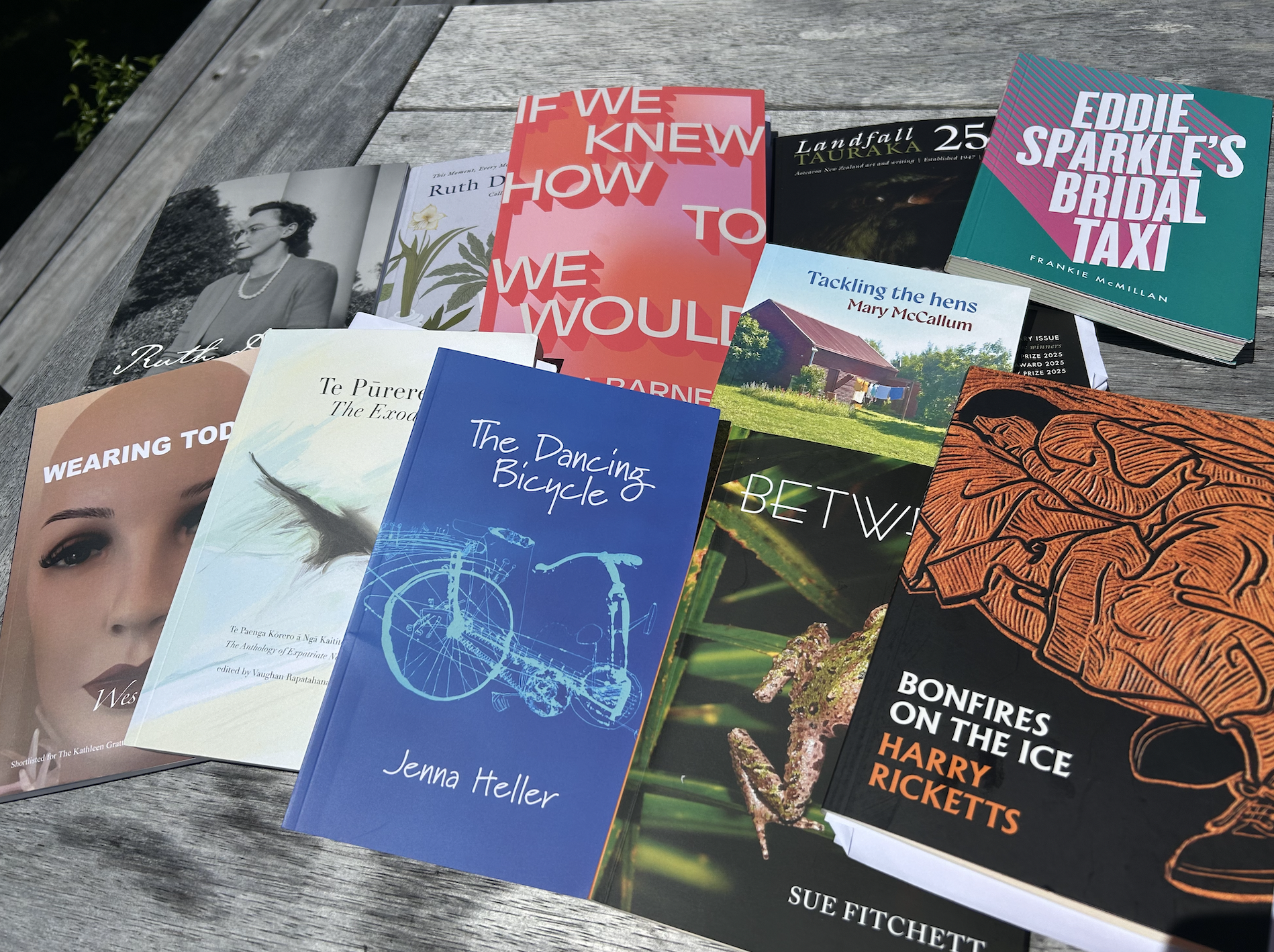
I keep pulling poetry books from my review stack on my desk that send me into a lexicon of superlatives. This book is no exception and I have barely scratched the surface of its rewards. Read Stephanie Burt on essa may ranapiri (‘Teeth Shine in the dark’) or David Eggleton on Nafanua Purcell Kersel (‘Bone Pen and Blood Ink’). Tru Paraha on visual poetry through feeling and form and Amy Marguerite’s approach to a new generation of poets through a potluck dinner. To celebrate its arrival in the world, I invited a few of the featured poets to select a poetry book they have loved in 2025. I have also selected a small extract from each of the editors’ chapters that resonated deeply with me, and a couple of extracts from the poets’ contributions.

This is a book to pack in holiday bags and reap infinite rewards over summer.

There are no sensible words for the sensed world, the unspeakable gory-glory of being bodied by life. I was lucky to be born to a farm, or under a mountain, its mounds of crumbling rhyolite pink as raw flesh. So of course I’m a poet – farms are factories for sex and death. I shot from the dirt like a blackberry bramble, thorny but fruitful, glossy with dark sweet promise. I knew the snowline’s flowers and creekbed ferns like the hairs on my own arms, though didn’t yet have names for them. And I knew the names of poisons we used to keep at bay the invasive weeds – glyphosate, triclopyr, penetrant – like casting spells. Of course I was a wizard kid; that’s part of it. Big fantasy bookworm burrowed in a library beanbag.

Rebecca Hawkes

A tasting platter

from ‘A Quietly Italicised Yes‘, Sam Duckor Jones by Anna Jackson:

“‘I put play at the very very top of everything that is important in the world’, Duckor-Jones has said. This was in an interview with Eva Corlett for a Guardian article about the church Gloria, described by Corlett as ‘a campy pink wonderland with tinsel curtains and a neon “Gloria” sign’, and by Duckor-Jones as representing ‘a kind of quiet fabulosity. His poetry shares this kind of quiet fabulosity.”

from ‘Representation Is Important’, Tayi Tibble by Robert Sullivan:

“So, what have I learned from reading this text? As Lesley Wheeler’s introduction to her book of essays on poetics, Poetry’s Possible Worlds, eloquently and compassionately states, reading poetry personally runs the risk of subsuming a more interesting text to the mundanity of one’s own experiences. I am a middle-aged poet with family commitments. My reading practice prioritises enjoyment, cultural identifications and pleasure to be derived from a text. I love to immerse myself in a poem, or a collection of poems, and learn about that other world through another’s sensory life and cultural and cognitive experience. The transport to other worlds that Wheeler speaks of is sped up in Tibble’s text. The worlds within worlds are deftly evoked in short prose sections. The twelve sections might be a blue-black hair cloak, if such a cultural artefact ever existed. The altered mythopoetics here – the altered Māui, Pocahontas’s altered name, the altered Samson as younger sister, the matrilineal descent line as hair turned into Medusan snakes, Scherzinger as icon, and the speaker looking for love, and representation, and tino rangatiratanga – encapsulates female heterogeneity without encapsulating it because of the sisterly hair-cutting scissors and the soft-dissolving fluid collage of identifications, attachments and detachments. This opening poem in an exciting book of poems is a marvellous, ever-moving heart-sore and full-hearted achievement.”

from ‘A Vivid Dream’, Chris Tse by Dougal McNeill:

“Following a word’s connotations, here tracing the patterns of a word and allowing ourselves to desire language and to be desired by its folds, to limn a lover nestling inside the poet’s own name as a thumb nestled against a body in speech, is to give ourselves over to the big mood, the utopian, the will of this voice. The parents who, in He’s So MASC’s sonnets, might ‘perhaps’ be ‘taken aback’ by the present of the ‘unnamed male’ with whom the poet has ‘shared more than each other’s time’, are altered in the course of this encounter too. Now, in Super Model Minority, both father and lover and poet find ways of being together and recognising each other in the act of naming. The desire to be desired is, finally, in Chris Tse’s work, a desire for and in community. If his are songs of thanks, they are also, for us, opportunities for praise. 謝.”


For more than twenty years, I’ve used poetry as an act of way-finding, to trace lines backwards, forwards and sideways in search of something akin to home. I’ve always loved restlessness in poetry – when the voice of a poem or its intent can’t be pinned down, when the poem itself resists the boundaries or constraints placed upon it. Perhaps this explains why I enjoy creating trapdoors and hidden paths in my poems: as much as I want a reader to gleam where I have come from, I also want them to be surprised where a poem takes them. My ultimate goal as a poet is more than simply communicating an idea or a ‘message’ – it’s to show how all the worlds and timelines we collectively summon are connected.

Chris Tse

a 2025 poetry list selected by XX poets

essa may ranapiri

Clay Eaters, Gregory Kan, Auckland University Press, 2025

This book for me was like an ideal synthesis of his first two collections. The space and intimacy of Under Glass and the control and historiocity of This Paper Boat. I felt as a ghost leaving or returning to an island (can one really say they are arriving or leaving ever) by the end of the book.

Ruby Solly

If We Knew How To We Would, Emma Barnes, Auckland University Press, 2025

I was lucky enough to get to read at Emma’s launch, lending my voice to some of their poems, which felt very special. There is something gentle and surreal to this book, though it also has so many hard hitters that pull us to the the mirror and show us not only ourselves, but society; how we have made it and how it has made us. There are moments of radical dreaming. There are moments of forlorn acceptance. There are moments of queer joy and sorrow; this was a book I needed this year and I’m so glad Emma has brought it into existence.

Chris Tse

Symphony of Queer Errands, by Rachel O’Neill, Tender Press, 2025

What I love most about a Rachel O’Neill collection is the constant thrill of surprise that sweeps you from poem to poem. Symphony of Queer Errands is a tremendous feat of imagination, from its ensemble of invented queer instruments to its treatment of language as something elastic and uncontainable. There’s something both dangerous and joyous in its attempts to capture what it feels like to make something out of nothing and that constant need to reach for something that’s just out of reach.

Nafanua Purcell Kersel

Over Under Fed, Amy Marguerite, Auckland University Press, 2025.

This year I loved Over Under Fed by Amy Marguerite (AUP). I was honoured to be able to read early drafts of this book through our shared MA workshop. Even so, the final published collection caught me off-guard with its sharp language and timeless yet contemporary vibe. Marguerite’s poetry is generous but also restrained which makes for a beautiful and compelling collection. As a poet and a reader, I gain so much from the insight into her raw and tender experiences of ED, love and obsession. I feel close to her pain but still safe in the in the poetry where there is comfort in form and surprise in content. This allows me a vantage point that feels askew and still perfectly balanced. Marguerite’s skill as deep-thinking scholar of language and craft is also displayed in Te Whāriki: Reading Ten New Poets from Aotearoa in the form of a critical essay about independent literary journals.   

Rebecca Hawkes

No Good, Sophie van Waardenberg, Auckland University Press, 2025

I’ve thought often of Sophie’s poems we published in Sweet Mammalian a ways back – Poem in which I am good, Song of the Selfish Girl – wondering what kind of lives they’d lead in a full collectionThe book arrived in my life at just the right time. I too have been away and returned. I have danced to the end of love, and lived in my wrongness, my chastened salt. Grief has prowled and lingered. For years now, I’ve been thinking of the lines Everybody I love will live forever./ Everybody I love will love me. How one can cast a wish into the world and in saying it, know its impossibility. But the book isn’t fatalistic. Yes, fate (loss, grief, limited time spent without any extraordinary grace, the preciousness of early and middle and late love) permeates the poems.Sophie’s poems find many delights in the day – stonking blue afternoons, wedges of good fruit, enthrallments – but also don’t flinch from the longing to share the days, to describe the world to a listener who can understand the speaker for what they see, to belong in the body and the upturned seasons outside it, to go on but also to halt for the muchness of all that must in its time be felt and held with all the weight of a heart.


Sam Duckor-Jones

Moon Too Heavy, Jac jenkins, Pavlova Press, 2025

I feel quite blessed to have read a lot of wonderful books of poetry this year!  The one I will shout out is Moon Too Heavy, a slim volume by Jac Jenkins, published by Pavlova Press.  Because it has a confident musicality & an artful physicality, which I am always drawn to.  & because it contains just the right amount of poems, nothing more, which I am always impressed by & jealous of.  It’s kind of in the Rebecca Hawkes school of farmgirl poetry (Jac lives on a Far North beef farm) and as such there is a lot of BODY in her poems.  Tightly controlled floridity.  Sex, sexiness, pregnancy, girlhood, motherhood – these are not so much ‘written about’ as they are played with – I can imagine Jac playing.  Playing in her rural poetry lab.  Using languages of mathematics & science & nature to experiment & play.  My favourite poem in the collection is a sort of list poem, a dense evolutionary chant that begins broadly: 

Oceanic hydrothermal vent begat Last Universal Common Ancestor begat Eukaryota begat Unikonts begat….. 

etc etc etc until eventually narrowing in and ending with

…bore Jean bore Anne bore Jac bore / Kate

That a poem thick with complex scientific language can become, in three stanzas, so intimate and dear is miraculous & it’s a delicious poem to read quietly in ones head but very difficult to read aloud to a listening room (I tried).  Moon Too Heavy is a weird little book about life that I loved very much.

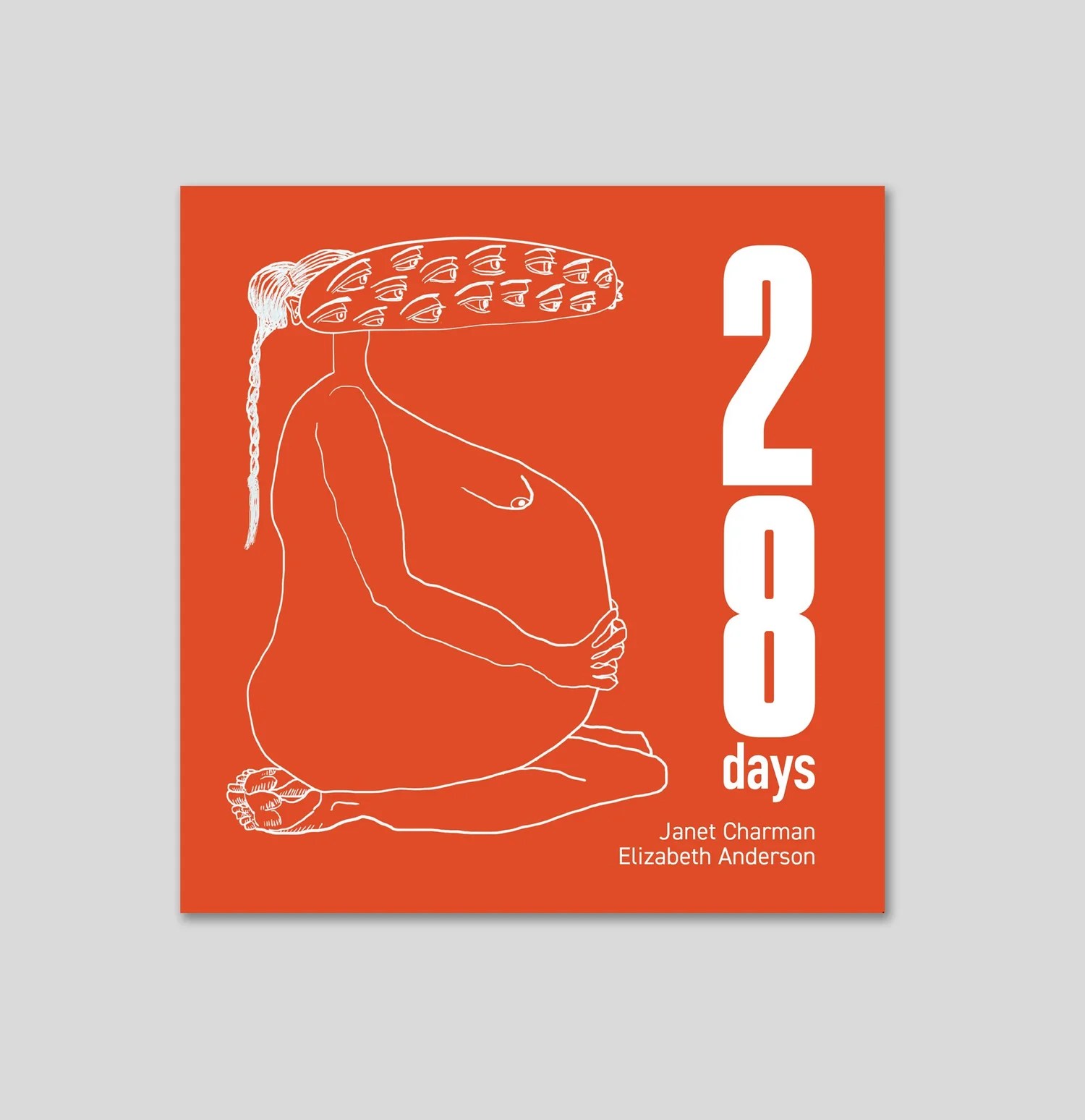
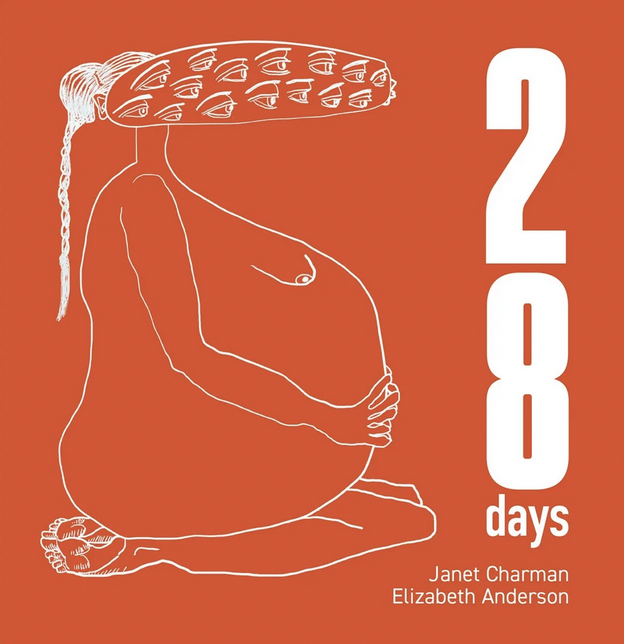
Poetry Shelf review: 28 days by Janet Charman and Elizabeth Anderson

28 days, Janet Charman and Elizabeth Anderson
Skinship Press, 2025

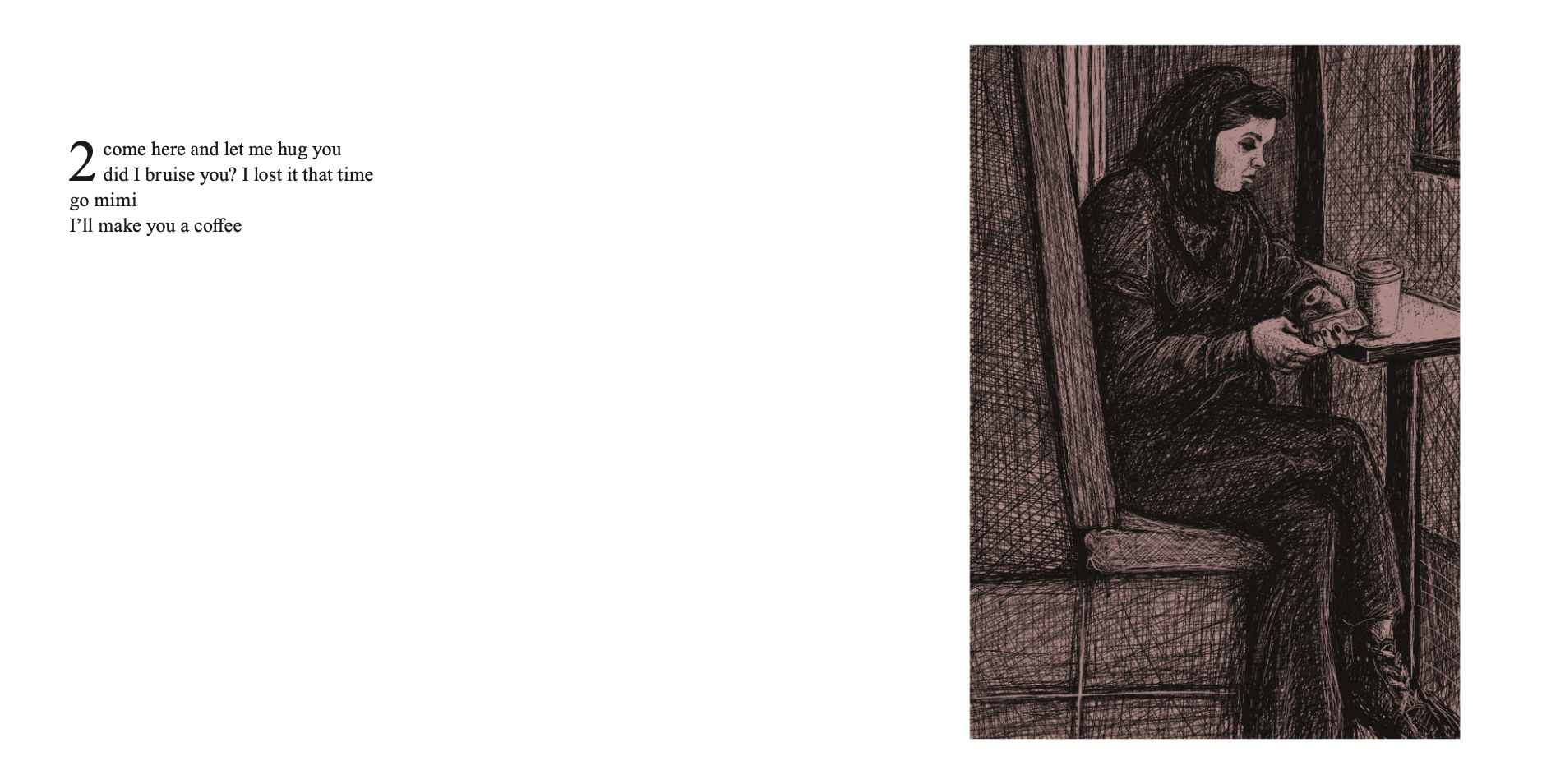
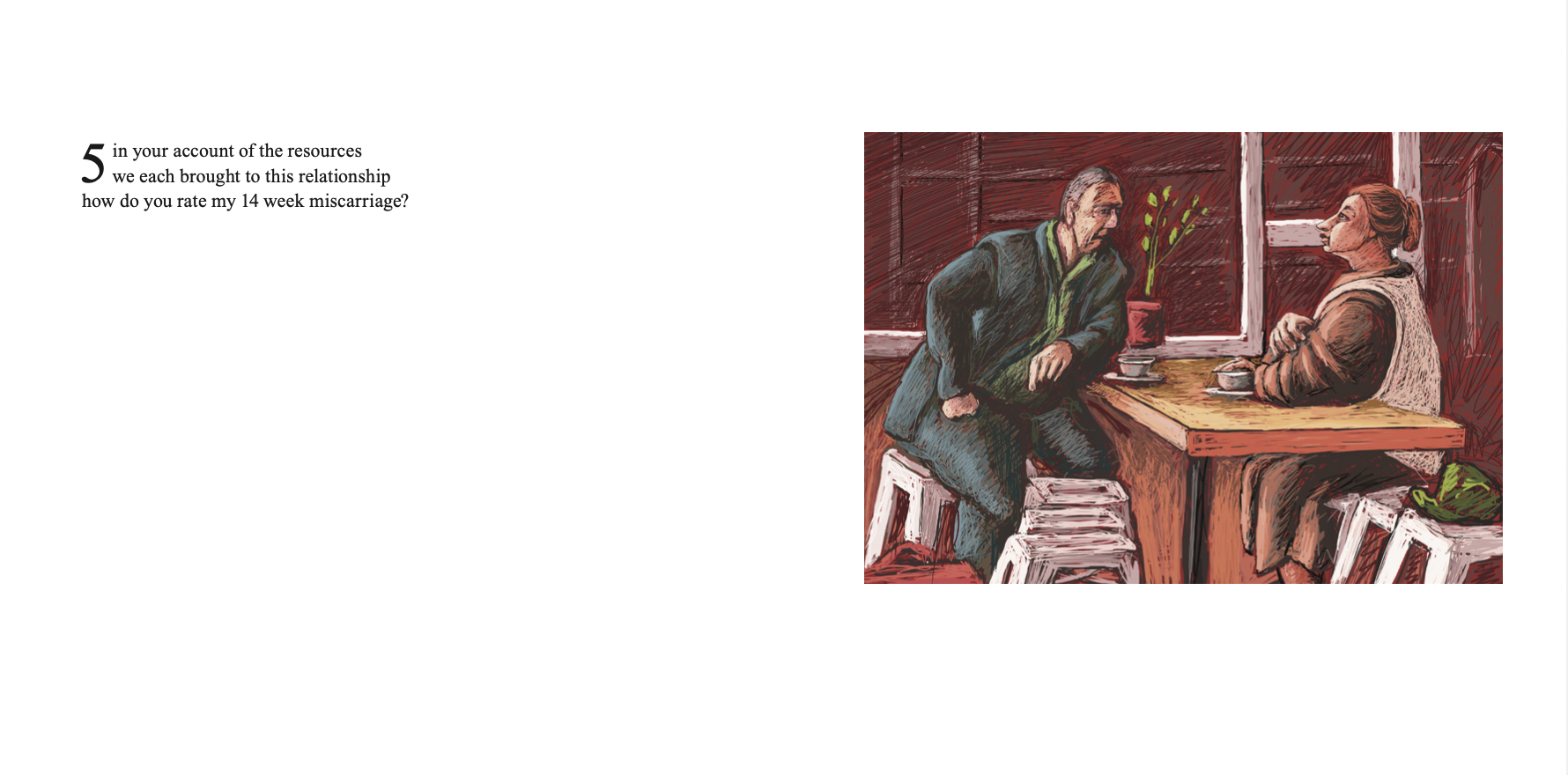
I am sitting at the kitchen table, the doors wide open, feeling the wind rustling in from the Waitākere ranges, the bird song racketing after all that rain, my flat white growing cold, and I slowly reflect upon 28 days. The book fits in the palm of my hand but expands in prismatic ways in both heart and mind. I have never experienced anything like it. It is pitched as a creative memoir. Elizabeth Anderson has produced 28 artworks, Janet Charman 28 texts. The artwork focuses on cafe scenes, drawing upon multi media, echoing Japanese ukiyo-e woodblock prints and Henri de Toulouse-Lautrec’s Parisian café paintings. The little texts – dialogue or poems or anecdotes – are like word kisses on the page.

The memoir is a collaboration, a contiguous relationship between word and image, between artist and writer, and this brushing close, this besidedness as the blurb says, is utterly fertile, utterly heart expansive in its reach. I am stretching for words, and they slip away. So I sit here on the rim of weeping, weeping at the way I’m brought cheek to cheek with the sharp edges of humanity. The shadows. My shadows. The unspoken. My unspoken. There in the cafe settings. There where dark brushes against light, where isolation and loneliness are rife. There where stories are shared, and equally stories are held back. Darkness and light.

Probably against the grain of reading a sequence of images and text, I look at Elizabeth’s images first. She produces all the drawings on her iPad using the Procreate drawing app, recording her observations in cafes or buses. I am absorbing the people frozen in a cafe moment, those on phones, those alone, those in groups, those with son or daughter, and each scene amplifies an intensity of mood. I can’t think when I have last felt portraits to such a degree. I feel the gaze of the eyes, the expression on the face. I feel the unspoken, and more than anything, the way we become a catalogue of memory, experience, pain, aroha, longing, recognitions.

In these tough times that can be so overwhelming, this book, I am feeling to its raw mood edges.

Now I return to the beginning and read Janet’s texts, these little patches of dialogue or poetry or anecdote, and again I am shaken to my core. It’s dark and light, its jarring and surprising. It’s gender relations and damage and patriarchy and femen and abuse and dressing wounds and how do we become and how do we be. Interior monologues, intimate revelations. Again I am feeling this book, feeling poetry to a skin tingling degree.

I am reading through the book for a third time, text alongside image, image alongside text, and the besidedness is extraordinary. It takes me deep into grief, into how we live, how vital our stories and conversations are, how connectedness matters, how listening to the person beside us matters. How important it is to nourish our children and ourselves in multiple self-care ways. And my words are a knot. How to re-view? How to speak? How to write?

Janet and Elizabeth’s collaboration began during the Canal Road Arboretum protest in Avondale, where the two artists first met. The book is in some ways a form of protest, in another ways a memory theatre, an intimate album. I haven’t felt a book this deep in a long time. This book is a gift. And I have ordered a copy to gift to a friend. Thank you.

Janet Charman is an award-winning poet, recipient of the Best Book of Poetry at the 2008 Montana New Zealand Book Awards. Her 2022 collection The Pistils was longlisted at the 2023 NZ Book Awards, and her 11th collection The Intimacy Bus was released in 2025.

Elizabeth Anderson is an artist and educator with an MFA from Elam. She has worked across design and television in Aotearoa and the UK, and now focuses on observational drawing and community-based creative work.

Skinship Press page

Poetry Shelf Monday Poem: Paranormal Phenomenon by Richard Reeve

Paranormal Phenomenon

My garden’s gum tree, creaking above my roof,
is nearly normal. By which I mean
the sound branches make when hit by weather,
rain, wind and the like, whinge of the limbs
bending to a gale, drizzle, or stillness
when the nut flowers bring in the bees.
All this is normal, scarcely worth commentary,

and yet, also, mysterious.

99 percent of all paranormal phenomena involve sticks,
shufflings in the wind, storms, shadows.
Sound or form first associated, then disassociated,
inflating superstition. The fact of weather.
99 percent of such occurrences being quietly remarkable,
the sound of the gum is quietly remarkable
(the one percent a mere statistic).

Richard Reeve


Richard Reeve is the author of seven collections of poetry, published variously by Auckland University Press, Otago University Press and Maungatua Press. His most recent publication, About Now, was published by Maungatua Press in 2024. A new collection is forthcoming. Reeve lives at Warrington, to the north of Dunedin, with his partner Octavia, cat Lionel, some hedgehogs, a selection of introduced bird species and a few mice.

Poetry Shelf noticeboard: The 2026 John O’Connor First Book Award

Named after SVP’s co-founder, and offered in collaboration with the Canterbury Poets’ Collective, this biennial award offers publication to the best debut manuscript of a South Island poet.

The inaugural competition was judged by Elizabeth Smither, who chose My thoughts are all of swimming, by Rose Collins.

The 2024 competition was judged by Harry Ricketts, and won by not everything turns away, by Philomena Johnson.

The 2026 competition will be judged by Fiona Farrell, and opened on 1 November 2025.

Submissions close at midnight on 16th January 2026.

It is open to anyone resident in Te Waipounamu / the South Island who has not yet published a full collection of poetry – for the purposes of the competition, a “full collection” is defined as 24 pages or more. A chapbook of 24 pages or fewer is fine. (If in doubt, contact us to check.)

Entry fee is $30, and the prize is publication by Sudden Valley Press
on National Poetry Day 2026, with as much fanfare as we can muster!

Details here

Poetry Shelf cafe readings: Ethan Christensen

Ethan Christensen is a writer from parents, grandparents, and tīpuna based in Coromandel Town. His work features in publications across Aotearoa and Australia, and he co-edited the penultimate issue of Overcom Magazine in 2024. In 2025, he won the Peter Wells Short Fiction Most Promising Young Writer award, presented by Samesame but different. In the breaths of community and belonging, he hopes others can see themselves in the experiences he puts to page, whatever they may be. You can find more of his published mahi on Instagram, @eth_christ.

Poetry Shelf celebrates a Laureate evening

Poetry Shelf celebrates our Poetry Treasures

Laureates: Chris Tse, Elizabeth Smither, Karl Stead, Michele Leggott, Cilla McQueen, Jenny Bornholdt, Bill Manhire, David Eggleton. Image: Miro King

An extraordinary gathering of Poet Laureates at the National Library in Wellington on November 27th inspired this celebratory post. Peter Ireland, who steered the event so beautifully, has kindly shared photos, audio and video links, and written an introduction. I invited a number of the laureates to contribute a poem and write a paragraph. Poet Philippa Werry was in the audience and shared a few words.

Stephen Olsen’s write-up in Wellington Scoop
Video links are available for one month

Laureates Line Up: a view from the wings

The genesis of Laureates Line Up took place 30 years ago when John Buck had the compelling idea of creating a Poet Laureate Award to recognise one hundred years of planting grapes on Te Mata land.

Fast forward to 27 November 2025, 14 Poets Laureate later, the National Library supported by Te Puna Foundation, Air New Zealand and Te Mata was inspired by John’s example for its 60th birthday by holding the poetry party of the year.

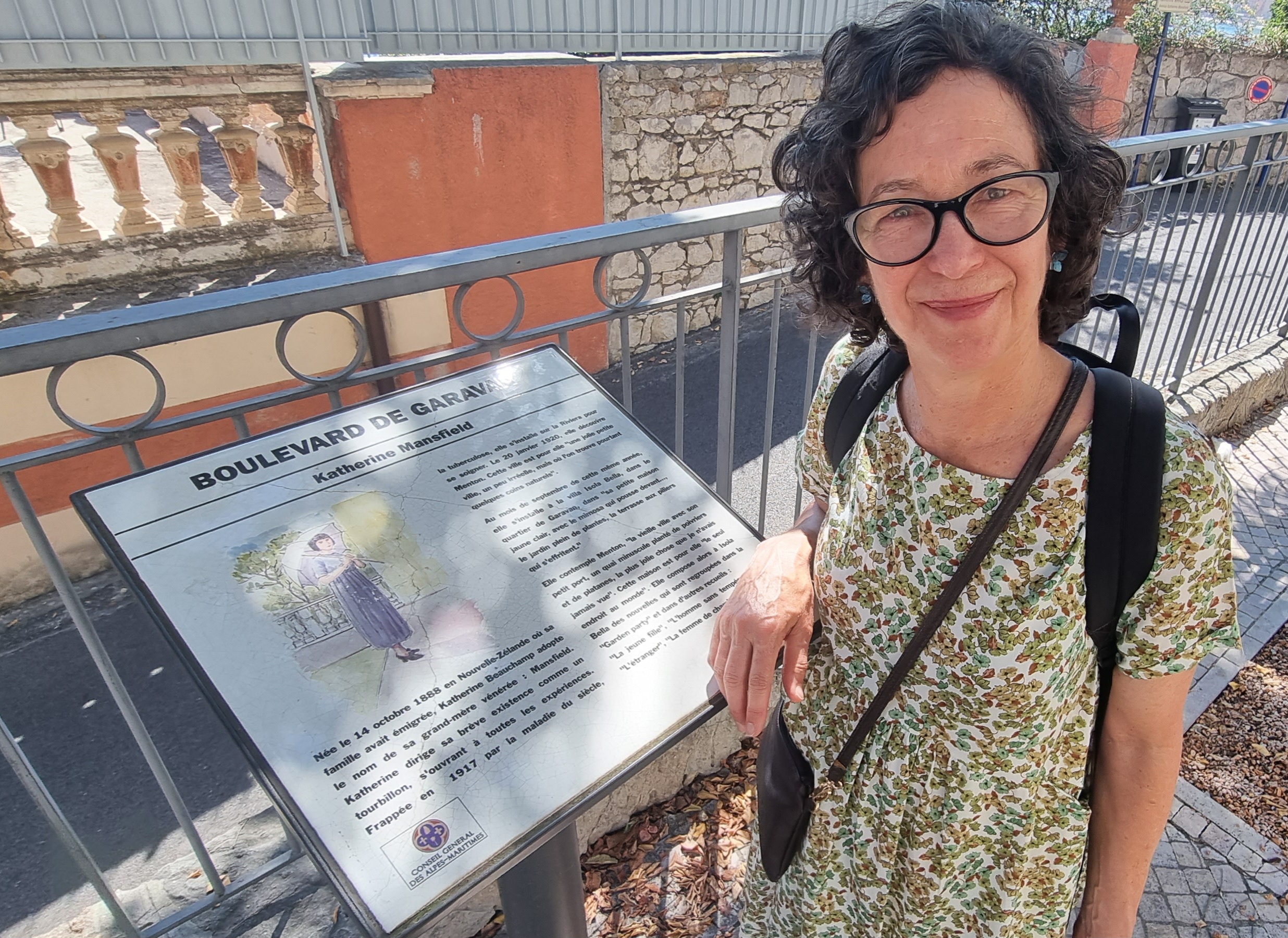
Fergus Barrowman presided as MC with a touch both deft and warm and Selina Tusitala Marsh, prerecorded in Menton lead out with ‘Te Aroha’ and a tribute to Vincent O’Sullivan.

Robert Sullivan embraced definitions of aroha from his home in Ōamaru; before eight Laureates took the stage one by one; together with Jillian Sullivan and Dominic O’Sullivan reading on behalf of Brian Turner and Dominic’s dad, while exploring a family tie along the way.

There have been Laureate gatherings before, but time had caught up with some for Laureates Line Up. But local poets were out in force among the audience of 250 to reinforce the point that poetry is in good heart in New Zealand and that the Poet Laureate Award has mana and is thriving.

As Laureate David Eggleton observed after the reading, it did indeed feel like an historic moment. And a precious one.

Peter Ireland
National Library

Image: Miro King

Laureates Line Up: a view from the audience

A rare and precious moment at the National Library: 14 Poet Laureates, all of them gathered either in person, online or by proxy, or, as Jillian Sullivan said about Brian Turner, with their memory in our hearts; along with Jacob Scott, creator of the tokotoko for each poet, Peter Ireland (National Library ”Poet Laureate minder”) andloyal sponsors John and Wendy Buck of Te Mata Estate winery, who provided the fine Te Mata wine to go with the delicious nibbles. 

The evening began with a welcome from Jackie Hay, of the community engagement team at the National Library (the “rare and precious moment” quote is hers) and an acknowledgement of those whom we’ve sadly lost in recent years: Vincent O’Sullivan, Brian Turner and kaumātua Tom Mulligan from Matahiwi marae. Selina Tusitala Marsh (“bonjour from Menton”) then led everyone in a pre-recorded waiata of Te Aroha and Fergus Barrowman, with warmth and humour, introduced the Laureates to read in pairs. New Poet Laureate Robert Sullivan joined in online from Oamaru, followed (again from sunny Menton) by Selina reading a poem to honour Vincent O’Sullivan, remembering a time when they were both guests at Lockwood Smith’s London home and Vincent, uncomplaining, was given a room on the third floor.  

In the lineage of laureates
excellence is simply this
just climb the stairs and write 

The next pairing was Jillian Sullivan, Brian Turner’s partner, reading for Brian, and Dominic O’Sullivan, Vincent’s son, who flew over from Australia to read for Vincent. Jillian read “The rocks below”, Brian’s message to a grieving friend; his shortest, one-line poem titled “New Zealanders, a definition”, “Deserts, for instance” (which is to be the text of a sculpture in Central Otago to recognise him as Poet Laureate of Nature) and lastly, a poem that Brian read at his final public reading last year in Dunedin. Dominic read two family poems, one about Vincent’s grandfather, the other a poem carved on the headstone of Dominic’s daughter Sarah.

Bill Manhire and Jenny Bornholdt read poems from new books coming out next year. Bill commented, “I spend far too much time on social media” and described a recent post about Dracula’s grave (or lack of) at a church in Whitby, before a brilliant reading of “Too many Draculas” (definitely worth buying the new book for that poem alone). He said that one of the things being Poet Laureate had given him was the courage to use poetry to speak out on public events and then read his protest poem “Gaza”.

His parents held him while he died
but they are both dead, too.
Or he held them, no one remembers

Jenny read four new poems: “Luck”, “Forecast”, “Worry” and “First aid”, the last one ending with a lovely, very Wellington-seeming scene on a bus. Elizabeth Smither read some wonderful and hilarious librarian poems, which all the librarians in the audience clearly related to, and C K Stead read some of his recent Catullus and Kezia poems, bringing an Auckland flavour with shades of Kohimarama and Rangitoto. Fergus then read for Ian Wedde, in Ponsonby: another Auckland, very Ponsonby poem (“See what love can do”) with a perfect ending, and he also read Hone Tuwhare’s “Toroa”, noting its link with Wellington and the Tanya Ashken sculpture on the waterfront.

Your head tilts, your eyes open to the world.  

Two poets from the deep south followed: David Eggleton (who described himself as the pandemic Poet Laureate and read an extract from Rāhui, his lockdown journal) and Cilla McQueen, who read “Letter to Hone 2022” (“one of many”) and “Learning by heart”, written the day after a car accident. And the very last pairing was Michele Leggott and Chris Tse. Michele read “a summertime poem” and a poem in praise of the scientists and technicians – and the mouse! – of the Malaghan Institute:

The battlefield
of blood and bone marrow

Chris, the outgoing Poet Laureate, read “I want things that make me happy”:

Give me scars of adventurous days
Give me old age and better 

And his last poem looked ahead to “the other side of next year”, a fitting ending. (Lots of these poems had wonderful endings). Wonderful and very special line-up, amazing evening of poetry and stories.

Philippa Werry

Laureate Jenny Bornholdt. Image: Miro King

eight poets laureate select a poem

I think of myself as being a fairly quiet poet but being poet laureate helped me find the courage to step into public spaces  – even to occasionally attempt writing to order. ‘Erebus Voices’ is one example. It was written for Sir Edmund Hillary to read at a Scott Base memorial service in November 2004 honouring the 257 passengers and crew who had died 25 years earlier in the Erebus tragedy. Peter Beck, then Dean of Christchurch Cathedral, who led the service, requested the poem on his behalf. Apparently Sir Ed was happy to participate in the service, but did not wish to read a Christian text. One of his closest friends had died in the disaster. I was able to see him reading the poem on the TVNZ News. He gave it heaps.

Erebus Voices

The Mountain

I am here beside my brother, Terror.
I am the place of human error.
I am beauty and cloud, and I am sorrow;
I am tears which you will weep tomorrow.
I am the sky and the exhausting gale.
I am the place of ice. I am the debris trail
And I am still a hand, a fingertip, a ring.
I am what there is no forgetting.
I am the one with truly broken heart.
I watched them fall, and freeze, and break apart.

The Dead

We fell.

Yet we were loved and we are lifted.

We froze.

Yet we were loved and we are warm.

We broke apart.

Yet we are here and we are whole.

Bill Manhire
from Lifted, Victoria University Press, 2009

At the conclusion of ‘Persuasion’ Anne Elliot enters her father’s house so happy as to require an interval of meditation to prevent her emotions from overflowing. ‘She went to her room, and grew steadfast and fearless in the thankfulness of her enjoyment’. Jane Austen often uses this corrective half-hour of quiet to steady the emotions, to lower the pulse, to regulate joy or tears. I imagined the jumble of Anne’s feelings before she faces the evening’s pallid entertainment and before she becomes pastel herself. I removed all the commas because jumbled emotions need no pause.

What Anne Elliot did in her respite room

She peeled off her gloves laid down
the umbrella offered by Captain Wentworth
she went to the window and looked out
too agitated to sit she removed her shawl
and bonnet smoothed her brow patted her hair
bent at the waist and eased herself into a chair
deep breaths counting to ten then
letting them out again to the same tempo
gradually her heartbeat slowed she touched
her pulse with two fingers to confirm it
and the room’s familiar things settled
her books her hairbrushes her jewellery box
a crystal vase with flowers one browning leaf
a little dust since this morning had alighted
indiscriminately on the furniture. Half an hour
and she felt she was turning pastel enough
to return to the drawing room.

Elizabeth Smither

This poem of Brian’s spoke to me in a personal way, the way his poetry does, shining a light on your own fears, losses, hopes. And wonders. Explaining how things are. How things could be. I am leaving this week to walk the length of the South Island, or as Brian says in Hard Luck, Nature: “here’s hoping, here’s to a decent attempt, for all the right reasons.’ I want to be in the mountains at the date that’s a year of him leaving. To be crossing rivers, standing on summits, facing the steep bits, loving the slopes down from the bluffs. This poem speaks metaphorically of life at the same time it carries the authenticity of his own long tramps in nature. And as for grief, there is hope in the lines; ‘the dusty earth/ believes we are crying/yet the river sings’, and advice in his mantra: ‘Let’s go on reaching,’ and the two words, ‘living, here.’

Jillian Sullivan


 Walking in                               

The country throbs 
and all that is dead 
is buried by all that’s 
so convincingly alive.

We sweat. The dusty earth 
believes we are crying 
yet the river sings.
We hate the steep bits,

love the easy grades 
down from the bluffs, 
the way the body 
handles it all

as long as we don’t 
over-reach ourselves.
Let’s go on reaching.
We carry all that we need,

we think we know 
where we’re heading 
and why, and two words 
dwarf all others: living, here.

Brian Turner
from All That Blue Can Be, 1989

‘Worry’ combines three occasions I’d written  notes about, thinking I’d probably want to use them in a poem, or poems, sometime. I started with worrying about the day and then, in the way that poetry happens, the other two followed on from that. Each had its own strangeness and I think this is what bound them together. It was good to start with upset and finish with a rush and then the calmness of mothers sleeping.

Worry

I woke to worry
about the day
so went out into the garden
to move things around. Said
sorry, sorry, sorry
to stick insects disturbed
along the way.

Then I walked
along the river, said hello
to two women and
a baby, one man,
a runner and three
cyclists. Dogs veered like thoughts
into a tiny experimental
forest.

I walked beside tennis courts
to the next sunny rise, to the bent
tree, the big rock, then
I was done.

I sat and remembered
the time my cousin and I
ran through all the gardens
of the world. Our mothers slept
on the lawn while we sprinted through
Spain, Greece, Italy; my uncle
grumpy amongst the bright flowers
of India. Japan was an ocean
of pale stones, calm as our mothers
in their childhood beds, whispering
like grass.

Jenny Bornholdt
from What to Wear, forthcoming THWUP, Feb 2026

This is a praise poem for the scientists and clinicians of the Malaghan Institute of Medical Research and for the mouse whose genes helped save my life three years ago. For eight or nine months I was part mouse and then the genetic material dispersed and I was myself again, with a debt of gratitude that is hard to overestimate.  

lymphocyte | rag

I am a chimera  —  the 68 million cells
each with its mouse head  —  and trailing antibodies
made from transcriptions of a human gene
have replicated themselves who knows how many times
antigen receptors looking for trouble  —  doubled
in their capacity to hunt down and eliminate
diffuse large B-cells  —  gone crazy
killers versus killers  —  they hang about
munch munch munch  —  creep creep creep
the battlefield of blood and bone marrow
the waterfall above my heart  —  mouse god Apollo
tune up your banjo and lead those antibods
in a ragged medley  —  you’re going to miss me
when I’m gone  —  it’s going to take
years to rewrite the symphony
that was my lymphocytes  —  white mice
rejoice  —  your red eyes and the control panels
have wrought the miracle  —  plain as day
a string of chimeric figures
jigging on the high plateau
and below their fandangles  —  a single line
near normal subsets  —  dance mice
dance scholars and poets everywhere  —  dance on ice
dance in the streets  —  and praise
the high chimeras of the blood volcano
and the caves where miracles are made

Michele Leggott

Sláinte

It was to the surprise of some that Vincent accepted a knighthood in 2022. He explained that one of his reasons was the sense of historical irony it brought to his family’s story. It was for the sake of his grandfather Tim, born in Tralee shortly after the Great Famine, and who died before Vincent’s father was born.

Sláinte is a reflection on Tim’s story. His death from cancer in 1898 and his widow Maryanne’s emigration to New Zealand with her children with Vincent’s father, also Tim, the youngest. For me, its resonance is simply that it is a poem about family and one of Vincent’s last. Written as he said,

‘As close as it gets
this late in another’s day’.

Sláinte

A man who adds up to half
my lifetime, were we
into counting. A man from
a train looks up to the grey cliff
of the Mater Hospital, Eccles
Street, 1897.

At the end of his drenched
disconsolate country,
the woman is pregnant to the man
who has travelled from Kerry
in pain’s private carriage.

It is always dusk
in my thinking of it, the lone
man’s arriving, the lights
white-circled in the evening
wards, the veiled nurses …
his fingers nervous (as his son’s
in time) on pyjama buttons.

My father would hear
as a boy from a shawled
sybil in the street of the Bon
Secours how she’d seen
his father that same day
as he died in Dublin,
smoking as though back home,
at ease on his doorstep,
before fact arrived.

It was later again. A butterfly
out of season on the curtain
of the room where my father’s born.

Strand Street by autumn then
with the widow’s five
charges, planning the world’s
passage from a corner store,
so the South stays always
morning in memory,
boys aboard the Scharnhorst
a decade later, fun
on deck and the German sailors
teaching numbers and phrases,
the horizon hauling
at Timaru’s rising …

This now for my father’s
father, and then my father,
unknown to each other yet never
further than namesake, one,
and one to another, to my
saying this. As close as it gets
this late in another’s day.
In theirs. In mine.

from Still Is, Te Herenga Waka University Press, 2024

After my last  collection, In the Half Light of a Dying Day, I said I would write no more poems, and for two and a half years I didn’t, but in the past few weeks I’ve found myself writing a series of sonnets.  There are currently about 20 and they seem to be continuing.  This one, ‘Gary’ (above), was the seventh.  It appeared in a recent Listener and resulted in many questions about my own survival from going unconscious out there.  The sonnet’s 14 lines are limiting, but it’s true that I did ‘pass out’ while swimming, and ‘came to’ underwater.  I think I survived because it didn’t panic, just floated to the surface, and hitched a ride inshore with a woman I’d been chatting to out at the yellow buoy who was equipped with one of those orange balloons some swimmers use to make themselves visible, or to stay afloat.  After the event I was instructed by my wife and daughters not to do big swims any more and have restricted myself to the nearer buoys; and I think I’m now too  old and weak to go any further.  The whale I’d seen a few days before my ‘passing out’ incident returned next day.  It was identified by Project Jonah experts, as a young Southern Right whale, and has not been seen again.  It seems Gary (Williams) did not drown; he’d appeared to be swimming well, as usual, and had a heart attack. Many older swimmers (I among them) think it would be a great way to go.  Gary, father of the New Zealand comedian Guy Williams, was much loved by all of us in what we call the High Tide Club at Kohimarama.   

 Gary 

There’s a group in Kohi’s High Tide club swims
most days to the Yellow Buoy. I had been one 

until, aged 90, I passed out on my way back 
and came to in the world of Underwater 

where only a week before I’d met a whale,
a young Southern Right, maybe an omen.

So I’ve never been back to that buoy, and yesterday
one of the group, Gary, who always called me CK, 

eager in every weather and loved by us all 
died in the water and couldn’t be revived. 

Out at the yellow today his mates spread flowers 
and gave three cheers. His daughter told me Gary 

would have been pleased to die with an audience. 
‘He was theatrical’, she said, like him loud and cheerful. 

CK Stead

‘Mostly Black’ is one of the three poems I read at the Poet Laureates’ event at the National Library in November 2025, all taken from Respirator: A Poet Laureate Collection 2019 – 2022, published by Otago University Press. Respirator is, deliberately, a kaleidoscopic whirl of a book about a turbulent time – or maybe it’s just a cosplay ragbag of a book, containing stage jewellery and other suspect finery. The book’s cover, a photo taken in the West Coast bush/Te Tai Poutini, invites the impression that it contains within an assortment of rusted-on, cast-iron ironies: humanity’s engineering marvels found abandoned in a rain-forest which are the lungs of the planet – or something like that. So, ‘Mostly Black” is mostly a sort of found poem, dug out of the rain-forest of the mind. A craft-minded, or crafty, poet, given enough words to rhyme and chime with, usually can connect anything with anything and make it stick. This poem, though, is built around a mono-rhyme. It ponders the paradoxes of nationhood and identity and self-hood through the smoked-glass lens of the word ‘black’.

When I found myself invited to become the twelfth Poet Laureate in National Poetry Day in August 2019, I already possessed a folder of poems, completed in 2019, that were my response to holding the Fulbright-Creative New Zealand Pacific Writers’ Residency, which I held for three months at the end of 2018 at the Manoa campus of the University of Hawai’i. These I rolled over into the bundle that became Respirator, capturing what I wrote from the beginning of 2019 and to end of 2022 chronologically, though not all the poems I wrote in that time-frame made it into the final selection of well over 100 poems. The hardback book consists of verses for specific occasions, pandemic journal poems, comic and satiric poems, Moana Nui poem sequences, and more. It is a chronological record of what I thought I should write about as the Poet Laureate during those years. The brief was: be yourself, which I took to mean, speak as you ought to speak – with nobody, and yet everybody, hanging on your words.

Mostly Black

Before, as it was, it was mostly black,
dark beaks, polished talons, feathers, a black
regime drenched in the melancholy black
of rains that took tides further towards black.
From hinges of sunlight hung blocks of black,
and risen humps of islands were matt black.
Cinders sailed from bush burn-offs, carbon black.
Beads on antimacassars gleamed jet black.
Through pine’s silent groves possum eyes shone black.
Above tar-seal a melted rainbow turned black.
At disintegration of monolith black,
green, all that blue can be, then back to black.
Green of pounamu lost under lake’s black.
Blackout’s lickerish taste, blood-pudding black,
and midnight mushrooms gathered from deep black.
Tattoos drawn with bent nib and homemade black.
Batman’s mask, a dull sheen of cue ball black.
The primeval redacted, placed in black
trash bags, or else turned out as burnt bone black.
Pull on the wool singlet of shearer’s black,
for blacker than black is New Zealand black,
null and void black, ocean black, all black.
In Te Pō’s night realm, from Te Kore’s black,
under the stars spreads the splendour of black.

one laureate reads a poem

Hone Tuwhare (1922-2008) reads ‘No Ordinary Sun’, from No Ordinary Sun, Blackwood & Janet Paul, 1967. Some of the poems on this record were recorded at a reading given at the Birkenhead Public Library, during the North Shore Festival of Arts and Crafts, on 23 February 1967. You can listen to the album at the National Library.

two laureates on video

Poetry to me is like a waiata, which translated can mean reflecting water. Yet I find most of the language I have for poems comes from other poems, such as “a ripple of words on water / wind-huffed” which is a quote from Hone Tuwhare, or to borrow from William Carlos Williams, the very ordinary become special because it is “glazed with rain.” I so enjoyed the readings from all the poets’ laureate. My many many thanks for this honour. Ngā mihi nunui.

Robert Sullivan, current Poet laureate

Poetry Shelf Playing Favourites: Murray Edmond

INTERVIEW WITH A POEM: ‘Night Shift 1’ (1970)

Night-Shift 1

I get up at 4.00pm
& buy a cheese
3 tomatoes, an orange, & a tin of fruit juice
as usual;
also a paper.
I return to the kitchen
& put 2 tomatoes in the fridge for midnight,
cut off a piece of cheese
& put the rest in the fridge,
also for midnight;
then I open the tin of fruit juice,
two triangular holes neatly opposite each other;
I wish I had had time to put it too in the fridge to cool.
When I come to sit down at the table
I find Kathryn is reading my newspaper.
I eat the tomato, the piece of cheese & the orange;
also I drink the tin of fruit juice.
I feel I need some exercise,
So I go for a walk as the sun goes down.

Murray Edmond
from Entering the Eye, Caveman Press, 1973
First publication of this poem was in Landfall 98, June 1971, pp.122-123 (lovely cover by Pat Hanly – please note, Landfall then cost $1.00!).

Interviewer: Today we are speaking with a poem, which hasn’t been seen for many years, but has been reprinted here today. I began by asking the poem how it persuaded the poet to get re-printed:

Poem: Truth to tell, I didn’t even recognize the old bugger, it’s been so long.

Interviewer: So, did you get in contact . . . I mean, was it you who approached him?

Poem: Pure coincidence. I was on my way down to the mall. I work down there, back of the supermarket. Opening boxes all night. It’s a job. I usually stop off at the local – have a beer and a falafel. I took a short cut down a street I’d never been before. I’ve completely lost contact over the years. Once you’re written, that’s it. Most of them don’t give a monkey’s after that.  They go off and they write different kinds of poems. But we’re pretty stuck as we are. As we were, so to speak.

Interviewer: So, what happened?

Poem: This old guy was mowing the berm. Pushing an old hand mower. I walked right past him. He’d looked up and caught my eye. I thought: why is he looking at me like that? I’d gone about twenty paces further on, and I stopped. It was him.

Interviewer: So, did you say hullo?

Poem: I turned back and had a second look. It was him all right. We were staring at each other. Just staring like. Then we both pretended not to know. He was the first to break. He put his head down and started pushing the mower like fury.

Interviewer: So, nothing happened.

Poem: It had been too long. Like seeing an old lover across the street.

Interviewer: When I read you, I don’t see much love in you.

Poem: I like to think I’m a love poem.

Interviewer: Really?

Poem: True.

Interviewer: How do you work that out?

Poem: I don’t. It’s what I am.

Interviewer: I don’t see it. Who’s the lucky . . . whoever?

Poem: Not that kind of love. All youse interview bods are the same. Love! For the fucking world. And all its shit. The sun, the cheese, the fridge, the tin of juice, the fucking orange, bro!

Interviewer: Do you call that love?

Poem: I call it love. What do you call it?  Sorry! “We ask the questions”. Mind you, maybe you’re a bit right. Turned out we had the same girlfriend once. That was a bit odd. I’d forgotten all about her. I wanted to ask him ask: Where is she now? But I didn’t.

Interviewer: Was that Kathryn?

Poem: Kathryn?

Interviewer: In the poem. You should know: “I find Kathryn is reading my newspaper.”

Poem: Oh, Kathryn! No, no.

Interviewer: So, who was Kathryn?

Poem: She’s still there. She’s in the poem. She’s reading the newspaper.

Interviewer: Are you just making this up?

Poem: No, no. Cross my heart. Well, yeah. I guess. I’m aware that I’m just made up. “Every time I wake up, I’m putting on my make-up . . . “ Don’t look so worried, bro. Aretha Franklin!  I’m not ‘making up’ to you. Swear. One thing I am proud of is my semi-colons. Did you notice? Didn’t think so. And did you notice the lack of pull-tabs back then? Do your homework. Thing is I’ve worked night shift for years. They say it stuffs your health. Stuffs your . . . what’s it called? Psyche? Is that the word?

Interviewer: You’re the poem. You should know.

Poem: Tell me: how do you get a job like yours?

Murray Edmond: born Kirikiriroa 1949; lives in Glen Eden, Tāmaki-makau-rau. Recent publications: Time to Make a Song and Dance: Cultural Revolt in Auckland in the 1960s (Atuanui Press,  2021) – cultural history; FARCE and Sandbank Sonnets: A Memoir, (Compound Press, 2022) – 2 books of poems; Aucklanders (Lasavia, 2023), a book of 15 short stories.