
Welcome to a new and ongoing series on Poetry Shelf. I have been thinking a lot about the place of poetry in global catastrophe and the incomprehensible leadership in Aotearoa. How do we write? What to read? Do we need comfort or challenge or both? I am inviting various poets to respond to five questions. To launch the series, poet Khadro Mohamed.
I have also found it hard to find a place for art amongst the pain and suffering in the world. Whether its watching our media class and politicians shamelessly cheer on the genocide and inconceivable human suffering in Gaza or the suffering in my own homeland, Somalia, where famine and environmental catostrophe threatens to unravel the entire land. It makes me wonder if it’s even worth it anymore? How can I write about trivial things while people, mypeople, suffer and die across the globe? But I’ve been reading a collection of poems by Palestinian author Sarah M Saleh, Arab-Australian poet Omar Sakar as well as Somali-British poet Warsan Shire, and it’s really helped put a lot of my troubles with poetry during this time at ease.
They all write in a means to make sense of this senseless world.
Refaat Alareer, a Palestinian professor who was murdered by Israel, wrote a poem ‘If I Must Die’ in which he predicts his murder and asks for the world not to forget him and the people of Gaza. This poem has since been translated into hundreds of languages and hangs on the signs of protestors across the globe, including here in Aotearoa, one of the furthest places from Gaza. It’s such a powerful reminder that we must not forget that artists (think: Palestinian artists like Edward Said, Ghassan Kanafani, Mohamed Darwish, Silman Mansour) and in turn, art, is an important tool in imaging a better world.
I don’t want this answer to get too long, but I guess what I am saying is that art is important. Even if it feels like a stupid thing to care about amongst the pain. We must lean into building stronger connections with each other and creating spaces that honour the oppressed and marginalised.
Khadro Mohamed
Have local and global situations affected what or how or when you write poetry?
If by ‘global situation’ you mean the unfolding genocide in Gaza, then yes, it has affected me and my writing profoundly. I am incredibly proud of my Muslim identity and my Somali heritage, but it has become jarring to watch mosques blown up and pages of the Quran smeared with blood flutter in the wind. It has made me angry. But I have not written any poetry about it. I feel like it’s too hard to put what I feel into words, but more importantly: how can I sit to write poetry while I watch Palestianians suffer, right there, on my screen?
I have found it much easier to read and attend book launches to embed myself into the literacy scene. I recently attended the joint book launch of romesh dissanayake and Saraid DeSilva’s books When I Open the Shop and Amma. Saraid wore some earrings with the Palestinian flag, and watching them dangle from her ears as she spoke was such a soothing feeling. Romesh opened his speech by making it clear to the audience that he stands with Palestine and was met with a round of applause from the audience. I think watching the literacy community in Wellington respond to Gaza’s call has been particularly heartwarming.
Prominent poets like Hera Lindsay Bird, Tayi Tibble, Ash Davida Jane and writers like Pip Adam and Saraid de Silva (among many many more) have all made me hopeful for the feature of NZ literacy. I am really glad that my fellow writers care about Palestine and our collective liberation like I do. I feel more seen, and very safe attending a range of events knowing that the majority of my peers share my hope for a free Palestine.
Does place matter to you at the moment? An object, an attachment, a loss, an experience? A sense of home?
The only place that seems to matter to me lately is Palestine as a free and liberated land. It’s hard to explain it, my connection to this land that I have never been to. But I think as I grow more connected to my faith, I cannot deny the significance of Palestine as a place of worship as well. Especially as Palestinians, despite it all, find time to pray daily and mark the start and end of Ramadan.
I also feel connected to my prayer rug, it’s really soft and orange and I brought it from a market in Cairo back in 2012. But I find myself sitting on it and just thinking and praying and hoping.
Are there books or poems that have struck a chord in the past year? That you turn to for comfort or uplift, challenge or distraction.
Poetry is so much fun and there is so much poetry being released into the world all the time. I recently read poetry from Warsan Shire’s collection Bless the Daughter Raised by the Voices in Her Head in which Warsan writes extensively about being Somali in the West. It’s so comforting, her poetry is not only beautiful, but I also feel really seen whenever I open the pages of her book.
I have also read recently Songs for the Dead and the Living by Sarah Saleh, a story of Palestinian refugees in Beiruit before the war. It’s an incredibly moving book that left me feeling really sad but somewhat hopeful for the future.
I am also halfway through ‘Amma’ by Saraid DeSilva, a book about generations of women who are connected. I really love Saraid’s writing in this story. I think her characters are really strong and she interweaves a variety of perspectives and experiences into the stories.
What particularly matters to you in your poetry and in the poetry of others, whether using ear, eye, heart, mind – and/or anything ranging from the abstract and the absent to the physical and the present?
I think all arts are really good at responding to current events, global and local. That has never really changed. I think what matters to me right now is poets and poetry that speaks to the horrors that we are seeing, these voices are overwhelmingly Muslim and Arab at the moment, but I would encourage all poets and writers to write and speak and to educate themselves on Palestine and how all of our movements for equality are interlinked.
It’s no mistake that people who put themselves on the opposing side of Māori rights advocates also align themselves with the genocide in Gaza. We’re all interconnected and it’s more important than ever to build connections and threads to stay connected.
Is there a word or idea, like a talisman, that you hold close at the moment. For me, it is the word ‘connection’.
I think the word ‘faith’ has been really important to me. Not just in the religious sense, but also having faith in the community that I have built around me. I have faith that the world will become a better place soon and it’ll be because we all worked really hard for it.
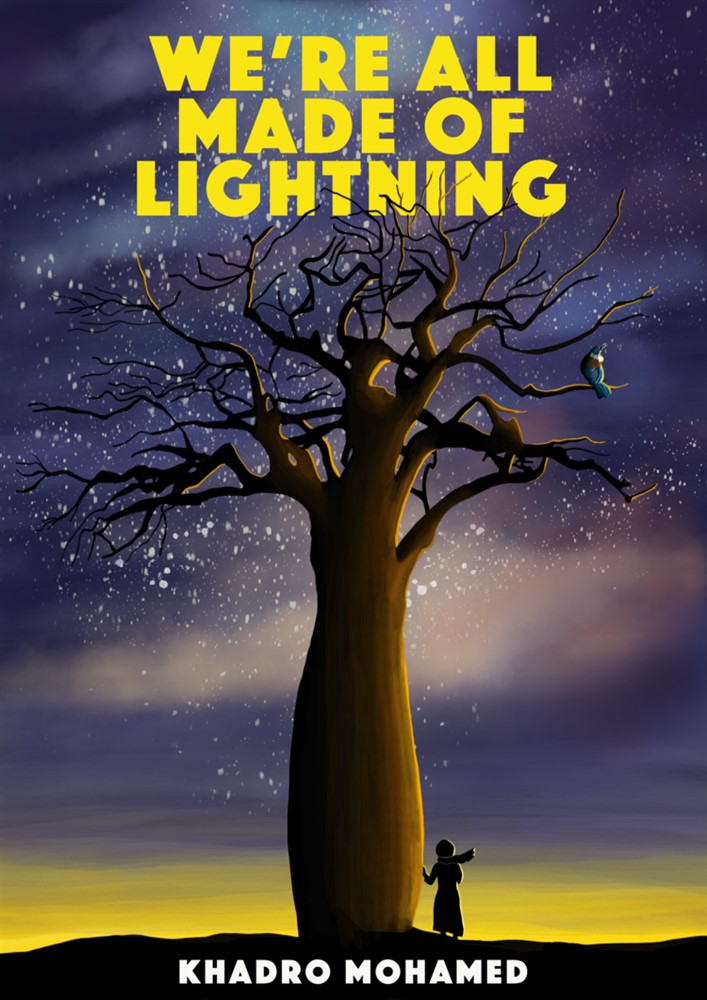
Khadro Mohamed is a writer and poet from Wellington. She’s written a poetry collection, We’re All Made of Lightning (Tender Press, 2022), which won an award at the Ockam NZ Book Awards. She’s also working on a novel (and promises she is almost done with it!).
Tender Press page
 NZ Poetry Shelf
Pingback: Poetry Shelf newsletter | NZ Poetry Shelf