
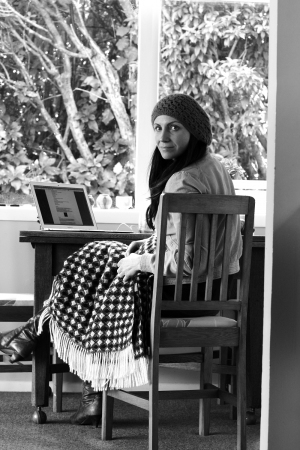
Photo Credit: Matt Bialostocki
Blue Heart
Full size model of a Blue Whale heart, Te Papa Museum
The boy enters the whale heart. He finds his way.
His hands slide down the peachy aorta, his body
swallowed into the central chamber. My face pushes
after him because it’s just fibre and glass, and he’s
my first child, on his knees, his back to me. His hands
perform their work of play along a smooth ridge of cartilage
like a cardiac surgeon. Interpretations of the ‘whale’ fall
into three categories: The whale is real and my son
lives in her heart. Or the whale is the dream
I have for my son. Or the whale is an allegory
that should not be taken to heart. Some things take time
to understand. Last time we visited my grandmother
I knew she would die before I saw her again.
She’d been having regular blood transfusions—
pulsing circles of bright red tubing—which helped
for a few weeks before another fall, after which she’d rest
one cheek on the carpet. My son sat on her lap and she played
at biting his fingers, her grey dentures clacking together,
and he squealed and pointed, and then pointed to the fireplace,
and then pointed to the window where a dried floral arrangement had sat
for twenty years. Everything was there for him.
She took his pointing finger between the soft pads of her lips.
How do you enter the biggest heart? Do you say
that it weighs up to fifteen hundred pounds? The largest heart
is like a compacted Volvo! Maybe you must imagine it beating
inside you? Maybe you find it one quiet morning,
your son asleep, his cheeks flaring the colour of summer plums.
Author’s bio: Sarah Jane Barnett is a writer, tutor, and book reviewer who lives in Wellington. Her first collection of poems, A Man Runs into a Woman, was published by Hue & Cry Press in 2012, and was a finalist in the 2013 New Zealand Post Book Awards. Her work has appeared in various publications including Sport, Landfall, Best New Zealand Poems, and Southerly. Sarah has a PhD in creative writing from Massey University in the field of ecopoetics. She blogs at: theredroom.org.
Author’s note: ‘I wrote this poem as part of my PhD thesis which, in part, looked at the different ways poets write about the nonhuman world. While writing my thesis I had my son and my grandmother died. Both of these events felt huge and brittle and surreal. Both were difficult to write about. One afternoon I took my son, Sam, to Te Papa and he played for ages in their scale model of a blue whale heart. It made me think about the way poets often resort to using the natural world as a metaphor when trying to describe love, grief, or the sublime. That’s when I wrote this poem.’
Paula’s note: The opening line of Sarah’s poem, so exquisitely simple stalled me with myriad, potential directions: fable, fairytale, the slippery slopes of surrealism, metaphor and real-life anecdote (as the epigraph in fact signals). This heavenly poem celebrates the child — the mother-son relationship is clasped in its tender embrace. Poignantly, the life of the son is countered by the death of the grandmother, not as a set of scales but as a largeness of love and loss that finds its potency in the smallest of detail. The poem enacts the mystery of writing a poem — the way stream-of-consciousness or random thoughts that accumulate like stepping stones can drive the poet’s pen and make magic out of metonymy and juxtaposition. The son points out the luminous detail so that place becomes vibrant and beloved. The life blood of this poem is heart: the whale’s heart, the son’s heart, the grandmother’s heart. But more than than anything, it is the internal love heart that renders the grace, economy, attentiveness, poetic craft, the words that shine out, the story that unfolds and the images that startle (‘cheeks flaring the colour of summer plums’) in maternal ink. This is why I love poetry.
Sweet Mammalian is a new literary journal edited by 3 Wellington poets. The journal was created out of a wish to see more good, new writing out in the world. The editors of Sweet Mammalian aim to provide a fresh space for poetry that comes out of the complex, the absurd, the warm-blooded. They aim to provide a space for all kinds of writing. The inaugural issue of Sweet Mammalian is launched today, Friday 10 October, with a launch party and reading in Wellington.
The link to Sarah’s poem in the inaugural issue is here.
Sarah Jane Barnett’s fabulous, debut poetry collection was short-listed in the Poetry Category at this year’s New Zealand Post Book Awards. She has contributed a piece to the ongoing series On Poetry that NZ Poetry Shelf is hosting. I totally agree with her tip that reading makes a writer (and I would add writing). Read read read write write write (a simple but time-tested formula. There was an excellent interview in the Listener but you need to subscribe in order to follow link.
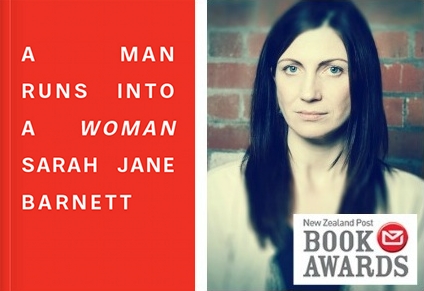
Sarah Jane Barnett A Man Runs Into a Woman Hue & Cry 2012 This is what I wrote about this book last year (part of it ended up on the blurb at the back of the book): Sarah Jane Barnett’s debut collection is a gift for the ear. The words are poised, graceful, musical; verbs and adjectives soar and vault and balance. Within her glorious word gymnasium, Barnett is a poetic trapeze artist with feet on the ground and magical arcs and sidesteps in the air. As the cartographer of human experience, she steps boldly into the shoes and lives of others – a cable television engineer, a geographer, a pipeline worker. Her alert mind and canny eye for detail translate and transform what we may have missed in the world into poetic vignettes that are both light-footed and fresh.
the red room Sarah’s blog
And now from Sarah:
Three Tips for Beginning Poets
Even though I’ve been writing poetry for the last ten years, I still feel like a beginner. I can’t imagine this will ever change. Every time I read a new collection of poetry I learn something new. There is always somewhere else to go; some new poems to write. So, while these tips are aimed at writers who are just starting out, I think they are useful for any writer.
1. Read poetry
A few years ago at a writers festival I met one of my idols, Canadian poet Christian Bök. After he signed his book for me I asked him what advice he had for poets just starting out. His one word reply: “Read.”
It seems an incredibly obvious statement to make, but I’ve been given the same piece of advice by many other poets, and it’s now the piece of advice I give to other people. I think that sometimes poets become so focussed on writing new work that they forget the best poetry is part of a wider dialogue with other poems and art forms. It’s not just about reading, though, but reading with a critical eye. Poets are notorious magpies. By reading other poets you can look at the mechanics of their poems. What tricks do they use? How do they use form, language, sound, and imagery? What poems make you excited and why? Once you figure out these things, you can try them out in your own poems. This tends to result in poems that sound like the poet that’s inspired you, but in the process you learn how poems work.
A great exercise related to this idea is to take the first line of a poem you like, and then use that line to write your own poem. At the end, take away the first line.
2. Experiment with form
After I finished my MA in creative writing I had writers block for about six months. No matter what I tried, I could not write a poem. To feel like I was doing something useful with my time I started to write short stories. These came easily and I enjoyed playing with dialogue, narrative, and place, which poets don’t usually get to do. In the end the stories weren’t very good, but after I finished writing them I started to write long narrative poems, and now these are my favourite poems to write.
What I am trying to say is that no time writing is wasted. If you’re a poet there is a lot to learn from writing stories, creative non-fiction, and essays. I think that every fiction writer should write some poems as a way to learn about how to apply pressure to language.
3. Never give up on a poem
I started to seriously write poetry in 2002 after attending a workshop run by Christchurch poet, James Norcliffe. James was the first person to encourage me to send poems out for publication, so I own him a lot. The best piece of advice he gave during that workshop was to never give up on a poem. Sometimes it takes a long time for a poem to reveal itself. It’s a bit like an archeological dig: you’re not sure what the final find will look like.
Take a recent poem of mine. I wrote this poem at the beginning of my PhD and it never really worked. The form was wrong, and the last few lines were rubbish. I’d take it out every three or four months and push the words around the page. A few weeks ago – four years since I first wrote that poem – the poem finally revealed itself.
Sarah Jane Barnett is a writer, reviewer, and tutor who lives in Wellington. Her debut collection, A Man Runs into a Woman (Hue & Cry Press) was selected as a finalist in the 2013 New Zealand Post Book Awards. She blogs at http://theredroom.org.
 NZ Poetry Shelf