as our dead rise heading for the stars what if they get snagged on a satellite
will they be caught forever in a rotating purgatory-like state as if stuck on a glaring
disco-blaring merry-go-round that no-one can get off what if they land on the celestial star-link waka –
this is a genuine concern
i imagine a static-y incoming msg from my mum trying to give me her beauty tips
but they’d come in 90 mins apart fits & starts ////// don’t ////// for ///// get
your ////// lip ///// ////// stick ///// and //// re///// member lux//// soap ///// ponds
dry ///// skin //// cream ///// after ///// rins //// ing with ///// cold ///// water
i think i’d prefer ‘te huka mate’ were offline most of the time
Ariana Tikao
The first of the stars
Ask the wind why it howls Ask the storm cloud why it thunders Ask the Living Earthly Things why do they seek shelter from the lashing rains
Little Brother he will answer ‘Kua riri au ki ōku tuākana!’ I am angry with my brothers
You know how brothers are Sometimes they fight like only brothers fight With terrible ferocity
Ask Little Brother ‘He aha koe i riri ai?’ Why are you angry?
Little Brother he will answer ‘Kua hīanga rātou i tō mātou matua Kua hiki atu ki te pōuri kei runga’ They have betrayed our father lifting him to the gloomy darkness above
So Little Brother rages even as his mother weeps and all his brothers fall before him All except one
Ben Brown 2025
Puaka
Set in the blackness of space your glare is a whisper, a glimmer, a sliver, your gleam a loosened feather of flame,
your light a phantasmagorical ghost to haunt our fire-eating solar system through light years that in earthly time measures
four and a half centuries before your light and fire finally makes land as a pre-dawn solitaire
diamond nestled bright in a cushion of dark velvet sky above my door, your gleam as factual
as science, or time and far too real for myth or song alone. Puaka, you are family,
each winter rising again early in our southern sky to blaze blue, singular, easy to locate and kind enough to draw near
as we eat or pray or sing, your appearance so vast, your light so ancient, yet somehow, new and near and small enough to fit my eye.
Kay McKenzie Cooke
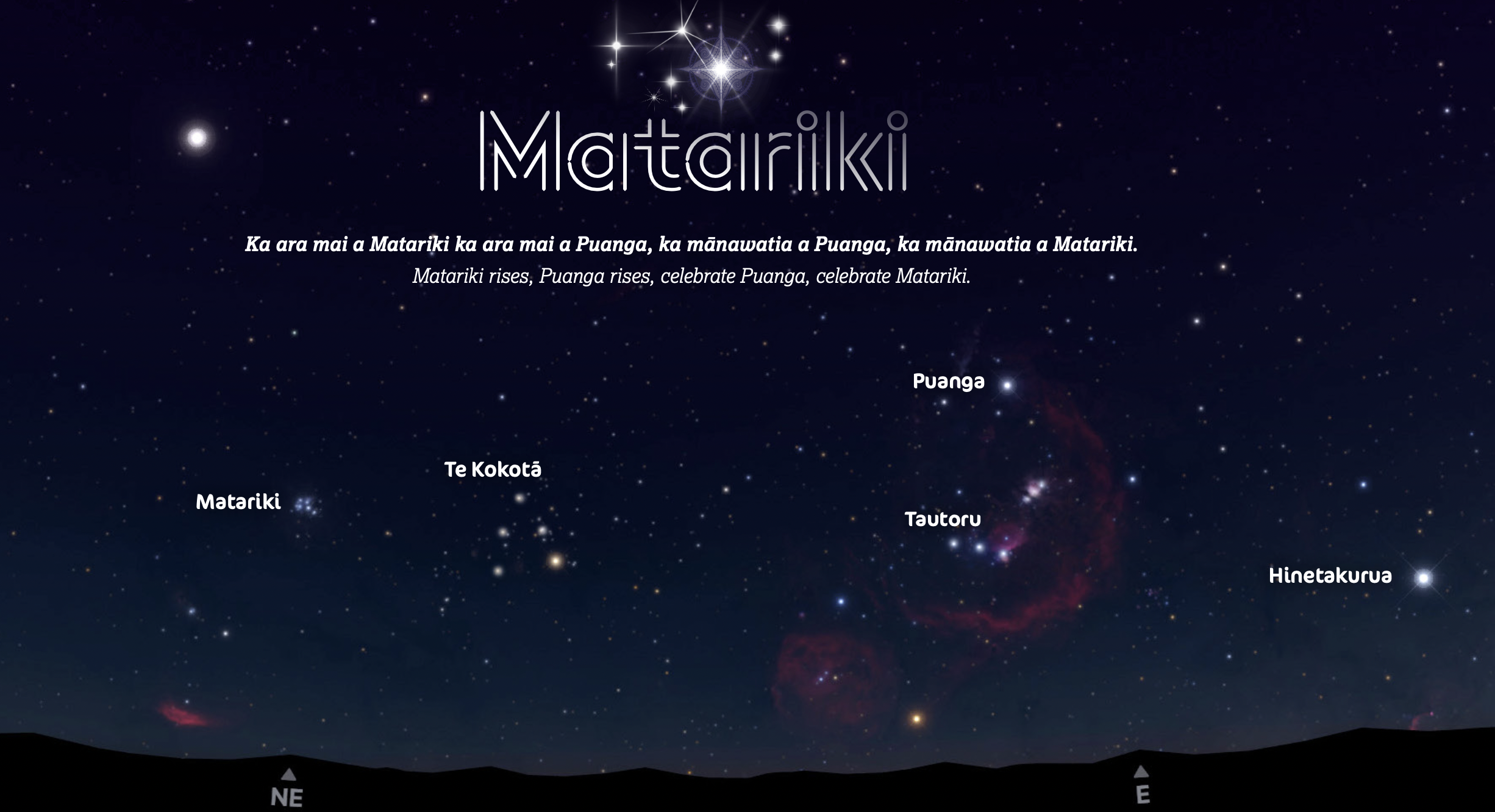
NOTE: Puaka (Puanga, sometimes Poaka) Rigel, is the star southern Māori iwi and hapū look to as a harbinger for the Matariki cluster. More information can be found here.
What the stars say
I hear bird bones crack, splinter. I hear offal slosh in a bucket.
Matariki have seen it all before — my star companions remain silent. Have they gone mad?
Yes, mad as a meat axe.
I hear gunshots at the growing wall, I hear laughter at cocktail hour out of mouths as wide as mako shark.
The bleached face of Sirius gives no clue, all are catching a ferry to the Isle of the Blessed.
My ageless self, trapped in a maimai — who knows how temporary?
It seems I am lasting forever, as long as stories repeat.
I blush and quiver to see myself related to this pale imitation of the gods.
Reihana Robinson from Auē Rona, Steele Roberts, 2012
The poets
Ariana Tikao is a Kāi Tahu writer, musician, and curator from Ōtautahi. She was a 2023 Ursula Bethell Writer in Residence at Canterbury University, and was awarded as a New Zealand Arts Laureate in 2020. She has co-written two books Mokorua (2022) and Te Rā: The Māori Sail (2023), and her first poetry collection Pepeha Portal will be published by Otago University Press in 2026.
Ben Brown (Ngāti Mahuta, Ngāti Koroki, Ngāti Paoa) writes children’s books, short stories and poetry for children and adults, general non-fiction, freelance articles and memoir. In 2006 he won Best Picture Book with artist/illustrator Helen Taylor in the NZ Post Children’s Book Awards with their book A Booming in the Night. His poetry has been published in various anthologies here and around the world and Radio NZ and The Radio Network have also recorded him. In 2011 he was the Maori Writer in Residence at the Michael King Writers Centre in Devonport Auckland. His poetry collection Between the kindling and the blaze was shortlisted in the 2014 Nga Kupu Ora Aotearoa Maori Book Awards. In 2021 he was appointed inaugural Te Awhi Rito New Zealand Children’s Reading Ambassador. He was the Te Kaipukahu University of Waikato Writer in Residence in 2024. He is also a father of two, which he considers his best work to date.
Kay McKenzie Cooke (Kāti Māmoe, Kāi Tahu) lives and writes in Ōtepoti. She is the author of four poetry collections. Her first poetry collection Feeding The Dogs won the Jessie McKay prize in 2003.
Reihana Robinson’s latest poetry volume BE THE RISING HUMAN is available from Carson’s Bookshop in Thames, Paradox Books in Devonport and on Amazon and KDP.
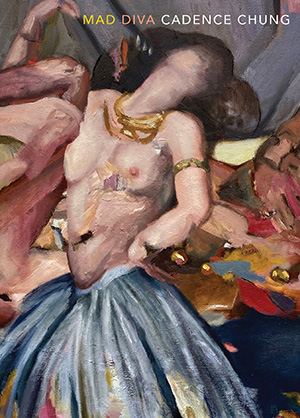
Mad Diva, Cadence Chung Otago University Press, 2025
But lo! Here’s my heart in my hands, clots squished on my sleeve, all sinewy and stringy in that way organs are. If you don’t want to take it, well, I wouldn’t blame you. But it’s the same heart those poets had once. One with reckless abandon, always finding love in every little corner and squashing it flat on the page.
from ‘Love Lyrics’
A recurring word that epitomises poetry collections I have read and loved this year is heart. The word is particularly applicable to Cadence Chung’s second collection, Mad Diva. Not only does the poetry offer heart ripples, it is rich in ear and art, and most definitely heat. A symphony of heart. And yes, as the title suggests, we are entering the addictive terrain of opera, a chorus of intensity, an intensity of chorus, with threads of painting and poetry making moving in and out of view.
I once sat in an auditorium listening to Alessandra Marc sing arias and you could hear a pin drop. It was a full scale body reaction. I could scarcely breathe. I get that when I put Maria Callas singing Bellini’s Norma on repeat on the turntable. Listen to ‘Casta Diva’ and let that settle under your skin. I was raised with an opera soundtrack and grew deep into loving it, but I was surprised how my relationship with the music changed when I had finished my PhD in Italian and could understand the words! Suddenly I was catapulted into everyday language delivering scenes of desire and betrayal and amore. I think of this haunting scene of listening because here I am in Mad Diva and it is grit and grandeur and intake of breath . . . and yes, catapulting us into different ways of listening reading understanding. Ancora. Ancora. Ancora.
Mad Diva‘s opening poem ‘Mélodie’ spirals around song, a singing heart, an off-key dream, and stands as a vital entry point into the poems to come, the way poetry is pitched in diverse keys, with harmony and disharmony, solo flights and connecting chords. Or the way languages generate melody with their different pronunciations and accents on vowels and consonants. The musical notes of speech. One of the delights of reading poetry is the surprise arrival – especially individual words on the line. Janet Charman is a whizz at this. As is Cadence. This is poetry to listen to. This is poetry to feel from your seat in the auditorium.
O, the night that stretched before us! The cool lamplight of it, shining like cicada-wing.
from ‘VI. O, the night’
Thematic subject matter is a unifying thread in the collection. It is like we venture into an opera house to witness performance, to move in and out of opera scenarios, but these divas are out and about in the world as much as they inhabit the skin of a character. Let’s move in deeper. Let’s listen in wider. These mad divas. Let’s move behind the scenes and the surface brocade. Across two acts, these poetic performances, dig deep into yearning and fancy dress, painted bodies and madness, weapons and treasures. It’s personal. It’s imagined. It’s sung across centuries.
In One Thousand and One Nights, Scheherezade told stories to stay alive, to witness the next dawn, but in the mesmerising poem ‘Scheherezade’, she is Ubering into town with the poet/speaker. The poet/speaker is musing on what it would be like to be locked in a bind of telling, never speaking herself. And herein is a glittering hook of the collection: yes it’s a dazzling navigation of divas in performance, on and of stage, but it’s also the navigation of a poet in the seismic heart of poem making, drawing upon other poets as aids. What to tell? What to speak? How to speak? The voice sometimes appearing in italicised dialogue, sometimes not: ‘How do I write about the Great Themes?’ Or: ‘They say all poetry is about Love, Death, / and Time. What a horrible thing a poet is, / writing about these things instead of living / them, deep inside a lover thinking about / what a sensual poem it will make.’
The poem ‘Scheherezade’, feels like a pulsating core of a collection that portrays a poet as much as it portrays divas. It is personal vulnerable tactile aromatic as it speaks to the way making poetry can never be pinned down to exactitudes. It is gauze for us to peer through:
I try to be like her, swallowing my histories in rattles of metal, hide my grandmother’s jade in the back of my jewellery box. But my foreignness finds me anyway, in mispronounced names and schoolyard games and men leaning in ever closer on the bus. I call to her: with a clink of long earrings she looks at me. Tell me Scheherezade, I try to say. When does the telling end? Tell me, When does the silence come? I fill every space with poems and only in the dull hum of the ride home do I realise how stupid, how stupid it all sounds. She can only tell, I can never ask. She is as distant to me as a ship gauzed by time.
Ah. So much to say about this sontuosa collection. It is akin to unpacking a heart basket packed with entangled treasures, with flakes of wound, multiple perfumes, pinpricks of discovery tragedy epiphany, the fireworks and nuances of recognition . . . because every time you unpack this precious basket (just liking putting on a much loved album), you hear and discover something anew, behind the scenes, behind the character, that new connection, an idea that trills, an idea -knot to play with, a ‘cicada-wing’ spark of what poetry can light. So it’s a standing ovation: Bravissimo! Bravissima!
a reading
‘Habits’
‘Ulysses’
‘Fire Island’
a conversation
Were there any highlights, epiphanies, discoveries, challenges as you wrote this collection?
I guess in a way, Mad Diva was a whole series of tiny epiphanies. It’s a bit of a culmination of different manuscripts that hadn’t quite worked out. I’d written very glitzy, narrative-based ones, and also very confessional ones, and this manuscript merges the two in a combination of the fantastic and the lyric. Many of the poems are named after and in the voice of famous divas in the canon — Carmen, Delilah, Salomé, Scheherazade — and I discovered how easy it is for me to drive a poem through a character voice. It was what helped me combine the two facets of my writing: a first-person confessional voice combined with a character façade. It’s a bit like a recital, where you’re still yourself, but a heightened, slightly over-the-top version. I think that’s an important balance in poetry, and a tricky one to pull off! Readers often assume the lyric ‘I’ is the poet, and while that is true in a sense, I never want to just be recounting a true experience without transforming it in some way. Especially when some of the poems in the collection deal with topics of madness and mental illness, I wanted to keep some distance, for both myself and the readers, while still staying truthful to the lyric project.
What matters when you are writing a poem? Or to rephrase, what do you want your poetry to do or be?
Really, I hope that a poem is whatever the reader needs it to be! Having your poetry read by different people is such a strange experience, because you get so many different responses and interpretations. When I read a poem that I love, it shocks me, gives me a little jolt that I carry throughout the day. I want to see something in there that I couldn’t have written myself, that makes me see things just a little differently. I’m always going on about transformation, but I think it’s really true. A poem transforms the poet’s experience or thoughts, then the poem transforms the reader, and so on: a chain of tiny differences is created.
Are there particular poets that have sustained you, as you navigate poetry as both reader and writer?
The poets I’m constantly reading are my contemporaries in this new generation of poets. In particular, my beautiful friends Jackson McCarthy, Amelia Kirkness, Zia Ravenscroft, Maia Armistead, and Joshua Toumu’a. I’m really inspired by the boldness and assuredness of new writers, and the heavy lyric moment we’re returning to. Being self-effacing is out, being insecure is out, cringing at earnestness is out. Love is in!
We are living in hazardous and ruinous times. Can you name three things that give you joy and hope?
The biggest thing that keeps me going is being part of the strong arts communities I’m in. Being in a bookshop or concert hall or theatre or dive bar and having it full of enthusiastic people is so special. Three specific things that have been giving me joy lately: going to and running literary events, rehearsing for operas with my music friends, and playing with my little cat Hebe.
Tell us about your tour
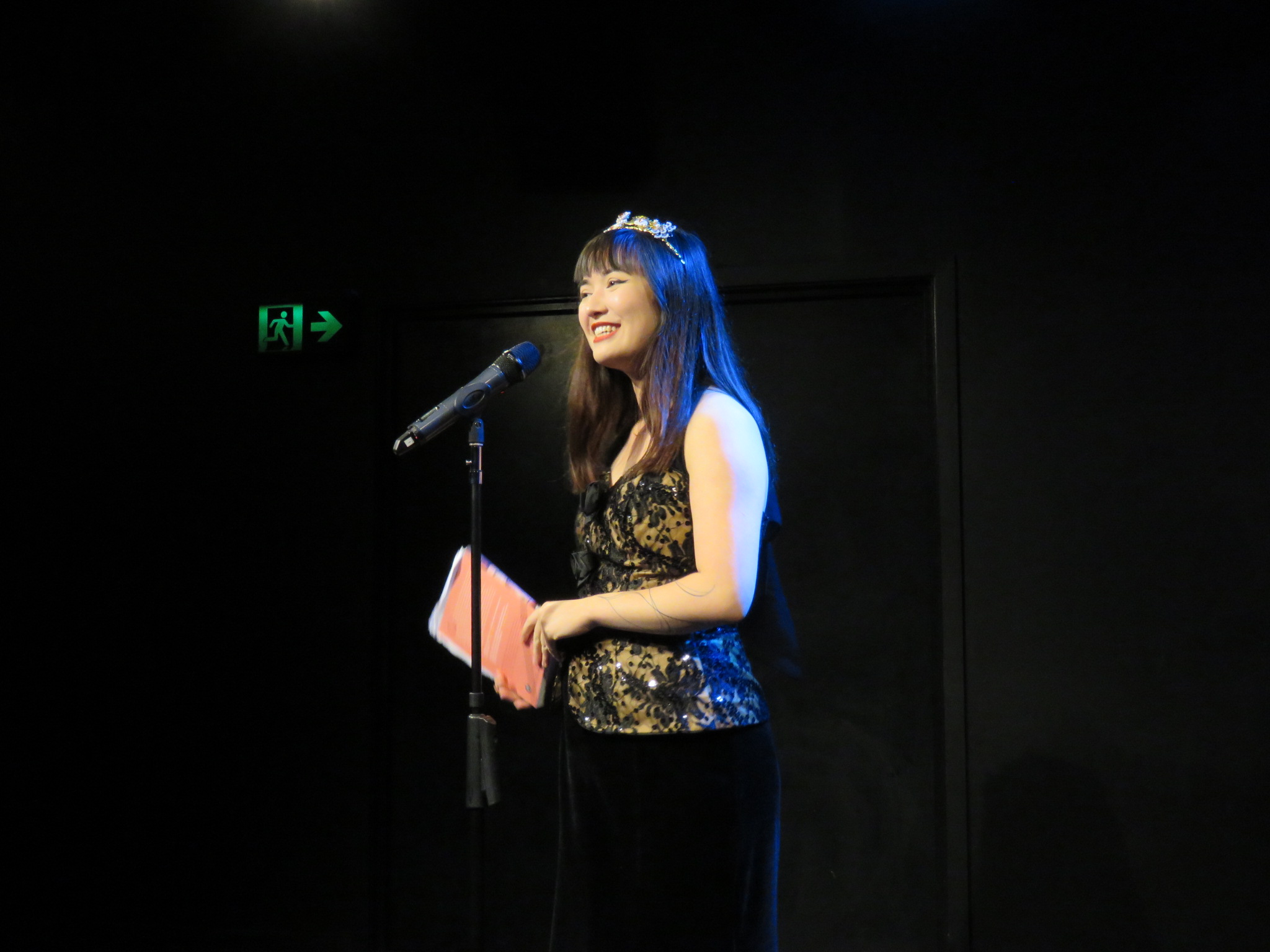
As part of Mad Diva’s release, I went on tour to four cities: Te Whanganui-a-Tara | Wellington, Tāmaki Makaurau | Auckland, Ōtepoti | Dunedin, and Ōtautahi | Christchurch. These launch events featured guest poets Jackson McCarthy, Zephyr Zhang 张挚, Rushi Vyas, Claudia Jardine, and Amelia Kirkness, as well as guest singers from the New Zealand School of Music, and Sarah Mileham, Tomairangi Henare, Teddy Finney-Waters, and Emily-Jane Stockman. It was such a fun and chaotic time. It took place over the span of a week, so I tried to cram in as much sightseeing as I could while also performing and connecting with friends around the country! We had a great turnout at all of the events and I was so thrilled to meet new people, as well as people I’d only ever met online. I had no idea what to expect with the tour, so I was really heartened to see people coming out to support new poetry.
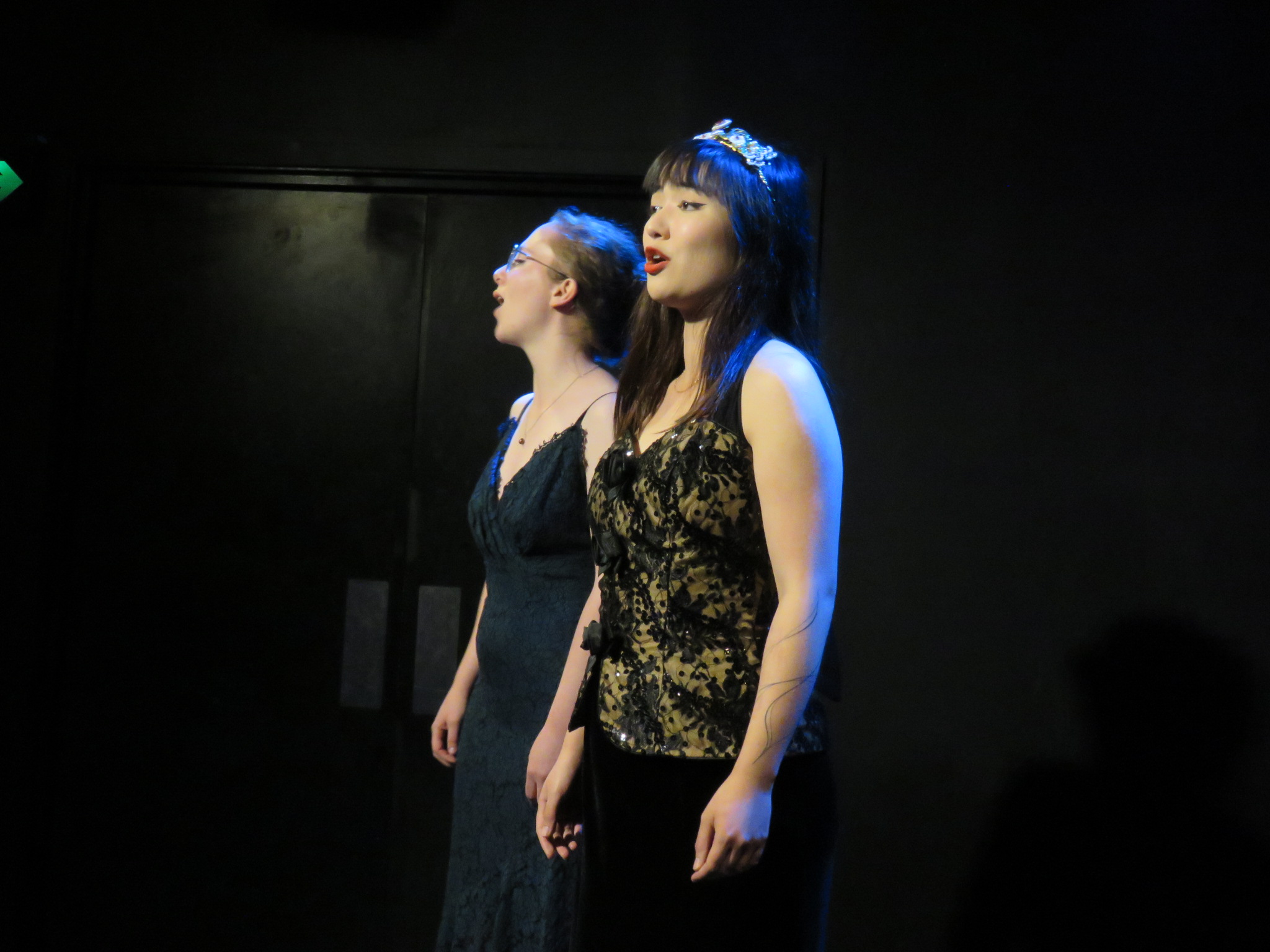
Cadence with Emily-Jane Stockman, at Little Andromeda, Ōtautahi Christchurch
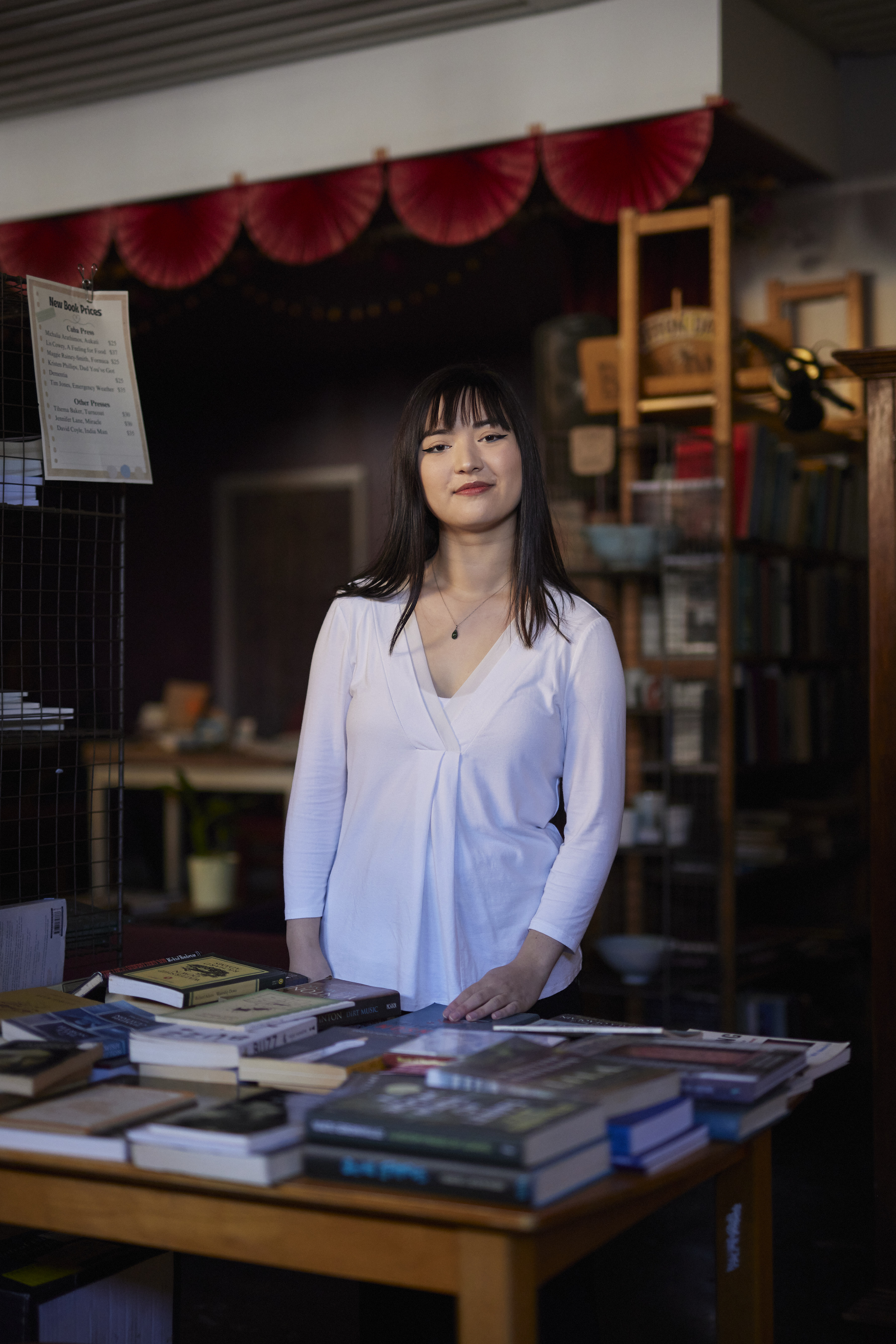
Cadence Chung is a poet, composer, and singer currently in her Honours year at the New Zealand School of Music. Her nationally bestselling chapbook anomalia was released in 2022 with Tender Press, and her anthology of young artists, Mythos, was released in 2024 with Wai-te-ata Press. Her next book, Mad Diva, was released in April 2025 with Otago University Press. She also performs as a classical soloist, presents on RNZ Concert, and co-edits Symposia Magazine, a literary magazine for young New Zealanders.

 NZ Poetry Shelf