Sarah Ross and I have contributed to an article on the Sarah Broom Poetry Award for Booknotes Unbound (the New Zealand book Council online magazine). It includes a poem by each of the finalists.
Booknotes Unbound here
Sarah Ross and I have contributed to an article on the Sarah Broom Poetry Award for Booknotes Unbound (the New Zealand book Council online magazine). It includes a poem by each of the finalists.
Booknotes Unbound here
Photo credit: Danny Baillie
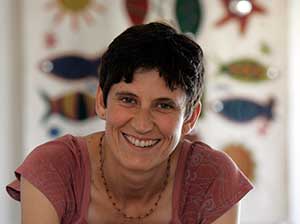
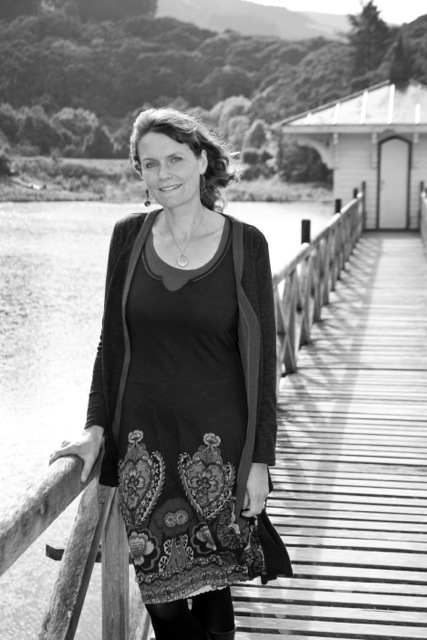
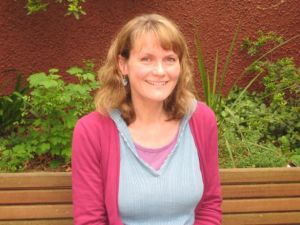
Emma is a Dunedin-based poet (four collections published), novelist, teacher, mentor and anthologist. She has a PhD in English Literature from London’s University College, received the inaugural Janet Frame Memorial Award for Literature (2008), the Kathleen Grattan Award for Poetry (2011) and was the 2012 Robert Burns Fellow at the University of Otago. She was the Summer Resident at the Pah Hometead in 2014 (supported by Sir James Wallace Arts Trust/ University of Otago). Her latest collection is entitled The Truth Garden.
My reaction to Emma’s poems: ‘Emma’s poems often find a starting point in her domestic life—with her exquisitely tuned ear and her roving mind producing lines of singing clarity. The musicality is enhanced by a sumptuous vocabulary, by single words that stand out in a line and a rhythm that gives each poem startling breath and movement. What struck us particularly is the way each poem is made more complex—through an unfolding pocket narrative, meditative strains of thought, aching confession, political sharpness, the rollercoaster ride of maternal feeling. These were definitely poems with an aftertaste that kept you wanting more.’
Did your childhood shape you as a poet? What did you like to read? Did you write as a child? What else did you like to do?
My sister and I were surrounded by books: my mother is a voracious and rapid reader; there had to be at least weekly visits to the library for her to maintain her supply. My father used to say she couldn’t possibly be reading at that pace; she was turning the pages too fast. She was not just bookworm but book termite. She read to us often — AA Milne and Beatrix Potter when we were preschoolers — and she also actively encouraged our participation in drama lessons, and — at our pleading — wrote us small items to perform for family. Theatre I think also helped to attune my ear to pace, variation in tone: many of the aural aspects of language. I was a slightly shy, slightly overweight child and had started at 6 different schools before high school: books of all kinds were a refuge from the inevitable ill-fit of new-girl/plump-girl.
I did write as a child. One of the ways I tried to stay in touch with a friend in Christchurch when we moved to San Diego was to send her a ‘novel’ (a few pages typed up from my wonky handwriting by my ever-patient mother) about horses. The friend and I had an ongoing imaginary game of horse-riding adventures with another friend, where we were some sort of horse and human hybrid, cantering all over the Spreydon school playground and our back gardens, and making up odd mixtures of talcum powder, perfume, grass, water and weeds at home to feed the horses…(this must have been unbeknownst to somebody’s mother: who would let kids splash perfume into buckets to feed invisible stallions?). I missed Nicola and the game so intensely that writing the story seemed a way of holding on to both friendship and game. I even tried to illustrate it, which is a woeful confession as I have the drawing skills of an eggplant. Other things I loved doing: I was a good swimmer, just about lived in the water in California, but didn’t have any interest whatsoever in competitive swimming. I loved music, but probably didn’t get lessons soon enough – or rather, had a regrettable gap of six years between recorder and clarinet. I like to fantasise that my potential fell through that gap like a necklace through a knot in the floorboards….I tried hard at clarinet, but was as average as average can be. I loved hooning around on roller skates; all the kids in my street in San Diego at one point had a grand scheme to perform Grease on wheels in the road…we practised, we choreographed; we entered school talent contests with our own dances… That sort of free, imaginative, almost wholly unsupervised play for primary school children was a lot easier in the 1970s: even, it seems, in urban California. I took various dance classes in San Diego too: Polynesian Dance; Jazz Dance; but as I said, I was an inelegant, dumpy, ordinary, slightly clumsy child – so almost everything other than swimming and reading seemed to have an element of struggle to it.
When you started writing poems as a young adult, were there any poets in particular that you were drawn to (poems/poets as surrogate mentors)?
When I read Hone Tuwhare as a 14- year-old, it was like discovering a new art form, even though I’d read a fair amount of narrative, nonsense, or Romantic poetry either consciously shaped for children or digestible by children — Eleanor Farjeon, Edward Lear, Kate Greenway, Walter de la Mare, John Masefield, Browning’s The Pied Piper of Hamelin… I thought I knew poetry but coming across Tuwhare’s poem ‘Rain’ in a fourth form English class felt like some fog had peeled away from the world: the very air had clarified. And then I was introduced to the poets of the Mersey Sound through an anthology I got for a class prize – and there were poems filled with humour and identifiable urban detail — fish and chip paper, denim jackets, neon lights, cups of tea, steamed up café windows, brown packing string: these poems too were a revelation. I suppose there was a transition from poetry that seemed to be set in the realm of myth and imagination to poetry that dealt with the realities I had to start confronting without the protective feather-down of family. I read Plath and TS Eliot at high school; Dylan Thomas; Cilla McQueen; Fleur Adcock; Alistair Campbell; and began to read independently over the school holidays as if it was some kind of secret vice – buying myself Faber and Faber editions of WH Auden and Wallace Stevens, more of the Penguin Modern Poets anthologies – reading them in a kind of uninformed, naïve way, trying to find that clarifying ‘hit’ again that Tuwhare and Plath had both given me.
Hone had a similar effect on me. I likened it to putting on glasses for the first time. Did university life (as a student) transform your poetry writing? Theoretical impulses, research discoveries, peers?
I think it did. It probably led me even further away from the fantastical and science fiction, which were genres I absolutely loved reading as an adolescent. (John Wyndham, Ray Bradbury, Maurice Gee, Ursula Le Guin, Louise Lawrence, Penelope Farmer…)Taking courses in canonical literature, and striving to do them well, left little time for exploring outside the set reading lists. Yet an honours course in Modern Poetry, which Bill Manhire taught at VUW, was as important to me as the original composition paper I did there. Bill’s work as an academic teacher is perhaps mentioned less often than his work as a creative writing mentor: he could talk about various periods in literary history with an apparently casual, contemporary language that was still incisive and vivid. It made it all seem fresh, relevant, ripe with anecdote and choice morsels of quotation. He spoke without condescension or aloofness, which then, anyway, was actually still very rare in university professors towards undergraduates: these things have immeasurable impact on a very young scholar or writer.
The course in original composition taught me to try new forms, and it encouraged re-writing, rather than preciousness and weak defensiveness — the ‘Well that’s the way it really happened’ or ‘That’s just the way it came out’ bullishness that’s common in workshop situations. It encouraged stepping back from the work and testing it. It asked technical questions such as, why that tonal shift? Why that line break? Why so obscure? One of the most important things Bill said to me was about a syllabic poem, which was comparing psychological scars to physical scars, and doing so in that terribly abstruse, fraught, coded way that new writers often tackle the personal. The class went totally shtum, and Bill, who usually tried to hold back on commentary so that it was a student forum, finally said, with a serious frown, “I’ve got no idea what it means, but it sounds really good.” Everybody else in the room seemed to suddenly go limp with relief. They didn’t have to grapple with that recondite, contorted crocodile of a draft any more. That was a moment where I realised I actually might have some kind of poetic ear, but that I’d also inadvertently managed to write something that was almost purely sound, with no sense at all. When I re-read that poem now, more than 20 years on, I have no idea what some of it means either.
In some ways I think the lessons from a course like that only come to fruition many years afterwards: they really are just one step in a much longer process of self-education, and learning through doing. They help to set the clock running: but the clock has to keep being wound on.
For my PhD, I wrote on expatriation as depicted in the work of Katherine Mansfield, Robin Hyde, Janet Frame and Fleur Adcock — I could discuss ways in which I think their work has influenced mine, but I think it would only be of interest to me and my navel and even my navel is getting sick of me…
I love the way your poems abound in complexity. The first delight is the delight of music, the way each poem is a miniature musical score. The second and third delights are the way your poetry engages both heart and mind at a profound level. What are key things for you when you write a poem?
That’s a really generous critique. Yes, the way a poem sounds is key: though even after all these years of reading poetry and even teaching it, the rhythmic element is often done intuitively rather than according to a strict percussive rule or a classically constrained metrical scheme. But I do listen closely to pace; I think of the line break as a micro-pause; I think of white space as silence, or yes, articulate musical rests. All the other aural components are things I enjoy and crave when reading poetry: so I try to gently feed them into the work too.
What poets have mattered to you over the past year? Some may have mattered as a reader and others may have been crucial in your development as a writer.
Jack Gilbert; Tomas Tranströmer; Alice Ostriker: Siobhan Harvey; Ian Wedde; – I’ve only just read his Lifeguard poems, and was astonished at the combination of control and tenderness; the way the dreamy refrain ‘shadow stands up…’ accrues more and more eerie power as the poem proceeds.
In terms of the question who has been ‘crucial in your development as a writer’ over the past year, I’d say Michael Harlow, whose review of The Truth Garden was a turning point for me in terms of self-acceptance. Even as a 20-something, that decade which is always the decade of refining one’s public persona, of perfecting cool, whether you’re a writer, a student, a shop worker or an office clerk, I was, hmmm, temperamentally suspicious of what seemed a ubiquitous tonal irony in local poetry: of what I sometimes felt was dishonesty, or posturing, or a reserve that seems on some levels a failure to commit. There is a downbeat understatement in some contemporary poetry that very often tips over into the banal – where poets are so afraid of saying too much, or of seeming sentimental, of seeming uncool, that the default mode is a lack of affect; a ‘like, whatevs.’ I’d rather be accused of being too ornate, or ‘high octane’, or of making the emotional position of the poem too clear, rather than appear disengaged and numbed down. Harlow’s review felt like someone saying certain aesthetic risks are worth taking.
What New Zealand poets are you drawn to now?
I’ve been very excited by the young Joan Fleming’s work and by a young expatriate English woman, Loveday Why, who is studying at Otago and writing poetry also. These two young women seem to manage to infuse their work with an enormous amount of feeling and yet also to have technical control, an eye for a delectable oddness of imagery and phrasing, a way of bending the line and toying with syntax and white space in ways that seem psychologically expressive as much as academically or theoretically driven. I’m also intrigued by Ashleigh Young, and am keen to see what she does next. I’m struck by her prose as much as, if not more than, her poetry: she strikes me as a gifted essayist/blogger — she applies a poet’s microscopic attention to the sway of a sentence.
Do you think your writing has changed over time?
Yes. But I want to change it again. I’ve had a phase of the poems expanding, turning into 2-3 page mullings, and now I’m longing for the cool crisp ice cube; the tequila shot rather than the rambling lunch.
You write in a variety of genres (poetry, fiction, critical writing). Do they seep into each other? Does one have a particular grip on your heart as a writer?
They do infuse each other. Although I write reviews I don’t claim to be a critic – I think of myself as a practitioner reading other writers closely to see what I can learn from them. I think of a critic as someone who has the full weight of academia behind them; someone, in other words, with a full-time salary and regular hours to immerse themselves. It’s something of a shock to realise people consider me mid-career. I still feel like a novice. Every book, every poem, makes me feel like a novice. That’s part of the allure, I suppose. So I’m still trying to figure out, poetry or fiction? Which is my natural habitat? As a matter of fact, the 92,000 word novel I’ve been writing on and off over the past 3 years started off as a verse novel. Then it rebelled and the lines started refusing to break as I tried to build up my own understanding of the character dynamics. I’m trying to gird every part of my anatomy to go back to it and see if I can recast the entire thing as a verse novel again. It’s like arm wrestling with a stroppy Sumo-sized toddler. Sometimes it won’t even come and sit up at the table.
Michael Hulse recently queried the status of certain poems in a review he did for New Zealand Books. In his mind, some poems weren’t in fact poems. How would you define poetry?
Poetry is so broad – this is one thing that teaching creative writing constantly reminds me. It can be narrative, epic, lyric, patterned by numbers, patterned by wildly arbitrary constraints, it can be experimental, digital, anecdotal, it can be two words on a page, or even one word on a page that highlights its own typographical components, it can have a tight rhyme scheme, it can have a rolling freight train metre, it can merge into prose and call itself a prose poem; it can have a close relationship to visual sculpture. Even that list is not exhaustive. For my own practice, the musical elements are vital. The luminous moment is vital; sometimes the poem embodies the movement towards or away from that luminous moment. I also like the idea of a poem tracing the activity of a mind as it works out just what it thinks; of a poem transcribing the very process of realisation. But as a reader, I’m open to poems that do all the things my own work can’t, as well as to those that work in the same space. In fact, it’s often more exciting to read someone whose work is vastly different from one’s own: it’s like foreign travel.
You were recently The Pah Homestead Resident in Auckland. How did this new location and distance from home affect your writing?
There were acres and acres of time. That was the main difference. When I had the Burns Fellowship two years ago, I still had a very young child (a two-year-old), we moved house, and the fellowship itself involved a lot of public speaking, which meant that in some ways the year was quite stressful; in addition, my normal domestic responsibilities continued. At the Pah Homestead, I could write all day every day anywhere I liked: at the dining table, in the bedroom, at the desk, on the floor, legs waving in the air like a synchronised swimmer if I wanted. No having to drop everything to attend to family needs. I got a huge amount done: I managed to finish the draft I’d started on the Burns — and I’m still immensely grateful for that opportunity. My husband should be considered one of the co-sponsors of that stint: he solo-parented for the entire three months and he did a better job than I would have on my own. I absolutely loved the solitude and it felt like truly coming home in a very deeply reassuring, even empowering way.
Women writers have often had to manage a writing life along with domestic demands and have been denigrated for writing that embraces domestic concerns. You write some of the best domestic poetry in New Zealand and I say that partly because your poems take the reader into the aching and joyous gut of family life in ways that are poetically complex, moving, haunting. Any thoughts on this?
I’m less and less sure of where the domestic and the political drop hands – if ever. Sometimes the poetry comes out of a real struggle with all the roles I have to play. Sometimes the domestic is my subject because I don’t have the time to read, research and explore more arcane or erudite topics, or topics that actually interest me more than the fights over getting dressed in the morning, or where the red light sabre is, or what to cook for dinner. The psychic energy parenthood takes is enormous. I also think that another way of describing so-called domestic poetry is psychological poetry. It’s about mind, character, power dynamics, identity development, relationships, dependence, independence. Nearly every day we leave home for the world; nearly every day we come back home with the air of the world on our skin. Where does home end and the world begin? Is the ‘where’ a mythical line, an imaginary equator?
What irks you in poetry?
Self-conscious quirkiness and the posturing default irony mentioned above. (I don’t dismiss layered, witty, or dramatic or knowing irony of course.)
What delights you?
Musicality; crispness; an ear for the unintended double meanings in casual speech; innovators like Anne Carson; typographical experimentation; wit; multiple meanings; psychological depth.
Name three NZ poetry books that you have loved.
Only three? How cruel!
Cloudboy by Siobhan Harvey
Sheet Music by Bill Manhire
The Tram Conductor’s Blue Cap by Michael Harlow
Selected Poems by Lauris Edmond (An extra for the same price!)
The constant mantra to be a better writer is to write, write, write and read read read. You also need to live! What activities enrich your writing life?
Conversations with lively adventurous warm hearted friends, sleep, art galleries, theatre, film, teaching new young hungry energetic responsive students, conversations with my children, walking, running, looking out the window. Very important to look out the window.
Some poets argue that there are no rules in poetry and all rules are to be broken. Do you agree? Do you have cardinal rules?
The line break is a marvellous invention. It should be used consciously.
Do you find social media an entertaining and useful tool or white noise?
All three things, actually. They exhibit the best and the worst of humanity: ingenuity, the urge to connect. Yet they can be a shallow, addictive distraction, and a vehicle for spitefulness and vitriol. So I suppose they are only as good as we are.
What were some of the key elements of the poems you submitted for the award?
The immediate concerns of the intense ‘terrarium’ of my own small family; my ambivalence about various social movements/mind-sets or rapid technological change; anxiety about ecological crisis; the coded way dreams speak to us. I know that I’ve been working over maternal anxieties, fears and discomforts for several books now, fiction and poetry, and this subject won’t leave me alone, but I was also trying to consciously push myself to try something completely different – hence the social media poems, which have a visual/pictorial component too. I decided that my ambivalence about social media could be put to a more positive use than just a cyclical disgruntlement then attraction, and it could perhaps seed some poems instead.
Finally if you were to be trapped for hours (in a waiting room, on a mountain, inside on a rainy day) what poetry book would you read?
Definitely Wallace Stevens’ Collected Poems. I’ve owned it since I was 16, I think, and I still haven’t managed to read every single word, but I go back to it again and again. It’s a kind of atheist’s Bible: it’s technically supreme, musically audacious and exquisite, intellectually diamond cut, it offers enormous consolation, somehow, to an atheist who longs for transcendent meaning but just cannot hear a God who suffers the little lambs to come unto him.
Emma Neale’s blog
New Zealand Book Council page
University of Otago Press page
Steele Roberts page
New Zealand Electronic Poetry Centre page
Interview with Emma Neale published in The Listener, April 26-May 2 2008 Vol 213
Emma Neale’s Random House profile
Feature in Otago Daily Times
Photo credit: Shane Wenzlick/Fairfax Media
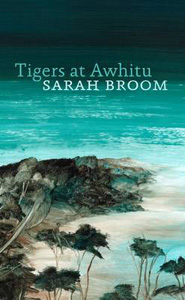
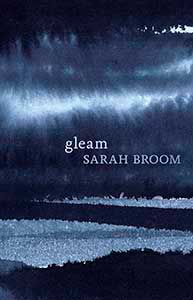
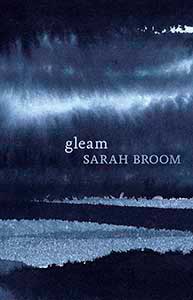
The Sarah Broom Poetry Award aims to provide recognition for an emerging or established poet, and to provide financial contribution to support their work. The prize was established in 2013 in honour of New Zealand poet Sarah Broom (1972 – 2013), the author of Tigers at Awhitu and Gleam (published by Auckland University Press).
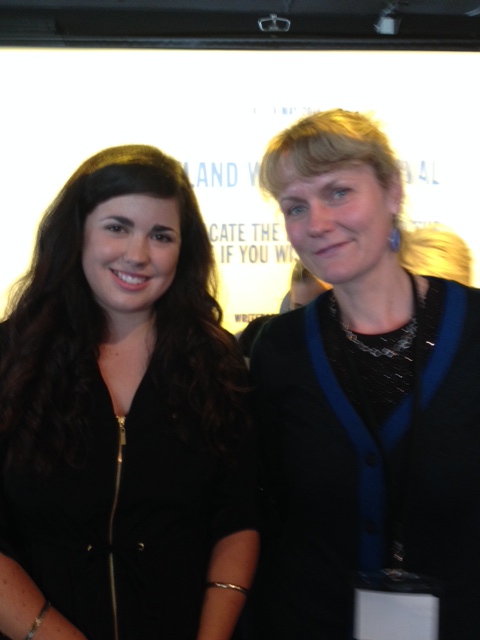
In 2014 the judging panel included Sarah’s husband Michael Gleissner, Sarah Ross, Paula Green, and guest Head Judge, the much loved poet, Sam Hunt.
The inaugural Sarah Broom Poetry Competition attracted around 300 entries from throughout New Zealand. The submissions included established poets, emerging poets and poets at all stages between, and clearly reflected a writing landscape that is in very good heart. The entries demonstrated a stunning range of complexity, subject matter, tone, style and form. The quality and breadth of submissions created a tough job for the judging panel with at least thirty poets deserving a spot on the shortlist. The selected finalists will read in a session at the Auckland Writers Festival where Sam Hunt, will announce the winner (Sunday 18th May, 1- 2pm, Upper NZI Room ).
The three finalists are:
Emma Neale
Photo Credit: Graham Warman
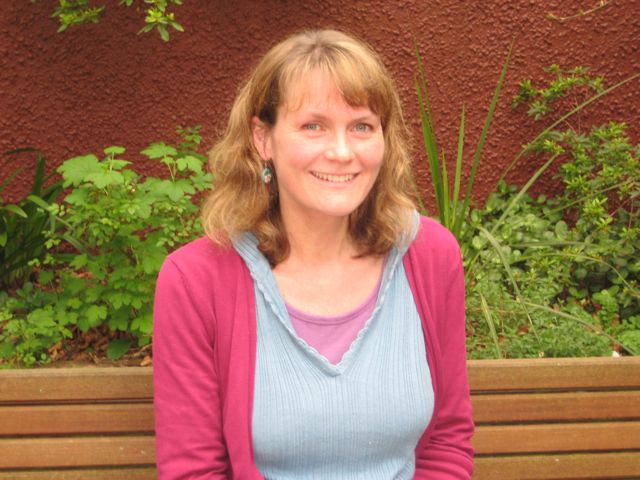
Emma is a Dunedin-based poet (four collections published), novelist, teacher, mentor and anthologist. She has a PhD in English Literature from London’s University College, received the inaugural Janet Frame Memorial Award for Literature (2008), the Kathleen Grattan Award for Poetry (2011) and was the 2012 Robert Burns Fellow at the University of Otago. She was the Summer Resident at the Pah Hometead in 2014 (supported by Sir James Wallace Arts Trust/ University of Otago). Her latest collection is entitled The Truth Garden.
Emma’s poems often find a starting point in her domestic life—with her exquisitely tuned ear and her roving mind producing lines of singing clarity. The musicality is enhanced by a sumptuous vocabulary, by single words that stand out in a line and a rhythm that gives each poem startling breath and movement. What struck us particularly is the way each poem is made more complex—through an unfolding pocket narrative, meditative strains of thought, aching confession, political sharpness, the rollercoaster ride of maternal feeling. These were definitely poems with an aftertaste that kept you wanting more.
Emma: ‘I wonder if the rhythms of everything from nursery rhymes to an old tape of Yehudi Menuhin playing Mendelssohn violin sonatas, which I used to listen to obsessively as a teenager, are as deeply embedded in my sense of poetic music as my love of certain poems.’
CK Stead
Karl has published over forty volumes of poetry, fiction, memoir and criticism. Along with New Zealand’s highest honour (the Order of New Zealand), he has received the 2009 Prime Minister’s Award for Fiction, a 2009 Montana Book Award for his Collected Poems and the esteemed Hippocrates Prize for Poetry and Medicine in 2010 amongst numerous other awards. Karl’s latest collection is The Yellow Buoy (published by Auckland University Press in New Zealand and Ark in the United Kingdom).
Karl’s poems embrace a vision that welcomes both an intellectual life and an everyday life along with a joyful attentiveness to sound. There is the characteristic wit, reflection and irony, but there is also tenderness, empathy and acute insight. These poems radiate such a contoured experience for the reader through their layering of ideas, self-confession, musical agility and location within a history of reading and thought. The subject matter shifts from the intimacy of a love poem to his wife, Kay, to a cheeky eulogy to Derrida (‘the enemy of plain sense’) to a hilarious case of mistaken identity. These poems have an unwavering strength to pull you back again and again to fall upon new discoveries.
Karl: ‘Poetry has been my life, and all the other literary endeavours, criticism, scholarship, fiction, circle around and out from it.’
Kirsti Whalen
Kirsti is a poet and disability advocate currently studying Creative Writing at Manukau Institute with Robert Sullivan and Eleanor Catton. She has written and read poetry since she was a child, and has won both the Katherine Mansfield Young Writers Award and the Bell Gully National Secondary Schools Poetry Award. She has published poems in various journals.
Kirsti is a fresh young voice on the poetry horizon line. Her submission indicates she has an astonishing ear for the way sounds soar on a line, the way they dip and fall. Her syntax is bold and on the move, but she is unafraid of neither simplicity nor silent beats. The poems take you into the heart of family from a mother’s x-rays to kitchen dinners to a grandmother’s quince trees. Each poem is brought alive to a startling degree with sensual detail, electric connections, canny ellipsis, judicious repetition. It is a voice that feels original, that is willing to take risks and that exudes a love of writing in every nook and cranny.
Kirsti: ‘I have been working to tell the story of my family, which is about women’s resilience and the ways of winning the most subtle and internal of wars.’
Award website: http://www.sarahbroom.co.nz/poetry-prize.html
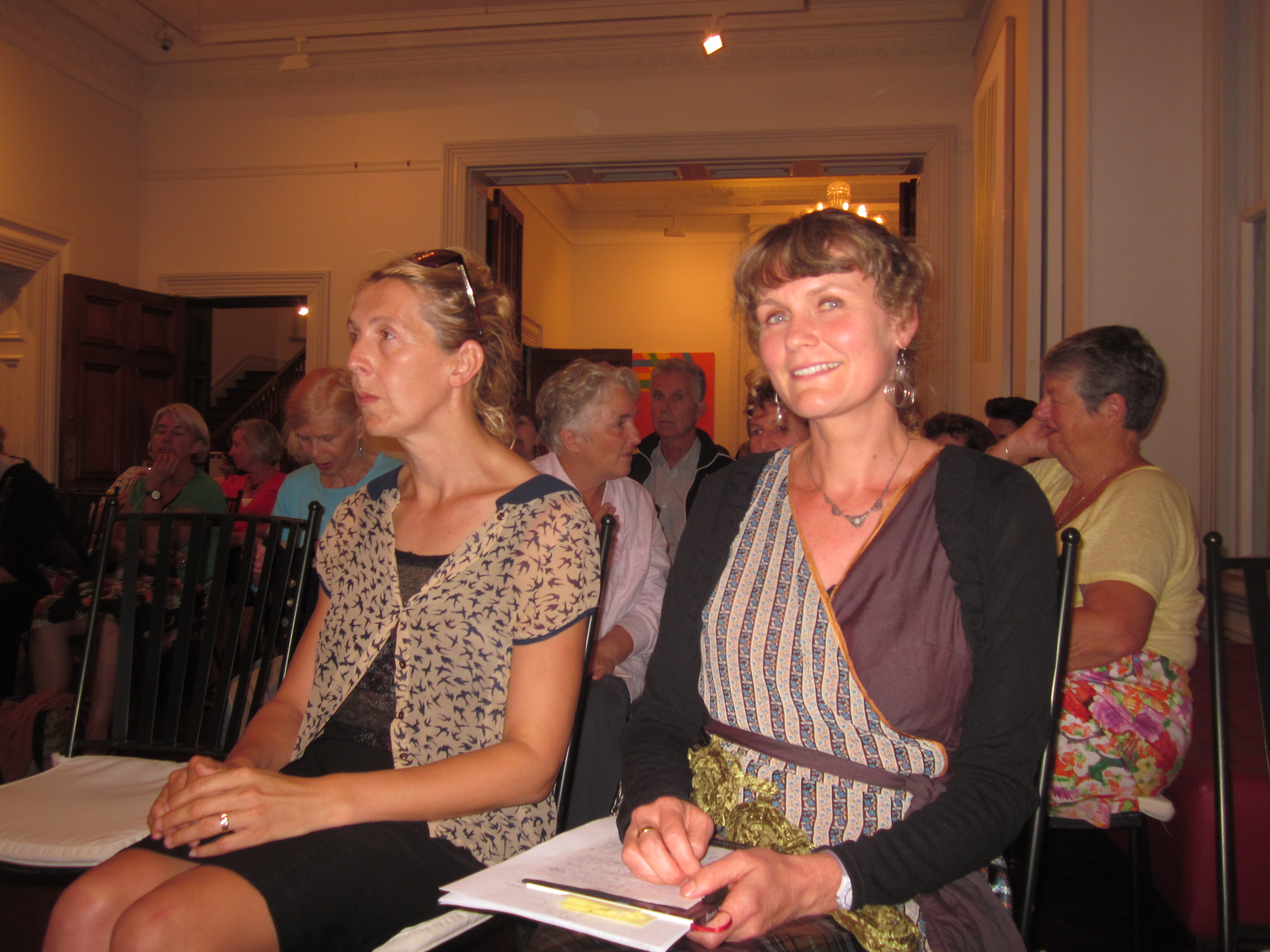
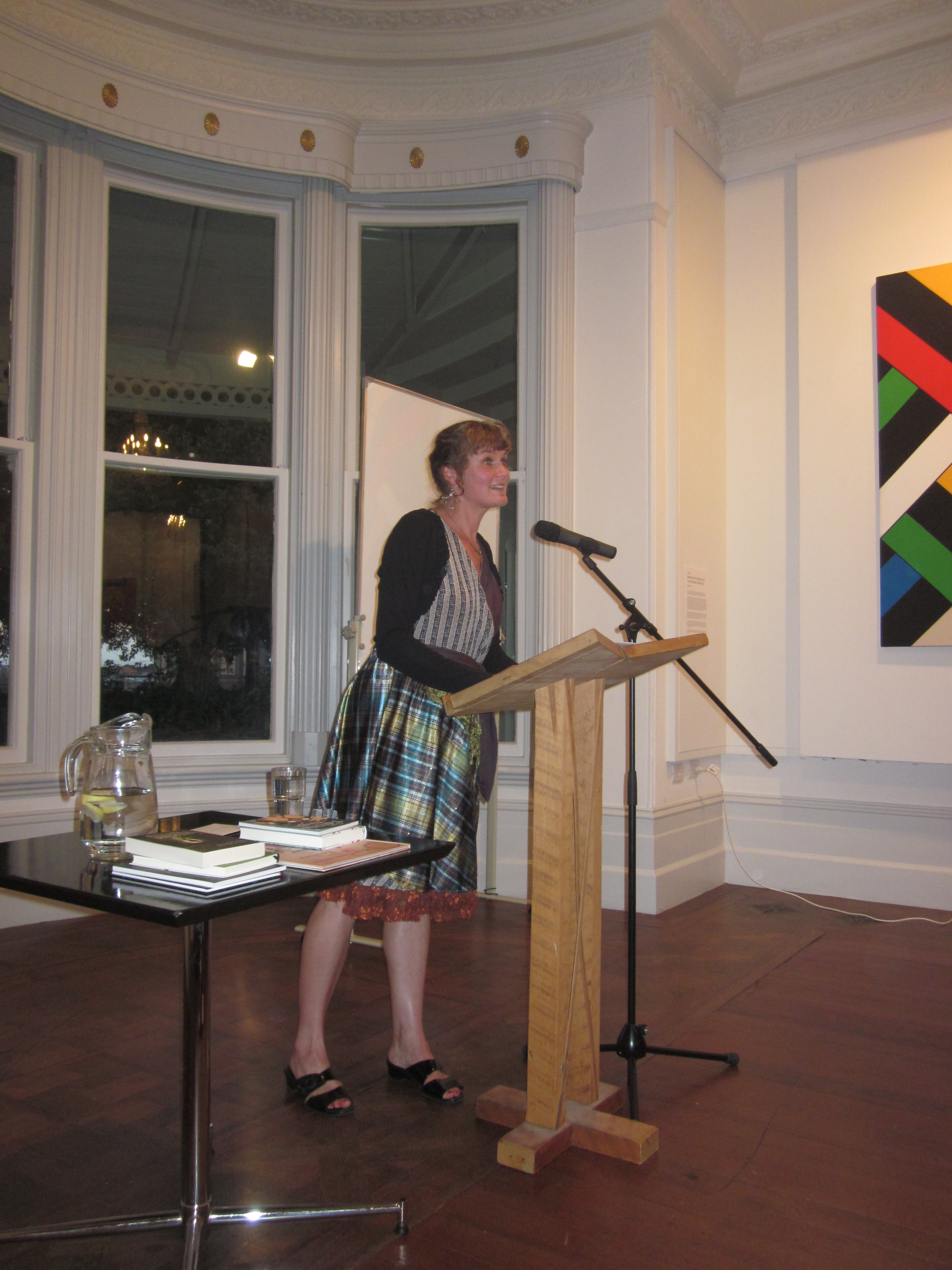
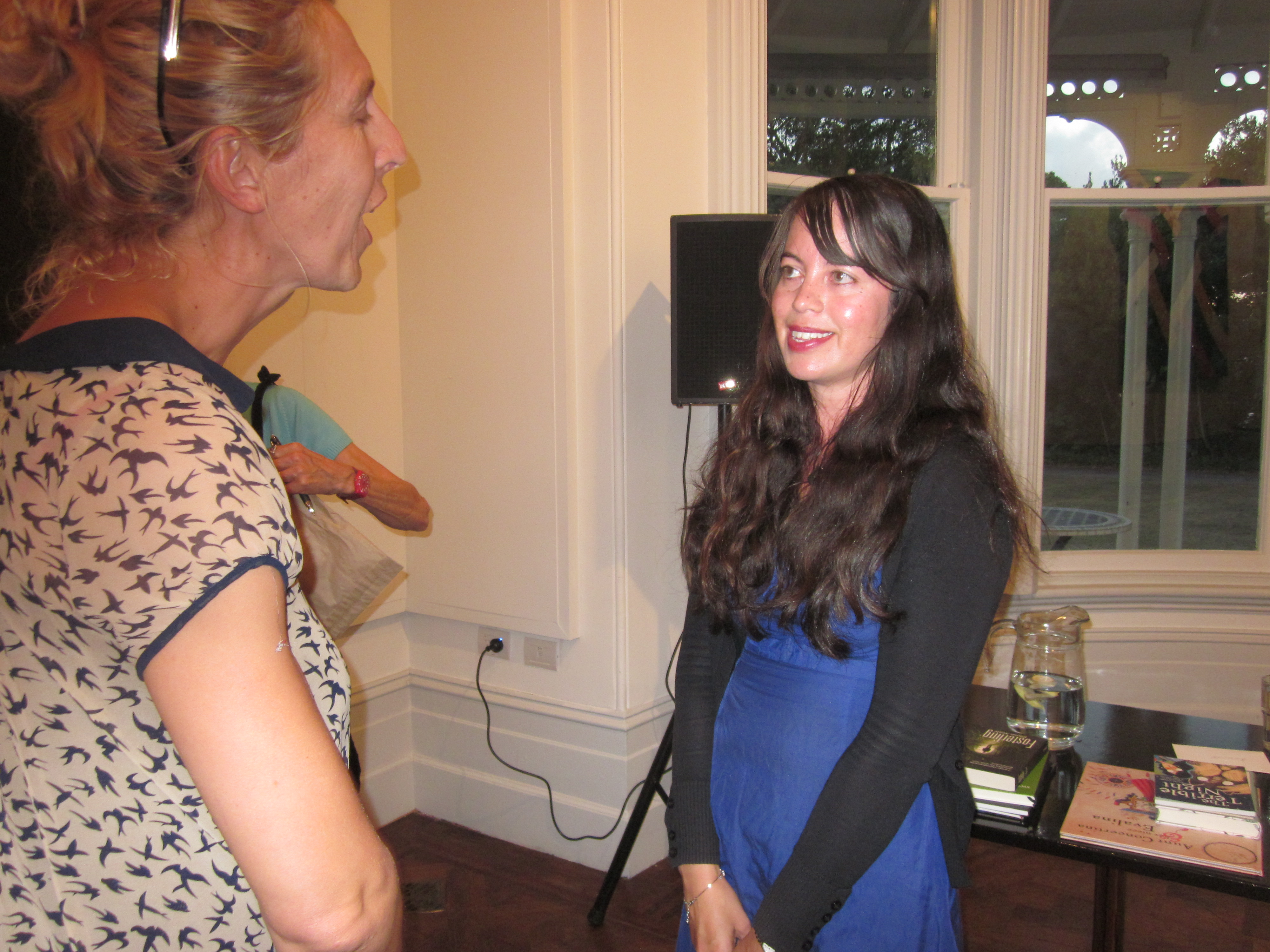
Last night Siobhan Harvey and I were the support acts for Emma Neale who is the current Literary Resident at The Pah Homestead in Auckland. There was an impressive audience made up of poetry fans, local poets, friends and family.
What a treat to hear our guest from Dunedin read. At question time, someone asked Emma to discuss the difference between writing poetry and fiction (she does both!). For her, poetry originates in a musical phrase, a musical fragment, the music of language (Interestingly she shows drafts of her novels to people for feedback but not drafts of her poems). When I sat back into the pleasure of her poems, it was my ears that pricked to attention — to a state of utter attentiveness. I have read the poems in The Truth Garden a number of times and admired their musicality, but to hear them in Emma’s voice adds extra musical zest. Words chime and words tremble. I particularly loved hearing ‘An Inward Sun,’ a poem written after Janet Frame. Emma gave us humour, intimacy, self revelation.
Two new poems particularly stuck me. The prose poem, ‘Stoic,’ that looped and curled on itself, drawing upon a mother-in-law along with the poet herself. It was witty, sharp, wry, pungent and densely packed with musical notes and observation. Then, in a completely different tone, but equally transporting, ‘PokPo’ used a work of art as a starting point (a large white mouse). This poem was as much about mother and son, and maternal relations, as it was about art. There was poignancy and daring in its musical phrasing.
Interestingly Emma’s The Truth Garden was published as a result of The Kathleen Grattan Award — and Siobhan Harvey read from her manuscript that won the same award last year. Her reading of excerpts from the long narrative poem moved the audience profoundly (it will appear in book form later this year courtesy of Otago University Press!).
As for me I came away feeling I had put my foot in my mouth after responding to a question: Is there such a thing as women’s poems? Or some such wording. I spent seven years writing a doctorate where my central thesis/question was: Does it make a difference if the writer’s pen is held by a woman? This was explored in an Italian context (my Doctorate is in Italian). However, I read theory from all round the world as well as navigating Italy’s social, cultural, legal, political, historical and literary contexts. Such a question cannot be reduced to a black and white answer. There are smudges and blurs whichever way you look. But I strongly feel we haven’t yet told the story of women poets in New Zealand. And for all kinds of reasons I do think it makes a difference when the pen is held by a woman. Does this mean there is such a thing as men’s poetry and women’s poetry? I don’t know. Reviews of women’s poetry still denigrate it with a gender bias. You have to go back to Ursula Bethell and Eileen Duggan (and then further back still) and follow in the footsteps of our pioneering women writers to see how style, tropes and content (they can be in a symbiotic relationship) create writing that some people dismiss (particularly if it is domestic). Gosh the whole feminine-masculine debate is a minefield. Ahh! Mmm. Ah well.
But tricky questions aside, it was terrific night. Just wonderful. So grateful thanks to The James Wallace Trust and The Pah Homestead crew.

This is the first of a regular feature on NZ Poetry Shelf. I cribbed the idea from The Poetry Foundation (which I follow on Twitter). Each month I will invite a handful of NZ poets and poetry fans to share a handful of poetry books they are currently reading and loving. Where it is relevant, I will flag any new venture, project, award, book, event or news associated with them.
First up this month is Emma Neale, a Dunedin poet and novelist that currently holds the University of Otago Wallace Residency at the Pah Homestead. She will be reading at an event at the homestead on March 20th. Details here.
3. New Collected Poems by Sylvia Townsend Warner (Manchester: Carcanet 2008.) Not the New Zealand educationalist, Sylvia Ashton Warner, but the English author, who lived from 1893-1978, and who was in a relationship with another woman for about 40 years. I’ve just started this, and it’s a borrowed copy, recommended by friend and academic Pete Swaab, but already I’m reminded of Robin Hyde and the way she seems to move between Georgian and modernist aspects of style; and I’m amazed at how dexterous she is with very simple rhymes; and at the range of characters within her poems. She seems to fuse all the traditional aspects of prosody with a good sense of psychological narrative.
Second is Ian Wedde, our previous Poet Laureate:
1. Michael Hofmann‘s great Twentieth-Century German Poetry: An Anthology (Farrar, Straus and Giraux, 2005). Ends with the laconic Jan Wagner (b. 1971) and begins with the equally astringent Else Lasker-Schuler (umlaut u) (b. 1869). In between, of course, Rilke et al, not always so terse.
2. Am in pursuit of my remote nineteenth century relative Johannes Wedde‘s long poem in praise of the Paris Commune of 1871. Johannes (b. 1843) was a German Socialist Workers Party member, newspaper editor, and scourge of Bismark, who corresponded with Engels in London in the 1880s. The poem may not be much good but I’m enjoying looking for it.
Thirdly Marty Smith whose debut collection, Horse with Hat, was recently launched by Victoria University Press. I will review this book shortly.
1. I love D. A. Powell’s Cocktails (and Tea and Lunch ) because I can go for a wander through the New York of cocktail bars, and cinemas and The Gospels. The poems are really horrifying and funny and sad. They’re fragmentary, and there’s a breathless quality, a breath-taking stop-start set of startling images that pull you through each poem,
2. Anne Carson’s If not, Winter Fragments of Sappho is always in the back of my mind, for the sheer brilliant power of the lining. The original fragments are reproduced on the left of each page, with Carson’s translations on the right, so you can see how she’s used brackets and space to illuminate the fragments that are present, lifting them out of profound absence into startling beauty.
Finally Martin Edmond on what he loved about editing the new Alan Brunton anthology:
Beyond the Ohlala Mountains Alan Brunton; eds. Michele Leggott & Martin Edmond (Titus Books, March 2014). The pleasure for me is in seeing such a handsome presentation of a selection of poems from a corpus I have been speaking in my head all my adult life; and that these resonant, intelligent, strange and resolutely engagé poems are now available for anyone to read.
Photo credit: Graham Warman
Emma Neale has contributed this piece as part of an occasional series (On Poetry) from New Zealand writers. Emma is a Dunedin-based poet (four collections published), novelist (The Fosterling is a terrific read), teacher, mentor and anthologist. She has a PhD in English Literature from London’s University College, received the inaugural Janet Frame Memorial Award for Literature (2008), the Kathleen Grattan Award for Poetry (2011) and was the 2012 Robert Burns Fellow at the University of Otago. Her poetry is steered by a deft pen, a pen that embraces family as much ideas, and music as much tropes. She writes out of empathy for the world (both universal and particular) and her poems divert the intellect and hook the heart. Her poetry to date cannot be aligned solely with family preoccupations, but her family poems are some of the best I have read. This line from ‘No Time Like the Present’ could also be a cue to her poetry writing: ‘No present like time/ to follow thought’s curving rivers.’
On writing a villanelle
When I teach a second-year poetry workshop at the University of Otago, I try to set the students at least two exercises each semester that are new to me, too, to keep my teaching fresh, and to put myself back in the hot-seat: a writer is only as experienced as the new form they’re trying, and I think it’s important to remind myself just how daunting composing-to-deadline can be – not to mention the process of having a first draft read in public.
This year, one of the classic forms I set was the villanelle. I’ve read dozens, but had never tried to write one. The students turned up some good examples, ranging from comic commentaries on poetry itself (Nicola Thorstensen) to whimsically lovelorn (David Cooper). For many of them, it seemed as if writing within these strict constraints actually altered their work for the rest of the semester: it clarified and tautened even their attempts at free verse and/or concrete and in one case, digital, form. It was a prime example of the way form and structure actually give energy to the ideas and words, rather than binding them too tightly. As we might hear the drives of the wasp trapped in the jar more clearly than if the jar weren’t there: the force of the emotion or argument pushes hard against the glass walls of form.
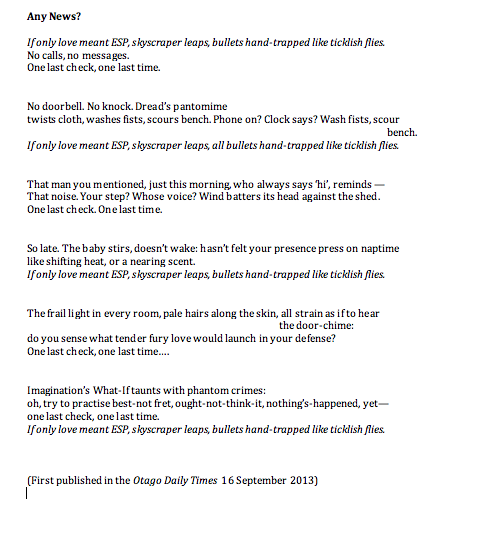
When I started to tackle a villanelle, I initially wanted to write about a fictional character with OCD, based on a young girl I saw in a documentary years ago. I thought the repetitive structure would be useful to capture that stuckness, that inescapable treadmill of obsession. There’s only a skerrick of that in the poem still. It very quickly took on a real world anxiety, about a specific event, rather than being about a psychiatric disorder as such. (Although I’d like to try it again for that purpose.)
Initially I found it hard not to try to work in a kind of narrative progression: but soon saw that the stasis — even in the closure — would be a much better expression of anxiety than writing in a point of release, relief, uplift, psychological shift (even worst-fears-realised) would have been.
The technicalities of finding rhyme or half-rhyme gave the process an unexpected buoyancy: it’s like a kind of verbal orienteering, a happy, almost spatial problem solving. I knew I was meant to repeat two refrains and really wanted to stick with ‘one last check, one last time’ – only to belatedly realise that ‘time’ has a very limited range of potential rhymes. It also meant I had to cheat a little, and use assonance instead of perfect end rhyme, or even half rhyme, for the first and third lines… can we call assonance quarter rhyme?!
The title was a bugbear. I’ve already published a poem called ‘Traveller Overdue’ which is about separation, fear of loss, and a loved one at risk, although it’s in open form and uses mimetic typography — rather than refrains and rhyme — as its way of trying to embed presence into the white void of the page. ‘Overdue’ kept coming back, like an unpaid fine addressed to the wrong person, and I had to keep sending it away again. I tried about 8 different options: all yuck yuck yucketty yuck. Finally, hooray, when imagination’s account is in the red, along come the rich funds of Roget’s Thesaurus – and the phrase ‘Hold the Line’ seemed to arrive with a slap to the forehead. The reference to the phone line, the life line, the poetic line, all seemed perfect: but then I realised that friend and colleague Sarah Broom’s posthumous collection Gleam contained a sparse, moving lyric called ‘Holding the Line’. The loss of Sarah to poetry, and the publication of her collection, both seemed too recent for me to have a similar title, even as a tribute to her. I needed a title that would still evoke a sense of expectation, suspense: without falling either way. Although ‘Any News?’ loses the reflexivity of the other choice, perhaps the fact that it’s also more demotic helps to get that sense of visceral dread more, once you’re into the cyclical doubts of the poem.
I think when I try the form again, I’ll work harder at getting that separate aphoristic quality into the two refrains. When they repeat so often, it would seem logical to make them rich, complex, mysterious, perhaps, so that revisiting them is endlessly compelling. (Although monotony may sometimes be the mood the poet wants, of course, if the subject matter is about endurance.) There’s a much closer relationship to song than the sestina and pantoum, the other closed forms I’ve most enjoyed writing before. Even though I knew that intellectually, from reading other villanelles and reading about the villanelle, there is nothing like moving the mind around within the architecture of a poetic form for us to really know the possibilities of its psychological space and aesthetic effects.
Emma Neale’s blog
New Zealand Book Council page
University of Otago Press page
Steele Roberts page
New Zealand Electronic Poetry Centre page
Interview with Emma Neale published in The Listener, April 26-May 2 2008 Vol 213
Emma Neale’s Random House profile
Feature in Otago Daily Times
Emma Neale has just announced she is retiring from her job as the Monday Poem selecting editor for the Otago Daily Times. She has done a terrific job, and said it was ‘gratifying to launch new writers through the paper.’
Sue Wootton, the new editor, is interviewed in the paper this morning. ‘It was the obvious question for a leading New Zealand poet: ”What makes a good poem?” ”If you poke it with a stick and it moves it’s alive,” Sue Wootton says.’ See full piece in ODT.
The ODT is also a consistent reviewer of New Zealand Poetry. Bravo! Could we see other papers taking this up please? And publishing a poem once a week?


As promised, I am launching this blog with a taste of some of the books I have enjoyed in the past year (it is coming in three parts). Part three I am linking to two books I reviewed in The Herald.
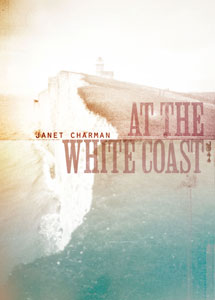
Janet Charman At the White Coast Auckland University Press 2012
An award winning poet, Janet Charman’s new collection is dedicated to her grandmothers and this book does seem like a gift for women. At The White Coast is a collection of travel poems – here, abroad and through the past, whether invented or true. Charman’s continual flair with words translates into enviable lines, sweet rhythms, elastic syntax, experience rendered into economical delights. She moves from bedsits to ferry stops, from trains to social work, from picket lines to boyfriends, from girlfriends to spaghetti-authentico (‘always in besidedness/ more than a couple’). Or ‘i think/ before sailing into orchard and paddock/ she had the breathless crush of metropolis’. This is my favourite Charman book to date – the poems are both moving and marvellous.
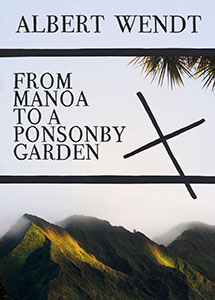
Albert Wendt From Mãnoa to a Ponsonby Garden Auckland University Press 2012
Albert Wendt’s latest collection, From Mãnoa to a Ponsonby Garden, is a joy to read. The poems reach out into the stretch of the Pacific with their heart very much in the present. They navigate birthdays, love, death and growth. The terrific sequence of garden poems is like a memoir or diary in the form of a garden narrative; the flowers, the vegetables, the family, the generations, the life cycles are hued with tenderness, vulnerability, strength, humour, wisdom. The love that the poet feels for his partner, Reina, is a poetic drumbeat –essential, moving, steady. These poems come out of quietness, contemplation, experience. Our poetic elder has delivered a masterpiece.
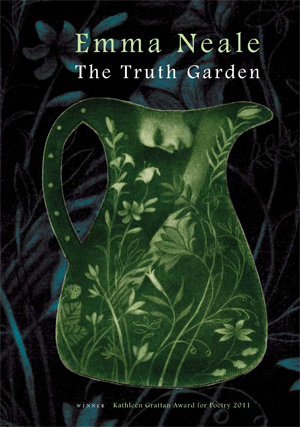
Emma Neale The Truth Garden Otago University Press 2012
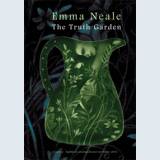
Emma Neale’s collection, The Truth Garden, deservedly won the Kathleen Grattan Award for Poetry in 2011. The book features an exquisite cover image by Kathryn Madill, but I found the small, tight font didn’t do justice to the poems. If Neale’s poetry were a tapestry it would be cast in rich threads – luminous phrases catch your eye repeatedly and make you linger. Poems carry you through family, rivers, cycling, time, night, dreams and musings with tenderness, attentiveness and imagination (‘Night, and the study window burns/ not like a beacon, but as if to warn/ late travellers from some hidden reef/ of thought’). Or ‘how to stockpile time, how hoard its shine/ when time is the very stuff that seeps inside us.’ There is a magnificent sestina on fidelity that, with its repeating rhymes, echoes the tidal flux of trust and love.
Kerrin P Sharpe Three Days in a Wishing Well Victoria University Press 2012
Kerrin P Sharpe was awarded the New Zealand Post Creative Writing Teacher’s Award in 2008, and now this Christchurch-based writer has released her first poetry collection, Three Days in a Wishing Well. It was one of my top debuts for 2012. Sharpe brings a raft of poetic tools into marvellous play: economy, rhyme, omission, mystery. Reality corkscrews in a fairytale like manner; subjects range wide from hats to monks, from mother to father, from lighthouse keeper to sewing needles. Each poem is utterly flavoursome as it combines music, anecdote and emotional lift: ‘to hug my father was/ to know the sky: the/ voices of soldiers the/ families that squeezed/ him inside.’ Stunning.
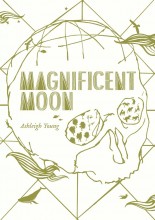
Ashleigh Young Magnificent Moon Victoria University Press 2012
Ashleigh Young, winner of the Landfall Essay Competition, also has a debut collection out (Magnificent Moon). Her poems bring together anecdote, an everyday that is off beat, stretching metaphors, gorgeous rhyme, swooping anecdote and the best found poem I have read in awhile (Buttons). For me it is a vibrant collection, and enough poems stand out to make it stick and flag this writer as one to watch.
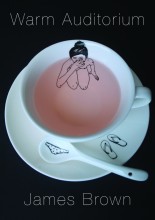
James Brown Warm Auditorium Victoria University Press 2012
James Brown lets you into his workspace in his new collection (Warm Auditorium). It’s a great title that stands in for poetry if not life — his auditorium is packed with people, ideas, talk, wit, confession, story, aphorisms, provocations, warmth, sidetracks, playfulness. Brown likes to make things up, break rules, move you, challenge you, divert you. His poetry is so good you want to linger in the dark reading space and lean in towards the light and lift of his lines. As he says: ‘poetry/was running round my head like marbles over linoleum.’
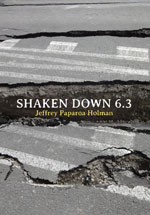
Jeffrey Paparoa Holman Shaken Down 6.3 Canterbury University Press 2012
Jeffrey Paparoa Holman, like Fiona Farrell, has responded to Christchurch’s earthquakes in writing. His thoughtful endnote considers whether poems have any worth in the aftermath of catastrophe. He suggests that ‘a poem can send us back out into this troubled and marvellous world prepared to live more fully.’ A big claim, but his new collection, Shaken Down 6.3, does just that. These fine, troubling, beautiful poems are a window for us all. The photographs are a bonus.