
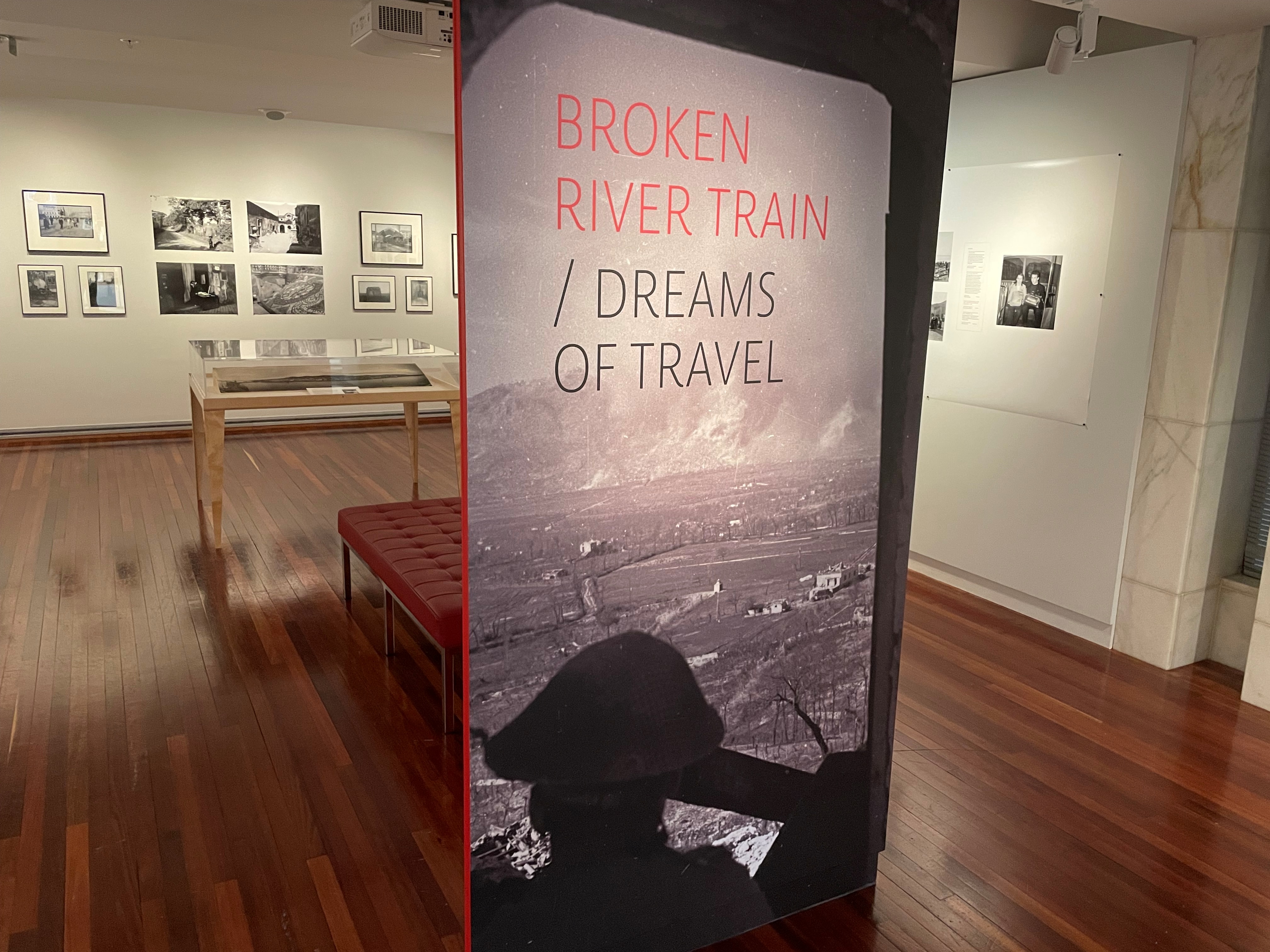
Installation shot, Peter Ireland
For the past four years I have been addicted to travel as my ventures into the physical world have been restricted to blood labs and the hospital. I travel every day within and beyond the pathways and tow ropes of a poem, within the joy and nourishment of a secret books I am writing, within the writings and conversations and posts I create and poets contribute to Poetry Shelf. I travel into the past, especially to my long term scholarly relationship with Italy and the incredible experiences I have had there, to New York, London, Scotland, Ireland, Portugal, France, Barcelona, Japan to name a few, and all over Aotearoa with my partner Michael and our girls (as both children and adults).
Travel is a way of widening how we approach beauty, human endeavours, art, music, theatre, literature, sport, physical challenges, cultural relationships, racism, sexism, how we create and dismantle hierarchies, how we feed ourselves and our families, how we can communicate in different languages. How we see things in astonishing lights.
Travel is also a way of widening the markers of home. Of finding and holding beauty, of holding epiphanies close to our hearts, of listening to the stories of the person standing next to us, of taking time out from daily routines to savour and reboot within the rhythms of travel whether by train or bus or car or bicycles, or in hiking books or walking shoes.
Peter Ireland has created a mesmerising exhibition at the National Library, entitled Broken River Train | Dreams of Travel. To celebrate, and with the help of Peter and a group of poets, I offer you a poetry and image travel feast.
Peter has written an introduction to the exhibition and we have included seven photographs, along with a link to the collection of William Williams, one of the photographers.
I went travelling through my poetry shelves to select a dozen poems that offer myriad travel connections.
To travel is to dream. To dream is to travel. To dream and to travel is to connect and to reboot.
Paula Green
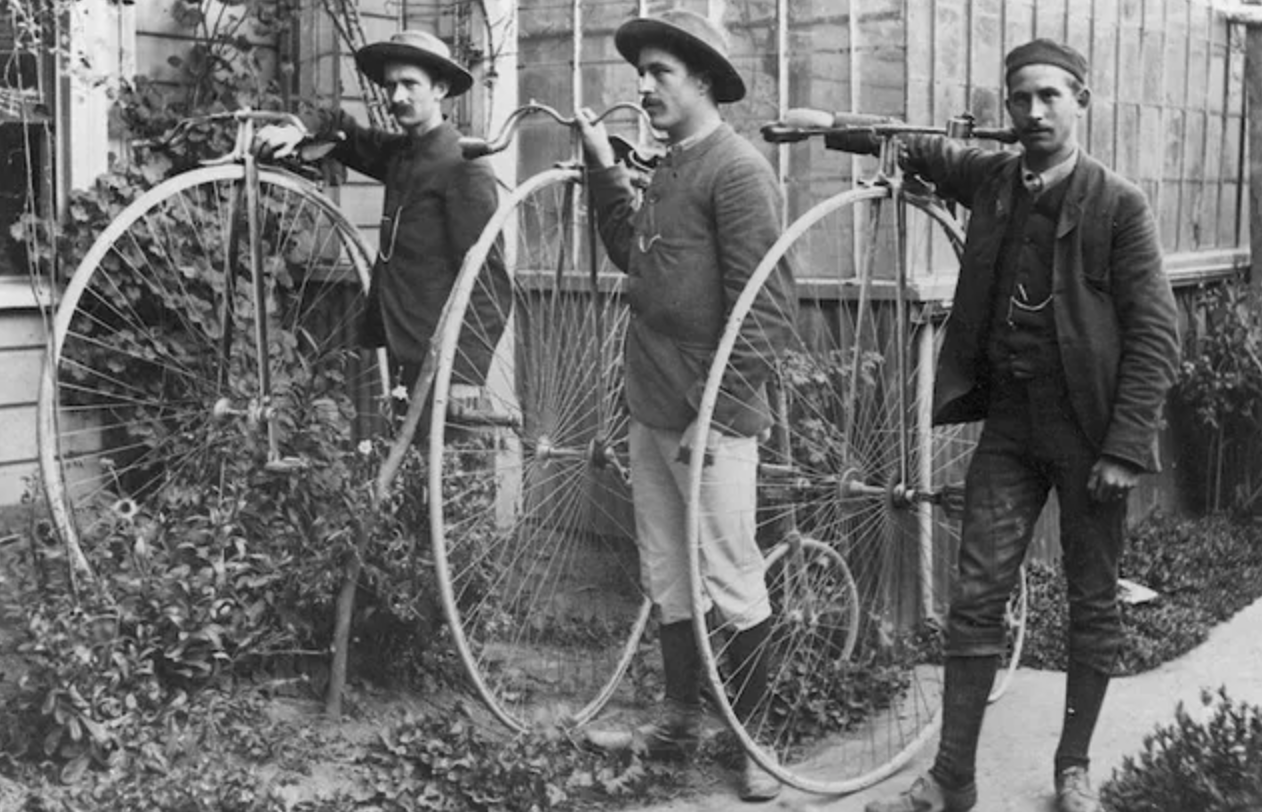
H. A. F. Jackson, J. Alexander, and A. G. Jackson with penny-farthing cycles. The three men travelled from Christchurch to the West Coast on the bicycles in January 1887. Photographer unidentified. ATL: PA1-f-010-21
I don’t know exactly why this exhibition came to the fore and into the programme, though to spend time looking at the collections of the Turnbull Library is to travel and to roam. And as someone for whom dreams are almost always about travel, then a sense of why this exhibition begins to emerge. The exhibition originally had the title of Road Trip … and the wonderful image above was the first added to a file of about 350 images, of which 51 appear in the exhibition. Curiously, and somewhat to my regret, the Penny Farthing cyclists didn’t make the final cut though it’s an image I remain very fond of.
Along the way I came across a Steffano Webb image of Christchurch Railway Station showing a sign for ‘Broken River Train.’ This felt like just the right title.
Central to the exhibition is a selection from the more than 1000 holiday pictures taken by William Williams during the leisurely trip to Europe he made with his wife Lydia between 1925 and 1927. Evocative, dreamlike images of ‘foreign places,’ timeless, austere, sparsely populated stage sets of history, pre-tourist boom and ripe for William Willam’s deliberate and tender record.
A hundred years on these images speak to the opening lines of L. P. Hartley’s novel, ‘The Go-Between,’ that ‘the past is a foreign country, they do things differently there.’ Whilst true in one sense, I suggest that we are more than passive onlookers at a remote world, we respond to the pathos and beauty of the images, that in looking at the past we rearticulate it, make it fresh and meaningful, dream it anew.
Other photographers provide key imagery for our dreams of travel, including Leo White, official war photographers Thomas Frederick Scales and George Kaye and the American adventurer Melvin Vaniman. Max Oettli, John Pascoe and Edgar Williams are also among the abiding spirits.
My hope for the exhibition is that visitors will find it evocative and that they take away a favourite image in their mind together with an appetite for exploring the collections for themselves.
Peter Ireland
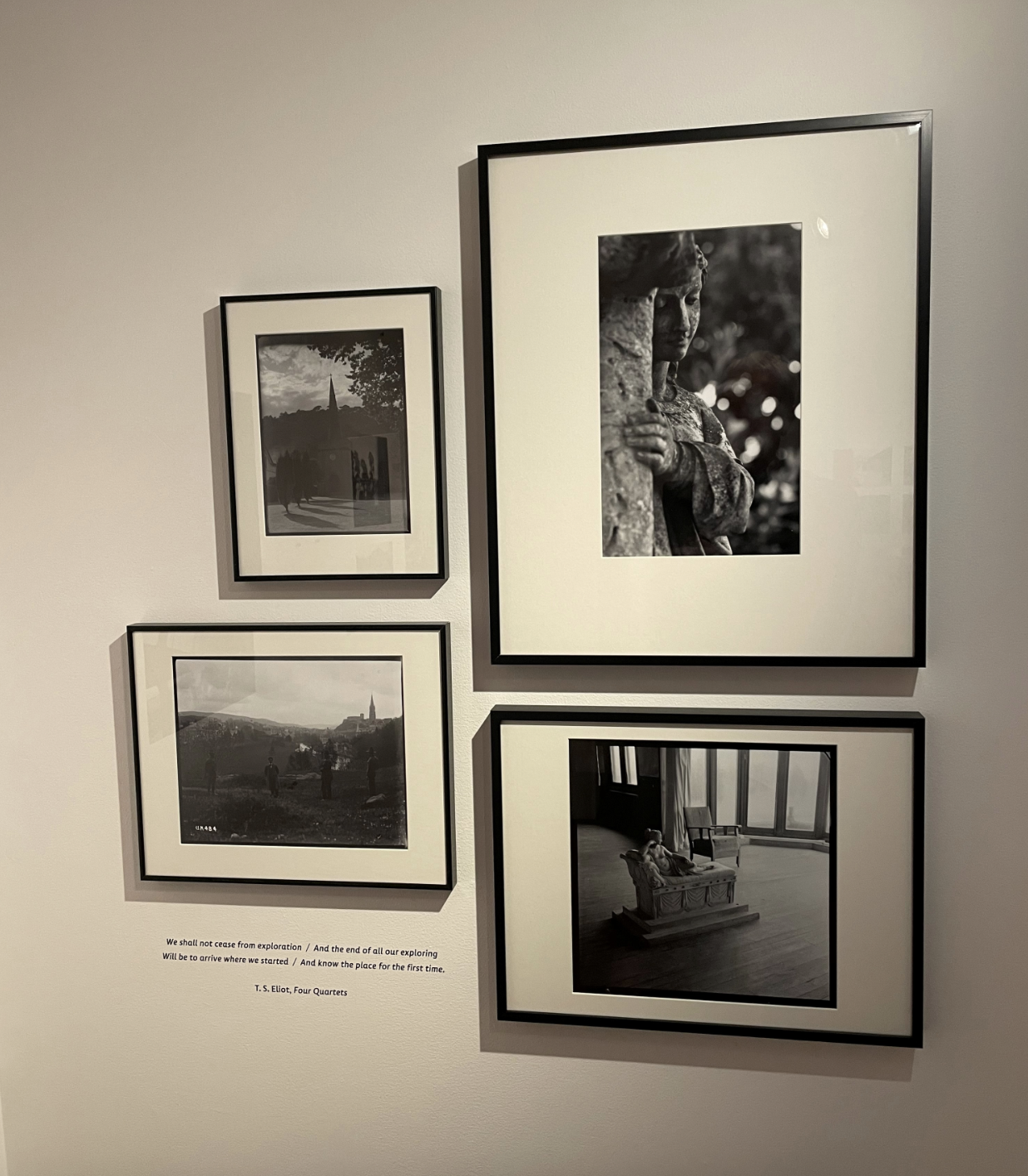
Installation shot, Peter Ireland
Seven Photographs
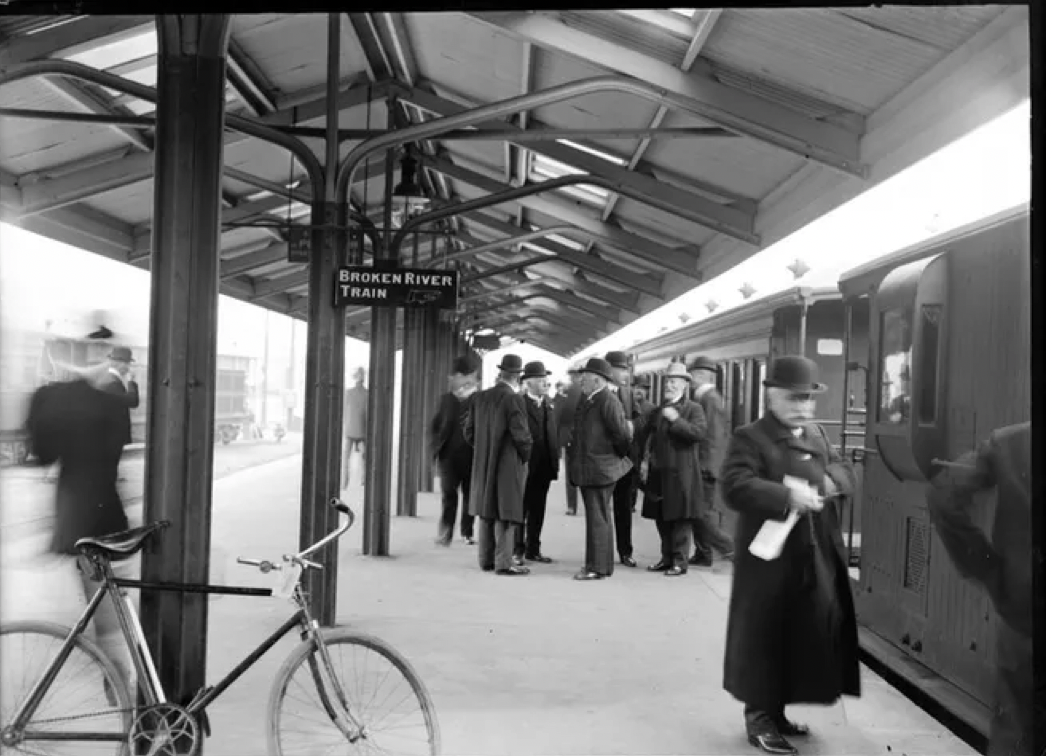
Christchurch Railway Station, c. 1906
Photographer Steffano Webb
ATL: 1/2-040999-G
The platform sign for Broken River Train provides a helpful clue for dating this image. The Broken River train serviced a temporary railway terminus on the midland railway line, completed in time to allow travel to the Christchurch exhibition in 1906 – 1907. Thirty-six years in the making, the midland line was finally completed in 1923 with the opening of the 8.5km Ōtira tunnel.
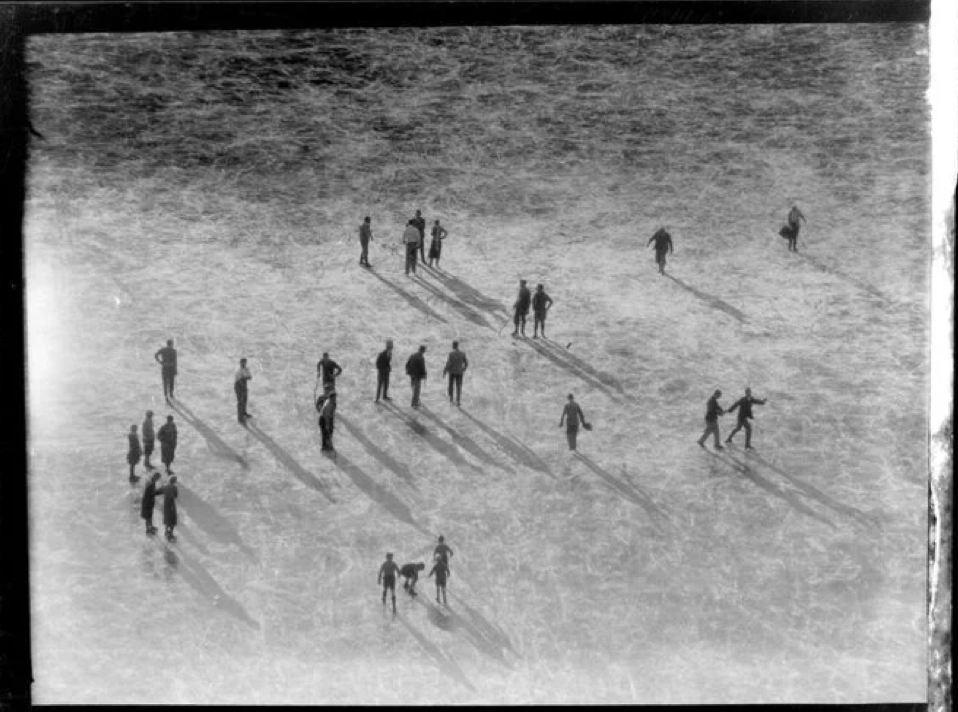
Ice skating in the Otago region, c. 1935
Photographer: Leo White
ATL: WA-25279-F
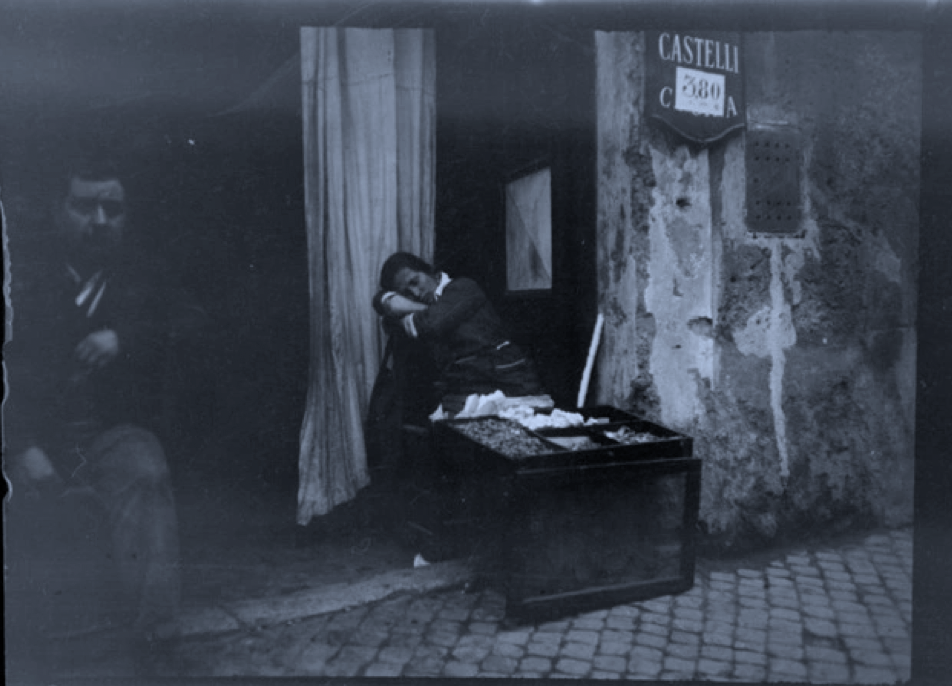
Street vendor, Barcelona, Spain, c.1926
Photographer: William Williams
ATL: 1/4-100043-F
William Williams (1858 – 1949) was born in Cardiff and emigrated to New Zealand with his family about 1881. He lived in Wellington for a time, recording his experience of life in a bachelor’s flat, the ‘Old Shebang,’ on upper Cuba Street. In 1887 he married Lydia Devereux, the couple living first in Napier, then moving to Dunedin and to an address on Royal Terrace, Kew.
There are a 1000 images recording the leisurely European holiday the Williams took between 1925 and 1927. This selection forms a centrepiece of the intended dreamscape of the exhibition. You can check out the collection here: https://natlib.govt.nz/items?text=William+Williams+1925-1927+Europe&commit=Search
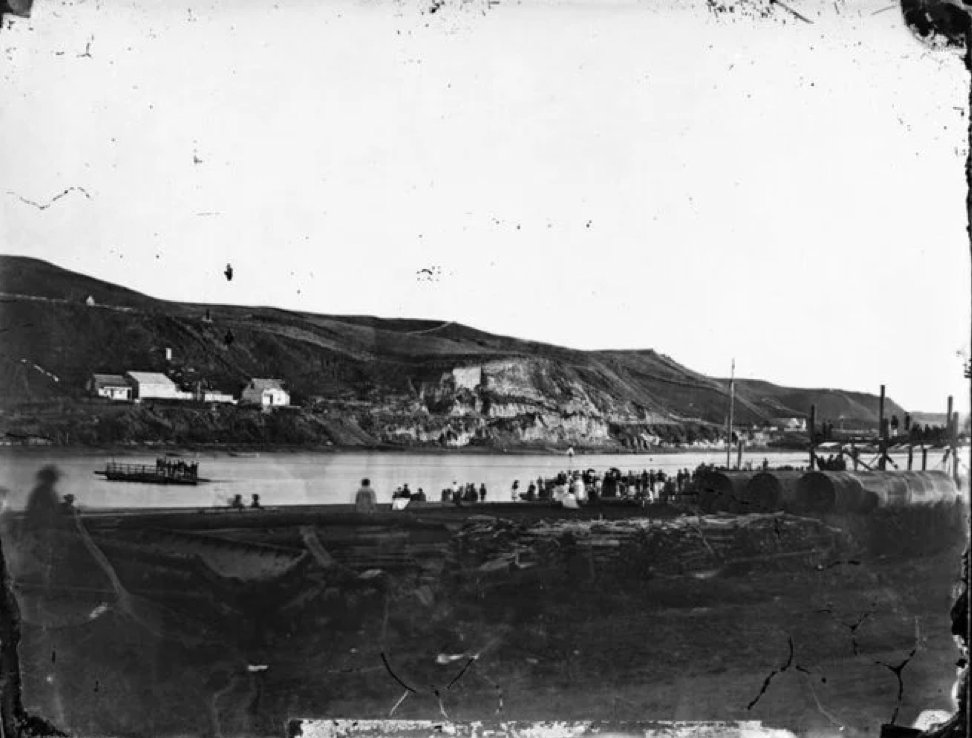
M. Vertelli crossing the Whanganui River on a tightrope, 31 October 1867
Photographer: William Harding
ATL: 1/1-000253-G
M. Vertelli, dubbed the ‘Australasian Blondin,’ caused quite a stir on his tour of New Zealand as these two reports suggest:
‘On Saturday next at 3 o’clock M Vertelli will astound the admiring multitude by accomplishing the most daring act recorded in ancient or modern times, and, regardless of danger, unconscious of fear, he will, by, as it were, a magic chain, connect Campbelltown and Wanganui by bridging the noble river, (900 feet across!) the vast expanse of waters flowing beneath.’
Source: Wanganui Herald, Volume I, Issue 124, 24 October 1867, page 3
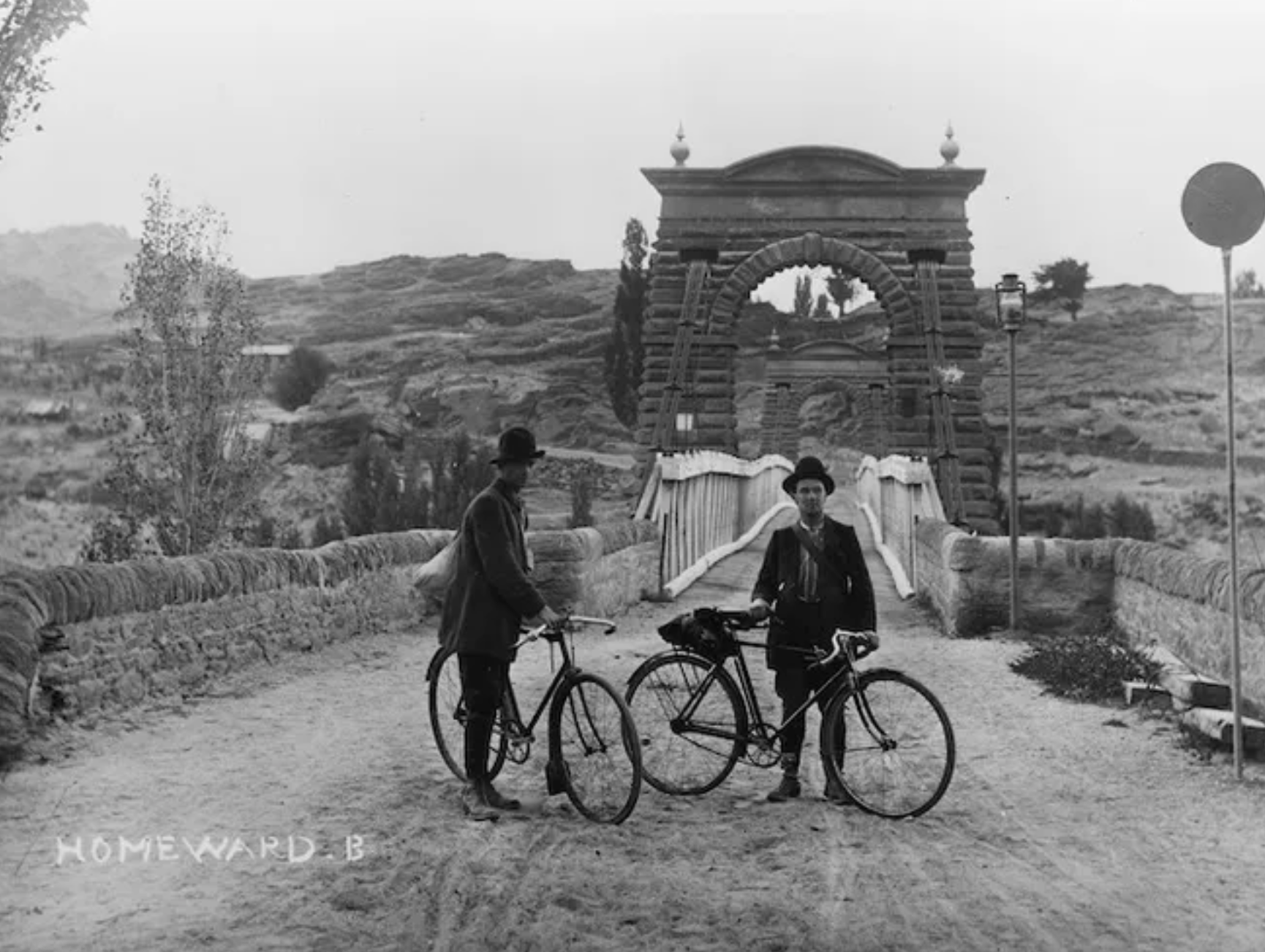
Cyclists Pat Driscoll and Bill Mulrooney near the road bridge in Alexandra, c. 1901
Photographer: J.H. Ingley
ATL: MNZ-1740-1/2-F
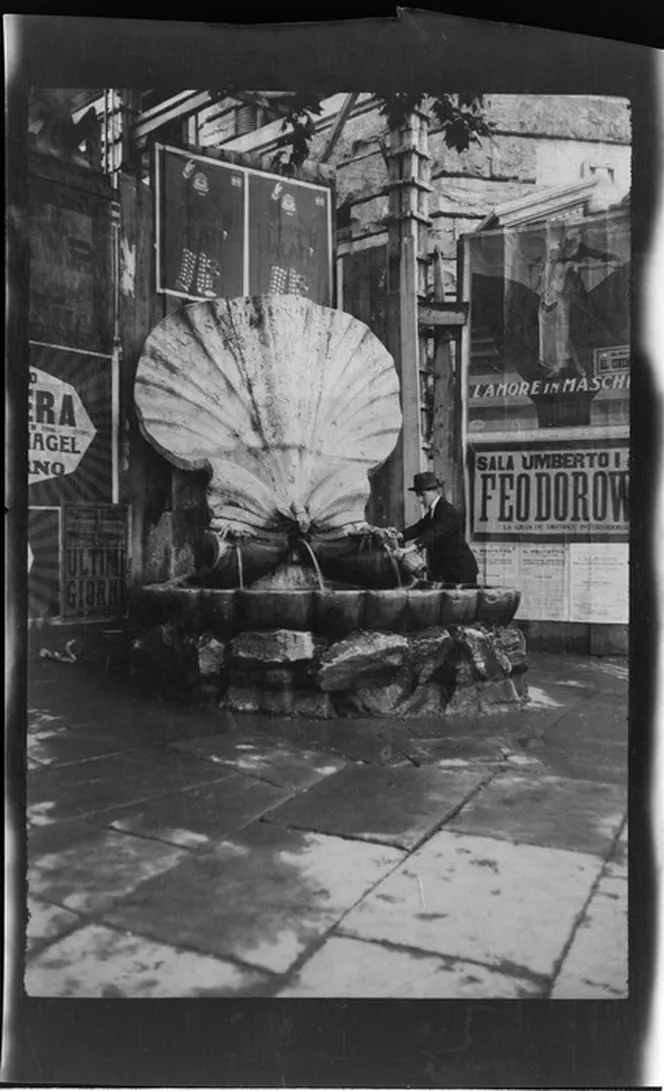
Bernini Fountain, Rome, Italy, c.1926
Photographer: William Williams
ATL: 1/4-100248-F
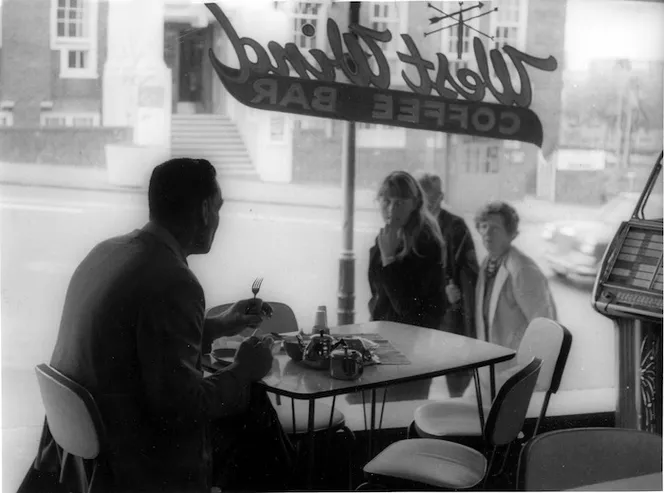
Taxi driver’s dinner, Westwind coffee bar, Queen Street, Auckland, 1968
Photographer: Max Oettli
ATL: PADL-000106
a dozen poems
The Armchair Traveller
Excuse me if I laugh.
The roads are dark and large books block our path.
The air we breathe is made of evening air.
The world is longer than the road that brings us here.
The necklace is a carving, not a kiss.
You run towards the one you can’t resist.
At first she edges backwards, then she stalls.
Now every sentence needs another clause.
The road goes off through willows, then it winds.
Is that the famous temple over there?
Why are the people round about so undefined?
Why must they kiss then disappear?
Time now to let the story take its course,
just settle back and let the driver drive.
Bliss is it late at night to be alive,
learning to yield, and not to strive.
Bill Manhire
from Wow, VUP, 2020
xxv. No Response
Noman under a sheep who’s calling?
Why am I calling sheep farmers? Don’t they hear
the call of Cassino? Don’t they know you can see
the whole damned world from the top of Montecassino!
The whole wide world if you stretch your arms out
and fall off the edge and sail like a paratrooper?
Didn’t they remember the names here?
My mind leaves the walls of the abbey and sits
in the train station chapel with the smell
of cigarettes outside.
Robert Sullivan
from Cassino: City of Martyrs / Città Martire, Huia, 2010
In Dublin
for my father, need it be said
I’ll go to Ireland some day, see those places
you’ve told me about, now that is a promise.
Not before I die, don’t leave me alone, my father
said, contrary as ever, all that bullshit and teardust
I knew so well, and that is how I let the years
slide steadily and quietly away beyond
his last defeated breath. But the day had to come
and I wish there was some way I could tell you
how much I love the broad River Liffey that runs
through the town and the way I’m enchanted
by St Stephen’s the sunlit park in the heart
of the city and the magnificent Corinthian
portico on the Four Courts, and yes the new Spire
of Dublin which of course you wouldn’t have seen
a whip of metal one hundred and twenty metres
high in the sky and the way they joke about the ‘stiffy
by the Liffey’ with that raw sly affection
but really it’s here in this music store in Dublin
these swift easy Irish tears of mine begin falling
between the CD spines lay me down / between
the bars / everybody / I’ll see your heart and I’ll raise
you mine / stay with me till dawn / volcano / no ordinary
love / nothing can
nothing can
and I remember that you could sing
a sweet tenor all your own
So, yes, here I am, I’ve made it, right to the centre
of it all, it’s a grand street is O’Connell Street
complete with bullet holes and all. I’m watching men
walk past their hard faces taut with strain and the women
with their difficult mouths. I feel perfectly at home,
thank you for asking.
Fiona Kidman
from Where Your Left Hand Rests, Random House, 2010
Tour Bus Minutiae and Commentary:
West Berlin, 1985
I have felt the bite & crunch of winter winds, the sudden
stir of snow hunched around the corner waiting to pounce
on you, I’m envigoured by it. It’s called: Berliner Luft:
Duft, Duft, dufte! Loverly.
Dog-lovers walk their pets home, anxious to complete
the chore quickly, a marvel of detachment & poise as the dog
pisses or shits. When new snow lies white on the ground,
the nature-mess that dogs make is easier to see and avoid.
There are over a hundred thousand dogs registered
in Berlin. The City Authorities are sympathetic.
Two hundred and fifty thousand trees have been planted.
Despite the generosity of statistics, there are canine
territorial disputes over the third tree. Tribal Elders
from my Dog Tribe—Ngati Kuri—will send a mediator
to Geneva, me. It’s not a piddly matter.
Every tree has been given a number which I find phantastisch!
You may rendezvous with the beautiful Dame from East Berlin
unter den Linden tree Nummer 2231 Eisenberger Strasse.
On the Wannsee border-bridge, a Spy Exchange Service—
Spionageastauschdienst—is in place.
Dead leaves, which carpet drain and pathway, are cleared away
by City Council workers who come from Italy and Türkei.
Five tons of dog-dung is collected every day.
Bottled bio-gas from such a rich source is exported.
Gas ovens at Dachau & Auschwitz have been made redundant.
A taped recording of mixed doggy-barks is enclosed with each
bottle. I’m not impressed . . . Doggy-bark recording is a dubious
practice.
On the Lietszensee Ufer the trees are stark and still. A ridge
of snow rests along the tops of their nobbly, snaky branches,
their dark winter bareness, fattened and enhanced. On the frozen
lake, voices go up in steam—to the hiss of skates, sluicing . . .
Inside the warm pub on Nachod Strasse a dog comes in wagging
its owner, Sabine, on the end of a leash. Sabine orders a coffee,
unwinds her scarf. The dog sits down by her feet. Helmut, A Berliner,
greets her with tongue-in-cheek: ‘Sabine, kommen Sie hier bei Fuss?’
Dear Brown Bear City, I love you. Ach ja! You’re s bloody wonder-
ful ache.
Hone Tuwhare
from Short Back & Sideways, Godwit, 1992
Ode to the little hotel
Little Hotel
we love you
and in your little
rooftop room we love
each other, even though
we are big
and hardly worthy of such
a little bed.
•
We love the street
you stand on
which is neither long
nor short, but somewhere
in between. And we love
your neighbours
who are our friends—
smaller than us
and so ideally suited
to their address.
•
O Little Hotel we love
your breakfast room
your petit déjeuner
the crypt we reach by
steep narrow stairs
a bob and a curtsy on the last
to miss the bottom
beam—we love
all this.
•
You are our first
and last of Paris, Little
Hotel. We love
your lightning and the
|rinsing rain, the way
your white towels sound
the slap of surf
outside our room.
•
You are the rabbit
of Paris. The duck
with beans and peas.
Little Hotel you are
our herb and cheese,
our soup and sauce,
you are all of these.
•
O Little Hotel
we love your lift
in which we are
always pleased
to know each
other, pressed so close
as we are.
And when we take them
we love your stairs—
wide enough for one
winding up to light.
•
Little Hotel
your windows through which
we duck and climb
to stand on your roof
and look out over
other roofs, we hold these
dear to us.
•
You are paint and wood
and stone and all things made
from the these. Little Hotel
you are a gallery
of leaves.
•
You are our pink suit
of Paris, Little Hotel, our men
in shorts, our jazz band.
Later we will slap our knees
and remember you as four musicians
outside the Sorbonne.
•
O Little Hotel
in whose room
we read and
rest a little
after long days
we revere you.
•
O Little Hotel
we will never
forget you. We will write
and we will return.
O Little Hotel
doorway to our city
of Paris
au revoir.
Jenny Bornholdt
from Summer, VUP, 2003. It was originally published as a limited edition accordion book (or leporello) hand printed by Brendan O’Brien, with drawings by Greg O’Brien.
The laboratory of time passing
The angle of the sun tells us
who we are
or might be. And what time passes
as it passes. How
each afternoon is soothed into
place – the newest tile
in the old town’s expansive roof – and
the ticking of
the unofficial parish clock: its most
senior citizen, his walking stick
ascending the high stone path,
bicycle bell
and water bottle clinging
to its shaft.
Saorge, 13 June 2002
Gregory O’Brien
from afternoon of an evening train, VUP, 2005
Getting to know you, Venice
Pigeons in Venice are born mathematicians. Under their wings,
the flash of fob watch and compass with metal points sharpened.
Kohl-eyed from nights spent marking and route-mapping,
they leave their ledges in the morning, the distance between
dome, cornice and cobbled square plotted for ease
of business. The city’s theirs—a lavish 3D drawing
of scrubbed stone and stolen-gold mosaics, an almost-place
defined by saints and lines, angles and lions and, of course,
the pigeons’ squawk. Raucous at ground level, they are silent
in flight, daring to keep the company of angels, careful
not to graze the pinnacles of temples. Down a side street, away
from the crowds, a gondolier monitors his comrades’ movements
via cell phone. The smells of garlic, myrrh and dead fish mix.
And above it all, the quiet, white whirr of pigeons’ wings.
I believe it might be possible to attempt the impossible
here—wear feathers? Dissolve solid marble
on the tongue? In this city, where rain falls from frescoes
and children fence their shadows in courtyards at dusk,
even the gutters and drainpipes
and dirt bins shimmer.
Claire Beynon
from Open Book: Poems and Images, Steele Roberts, 2007
Spare Change
New to London, maybe I gave off the scent Naïve
to the ragged man who shuffled
along the tube train aisle
where I stood gripping the pole
amid the massed bodies of rush-hour crush;
each face, it seemed, averted in disgust.
Like the small-town citizen I really was
when the man said, ‘Can you help me, love?’
I met his gaze then looked down
to see what he wanted to show me:
his forearm split open, swollen,
infection swarming like red wasps.
‘I need some change to get to hospital.
Spare a couple of quid?’
I didn’t know local custom. How to draw a blank
down over the mind, or how to give a pound
as indifferently as if our hands held slots for cash.
Instead I cried out, ‘What happened to you? Oh my God.’
He stalled, his stare a flame held too close,
then rolled down shirt and jacket sleeves.
‘Never mind.’ He pushed through the throng
as our train hurtled to the next stop.
A second stranger tapped my shoulder.
‘Forget him. He’s a con artist.’
But the fire-swarmed gash.
The pomegranate gasp of it.
The man shrugged. ‘Doesn’t let it heal.
I’ve seen him. Uses pocket knives, tin lids.
‘Grifter. Scabber. Shows wounds for sympathy.
Don’t encourage him with money.’
One man so strung out he’d self-harm for cash.
Another so jaded he’d cauterised compassion.
Decades on, the memory opens
and reopens in the same raw place.
As if I could heal anything
as pernicious as indifference
I am at it again with the sutures and saline
of these ink-black glyphs
needle and stitch
needle and stitch.
Emma Neale
from Liar, Liar, Lick, Spit, Dunedin: Otago University Press, 2024
Remembering America
The question ‘Do you miss it?’ is unanswerable.
It’s obscene to say yes. It’s depressing to others to say no.
It’s inauthentic and invertebrate to say maybe.
I’d rather sing ‘Oh baby, oh baby, oh baby’ in a song
than answer it. I have attempted just to name things
I have liked in my location-limited experience,
like fried clams as big as men’s watch-faces
or a turkey jumping majestically over my father’s bicycle wheel
or suburban snowmen bathing in the cold light of flat-screen TVs,
but that doesn’t answer the question ‘Do you miss it?’
any more than ‘I believe I was a cat in a past life’
answers the question ‘How do you feel?’
Prove to me that the country I thought I grew up in
was real. You can’t unless you beguile me
with your fireworky thinking, your monster-truck cunning,
your whispers of calumny that you cast like the peal of a cracked bell
across the prairies I’ve never been to
and the peninsulas I have been to
and the places I’ve been to and forgotten everywhere.
Missing something is a state of mind,
says the polar bear on her shrinking ice floe.
Knowing not to miss it is a state of grace,
says the hermit crab in her rented carapace.
America, like a lot of people, I’m keeping my distance,
as we do from a super-volcano on public land.
America, a house haunted by itself cannot stand.
America, you are a monument to monumental misrepresentation,
and all your monuments should commemorate this.
America, you’re apostrophised so much
because you’re still not listening.
America, you look even worse from somewhere else
than you do from inside yourself.
Erik Kennedy
from There’s No Place Like the Internet in Springtime, VUP, 2018
The Catskill Mountains
There is a world of things that bees can see
which we cannot. They sense the earth’s
magnetic field, the electricity
driven by the molten core.
I know that in my heart of hearts
I am not someone who loves the country.
But I do crave the idea of it
to fall upon its soils in relief,
to live in a cabin, in a hollowed out tree
in the Catskill Mountains.
Of course what I really want is America
not the the real one, the wide, wide one
with its purple this and that
and the big gold moon trapped in its branches.
Kate Camp
from How to Be Happy Though Human, VUP, 2020
Travel Bag
The notebook is a surrogate suitcase
in which to pack a road map, a water bottle,
a sharpened pencil, comfortable walking shoes,
a wind breaker, a mood catcher, some folk
music, a violin, cranberry nut mix, seasonal
fruit, a sailing ship, a glimpse of moonlight,
a well-thumbed dictionary, seven memorable novels,
five yoga positions, a braided river,
a tide chart, another violin, a view of clouds,
a pink travel mug, a philosophy of doing,
a philosophy of seeing, a guidebook to verbs,
an old cardigan, stepping stones, changing tides,
a light switch, woollen socks, ginger tea,
a book mark, a mountain to climb.
Paula Green
from Road Trip, a work in progress
Riding the train
As the river consumes its banks
I tell you, yes – as the sky
sucks the sea up into its chalky glare
at noon, as the stars
leak salty dew on the palms and the palm frond’s
jagged shadow disfigures
the stonemason’s perfectly furled siesta –
I’m lost, somehow, at the frontiers
of what’s distinct, of
waking and sleeping, seeing and dreaming.
I’m riding the train.
Don’t know if I’m blind
or in the longest tunnel, now, on the whole
bright coast, or what the difference is.
Ian Wedde
from Arriving blind, in Good Business, AUP, 2009

