Poetry Shelf Favourite Poems: Stacey Teague’s ‘Love language’

Love language

“Language does not pour out of me,
but is something I’ve entered” – Jack Underwood

I’m at home in the big air.
Under the surest sky I’ve seen
I am touching your poem.
The one where you stood in the afternoon.
Stopped at a pedestrian crossing.
In movie magic lighting.
Moving towards me! Imagine!
And I do want a little forehead kiss.
In line at a medium tier rural café.
I will eat a huge slice of lolly cake.
You will drink a huge chocolate milkshake.
Everything will be just huge.
The feeling also enters the room.
And the river is there bending around us.
And we see ourselves reflected on the surface.
And I can hold my stomach to keep the pain inside.
And you will hold it from the outside.
Sometimes, by the river, I see my life as big as a movie screen.
Other times it is a loose stone to kick down the path.
On a loose-stone night I kiss the big air.
When I’m taking the bins out.
I touch the poem in a romance way.
When taking out the glass recycling.
Before walking over to your house.
In a romance way.
The clouds touching as the credits roll.

Stacey Teague

I wrote this poem on a weekend away with the poets. I was sitting outside on the front deck of our Airbnb in Raumati, trying to get some sunshine and this poem came quite quickly. I was thinking about a recent trip I had taken to Whanganui with my partner. I was thinking about the Whanganui river, wide and deep and moving. About how lives feel big and small. About being lost in thought on bin night. I was thinking about how it feels to let somebody hold the things that are hard to carry by ourselves. I was also thinking about how good lolly cake is.

‘Love language’ was originally posted at The SpinOff, March 2023

Stacey Teague (Ngāti Maniapoto/Ngāpuhi) is a writer and teacher living in Te Whanganui-a-Tara. She is a publisher and editor at Tender Press.

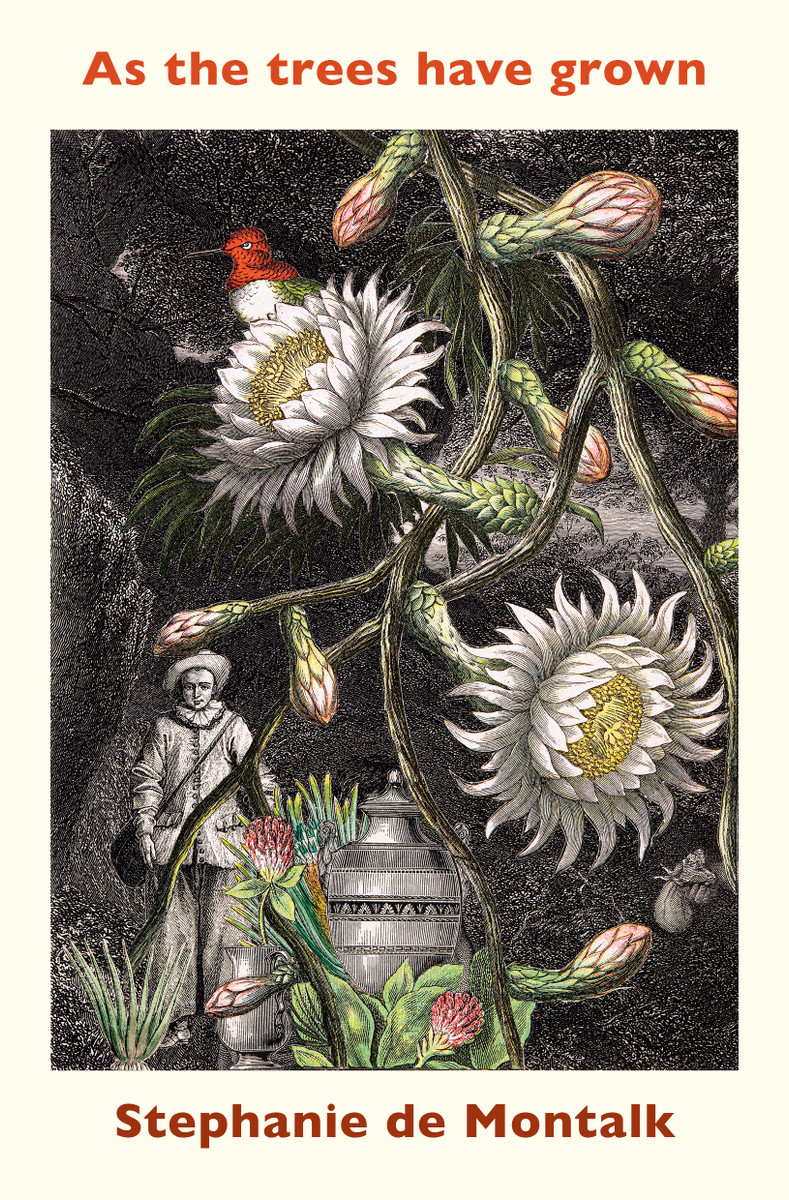
Poetry Shelf audio: Stephanie de Montalk reads from As the Trees Have Grown

Photo credit: Ebony Lamb

Stephanie de Montalk reads from As the Trees Have Grown
Te Herenga Waka University Press, 2023

‘Heartfelt’

‘At Waitangi’

Papaver somniferum

‘Park life’

‘The far north’

Stephanie de Montalk is a poet, novelist, memoirist, and biographer. She has also worked as a nurse and documentary film maker. For her first poetry collection, Animals Indoors, she received the NZSA Jessie Mackay Best First Book of Poetry award at the 2001 Montana New Zealand Book Awards. In 2015 she received a Nigel Cox Award at the Auckland Writers’ Festival, for her widely acclaimed memoir How Does It Hurt?

Te Herenga Waka University Press page

Poetry Shelf Monday Poem: Serie Barford’s ‘Dressed for theatre’

Dressed for theatre

Child-me bought paper doll dress-up books with coins garnered
from selling eggs. Pressed out cardboard figurines. Snipped
garments onto varnished floors.

Handcrafted sumptuous frocks with pastels, glitter and luncheon
paper. Decorated bodices with petals dipped in flour ‘n’ water
glue seasoned with salt to prevent mould. Embroidered hemlines
with sticky grass seeds resembling tiny beads.

Gently folded paper tabs around shoulders, waists, hips. Created
narratives for red carpet events. Shawls for warmth and glamour.

Arranged dolls under coloured spotlights – beams from handheld
torches filtered through glossy cellophane. Smoothed garments
with bitten nails. Mixed and matched accessories.

My dolls wore faux chiffon nighties. Slept in bespoke chocolate
boxes

until my nipples budded. Heralded a world beyond childhood.
I ran to greet it.

Dressed
undressed myself

others.

Gave away my dolls.

Serie Barford

Serie Barford was born in Aotearoa to a German-Samoan mother (Lotofaga) and a Pālagi father. She held a 2018 Pasifika Writer’s residency at the Michael King Centre, performed at the 2019 International Book Arsenal Festival in Kyiv, and collaborated with filmmaker Anna Marbrook for the 2021 Going West Different Out Loud poetry series. Her poetry collection (2021), Sleeping with Stones, was shortlisted for the Mary and Peter Biggs Award for Poetry at the 2022 Ockham New Zealand Book Awards. 

Poetry Shelf Poetry Day Notice – Drop by Drop: Adults Who Write Poetry for Children Competition

Drop by Drop:  Poetry for Children Competition

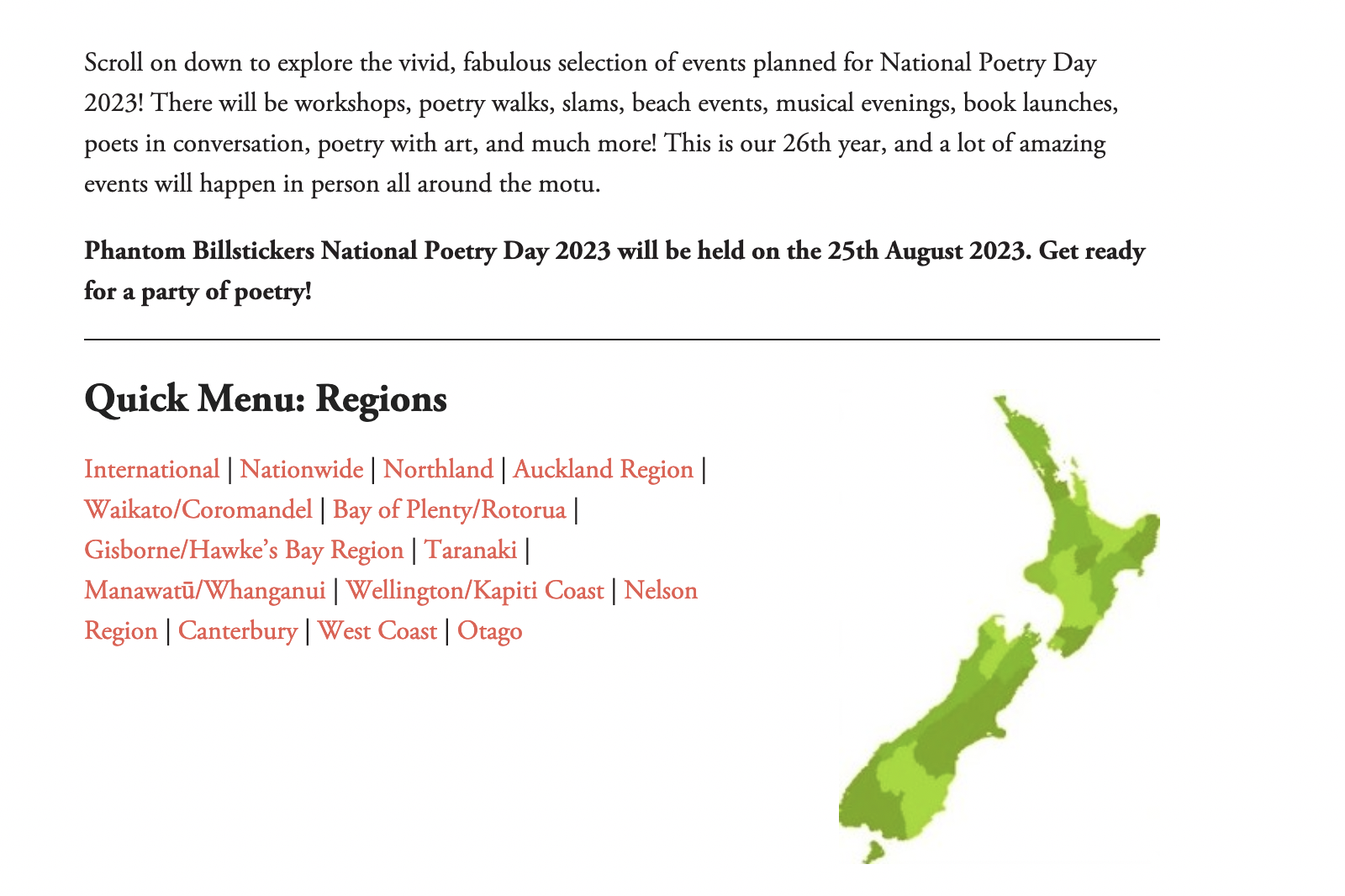
A new nationwide competition for adults who write poetry for children has been launched in the lead-up to Phantom Billstickers National Poetry Day in August.

‘Drop by Drop’ runs between now and 4th August and will be judged by renowned children’s writer and poet, Bill Nagelkerke. Entry is free and is open to anyone in New Zealand aged 18 years and over. The prize for the winning poem is $50. Up to three poems can be submitted on the theme of ‘water’ – to be interpreted as widely and wildly as entrants like. Poems should be aimed at 5-12 year olds. For further information visit the Poets XYZ Facebook Page or email thepoetsxyz@gmail.com.

The winner will be announced on Phantom Billstickers National Poetry Day on Friday 25th August.

The competition is organised by the Poets XYZ, a trio of New Zealand children’s writers. Elena de Roo, Kathryn Dove, and Melinda Szymanik are keen to see poetry for children flourish in Aotearoa New Zealand and to develop a network of children’s poets.

Poetry Shelf review: AUP New Poets 9 – Sarah Lawrence, harold coutts, Arielle Walker

AUP New Poets 9 – Sarah Lawrence, harold coutts, Arielle Walker, ed Anna Jackson
Auckland University Press, 2023

Each poetry book I read this year refreshes the page of what poetry can do. Yet some things remain constant in my addiction to reading poems: musicality, surprise, freshness, movement, heart – in varying blends and eclectic relationships. Aotearoa poetry is doing so much at the moment – there is neither constricting paradigms nor narrow recipes. Instead we get multiple connections along the sparking wires of writing. AUP New Poets 9, edited by poet Anna Jackson, brings sublime new poets to our attention. Anna has edited the series since issue 5 (2019), captivating our attention with the work of poets such as Rebecca Hawkes, Claudia Jardine, Vanessa Crofskey, Ria Masae, Modi Deng. This is Anna’s final issue, with Anne Kennedy taking over the editorial reins for issue 10.

In her introduction, lingusitically agile and idea forward, Anna writes potential pathways and animated openings for the reader. It is the kind of introduction that fertilises a book rather than burying its poetic potential in claustrophobic frameworks.

You can hear harold and Arielle read poems from their sequences here.

Sarah Lawrence

Sarah Lawrence’s sequence of poems embodies all the traits I have listed above. She achieves sweet movement along the line, petal-packed detail, heart spikes, flakes of the everyday alongside shards of strangeness. The combination is electrifying, luminous, immensely satisfying. Musicality is an imperative. Listen to the melody and chords in this stanza:

(…) Stitching the crumbs
into an upside-down cake, I speak slowly
to strangers who blink like cats.
On the lunar eclipse I come home glitter-drenched
to a gaggle of gawkers on beanbags outside, late
for the hole in the sky

from ‘The edge of winter’

I am in awe of the way metaphorical language enhances the physicality of both anecdote and reflection.

(…) The city is beginning
to pepper with faces I know. I can’t
leave our house without seeing at least one
man in a fisherman hat. I can’t leave our
house without saying at least one hello. Yes,
open your orange before we are home, it
is nice to squeeze stories from the rind.
Yes, I am here now & I am no longer
quite anonymous. The city is beginning.
I have never felt so brave.

from ‘real-life origami (to unfold)’

Slender moments shimmer in an intensity that draws love or grief or everyday friendship close. The “you” heightens the intimate layerings, and it is as though we get to inhabit that coveted addressee spot too. We move between the fragile and the tender, resemblance and divergence, the idyllic and the life singed.

Sarah writes with an intimacy ink that gets you warm and heart-touched as much as it startles and surprises. A dazzling arrival.

harold coutts

I find myself saying harold’s poems out loud, delighting in the rhythm and rhyme, the pitch and perfection of sound, and the sequence becomes a poem album on replay. Anna picked out ear-catching rhymes from the sonnet, ‘i am growing a garden’. Listen to that, and then listen to the melodic complexity of this stanza with its ripple lilts:

in the morning i cook eggs to placate the hearth of me
there’s a place for your shoes, still
i have missed you enough to fill all the walls i exist between
but never enough to call you

from ‘cooking eggs for one’

Gender is the insistent blood pulse of the sequence: ‘my gender is my inside room’. Gender is the vital refrain, an issue that links to body presence. The body with skin, lungs, ribcage, a body with growth and bloom, longings and limits. The body that loves and lusts, that eyeballs life or death, that brings itself into mesmerising view through physical detail and metaphor. I am moved immeasurably, held in the grip of heart and bone. The physicality and the animation. Haunted.

i am without my bones
mould me into carpet and lay me down
thus i might get some rest
i saw the sunset and now it rises
mocking the mountains of my eyelids
as i lurch home

from “hi and welcome to ‘i’, tired’ with harold coutts”

There is a sense of the body as threadbare, as shell, as stripped back by rodents. Yet it is also lavender bloom, survival. There are so many essential tracks through harold’s sequence, and I am only offering you this one, this body insistence, because it is gluing me to the lines. The tactile that arrests. The sublime music. Yet you will also fall upon the sun, flowers, swords and knives, swivel chairs, earth and dirt, love, pronouns, heat and sweat, the poet as reader, the reader as writer, and you will simply crave more. This is another dazzling arrival.

Arielle Walker

Reading Arielle’s sequence and I am held close in the tonic of what poems can be. Her opening poem, ‘a poem is a fluid thing all wrapped in fish skin’, is the most tender, the most illuminating embrace of the word and the world – whether physical, relational, heart-strung. Being. Becoming. Becoming poem. For yes, this is an offering of poetry as a form of becoming. I have never thought of a poem as a body of water but it feels so perfect – fluid yes but more than this. Hydrated, generating ebb and flow, life sustaining, beauty delivering.

How can I write a poem unless it rolls (a ready-made
river) out of the side of a mountain and runs gleefully
forward in a rush of eddying currents towards the sea
       so that all I have to do is hold out a hand to unravel
                       the slightest fraying edge of its fluidity, and
                                             spin a new yarn from its depths?

In her bio, Arielle writes: ‘Her practice seeks pathways towards reciprocal belonging through tactile storytelling and ancestral narratives, weaving in the spaces between.’ This resonates so deeply, as the poems are a form of guardianship, of caring for the natural world, trees plants, rivers. I am walking through the poems, hand in hand with a poet guide, making tracks through aural and textured delight, finding awe and nourishment. And as I walk, the guide draws my attention to here and there – I am thinking how caring for the natural world, how standing beside and beholding the sea, how weaving together this story and that story, this heart and that heart, is also a form of reading and writing: we are contemplating, translating, connecting, conversing, imbibing, witnessing, contributing.

Arielle’s form of writing is as full of movement and variation as the sea: constant, same, nuanced. She is spacing out, striking through, bunching up words, using italics, step-laddering. The shifting movement on the line echoes the shifting rhythm that is as visual as it is sonic. The musicality of a view is woven into the image-rich fabric of writing. She is weaving words of multiple languages from Te Reo Māori to English to Shetland dialect. The Scottish heather becomes weed in Taranaki landscapes. The shoormor where sea meets shore in Shetland becomes toes in the water, selkie returning to the sea, the river spine and river mouth, a new form, an old form, a memory, a myth.

she grew accustomed to her new form
learned to exchange salt for soil, built instead
upon the body of a mountain
her brine beginnings buried in the earth

she locked her words away too
dialect smoothed like seaglass
into new vowel shapes
the shoormal, the skröf, the lönabrak
forgotten

from ‘skin’

We will take what we need from the bush and no more. We take what we need from these poems and it will make our heart sing, our feet will plant firmly in the soil as we gather and acknowledge. And it is both essence and wide, irreducible and fortifying. These poems have touched a deep cord. They are quiet and humble and extraordinary in their dazzle.

Three poets with deft and distinctive approaches to writing, three poets who thread preoccupations with acute perceptiveness, earth concerns, personal disquiet and intimate recognitions. This is an anthology to celebrate, to dawdle over and absorb the satisfactions and epiphanies as you read. AUP New Poets 9 underlines the refreshing engagements a new generation of poets is producing in Aotearoa. And yes, altogether dazzling!

Sarah Lawrence (she/her) is a Pōneke-based poet, performer, musician and pizza waitress. She recently dropped out of law school to study acting at Toi Whakaari: New Zealand Drama School. Her parents are thrilled. She won the Story Inc Prize for Poetry in 2021, and you can find her writing in Starling, Landfall, A Fine Line and The Spinoff.

harold coutts is a poet and writer based in Te Whanganui-a-Tara. They have a hoard of unread books and love to play Dungeons & Dragons. Their work can be found across various New Zealand literary journals such as bad apple, Starling, Ōrongohau | Best New Zealand Poems, Poetry New Zealand Yearbook, and in Out Here: An Anthology of Takatāpui and LGBTQIA+ Writers from Aotearoa edited by Chris Tse and Emma Barnes (Auckland University Press, 2021).

Arielle Walker (Taranaki, Ngāruahine, Ngāpuhi, Pākehā) is a Tāmaki Makaurau-based artist, writer and maker. Her practice seeks pathways towards reciprocal belonging through tactile storytelling and ancestral narratives, weaving in the spaces between. Her work can be found in Stasis Journal, Turbine | Kapohau, Tupuranga Journal, Oscen: Myths and No Other Place to Stand: An Anthology of Climate Change Poetry from Aotearoa New Zealand (Auckland University Press, 2022).

Anna Jackson’s latest collection of poetry is Pasture and Flock: New and Selected Poems (Auckland University Press, 2018). She has also released Actions and Travels, a book on poetry (Auckland University Press, 2022). She is based in Wellington. 

Auckland University Press page

Poetry Shelf audio: Janet Wainscott reads from A Game of Swans

A reading from A Game of Swans, Janet Wainscott, Sudden Valley Press, 2023

‘The sampler’

‘The stationmasters’

‘She saw plesiosaurs’

‘The lagoon’

Janet Wainscott lives in Lincoln, near  Otautahi/Christchurch, and writes poetry and essays. Her work has appeared in takahē, Poetry NZ Yearbooks, Landfall, Catalyst and recent New Zealand Poetry Society anthologiesJanet won the poetry section of the NZSA Heritage competition in 2017 and the short prose section in 2019. In 2020 she was commended in the Hippocrates Prize for Poetry and Medicine competition. 

Her first collection of poetry, A Game of Swans, was published by Sudden Valley Press in May, 2023.

Sudden Valley Press page

Poetry Shelf Monday Poem: Ash Davida Jane’s ‘January 1st’

January 1st

on the horses’ birthday
we step brand new into the day,
hoping that for once, we have gone to bed
as one thing and risen another.
I go to bed tired, and I wake up
tired. I went to bed, a year ago,
and in the meantime I have grown
out of love. the days are
as long as they ever are. somewhere,
the horses are a year older. somewhere,
another horse slips wet and ready
into this life. how perfect, to be born
on the day that was already your birthday.
I go to bed, ready to love again,
legs unsteady as a newborn’s, expected
to hold up a body. how do we know
what to do the first time something
is asked of us. the first time we laugh.
the first time we taste salt. does
the body know how to love before
it’s born, thrust into a life it did not ask for.
nothing to unlearn yet. somewhere,
a mare licks her foal clean, nudges him
with her nose to try out his feet.
we try one step, then another.

Ash Davida Jane

Ash Davida Jane is a poet and editor from Te Whanganui-a-Tara. Her second book, How to Live With Mammals (Te Herenga Waka University Press, 2021) won second place in the 2021 Laurel Prize. She is a publisher at Tender Press and regularly reviews books on RNZ.

Poetry Shelf Celebrates: Winners of Given Words 2022 read their poems 

With the opening of competitions for the Phantom Billstickers National Poetry Day less than two months away, the director of Given Words, Charles Olsen, has invited the winners of the 2022 competition, Sarah-Kate Simons and Saphra Peterson, to read their poems for NZ Poetry Shelf.  

All entries had to include the five words helpdifferentthankfulwarrior, and dream, which were chosen by girls of the Our Little Roses orphanage in San Pedro Sula, Honduras. The winners were selected by Mikaela Nyman, Sophia Wilson and Charles Olsen. Their comments on the poems along with a selection of the entries by both adults and under-16s can be read on Given Words.   

On 1st August 2023, Given Words (now in its eighth year) will open with words chosen by students of López de Arenas Secondary School in Marchena, Seville, Spain. National Poetry Day competitions for 2023 will be added to the Competition Calendar during July.   

The winner of ‘Best Poem’ was Sarah-Kate Simons for her poem Prognosis.  

Winner of the ‘Best Poem by Under-16s’ was Saphra Peterson, aged 15, for her poem Doubt.  

Sarah-Kate Simons is a young poet and writer from rural Canterbury, where she lives with her adorable but troublesome Fox Terrier. She is widely published online, in magazines and in anthologies, such as Toitoi, Write On, Re-Draft, the NZ Poetry Society Anthology, and Poetry NZ Yearbook. She has also placed in several poetry and writing competitions, recently winning the 2021 HG Wells International Short Story Competition. Her other hobbies include ballet, talking to thin air and going ratting along the riverbank with her dog.  

Saphra Peterson lives in rural Canterbury but one day aspires to rule the world. She loves reading, writing, creating disturbing artwork, and running from the authorities. She can be found playing violent games of cards or contemplating her own demise. She hates writing biographies, in case you can’t tell. 

Poetry Shelf review: Jane Arthur’s Calamities!

Calamities! Jane Arthur, Te Herenga Waka University Press, 2023

Jane Arthur’s second collection, Calamities!, is a glorious translation of being, of existence in an unsettled world. Think comfort and discomfort, the physicality and elusiveness of being, its poetry and its prose. Big questions surface, little questions simmer. Conundrums hover and anxiety lurks. This is poetry of tilt and tremor and one reading wasn’t enough. I dived back in for more.

The opening poem, ‘The Better to See You With My Dear’, is a declaration for the poetry to come. The title draws the ubiquitous and macabre fairy-tale threat of bad things into a present tense, into the tension of apocalyptic views and warnings, into the tug between closing eyes and speaking out, between body worry and body action. And already as reader you are making a stand, ticking the boxes: action and/or speaking out, writing, deferring, addressing, more writing.

Add the imperative of awe, a need to feel the world: ‘I tried / to place myself in the context of the size / and the history of the universe’ (from ‘Meteorite’). Joy is elusive, elation is slippery. I come back to the notion of poetry as being. I have entered a book of ideas and of feelings, experience and thought. This is what Jane’s poetry does: it offers multiple paths, entrances and exits, pulling you into both the unimaginable and the imagined, the concrete and the elusive. It brings the tilt of the world within reach, so as reader, you can feel the heat and hit of anxiety, the unsettled.

A single poem can be so complex, so simple, so piercing, so affecting. Take ‘Dodge’, for example, where ‘each day is each of us / carving through space/ using our bodies’. Then, in the next stanza, we are divided into groups depending on how we answer the listed questions. The last stanza is a throb-of-the-heart moment, a “wow”, a stop-you-in-the-tracks-of-reading:

Do we live only to the limits
of our comprehension?
We will never know
what we don’t. Alack.
Some of us
carry shame and others of us
probably should.

Move from domestic life to philosophy, from dead flies in cups on kitchen shelves, to the prospect of heroism and couch hugging. Climate change is there in ‘Alien’, an ode to once was, to what ‘is kind of like / getting cooked alive but so slowly you’ll / probably barely notice it’. World fret meets individual fret meets world fret. Ah. Such friction. Such knowing that leads to less knowing that leads to knowing hunger in the fabulous poem ‘How, All Right’. And then, in travels though calamity, in the poem ‘Autumn’, the writer speaks of autumn light, where the nag of cheesy thoughts is nothing compared with bigger issues. This is a solace branch, this beauty moment, this invitation to pause and restock:

(….) Not us, not
when there are bigger things to worry about –

and not when it’s still possible to put them aside
to look at the low shadows, the glow

of evening sun across the branches
of trees that refuse to be anything but green.

The core of Calamities! contains a longer sequence, ‘The Bear’, and it’s mesmerising: part fable, part magic, part analogy. The speaker lives in a cave with no heating or sanitation but a hibernating bear for company, yet the visiting sisters don’t see the animal. Ah. The bear begins fierce and blazing, then shrinks and sags, and remains a vital source of heat, for the speaker is cold. So many paths through this sequence.

Jane produces the kind of poetry that haunts, that clings with mystery and mood, with a mise en abyme effect of story and storytelling, personal, global, affecting. How to get warm in the calamity of cold? How to find the bear and the cave and the point of rescue? I am rereading the collection, and writing becomes a key, reading and writing, this twinned joy, this survival.

The book’s final poem, ‘Imaginary Den’, makes a touching bridge back to ‘The Bear’. The poem begins with dogs nestling in close and then ends with an image of comfort and security. Such a perfect note to finish the collection, and indeed my review, a review that barely scratches the surface and depths of the book’s making, with its sweet craft and its intricate layering. Calamities! is a collection to spend extended time with, to nestle in close to the power of poetry to move and to comfort and to speak.

(…) The dogs want to be
near me, seek safety and comfort in numbers,

which is no new concept but one that
gets eroded as the world devises ways

to wring value out of its inhabitants
(and inhabitants wring value out of their world).

Let me dig my little hole. Let me
settle down into it, feigning safety, let me.

You can listen to Jane read ‘The Better to See You With My Dear’ here

Jane Arthur is the author of Craven, which won the Jessie Mackay Prize for Best First Book of Poetry in 2020. She received the Sarah Broom Poetry Prize in 2018 and has a Master of Arts in Creative Writing from the IIML at Victoria University of Wellington. Born in New Plymouth, she manages and co-owns a small independent bookshop in Wellington, where she now lives with her family.

Te Herenga Waka University Press page

Poetry Shelf favourite poems: Anne Kennedy’s ‘Die die, live live’

Die die, live live

1.

A puff of air
like a lover’s
sweet speech
bubble, blue
as sky. A brown
horizon turning
fast into tomorrow
and tomorrow, etc.
Mud and leather
and a man
who runs like rubber
drawn from itself
over mud
born from
its muddy
mother field.
A kick-off
and the howl of
a moon’s dog.
They kick
the tender thing and kick and kick the tender thing
and wail and sing.
Five-nil to them.
Fuck. And fuck
the conversion
too. More
points for them.
The ball sings.
The wind
sings a hymn
down the Saint
Patrick’s Day
parade-length
of field
and the wind
blows the ball
where it shouldn’t
go. You have to
hope these idiots
grasp softness
the idea of it
its air and
innocence.
Twelve-nil to
the other side.
Conversion? No.
A rose blooms.
The fullback
there he goes
into a scrum. He’s
in the scrum
for his girlfriend
the girl he loves.
A torn ear a red rose the love-song of the fullback
a big man a
fucking giant
look at him
run. A lot of blood.
He runs for the
invisible woman.
He’s a moving tree
a flowering
tree. The Aussie
should be sin-binned.
Oh. He is.
Penalty. Twelve-
three. Tenderness
and the terrible
wind-sound
necessary for
play. They kick the tender thing and kick and kick
the tender thing
and wail and sing.
A man jumps
to his feet
throwing the hand
of his girl into
the sky. He flails
and beseeches.
Go go go go go!
It’s her envoi.
A guttural
call Moss has
never heard before
coming from
here and here
a beating on
the edge of seagull
i.e. clarinet.
There’s a rolling
maul, players
scragging faces
with sprigs. The referee
runs and blood
runs like tears.
Penalty. Twelve-six.
Go man boot
the groaning
air cradle it
as your child.
Don’t fucking
drop it idiot.
A moan goes up.
It rests in
the bodied
stadium staying
there, living on
among the people
as damage.
They kick the tender thing and kick and kick the tender thing
and wail and sing.
Rain starts. Good
for the home team
(used to it).
The visitors gnash
their teeth. Mud
sprays men
into fossils
memento mori.
They’re covered
in the game
head to foot.
Outrageous penalty
fifteen-six. Fuck.
A scrum in mud
and more rain.
The field is
ankle-glass
sometimes shattered as a dance once seen moved in water
a splish and trail
like scarves.
Half time
(FW).

2.

The land shaved
of trees made
useful by
its nakedness
and water. Men
stand as if cattle
mirrored at
a trough. A whistle
like a cast
in a roving
eye roving
over the field.
The men swarm
towards the ball
flicking earth
and sky.
The Centre’s
butchering
down the field
as a lion hunts
prey in the late
afternoon.
As a boy he
loved animals.
Off-side. Fuck.
Blood and
sweat and blood
and the crack
of bones. They kick the tender thing and kick and kick
the tender thing
and wail and sing
and wail and sing.
A man is carried
off by St John’s
Ambulance. Ah well
Fifteen-eleven
but missed the
conversion the
egg. Another
kick-off and
before long
a line-out whatever
that is. A player
hurling himself
into infinity
running and falling
and not caring
his body everything
and nothing
hovering
on the brink of
his death, death
of a small
nation. He is
a carcass
or palace. He’s carried off by St John’s Ambulance.
But there’s a penalty.
Fifteen-fourteen.
They kick
the tender thing
and kick and kick
the tender thing
and wail and sing.
Howl and a face
coated in the season
and the game
is a season
imperative
compulsory
gone again and
a girl who walks into a woman. And rain drums length
of rain
drumming.
It’s late
and the sun dips
below the cap
of cloud touching
the heads of
the crowd limning
a moment blue.
They kick
the tender thing
and kick and kick
the tender thing
and wail and sing.
On the field
blood squelches
underfoot.
Twenty-fourteen.
Paul weeps
on her shoulder.
They’ve lost.
If they’d won
there’d be
just the same
weeping like a
well a stream
or cataract. She holds his bones under her hands
his back
where wings
might once
have been.
A good man
full of tenderness
giant i.e. a lot of
tenderness.
The small mercy
of no conversion.
A minute to go.
A man runs
down the field
like a doctor
in a field hospital.
A try to us!
Forty seconds
to go. The
half-back
lines up the
wet egg
of the universe
and after some
deliberation kicks
the tender thing.
And wails.
And sings.
Converted.
The sun sinks
The whistle blows.
They won!
(i.e. We won
apparently)
Paul and his mates
leap to their feet.
Hell we won.
They leap one
by one. Fintan
leaps to his feet.
Look even
Forest is leaping
to his feet. Moss
carried away with
the win and
Paul weeping
and giants leaping
and without thinking
she stands.
She looks down
at the long body
her old favourite.
And glances up
at the great giant
there beside her
a head taller
(no matter, he will
soon go away now
the game is over
and there is just
Finnegans Wake
to read or whatever
tall tale it was).
Light from
the tall lamp casts the giant shadow of the girl over Paul.
He is bathed
in a quick new
coolness, as
dusk falls suddenly
in the Tropics
and feels it
and stares up
at the girl and
backs and backs
(the love song
of the full-back).

Anne Kennedy
from The Time of the Giants, Auckland University Press, 2005

Note: The reason I’ve thought about that poem lately is that when I wrote it, in the early 2000s, rugby was the preserve of men. The voice in the poem is a woman who knows nothing about rugby and doesn’t really want to know because it’s not for her. But that’s all changed now that women are forging ahead so mightily with rugby and are being acknowledged for it. We need some new rugby poems!  

Listen to Anne read the poem at Ōrongohau | Best NZ Poems

Anne Kennedy’s recent books are The Sea Walks into a Wall and The Ice Shelf. Awards include the Prime Minister’s Award for Poetry and the Montana NZ Book Award for Poetry. Remember Me: Poems to Learn by Heart from Aotearoa New Zealand, edited by Anne, will appear later this year from AUP.