


This weekend the brilliant Featherston Booktown Festival will be in full swing – such a warm and inspiring occasion. Would so loved to have been at Friday’s late night event with Tayi Tibble, Becky Manawatu, Lee Murray, Madeleine Slavick and Mary McCallum (‘A Place to call Home’). Or to catch Jenny Bornholdt talking about Annemarie Hope-Cross (1968–2022) with Lynn Freeman.
And this week Poetry Shelf has launched a new series – I invite writers to respond to 5 Questions. Like so many people in these troubling times, I keep agonising over what and how to write, what and how to blog. Community feels so important.
Looking forward to opening AUP New Poets 10 edited by Anne Kennedy – it will be launched on May 29th but is out in shops now.
Also looking forward to seeing responses to sessions at the Auckland Writers Festival on social media. Lots of poets appearing at The Streetside events at Britomart. If anyone wants to send me festival thoughts, I will make a collage of them when the festival is over – words and pictures!
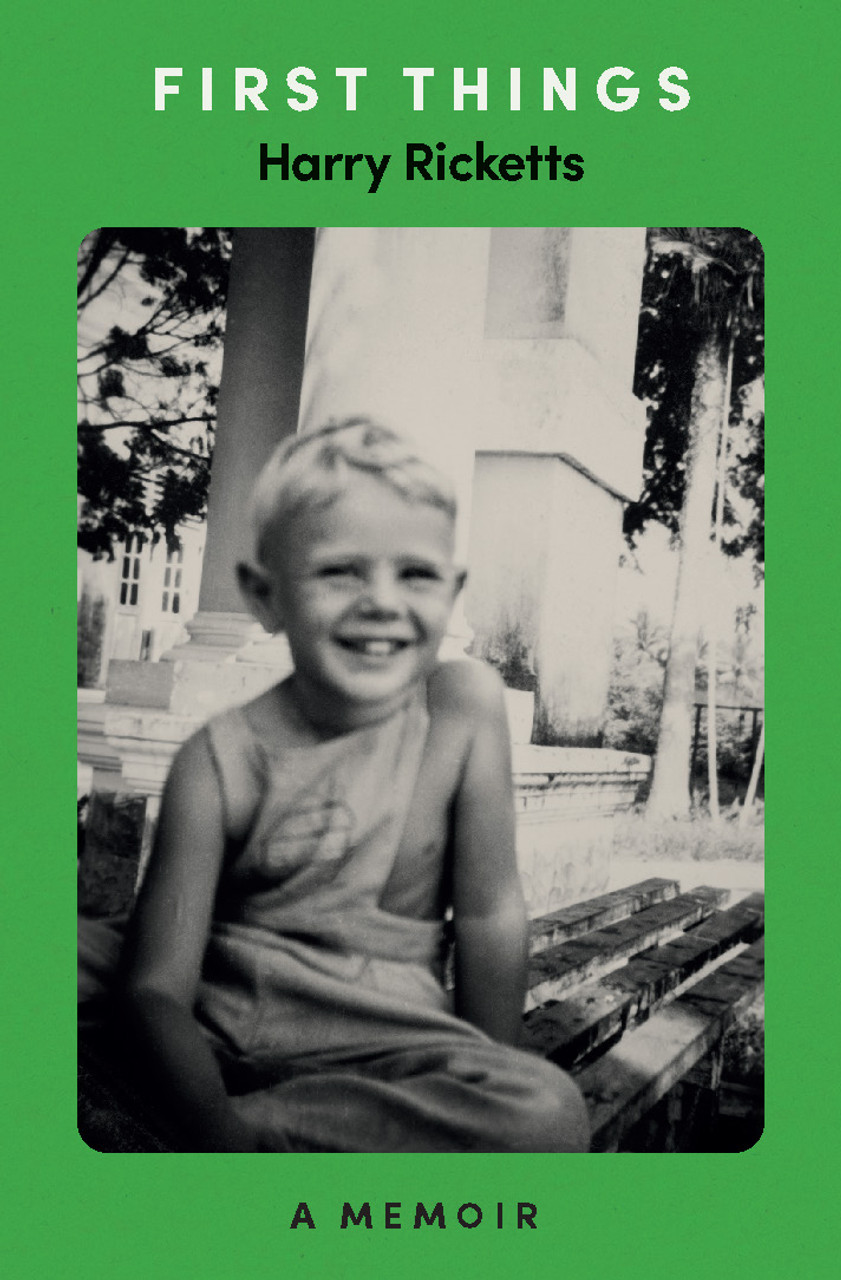
New books in my post box this week: First Things – A Memoir, Harry Ricketts (THWUP) and Manuali’i, Rex Letoa Paget (Saufo’i Press).
Poetry Shelf does not accept open submissions for poems, but do send me notices for the noticeboard, and new books. I cannot promise to feature or review everything as my energy jar is still half full. Thank you so much for your contributions, ideas and enthusiasm for poetry, and indeed, for the gorgeous books published in Aotearoa.


The week’s links
Monday: Monday Poem – Bill Manhire’s ‘Hello’
Tuesday: Sylvan Spring reads from Killer Pack
Jesse’s Reading Party
Wednesday: 5 Questions – Khadro Mohamed
The Rush Cottage Writers’ Residency
Thursday: Review and conversation with Amy Brown, My Brilliant Sister
Friday: Review of Madeleine Slavick’s Town
A poem and a musing
II
How she grew old happened in fine-darned places,
Cracked pictures, seen too close: you’d barely know . . .
She was a red-haired woman, two little lines
Sharp cut between her brows: her eyes looked tired
As long as I remember, and her strong mouth sad.
Still she held firmly: when we went for walks
It was I who flagged: you’d never guess what frocks
She made us, while the clean thread broke and broke,
And I stood pricking at red sateen, or spoke
Roughly: that dance, the only one we had,
I remember Judy’s frock of petals, wired
Bright blue, with silver wrappings round the stalks.
Sometimes I loved her: but I liked smooth faces
Like the other mothers had, and told her so.
She laughed: she was never frightened: she took knocks
Square on the mouth, and wouldn’t hit you back:
I never saw my mother dressed in black
But grief came . . . and she never let it go.
Robin Hyde
from ‘The People’ in Houses by the Sea and the Later Poems of Robin Hyde, ed Gloria Rawlinson (Caxton Press, 1952)
So many poems of and for and by mothers on my shelves. How do we know and love and speak our mothers? In my second collection, Chrome (Auckland University Press, 2000), I built my house, my home, my place of belonging. The four sections were infused with a colour: my yellow self, my rose-red mother, my father green as grass, and the blue ripeness of poetry. I haven’t looked at this collection for a very long time, but with Mother’s Day on Sunday I wanted to read the mother section and see how I felt. My mother died a few days before Christmas last year, after a challenging month, and I could barely get to the airport, let alone fly down to care for her, or go to her funeral. So I mourned her here, at home.
Chrome. Fabrizia Ramondino’s novel Althénopis, inspired me to perform, in poetry, the process of writing home. I was writing myself as home, I was writing my mother and father as home, and finally, I was writing the text itself, the long poem, as a form of home. Colour functioned as both filter and point of saturation. I was drawn to the compelling colours of certain films: the work of Andrei Tarkovsky and Peter Greenaway, Sergo Paradjanov’s The Colour of Pomegranates. Alexander Theroux’s book The Primary Colours extended the range and play of colour. The blue-purple of The Rothko Room in London’s Tate Gallery and the yellow of a Wolfgang Laib installation helped provide the stillness I needed in order to write.
It was good to return to this sequence, to see what I had written all those years ago, to remember the complications of maternal relationships, and how we only ever know partial versions of our parents. I usually keep my family out of my poems, so this was an usual book to write. Today, when things feel so challenging both health-wise and planet-wise, I am still drawn to colour, to the earthy hues of Frances Hodgkins, a still life of Agnes Martin, the vibrant art of Sara Hughes and Grace Wright, Saskia Leek and John Pule, to the light on the Waitākere Ranges, the colour pop of food on a plate, tomatoes ripening in the garden.
At the end of the toughest week I have had in ages, when I want to weep at this nincompoop Coalition, at how very hard it is to recognise notions of ‘better’ in any of their choices, I witness the immeasurable kindness and care of health workers despite their breaking points. And yes, it was good to return to Chrome, to think of my mother, to think of writing, of reading, to find moments of stillness and joy.
I have a couple of spare copies of Chrome to give away, message me if you would like one.
we call it repetition
we call it in that order
red dahlias on the table
your face still fevered and hectic
here is a history of mothering
here is resentment and love
love is your origin
the flowers and the light
cyclamens flame-deepened on the sill
fuschias held for a moment
I am holding my mother closer
lingering at the border of home
she walks across Scottish Highlands
along Nelson rivers and Northland tracks
with crisp air salvaging a life
the mother returns to the beginning
the mother in pieces
where do I begin?
my voice cracked and blunt
the difficult daughter herself in pieces
I will walk along the Cascade track
in the secluded undergrowth
we sweep the rocks
we take the sand
I, the wayward daughter with heart
grown on stories and words and damask
leaking mouth
leaking lungs
see the tired skin of the mother
my mother still with milk memory
she moves on her own now
to places she once lived
I search for a token
a familiar place
we speak
in shifting patterns
Paula Green, from ‘Red’ in Chrome

Town, Madeleine Slavick, The Cuba Press, 2024
Madeleine Slavick’s Town is her first book to be published in Aotearoa New Zealand. Born in the USA, she spent nearly 25 years living in Hong Kong before moving to a country road in the Wairarapa. Like this new collection, her previous books bring together poetry, stories and photographs. Town, exquisitely designed by Tara Malone and Paul Stewart at The Cuba Press, fits in the palm of your hand, the paper stock beautiful. It contains 50 stories and 50 photographs – and, in my mind, I call it a poetry collection.
I am immediately drawn into the pace of writing, the ambulatory beat, where as reader you become meandering walker, pausing to check the view, to dawdle between the lines, to linger upon an image, a single word. I am reminded of Blanche Baughan’s predilection for walking, for Jenny Bornholdt’s magnificent ‘Confessional’ in The Rocky Shore (THWUP, 2008). In Town, you encounter birds, buildings, letterboxes, paddocks and livestock, but as you travel, images yield memory, admissions, anecdotes, and the book you hold in your hand becomes a pocket memoir.
‘Language’ is the word dancing on the tip of my tongue as I read. These gems for example: “‘Need’ and ‘want’, the same word in Cantonese.” “In Cantonese, ‘editing’ is ‘washing.'” And then the poet is ‘back at the desk, washing’. A new country of residence is a lexicon of unfamiliar words, a new language to learn (te reo Māori for Madeleine), a new way of naming and being named (as in Hong Kong).
Ah. Walking is a form of writing, writing is a form of walking, and the wandering thoughts trace beauty and sky, parenting challenges, body and illness, thefts from paddocks and letterboxes. Writing poetry is a satisfying way of recording, laying down an album of memory, of delight. In Madeleine’s exquisite album, tiny exposures establish a sensual chain, carefully chosen ‘shots’ that, as we keep reading walking reading, sit within and burst out of the frame.
Madeleine writes:
Do you feel exposed after writing a memoir; can we trust
what you write, have you always known you were a
writer, is the ear more important than the eye, was the
book an essential item during the pandemic? Was the writer?
from ‘WRITE, WRITER’
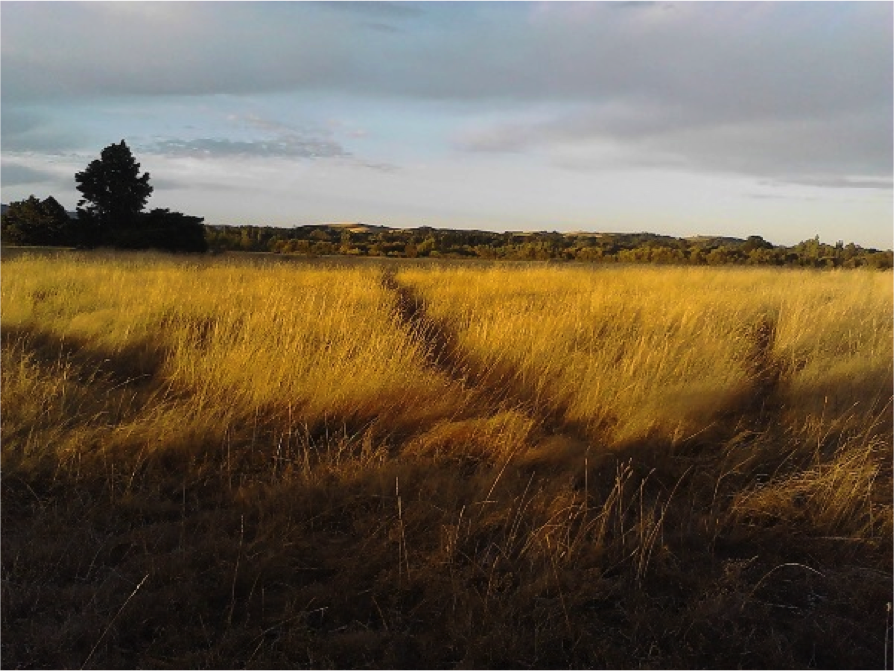
Madeleine’s photographs exude warmth – not just in the earthy colour palette but the visual focus, the satisfying composition: a building, a sign, the sky, shadows, the road. There are never people; the bench is empty, the footpath empty, the field an expanse of grass. It is as though I am invited to occupy the scene, for a sweet moment, to store an interplay of light and dark for a later date.
On the back of the book, Hinemoana Baker nails her endorsement: ‘Town is reminiscent of Robert Hass at his most beautifully imagistic, or Georgia O’Keeffe telling deep stories in flowers.’ Yes this a book to fall into, to savour the joy of contemplation, to recognise the ugly, the surprising, the familiar. It is a book of wonder.
Madeleine Slavick was born and educated in USA, lived in Hong Kong for almost twenty-five years and now lives in Wairarapa, Aotearoa. She is the author of Something Beautiful Might Happen, Fifty Stories Fifty Images, delicate access 微妙之途 and Round: Poems and Photographs of Asia. Town is her first book published in New Zealand.
Interview with Mark Amery. Madeleine reads the title poem of the book at 1’25.
“She is Seven” – installed in Whakaoriori Masterton video reading as part of the Outdoor Poems project
The Cuba Press page

My Brilliant Sister, Amy Brown, Scribner/Simon & Schuster Australia, 2024
Amy Brown’s debut adult novel, My Brilliant Sister, is a brilliant, insightful read with deftly crafted sentences and structure. Witty. Warm. Nuanced. It was the perfect book to devour over the past weeks, and underlines the strength of novels to get us thinking and feeling within and outside frames, to reflect on where we are and where we‘ve been, particularly as women.
Perhaps the reason it has resonated so deeply with me is because my doctoral thesis in The University of Auckland’s Italian department explored the writing of Italian women novelists, considering the ink in their pens from every direction possible, their silencing and their resistances, their preferences and their attachments. I ended up with the word ‘conjunction’ because it clearly signalled women, and in my thesis writers, can neither be determined nor regulated by models and expectations but form an enriching and necessary movement of ‘and’. We are this and this and this and this – whatever our gender.
Amy’s novel is a version of Stella Miles Franklin’s My Brilliant Career (1901), a novel that features the rebellious sixteen-year-old Sybylla Melvyn. Living in the Australian Outback, Sybylla rebels against the social strictures placed upon women, fuelled by those demanding rights and voice across the globe.
I am picturing Amy’s novel as a glass globe. It builds vital form though a series of layers that can be admired independently, but that work together to form a whole, a narrative object say, that depends upon conjunctions.
There are three narrative sections with three women protagonists in three different settings. ‘Ida’ is set in the present and features the voice of a mother/ writer/ teacher on the verge of rebellion. ‘Stillwater’ is set in the past and features the voice of Linda, Miles Franklin’s sister. Linda lives in the shadows and margins of her famous sibling. ‘Stella’ is set in the present and features the voice of a contemporary musician and songwriter who has retreated to an off-the-grid bach to reboot.
I hold the novel globe before me, and it sparks with light and intricate possibilities. Each voice is a refraction of Miles Franklin and her character Sybylla, a version of the three women protagonists, and a refraction of who I am as a reader. More than anything, it promotes the prismatic possibilities of women.
Character is utterly paramount, the voices shaped by Amy’s imagining, research and experience. Ideas are also paramount. Miles Franklin was a bohemian, a rebel, and stereotypes, whether women’s roles, placement in the margins, writing expectations and reception, are at the fore. I jotted down so many ideas in my notebook that got me sideways drifting.
Ida: To play is to pretend, but it is also real. The more realistic the pretence, the better the play. To play is to trick yourself into entering the real by appearing to escape from it, though the best games don’t give you time to think about them in this way.
Linda: My memory skims like a stone, hitting the surface of what happened at its worst moments and gliding above the months that must’ve been tolerable.
Linda: Words can, as everyone knows, be a form of nourishment. The best, like breastmilk, inoculate against the myriad contractable ills of the world.
Linda: This realisation urged me to write – to find any scrawlable instrument & begin telling my own story in the margins of your letter, however badly it came from my head in the moment.
Stella the musician: I can never remember the difference between average, median and mean, but I do recognise balance and I understand that it requires time.
Linda: At my side are birth, death, domestic labour, death; at yours, sea-bathing, freedom, success. Between us, we’ve lived a real life.
Many readers of the book have highlighted the interplay of intimate detail and wider focuses, a narrative texture that enhances its rewarding intricacies.
More than anything, the novel feels utterly real, not a reductive formula on creativity or domesticity, on how to define ‘women’, on either or. Yes, I am haunted by this book, I am inspired by this book, I am comforted by this book, because we are still writing, we are still communicating, mothering, going solo, inventing, breaking ceilings, changing laws. We are still loving, we are still stretching, discovering, rebelling. This brilliant book is to be shared.
With so much to say about My Brilliant Sister, so much I have not said, I invited Amy to respond to some of the questions that percolated as I read.

A conversation
Paula: I am a big fan of your poetry Amy. What changes when you shift from poetry to fiction?
Amy: Thank you, Paula. I think the transition from poetry to fiction has been gradual and subtle for me. My poems got longer – The Odour of Sanctity was, essentially, a 240-page poem. They gained prose footnotes (Neon Daze). They have always contained characters. And some of the fiction I was reading while writing My Brilliant Sister had a poetic texture – an emphasis on voice, unconventional plotting, symbolic weight, space for the reader to infer and play. Some that I remember particularly are Jenny Erpenbeck’s The End of Days, Jenny Offill’s Weather and Dept. of Speculation, and Claire Louise Bennett’s Pond. I think it’s only now that I’m writing my next novel – and conscious that I’m supposed to be writing a novel – that the process feels different, more deliberate.
Paula: Your novel depends upon both research and imagining. What were the challenges and the delights of this fertile braid?
Amy: Each has its own challenges and delights, as you say! I find the administration of research challenging; even after having done a PhD, I’m still quite hopeless at organising my notes, keeping track of sources and so forth. I lose quotes and berate myself and have to start over. And there’s often the sense of being overwhelmed by the responsibility of writing about those who’ve actually lived. But the thrill of dealing with primary sources – especially with historical voices – spurs me on. It was only when I read Linda Franklin’s reply to Stella’s parcel of My Brilliant Career that I thought I’d have a hope of writing my own novel; I needed to hear her written voice. On the other hand, the fact that Linda’s life was tragically short (she died of pneumonia when she was 25) and much less public than her sister’s meant that source material was limited, leaving space for me to imagine, speculate and relate.
Paula: Your three narrative sections juxtapose past and present: ‘Ida’ (present), ‘Stillwater’ (Linda, past), ‘Stella’ (present). Three different narrators, three different settings. Yet the movement of motifs, ideas and personal challenges is vital. Overlap is producing both difference and similarity. We have shone various spotlights into the shadows of the past in order to pay attention to what and how women write. Do you think there are shadows in the present that we still need to attend to?
Amy: Yes, absolutely. In Australia (where I’m writing from right now), there’s currently an “epidemic” (as the Guardian described it) of violence against women. As of yesterday, 27 women have been murdered by men so far this year. A gender pay gap also persists (21% in Australia). These may seem tangential to writing, but how one lives obviously affects how one writes. If you’re living in fear, or working long hours (paid or unpaid), then writing is going to be difficult. That is largely what My Brilliant Sister ended up being about (as it seemed to me, at least, as I was editing it) – the fact that writing a novel, or making art, or having a brilliant career of any sort, requires support and care; it’s much more communal than the myth of genius suggests. Stella Miles Franklin herself – specifically her bequest in perpetuity – is responsible for supporting women’s writing in Australia. The Stella Prize, for women and non-binary writers, is a brilliant contrast to the societal “shadows” that still exist. It was established by a group of angry (and apparently slightly drunk) women in 2012, after several years of Australia’s most prestigious fiction prize, the Miles Franklin Award, being given to men.
Paula: I still see critics denouncing the personal and the domestic as banal subject matter in fiction and poetry. I have reviewed wonderful poetry collections in recent years that explore issues and experiences of motherhood, domesticity, the impulse to write and create, the open parameters of creativity, of writing, of being, of thought. I am thinking of your own poetry, Louise Wallace, Hannah Mettner, Anna Jackson, Emma Neale, Kiri Piahana-Wong, Karlo Mila, for a start. Domesticity and creativity are at the heart of your novel. Like a daily pulse, a necessary heartbeat, providing both tension and reward. What sparked you to explore these within a narrative?
Amy: I think this was in part due to my not being finished with the diaristic, deeply domestic voice I’d been using in Neon Daze (a verse journal of the first four months of motherhood). In fact, I wrote Neon Daze while I was stuck with the historical middle section of My Brilliant Sister, because I’d just had a baby and my mind had no capacity for research or crafting a fictional voice. Instead, I let myself meditate on my immediate experience. When I eventually returned to My Brilliant Sister in earnest in 2021 (five years later!), we were in the midst of lockdowns in Melbourne and that confinement (not dissimilar to the confinement of having a newborn) led me to focus on the minutiae of life at home. Aside from these circumstantial factors, I also really enjoy reading work that honours precise domestic detail.
Paula: In an interview you describe the effect of reading Stella Miles Franklin’s novel My Brilliant Career at a turning point in your life. Did her approach to writing nuance your approach to writing?
Amy: Stella Miles Franklin wrote My Brilliant Career when she was a teenager, which I think is evident in the audacity and energy of the narration. Sybylla, Stella’s autofictional protagonist, is at turns hilarious and earnest, insufferable and inspiring, which charmed me and certainly helped me shape her character in the middle section of My Brilliant Sister. More broadly, I think I was encouraged by Franklin’s own courage in attempting to broach large, genuine questions in her novel – in a way, both of our novels concern what it means for women to lead a good life.
Paula: Stella based one of the characters, Sybylla, on herself. Did you find yourself weaving autobiographical traces into your narrative?
Amy: Yes, I did. The first of the three sections was, initially, much longer and more autobiographical than it ended up being in the published version. It became clear to me during the editing process that, while aspects of my own life were necessary to the novel as a whole, a swathe of diaristic material in the opening section would not go with the fictional second and third parts. So, last year, I started from scratch and rewrote the first section completely and fictionally, which felt impossible at the time but wonderful afterwards. Instead of patchworking different fabrics together, there were threads of autofiction laced through a more tonally coherent whole.
Paula: The novel’s two contemporary sections are set in the time of Covid, and signal its restrictive and divisive settings. For some it was a time of personal reassessment, of renewed values. Covid is still with us, but we face other local and global catastrophes. At one point, Ida comments on how reading a book enables you ‘to inhabit the lives of others’, to divert you from daily concerns. In the middle section, Linda proposes words as a form of nourishment. How do reading and writing work for you in these difficult times?
Amy: As long as I can remember, reading has been a treatment of sorts for me. I prescribe myself what I feel I’m lacking or require more of. Sometimes what I read feeds my mood, other times it teaches me something about how I’d like to write, or it shifts my perspective. Or it helps me sleep. At the moment I’m reading Charlotte Wood’s Stone Yard Devotional, about a woman who joins a convent in, it seems, a bid to escape a profound loss of hope. As a novel, it questions whether loss of hope is a moral failure. I think this is an enormously important question for the times we are living in. But, also, I am aware that while reading can be a source of hope and solace and empathy, it needs to be, as far as is possible, accompanied by action. I read and admired Pip Adam’s writing advice recently, which advocated for political activism and community engagement as writerly behaviours.
Paula: Have you read any books in past year or so that have haunted, transported, inspired, delighted you, as yours has me?
Amy: So many! I’ve had a blessed run lately. Here are a few favourites:
Tove Jansson’s The Summer Book haunted me with its perfect portraits of both youth and age, via six-year-old Sophie and her grandmother. It reminded me of my (of everyone’s) mortality in such a way that was more warming than chilling.
Lauren Groff’s The Vaster Wilds transported me to 17th century America with such visceral vividness that I still see it, involuntarily, most days. Weird but true.
Airini Beautrais’ The Beautiful Afternoon inspired me (as all of Airini’s writing does) for its intellectual heft and candour and goodness (for want of a better word).
Amy Brown is a New Zealand-Australian writer and teacher who lives in Naarm/Melbourne. She has published three collections of poetry, four children’s novels, and completed a PhD at the University of Melbourne. Her poetry, essays and reviews have been published in Australia and New Zealand. The debut novel which became My Brilliant Sister was shortlisted for the Victorian Premier’s Prize for an Unpublished Manuscript.
Simon & Schuster page
Welcome to a new and ongoing series on Poetry Shelf. I have been thinking a lot about the place of poetry in global catastrophe and the incomprehensible leadership in Aotearoa. How do we write? What to read? Do we need comfort or challenge or both? I am inviting various poets to respond to five questions. To launch the series, poet Khadro Mohamed.
I have also found it hard to find a place for art amongst the pain and suffering in the world. Whether its watching our media class and politicians shamelessly cheer on the genocide and inconceivable human suffering in Gaza or the suffering in my own homeland, Somalia, where famine and environmental catostrophe threatens to unravel the entire land. It makes me wonder if it’s even worth it anymore? How can I write about trivial things while people, mypeople, suffer and die across the globe? But I’ve been reading a collection of poems by Palestinian author Sarah M Saleh, Arab-Australian poet Omar Sakar as well as Somali-British poet Warsan Shire, and it’s really helped put a lot of my troubles with poetry during this time at ease.
They all write in a means to make sense of this senseless world.
Refaat Alareer, a Palestinian professor who was murdered by Israel, wrote a poem ‘If I Must Die’ in which he predicts his murder and asks for the world not to forget him and the people of Gaza. This poem has since been translated into hundreds of languages and hangs on the signs of protestors across the globe, including here in Aotearoa, one of the furthest places from Gaza. It’s such a powerful reminder that we must not forget that artists (think: Palestinian artists like Edward Said, Ghassan Kanafani, Mohamed Darwish, Silman Mansour) and in turn, art, is an important tool in imaging a better world.
I don’t want this answer to get too long, but I guess what I am saying is that art is important. Even if it feels like a stupid thing to care about amongst the pain. We must lean into building stronger connections with each other and creating spaces that honour the oppressed and marginalised.
Khadro Mohamed
Have local and global situations affected what or how or when you write poetry?
If by ‘global situation’ you mean the unfolding genocide in Gaza, then yes, it has affected me and my writing profoundly. I am incredibly proud of my Muslim identity and my Somali heritage, but it has become jarring to watch mosques blown up and pages of the Quran smeared with blood flutter in the wind. It has made me angry. But I have not written any poetry about it. I feel like it’s too hard to put what I feel into words, but more importantly: how can I sit to write poetry while I watch Palestianians suffer, right there, on my screen?
I have found it much easier to read and attend book launches to embed myself into the literacy scene. I recently attended the joint book launch of romesh dissanayake and Saraid DeSilva’s books When I Open the Shop and Amma. Saraid wore some earrings with the Palestinian flag, and watching them dangle from her ears as she spoke was such a soothing feeling. Romesh opened his speech by making it clear to the audience that he stands with Palestine and was met with a round of applause from the audience. I think watching the literacy community in Wellington respond to Gaza’s call has been particularly heartwarming.
Prominent poets like Hera Lindsay Bird, Tayi Tibble, Ash Davida Jane and writers like Pip Adam and Saraid de Silva (among many many more) have all made me hopeful for the feature of NZ literacy. I am really glad that my fellow writers care about Palestine and our collective liberation like I do. I feel more seen, and very safe attending a range of events knowing that the majority of my peers share my hope for a free Palestine.
Does place matter to you at the moment? An object, an attachment, a loss, an experience? A sense of home?
The only place that seems to matter to me lately is Palestine as a free and liberated land. It’s hard to explain it, my connection to this land that I have never been to. But I think as I grow more connected to my faith, I cannot deny the significance of Palestine as a place of worship as well. Especially as Palestinians, despite it all, find time to pray daily and mark the start and end of Ramadan.
I also feel connected to my prayer rug, it’s really soft and orange and I brought it from a market in Cairo back in 2012. But I find myself sitting on it and just thinking and praying and hoping.
Are there books or poems that have struck a chord in the past year? That you turn to for comfort or uplift, challenge or distraction.
Poetry is so much fun and there is so much poetry being released into the world all the time. I recently read poetry from Warsan Shire’s collection Bless the Daughter Raised by the Voices in Her Head in which Warsan writes extensively about being Somali in the West. It’s so comforting, her poetry is not only beautiful, but I also feel really seen whenever I open the pages of her book.
I have also read recently Songs for the Dead and the Living by Sarah Saleh, a story of Palestinian refugees in Beiruit before the war. It’s an incredibly moving book that left me feeling really sad but somewhat hopeful for the future.
I am also halfway through ‘Amma’ by Saraid DeSilva, a book about generations of women who are connected. I really love Saraid’s writing in this story. I think her characters are really strong and she interweaves a variety of perspectives and experiences into the stories.
What particularly matters to you in your poetry and in the poetry of others, whether using ear, eye, heart, mind – and/or anything ranging from the abstract and the absent to the physical and the present?
I think all arts are really good at responding to current events, global and local. That has never really changed. I think what matters to me right now is poets and poetry that speaks to the horrors that we are seeing, these voices are overwhelmingly Muslim and Arab at the moment, but I would encourage all poets and writers to write and speak and to educate themselves on Palestine and how all of our movements for equality are interlinked.
It’s no mistake that people who put themselves on the opposing side of Māori rights advocates also align themselves with the genocide in Gaza. We’re all interconnected and it’s more important than ever to build connections and threads to stay connected.
Is there a word or idea, like a talisman, that you hold close at the moment. For me, it is the word ‘connection’.
I think the word ‘faith’ has been really important to me. Not just in the religious sense, but also having faith in the community that I have built around me. I have faith that the world will become a better place soon and it’ll be because we all worked really hard for it.
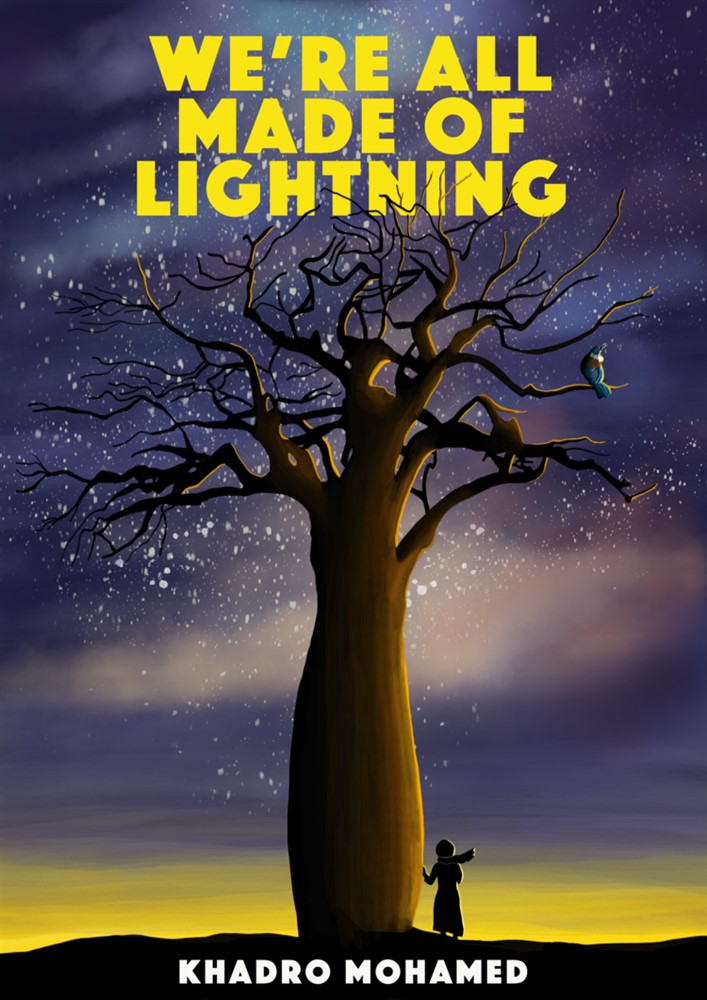
Khadro Mohamed is a writer and poet from Wellington. She’s written a poetry collection, We’re All Made of Lightning (Tender Press, 2022), which won an award at the Ockam NZ Book Awards. She’s also working on a novel (and promises she is almost done with it!).
Tender Press page

Hawke’s Bay Readers and Writers Trust Announce The Rush Cottage Writers’ Residency
Hawke’s Bay Readers & Writers Trust, in conjunction with Black Barn Retreats, is excited to announce a brand new residency for Aotearoa writers.
Applications are invited from writers who are currently resident in Aotearoa, working on any of the following forms: short stories, the novel, poetry, creative non-fiction, memoir and graphic novels. Applicants will need to have one work already published/self-published that is currently publicly available to Aotearoa readers, and provide a link to this in their application.
The residency includes nine free nights’ accommodation at Rush Cottage, which have been generously donated by Black Barn Retreats, and a stipend of NZD$1000 (including GST) to support the writer’s time. Entries close 5pm, 31 May, and are capped to the first 50 received.
Catherine Robertson, Chair of Hawke’s Bay Readers & Writers Trust, says, “We’re so grateful to Black Barn Retreats for this incredibly generous gift to New Zealand writers. Our Trust committee has four authors on it, so we know how scarce and valuable residencies are for writers, and we couldn’t think of a more heavenly place to write than historic Rush Cottage. We’re excited to bring our successful applicant to Hawke’s Bay, and hope that between writing, they’ll be able to get out and experience what our beautiful region has to offer.”
The residency must be taken any Tuesday night to the following Wednesday night inclusive, between 18 June and 31 August 2024. Catherine Robertson says: “The timings are tight this year, so applicants will need to be quick, especially as we’re capping the number at the first fifty. All going well, we plan to open entries earlier in coming years.”
All information can be found here
Or email hbreadersandwriters@gmail.com

To celebrate the arrival of Sylvan Spring’s debut poetry collection (Te Herenga Waka University Press, 2024), Sylvan shares three tracks from the collaborative album he made with friends – the album features poems from Killer Rack.
‘Exploding in Queer joy, this beautiful, visceral experience of a book is precise and magnificent in its craft, expansive and affecting in its content, somehow intimate and communal in the same breath, wild and compassionate. I fucking love this book and weep with gratitude and excitement every time I remember it’s in the world.’ —Pip Adam, author of Audition and Nothing to See
‘Dear Kim Sasabone from the Vengaboys’ Haz Forrester
‘if you were a body of water what would you be’ Jazmine Mary
‘colon’ Frazer Walker
Sylvan Spring is a Pākehā writer and occasional music maker who has been shaped by the lands and waters of Te Whanganui-ā-Tara. Their debut poetry collection, Killer Rack was released on February 8 by Te Herenga Waka University Press.
Te Herenga Waka University Press page
Bandcamp page – Sylvan performs poems from collection with friends. This is a collaborative album with a bunch of friends, featuring sonic interpretations of some of the poems from killer rack the book. any proceeds from the sale of the album will go to f’ine pasifika, to tautoko them in their support for mvpfaff+/pasifika lgbtqi+ people, particularly in navigating social services.
Sylvan in conversation with Pip Adam at Better off Read (Episode 138)


Poetry at the NAT 7pm this Wednesday, featuring Robert Sullivan and Michelle Elvy, with MC Sophia Wilson. Open mic, all welcome
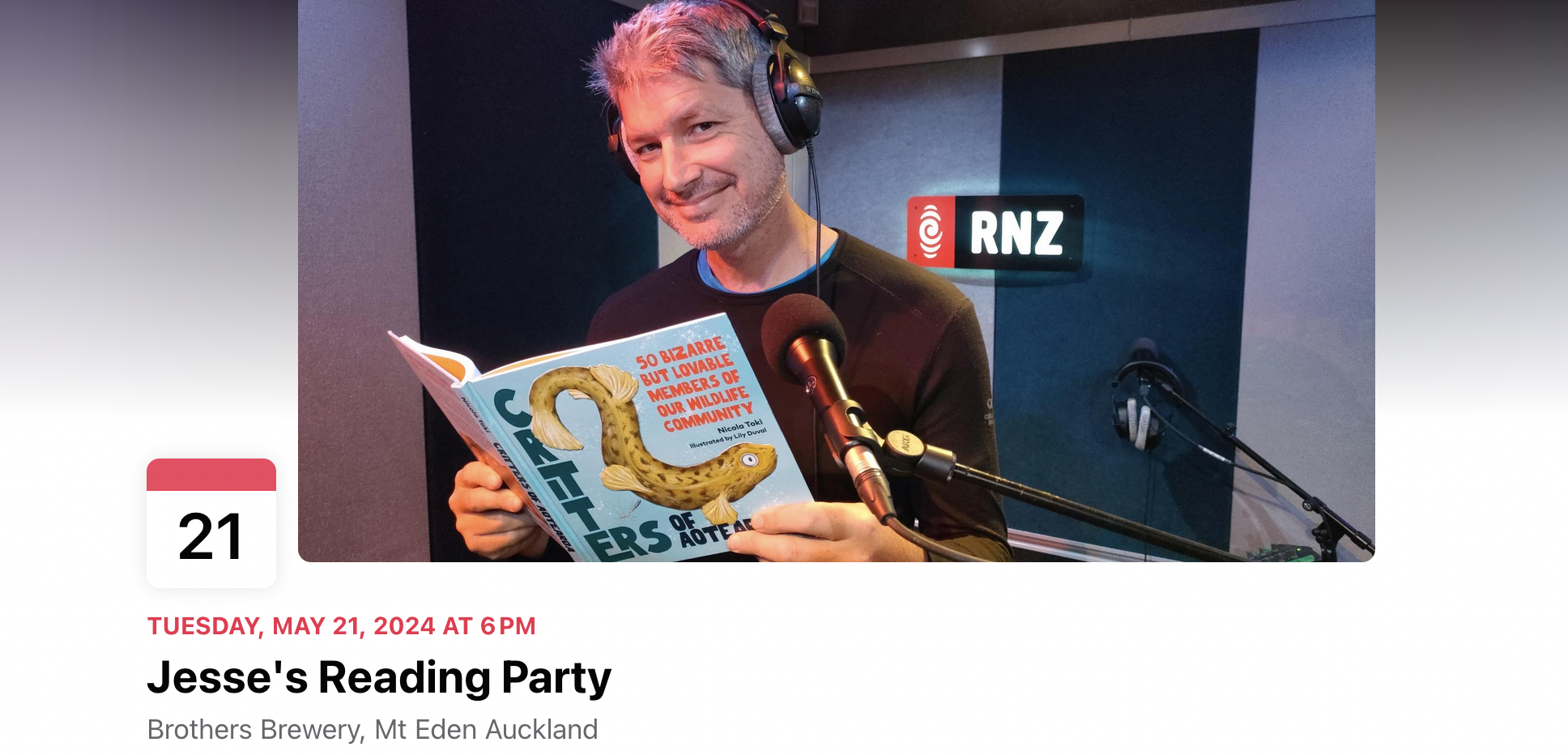
Event by Jesse Mulligan RNZ Afternoons
Brothers Brewery, 5 Akiharo Street, Mt Eden, Auckland
Tuesday 21 May 2024 6:00pm – 8:30pm
Join us for a reading party! Tickets are $10 and include a drink and a spot on the couch to read in peace and spend time with like-minded readers. Arrive at 6pm, start reading whatever book you like at 7pm, then discuss with other party goers.
Tickets here
Hello
I fell out of someone’s
debut novel, and now
I don’t know what to do.
It’s scary out in the world.
I would like to wake up
in that bed again,
a morning in late
1940s sunlight, just a few
years after the war,
sharing a cigarette
with the woman
who might go on
to be my wife. I don’t know,
something must have gone
terribly wrong. I think
maybe the workshop
hated me. I didn’t even argue
or run out blindly
into city traffic. It’s just
I was never developed.
I stubbed out my cigarette
and then she dumped me.
Bill Manhire
Bill Manhire‘s last collection of poems, Wow, was published in 2020, and was a Poetry Book Society Selection. An interview subsequently appeared in PN Review. A recent collaboration with Norman Meehan and others, Bifröst, has been released by Rattle.
 NZ Poetry Shelf