

Weather Report
There is a complex trough of grief
There is a ridge of missing hearts
Paula Green
you can’t write poetry about this government
hate mail
death threats
graffiti
but not poetry
you can’t write poetry about this government
those grotesques
never inspired no art
no heart’s ever danced
when they entered a room
nobody has lost sleep
over their absence
you can’t write poetry about this government
purveyors of cruelty and debt
like trying to find the beauty
in black mould
or concrete
Dominic Hoey
Dominic Hoey is a writer based in Tāmaki. When he’s not losing money on his various vanity projects, he’s teaching writing to people who hated school.
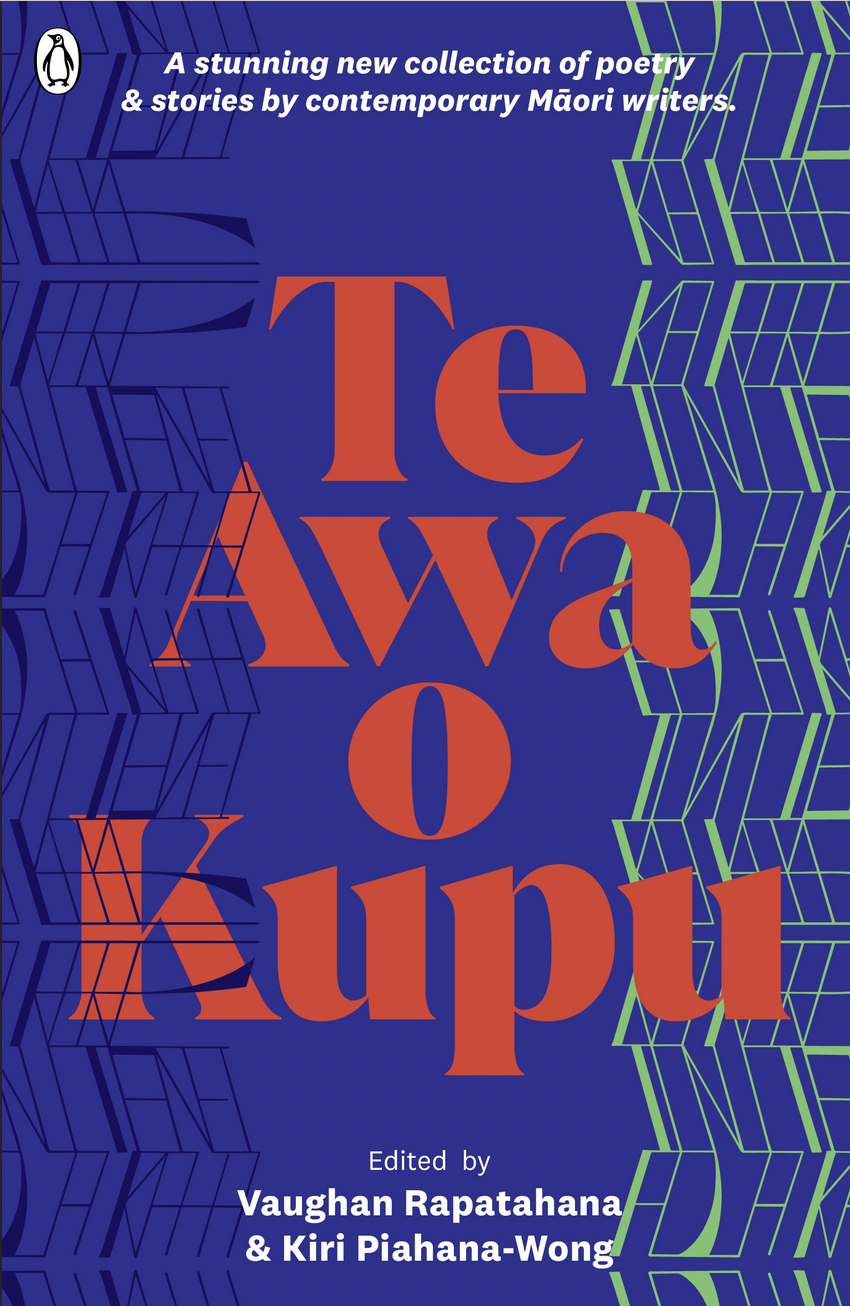
Poetry Shelf is gifting a copy pf Te Awa o Kupu, edited by Vaughan Rapatahana and Kiri Piahana-Wong, Penguin 2023, to Christopher Reed.
You can read a gathering of poems by Māori poets, a couple of which appear in this stunning anthology, here.
Sometimes a tree grows inside you
while oystercatchers call from the shore
and red-billed gulls paddle for worms in the mudflats
sometimes a tree comes in through your eyes, ears or fingertips
and settles in your bones
perhaps a pōhutukawa, bent, knotted, lovely
low branches bathing in a gentle tide
it comes to live in you
finding its place in some quiet corner
and when the bustle is too much
or the sky too dark
you can go there, you can sit with your tree
breathing together while the sea laps your roots
singing with the riroriro
savouring the wind
Janis Freegard
Janis Freegard (she/her) is the author of several poetry collections, including Reading the Signs (The Cuba Press). Her short story collection, Wild, Wild Women was published recently by At the Bay | I Te Kokoru after winning their short story manuscript competition. Born in South Shields, England, she grew up in the UK, South Africa, Australia and Aotearoa, and has lived in Te Whanganui-a-Tara Wellington most of her life. Website
Māori Language Week 2024 is a vital way of celebrating why the reo is utterly important in Aotearoa. This week Poetry Shelf has gathered poems by contemporary Māori poets whose writing nourishes, inspires, challenges, connects us. Te reo Māori is present in a line, a word, an idea, story, experience. May we listen with both ear and heart.
So many Māori poets, whose poetry has moved me, are not part of this tiny celebration. I will gift a reader a copy of Te Awa o Kupu, a stunning anthology of work by contemporary Māori poets, edited by Vaughan Rapatahana and Kiri Piahana-Wong (Penguin, 2023). I will also gift a copy of Talia by Isla Huia to a reader. Isla is appearing at the forthcoming Ladies LiteraTea. Leave a message here or on my social media pages by Rāhina 23rd September with your book choice and I will choose someone to send a copy to.
I am sitting at my kitchen table listening to the rain, listening to this poetry gathering, and I feel the words of Hone Tuwhare, pit-pattering on the wooden deck, as I read a glorious armstretch of poems and poets.
May we celebrate and support this forever language, this taonga every day, kia kaha te reo Māori.
Ka rongo au i a koe
e hanga kōwhao iti ana
i te marino
e ua
Hone Tuwhare
from ‘Rain’, originally published in Come Rain Hail
Bibliography Room University of Otago, 1970
‘Ua’ transl. Patu Hohepa, Hone Tuwhare Small Holes in the Silence: Collected Works, Penguin 2011
The poems
harakeke
karakia to Papatūānuku, to Ranginui, to all tūpuna
give thanks for their gifts
‘ngā taonga whakarere iho’
never take the mother or father or child of the plant
trim the edges of the blade and cut away the keel
return the remains to the whenua
make a small slice in the flesh of the leaf
strip back the skin until the fibre is laid bare
take care of this plant body
as if it were your own body
miro the muka against your own skin
steep the remnants in river water
and they will give you the first light of the rising sun.
Arielle Walker
from AUP New Poets 10, Auckland University Press, 2023
Te Ihi
From where does it come, te ha
the life breath
and what strange winds blow
through this house
in the drift and flow
of whaikorero
the call
ka ea ka ea
it is clear, it is clear
whakapiri tonu whakapiri tonu
hold fast, hold fast to what
te ihi, te ihi, te ihi
te ihi, what is that
te ihi, what is this word
te ihi, te ihi, what is it
kai mau, kia mau ki te aha
he paua mura ahi nga kanohi o Tumatauenga
the flashing eyes of Tu
haka it is haka
lightning flashing in the sky
rapa rapa te uira
ka tangi te whatatiri
and thunder
the beat of the feet till the earth shakes
kia whakatahoki au i a au
from where does it come, te ha
the life breath, te ihi
the sobbing wailing and laughter
Apirana Taylor
from a canoe in midstream (Canterbury University Press, 2009)
On trying to learn te reo at the Mākara crossroads
Any dormant hill takes a real climb
but this one is inside you
is the underside of you.
In order to make it ki te taumata
you find yourself becoming goat –
your hooves repetitive clacking
distant sounds becoming quite fucking close.
You send all your voices out
that everything might charge the gate
scuffed and stoney with history
but it’s hard to slow that many
animals once they are ambular.
From the peak you see old people
winding, marvelling
tourists of the past awakening
to the immensity of your cloven hoof.
Crack open the rocks against this wound.
Echo round the coast as you count the waka.
Anahera Gildea
from Sedition, Taraheke | Bush Lawyer, 2022
Castle Hill, 2003
As you approach
Kura Tawhiti –
this landscape of stone
across the valley
from the mountain of the kakapo –
you unease grows,
& points of reference
begin to change
as this curious land
unfolds from the earth
into the space we occupy;
therefore
give this place a simple greeting:
tena koe, tena korua, tena koutou –
and respect –
place an open hand
on the first rock
& walk softly
through the great silence
of many years
where each stone
will surround you
with legend
as it did
those past travellers
who asked shelter
& lay in the dark
listening to to their ancestors’ talk
dissolving in the rain.
Rangi Faith
from conversation with a moahunter, Steele Roberts, 2005
In the beginning
Sometimes I go back to where it
all ended for me, to where it
all began. They named the
cliff face after me — Te Āhua-o-
Hinerangi. The gulls still circle
there, the rātā still blooms,
all the threads of my story
still cling to the grasses and
tuapuke.
You might be wondering if
you should feel sorry for me —
after all I lost my husband to
the sea and then my own life.
I want you to understand, I
chose my destiny. When I sat
on the headland and did not
move, there was power in it.
And certainty. Not just my
grief, I knew.
What I didn’t realise is how
powerfully that knowledge
would grow into the ground
there, would seep into the
earth. I never intended
that my decision sway
others despairing of life.
Now I exist in kōrero
and waiata and yes
pakiwaitara too. My
very likeness is scored
into the cliff, cascading
down into the sea. But
I have grown bigger
than the life I had. I
can be everywhere
now. And nowhere.
Sometimes, on the
right day, with the
wind in the west and
the sea gleaming,
I even catch myself
on the edge of song.
Kiri Piahana-Wong
from Tidelines, Anahera Press, 2024
Titihuia’s Moko
We sit in the
twilight of your lounge
the sofa now a bed
You search my face for your kuia
I’ve carried her name
for almost thirty years
It’s good I’ve come
It’s good I’m learning
there isn’t much time you say
You insist, hold my hand
fingertips trace the valleys
between protruding veins of memory
Once were ringa raupā
feel the supple weight of it all
the fleeting pulse of all things
You show me a photo of her
taken before she got the
moko kauae I didn’t know she had
There isn’t much time
There are things now
that I will never know
You use every laboured breath
to pass whakapapa from memory
to tongue to ear
Stop only to make jokes
about flirting with the nurse
It’s good you’ve come
Āe, I’m the last one
You still refuse
to use my first name
call me only Titihuia
a name you won’t see
me live up to
Nicole Titihuia Hawkins
from Whai, We Are Babies Press, 2021
Okoro: Honouring Words
(((((((For Kateri)))))))
Here in
this part of
our Waipounamu
((with
my tūpuna
Maru))
I saw through
the night cloud
īnaka / īnanga / whitebait
but not the aurora
borealis I saw
in Ontario with you
in green curtains
dancing the horizon
ki tua o te ārai
(((beyond seeing)))
to the zenith
and firefly sparks
driving on
to Cape Croker,
Georgian Bay
where our tūpuna
continue the hui
Robert Sullivan
from Hopurangi Songcatcher, Auckland University Press, 2024
Blood Brothers
I recite a karakia for my brothers
they would prefer I bring kebabs
I tell them about the Hokianga
they tell me about their bills
I explain tangata whenua
they turn up the TV
I dream of Tāne Mahuta
they roll cigarettes
I summon the names of our ancestors
they take their medication
I miss our marae
they put the bins out
Anne-Marie Te Whiu
from Ora Nui 4, Oranui Press, 2021 and Te Awa o Kupu, Penguin, 2023
Defying death
Remember my whare
The solidity of it
I’ll stand there on the pae
Breathing like a bird
Waiting for its mother
Waiting for the words to call you home
Its bones creak like Nan’s
They are the curved pelvis
Surrounding me
As I move backwards inside our
Whare tangata
You all once lived here
Listen to the call
Tipping us off our path
Pulling us home
Watch out for the mokomoko
Trying to climb in and out
Defying death, is it me
Watch out for the mokopuna
Climbing out
Thinking that they don’t need to
Come home, is it me
Until we hear wailing
Calling us
The final fingernails
Of fire offered and we can choose
If they are thrown
Or cupped gently
In our hands
Turn us into birds
To escape
Or return us
As something new
Burning bright
Ki te ao mārama
Arihia Latham
from Birdspeak, Anahera Press, 2023
hā pīwakawaka
hā pīwakawaka
kei whea koe ināianei
taku hoa iti?
he manu me he waha rōreka
he whaikōrero pēnei i he waiata,
te wā katoa
he aha tō kōrero e hoa?
he aha te tikanga
o tēnei kōwetewete karawhiti?
kāore ahau e mōhio
nō te mea kua nunumi kē koe
ki tētahi atu wāhi
kāore ahau e kite i tō whatu kanapa
kāore ahau e rongo i tō pūrākauroa,
kua ngaro koe ināianei
ā kei te ngere ahau i a koe,
hā pīwakawaka
kei whea koe ināianei?
[hey fantail
where are you now
my little friend?
a bird with a dulcet voice
an oratory like a song,
all the time
what is your story friend?
what is the meaning
of this one-sided conversation?
I do not know
because you have already disappeared
to another place
I cannot see your glistening eyes
I cannot hear your long tale,
you are lost now
& I am missing you
hey fantail
where are you now?]
Vaughan Rapatahana
from ināianei/now, Cyberwit, India, 2021
Oral Language Written Down
The stats say that neither you nor I read.
But Pāpā, our houses are lined with books.
Walls thick with paper, pulp and pine.
Breathing with the drought and damp of the seasons.
In winter we sit fireside,
watching your finger navigate the page.
Letters scattering like lizards
heading back to the underworld.
Stories are always the same.
It’s us that changes.
Like how we dive into black pools
at night, to find each other
in the kitchen, reading
with the lights off,
watching the world
with the volume down.
Pāpā, you are dog-eared and brittle,
finger-printed and water-damaged.
While how I know you blooms
as ribs off a central spine.
Ruby Solly
from Tōku Pāpā, Te Herenga Waka University Press, 2021
Mana
Mana is my grandfather in his retirement from the darkness and depths
and ingrained dust of the coal mine to mow the marae lawn that extends to
the front door of his twice-built house with two coal ovens eternally warm
beneath the simmering pots of the boil up behind unlocked doors where
footwear for a centipede aligns beneath his broad verandah.
Mana is his right to deafness when the noise of the meaninglessness assails his
ears and he sees fit to visit his church of ancestors and lost lovers, whispering
his kōrero to them amid the clamour of his grandchildren and aunties. Aunties
think they run his world yet he remains remote from their cacophony. Never
mind, they mean well eh.
Mana is the pinstriped suit immaculately pressed and never out of fashion,
hung for Sundays and marae committee meetings and visits out of the rohe to
see his daughter or his son or his countless mokopuna, dry-cleaned and crisp
to match the obsidian shine of his shoes and the jaunt of his dark fedora.
Mana is the man who dies without saying.
Ben Brown
from Between the Kindling and the Blaze, Steele Roberts, 2013
12. te awa
the marae is locked. i consider staging my own death, causing the
catalyst for a tangi. it turns out, my cousin said, if you respect the river
it’ll never kill you, even if you ask. i use aunty’s toilets in the campground
office. i take a photo of the locked gate, the ātea fishnetted by metal. on
the banks, i put my ankles in, and say he hōnore in that place behind my
eyes. i do not believe in one atua, but it’s the only one i know. we say it
every morning in class, before whaea is fired.
it’s a gravel road to the convent. i know about the poet, so i’m looking
for his house. i don’t yet know about the raping. in the kitchen, a brown
nun takes five dollars a head for the night. i don’t yet know how many
greens there are, but i can see them all at once. i can smell the dirt. i sleep
in the infirmary bed on the upper floor. a paradox, really, the waiting to
be murdered by what’s beyond the plastic drape, and the lack of concern
about it. i say to mā when i’m urbanised again, about the way the fog
rolls on the river in the morning, about the writing a fake prayer in the
chapel and leaving it on the altar. about mother mary in stone, in the
garden. i say to her about these villages i am possessed by, about tīpuna
and graves and birds. she says she regrets my scottish name.
in tūrangi, i consider death too. i know it like the back of my hand,
which is an emergency exit from where i came; which is the wet earth
and each star that led us here. i know i want to be a hot body, like really
geothermal, brown and smelling like sinew. i am child floating, not yet
city thrusting or yearning for another kind of sun, all artificial. i’m
sober, looking at the forest floor, saying, i know you from somewhere.
maybe from somewhere in my digestive tract, or in aunty’s house where
we chat up the whakapapa over elderflower cordial, about how it’s more
circle than line, about how hinewai is a synonym for every kui that ever
lived. by god, it is almost meningococcal to wash in my own body of
water. in tūrangi i consider just laying me down with the wētā. fuck i feel
māori when i ‘m not scared. when crater lakes steam the phlegm from my
shell and it comes up half vomit, half karanga mai, karanga mai, karanga
mai rā.
Isla Huia
from Talia, Dead Bird Books, 2023
RĀRANGI
Eat kiwi with the skin on.
Draw the blinds down all the way.
Listen to the judder of the washing machine.
Fry an egg in the pan, sunny side down.
Sing ‘One day a taniwha’ to my nephew.
Scrub chicken fat off the oven tray.
Hang the washing out on the line.
Leave an open book face down on the table.
SUPERNOVA
On a walk, Nova gives me yellow flowers, instructing me to
put them in my pocket. I tell her they will get squashed, and
she says it doesn’t matter. She is strong-willed like all the
women in our family. But when we get home she is upset
when I take the flowers from my pocket; they are broken
and crumpled. I take her to the playground and watch her
swing on the monkey bars, a fearlessness in her as she goes.
At the kitchen table I help with her reo homework—we are
making a family tree. We trace the pencil lines all the way
back to our tūpuna. I spell out the names of each one.
I tell her that whakapapa also means ‘layers’, and there
are many layers to each of us. She just colours the paper
in rainbow. Afterwards, she carries her newborn brother
around proudly, in her polka dot T-shirt and overalls. She’s
her mother’s daughter.
ANCHORS
In the morning I sleep late. Kristy is always in the living
room with the baby, watching Teen Mom. This is something
I’ve come to depend on. Every time I feel sad I pick up my
nephew and take him into the garden. It’s sunny outside,
and in the distance I can see the city skyline.
I count every maunga I see: Mt Albert, Mt Eden,
Mt Roskill, One Tree Hill. Growing up, we never learnt
their Māori names: Ōwairaka, Maungawhau, Puketāpapa,
Maungakiekie. There is erasure in the naming and not-
naming.
I catch my foot on the nail on the deck, again. Hop
downstairs to see my parents, and slump into their blue and
yellow couch. When I left New Zealand in my early twenties,
I couldn’t wait to disappear. I didn’t want to see my past in
everything. Each time I came home I wanted to escape again.
This time, I have anchors.
Stacey Teague
from ‘Hoki’ in Plastic, Te Herenga Waka University Press, 2024
The poets
Anahera Gildea (Ngāti Tukorehe) is a poet, short story writer, essayist, and ‘artivist’. Her work has appeared in numerous journals and anthologies including Cordite Poetry Review, Pantograph Punch, Landfall Online Review, Black Marks on the White Page, Huia Short Stories (5,6,7,& 9), the NZ Edition of Poetry (2018), The Spinoff, Newsroom, Sport, Takahe, and JAAM. Her first book Poroporoaki to the Lord My God: Weaving the Via Dolorosa was published by Seraph Press (2016) and her collection, Sedition was published by Taraheke (2022). She is the co-editor of Te Whē, a bilingual literary journal, is the co-chair of Te Hā o Ngā Pou Kaituhi Māori, and sits on the board of ReadNZ│Te Pou Muramura.
Anne-Marie Te Whiu (Te Rarawa) is an Australian-born Māori living on unceded Wangal lands in Sydney. She is a poet, editor, cultural producer and weaver. She was a 2021 Next Chapter Fellowship recipient, and a 2024 Next Chapter Alumni recipient. In 2024 she was awarded a Varuna Residential Fellowship and a Bundanon Artist Residency. Anne-Marie’s forthcoming debut poetry collection titled Mettle will be published by UQP in 2025.
Apirana Taylor from the Ngati Porou, Te Whanau a Apanui, and Ngati Ruanui tribes, and also Pakeha heritage, is a poet, playwright, novelist, short story writer, story teller, actor, painter, and musician. His poems and short stories are frequently studied in schools at NCEA and tertiary level and his poetry and prose has been translated into several languages. He has been Writer in Residence at Massey and Canterbury Universities, and various NZ schools. He has been invited several times to India and Europe and also Colombia to read his poetry and tell his stories, and to National and International festivals. He travels to schools, libraries, tertiary institutions and prisons throughout NZ to read his poetry, tell his stories, and take creative writing workshops.
Arielle Walker (Taranaki, Ngāruahine, Ngāpuhi, Pākehā) is a Tāmaki Makaurau-based artist, writer and maker. Her practice seeks pathways towards reciprocal belonging through tactile storytelling and ancestral narratives, weaving in the spaces between. Her work can be found in Stasis Journal, Turbine | Kapohau, Tupuranga Journal, Oscen: Myths and No Other Place to Stand: An Anthology of Climate Change Poetry from Aotearoa New Zealand (Auckland University Press, 2022).
Arihia Latham (Kāi Tahu, Kāti Māmoe, Waitaha) Is a writer, creative, and rongoā practitioner. Her poetry collection Birdspeak is published by Anahera Press and her short stories, essays and poetry have been published and anthologised widely. She lives with her whānau in Te Whanganui a Tara.
Ben Brown (Ngāti Mahuta, Ngāti Koroki, Ngāti Paoa) was born 1962 in Motueka, and now lives and works in Littelton. He has been writing all his life for his own enjoyment and published his first children’s book in 1991. He is an award winning author who writes for children and adults across all genres, including poetry, which he also enjoys performing. In May 2021 he was made the inaugural NZ Reading Ambassador for Children – Te Awhi Rito.
Isla Huia (Te Āti Haunui a-Pāpārangi, Uenuku) is a te reo Māori teacher and kaituhi from Ōtautahi. Her work has been published in journals such as Catalyst, Takahē, Pūhia and Awa Wāhine, and she has performed at numerous events, competitions and festivals around Aotearoa. Her debut collection of poetry, Talia, was released in May 2023 by Dead Bird Books, and was shortlisted for the Mary and Peter Biggs Award for Poetry at the Ockham New Zealand Book Awards 2024.
Poet and editor Kiri Piahana-Wong is of Maori (Ngāti Ranginui), Chinese, and Pākehā (English) ancestry. She is the author of the poetry collection Night Swimming (2013) and Tidelines (2024), and she is the publisher at Anahera Press. Her work has appeared in over fifty journals and anthologies, and Kiri has performed at numerous literary festivals across the motu. In 2023 Kiri co-edited Te Awa o Kupu alongside Vaughan Rapatahana.
Nicole Titihuia Hawkins (Ngāti Kahungunu ki Te Wairoa, Ngāti Pāhauwera) is a writer, kaiako and proud māmā. Her debut collection, Whai, published by Tender Press, won the Jessie Mackay Prize for best first book of Poetry at the 2022 Ockham New Zealand Book Awards.
Rangi Faith (Kai Tahu , Ngati Kahungunu, English, Scottish) was born in Timaru and brought up in South Canterbury. He is retired from teaching and is currently living in Rangiora. His work explores both European and Maori history and welcomes the resurgence of te reo and kotahitanga in Aotearoa. Published books include Spoonbill 101 (Puriri Press, 2014), Conversation with a Moahunter (Steele Roberts, 2005) and Rivers Without Eels (Huia Publishers, 2001). His poetry is included in ‘koe’ An Aotearoa ecopoetry anthology (Otago University Press, 2024), Te Awa O Kupu (Penguin, 2023), No Other Place to Stand (Auckland University Press, 2022), The Penguin Book of New Zealand War Writing (Penguin, 2015), When Anzac Day Comes Around (Forty South Publishing Pty Ltd, 2015), and other collections and anthologies.
Robert Sullivan (he/him/ia, Kāi Tahu, Ngāpuhi, Irish) has won many awards for his poetry, editing, and writing for children. Tunui Comet (Auckland University Press, 2022) and Hopurangi / Songcatcher: Poems from the Maramataka (Auckland University Press, 2024) are his most recent collections. He also coedited with Janet Newman Koe: An Aotearoa Ecopoetry Anthology (Otago University Press, 2024). He is an Associate Professor in Creative Writing at Massey University and coordinates its Master of Creative Writing programme. He is a great fan of all kinds of decolonisation.
Dr. Ruby Solly (Kāi Tahu, Kāti Māmoe, Waitaha) is a writer, musician, and taonga pūoro practitioner living in Te Whanganui-a-Tara. She has two books of poetry with Te Herenga Waka University Press, Tōku Pāpā (2020) and The Artist (2023).
Stacey Teague (Ngāti Maniapoto/Ngāpuhi) is a poet and teacher living in Te Whanganui-a-Tara. She is a publisher and editor at Tender Press. Her second poetry collection Plastic was published by Te Herenga Waka University Press in March 2024.
Vaughan Rapatahana (Te Ātiawa) commutes between homes in Hong Kong, Philippines and Aotearoa New Zealand. Author and editor/co-editor of over 45 books, in several genres, in both his main languages, te reo Māori and English and his wrk has been translated into Bahasa Malaysia, Italian, French, Mandarin, Romanian, Spanish. Atonement (UST Press, Manila) was nominated for a National Book Award in Philippines (2016); he won the inaugural Proverse Poetry Prize the same year; and was included in Best New Zealand Poems (2017). He has appeared at numerous overseas festivals. he is series editor of two key books published by Penguin Random House in 2023, Te Awa o Kupu and Ngā Kupu Wero, which are compilations of firstly, poetry and short fiction, and secondly of non-fiction pieces, written by ngā kaituhi Māori over recent years.
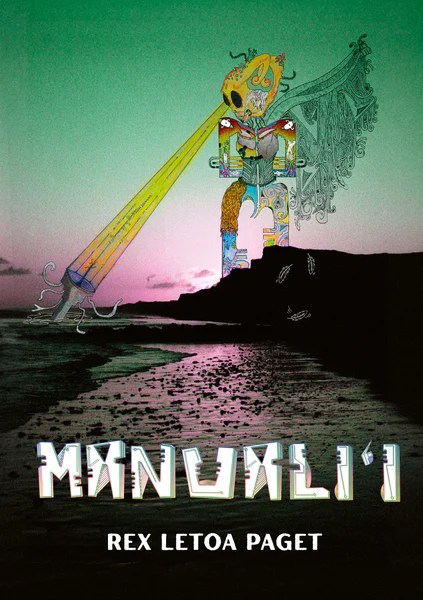
Manuali’i, Rex Letoa Paget, Saufo’i Press, 2024
your skin becomes a dark
damp winter cloak. july dew
necklacing your chest
holding your lungs close.
some weeks it’s like
that. like your mouth is
full of stones. the past a
pebble stuck between teeth.
practice patience.
ride the offbeat tracks
your ancestors lay down.
church organ your ribs.
from ‘Donnnie Darko’
Rex Letoa Paget’s debut collection, Manuali’i, was the perfect book to choose from my poetry pile. It is like a heart imprint on the page, and at this current smash of inhumanity, we need heart. I am immediately drawn into the initial acknowledgements, a form of mihi to the poet’s mother and father, to the way each parent shapes the two halves of his ‘good heart’. It feels, at this threshold of reading, I am entering a book of gratitude. Uncharacteristically, I leap to the acknowledgments page at the back of the book, and again the bloodlines of writing and living are underlined. Writing poetry can be so very private; the intimate seams, folds and pockets of living may find their way into a poem’s form. Yet writing poetry, along with its passage into the world, is so often in debt to family, friends, mentors, place, the books we love, the narratives that affect us.
your heart has always been a jukebox
first lit with mum’s acoustic guitar
bellowing to your nightmares
freedom’s just another word for nothin’ left to lose
dad’s empire of dirt you dust off
ask him what his favourite is when
the night is the dark side of the moon.
you gave yourself up.
burned out supernova falling thru gravity.
come with your silence
with your wild
your blackberry thorns
your mother’s music box
your father’s rusted sapelu
your nana-stitched knuckles
your grandfather-clock gold teeth
balance you scaled from the sea
sheep wool you pull and gift to fledglings.
from ‘The path doesn’t exist til you carve it’
There is so much to love about this collection, I want it to remain an open field of possibilities for you. It is self portrait and it is family gatherings, it is prayer and testimony, it is grief and it is love. How it is imbued in love. The presence of grandmothers signals the importance of familiar anchors, of nourishment and nurturing, of roots and self growth. There is music on the line, music on the turntable, music recalled. In the opening section, ‘Manuali’i’, the eclectic movement of words and lines on the page offers sweet shifts in visual and aural rhythms, as though there is no one way to pin sky-gazing or family relationships or writing poems to a singular form. The lower case letter at the start of sentences enriches the music.
The second section, ‘Icarus’, initially conjures the Greek myth, and I find myself sidestepping into notions of life as labyrinth, the risk of burning up, of plunging down and of drowning. More than anything I am revelling in Rex’s language, because, in both subject matter and lyricism, this is poetry of becoming. Verbs favour the present tense, writing exists in the moment of living, writing is a vital form of connecting. But the verbs do more than this, these tools of action, whether physical emotional or cerebral, stall delight and surprise me within the wider wordcape of a poetic language that is succulent and sense rich.
At times there is a profound ache, contagious, human, humane, and we are in the ‘Elysian plains’, there with the poet’s grief as he remembers his father. This is writing as inhalation as much as outward breath, not explaining everything, tracing threads to the Gods or ancestors, to the places we become, the connections that matter. And yes, I keep returning to the idea of poems as sustaining breath.
To travel slowly with this sublime collection is to enter poetry as restorative terrain, to encounter notions and parameters of goodness, fragility, recognition, to link the present to both past and future, to question, to suggest, to travel, to connect. Oh! and Manuali’i has the coolest illustrations.
A reading
‘La Douleur Exquise’
‘Shine on you crazy diamond’
‘Darling I’m here for you’
Rex Letoa Paget (Samoan/Danish) is a fa‘afatama crafter of words born in Aotearoa, now living on the unceded lands of the Wurundjeri people. His poetry and storytelling are his compass through space and time. His works are giftings from his ancestors and have been published in Tupuranga, Te Tangi A Te Ruru, AUNTIES, Overcom, No Other Place to Stand: An Anthology of Climate Change Poetry from Aotearoa New Zealand, Rapture: An Anthology of Performance Poetry from Aotearoa New Zealand, Spoiled Fruit: Queer Poetry from Aotearoa, and Australian Poetry Anthology Vol 10. His offerings are lessons, learnings, and acknowledgments for the timelines and traditions of yesterday, today and tomorrow.
Saufo’i Press page
Last week, World Suicide Prevention Day was marked by readings from Otago poets on the theme of mental health and loss; themes which Lynda Scott Araya, Diane Brown, Liz Breslin, Majella Cullinane, Clare Lacey and Mikaela Nyman have all written powerfully about. They were brought together by Linda Collins, local author, poet and editor (Loss Adjustment, Sign Language for the Death of Reason) with the support of Michelle Elvy of NZSA, the aim being to share, as well as raise awareness and funds for Life Matters – Suicide Prevention Trust.
‘As soon as I approached poets for the reading, everyone was incredibly enthusiastic about the idea. The event was deeply moving, with poetry the star, threading truths, feelings and connections. It could have been a sad occasion, with the death of my daughter integral to my creativity, but the kindness of poets carried me through – and upwards, softly and hopefully.’ Linda Collins
The poetry shared had a deep impact on all who were there, and it’s hoped this special reading will now become an annual event.
Life Matters can be reached here.
Praxia
after Sylvia Plath, Ariel
Dyspraxia, from the Greek:
Dys. Bad, difficult.
Praxia. Perform.
My clumsy child,
we trip up through life together
and even attempt
your maths schoolwork.
But sequencing is beyond us.
Marvel at our frozen brains.
Marvel at our fingers,
the lack of fine motor skills.
Our dead hands drop pens
on the floor. Again. Again!
My child cries: Enough!
No more reining in.
She runs, I run from classroom,
up the hill. Galumphing,
Whoops-a-daisy crash
is us tumbling
over and over.
Our knees are bloodied,
we struggle to get up.
Our neurons
sputter, stuck in recesses
of brain wiring.
Able at least to gasp,
laugh, we surrender
to the doing of nothing,
to languor on soft grass.
Dissing the dys,
just us;
stasis.
Linda Collins
recaptcha / all I ask is
prove that you’re not a robot
check all the boxes with crosswalks
trafc lights, fre hydrants, buses, trains
prove that you’re not a robot
optimise, improve, do more
do right, write lists
prove that you’re not a robot
cry quiet with the rain, close
your eyes, dream electric
prove that you’re not a robot
so you can progress to the next
and the next screen and
check all the boxes with sidewalks
so the robots can learn how to drive
check the hydrants, stop at the lights
prove that you have skin in the game
pay with plastic, use adaptogens
you haven’t touched another human in weeks
if a leaf falls can you
if a leaf falls can you
if a leaf falls can you
prove that you’re not a robot
teach the robots you know what’s what
check all the boxes with red lights, greens
you cut, you bleed, you sew, you click
prove that you’re not a robot
submit
Liz Breslin
from In Bed with the Feminists (Dead Bird Books, 2021)
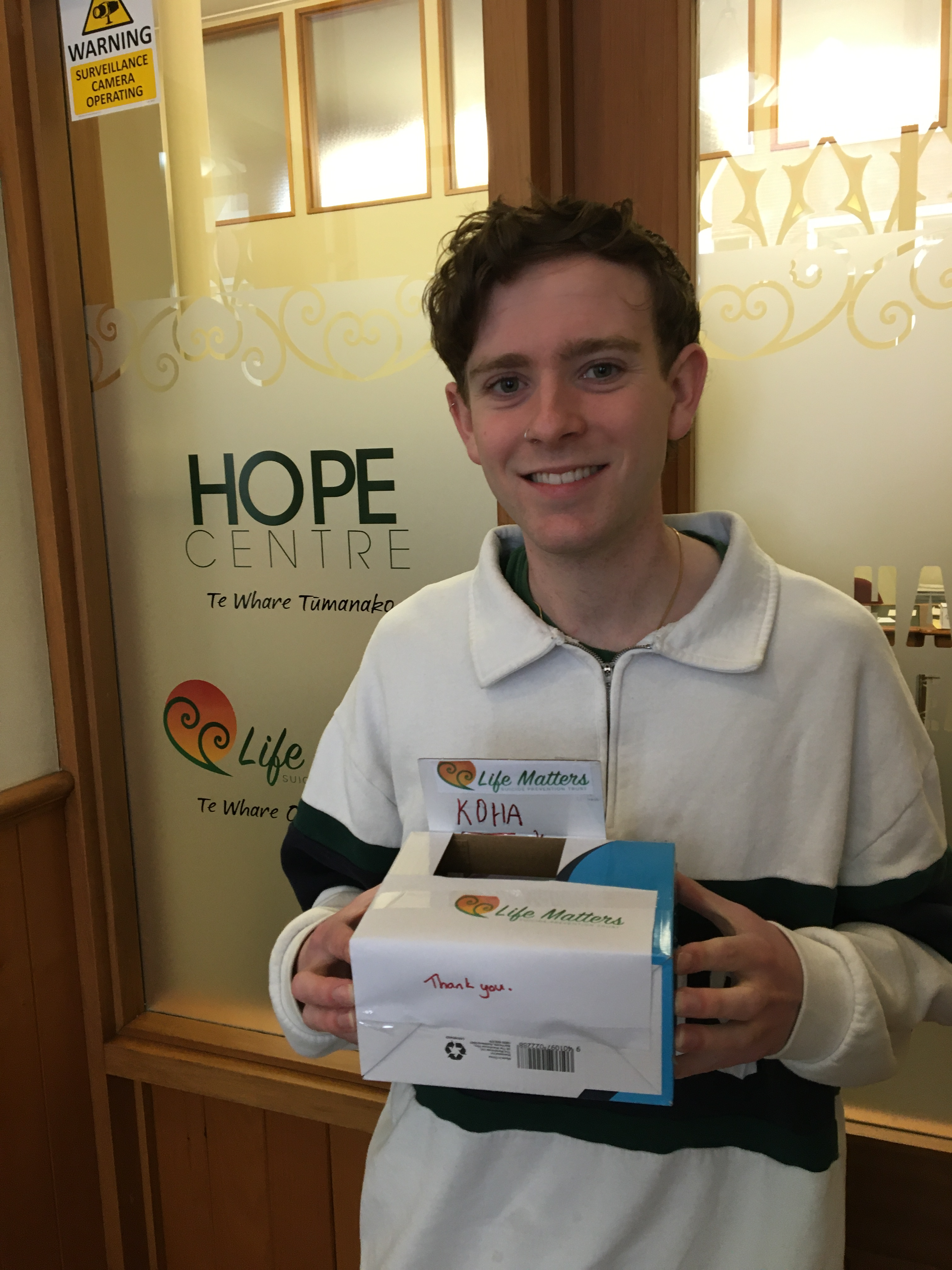
Bertie, at the Ōtepoti Hope Centre, Life Matters
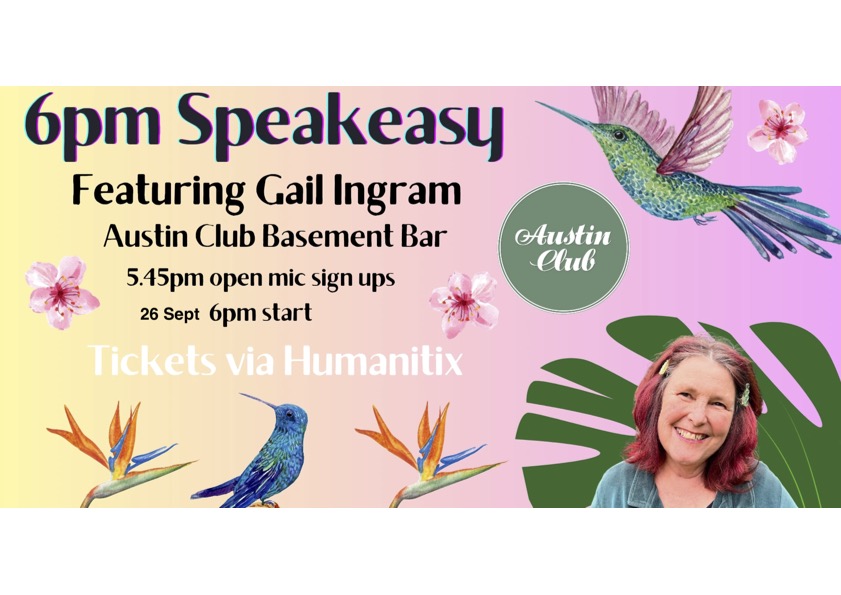
6pm Speakeasy @ Austin Club: a spoken word event in the heart of Ōtautahi’s CBD.
Coming at you live with a fresh new feature, last Thursday of every month.
MCed by Jor Dansaren and generously hosted by Austin Club Basement Bar – 161 Cashel Street, Christchurch.
Tickets available on following scale:
$5 – early bird/concession
$10 – general admission
$15 – generous admission
Tickets of each type limited – please consider choosing a ticket according to your capability to contribute. For any ticketing queries, please contact Jor Dansaren via Facebook..
Donations also welcome!
Door sales may be available, cash only.
Open mic sign ups from 5.45pm. Open mic kicks off 6pm with feature to follow.
September feature: Gail Ingram!
Gail Ingram is an award-winning writer from Ōtautahi, author of anthology (n.) a collection of flowers (Pūkeko Publications 2024), Some Bird (SVP 2023) and Contents Under Pressure (Pūkeko Publications 2019). Winner of both Caselberg and NZPS International Poetry Competitions, her poetry and short fiction has appeared across all five continents. She is a creative-writing teacher for Write On and managing editor for a fine line. She prefers the mountains to the sea.
details here
The house that lives by poetry
In the house that lives by poetry
tea is made the old, slow way,
or if you prefer, Turkish coffee
heated in a copper cezve on the stove.
Waiting is always a pleasure.
In the house that lives by poetry,
armchairs sag like soft cocoons
and a little bird rings a bell
like Eckhart Tolle.
In winter, the air in the house
smells like hay in Ted Kooser’s barn
on a warm Nebraska morning,
or the embers of a bonfire
on Eagle Pond.
In summer, there are always poets in residence
no matter what date the obituaries.
Their books we give due diligence
and leaks and cracks in the walls
are diligently ignored.
Jan FitzGerald
Jan FitzGerald is a full-time artist and poet who lives in Napier. She is the author of four previous poetry collections, the most recent being A question bigger than a hawk (The Cuba Press, 2022), and she has been shortlisted twice in the Bridport Prize poetry competition.
 NZ Poetry Shelf