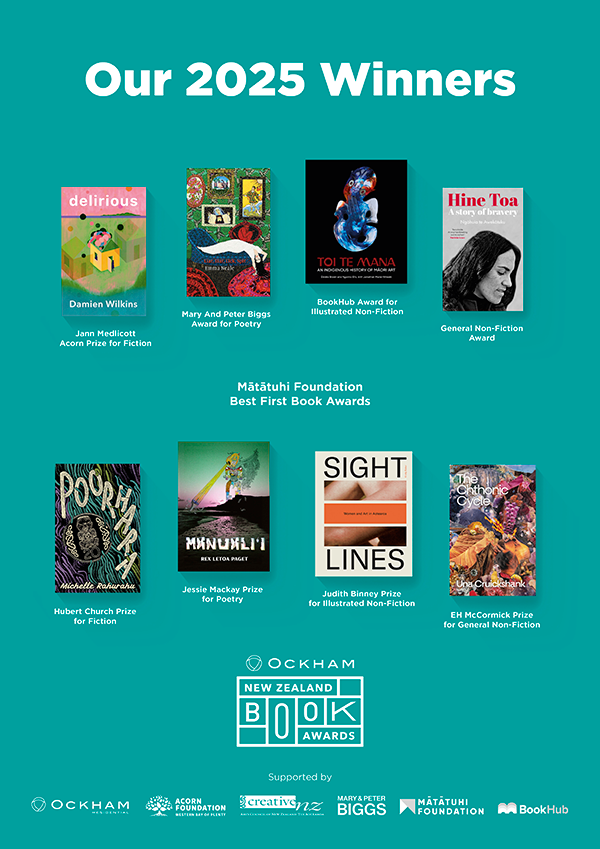
Full list of winners here
Last night I live-streamed The Ockham NZ Book Awards 2025 and it was top-shelf viewing. I absolutely loved it. I loved hearing the sixteen finalists read (ordering more books today!!) and I loved the opening speeches of Mark Todd and Miriama Kamo. You can watch the full ceremony here.
Sixteen wonderful books that underline the strengths of our writing across voice and genre: books that are vital, significant, penned with aroha, full of heart, sparking connections, a multiplicity of voices, knowledge, wisdom, insight, challenge, storytelling, poem making.
Two opening mihi stood out for me.
Mark Todd, the co-founder of Ockham Residential, shared a few personal thoughts on why books matter: “It is important to keep producing stories that help us reflect upon what reality is ( . . . ). I’ve just finished reading East of Eden by John Steinbeck (sorry it’s not a local book) but fuck it’s good (. . . ) Writing helps us to understand each other, to reflect upon our own lives, our own ethics, good writing helps us all, in those ways, to potentially bind us together.”
Miriama Kamo was brilliant as MC. She began her mihi with the call of the birds: “While some forces move to dull the choir that the many birds we know make together, is what makes the forest truly sing, and that inclusiveness instinct is what draws us together tonight, honouring and celebrating the many diverse voices of our writers, and their voices are more important that ever in moments of political turmoil and social and personal anxiety. Books give us a chance to reflect, to slow our heart beat down, in a time of increasing polarisation. Books remind us of the validity of other perspectives, in times when power claims certainty of how we must think and act, books teach us nuance. In times of ugliness, books can cat beauty, and our finalists do all this, whether they explore ambiguity and the concepts of truth and untruth, or help us to explore colonisation and inheritance and settlement and belonging in new ways, whether they draw us into a meditative space to explore nuances of New Zealand culture, or present us simply with images that speak to the heart and soul. Books draw us deeper into our own humanity.’
Thirdly I loved Kirsty Baker’s speech as winner of Judith Binney Prize for Best First Book of Illustrated Nonfiction with Sight Lines: Women and Art in Aotearoa (Auckland University Press). Her speech included this: ‘It’s an honour to have Sightlines honoured here tonight, although outside of this room the world feels almost unbearably dark and heavy, hard won rights are being stripped back, equity is being erased, people are facing genocide. Look around the globe and humanity seems to be showing us the absolute worst that we are capable of. So often though it’s the artists and writers who remind us that we can collectively effect change. As the indomitable artist and writer Bell Hooks has said, “The function of art is to do more that tell it like it is, it’s to imagine what’s possible”, so to artists and writers in this room, keep on imagining.
The poetry winners
I am mindful every year that for every astonishing book that makes the longlist, the shortlist or the winning spot, there are other equally astonishing books that don’t. History has a catalogue of astonishing and much loved books that have not won awards. So first I offer a warm hug to those who missed out. There is a reader out there who has held your book to their heart.
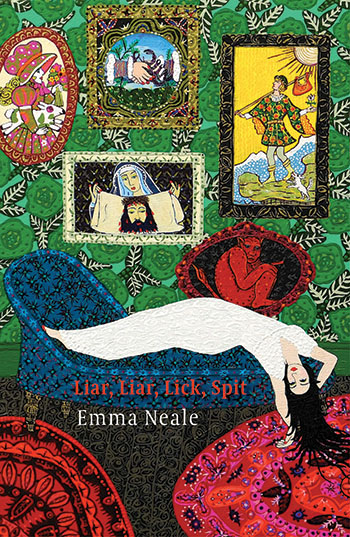
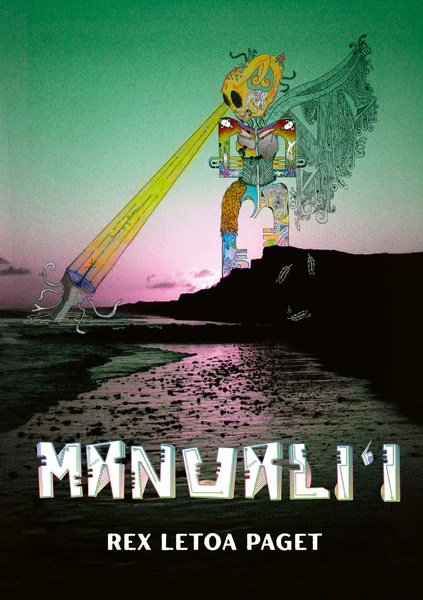
I celebrated the four poetry finalists on Poetry Shelf and I utterly loved them them all. Four equally moving reading experiences as my features attest, but today I salute Manualiʻi by Rex Letoa Paget (Samoan/Danish) (Saufoʻi Press), winner of the Jessie Mackay Poetry Prize for Best First Book of Poetry and Emma Neale winner of the Mary and Peter Biggs Award for Poetry for her collection Liar, Liar, Lick, Spit (Otago University Press).
Emma Neale, Liar, Liar, Lick, Spit (Otago University Press)
The Lake
This child feels it like blue pollen that makes her hive of fingers dance.
This one a groove along his spine that must be filled with running.
Another as music that only rises here, deep in his mind, never sung.
This last, as crystal numbers that link, fold and fall like pleats in time.
We think they all must know the lake’s mother tongue.
They are her water cupped in our hands,
new skins for the old light we believed in.
Emma Neale, from Liar, Liar, Lick, Spit
“I want to choose the words so that each potential nuance fuels and remains true to the poem’s psychological energy. I want the poem to resonate with sonic qualities so that it shows traces of its musical ancestry. I want the poem to have a hot nucleus of emotional truth.” Emma Neale, conversation with Paula Green
Emma’s poetry has always been a gift for the ear, and this collection is no exception, the linguistic dexterity, the rich lexicon. With her new collection, there is a terrific density of sound and effect. Every poem an intricate arrival of sonic mesh knit chord soar whisper. How it strikes the heart as you read.
To be reading this book is so very timely, when we are grappling and despairing at inhumane leadership, at planet-and-people-polluting toxic lies, at the self-serving manipulations of self-serving politicians. How to read and write in the age of weasel Trump and weasel Luxon Seymour Peters? What can language do? Ah.
I hold this book close to my heart because it reminds of the reach and possibilities of poetry. We can speak of the child, sons and daughters, mothers and fathers. We can write of loss and love, grief and abuse, epiphany and recognition. Failings and flailings. We can write out of and because of omission, and we can write out of and because of erasure.
There are multiple tracks and clearings as you read. You might feel the sharp blade of reading along with the sweet balm of self care. Take ‘Genealogy’, for example, a poem that steps into a complicated weave of ancestry, where Emma asks, so astutely, ‘is every white genealogy poem an erasure poem / is every postcolonial poem an erasure poem will we ever be fair / and true and clear’.
Or take ‘An Abraham Darby Rose’. Take this poem and sit with under the tree in the shade and embrace its physicality, an attribute that is a gold thread of the collection as whole. Spend time with the rose, honing in on both thorn and petal (‘peach-toned ruffles’), before facing the needle sting of the son’s departure, the self-examination within the greater context of life – and sit there finding ripples of comfort as the speaker gently places plantings in ‘the soil’s quiet crib’. Take this poem and hold it close.
Imagine we are in a cafe. Imagine we are in cafe reminding ourselves that silence is a form of consent. To write is to fertilise our community gardens. To write, as Emma does, and speak of tough stuff is to strengthen who and how we are in the world. To navigate, as Emma does, being mother daughter sister friend. Human and humane being. To gather a box of groceries for the welfare centre: ‘in the hope that kindness migrates invisible currents / to pollinate every tyrant’s heart’ (from ‘Wanting to believe in the butterfly effect’). To gather a folder of poems.
Ah. This precious book with its layers and weave of vulnerability and admission. This book of hauntings. This haunting book. This necessary fertile sequence of plantings. I love this so very much indeed.
Paula Green, from Poetry Shelf review
I want to hold this morning
under an agapanthus sky
with a gentle, moth-eyed horse
as if the thread of language
could ever weave a hide
against the hook and ache of loss
when we carry it
deep as the mare carries
the sprint, the vault,
in her hocks, her fetlocks.
Emma Neale
from ‘The Moth-eyed Steeplechase Horse’
You can read the full review with our conversation here.
You can hear Emma read poems here.
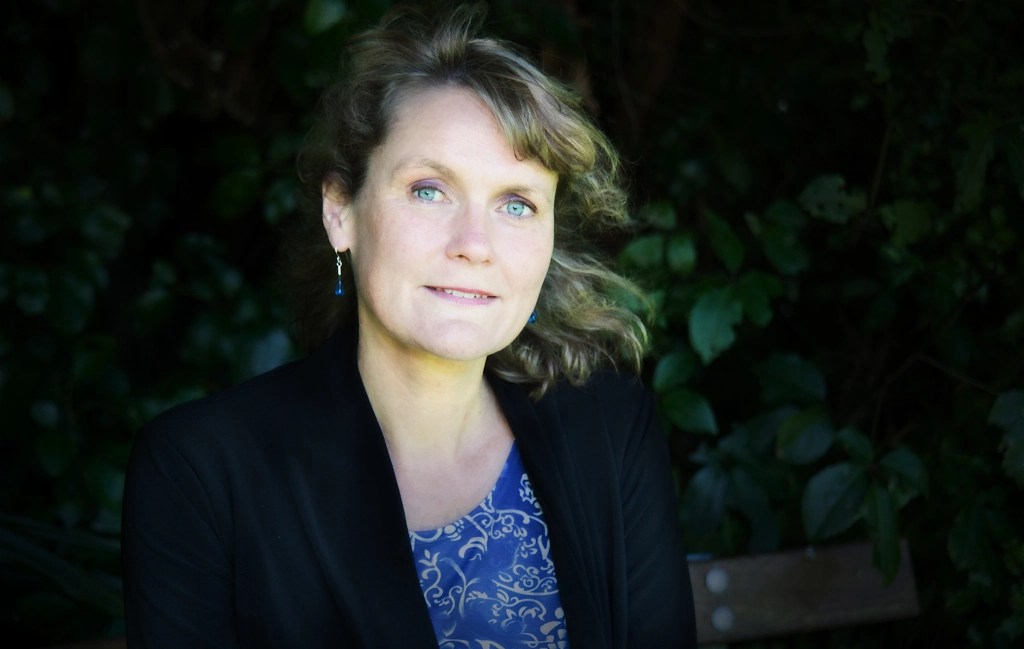
Emma Neale is the author of six novels, seven collections of poetry, and a collection of short stories. Her sixth novel, Billy Bird (2016) was short-listed for the Acorn Prize at the Ockham New Zealand Book Awards and long-listed for the Dublin International Literary Award. Emma has a PhD in English Literature from University College, London and has received numerous literary fellowships, residencies and awards, including the Lauris Edmond Memorial Award for a Distinguished Contribution to New Zealand Poetry 2020. Her novel Fosterling (Penguin Random House, 2011) is currently in script development with Sandy Lane Productions, under the title Skin. Her first collection of short stories, The Pink Jumpsuit (Quentin Wilson Publishing, 2021) was long-listed for the Acorn Prize at the Ockham New Zealand Book Awards. Her short story, ‘Hitch’, was one of the top ten winners in the Fish International Short Story Prize 2023 and her poem ‘A David Austin Rose’ won the Burns Poetry Competition 2023-4. Her flash fiction ‘Drunks’ was shortlisted in the Cambridge Short Story Prize 2024. The mother of two children, Emma lives in Ōtepoti/Dunedin, Aotearoa/New Zealand, where she works as an editor. Her most recent book of poems is Liar, Liar, Lick, Spit (Otago University Press, 2024).
Otago University Press page
Manualiʻi by Rex Letoa Paget (Samoan/Danish) (Saufoʻi Press)
DARLING I KNOW YOU SUFFER AND I’M HERE FOR YOU.
we laugh like we used to.
before the kids.
before the house.
back when debts were settled with
two coloured cats eye marbles
and my only pokémon card
i bought with my lunch money
off my rich palagi mate.
when ceilings were creaking floorboards
humming girl power anthems and
ain’t that just the way that life goes
down
down
down
down.
like mike splitting free throw lines.
i wanted to be the paekākāriki express.
chipping and chasing wild watercress
shotgunned under rooftops of punga eels
who sheltered clay soil paths dad spent a summer digging.
he carved our names into tree roots staircased to a creek
where we’d wash our legs scraped with blackberry.
we ran through maize he grew
chasing mystic moon views rising
at the edge of his green thumb.
he planted his seeds with
bootstraps
calloused hands and
we don’t need no education.
survived in
motor oil
whiskey breath
rothman cigarettes.
half his mates didn’t survive
asbestos or asphalt.
a few sit round his lounge now
broken boned road workers
fingers twisted in carpal tunnel
gifting bags of greenery.
cancer scares
cancer skin
four hundred dollars
a week in pension.
gettin up
getting high
gettin down
gettin no-no-nowhere.
i sit across a table in remuera where
white collars popped discuss
what to do with their third property.
i stare at perfect crooked teeth dipped
in italian red wine
gnawing chipped paint off their beach house
in a town
they can’t even pronounce.
reclined in a railroad home
dads bones rattle and radiate
we throw our hands up to celebrate
him eating the first solid thing in weeks.
Time spins on a record player
our wishes crackle into dust.
can we pause for a moment?
can we go back to the start?
i missed my favourite part.
i visit dry creeks wishing for the same thing.
sandalwood burns through hallways and yeah
ain’t that just the way that life goes
down.
down.
down.
down.
Rex Letoa Paget
There is so much to love about this collection, I want it to remain an open field of possibilities for you. It is self portrait and it is family gatherings, it is prayer and testimony, it is grief and it is love. How it is imbued in love. The presence of grandmothers signals the importance of familiar anchors, of nourishment and nurturing, of roots and self growth. There is music on the line, music on the turntable, music recalled. In the opening section, ‘Manuali’i’, the eclectic movement of words and lines on the page offers sweet shifts in visual and aural rhythms, as though there is no one way to pin sky-gazing or family relationships or writing poems to a singular form. The lower case letter at the start of sentences enriches the music.
The second section, ‘Icarus’, initially conjures the Greek myth, and I find myself sidestepping into notions of life as labyrinth, the risk of burning up, of plunging down and of drowning. More than anything I am revelling in Rex’s language, because, in both subject matter and lyricism, this is poetry of becoming. Verbs favour the present tense, writing exists in the moment of living, writing is a vital form of connecting. But the verbs do more than this, these tools of action, whether physical emotional or cerebral, stall delight and surprise me within the wider wordcape of a poetic language that is succulent and sense rich.
At times there is a profound ache, contagious, human, humane, and we are in the ‘Elysian plains’, there with the poet’s grief as he remembers his father. This is writing as inhalation as much as outward breath, not explaining everything, tracing threads to the Gods or ancestors, to the places we become, the connections that matter. And yes, I keep returning to the idea of poems as sustaining breath.
To travel slowly with this sublime collection is to enter poetry as restorative terrain, to encounter notions and parameters of goodness, fragility, recognition, to link the present to both past and future, to question, to suggest, to travel, to connect. Oh! and Manuali’i has the coolest illustrations.
Paula Green, Poetry Shelf review.
You can hear Rex read here
Rex Letoa Paget (Samoan/Danish) is a fa‘afatama crafter of words born in Aotearoa, now living on the unceded lands of the Wurundjeri people. His poetry and storytelling are his compass through space and time. His works are giftings from his ancestors and have been published in Tupuranga, Te Tangi A Te Ruru, AUNTIES, Overcom, No Other Place to Stand: An Anthology of Climate Change Poetry from Aotearoa New Zealand, Rapture: An Anthology of Performance Poetry from Aotearoa New Zealand, Spoiled Fruit: Queer Poetry from Aotearoa, and Australian Poetry Anthology Vol 10. His offerings are lessons, learnings, and acknowledgments for the timelines and traditions of yesterday, today and tomorrow.
Saufo’i Press page




 NZ Poetry Shelf