Melinda Szymanik is an award-winning writer of picture books, short stories and novels for children and young adults. She was the 2014 University of Otago, College of Education, Creative New Zealand Children’s Writer in Residence, held the University of Otago Wallace Residency at the Pah Homestead in 2015, and was a judge for the 2016 NZCYA Book Awards. Her most recent book is My Elephant is Blue (Penguin, 2021).
20 May 2021: Winners in the 2021 Hippocrates Prize for Poetry and Medicine were announced by live webcast on Wednesday 19th May to an international audience from North America, Europe, Asia and Australia.
First Prize in the FPM-Hippocrates Open Awards went to Fran Castan, former magazine editor, freelance writer and teacher of writing and literature from New York City, USA for Voice Mail. About her poem she said: “When my friend, the poet Siv Cedering, was suffering from pancreatic cancer, I would visit frequently. I wrote Voice Mail as witness to our experiences during her heroic struggle.”
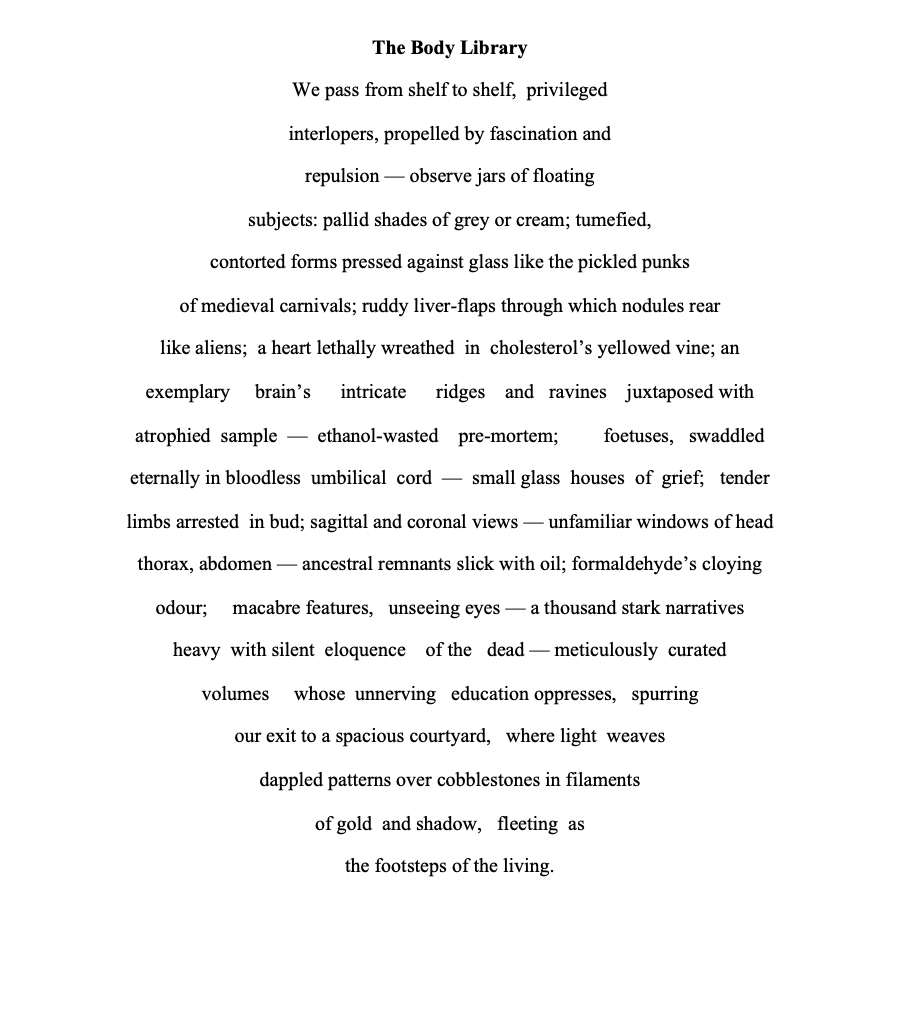
First Prize in the FPM-Hippocrates Health Professional Awards went to Sophia Wilson from Dunedin in New Zealand for The Body Library. Sophia has a background in arts, medicine and psychiatry.
She said: “The Body Library is a mélange of memories of the anatomy and pathology museums at Sydney University. I recall in particular the enormous sense of privilege, the bizarreness of human body parts being presented and objectified in this way, and the relief of exiting the hallowed rooms into daylight.”
‘The Body Library’ first published in Hippocrates Prize Anthology 2021, hippocrates-poetry.org
Sophia Wilson has recent writing in Mayhem, Blackmail Press, Intima, Australian Poetry Anthology, Shot Glass Journal, The Poetry Archive, Landfall, A Fine Line, Not Very Quiet, Ars Medica, Hektoen International, Poetry New Zealand, Flash Frontier, Best Microfiction 2021 and elsewhere.She was runner-up in the 2020 Kathleen Grattan Prize for a Sequence of Poems and her poem ‘The Captive’s Song’ won the 2020 Robert Burns Poetry Competition. Sophia has a background in arts and medicine and is based in Aotearoa New Zealand.
Paula Green, from Cookhouse, Auckland University Press, 1997
My theme-season introductions seem like miniature self confessions on life and poetry. Crikey! I always have much to say about food and poetry because I love cooking and I love writing. My first book Cookhouse got scathing reviews either for being too domestic or forbeing too experimental. I walked around the supermarket on a Sunday morning reading the first review of my first book saying OMG OMG OMG. It was my first lesson as a writer: leave reviews with the person who wrote them. Just get on with what you love. A few weeks later I opened the Listener and there was a photograph of Cookhouse on the recipe page with a Marcella Hazan cookbook ( I loved her recipes!). Plus one of my poems, sitting on the page like a recipe. That was my second lesson as a writer. Your books and poetry find their way into surprising places and you will never know how your poetry touches people. Although sometimes you get an inkling: a stranger might walk up to you, or send an email or a card, and surprise you (in a good way!).
I can’t keep food out of my poetry and I am equally drawn to writers with similar intent. It is one reason I am such a fan of Nina Mingya Powle’s poetry. Her poems lead in multiple directions but the sensual hooks are often sparked by food. Ian Wedde is the same. I adore The Commonplace Odes. It has always mattered what food I put in my body, and it is a bit the same with with poetry. I want to cook a meal that tastes good and I want poetry that satisfies my reading tastebuds whether I am writing or reviewing. In fact don’t call me a reviewer please. And I am not actually very kind. I simply love reading poetry and sharing my engagements. Just as I love cooking a meal every night for my family.
The poems selected are not so much about food but revel in a presence of food to varying degrees. Grateful thanks to the publishers and poets who continue to support my season of themes.
The Poems
De-stringing beans
A mountain of runner beans
to top and tail and de-string.
She decides to do it for them: her sons
so they will be eaten this evening
sliced into green splinters
with pink seeds showing through.
Easier to sit than stand. Her best profile
towards the door when her son appears.
She wants to disguise how content she is.
The stringy edges, tops and tails, in a dish
the beans growing, like a mountain of shoes
later to be wrapped in tinfoil
roughly divided into two.
No one else in the family will eat them.
In an article it says they are underrated
almost despised as a vegetable
underestimated on two counts
or three: first the vigorous way
they climb, clamber to the sun
second they are rich in iron
and last and best: this contentment
so rarely found, except in
a painting of a woman pouring from a jug
someone bathing someone in a tub
this mountainous-seeming task
calming with each stroke of the knife.
Elizabeth Smither
little walnuts
served from across the seas
in a tin or a jar, fished from suitcases
presented
with grandmotherly dimples
little walnuts – xiao he tao
proudly, good for brain.
except neurons are firing
in staccato, half-
forgotten Mandarin.
they manage xie xie and dutifully
I eat them.
I forget why I ask for these –
the carnage of shells
scraps of brown meat
and a strange invasion staged
on my tongue – slow
and clumsy muscle.
I am quick to rise – you do not get to comment on what’s in my lunch box –
but just as quick to pick
the yolks of my too-dry lotus mooncakes –
discarded suns
of a world in hieroglyphs.
and when I have counted
waves of sleep – yi, er, san –
I don’t dream in the same vowels.
what can I bring back for you?
her smile like furls of steaming jasmine tea
amidst clamouring children
hawking their wants like roadside wares
or suitcase wheels clicking on concrete
destined for smog and skyscrapers.
I always ask for my little walnuts.
*Little walnut or xiao he tao is a particular kind of Chinese walnut with a distinct sweet-salty flavour.
Joy Tong
from A Clear Dawn: New Asian Voices from Aotearoa New Zealand, eds Paula Morris and Alison Wong, Auckland University Press, 2021
from A Clear Dawn: New Asian Voices from Aotearoa New Zealand, eds Paula Morris and Alison Wong, Auckland University Press, 2021
With Nectarines
to Claire Beynon
A cob loaf rests on a surface,
perhaps a table, an altar, a jetty,
that reaches over a shoreline toward dark water
and the approaching edge of night.
Out there an indigo quiet where the sky lowers to sea,
clouds shouldering weight of storm to come;
a hint of beach, airborne flicks of white,
where seabirds swoop for fish and scraps.
On this side of a sill,
the bread, and a bowl of tawny nectarines
occupy foreground that’s human with light,
with hearth-glow in the corner,
tended against incoming cold.
The bread is warm from the oven,
the fruit ripe, and the room that extends
from the canvas edge into my lived space
where the painting hangs, included as offering
to the sombre air,
to anyone who comes to this threshold, empty.
Carolyn McCurdie
Super Wine
The news is early or his clock is slow,
so he grabs his mug of tea and pops
a biscuit in his pocket,
the top pocket of a faded old coat.
It’s a wreck of a thing, this coat of his.
a shamefully limp and grubby article,
but he wears it through the news and Campbell Live
and on into the night,
and he wears it when he leaves his little flat
and slips up the lane and out into the park
and lights a cigarette
(his skinny nine-o’clocker
and the last of the day).
And he smells the smells of mown grass and woodsmoke,
and he walks across the park towards the lights,
the lights of the houses on the hill,
secular stars of silver and orange,
and he walks beneath the frosty stars themselves,
this unmarried, unmended man,
this unmarried, not-unhappy Earthling,
A Super Wine forgotten in his pocket.
Geoff Cochrane
from Pocket Edition, Victoria University Press, 2009
If you love me you’ll buy Bluff oysters and cook asparagus. Even though I don’t like either.
for Kirsten Holst, for feeding me many good things
and for Alison and Peter, for their Bluff oysters and asparagus
When I am no longer who I was
I can only hope that I will be loved by someone
so much that every day during Bluff oyster season
they will buy me a dozen Bluff oysters.
Even though they don’t like Bluff oysters
they will buy them for me
and every day I will exclaim
“I can’t even remember the last time I had Bluff oysters!”;
they will nod at the extreme length of time it has been.
When I am no longer who I was
and when Bluff oyster season is over
I can only hope that I will be loved by someone so much
they will cook me freshly picked asparagus every day.
Even though they don’t like asparagus
they will grow it for me and pick it for me
and lightly steam it
so that I can relish it served with hollandaise sauce
(although some days more lazily served with butter and lemon).
I will eat it with my fingers
and let the sauce (or butter) dribble down my chin;
no one will mind or tell me to be less messy
it will just be moments of edible joy.
In reality I don’t like Bluff oysters (or any oysters)
and I can’t stand asparagus (the taste and texture are disturbing);
I can only hope that maybe someone will love me enough
to buy and cook me the things that I love
even though they hate them, even though I won’t remember.
Paula Harris
the great pumpkin war
standing in the kitchen crying
beaten by a vegetable
thought by now it would be easier
people have suggested this (people i trust)
the myth of progress
you do something every day it gets easier
in reality each day the dirt accrues
it multiplies between cupboard doors
i am running out of resources
i am getting further & further into
the ten-year warranty on the fridge compressor
one day soon i will have to pick up the knife
& address the pumpkin in the room
bought so cheaply from the farmers’ market
now growing larger by the day
taking up all the bench space
i fear for the fruit bowl
my mother says to drop it from a height
she throws hers down the stone garden steps
my previous attempt resulted in
20 minutes lost to searching for an unscathed pumpkin
trying to break open a pumpkin at night
is like starting a winter war in russia
i am letting everything get out of control
i sleep knowing it is getting worse
i do not think i can win at this
i do not think i can carry on in any capacity
Rhys Feeney
from AUP New Poets 7, ed Anna Jackson, Auckland University Press, 2020
The Cheese Scone Recipe as Promised
What’s the secret, people ask,
why do your students return
year after year to your class?
Cheese scones, I say, crisp
on the outside, soft inside
like all good characters. First,
turn up the heat, 200 degrees
should do it. Next, sift two cups
of self-rising flour, holding the sieve
high, letting the flour fall like snow
in the air, then add a heaped half
teaspoon each of salt, mustard powder
and a good pinch of cayenne for a lick
of fire. Stir and rub in 30 grams
of butter. If in a hurry, as I usually am,
you can grate the butter or cheat
with the food processor,
but do not go all the way, stop
at the crumbly stage, add 75 grams
of grated cheese, then beat a large egg,
with about 75 mils of buttermilk,
(if you have none, add lemon juice to milk,
rest it for ten minutes). Breaking
the drought pour into the dry ingredients,
mixing first with a knife, then lightly
with your hands to bring the soft dough
together. If it seems too dry
add more buttermilk, but like
it’s a newborn and precious, go easy
with your handling, remembering
scones and poems need a light touch.
Cool hands, my mother said,
though mine have always been hot.
Roll the dough out in a rough circle,
not too thin, about 2.5 cm thick.
With students due any minute,
I usually take the lazy way, divide
it roughly into 8 triangles but you might
be wanting to impress your mother
or daughter-in-law, and have the time
and the aesthetic sense for fluted cutters.
Appearance improves the taste
so brush the tops with milk, sprinkle
on a little grated cheese, and a dusting
of cayenne. Bake on a high shelf
for about 15 minutes till golden
and irresistible. Making scones
is not dissimilar to crafting a poem,
you need to pay attention to detail,
measuring, mixing, letting in air,
but there the recipe ends.
What I haven’t talked of can not
like metaphor, be quantified, the secret is
to bring to the process, a little of you.
Diane Brown
the children open their
lunch boxes to each other
a ham sandwich
for a Fijian fried egg and three cassava sticks
a mini feta quiche
for a South Indian roti parcel stuffed
with cumin and okra
a tub of yogurt
for a Middle Eastern pouch of semolina
sautéed in ghee and cardomens
a celery stick
for a Tongan plantation ladyfinger banana
a juice box for
fresh Kiribati island toddy
the wooden decks approve
their slats on standby to suck evidence
of sharing and spit them into the crawl space
beneath the salivating joists
it’s the allergies
the adults
the food policies
and
the way fear feeds us all
Mere Taito
P r o p e r t i e s
You’ll need oil – For your forehead on Ash Wednesday, for the insides and outsides of your palms. For sore inner ears and lifeless hair. For removing the evil eye – that’s the most important. Though not one in the family knows the ritual, better to be with, than without.
Grapes and leaves – For your rice and pinenuts, for your grape jelly.
And ash – For the grape jelly – vine cinders to be precise. For holy crosses over the front doors of your houses or workplaces. For the bottoms of incense holders – hubris to clear it out.
Rose petals – For gravestones, but mostly for the preserve that fits into a spoon followed by icy water.
Water – From the priest, for drinking in the first month of the year and sprinkling in every room. For keeping in the fridge thereafter. For putting chamomile into – tea or warm compresses.
Garlic – For everything. For mashing up and applying with honey to sores. For rubbing on styes. For wrapping in bread and swallowing whole when feverish. For shooing away evil by saying the word alone – along with a spitting sound.
Vana Mansiadis
from Ithaca Island Bay Leaves: A Mythistorima, Seraph Press, 2009
1.2 To the cookbook
Turning east, I drove towards blue grey
Mountains down which cloud crawled
From summits which were already sky. High in it
A glare like grubby porcelain told me that morning
Was advanced. The nibbled winter paddocks were over-
Written in a language no one had ever taught me:
Glottal, almost choking, wet. Lines
Of leafless shelter-belt enwrapped the shorter
Rows of berryfruit trellises in need
Of pruning. My destination: an art gallery.
My mission: to speak about art and poetry.
It was going to be all over before I got there.
Quintus Horatius Flaccus, help me
In my hour of need, help me turn my back
on landscape that wants to be art, on poetry with feet
Of clay. The lovely world has everything I need,
It has my kids, my sweetheart, my friends, it has a new book
With mouth-watering risotto recipes in it,
The kind of plump rice you might have relished,
Horace, in the Sabine noon, yellowed with saffron.
‘The zen poet’ is another of you, he wrote a poem
About making stew in the desert which changed my life.
A good cookbook is as good as a book of poems
Any day, because it can’t be more pretentious
Than the produce you savour with friends as night falls.
Ian Wedde
from The Common Place Odes, Auckland University Press, 2001
Custard
When I was smaller than the family dog,
Dad would tell Mum
that he was taking me to kōhanga.
Then we’d go to the bakery
and get as many custard pies
as we could handle.
Park up by the river,
talk,
eat,
listen to the radio a while.
He’d light one up
as fat as the mighty brown trout,
captured and killed
and lull me to sleep
with a puku full of custard
in his red van
with all his windows up.
Now I am grown
and you ask me to explain something you said.
My eyes glaze
and all I can see is that
red van,
pastry flakes resting
in the corners of my sleeping mouth.
Ruby Solly
from Tōku Pāpā, Victoria University Press, 2021
The Poets
Diane Brown is a novelist, memoirist, and poet who runs Creative Writing Dunedin, teaching fiction, memoir and poetry. She is the Poetry Editor for ‘The Mix’ in the Otago Daily Times. Her latest book is a poetic novella, Every Now and Then I Have Another Child, Otago University Press 2020.
Geoff Cochrane is the author of 19 collections of poetry, mostly recently Chosen (2020), two novels, and Astonished Dice: Collected Short Stories (2014). In 2009 he was awarded the Janet Frame Prize for Poetry, in 2010 the inaugural Nigel Cox Unity Books Award, and in 2014 an Arts Foundation of New Zealand Laureate Award.
Rhys Feeney is a high school teacher in Te Whanganui-a-Tara. You can buy Rhys’ debut collection, “soyboy,” as part of AUP New Poets 7
Paula Harris lives in Palmerston North, where she writes and sleeps in a lot, because that’s what depression makes you do. She won the 2018 Janet B. McCabe Poetry Prize and the 2017 Lilian Ida Smith Award. Her writing has been published in various journals, including The Sun, Hobart, Passages North, New Ohio Review and Aotearotica. She is extremely fond of dark chocolate, shoes and hoarding fabric. website: www.paulaharris.co.nz | Twitter: @paulaoffkilter | Instagram: @paulaharris_poet | Facebook: @paulaharrispoet]
Vana Manasiadis is Greek-New Zealand poet and translator born in Te Whanganui-a-Tara and based in Tāmaki Makaurau after many years living in Kirihi Greece. She is 2021 Ursula Bethell Writer-in-Residence at Te Whare Wanaga o Waitaha Canterbury University. Her most recent book was The Grief Almanac: A Sequel.
Carolyn McCurdie is a Dunedin writer, mostly of poetry and fiction. Her poetry collection ‘Bones in the Octagon’ was published by Makaro Press in 2015.
Neema Singh is a poet from Christchurch of Gujarati Indian descent. Her work appears in Ko Aotearoa Tātou: We Are New Zealand(2020) and A Clear Dawn: New Asian Voices from Aotearoa New Zealand (2021) and she is currently working on her first collection of poetry, a series of poems unfolding the layers of culture, identity and history contained within ordinary moments. Neema is an experienced secondary school English teacher and holds a Master of Creative Writing from The University of Auckland.
Elizabeth Smither ‘s new collection of stories: ‘The Piano Girls’ will be published in May by Quentin Wilson Publishing.
Ruby Solly (Kāi Tahu, Waitaha, Kāti Māmoe) is a writer, musician and taonga pūoro practitioner living in Pōneke. She has been published in journals such as Landfall, Starling and Sport, among others. In 2020 she released her debut album, Pōneke, which looks at the soundscapes of Wellington’s past, present and future through the use of taonga pūoro, cello, and environmental sounds. She is currently completing a PhD in public health, focusing on the use of taonga pūoro in hauora Māori. Tōku Pāpā, published in Februrary 2021, is her first book.
Mere Taito is a poet living and working in Kirikiriroa.She is interested in the way poetry can be used to revitalise minority Indigenous languages like Fäeag Rotuạm ta.
Joy Tong picks wildflowers from neighbours’ fences, pets strangers’ dogs and chases stories in the streets. She’s a student, musician and writer from Tāmaki Makaurau and her other works can be found in Landfall, Mayhem and Starling, as well as A Clear Dawn, an anthology for NZ-Asian voices.
Ian Wedde was born in Blenheim, New Zealand, in 1946. He lives with his wife Donna Malane in Auckland. ‘To the cookbook’ is from a sequence called The Commonplace Odes, published as a book by Auckland University Press in 2001. He was New Zealand Poet Laureate in 2011.
This is brilliant! Check out Faith Wilson’s review here.
‘As I drank every word of Rangikura, then back to Poūkangatus then back to Rangikura again, I felt myself defrost. Yes, poetry can be fucking good, can be genius even. That this enigmatic kid from Porirua, this Māori Mona Lisa, was out here, walking over the words of the dead white poets in stiletto heels and dripping gold, was doing her own kanikani, the one only she knows, evolved from ancestral blessedness, showing the world, showing me, showing you, how it’s done.’
Gaps in the Light, Iona Winter, Ad Hoc Fiction, 2021
Iona Winter reads ‘Gregorian’
Iona Winter (Waitaha/Kāi Tahu) lives in Ōtepoti Dunedin. Her hybrid work is widely published and anthologised in literary journals internationally. Iona creates work to be performed, relishing cross-modality collaboration, and holds a Master of Creative Writing. She has authored three collections, Gaps in the Light (2021), Te Hau Kāika (2019), and then the wind came (2018). Skilled at giving voice to difficult topics, she often draws on her deep connection to land, place and whenua.
International Writers’ Workshop NZ Inc (IWW) is delighted to announce that renowned New Zealand poet Vana Manasiadis, will judge The Kathleen Grattan Prize for a Sequence of Poems later this year. The official announcement was made at IWW’s annual Mid-Winter lunch in Northcote yesterday.
Vana Manasiadis is a New Zealand-Greek writer, translator and creative writing teacher whose collection of poetry The Grief Almanac: A Sequel was launched in May 2019. Along with Behrouz Boochani Vana is a 2021 Ursula Bethell Writer-in-Residence at Te Whare Wānaga o Waitaha Canterbury University.
The prize of $1,000 – which is made possible due to an ongoing bequest from the Jocelyn Grattan Charitable Trust – is for a cycle or sequence of unpublished poems that has a common link or theme. This is the thirteenth year IWW has had the honour of organising the Prize.
In 2020, the prize was won by Wanaka poet Liz Breslin for her sequence titled: In Bed with the Feminists.
The competition is free for IWW members to enter. It is very easy for aspiring poets and writers to join IWW to be eligible to enter their poetry in the competition.
Previous winners over the past few years include: Liz Breslin (2020) Siobhan Harvey (2019) Heather Bauchop (2018), Janet Newman (2017), Michael Giacon (2016) Maris O’Rourke (2015) and Julie Ryan (2014.)
Manasiadis said: “The prize is so important to the country’s literary landscape, and I am very honoured to be judging this year’s competition. I can’t wait to spend time with the talents of the 2021 entries – and I hope there will be many of them!”
President of IWW, Duncan Perkinson said: “As a writing group, we are proud to organise The Kathleen Grattan Prize for a Sequence of Poems and we are thrilled to have Vana judge this year’s competition. Both of the two previous winners (Liz Breslin in 2020 and Siobhan Harvey in 2019) have used the prize as a springboard to launch their books – In Bed with the Feminists and Ghosts – with both having been released in the past couple of months.”
About the Judge
Born in Te Whanganui-a-Tara Wellington, Vana Manasiadis has been moving between Aotearoa New Zealand and Europe the last 25 years. Her poetry experiments with hybridity and code-switching and has been translated into Greek and Italian, and she has edited and translated from the Greek for Shipwrecks/Shelters, a selection of contemporary Greek poetry. In 2018 she co-edited Tātai Whetū: Seven Māori Women Poets in Translation with Maraea Rakuraku.
Preparatory Workshop
As well as judging the competition, Manasiadis will conduct a workshop on Writing Poetry at IWW’s meeting venue, the Lindisfarne Room at St Aidan’s Church, 97 Onewa Road, Northcote, Auckland on Tuesday August 17th. Doors open at 10 am and the workshop runs from 10.30 am to 12.30 pm. While visitors are welcome to attend the workshop for a $10 visitor fee, potential entrants must have joined IWW before July 20th in order to enter the competition.
About the Competition and about IWW
The rules for the competition, details of how to join IWW, meeting times and other activities of the workshop, which meets on the first and third Tuesdays of the month from February to November and runs several competitions a year, are available from the IWW website: iww.co.nz.
Key Dates for The Kathleen Grattan Prize for a Sequence of Poems in 2021
20 July: Last day for new members to join IWW to be eligible to enter this year’s Prize.
17 August: Workshop with Vana Manasiadis on writing poetry.
5 October: Closing date for entries.
16 November: Announcement of the 2021 winner of The Kathleen Grattan Prize for a Sequence of Poems.
Contact
For further information about the Prize or about IWW, contact Duncan Perkinson, email iww-writers@outlook.com or check out the website
Foxstruck and Other Collisions, Shari Kocher, Puncher & Wattman, 2020
The cover of Foxstruck and Other Collisions reminded me of an astral vista (my partner said a Rothko painting not knowing there’s a Rothko poem inside!), but the image is in fact Kate van der Drift’s artwork, a camera-less photograph. She buried large format sheet film in the Piako river between the ebb and flow of low and high tides. What looks like a stellar view is the alchemy of pollution and nutrient by-products of intensive farming. Enter a poetry book and already nothing can be taken for granted. The title Foxstruck and other Collisions is equally fascinating. Enigmatic but rich in possibility.
Shari Kocher’s collection is a sumptuous read. It is structured in seven sections moving from the weight of lead, through the practicality of tin and iron, and the preciousness of gold, copper and silver, to the liquid toxicity of mercury. I am no alchemist but each element feels prismatic with poetic connections, shifting perceptions, uses, misuses. What bridges will form between one element and the other? Would I gain more from reading, if I were an elemental whizz? How will the elements interact with the properties of a poem? The properties of an element with a poem’s movement? All this musing and I am on full alert.
Here I am entering an alchemy maze and all I can think about is fabric as I read. I am always suspicious of academic criticism that stretches a poem to fit a premise or theory, but I am (no way an academic critic) falling upon words, phrases, ideas, details, motifs that give my approach zing. Let me be clear: a poetry book will always offer myriad pathways, frames, devices that refract, reflect, dissolve, connect. I guess I always want to put my finger upon a poem and discover its pulse.
Why fabric? Shari’s poems resemble brocade (full of sheen and intricacy), the rustling texture of silk, hard-wearing everyday denim and the coolness of cotton against skin. Glorious! There are weaves and tucks and fasteners and stitching. I am thinking of the loom behind the line, the handwork and the handiwork, and never forgetting the heartwork. I am thinking of threads and buttons and agile sewing needles. Because this poetry is rich in craft and artistry. The visual matters as much as the aural. Motifs glint. Story is intricate thread.
The collection has been slow in the making, composed over five years, and walked into being as much as written. In her endnote, Shari shares the question that might well have been there from the start: ‘In light of this task set before me, which I take as the task to love, how am I to live?’ Each poem came to life on foot, a rule set by the poet, with the walking rhythms nurturing first seeds through the many drafts.
Take any poem and the rewards are numerous. I particularly love ‘Fritter the Fat Then Fry It’. The fabric of the poem is intricate with sound and image. The poem brings to mind a feminist folktale that will bite your ankles as you walk. Corpse, Narrator and Belovèd speak, with overlapping voices, sharp stitching. Here is the opening of the poem, the Narrator speaks:
Once upon a time a house
all the modcons, etcetera but she flits
vagrant as a dandelion’s flimsy puff
blowing about in a yard
empty of air and light a hole
shucked to the floor like a skin
all that space shut-up
the chimney sealed
against birds
smoke and one
homeless soul
chewing her finger
nail outside the door slipped
sideways into maternity
ward of the state where she once laboured
abandoned to her fate under the weight
of sixteen generations of women
who lived to be fed to the dogs
day after day without complaint.
The soundtrack of the collection is sublime: words loop and repeat, with rhyme, with connecting vowels and consonants heightening the music. Such rich delight in the ear. This from ‘Girl in the Mirror’, a poem dedicated to poet Joan Fleming:
sound of her gentling
mind on me each plate
washed as if to placate
the place I’d become (from)
the shower wiped free
just sketch she said just
sketch what you see
the grain of the wood
on the windy deck the scab
on the knob of your knee
Expect restraint and exuberance. Expect rawness and polish. Expect lutes and ladders, saltspray and violins. Expect rose oil and valleys, kitchens and throats. Cosmic glitter. Questions. Breath. An alphabet unskinned. A grounding in land. The natural world with all its challenges and beauty. As Joan Flemming says on the back of the book, ‘This is dazzling poetry.’
I am just hoping my little piece will connect with readers who want to track the book down and read it for themselves, because yes this book dazzles in its love of language, its love of life, its joy in discovery.
Shari Kocher is a poet, creative writer, thinker and therapist. Foxstruck and Other Collisions (Puncher & Wattmann, 2021) is her second poetry collection, following The Non-Sequitur of Snow (Puncher & Wattmann 2015), which was shortlisted for the Anne Elder Award. Recent accolades include The Peter Steele Poetry Prize (2020), The Venie Holmgren Environmental Poetry Award (2018), and The University of Canberra Health Poetry Prize (2016). Shari holds MA and Doctorate degrees from Melbourne University, and works in a supervisory and remedial capacity.






 NZ Poetry Shelf