Category Archives: Uncategorized

Poetry Shelf Monday Poem: Kay McKenzie Cooke ‘below the 45th’

below the 45th

Among the dark brood
of hills, I spot a landed square of kakapo-green,
a paddock’s grab of sunlight on grass
caught in one glance
just as noon strikes Dunedin’s western hills.

No matter where you go in Dunedin
there’s bound to be some hill’s flanks
to fix an eye on — a rock-shrouded cliff,
the bones of a quarry, the harbour’s overcoat-navy
smudge of peninsula, a slouching Mount Cargill

parked at the end of George Street.
Beyond this café’s window, hills loom
as the conversation moves and sways:
someone pointing out that here,
below the 45th parallel,

it’ll soon be time to plant courgettes,
celery and tomatoes. For today though,
under this present soar of clouds
in full sail, winter hills
are magma-heavy, slumped

into their own eternal weight
until by some quick trick,
a piece of trapped sunlight breaks free 
to mark land from sea-light,
bend rock from mist.

Kay McKenzie Cooke

Kay McKenzie Cooke (Kai Tahu, Kati Mamoe) lives in Ōtepoti Dunedin. Her most recent collection of poetry is titled Upturned published in 2020 by Cuba Press. She is presently working on a manuscript for her second novel, as well as writing poems for her fifth collection of poetry. 

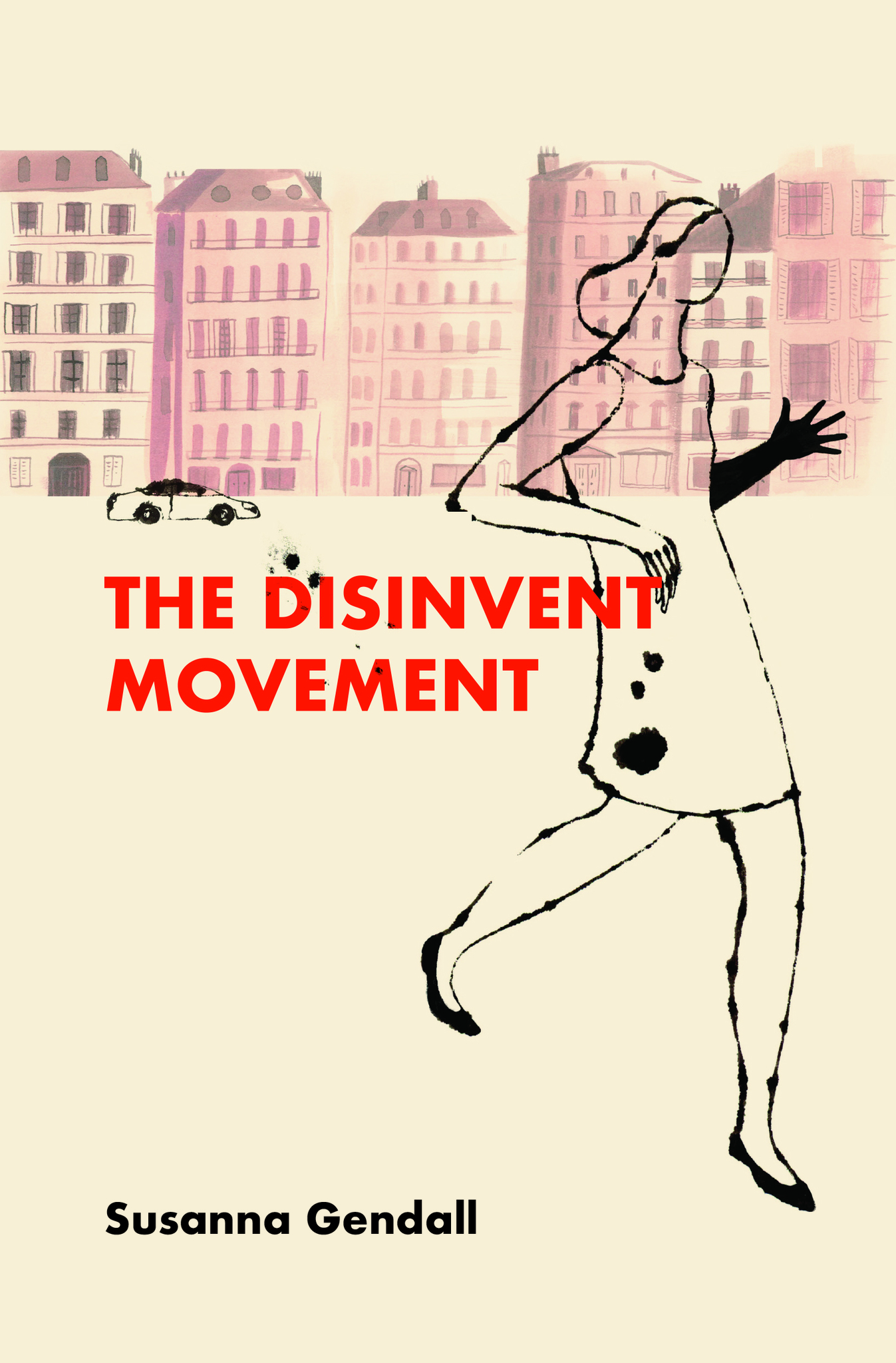
Poetry Shelf celebrates: Susanna Gendall’s The Disinvent Movement

The Disinvent Movement Susanna Gendall, Victoria University Press, 2021

‘Every week we would disinvent something. This week it would be plastic. Next week it would be the aeroplane. I stood outside the supermarket and handed out flyers, which people kindly refused as they left carrying large packs of bottled water.’

Susanna Grendall’s short fiction and poetry have appeared in a number of journals in Aotearoa, in print and online. The Disinvent Movement is her first book. Presented as a novel, it might also be viewed as poetry or short fiction. The short chapters, the 81 vignettes, create a patchwork-quilt effect, exquisitely stitched pieces that fit together as both absence and arrival. One chapter appeared as a poem on The Spin Off‘s Friday Poem. Susanna (at the time of publication) lives in Wellington and Paris, and the novel bridges both cities, along with time spent in other countries.

The novel sustains the rhythm of the quotidian, almost as though we accompany a bricoleur strolling, collecting, musing, assembling, pausing. There is a plainness at work. There is a knottiness at work. There is the protagonist, both intimate and at a distant. She is in an abusive marriage, but that is held at arm’s link, so we only get squinty looks. She is vignetting her encounters with men (love affairs) that masquerade as encounters with self. She invents the Disinvent Movement as she craves substance, concreteness, attachment. More importantly she yearns to rid (disinvent) the world of unnecessary things (plastic, appliances). She holds so much at arm’s length: her children, her husband, her lovers, her friends. Yet in this swirl of daily existence she is exposing herself. It is poignant and it is unsettling. How do we survive the slam of life and living? Of finding a place in our mayhem world?

The protagonist’s Disinvent Movement acquires straggler fans who don’t necessarily get what disinvent means. Maurice does. Maurice wants to disinvent cars. To black out car windscreens, and to set them all on fire a week later. Mavis however wants to drive her car to pick up horse manure (sometimes). The windscreens get painted black, but such anarchy prompts the protagonist to flee.

She is working in an office not quite under her own name. Nothing feels stable, neither the people close at hand, nor the people at arm’s length. She asks near the end of the book: ‘What was identity except a bit of stitching?’ Indeed. I am reading this and as I read I am unravelling and picking up stitches, admiring patterns, threading yarn and inventing as much as disinventing. Catching the mistakes in living, the craft in living, the self garment in the making.

I read this in one compulsive swallow. It is unlike anything I have read (maybe whiffs of French and Italian writing) and is altogether glorious.

Te Herenga Waka University Press page

Susanna reads and talks about the book with Lynn Freeman RNZ National

Poetry Shelf celebrates Ockham NZ Book Award 2022 Poetry Short List: Tayi Tibble’s Rangikura

‘I love words so much they blind me.’

from ‘Mahuika’

Tayi Tibble caught my poetry heart with her debut collection – Poūkahangatus – and the hearts of a galaxy of poetry fans. Rangikura is snaring my heart again. Gloriously so.

Why is it so good to read this book? It is stepping into liquid currents of words, river currents of ideas, images, feelings: incandescent, life-affirming, fast flowing. The poem is the water current and the lightness current, and it is the vessel-on-the-water current. I am climbing in, word splashed, and drenched in joy. The poet is deep diving, skimming the shallows, riding the rough, revelling, honouring, exposing.

Feel the vernacular, the te reo, the melodies along the line, and it is so skin-prickling good.

The first part reclaims the girl. This is girlhood and it is feminism. It is dangerous and vulnerable, mermaid girls racing the boys in the water, girl bonding, girl bounding, the step-brother test, horoscopes, delivering kittens, armouring the danger-girl, becoming winter, the East Coast map carried inside. A road map of adolescence. And always the scintillating rapids of writing. Bliss.

And I remember the year
we were the two strongest ‘girl swimmers’
in our syndicate. This meant
we were forever forced to race
the boys for Western feminism
and you would always win,
even against the boys who were so like men
the teachers treated them as if they were
more muscle than human.

from ‘Lil Mermaidz’

The middle section is a sequence of she he prose poems, a shift in key, a miniature novel in verse, where love is threaded at a distance, and we all might have different things to say about the he, about the she, the tyranny of separation, and the tyranny of waiting. The sexiness of everything. Hierarchies. The love affair, the love relationship, ah what to call this, as dialogue and desire unfold in restaurants and hotel rooms, and the restaurants are sweet and soured with taste and preference. I am almost eating the rice and peanuts (well not the meat), relishing the ‘tacky’ surroundings. And it is sharp edge reading this love, this like love like suite. Think of the way you might look at a photograph and everything is sharp edged with life. And light. And yes the dark shadow jags.

The third section returns to free verse, freedom to break the line, to make it clear that sometimes politics is personal, and that maybe politics is always personal, and that poetry is the the whenua, the maunga, the ocean, the awa. Poetry is sky and breath and beating heart. Tayi’s poetry is grounding liberating speaking out singing. This is what I get when I read Rangikura. It is poetry, but it is also life, more than anything this is poetry as life.

Tayi’s collection is framed by an opening poem and a last poem, ancestor poems, like two palms holding the poetry tenderly, lovingly. Hold this book in your reading hands and check out the electricity when you stand in the river, the ocean. Reading Tayi spins you so sweetly, so sharply, along the line, off the line. I love this book so much.

I sat in the lap of my great-grandmother
until the flax of her couldn’t take it.
So she unravelled herself and
wrapped around me like a blanket
and at her touch the privilege of me
was a headrush as I remember
making dresses out of sugar packets,
my bro getting blown up in Forlì,
my grandfather commemorated under one tree
even though he forced himself into our bloodline
and then abandoned me and me and me.

from ‘My Ancestors Ride with Me’

Tayi Tibble (Te Whānau ā Apanui/Ngāti Porou) was born in 1995 and lives in Wellington. Her first book, Poūkahangatus, won the Jessie Mackay Best First Book of Poetry Award in 2019.

Xoë Hall: xoehall.com

Te Herenga Waka University Press page

Paul Diamond review on Nine to Noon, RNZ National

Faith Wilson responds to Rangikura at The Spinoff

Kiri Piahana-Wong review at Kete Books

Poetry Shelf noticeboard: Poetry New Zealand Yearbook 2022 launches online

Poetry New Zealand Yearbook 2022

Edited by Tracey Slaughter

Monday 14 March 2022, 6pm 

Online via Zoom — 
with readings from a selection of this year’s PNZYB poets

Please RSVP here by 7 March


Join us on Zoom 


Books will be available at a 10% discount via Poppies

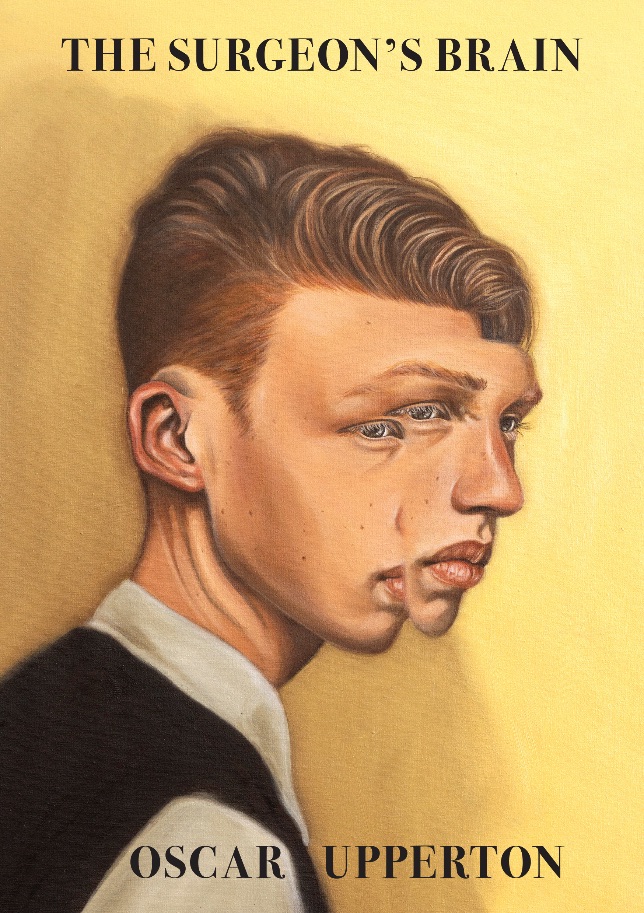
Poetry Shelf noticeboard: Oscar Upperton launch postponed

Due to Covid-19 and the current number of cases in the community,
we are sorry to postpone this evening’s launch of
The Surgeon’s Brain by Oscar Upperton
until further notice.

We apologise for any inconvenience this may cause.

Stay safe.

Poetry Shelf noticeboard: Dunedin Fringe Festival

Dunedin Fringe presents 

a premiere-packed programme for 2022

Festival dates: March 17-27

Programme

The Dunedin Fringe Festival is preparing to go ahead under the current ‘Red’ setting of the Covid Protection Framework, providing a supportive platform for artists to show their work and the opportunity for audiences to discover something new, whilst implementing a range of protocols to keep staff, artists and audiences safe.

An unmissable highlight in the festival calendar, the world’s southernmost fringe is back 17-27 March in Ōtepoti/Dunedin. This year’s programme is packed with premieres, offering audiences the chance to be the first to see innovative and experimental new work from established and emerging artists.

In Intoxicana, award-winning humourist Te Radar delivers a hilarious illustrated lecture revealing the untold stories of intoxicating substances from New Zealand’s past; vibrant dance double-bill Vivid Dreaming presents a collection of human experiences and issues set in the abstract worlds of our subconscious; and director Ruth Carraway (formerly of UK series Grange Hill and The Bill), works with a cast of people who have touched the prison system in theatre piece Been Through Enough.

First of its kind kaupapa Māori opera, Silence is, challenges preconceptions and explores the cacophony of physical, spiritual and political silences around us; while debut theatre The World’s First Lovers weaves a tapestry of Māori mythology and personal anecdote, combining the celestial realm and the human realm with personal stories that affect us all.

For the first time in Fringe history, delve into the world of fashion from the fringes Fashion X Fringe X Fashion in an event that highlights diverse, thoughtful, and challenging fashions from a selection of designers – current students, graduates and lecturers – all from Fashion at the School of Design, Otago Polytechnic.

Local artists take you on a unique voyage through Dunedin’s marine history. The salty crew of Sea Shanties and Salty Stories will take you across the harbour on a ferry while regaling you with tales and shanties from the salty brine; and GASP! Dance Inclusive explores the rich history of St Clair beach with a debut short film series, Promenade.

Tailored to Dunedin, Chris Priestly and the Unsung Heroes is an all-original musical theatre performance about New Zealand’s villains, rogues, and unsung heroes, led by Peter Elliot ONZM.

Festival Director Gareth McMillan said it was important in the face of yet another year of disruptions that the Fringe could offer support to smaller events with a lower risk profile to go ahead, and offer a platform to artists to continue to share their work and make an income.

“We are fortunate to be in a position to proceed with our Fringe events under the Red light restrictions and are taking extra precautions to make sure that this undertaking is as safe as possible,” he said.

“We hope that people will continue to support our artists as best they can, whether that be through coming along to an event if they feel comfortable, buying a ticket for someone else, or enjoying some of the online shows that are part of this year’s programme.”

This year’s online offering includes theatre pieces Rough Night and Shattered; dance pieces Promenade and Inherent Awkwardness; comedy from Rob McLennan: Pool Shark and Neechie-Itas; and performance art show Maggie Cocco’s Science for Sociopaths.

The festival’s comedic legacy will be upheld by a host of national comedy stars, including Taskmaster NZ’s David Correos, 2021 Billy T Award nominee Jack Ansett, Liv McKenzie (NZ Comedy Festival Best Newcomer 2019) and a split bill from Ben Hurley and a special guest.

Award-winning writer, performer and comedian Sarah Harpur returns to the Fringe in 2022 with her first comedy play, Shit Kidwhich in its infancy was selected for the UNESCO Cities of Literature Short Play Festival in 2019. The fictional performance tackles topics such as the painful intersection between motherhood and ambition with delicate wit.

The Late Night Line Up will once again take over the Emerson’s Festival Theatre, every Thursday through Saturday of the Fringe, entertaining festival-goers into the night with a hand-picked itinerary of headline comedians and musical talent.

Artist collective Spectacle will present a dynamic, immersive, participatory pan-art show on the theme of disturbance; The Blue Oyster Art Project Space is delivering another stunning performance series; Jojo Marsh of Bondage Queen fame returns to Dunedin with A Nifty History of Evil, a hilarious journey through history’s biggest baddies; and Ōtepoti Hip Hop Hustle will be back and bigger than ever for 2022, presenting the four elements of hip hop: DJing, MCing, dance, and graffiti art.

The 11-day festival programme also offers the opportunity to explore art in different spaces.

Fancy watching a live Shakespeare performance from the comfort of your garden? This year you can with The Barden Party! A small troupe of travelling actors will be bringing music, mischief, magic to Dunedin gardens in a performance of A Midsummer Night’s Dream. The Shakespearean performance is peppered with folk-like renditions of popular music ranging from Billie Eilish to Wham.

Surround yourself in sound with STORK AND GAMELAN, a piece made up of traditional and improvised compositions using gamelan – a traditional, large scale instrumental ensemble; and find art in surprising spots across the city with Cargo Bike Art Space offering an ever-changing programme of artists, showcasing artistic works of projection, puppetry, and sound.

 publicity@dunedinfringe.org.nz.

Dunedin Fringe thanks all our supporters. Core funding is gratefully received from:

Poetry Shelf review: Anne Kennedy’s The Sea Walks into a Wall

The Sea Walks into a Wall, Anne Kennedy, Auckland University Press, 2021

          On the beach, always an aftermath of a wedding
          froth and a mess of ribbon and glass,
          a runway for lost souls returning
          a regret.

          Tangaroa is like butter in the sun today.

          I love the wall. I pummel the wall. My hands are on
          the warm, grey, post-industrial wall.

          In the next storm, the sea will take the wall
          back into its real-time, moving, shining
          thing.

          My heart is like a wall
          struck down in a storm.
          You didn’t even need that wall
          at all.


               from ‘The Sea Walks into a Wall’


Opening a new collection by Anne Kennedy is always a delight. Her 2021 collection The Sea Walks into a Wall confirms she is one of Aotearoa’s most inventive and assured poets. She weaves autobiographical traces along a musical clef with a roving mind and linguistic agility. She touches upon matters of the heart, political issues that demand voice, multiple themes. The Sea Walks into a Wall is shortlisted for Ockham NZ Book Awards, and it is easy to understand why her poetry has received multiple awards to date.

The opening poem ‘Flood Monologue’ features a stream as protagonist: a companion stream, a sick stream, a raucous stream. The poem is lithe and witty, complex and plain. It is the perfect gateway to a collection that renders streams and currents into poetic existence. You absorb poetic movement as process, thought, revelation. Helen Rickerby says on the back of the book, Anne has produced ‘a treasure trove’. And indeed she has.

I keep returning to the poetry as tidal movement. The poet is pausing, adding, refining. Anne plays with the melody, employing strong and weak beats, short and long phrasings. The collection’s tidal music is exquisite in the ear. Nowhere more so than in the title poem ‘The Sea Walks into a Wall’. What is said laps against what is not said, daily life ripples alongside a reading life and a thinking life. The waves shimmer with both past and future, the present a luminous constant. It is the kind of poem that keeps pulling you back in, like a swimmer pulled back into ocean enchantments.

‘In the Way’ is not water focused, yet its tidal effect is a wave-smash of feeling, hauntings perhaps, as the lines spiral and loop and cut back. This is a poem of family and home, like a curling fable, with an aromatic arrival of distractions, subtractions, contractions. How to live? How to be? Things get ‘In the way’, and as the repeating line reiterates, ‘Love fills the room like a maze’.


        For several months you hold the car door open for toddlers.

        Weeks watching the progress of mercury in a thermometer.

        Several years the pages of critical theory kept you from death.

        A poem kept you from death.

        A big wind gathers out at sea.

        There’s another thing like a box and you don’t know what’s in it.

        You walk together in the forest and the forest is a thing.


             from ‘In the Way’      


I love the way the collection as a whole cannot pinned down to narrow keys, form, lengths, and the tonal shifts and reaches (like the ocean) are exactly what adds pleasure to the reading experience. There is an ongoing sense of the poet speaking to you the reader. Alongside a plainer poem (with its own complex delights) there will be a denser treat. ‘Warp and Aho: A Part-life in Flax’, with its thatch and weave and lace holes, is a tour de force occasion. A poem that hooks you into its stitching, line after line, with linguistic deftness, multiple languages, personal musings, opinions, admissions, and again, even though this is a poem of weft and weave, I am reminded of the glorious movement of the ocean.

Anne has produced the kind of poetry collection that demands repeated readings, in multiple states of mind, in diverse reading locations. It will astonish, challenge, transport and soothe. A sumptuous and satisfying reading experience.

Anne Kennedy is the author of three novels, a novella, four books of poetry, and many anthologised short stories. Her first book of poetry Sing-song was named Poetry Book of the Year at the 2004 Montana New Zealand Book Awards. The Darling North won the 2013 New Zealand Post Book Award for Poetry, and Moth Hour was a poetry finalist at the 2020 Ockham New Zealand Book Awards. Anne has also won the BNZ Katherine Mansfield Short Story Award and has held fellowships at the University of Auckland, the IIML, and at the University of at Hawai‘i. She has taught creative writing for a number of years in Hawai‘i and Auckland.

You can read ‘Fox and Hounds’ previously published on Poetry Shelf

Auckland University Press author page

NZ Poetry Shelf noticeboard: Ockham NZ Book Awards 2022 Short List

Judges’ comments on books here

The shortlist – from a longlist of 40 books by four panels of specialist judges (for fiction, poetry, illustrated non-fiction and general non-fiction) – includes both literary luminaries and first-time authors.

Rob Kidd, the convenor of judges for the Jann Medlicott Acorn Prize for Fiction, says the finalists in this category refuse to be pinned down by genre.

“These novels are packed with life in an array of ordinary and extraordinary forms; they all swell with vitality. A Good Winter by Gigi Fenster is an unnerving and absorbing reading experience as the darkness gradually closes in. Bryan Walpert’s Entanglement is dazzlingly intelligent and ambitious in scope. Rebecca K Reilly’s Greta & Valdin is gloriously queer, hilarious and relatable, and Kurangaituku by Whiti Hereaka is poetic, intense, clever and richly imagined.”

The American writer, editor and literary critic John Freeman will assist the three New Zealand judges to select the fiction winner, who this year will take home a prize of $60,000.

Saradha Koirala, convenor of judges for the Mary and Peter Biggs Award for Poetry says the four category finalists have pushed their craft to new limits, giving us outstanding examples of how our literary voices have evolved.

“In a time of global instability, Aotearoa poets have reconnected to their sense of self, exploring identity and challenging our collective history. Tayi Tibble’s Rangikura pays tribute to millennial culture and uses the power of humour, sexuality and friendship to create a collection that encapsulates this generation of Aotearoa. In Sleeping with Stones, Serie Barford demonstrates her ability to use simple eloquence to write about complex matters. Anne Kennedy creates poems that are consistently engaged with issues of the anthropocene in The Sea Walks into a Wall, and the pristine imagery and fine ear for rhythm and beat means each of Joanna Preston’s poems in Tumble are a celebration of poetry,” says Ms Koirala.

The judges found the four finalist books in the Booksellers Aotearoa New Zealand Award for Illustrated Non-Fiction impossible to exclude in both their exemplary individual qualities as books, and the insight and depth they all bring to their varied and valuable content, says convenor of judges Chanel Clarke.

“Particularly outstanding this year are a number of well-researched yet not so well-known histories and herstories, beautifully delivered, that invite surprising new understandings of ourselves. Dressed: Fashionable Dress in Aotearoa New Zealand 1840 to 1910 by Claire Regnault is a beautiful and beguiling book that will seduce a wide audience. In NUKU: Stories of 100 Indigenous Women, Qiane Matata-Sipu gracefully presents her subjects in their own words and through her tremendous portrait photography. Shifting Grounds: Deep Histories of Tāmaki Makaurau Auckland by Lucy Mackintosh is a fresh and timely study that weaves multiple narratives into a highly readable story and The Architect and the Artists: Hackshaw, McCahon, Dibble by Bridget Hackshaw is a thorough and beautifully produced triangulation of creative practice,” says Ms Clarke.

Nicholas Reid, convenor of judges for the General Non-Fiction Award says the category finalists stand out not only for their individual excellence in research, story-telling and deep insight, but also for their contribution to the ongoing narrative of what it means to be a New Zealander.

“Each work brings deep insight and beautiful writing to their subjects, which included three very different autobiographies and a work of remarkable historical scholarship. From the Centre: A Writer’s Life by Patricia Grace is a rare literary memoir, free of egotism; Dave Lowe’s The Alarmist: Fifty Years Measuring Climate Change has a rich texture of family and a clear awareness that members of the scientific community are not always in harmony; the prose in Charlotte Grimshaw’s The Mirror Book is exquisitely precise in its navigation of the complexity of the author’s family dynamics, and Vincent O’Malley helps readers to think critically as he presents balanced arguments about contested battles and other conflicts in Voices from the New Zealand Wars | He Reo nō ngā Pakanga o Aotearoa.

The shortlist (*represents debut authors)

Jann Medlicott Acorn Prize for Fiction

  • A Good Winter by Gigi Fenster (Text Publishing)
  • Entanglement by Bryan Walpert (Mākaro Press)
  • Greta & Valdin by Rebecca K Reilly (Te Herenga Waka University Press)*
  • Kurangaituku by Whiti Hereaka (Huia Publishers)

Mary and Peter Biggs Award for Poetry

  • Rangikura by Tayi Tibble (Te Herenga Waka University Press)
  • Sleeping with Stones by Serie Barford (Anahera Press)
  • The Sea Walks into a Wall by Anne Kennedy (Auckland University Press)
  • Tumble by Joanna Preston (Otago University Press)

Booksellers Aotearoa New Zealand Award for Illustrated Non-Fiction

  • Dressed: Fashionable Dress in Aotearoa New Zealand 1840 to 1910 by Claire Regnault (Te Papa Press)
  • NUKU: Stories of 100 Indigenous Women by Qiane Matata-Sipu (QIANE+co)*
  • Shifting Grounds: Deep Histories of Tāmaki Makaurau Auckland by Lucy Mackintosh (Bridget Williams Books)*
  • The Architect and the Artists: Hackshaw, McCahon, Dibble by Bridget Hackshaw (Massey University Press)*

General Non-Fiction Award

  • From the Centre: A Writer’s Life by Patricia Grace (Penguin, Penguin Random House)
  • The Alarmist: Fifty Years Measuring Climate Change by Dave Lowe (Te Herenga Waka University Press)*
  • The Mirror Book by Charlotte Grimshaw (Vintage, Penguin Random House)
  • Voices from the New Zealand Wars | He Reo nō ngā Pakanga o Aotearoa by Vincent O’Malley (Bridget Williams Books)

Poetry Shelf noticeboard: The Inaugural John O’Connor Prize for Best First Book of Poetry

The Canterbury Poets Collective is delighted to announce their short-list (in no particular order) of manuscripts submitted to the John O’Connor Best First Book competition.

Congratulations to these successful poets! Their manuscripts have been forwarded to Elizabeth Smither for adjudication.

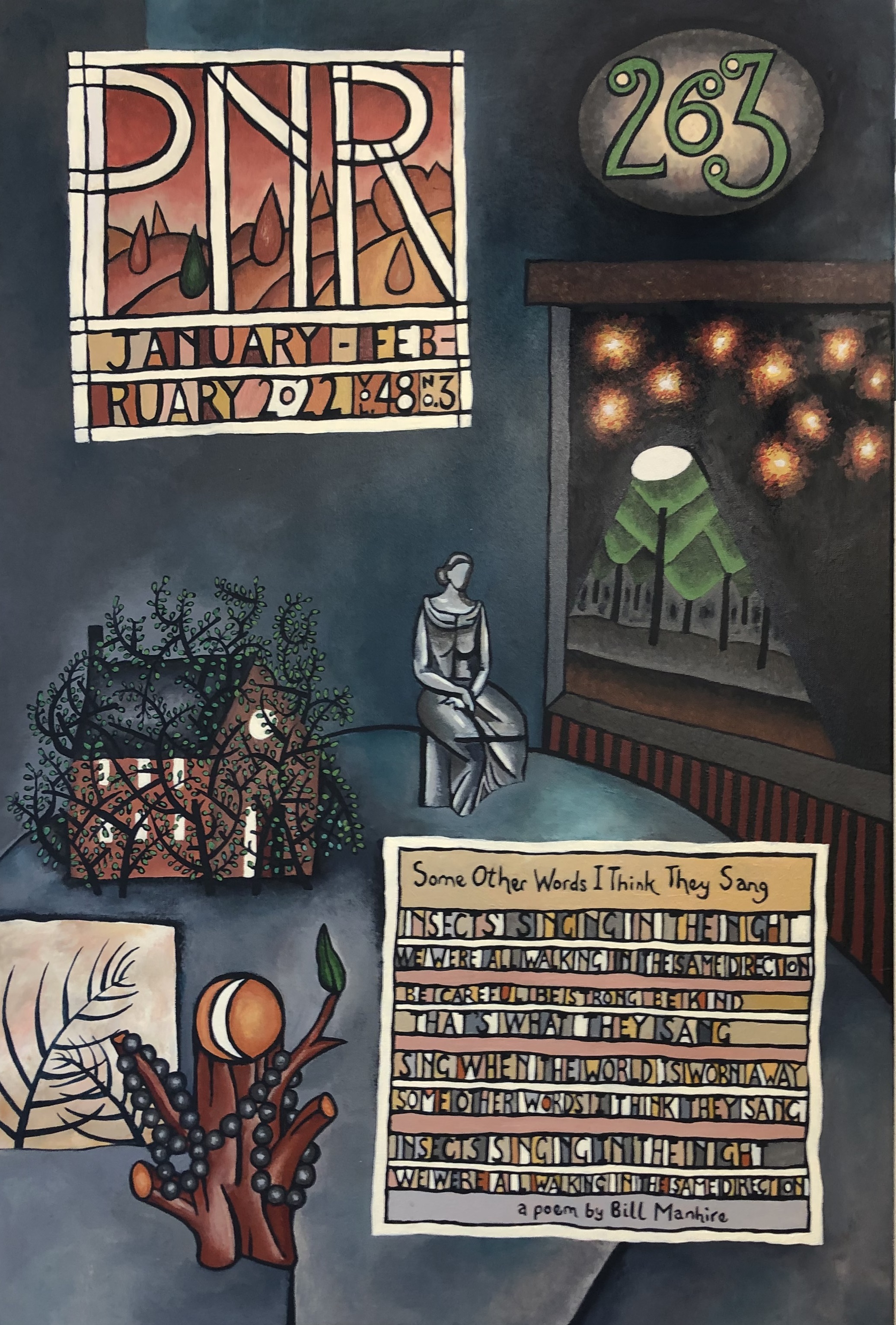
Poetry Shelf celebrates: Gregory O’Brien’s cover, Bill Manhire’s poem

Gregory O’Brien is currently creating covers for PN Review. They are simply glorious. The latest cover (263) also features an exquisite new Bill Manhire poem. The combination has prompted me to take out a subscription. I keep looking and rereading, relooking and reading. This is what poetry and art can do. The effect here is enigmatic, mysterious, musical, topical, physical, and utterly of these unsettling times. Both the poem and the art make me feel the bliss of colour and line, image upon image, and then I feel like weeping for the light and the dark, in the light and the dark, for the containment and the contained. The echo mantra that ‘we are all walking in the same direction’ haunts.

Some Other Words I Think They Sang 

Insects singing in the night. 
We were all walking in the same direction. 

Be careful. Be strong. Be kind. 
That’s what they sang. 

Sing when the world is worn away. 
Some other words I think they sang. 

Insects singing in the night.         
We were all walking in the same direction.

Bill Manhire

PN Review newsletter