Category Archives: Uncategorized

Poetry Shelf cafe readings: Ethan Christensen

Ethan Christensen is a writer from parents, grandparents, and tīpuna based in Coromandel Town. His work features in publications across Aotearoa and Australia, and he co-edited the penultimate issue of Overcom Magazine in 2024. In 2025, he won the Peter Wells Short Fiction Most Promising Young Writer award, presented by Samesame but different. In the breaths of community and belonging, he hopes others can see themselves in the experiences he puts to page, whatever they may be. You can find more of his published mahi on Instagram, @eth_christ.

Poetry Shelf celebrates a Laureate evening

Poetry Shelf celebrates our Poetry Treasures

Laureates: Chris Tse, Elizabeth Smither, Karl Stead, Michele Leggott, Cilla McQueen, Jenny Bornholdt, Bill Manhire, David Eggleton. Image: Miro King

An extraordinary gathering of Poet Laureates at the National Library in Wellington on November 27th inspired this celebratory post. Peter Ireland, who steered the event so beautifully, has kindly shared photos, audio and video links, and written an introduction. I invited a number of the laureates to contribute a poem and write a paragraph. Poet Philippa Werry was in the audience and shared a few words.

Stephen Olsen’s write-up in Wellington Scoop
Video links are available for one month

Laureates Line Up: a view from the wings

The genesis of Laureates Line Up took place 30 years ago when John Buck had the compelling idea of creating a Poet Laureate Award to recognise one hundred years of planting grapes on Te Mata land.

Fast forward to 27 November 2025, 14 Poets Laureate later, the National Library supported by Te Puna Foundation, Air New Zealand and Te Mata was inspired by John’s example for its 60th birthday by holding the poetry party of the year.

Fergus Barrowman presided as MC with a touch both deft and warm and Selina Tusitala Marsh, prerecorded in Menton lead out with ‘Te Aroha’ and a tribute to Vincent O’Sullivan.

Robert Sullivan embraced definitions of aroha from his home in Ōamaru; before eight Laureates took the stage one by one; together with Jillian Sullivan and Dominic O’Sullivan reading on behalf of Brian Turner and Dominic’s dad, while exploring a family tie along the way.

There have been Laureate gatherings before, but time had caught up with some for Laureates Line Up. But local poets were out in force among the audience of 250 to reinforce the point that poetry is in good heart in New Zealand and that the Poet Laureate Award has mana and is thriving.

As Laureate David Eggleton observed after the reading, it did indeed feel like an historic moment. And a precious one.

Peter Ireland
National Library

Image: Miro King

Laureates Line Up: a view from the audience

A rare and precious moment at the National Library: 14 Poet Laureates, all of them gathered either in person, online or by proxy, or, as Jillian Sullivan said about Brian Turner, with their memory in our hearts; along with Jacob Scott, creator of the tokotoko for each poet, Peter Ireland (National Library ”Poet Laureate minder”) andloyal sponsors John and Wendy Buck of Te Mata Estate winery, who provided the fine Te Mata wine to go with the delicious nibbles. 

The evening began with a welcome from Jackie Hay, of the community engagement team at the National Library (the “rare and precious moment” quote is hers) and an acknowledgement of those whom we’ve sadly lost in recent years: Vincent O’Sullivan, Brian Turner and kaumātua Tom Mulligan from Matahiwi marae. Selina Tusitala Marsh (“bonjour from Menton”) then led everyone in a pre-recorded waiata of Te Aroha and Fergus Barrowman, with warmth and humour, introduced the Laureates to read in pairs. New Poet Laureate Robert Sullivan joined in online from Oamaru, followed (again from sunny Menton) by Selina reading a poem to honour Vincent O’Sullivan, remembering a time when they were both guests at Lockwood Smith’s London home and Vincent, uncomplaining, was given a room on the third floor.  

In the lineage of laureates
excellence is simply this
just climb the stairs and write 

The next pairing was Jillian Sullivan, Brian Turner’s partner, reading for Brian, and Dominic O’Sullivan, Vincent’s son, who flew over from Australia to read for Vincent. Jillian read “The rocks below”, Brian’s message to a grieving friend; his shortest, one-line poem titled “New Zealanders, a definition”, “Deserts, for instance” (which is to be the text of a sculpture in Central Otago to recognise him as Poet Laureate of Nature) and lastly, a poem that Brian read at his final public reading last year in Dunedin. Dominic read two family poems, one about Vincent’s grandfather, the other a poem carved on the headstone of Dominic’s daughter Sarah.

Bill Manhire and Jenny Bornholdt read poems from new books coming out next year. Bill commented, “I spend far too much time on social media” and described a recent post about Dracula’s grave (or lack of) at a church in Whitby, before a brilliant reading of “Too many Draculas” (definitely worth buying the new book for that poem alone). He said that one of the things being Poet Laureate had given him was the courage to use poetry to speak out on public events and then read his protest poem “Gaza”.

His parents held him while he died
but they are both dead, too.
Or he held them, no one remembers

Jenny read four new poems: “Luck”, “Forecast”, “Worry” and “First aid”, the last one ending with a lovely, very Wellington-seeming scene on a bus. Elizabeth Smither read some wonderful and hilarious librarian poems, which all the librarians in the audience clearly related to, and C K Stead read some of his recent Catullus and Kezia poems, bringing an Auckland flavour with shades of Kohimarama and Rangitoto. Fergus then read for Ian Wedde, in Ponsonby: another Auckland, very Ponsonby poem (“See what love can do”) with a perfect ending, and he also read Hone Tuwhare’s “Toroa”, noting its link with Wellington and the Tanya Ashken sculpture on the waterfront.

Your head tilts, your eyes open to the world.  

Two poets from the deep south followed: David Eggleton (who described himself as the pandemic Poet Laureate and read an extract from Rāhui, his lockdown journal) and Cilla McQueen, who read “Letter to Hone 2022” (“one of many”) and “Learning by heart”, written the day after a car accident. And the very last pairing was Michele Leggott and Chris Tse. Michele read “a summertime poem” and a poem in praise of the scientists and technicians – and the mouse! – of the Malaghan Institute:

The battlefield
of blood and bone marrow

Chris, the outgoing Poet Laureate, read “I want things that make me happy”:

Give me scars of adventurous days
Give me old age and better 

And his last poem looked ahead to “the other side of next year”, a fitting ending. (Lots of these poems had wonderful endings). Wonderful and very special line-up, amazing evening of poetry and stories.

Philippa Werry

Laureate Jenny Bornholdt. Image: Miro King

eight poets laureate select a poem

I think of myself as being a fairly quiet poet but being poet laureate helped me find the courage to step into public spaces  – even to occasionally attempt writing to order. ‘Erebus Voices’ is one example. It was written for Sir Edmund Hillary to read at a Scott Base memorial service in November 2004 honouring the 257 passengers and crew who had died 25 years earlier in the Erebus tragedy. Peter Beck, then Dean of Christchurch Cathedral, who led the service, requested the poem on his behalf. Apparently Sir Ed was happy to participate in the service, but did not wish to read a Christian text. One of his closest friends had died in the disaster. I was able to see him reading the poem on the TVNZ News. He gave it heaps.

Erebus Voices

The Mountain

I am here beside my brother, Terror.
I am the place of human error.
I am beauty and cloud, and I am sorrow;
I am tears which you will weep tomorrow.
I am the sky and the exhausting gale.
I am the place of ice. I am the debris trail
And I am still a hand, a fingertip, a ring.
I am what there is no forgetting.
I am the one with truly broken heart.
I watched them fall, and freeze, and break apart.

The Dead

We fell.

Yet we were loved and we are lifted.

We froze.

Yet we were loved and we are warm.

We broke apart.

Yet we are here and we are whole.

Bill Manhire
from Lifted, Victoria University Press, 2009

At the conclusion of ‘Persuasion’ Anne Elliot enters her father’s house so happy as to require an interval of meditation to prevent her emotions from overflowing. ‘She went to her room, and grew steadfast and fearless in the thankfulness of her enjoyment’. Jane Austen often uses this corrective half-hour of quiet to steady the emotions, to lower the pulse, to regulate joy or tears. I imagined the jumble of Anne’s feelings before she faces the evening’s pallid entertainment and before she becomes pastel herself. I removed all the commas because jumbled emotions need no pause.

What Anne Elliot did in her respite room

She peeled off her gloves laid down
the umbrella offered by Captain Wentworth
she went to the window and looked out
too agitated to sit she removed her shawl
and bonnet smoothed her brow patted her hair
bent at the waist and eased herself into a chair
deep breaths counting to ten then
letting them out again to the same tempo
gradually her heartbeat slowed she touched
her pulse with two fingers to confirm it
and the room’s familiar things settled
her books her hairbrushes her jewellery box
a crystal vase with flowers one browning leaf
a little dust since this morning had alighted
indiscriminately on the furniture. Half an hour
and she felt she was turning pastel enough
to return to the drawing room.

Elizabeth Smither

This poem of Brian’s spoke to me in a personal way, the way his poetry does, shining a light on your own fears, losses, hopes. And wonders. Explaining how things are. How things could be. I am leaving this week to walk the length of the South Island, or as Brian says in Hard Luck, Nature: “here’s hoping, here’s to a decent attempt, for all the right reasons.’ I want to be in the mountains at the date that’s a year of him leaving. To be crossing rivers, standing on summits, facing the steep bits, loving the slopes down from the bluffs. This poem speaks metaphorically of life at the same time it carries the authenticity of his own long tramps in nature. And as for grief, there is hope in the lines; ‘the dusty earth/ believes we are crying/yet the river sings’, and advice in his mantra: ‘Let’s go on reaching,’ and the two words, ‘living, here.’

Jillian Sullivan


 Walking in                               

The country throbs 
and all that is dead 
is buried by all that’s 
so convincingly alive.

We sweat. The dusty earth 
believes we are crying 
yet the river sings.
We hate the steep bits,

love the easy grades 
down from the bluffs, 
the way the body 
handles it all

as long as we don’t 
over-reach ourselves.
Let’s go on reaching.
We carry all that we need,

we think we know 
where we’re heading 
and why, and two words 
dwarf all others: living, here.

Brian Turner
from All That Blue Can Be, 1989

‘Worry’ combines three occasions I’d written  notes about, thinking I’d probably want to use them in a poem, or poems, sometime. I started with worrying about the day and then, in the way that poetry happens, the other two followed on from that. Each had its own strangeness and I think this is what bound them together. It was good to start with upset and finish with a rush and then the calmness of mothers sleeping.

Worry

I woke to worry
about the day
so went out into the garden
to move things around. Said
sorry, sorry, sorry
to stick insects disturbed
along the way.

Then I walked
along the river, said hello
to two women and
a baby, one man,
a runner and three
cyclists. Dogs veered like thoughts
into a tiny experimental
forest.

I walked beside tennis courts
to the next sunny rise, to the bent
tree, the big rock, then
I was done.

I sat and remembered
the time my cousin and I
ran through all the gardens
of the world. Our mothers slept
on the lawn while we sprinted through
Spain, Greece, Italy; my uncle
grumpy amongst the bright flowers
of India. Japan was an ocean
of pale stones, calm as our mothers
in their childhood beds, whispering
like grass.

Jenny Bornholdt
from What to Wear, forthcoming THWUP, Feb 2026

This is a praise poem for the scientists and clinicians of the Malaghan Institute of Medical Research and for the mouse whose genes helped save my life three years ago. For eight or nine months I was part mouse and then the genetic material dispersed and I was myself again, with a debt of gratitude that is hard to overestimate.  

lymphocyte | rag

I am a chimera  —  the 68 million cells
each with its mouse head  —  and trailing antibodies
made from transcriptions of a human gene
have replicated themselves who knows how many times
antigen receptors looking for trouble  —  doubled
in their capacity to hunt down and eliminate
diffuse large B-cells  —  gone crazy
killers versus killers  —  they hang about
munch munch munch  —  creep creep creep
the battlefield of blood and bone marrow
the waterfall above my heart  —  mouse god Apollo
tune up your banjo and lead those antibods
in a ragged medley  —  you’re going to miss me
when I’m gone  —  it’s going to take
years to rewrite the symphony
that was my lymphocytes  —  white mice
rejoice  —  your red eyes and the control panels
have wrought the miracle  —  plain as day
a string of chimeric figures
jigging on the high plateau
and below their fandangles  —  a single line
near normal subsets  —  dance mice
dance scholars and poets everywhere  —  dance on ice
dance in the streets  —  and praise
the high chimeras of the blood volcano
and the caves where miracles are made

Michele Leggott

Sláinte

It was to the surprise of some that Vincent accepted a knighthood in 2022. He explained that one of his reasons was the sense of historical irony it brought to his family’s story. It was for the sake of his grandfather Tim, born in Tralee shortly after the Great Famine, and who died before Vincent’s father was born.

Sláinte is a reflection on Tim’s story. His death from cancer in 1898 and his widow Maryanne’s emigration to New Zealand with her children with Vincent’s father, also Tim, the youngest. For me, its resonance is simply that it is a poem about family and one of Vincent’s last. Written as he said,

‘As close as it gets
this late in another’s day’.

Sláinte

A man who adds up to half
my lifetime, were we
into counting. A man from
a train looks up to the grey cliff
of the Mater Hospital, Eccles
Street, 1897.

At the end of his drenched
disconsolate country,
the woman is pregnant to the man
who has travelled from Kerry
in pain’s private carriage.

It is always dusk
in my thinking of it, the lone
man’s arriving, the lights
white-circled in the evening
wards, the veiled nurses …
his fingers nervous (as his son’s
in time) on pyjama buttons.

My father would hear
as a boy from a shawled
sybil in the street of the Bon
Secours how she’d seen
his father that same day
as he died in Dublin,
smoking as though back home,
at ease on his doorstep,
before fact arrived.

It was later again. A butterfly
out of season on the curtain
of the room where my father’s born.

Strand Street by autumn then
with the widow’s five
charges, planning the world’s
passage from a corner store,
so the South stays always
morning in memory,
boys aboard the Scharnhorst
a decade later, fun
on deck and the German sailors
teaching numbers and phrases,
the horizon hauling
at Timaru’s rising …

This now for my father’s
father, and then my father,
unknown to each other yet never
further than namesake, one,
and one to another, to my
saying this. As close as it gets
this late in another’s day.
In theirs. In mine.

from Still Is, Te Herenga Waka University Press, 2024

After my last  collection, In the Half Light of a Dying Day, I said I would write no more poems, and for two and a half years I didn’t, but in the past few weeks I’ve found myself writing a series of sonnets.  There are currently about 20 and they seem to be continuing.  This one, ‘Gary’ (above), was the seventh.  It appeared in a recent Listener and resulted in many questions about my own survival from going unconscious out there.  The sonnet’s 14 lines are limiting, but it’s true that I did ‘pass out’ while swimming, and ‘came to’ underwater.  I think I survived because it didn’t panic, just floated to the surface, and hitched a ride inshore with a woman I’d been chatting to out at the yellow buoy who was equipped with one of those orange balloons some swimmers use to make themselves visible, or to stay afloat.  After the event I was instructed by my wife and daughters not to do big swims any more and have restricted myself to the nearer buoys; and I think I’m now too  old and weak to go any further.  The whale I’d seen a few days before my ‘passing out’ incident returned next day.  It was identified by Project Jonah experts, as a young Southern Right whale, and has not been seen again.  It seems Gary (Williams) did not drown; he’d appeared to be swimming well, as usual, and had a heart attack. Many older swimmers (I among them) think it would be a great way to go.  Gary, father of the New Zealand comedian Guy Williams, was much loved by all of us in what we call the High Tide Club at Kohimarama.   

 Gary 

There’s a group in Kohi’s High Tide club swims
most days to the Yellow Buoy. I had been one 

until, aged 90, I passed out on my way back 
and came to in the world of Underwater 

where only a week before I’d met a whale,
a young Southern Right, maybe an omen.

So I’ve never been back to that buoy, and yesterday
one of the group, Gary, who always called me CK, 

eager in every weather and loved by us all 
died in the water and couldn’t be revived. 

Out at the yellow today his mates spread flowers 
and gave three cheers. His daughter told me Gary 

would have been pleased to die with an audience. 
‘He was theatrical’, she said, like him loud and cheerful. 

CK Stead

‘Mostly Black’ is one of the three poems I read at the Poet Laureates’ event at the National Library in November 2025, all taken from Respirator: A Poet Laureate Collection 2019 – 2022, published by Otago University Press. Respirator is, deliberately, a kaleidoscopic whirl of a book about a turbulent time – or maybe it’s just a cosplay ragbag of a book, containing stage jewellery and other suspect finery. The book’s cover, a photo taken in the West Coast bush/Te Tai Poutini, invites the impression that it contains within an assortment of rusted-on, cast-iron ironies: humanity’s engineering marvels found abandoned in a rain-forest which are the lungs of the planet – or something like that. So, ‘Mostly Black” is mostly a sort of found poem, dug out of the rain-forest of the mind. A craft-minded, or crafty, poet, given enough words to rhyme and chime with, usually can connect anything with anything and make it stick. This poem, though, is built around a mono-rhyme. It ponders the paradoxes of nationhood and identity and self-hood through the smoked-glass lens of the word ‘black’.

When I found myself invited to become the twelfth Poet Laureate in National Poetry Day in August 2019, I already possessed a folder of poems, completed in 2019, that were my response to holding the Fulbright-Creative New Zealand Pacific Writers’ Residency, which I held for three months at the end of 2018 at the Manoa campus of the University of Hawai’i. These I rolled over into the bundle that became Respirator, capturing what I wrote from the beginning of 2019 and to end of 2022 chronologically, though not all the poems I wrote in that time-frame made it into the final selection of well over 100 poems. The hardback book consists of verses for specific occasions, pandemic journal poems, comic and satiric poems, Moana Nui poem sequences, and more. It is a chronological record of what I thought I should write about as the Poet Laureate during those years. The brief was: be yourself, which I took to mean, speak as you ought to speak – with nobody, and yet everybody, hanging on your words.

Mostly Black

Before, as it was, it was mostly black,
dark beaks, polished talons, feathers, a black
regime drenched in the melancholy black
of rains that took tides further towards black.
From hinges of sunlight hung blocks of black,
and risen humps of islands were matt black.
Cinders sailed from bush burn-offs, carbon black.
Beads on antimacassars gleamed jet black.
Through pine’s silent groves possum eyes shone black.
Above tar-seal a melted rainbow turned black.
At disintegration of monolith black,
green, all that blue can be, then back to black.
Green of pounamu lost under lake’s black.
Blackout’s lickerish taste, blood-pudding black,
and midnight mushrooms gathered from deep black.
Tattoos drawn with bent nib and homemade black.
Batman’s mask, a dull sheen of cue ball black.
The primeval redacted, placed in black
trash bags, or else turned out as burnt bone black.
Pull on the wool singlet of shearer’s black,
for blacker than black is New Zealand black,
null and void black, ocean black, all black.
In Te Pō’s night realm, from Te Kore’s black,
under the stars spreads the splendour of black.

one laureate reads a poem

Hone Tuwhare (1922-2008) reads ‘No Ordinary Sun’, from No Ordinary Sun, Blackwood & Janet Paul, 1967. Some of the poems on this record were recorded at a reading given at the Birkenhead Public Library, during the North Shore Festival of Arts and Crafts, on 23 February 1967. You can listen to the album at the National Library.

two laureates on video

Poetry to me is like a waiata, which translated can mean reflecting water. Yet I find most of the language I have for poems comes from other poems, such as “a ripple of words on water / wind-huffed” which is a quote from Hone Tuwhare, or to borrow from William Carlos Williams, the very ordinary become special because it is “glazed with rain.” I so enjoyed the readings from all the poets’ laureate. My many many thanks for this honour. Ngā mihi nunui.

Robert Sullivan, current Poet laureate

Poetry Shelf Playing Favourites: Murray Edmond

INTERVIEW WITH A POEM: ‘Night Shift 1’ (1970)

Night-Shift 1

I get up at 4.00pm
& buy a cheese
3 tomatoes, an orange, & a tin of fruit juice
as usual;
also a paper.
I return to the kitchen
& put 2 tomatoes in the fridge for midnight,
cut off a piece of cheese
& put the rest in the fridge,
also for midnight;
then I open the tin of fruit juice,
two triangular holes neatly opposite each other;
I wish I had had time to put it too in the fridge to cool.
When I come to sit down at the table
I find Kathryn is reading my newspaper.
I eat the tomato, the piece of cheese & the orange;
also I drink the tin of fruit juice.
I feel I need some exercise,
So I go for a walk as the sun goes down.

Murray Edmond
from Entering the Eye, Caveman Press, 1973
First publication of this poem was in Landfall 98, June 1971, pp.122-123 (lovely cover by Pat Hanly – please note, Landfall then cost $1.00!).

Interviewer: Today we are speaking with a poem, which hasn’t been seen for many years, but has been reprinted here today. I began by asking the poem how it persuaded the poet to get re-printed:

Poem: Truth to tell, I didn’t even recognize the old bugger, it’s been so long.

Interviewer: So, did you get in contact . . . I mean, was it you who approached him?

Poem: Pure coincidence. I was on my way down to the mall. I work down there, back of the supermarket. Opening boxes all night. It’s a job. I usually stop off at the local – have a beer and a falafel. I took a short cut down a street I’d never been before. I’ve completely lost contact over the years. Once you’re written, that’s it. Most of them don’t give a monkey’s after that.  They go off and they write different kinds of poems. But we’re pretty stuck as we are. As we were, so to speak.

Interviewer: So, what happened?

Poem: This old guy was mowing the berm. Pushing an old hand mower. I walked right past him. He’d looked up and caught my eye. I thought: why is he looking at me like that? I’d gone about twenty paces further on, and I stopped. It was him.

Interviewer: So, did you say hullo?

Poem: I turned back and had a second look. It was him all right. We were staring at each other. Just staring like. Then we both pretended not to know. He was the first to break. He put his head down and started pushing the mower like fury.

Interviewer: So, nothing happened.

Poem: It had been too long. Like seeing an old lover across the street.

Interviewer: When I read you, I don’t see much love in you.

Poem: I like to think I’m a love poem.

Interviewer: Really?

Poem: True.

Interviewer: How do you work that out?

Poem: I don’t. It’s what I am.

Interviewer: I don’t see it. Who’s the lucky . . . whoever?

Poem: Not that kind of love. All youse interview bods are the same. Love! For the fucking world. And all its shit. The sun, the cheese, the fridge, the tin of juice, the fucking orange, bro!

Interviewer: Do you call that love?

Poem: I call it love. What do you call it?  Sorry! “We ask the questions”. Mind you, maybe you’re a bit right. Turned out we had the same girlfriend once. That was a bit odd. I’d forgotten all about her. I wanted to ask him ask: Where is she now? But I didn’t.

Interviewer: Was that Kathryn?

Poem: Kathryn?

Interviewer: In the poem. You should know: “I find Kathryn is reading my newspaper.”

Poem: Oh, Kathryn! No, no.

Interviewer: So, who was Kathryn?

Poem: She’s still there. She’s in the poem. She’s reading the newspaper.

Interviewer: Are you just making this up?

Poem: No, no. Cross my heart. Well, yeah. I guess. I’m aware that I’m just made up. “Every time I wake up, I’m putting on my make-up . . . “ Don’t look so worried, bro. Aretha Franklin!  I’m not ‘making up’ to you. Swear. One thing I am proud of is my semi-colons. Did you notice? Didn’t think so. And did you notice the lack of pull-tabs back then? Do your homework. Thing is I’ve worked night shift for years. They say it stuffs your health. Stuffs your . . . what’s it called? Psyche? Is that the word?

Interviewer: You’re the poem. You should know.

Poem: Tell me: how do you get a job like yours?

Murray Edmond: born Kirikiriroa 1949; lives in Glen Eden, Tāmaki-makau-rau. Recent publications: Time to Make a Song and Dance: Cultural Revolt in Auckland in the 1960s (Atuanui Press,  2021) – cultural history; FARCE and Sandbank Sonnets: A Memoir, (Compound Press, 2022) – 2 books of poems; Aucklanders (Lasavia, 2023), a book of 15 short stories.

Poetry Shelf review: No Good by Sophie van Waardenberg

No Good, Sophie van Waardenberg
Auckland University Press, 2025

What initially hooks us into a poem? For me, there is no singular response. Indeed if there were, it might limit what poetry can be and do. When I first started reading Sophie van Waardenberg’s new collection, No Good, I jotted down two words in my notebook: rhythm and voice. I was hooked. I was drawn into the musical cadence of a speaker speaking, drawn into the under and over currents of spiky, thistle, bloom. And as I read the collection, on a number of occasions over the past few months, crucial questions arrived. I was especially musing on the way a poem might become both self and other.

The title is the perfect welcome mat into the collection, particularly coupled with the cover illustration, where ‘good’ wavers, and I gaze at the beetle on the apple that is both good and not good. Pausing on the welcome mat, a cascade of (centuries) of good girl propaganda spins in my mind, and I am peering into the no good to see the next apple in the bowl, a portal of good in the pillowcase of no good.

And then, there on the first page, the ‘Poem in Which I am Good’, and the welcome mat widens, and still I am musing on the good girl, the no good girl, and the lyrical voice is blisteringly affecting.

Everything will be good, and the trousers I left
to blow in the wind and the rain and lemon leaves,

them too. The linen will keep its soft thatching.

Who is she? How is she? The speaking voice gently draws me into both flawed and happy, and as much as I am on the edge of weeping, I hold tight to the coat-tails of joy. These words. These lines. These poems. I read : ‘A girl is born out of comparison.’ Read the glorious poem, ‘Sticky’, and feel the possibility of girl stretch oh so wide, even in the complicated history of her making, whether personal, or across centuries, or as negotiable and contested ideas.

A girl is filth and bright. A girl is born
out of comparison. A girl can sing or can’t.
A girl is held inside a duck’s bill, weighed
against a slice of bread for softness.
What flour is a girl made of? Wheat or corn?
How can a girl get clean again?

The middle section of the book, ‘Cremation sonnets’ resembles a grief casket, where the poems lead in multiple directions, carrying us between presence and absence, letting go, and unable to let go. This lost love. This elegiac memory.

The final sequence of poems, so utterly moving, are written with the ink of love. The poems are addressed to ‘you’, written across a distance between here and there, between hunger and satisfaction, dream and reality, turning away and moving close. This is love. This loved and loving woman. This is ache and this is a yearning to love and be loved. Such gentleness, such a slow perfect unfolding of what is special, with only so much revealed and gently placed in the pockets of the poems. And if this is a love that is over, such deep sadness, it seems to me, that love finds a way to linger in residues, traces, scents.

The word I write in my notebook in my latest reading is bridge, the way poems become a bridge, establish vital bridges. Think sweet and sour crossings, fluid and awkward, here and there, good and not good. Not as a restrictive dichotomy but as a series of movements, like music, like the way personal experience resists pigeon holes. Traversing the myriad bridges in Sophie’s sublime collection makes me both think and feel the world. Yes I am thinking and feeling a version of her world, but also a version of my world. And this moves me.

Rhythm, voice, bridges. I hold this book out to you so you may find your own self-affecting crossings.

A stagger of lemons and a goneness
I can’t swallow. Hello the same feeling,

didn’t I wash you off,
you get everywhere, sog up my arms

and droop me. It’s something alien
in my gut that knows you so well.

I say it again: I am not a creature of sorrow.
But I could be proper sad if I put my mind to it,

if someone dropped me from a height.

from ‘The Getting Away’


Sophie van Waardenberg is a writer from Tāmaki Makaurau. She holds an MFA from Syracuse University where she was editor-in-chief of Salt Hill Journal. Her first chapbook, ‘does a potato have a heart?’, was published in AUP New Poets 5 (2019). Her poems about eating carbohydrates and kissing girls can be found in Cordite, Sweet Mammalian, The Spinoff and Best New Zealand Poems.

Listen to Sophie read two poems on Poetry Shelf: ‘Self-Portrait as Adolescent Covered in Flour’, ‘Hymn to the Insomniac in Fool’s Spring’

Auckland University Press page

Poetry Shelf Monday Poem: ‘doe-eyed’ by Zia Ravenscroft

doe-eyed


we’re all just kids riding bikes through
quiet neighbourhoods where all the houses
are identical and the colour of sand.
we’re all just the distant sounds of laughter,
sometimes crying.
we’re all just streetlights, we’re all trying
not to blind each other when we open
our mouths and sometimes we’re candles
and other times we’re the splash of water
and the flood.
we don’t mean to do this to each other
turn ourselves into headlights
and everyone else into deer.
we don’t mean to make the world
an open wound, but sometimes you’ll look
down and see the sharp thing in your own
hand. use your mouth or shut it then.
turn on veranda-light, open your hand.
we’re waking up together, we’re each other’s
alarm clocks, we’re the painted chain-link
fences, we’re the scream of love, we’re standing
up all the way down hill on bicycles we never
owned but somehow made out of all this red.

Zia Ravenscroft

Zia Ravenscroft is a writer, actor, and drag king currently studying in Te Whanganui-a-Tara. He has previously been published in Starling, Cordite, and Circular among others, and performed at the National Poetry Slam Finals in 2023. They like writing about boys and bodies and boys’ bodies. 

Poetry Shelf cafe Readings: Alexandra Cherian

Alexandra reads and talks poetry

Alexandra Cherian (she/they) is a filmmaker, writer, and girltwink extraordinaire from Te Whanganui-a-Tara. She has been published in bad apple, Takahē, Starling and Overcom among others, and is a founding member of queer filmmaking collective The New New. In 2025, she completed her Masters in Creative Writing at the International Institute of Modern Letters.

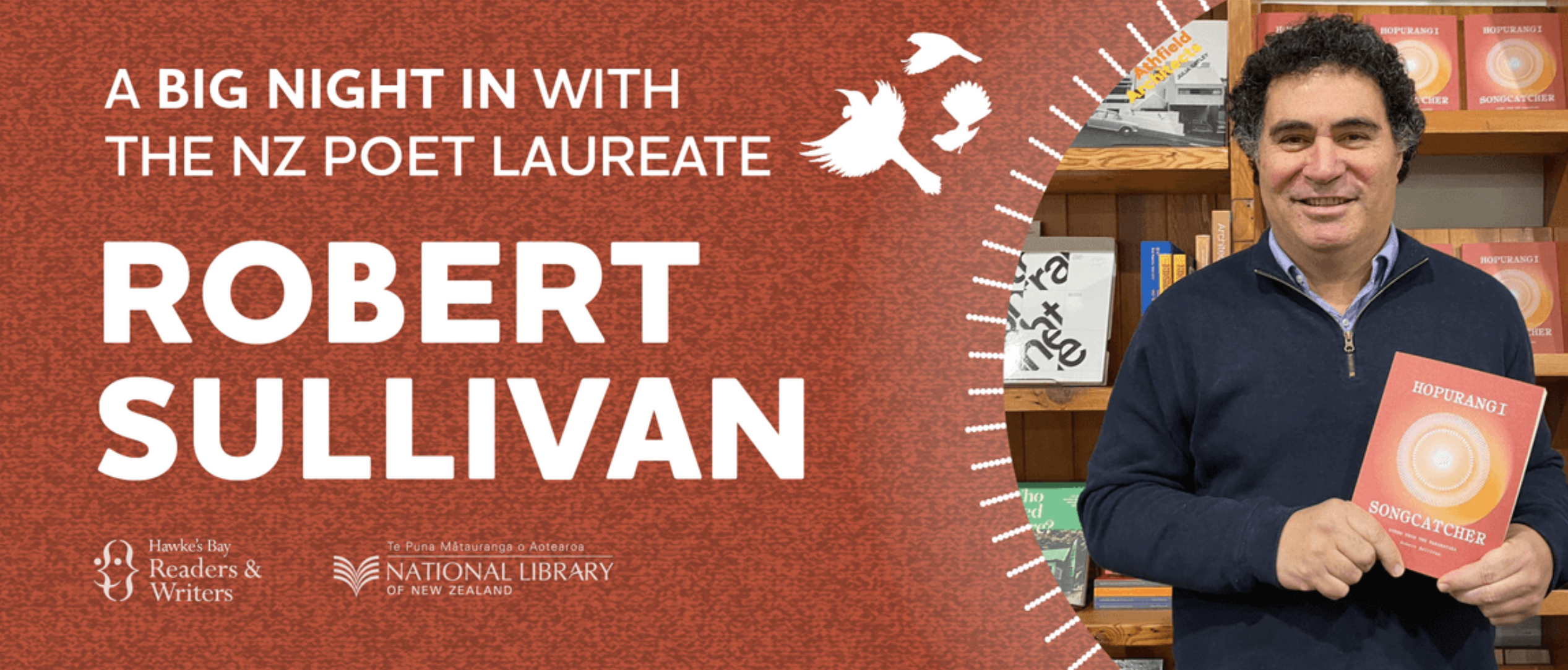
Poetry Shelf celebrates Aotearoa’s new Poet Laureate: Robert Sullivan

This evening, on 27 November, the National Library is celebrating 60 years of the Library with a ‘Laureates line up’ — a rare gathering of nearly all living New Zealand Poets Laureate. Enjoy readings from legends like Elizabeth Smither, Jenny Bornholdt, Michele Leggott, Cilla McQueen, Ian Wedde, Karl Stead, Selina Tusitala Marsh, David Eggleton, Chris Tse, and Robert Sullivan, with Fergus Barrowman as MC.

6pm – 8pm, National Library, Wellington

It is also a chance to celebrate our new Poet laureate, Robert Sullivan. From my extended shelf of favourite poems by Robert, I have chosen a poem that has travelled with me for a long time. I posted this poem last year to launch my ongoing Playing Favourites series. The comments I wrote in 2024 still stand. This is why poetry matters. This is why honouring a poet who has gifted us so much through his sublime poetry collections matters.

Robert also reads a few poems.

I highly recommended Robert’s most recent collection, Hopurangi / Songcatcher (AUP) which was shortlisted for the Mary and Peter Biggs Award at the 2025 Ockham Book Awards. I wrote: “I often use the word ‘breathtaking’ when I am tagging a poetry collection I love, and yes, poetry can take your breath away, but after reading Robert Sullivan’s sublime new collection, Hopurangi—Songcatcher: Poems from the Maramataka, I am musing on the idea, ‘breath-enhancing’.’ — Paula Green, Poetry Shelf

This is a day to celebrate poetry, to listen to poets, to read poems, and to advance the connecting and vital strength of words.

a reading

a poem

Voice carried my family, their names and stories

Their names and fates were spoken.
The lands and seas of the voyage were spoken.
Calls of the stroke at times were spoken.
Celestial guidance, sightings, were spoken.
Prescriptions – medical and spiritual – were spoken.
Transactions – physical and emotional – were spoken.
Family (of), leaders (to), arguments, were well spoken.
Elders (of), were well spoken.
Burials were spoken.
Welcomes at times were spoken.
Futures lined up by pasts, were spoken.
Repeating the spoken were spoken.
Inheritance, inheritors, were spoken.
Tears at times were spoken.
Representations at first were spoken.
The narrator wrote the spoken.
The readers saw the spoken!
Spoken became unspoken.
[Written froze spoken.]

Robert Sullivan
from voice carried my family, Auckland University Press, 2005

When Robert Sullivan’s poetry collection, Star Waka, entered the world in 1999, it felt like a significant arrival. This was a poet who sang from his past present future, his ancestors friends loved ones. His collection voice carried my family particularly resonated with me, and it is a book I draw from my shelves when I crave nourishment.

This poem. This poem in particular, that speaks even more deeply to me today, when voice brings us together across the motu, bringing us together through stories, songs, history, aroha and the respect that matters.

This poem that reminds me, so acutely, so vitally, how much voice matters, how much a poem can matter – when the world our nation and our people hang by a fragile thread. When I hang by a fragile thread.

Today this poem, this precious poem, is a poem to hold close.

Robert Sullivan is Aotearoa New Zealand’s 14th Poet Laureate. He belongs to Ngāpuhi (Ngāti Manu, Ngāti Hau / Ngāti Kaharau) and Kāi Tahu (Kāti Huirapa ki Puketeraki) iwi and is also of Irish descent. He has won many literary awards. His most recent books are Hopurangi / Songcatcher (AUP) which was shortlisted for the Mary and Peter Biggs Award at the 2025 Ockham Book Awards, Koe: An Aotearoa Ecopoetry Anthology coedited with Janet Newman (Otago University Press 2024) and a collection of essays coedited with Anna Jackson and Dougal McNeill, Te Whāriki: Reading Ten New Poets from Aotearoa (AUP 2025). Robert is Associate Professor in Creative Writing at Massey University. He lives in Ōamaru.

Auckland University Press page

Poetry Shelf Playing Favourites: Richard von Sturmer

My recent book, Slender Volumes, is made of 300 seven-line poems. Really they are 300 stories, told in different modes: the realistic, the autobiographical, the historical and the surreal. One, popular with audiences when read aloud, is number 216, which concerns Mr Moth and his dairy:

There was a dairy at the end of the road owned by Mr Moth. Everybody knew it as Moth’s dairy. He sold ice blocks made in a special mould – the stem being a popsicle with a large wing on each side. The ice blocks came in different colours and were named Emerald Surprise, Ruby Splendour and, best of all, the Tiger Moth. The dairy always shut its door at dusk. No fluorescent lights were switched on. Mr Moth liked the darkness.

What seems to be a figment of my imagination, in the surreal mode, in fact came from a walk around Onehunga Bay Lagoon. On this particular walk my wife Amala and I encountered an old-time resident who told us that many years ago there used to be a dairy opposite our house on Normans Hill Road. The dairy was owned by a Mr Moss. I misheard him, and thought he said “Mr Moth”. This led to a reverie about Mr Moth and his dairy, which I wrote down when I got home.

Richard von Sturmer is a New Zealand writer. He was born on Auckland’s North Shore in 1957. His recent works are the acclaimed memoir, This Explains Everything (Atuanui Press, 2016), Postcard Stories (Titus Books, 2019), and Resonating Distances (Titus Books, 2022).

In 2020 he was the University of Waikato’s writer-in-residence. His book Walking with Rocks, Dreaming with Rivers: My Year in the Waikato (Titus Books, 2023) was written during his residency.

In 2025 his new collection of poetry, Slender Volumes (Spoor Books, 2024), was shortlisted for the Mary and Peter Biggs Award for Poetry at the 2025 Ockham Book Awards.

Poetry Shelf Playing Favourites: Jeffrey Paparoa Holman

Wheat in the East

The body you gave me’s wearing
thin: I won’t patch a scarecrow’s
coat. The plains of the east I tilled
are stippled with wheat; magpies nest

in the hair of my head, my heart is
all marching feet. This night I lie
beside my wife; the moon creaks over

the sill: I breathe, “You’re a tinny sod!”
and tilt in the coffin of sleep. I dream
of what’s left in this sliver of life,
the reins my hands can’t reach.

Jeffrey Paparoa Holman
London 1993

 
This poem was written in London in the mid-1990s, at a time when I was working in a central city bookshop – Waterstones – and devoting myself to writing. Short stories and poetry, going along to writing programmes at City Lit adult education centre in WC2H, and making friends with Dylan Horrocks, also at the same Charing Cross Road branch, doing his drawings and cartoon strips in lunch breaks, evenings and weekends. We all now know the result of his apprenticeship to the art. Quite when or why this poem emerged, it’s too far gone to remember, but it’s fair to say, is part of a self-appointed midlife apprenticeship to my lifelong writing urges. It was time to get serious and ‘Wheat in the East’ belongs there. 1997, I was back in New Zealand for good – in both senses –  returning to university to finish a rusty, abandoned 1970s BA. I decided the following year, to put together a self-published 36 pp chapbook, with Johnathan of Molten Media as my guide. In 1998, we produced Flood Damage, where this poem, with many other London-birthed works appear.  I was away. There was no stopping now. I couldn’t know it, but I was on my way to publishing what became As Big As A Father, with Steele Roberts, in 2002. The title poem here had also been written in our London council flat. This poem was part of that journey, so resides in my heart, with affection.

Jeffrey Paparoa Holman writes poetry, short fiction, history and memoir. He has published seven volumes of poetry; Best of Both Worlds (history, 2010); The Lost Pilot (memoir, 2013); Now When it Rains (memoir, 2017). As Big As A Father (Steele Roberts, 2002) was shortlisted in the Montana Book Awards, Poetry, 2003. Best of Both Worlds: the story of Elsdon Best and Tutakangahau (2010) was shortlisted in the Ernest Scott Prize, History (2011, Australia). His most recent work, a family history, Lily, Oh Lily – Searching for a Nazi ghost, is published by Canterbury University Press.

Poetry Shelf Monday Poem: ‘volume turned down to 7’ by Kay McKenzie Cooke

volume turned down to 7

Slowly it dawns, the need to listen
to the faint grief of a mourning cello, the sky’s blue jug
pouring out a second helping of custard sun,
this music that vies with a lost bee and a kereru’s three-note
flight path beyond our open door. Nick Tipping’s low voice,
sounding like a pilot’s announcement: Enjoy this shadow of trees,
this laughter of water. From among a shock of leaves, a tūī’s semi-colon,
a piano note, a caught dragonfly cupped in the soft sweat of a child’s hand.
The lowest black key repeating—a lawnmower four houses down.
Nick corrects himself, ‘Rachmaninoff,’ he says.
My grandson comes down to visit from upstairs, says,
‘I thought you were still in bed.’
No. I’m here just awake and no more even though
it’s now past noon. I’m here taking it all in. The Concert Programme
in summer, volume turned down to 7, the fret of a pīwakawaka. No.
I stand corrected. Vaughan Williams’ Lark Ascending.

Kay McKenzie Cooke

Although Kay McKenzie Cooke (Waitaha, Kāti Māmoe, Kāi Tahu) lives in Ōtepoti Dunedin, she continues to hold a deep connection to Murihiku Southland, the province where she was born. She is the author of four poetry collections and three novels.