Category Archives: Uncategorized

Poetry Shelf Monday Poem: Marcus Sellwood’s ‘Aotea Square’


Aotea Square


Finally just us two

reclining on the shores of Aotea square

The absolute epicentre

of any bonafide

Auckland urban romance


I’m convincing you the pavers

could almost be sand

If you squint hard enough anyway

But I’ll say any old guff

just to make you smile


The sun’s evaluating the skyline

It’s making me drowsy

or you’ve doped me with the pretzels

I swear the odd gradient of these steps

is identical to a beach on the tip of the Coromandel

I can’t quite remember the name of

or perhaps I never knew to begin with


Your polygamy story soon jolts me out of my reverie

En masse the city dwellers

are lying around sun-drunk

sprawled all over my fake foreshore

in their suitably fake sunglasses

half watching the Chinese cultural festival

cryptically splash at our feet


We’ve got gigs across town from one another

so we’re play-acting

sulky besotted teenagers being torn asunder

by unspecified forces

much larger than our-tragic-selves


The IMAX sign looks down frowning, unconvinced

and for heaven’s sake, it would know!


Marcus Sellwood


Marcus Sellwood is a musician and occasional poet. He was born in central Auckland and has lived his whole life there. He likes to write about his experiences of the fast-changing city.


Poetry Shelf noticeboard: Le poetry at the Open Book for Bastille Day


65445682_1484728511670181_3314809918866849792_n.jpg
Le poetry

Quelle joie! Our monthly cultural extravaganza is on Bastille Day. Let us hope some poems include French words.

Our monthly cultural extravaganza is on Bastille Day. Let us hope some poems include French words.

Les readings by:
* Steven Toussaint, poet
* Chris Holdaway, poet
* Anna Livesey, poet

Plus snacks and a glass of vin. Truly, our lives are blessed.

Sunday, July 14, 2019 at 3 PM

The Open Book

201 Ponsonby Rd, Auckland

Poetry Shelf noticeboard: Rob King donates money from Waiting for Birds to Dementia Wellington


image1.jpeg

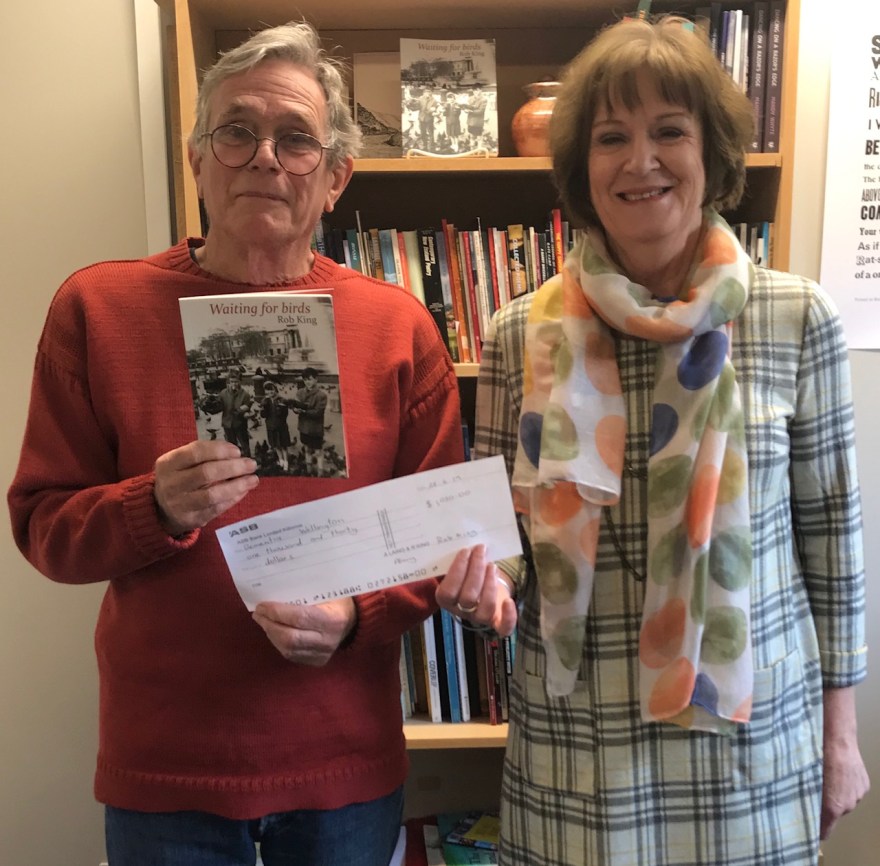
Image credit: Mākaro Press. Dementia Wellington Chief Executive Anne Schumacher receives the $1030 cheque from poet Rob King in Wellington today.


Poet with Alzheimer’s donates $1030 in royalties to Dementia Wellington

Lyall Bay poet Rob King lives with Alzheimer’s but it hasn’t stopped him publishing his fifth poetry book, Waiting for Birds, which launched in March and has already netted him over a thousand dollars in royalties – money he donated today to Dementia Wellington.

King’s collection gathers together new and previously published poems written over 50 years in England, where he was born, Scotland, and New Zealand, where he moved 12 years ago. He decided to donate his poetry royalties to Dementia Wellington to show his appreciation of their support through workshops and community outreach. He also donates the proceeds he receives from his watercolours.

The Chief Executive of Dementia Wellington Anne Schumacher, who received the cheque from Rob King in Wellington this morning, is delighted. She says the poet, with the support of his partner, Ali Laing, is an inspiration to others living with dementia.

Waiting for Birds is a true testament of Rob’s determination to keep doing the things he loves,’ she says. ‘Rob is a brilliant example of someone truly living well with dementia, staying active and engaged in his community and continuing to pursue his passions. I am delighted that his book is proving to be so popular and we are very grateful for his generosity. The money will go towards helping more people live well with dementia.’

Presenters at this year’s Dementia Wellington symposium received a copy of King’s book as a thank-you gift, and King and Laing sold a number of copies to people attending the conference. It’s also been selling in bookshops, including the poet’s local – The Children’s Bookshop in Kilbirnie – where the book was launched.

Rob King worked with Mary McCallum and Paul Stewart of Wellington’s Mākaro Press to bring Waiting for Birds together. Many of the poems are about people Rob had met over his life – from neighbours in Yorkshire, where he grew up, to the homeless he worked with in Scotland, to locals waiting for the train in Ngaio.

‘Rob’s eye often falls, and his ear tunes, to eccentrics and people who are a little different and often on the fringes of society,’ McCallum says. ‘He has a humorous and compassionate take on the world and a poet’s eye for detail. His poems are never maudlin or self-pitying but instead celebrate life as a “dishful of stars”.’

‘As we worked with Rob on the book, his memory loss became more pronounced,’ says McCallum, ‘but working with the poems kept some of his memories in front of him. When Rob was sent the final proofs of the book to read and sign-off, he was unable to read for himself, so his partner, Ali, sat with him one afternoon and read the whole collection out loud. She said she was anxious about this, but as she went on she warmed to the task and enjoyed the way the poems brought back memories of times past for them both. Ali said there were many laughs and a few tears (all hers).’

Mary McCallum says Rob is a great ambassador for people living with Alzheimer’s, showing what’s possible, and how to live with humour, hope and optimism despite a dementia diagnosis.


colophon black.jpg

Mākaro Press

Our books speak for themselves

Poetry Shelf Friday talk spot: Kate Camp on Matthew Arnold’s ‘Dover Beach’


The sea is calm tonight.

The tide is full, the moon lies fair

Upon the straits; on the French coast the light

Gleams and is gone; the cliffs of England stand,

Glimmering and vast, out in the tranquil bay.


from ‘Dover Beach’


‘Dover Beach’ by Matthew Arnold

I only discovered this poem in the early 2000s, not sure how I missed it as it so central in the canon. Mum is a poetry fanatic, and has loads of poems committed to memory. She had been the victim of a violent crime around that time, and as she reeled from the impact on her life, she found this was the poem that was going round in her head. You can see why – it’s strangely comforting even in its offering of a final bleak vision. We decided we would both learn it off by heart, and we did, over the course of a few weeks. We sat in the car and recited it to each other outside the pub, before going in to watch an All Blacks game.

Fast forward to about five years ago, we visited Dover Beach along with my husband. We were all supposed to have remembered the poem to recite together on the beach. Staggering a bit on the pebbles (which the waves draw back and fling at their return up the high strand…) we mostly achieved it, although I have to say I was the only one of us who had it word perfect.

As we walked back up the dark beach, Paul was in front, then me, then Mum. I turned around to see her, knowing I would want to remember this moment. Over her head, out in the tranquil bay, fell a shooting star.


Kate Camp


Kate Camp is a Wellington-born essayist and poet, with six collections of poetry published by Victoria University Press. She has also written essays and memoir. Unfamiliar Legends of the Stars won the NZSA Jessie Mackay Best First Book of Poetry Award (1999), and The Mirror of Simple Annihilated Souls won the New Zealand Post Book Award for Poetry (2011). Snow White’s Coffin was shortlisted for the award in 2013, and The internet of things was longlisted in 2018. She has received the Creative New Zealand Berlin Writer’s Residency (2011) and the Katherine Mansfield Menton Fellowship (2017). Her essay ‘I wet my pants’ was a finalist in the Landfall essay competition in 2018.


Dover Beach

The sea is calm tonight.

The tide is full, the moon lies fair

Upon the straits; on the French coast the light

Gleams and is gone; the cliffs of England stand,

Glimmering and vast, out in the tranquil bay.

Come to the window, sweet is the night-air!

Only, from the long line of spray

Where the sea meets the moon-blanched land,

Listen! you hear the grating roar

Of pebbles which the waves draw back, and fling,

At their return, up the high strand,

Begin, and cease, and then again begin,

With tremulous cadence slow, and bring

The eternal note of sadness in.


Sophocles long ago

Heard it on the Ægean, and it brought

Into his mind the turbid ebb and flow

Of human misery; we

Find also in the sound a thought,

Hearing it by this distant northern sea.


The Sea of Faith

Was once, too, at the full, and round earth’s shore

Lay like the folds of a bright girdle furled.

But now I only hear

Its melancholy, long, withdrawing roar,

Retreating, to the breath

Of the night-wind, down the vast edges drear

And naked shingles of the world.


Ah, love, let us be true

To one another! for the world, which seems

To lie before us like a land of dreams,

So various, so beautiful, so new,

Hath really neither joy, nor love, nor light,

Nor certitude, nor peace, nor help for pain;

And we are here as on a darkling plain

Swept with confused alarms of struggle and flight,

Where ignorant armies clash by night.


Matthew Arnold


Poetry Shelf noticeboard: new date for Steven Toussaint’s launch

7225415f-cf82-4d34-9a92-3d7d03df0850-1.jpg


Please note the change of date.

You are warmly invited to the launch of

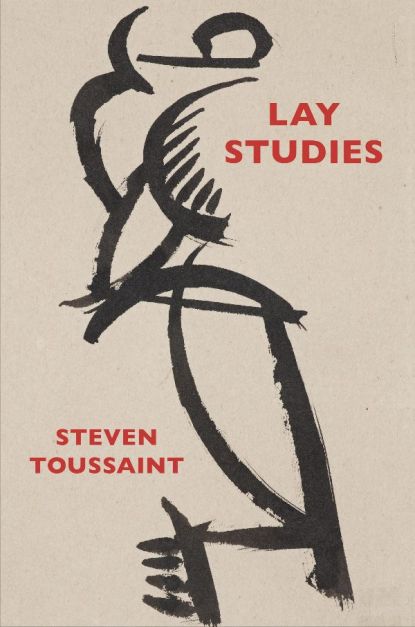
Lay Studies
by Steven Toussaint

on Tuesday 9 July, 6pm–7.30pm
at Unity Books, 57 Willis St, Wellington.

Lay Studies will be launched by John Dennison.


Poetry Shelf audio spot: Vaughan Rapatahana reads ‘mō ōtautahi’ [for Christchurch]


Vaughan Rapatahana commutes between Hong Kong, Philippines and Aotearoa New Zealand. He is widely published across several genre in both his main languages, te reo Māori and English. He earned a Ph. D from the University of Auckland with a thesis about Colin Wilson and writes extensively about him. Rapatahana is a critic of the agencies of English language proliferation, inaugurating and co-editing English language as Hydra and Why English? Confronting the Hydra (2012 and 2016.)

He is a poet, with collections published in Hong Kong; Macau; Philippines; USA; England; France; India and New Zealand. Atonement was nominated for a National Book Award in Philippines (2016); he won the inaugural Proverse Poetry Prize the same year; and was included in Best New Zealand Poems (2017.)

He writes commentaries for Jacket2 (University of Pennsylvania): a 2015–2016 series and again during 2018-2019.  In 2019 he edited an anthology of Waikato poets: Ngā Kupu Waikato.

His New Zealand Book Council Writers File


Poetry Shelf review: Landfall 237

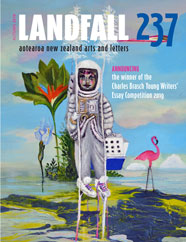
otago708667.jpg

Landfall 237 edited by Emma Neale


Landfall 237 offers rich pickings for the poetry fans: familiar names (Peter Bland, David Eggleton, Elizabeth Smither, Ria Masae, Lynley Edmeades and Cilla McQueen) to emerging poets (Rebecca Hawkes, Claudia Jardine, essa may ranapiri) and those I am reading for the first time (Robynanne Milford, Jeremy Roberts, Catherine Trundle to name a few). The reading experience is kaleidoscopic, pulling you in different directions, towards both lightness and darkness, risk and comfort. And that is exactly what a literary journal can do. I was tempted to say should, but literary journals can do anything.

Landfall has a history of showcasing quirky artwork – and this issue is no exception. Sharon Singer’s sequence, “Everyday Calamities’ with its potent colour, surreal juxtapositions, strange and estranging narratives, and thematic bridges, is an addictive puzzle for heart and mind. I am circling humanity, the power of connection, the individual both tenacious and frail, the state of the planet. Paintings whirling and tipping you into moments that soothe, bewilder and provoke. I adore these.

I turned from these to Rachel O’Neill’s prose poem ‘The Supernatural Frame’ and get goosebumps:

You may look upon the painting through these special

foiled binoculars. We are at a safe distance. Afterwards you

may feel a chill or a fever linger for two days and a night,

accompanied by an infernal cough.


On the centennial of the birth of Ruth Dallas in Invercargill, I am also delighted to see John Geraets spotlight her poetry. Certain Dallas poems have always had a place in NZ literary anthologies (think ‘Milking Before Dawn’) but as readers we may less familiar with the wider expanse of her work. Like so many women poets of the twentieth century she is in the shadows. In his intro John suggests it is not clear how to include her ‘within more recent nexus based on gender, ethnicity, ecology, avant-gardism, faith or political affiliation’. He responds by assembling her words – culled from Landfall editor-contributor responses and her autobiography Curved Horizon – on the left-hand pages and his words on the right. He first sees in her poetry – compared with contemporary writing choices – predictability, regularity, un-excitement, regionalism; and then, by paying attention and refreshing his routes, he opens up poems to different movements. He moves in close to the poem. I love that. Much I could say on how we approach the women from the past! Expect 568 pages soon.


I absolutely love the poetry in this issue; it is both fresh and vital! I see neither formula nor dominating style but shifting stories, musicality, feeling, political bite, muted shades, bright tones.


Here are some highlights:


Joanna Preston’s poem ‘Allegrophobia’ carries you from birth to tardiness to spring in a layered on punctuality – a perfect little package.

Jasmine Gallagher’s ‘Be Still’ sent me to her bio because I want to read more by her. She is a doctoral student at the University of Otago and has previously been published in brief. Her poem is poetry as brocade – glinting for the eye and chiming for the ear.


Slattern: a

hoar frost:

a rime

Cold seed bed

Rot and slime


Another poet, Catherine Trundle, also sent me scavenging for more. She writes poetry, flash fiction and experimental ethnography. Her poem ‘The Caravan behind the Plum Tree’ is also an exquisite brocade.


This lush cusp of spring rides

pinkish, amoebic, wilding

the inside, every flesh ’n’ cranny

while the sunlight lunges in

through winter tidelines

of curtain rot


Tam Vosper’s ‘Ailurophilia’ was an equal hook for me. He is working on a PhD at Canterbury University that considers Allen Curnow and the poetics of place. Again this is brocade poetry: so rich in effect.


All Gallic pluck

and casual loft

you claim a suntrap,

slump sidewise down,

and unhinge your barbed yawn:

           a shark to shoaling mice.


And I want to add Medb Charleton’s ‘I think I Saw You Dreaming’, Rebecca Hawkes’s ‘If I could breed your cultivar / I’d have you in my garden’ and Gail Ingram’s ‘The Kitchen’ to my list of brocade poetry. Glorious.

In contrast you have the spare deliciousness of Ariha Latham’s ‘Waitangi’. Another poet whose work I want to track down.


When I read Ria Masae’s “Jack Didn’t Build Here’ I can hear her performing its sharp mix of personal and politics  – and it cuts into my skin. Six houses built. She carries us from the father’s house full of stories to David Lange’s Mangere home open to the locals: he ‘understood the pressures of fa’alavelave,/ cos he brown on the inside like that’. She bears us from the house her mum built with its’ celebration tables’ to the house Key built with its ‘security code gate’. She ends with a question (the house to be built?):


What house will Jacinda build?

Will it enable my daughters to build their own homes

of tangata whenua foundations and fa’a Samoa roofs

in this palagified City of Sales?


You can move from political bite to the glorious wit you often find in an Erik Kennedy poem. His ‘All Holidays Are Made-Up Holidays’ is no exception. Meet Cabinet Day – ‘we went along/ from house to house hanging little doors / around each other’s necks to hide our secrets’. Or the Feast of Holy Indifference. Genius!

Claire Orchard’s poem, ‘Breakages’, swivels on a set of shelves, on the objects that they hold, and in that satisfying movement speaks of so much more; the poem resembles a shelf of family history with peaks and troughs.


I enjoyed the way it had begun to display time

in the style of tottering, elderly people


I heard Joan Fleming talk about new poetry she was writing at the Poetry & Essay conference at Victoria University in 2017. The poems came out of her experience of camp life in Nyrripi and surrounding areas in Australia’s Central Desert. I was moved by her discussions of collaboration and consent, her attentiveness to the local. Two poems here – ‘Alterations’ and ‘Papunya is Gorgeous Dirty and I Second-guess my Purposes’ – come out of this experience. I can’t wait to see this in book form.


Finally a treat from Cilla McQueen. She has written ‘Poem for my Tokotoko’; it is personal, physical and abundant with the possibilities of poetry. Pure pleasure.


Sometimes I see you as an enchanter’s staff,

scattering poems like leaves to the west wind;

at others you’re practical, a trusty pole

by means of which, through quarrelling

undercurrents, I can ford turbulent water.

By means of which I put myself across.


This is such good issue – there are reviews and fiction I haven’t read yet, and the announcement of the Charles Brasch Young Writers’ Essay Competition 2019 – but on the poems only, it warrants a subscription. Yep – Landfall has its finger on the pulse of NZ poetry.


Landfall 237 page


Poetry Shelf noticeboard: Lani Wendt Young to deliver NZBC annual lecture

Screen Shot 2019-06-26 at 10.01.27 AM.png


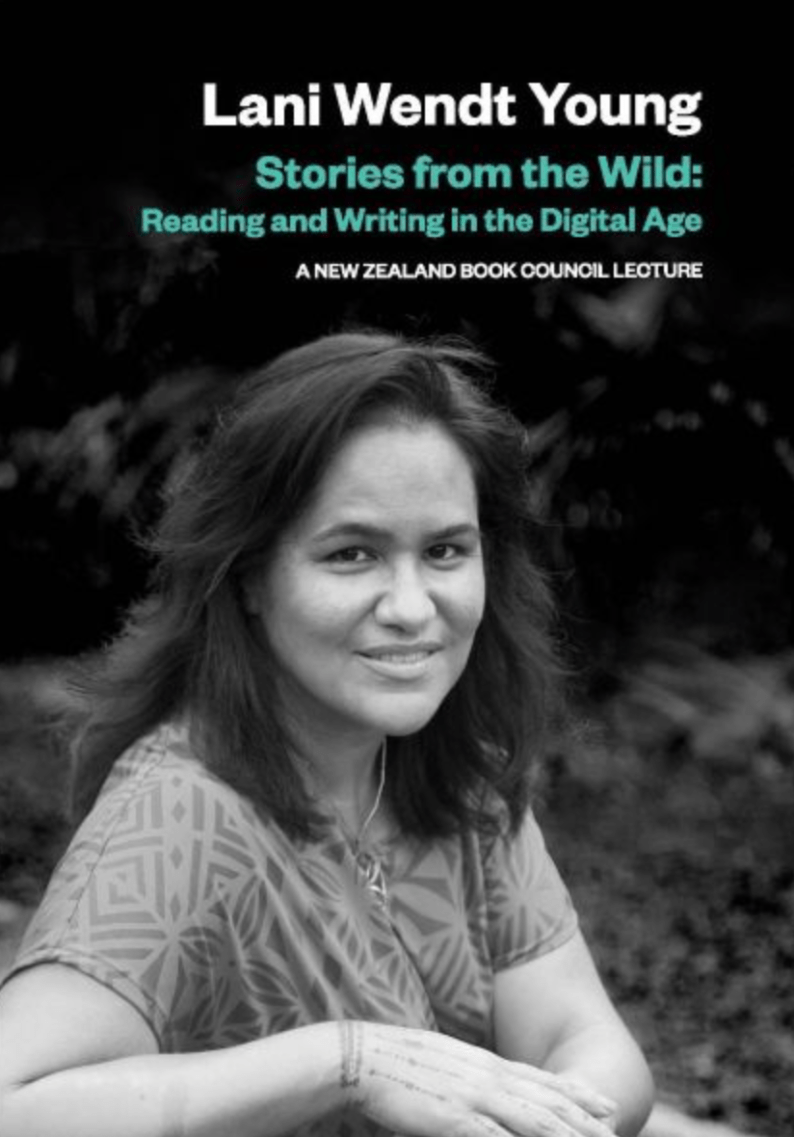
The New Zealand Book Council is thrilled to announce that award-winning author, publisher and journalist Lani Wendt Young will deliver its annual lecture on Wednesday 28 August at Wellington High School.

Stories from the Wild: Reading and Writing in the Digital Age is a brave and personal charting of the current realities and possible futures of publishing, reading and writing. Young explores these topics with her distinctive honesty, humour and passion.

Named Pacific Laureate 2018, Young is well known for her bestselling young adult series Telesa, as well as her critical and engaging essays and blogs on feminism, motherhood, Samoan culture, Pasifika literature, and digital and self-publishing. She has long been vocal about child sexual abuse and domestic violence in Pasifika communities and has raised the profile of these issues on a global scale.

Book Council CEO Jo Cribb is very excited about the event.

“We are honoured to have Lani as this year’s speaker as this will be the only chance for a Wellington audience to hear her speak this year. She is a forerunner in the field of self-publishing and an inspiration to the next generation of writers and readers.”

“Lani’s topic this year is really thought-provoking,” says Jo, who adds that while Young’s fans range from her teenage readers to parents who visit her Twitter feed for advice, it will be of particular interest to parents, aspiring writers and those from Pasifika communities.

Minister of Social Development and Disability Issues, and Associate Minister of Pacific Peoples and Arts, Culture, and Heritage, Carmel Sepuloni, will give the opening address.

Young joins a star-studded line-up of previous speakers, including Joy Cowley, Selina Tusitala Marsh, Owen Marshall and Witi Ihimaera.

Last year’s event sold out within two days, and tickets for the 2019 event will go on sale on August 5. Updates will be sent out via the Book Council mailing list and social media.

WHAT: Stories from the Wild presented by Lani Wendt Young
WHEN: Wednesday, 28 August 2019, 6pm
WHERE: Wellington High School, 249 Taranaki St, Mt Cook, Wellington, 6011

The Book Council Lecture

The New Zealand Book Council Lecture has become a prominent part of the literary landscape in Aotearoa New Zealand. It provides an opportunity for one of our country’s leading writers to discuss an aspect of literature close to their heart.

For more information, please contact:

Dom Visini, Publicity, Whitireia Publishing nzbclecture@whitireia.ac.nz
Melissa Wastney, Communications and Engagement Manager, NZ Book Council communications@bookcouncil.org.nz 021512100