Category Archives: Uncategorized

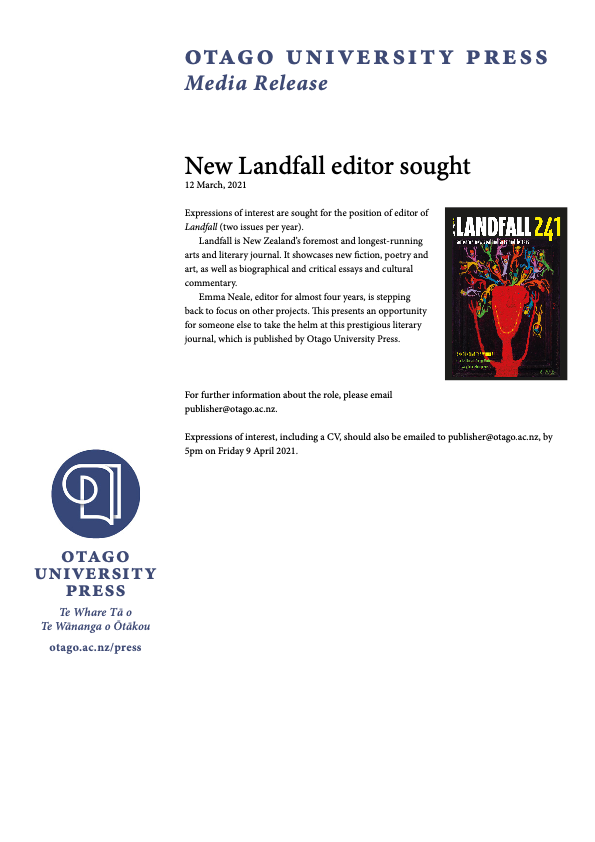
Poetry Shelf noticeboard: Paula Green reviews Landfall 240 at Kete Books

A good literary journal will offer the reader an inviting range of tones, subject matter, emotional effects and cerebral demands. Familiar writers will sit alongside new voices. Landfall 240 achieves an eclectic mix of voices, especially as it favours multiple genres: poetry, fiction, memoir, essays, artworks, reviews. Such a writing smorgasbord suits my habit of devouring issues over repeated visits and the degree to which certain pieces affect me is why I am a long-term Landfall fan.

An annual highlight is always the results of the essay competition. Editor Emma Neal received 85 entries this year and A. M. McKinnon’s winning essay, Canterbury Gothic, is a little beauty. The essay begins with a great aunt, exquisitely detailed, and moves through a city’s architectural detail to the dark and moving twists in a family history.

full review here

Poetry Shelf Monday Poem: Chris Tse’s ‘Identikit’

Identikit

when asked to explain the lines that lead to now, you describe / 

the shape of your body as it hits water / the shape of cold water

shocking muscle / the shape of fleshy chambers forced to loosen

and acquiesce / the shape of your grandparents in their coffins /

the shape of coffins that are too small to contain entire lifetimes /

the soft and hard moments we can’t forget no matter how often we

turn our backs to the light / [you write this poem out of love / but

even love can be a blindfold] / the shape of you and your parents

standing in your grandparents’ driveway / after being kicked out

for talking to your aunty’s white boyfriend / your hand reaching

out to someone you don’t recognise in a dream / their silhouette

branded upon your brain / [you’ve tried to swallow the night and

all its inhabitants / but they weren’t designed for consumption] / the

night standing in for doubt / as you argue with your own memory /

waking up to the smell of 皮蛋瘦肉粥 / the shape of a bowl designed

to hold love / love that is never spoken of because to do so would

silence it / the shape of silence when you tell your parents you’ve

fallen in love with a white boy / the shape of that white boy pressed

against your body / both your hearts / shaped like hungry mouths /

the shape of your mouth biting into the world’s biggest egg / the

shape of years spent running before walking / your knees shredded

and bloody / even after you grew the thick skin they said you would

need in this lifetime / the years pass like a watched pot / but you imagine

steam rising from its wide open body / flashbacks to the shape of air

being forced into a lifeless body / some incisions are made to clean

blood, others to fast-forward a certain end / when your grandparents

spoke of life it was whatever came their way / no one back then had

time to hide behind the sky / to pull strings / to taste control / the shape

of control does not fit with the shape of effort / a grounded bird tries

to climb an invisible ladder to heaven / to correct a path the world

wouldn’t let it look upon / in case it traced a line too close to comfort /

we all fear the shape of comfort when it belongs to someone else /

forgetting that we all look the same buried six feet under / both your

grandparents appear before you on the night you learn how to take off

your blindfold / when you finally recognise the shape of acceptance /

and how it might fit among the ruins of your rejections / it goes like this: /

the fights, the kisses, the direct hits / unfolding yourself into a shape

the world doesn’t know how to contain / what doesn’t fit / what doesn’t

hold true / the shape of your name / the shape of a bowl that never

empties / all of these things fit together if you turn them the right way up /

you run your finger along the lip of the bowl and remember / what it

means to be laced in time and not know how to use your hands to feed

yourself / you count the years / you feel their shape flooding your

throat / making a noise / making a space for what’s to come

Chris Tse

Chris Tse is the author of the poetry collections How to be Dead in a Year of Snakes and HE’S SO MASC. He and Emma Barnes are co-editing an anthology of LGBTQIA+ and Takatāpui writers to be published by Auckland University Press in 2021. He also edits The Spinoff’s Friday Poem.

Poetry Shelf noticeboard: A Phantom Billstickers competition for unpublished poets

***Calling all UNPUBLISHED POETS***

For the first time ever, we are running a Phantom Poetry Open Mic contest!One winner will see their poem published in a campaign across the Phantom network.We want to give a voice to the unheard. An audience awaits your creativity.

*Must be a previously unpublished poet living in NZ.

*Submit as many poems as you like until January 15, 2021.

*Use this link to enter

*Share with your poet friends*

Poetry Shelf noticeboard: Anna Jackson reviews Bill Manhire’s Wow at ANZL

This is my equal favourite review of the year (along with Selina Tusitala Marsh’s review of Tusiata Avia’s The Savage Coloniser Book – also at ANZL site).

Here is a taster of Anna Jackson’s review of Wow (VUP:

This is a collection full of birds and full of song. It opens with a ballad telling the story of the huia – ‘I was the first of birds to sing / I sang to signal rain / the one I loved was singing / and singing once again’ – and the last section of the collection ends with a poem almost in prose, ‘After Surgery,’ in which ‘A small bird flies out of the body, out of a blink perhaps, / maybe out of the lungs.’ This poem is followed by the final poem in the collection, ‘Little Prayers (15 March 2019)’, which is both a lament and a hymn, and a kind of a round, in which the closing line is also the opening line. A boy and girl sing, terribly, in another poem in the collection; in another, a robot, who also has a narrative function, makes music from deep within its machinery (and poetry out of typos); omens and similes sing together in another.

Bill Manhire’s poetry is always lyrical whether the lyricism is the lyricism of the ballad or the lyricism he finds in ordinary, unmetred New Zealand conversational speech. Sometimes it seems as if you can hear a poem tuning up, finding its rhythm before it turns itself into song. As it lifts into song, it lifts, too, into meaning.

Full review here.

Poetry Shelf noticeboard: takahē 100 launched

There was an important event in Ōtautahi Christchurch last night (Thurs 10th December) at the Sign of the Takahē. The 100th issue of takahē magazine was unveiled, with new poems from David Eggleton, Selina Tusitala Marsh, Bernadette Hall, James Norcliffe, Tony Beyer, Jess Fiebig, Oscar Upperton, John Allison to name a few.

Also the winners of 2020 Monica Taylor takahē poetry competition were announced, and the winner read at the launch.


Poetry editors Gail Ingram and Jeni Curtis read “Striking the pounamu”, a 100-line poem compiled of lines from 84 poets from Aotearoa, including Elizabeth Smither, Albert Wendt alongside new names.

Fiction writers include Paula Morris, Sue Wootton, Anthony Lapwood and others.

takahē website

Poetry Shelf noticeboard: Ursula Bethell Residency 2021

The writers in residence in the University of Canterbury’s (UC) College of Arts will be Vana Manasiadis and Behrouz Boochani. They will both join the University’s English department for the first half of the year.

Senior Lecturer Erin Harrington says the University’s English department is thrilled to be able to support these two talented writers. 

“They bring with them a wealth of expertise, and impressive track records that connect the local with the international. Their mutual interests in the power of language and translation, and the experiences of migrants and exiles, are an important way of demonstrating the power of the creative arts. We and our students will be lucky to have them join our community.”

Dr Harrington notes the writers have some fortuitous overlap and points of intersection in their work.

“Both writers have international connections and networks, are multilingual, and have an interest in translation – which includes making work available in other languages, and in language revitalisation. Both are interested in the stories of migrants and exiles. Both are interested in indigeneity, and Behrouz is interested particularly in the relationships of indigenous peoples globally.”

Ursula Bethell Writers in Residence 2021:

Vana Manasiadis is a New Zealand-Greek writer and translator whose collection of poetry The Grief Almanac was launched in May 2019.

For the residency, Vana’s project draws from her interest and expertise in translation, and the way that it can withhold, bridge, restrict and embody dialogue. This poetic work, like her other hybrid works, will combine poetry, prose, script and visual art, offering a series of dialogues and monologues from migrants, exiles, and voices from Aotearoa New Zealand.

Vana says: “As well as providing support and space, the residency will be contributing significantly to the community of the project – and I’m beyond thrilled”.

Award-winning author, Kurdish-Iranian journalist Behrouz Boochani, who spent six years detained by Australian authorities on Manus Island in Papua New Guinea, was granted refugee status in July 2020. He is currently a Senior Adjunct Research Fellow at the University of Canterbury’s Ngāi Tahu Research Centre.

Behrouz’s proposed work is a short story collection named Ghobad, which is the story of indigenous generations in pre-modern Kurdistan. The work will be written in the Kalhori dialect, which has been systematically suppressed and is in danger of dying out, and it will then be translated into English.

“The residency also offers precious space for exploring writing in a context outside of Manus Island,” he says.

The Ursula Bethell Residency in Creative Writing, jointly funded by the university’s College of Arts and Creative New Zealand, was established by the University of Canterbury in 1979 to provide support for New Zealand writers and foster New Zealand writing. The residency allows authors of proven merit in all areas of literary and creative activity an opportunity to work on an approved project within an academic environment.

Since the inception of the Writers Residency, UC has been home to dozens of fiction-writers, poets and dramatists, many of whom have made valuable contributions to the development of young writers studying at the university. Since 1979, UC has hosted many renowned writers, including Keri Hulme, Kevin Ireland, David Eggleton, Eleanor Catton, Owen Marshall, Fiona Farrell, Tusiata Avia, and Victor Rodger.

Poetry Shelf review: Mohamed Hassan’s National anthem

Mohamed Hassan, National Anthem, Dead Bird Books, 2020

the songs I breathe to

make my bones ache

smell like mama’s deep

fried cauliflower after

a long day of diaspora


from ‘John Lennon’

Reading Mohamed Hassan’s new collection, National Anthem, opens up what poetry can do. It widens your heart. It makes you feel. It makes you think. It gets you listening. It makes you think about things that matter. Humanity. Family. Soil.

It makes me yearn for a world where divisions and privileges – based on where you come from, the colour of your skin and the language you speak – are no longer active.

The poetry I have loved this year keeps returning to the word listen. For all kinds of reasons. The way poetry is music, the way poems active with sound feed your ear. The way you listen to other voices that are distinctive and are vital chimes on human experience. I need to read these poems. I need to read these poems and listen to how tough it is when people insist on sideswiping those who do not match their own reflection and choices.

Mohamed’s poetry, amongst other things, is written in soil, with all its significance – this living breathing life-essential earth that nourishes us, hearts, minds, bodies, connections. Soil, as a living entity is so contested and so unbearably damaged by greed and ignorance. It defines where we stand and where we have stood. Mohamed writes from the soil he has left behind in Egypt and the soil of his second home Aotearoa, the soil of his travels. The ink soil in his pen carries the earth of dreams, experiences, kinship, wounds, connections. Islamophobia. Revelations. Griefs. Hopes.  

Such acutely personal poetry is sometimes filtered through other characters, whether speaking of racism, isolation, separation, love:

I am a poet who writes about my feelings but can’t open up without being in character

without the stage lights and the orange diffusers softening my face for the audience 

from ‘Grief is an expensive habit’


Family is important. The poems never lose sight or contact with family. The grandfather looms large in particular dreams and memories. He is in a humiliating childhood scene, but he is also loss:

you can’t discard a loss the way you can

a birthday gift or a broken laptop


it lives with you, sleeps in the spare room

by the laundry and occasionally eats your food


I want to never lose my parents

but find a loss like that in someone


a love that sears into your lungs and lingers

if you draw the short straw and not die first


from ‘Bury me’

The grandmother is equally important. She is there in ‘When they ask you / why you speak so well for an immigrant’, a poem that reacts to the title’s misguided and recurring compliment:

Tell them

about your grandmother’s laugh

how you never quite knew whether she was story or myth

the upper lip in your conviction

or a song ringing in your bones

drifting through the kitchen window

with the fried shrimp and newspaper voodoo dolls

National anthem layers experience, and that layered experience opens up what immigrants deal with. This cannot be underestimated. This daily erosion. The intricate and extraordinary poem, ‘Life at a distance’, recounts the family’s move to Aotearoa, the mother yearning for home, bearing the racial slurs, crying bathroom tears. Twenty years later, the educated, assimilated and beloved son moves to Istanbul with his ‘kiwiness’.

migration is its own form

of social isolation


an ocean that sits between you

and everyone else

This is the kind of poem that burrows in deep with its complications and toughness, its epiphanies and its wisdoms. I want to hear it read aloud. To hear it sung in the air. This is a son’s story and a mother’s story, a braid of realisations: ‘and you realise she is wading through / her own migration, that like her / you are a dandelion flung in the wind’. One verse depicts the mother still watching Egyptian soap operas and skyping the grandmother, but doing things and being in a country she no longer wants to leave. ‘Home’ has doubled back on itself.

she tells me she is praying

I come home


and home

by any other name


is a quarantine

you have chosen


is a field of dandelions

flung together


learning to grow

In fact this is the kind of book that burrows in deep with its deft and moving exposures. The poetry is the hand on the heart, the hand never leaving the heart, especially after the individual, societal and cultural wounds of the mosque attacks, and the cumulative stories of grief, disharmony, anxiety, uncertainty, ignorance. The personal stories. The politics. Mohamed names the terrorist because he wants the repeated name to fade to oblivion. Jacinda refuses to name the terrorist because she too wants to demolish any shard of power or presence. Mohamed is using words, shaping poems, intensely personal, searingly political, to dissipate a name and move towards healing a community.

we will say your name

until you you are no more real

until your oblivion fades


and we will have sprouted

daffodils from our pain

a forest from our eyes

a mountain

a most beautiful way to heal


and who will worship you then?


from ‘The Prime Minister will not say his name but I will’

The poems hold out hope, time and time again, in an image or a phrase, in a word such as daffodils, in the idea that arms opening wide will embrace the whole person not just what they choose, in the dissatisfaction of arm’s length, in ‘the five stages of peace’. I keep wanting to share a poem with you, to sit down with you in café and say read this, feel this, ponder this, be changed, open your arms wide and greet the whole person, the poem. I am a privileged white woman with a warm home and food in the fridge, a loving family, a long history of publication, a tertiary education, a history of travel, a place to call home. But I need to listen harder. When will these global hierarchies and inequities end?

Mohamed brings us back to a person holding a pen fuelled with ink and soil and memory and challenge. He puts himself on show (albeit in character at times) no matter the pain. Here he is at the airport, at customs where some people sail through invisibly, while some people are interrogated because of name or colour. It is the poem’s ending that gets me, that keeps reminding me – in this catastrophic year of pandemic, overstretched frontline staff, hate crimes, wars, conspiracy theories, poverty, insufferable greed, and sexual and domestic abuse – every name and statistic is a real person. A real person with story.

This ending. This poem. Buy the book and read the poem:

listen

let’s take things slow

I want this, I do

but let’s build a relationship

on more than just racial profiling


I want you to know the real me


can’t you that I

well …


I’m just a boy

standing in front of a boy

asking him


to let me in


from ‘Customs: a love story’

The title poem, ‘National anthem’ is also a beauty, a poem of pledges that include good coffee, voices in unison, the grandmother’s laugh, zero flags and borders. The final stanza, the final lines in the collection are the kind of lines that will keep you going over corrugated roads and spiky living, that will keep you going whatever your story, whatever your challenges, and pain and love and prospects of death or hope. I am so hoping that Mohamed gets to read at Aotearoa festivals next year, not just five minutes in a poetry line up, but in a whole session where we can hear his words sing and shine and cut and hold out arms and offer such exquisite and necessary hope.

to those who would plot to sow me love

to bake me warmth and never break my art

to rob my eyes for safe keeping

to drown me in unconditional trust


to build with me

a new sun


I pledge myself


to you


from ‘National anthem’

Mohamed Hassan is an award-winning journalist and writer who has lived in Egypt, Aotearoa and Turkey. Hewas the winner of the 2015 NZ National Poetry Slam, a TEDx fellow and recipient of the Gold Trophy at the 2017 New York Radio Awards. His poetry has been watched and shared widely online and taught in schools internationally.

Dead Bird Books page

Poetry Shelf noticeboard: Blog and email issues

One again i am running into blog obstacles – this time I am having trouble with my emails and can’t load anything from an email because none of my emails are loading on my laptop and desktop. So I do apologise if I am not getting back to you and my normal transmission this week is interrupted. I can reply to emails on my phone.

Poetry Shelf noticeboard: the Wellington celebration of Ko Aotearoa Tātou | We Are New Zealand: An Anthology.

EVENT: Ko Aotearoa Tātou | We Are New Zealand

Please join us for the Wellington celebration of Ko Aotearoa Tātou | We Are New Zealand: An Anthology.
 
Thursday, 3 December 2020, 6.00–7.30pm
GOOD BOOKS, 2/16 Jessie Street, Te Aro, Wellington

 
In the aftermath of the Christchurch terrorist attacks of 15 March 2019, Prime Minister Jacinda Ardern declared: ‘We are all New Zealanders.’ These words resonated, an instant meme that asserted our national diversity and inclusiveness and, at the same time, issued a rebuke to hatred and divisiveness.

Ko Aotearoa Tātou | We Are New Zealand shares new works of fiction, nonfiction, poetry and visual art created in response to the editors’ questions: What is New Zealand now, in all its rich variety and contradiction, darkness and light? Who are New Zealanders?

The book will be introduced by editor Michelle Elvy, with presentations from writers and artists who contributed to this new volume of work. 
 
Featuring:
Jennifer Halli
Zainaa Hilal
Fiona Lincoln
Catarina de Peters Leitão
Hanif Quazi
Sudha Rao
Ellie Stiggers
Apirana Taylor
Stacey Teague

Copies will be available for purchase at the event. Drinks and nibbles provided. All welcome! 

RSVP to: shop@goodbookshop.nz

Find out more about Ko Aotearoa Tātou | We Are New Zealand here.

Poetry Shelf noticeboard: Peta-Maria Tunui and Charles Olsen win Ó Bhéal’s 8th International Poetry-Film Competition with ‘Noho Mai’


We are thrilled to announce the winner of Ó Bhéal’s 8th International Poetry-Film Competition – Noho Mai.


Our warm congratulations to filmmakers Peta-Maria Tunui (also the poet), Waitahi Aniwaniwa McGee, Shania Bailey-Edmonds Jesse-Ana Harris, Lilián Pallares and Charles Olsen.


Noho Mai’s creators receive the Ó Bhéal award for best poetry-film, designed by glass artist Michael Ray. ‘Symbolized in the bird’s flight, a group of Māori, Pākehā and Colombian creatives explore life’s journey, the longing to return to the nest, and the life-giving connection with our ancestors.’


Judges’ Comments:


“And so, I was drawn into this beautifully filmed, beautiful soundscape, delivered with a natural ease, the first time I watched all the wonderful poetry films submitted to this competition. The sparse lines of the poem ran along the wind of the film with powerful imagery. Strong but subtle. Neither the text, nor the image in the frame, collided –  but fused together. The visual elements I was looking for were right there. The text of the poem was powering the vision in this beautiful language, I could not help but respond warmly to this film. It was a huge challenge to choose one overall winner in such a feast of poetry films, one which shone. This one did it for me. Congratulations all.” – Dairena Ní Chinnéide  


“An absolutely stunning film. The finely wrought dance of words, visuals, music, pace and the dreamlike cadences of the Māori language. Noho Mai delivered everything I look for in a poetry film. A moving, beautiful poem and universal, timeless core of meaning which speaks also to our particularly detached and disconnected times. The filmmaking is a testament to the power of collaborative vision, crafted through the generous talents of six visual artists from New Zealand, Colombia and Spain. I would encourage any and all to relish this gleaming and worthy winner. An exquisite poetry film. – Paul Casey


The link is here


Here’s what Charles Olsen said — commenting on the award on Facebook: 
Kia ora, it has been wonderful seeing all the films in the festival. Congratulations to all the filmmakers and poets! And a big thank you on behalf of our team to Dairena and Paul for selecting Noho Mai. 


Noho Mai grew out of a workshop Peta-Maria Tunui, Lilian Pallares and myself set up just as we were going into the first lockdown in Spain and New Zealand back in March and it was a wonderful and often moving experience working together with young talented Māori creatives. To see its flight to festivals and audiences around the world has been amazing and to receive this award is very special for all of us.

Thank you! Ngā mihi nui ki a koutou. 🌿💙