Category Archives: Uncategorized

Poetry Shelf 2025

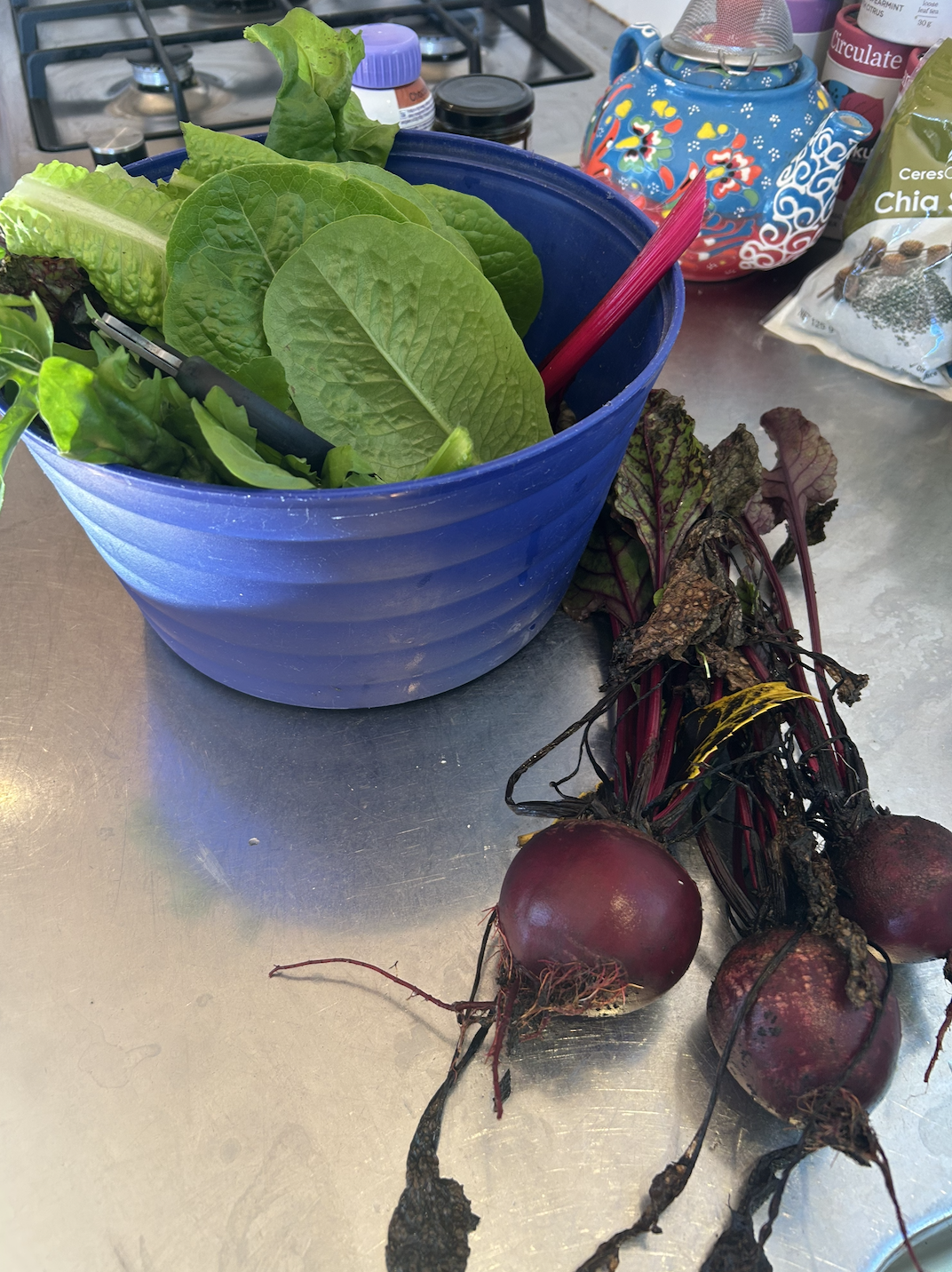
growing aubergine for the first time

Inside the city a house
Inside the house a room
Inside the room a cupboard
Inside the cupboard a drawer
Inside the drawer a box
Inside the box a necklace
Inside the necklace a story
Inside the story a city hope

Some years I invite you to share your favourite reads of the year, especially poetry, especially when poetry doesn’t get much attention in the end-of-year lists and book stacks that we are seeing across all forms of media. This year has sizzled and simmered and shone with local poetry: new collections along with live performances. So many collections document and explore tough stuff: illness, heartbreak, despair, suicidal thoughts, global wars and inhumanity, our government inflicting more and more damage on planet and people. And so many collections deliver love, a multi-stranded love and love in what words can do, whether exuberant or sweetly nuanced.

Every poetry book I have picked up, lingered over and reviewed (put review in the side bar and you will discover my reviews), I have utterly loved. Sadly for me, there is still a stack of books on my desk I’m itching to get to (see photos below), books by poets I love, books by poets new to me. This week I made the hard decision to return to reviewing these books after Poetry Shelf and I have rebooted, after we all get through the busy season where it is hard to read more than shopping lists.

I want to share a couple of highlights with you, but first a wee update. I am standing at a fairytale door, a threshold onto my new road. What specialists call my new normal, not the normal I enjoyed when I was travelling all over the country, visiting schools, doing events and author tours, reading and writing all day long. I have had a bone marrow transplant that has gifted me the miracle of life, thanks to an anonymous donor and an incredible medical team, but it comes with scars. Looks like I will always have to use my energy jar carefully, to manage my daily physical challenges with various aids. But I sure in heck find enjoyment and delight in every day.

Poetry Shelf has made such a difference in year that I have tagged both my worst and best. So many poets contributing, so many poetry fans reading and sharing. So many thoughtful caring emails, especially those responding to The Venetian Blind Poems, especially those responding to features and audio that have resonated with you. Poetry Shelf is nothing without you, without readers and writers connecting across generations, cultures, the length and the breadth of the country.

Creating three new series this year has been a special highlight for me. I have included links to one of them, Poetry Cafe Readings, because hearing these poets read has been such a gift. This will be back next year, along with the Speaking Out ( check out the Gaza poems) and Playing Favourites series (check out Jackson McCarthy), plus some new ideas. I have also included a link to the fabulous Te Whāriki anthology where some of the contributors selected a favourite poetry book of 2025.

Feature on Te Whāriki: Reading Ten New Poets from Aoteatoa, edited by Anna Jackson, Dougal McNeill and Robert Sullivan (Auckland University Press, 2025)

Poetry Shelf Cafe readings: Poets read and talk poetry for around twenty minutes

Richard von Sturmer reading
Jo McNeice reading
Anne Kennedy reading
Aruna Joy Bhakta reading
Harry Ricketts reading
Alexandra Cherian reading
Ethan Christensen reading
Sue Wootton reading

I often ask poets in interviews what words matter to them as they write – but today I am asking you what words matter as you live each day. I am thinking: kindness, self-care, connections, hope and joy. Over the next month or so I am going to read novels, watch movies, listen to music, tend the vegetable garden, and bake and cook.

Sending aroha to you all along with a huge bouquet of sweet and salty Te Henga ocean air.

Books on my must-read pile:

Poetry Shelf review: STANDING on my SHADOW by Serie Barford

STANDING on my SHADOW by Serie Barford
Anahera Press, 2025

Serie Barford and I have been travelling cancer roads for a number of years, so to both have poetry collections out this year resonates deeply. Especially when 2025 has been challenging for both of us, and especially when Serie is now in hospice care, knowing this may be her last summer. I hold this sad news to my heart. We all do – friends, our poetry communities, family.

I have been rereading Serie’s book over the past fortnight in the gaps of appointments. Writing down single words and phrases in my notebook. Musing on how poetry, whether we write or read it, can be so nourishing, so connecting.

Serie’s collection is divided into five parts, offering poetry that is embedded in the somersault effect on body and mind when navigating cancer. She is standing on the rim and guts and wings of all kinds of shadows. Think death. Think life. Think uncertainty. Think aroha.

The opening section, ‘The Exclusion Zone’, draws us to the Chornobyl Exclusion Zone in Ukraine, where there are signs of rejuvenation in the devastation. The first poem, ‘Picture this’, does exactly that, invites us to picture the scene. It is physical, it is elsewhere, on the the other side of the world, with ‘a blue wooden church’, with flowers tumbling from hanging baskets, Sisters of Mercy feeding the hungry. And the poet is asking us to picture her with her notebooks of cancer jottings. And then the final stanza. This is it. This is a poetry collection where the physical detail of the world, whether at home or away, is luminous. Where all senses operate under a heightened awareness, reminding us that tough health diagnoses sometimes intensify what is important, what offers bridges to joy and delight. Here is the final couplet:

Picture sun on my face. A cobbled street. An outside 
table. Glistening red borscht for lunch. Delight.

In the next poem, ‘Chornobyl Cinderella’, an abandoned shoe is spotted, a shoe that is a repository for story, for unbearable loss and tragedy, and it feels like our lives are peppered with abandoned shoes, with narratives that arrive in wisps and slants. The what is not said and can never be said alongside the what is said and must be said. The kind of border a poet might struggle with as she writes poetry out of an experience that is sometimes unspeakable.

I begin with the exclusion zone. I picture the exclusion zone, and it is both Chornoble and a personal experience. It is precious life and it is precarious life. Ah, how I connect with this book. In the second section, ‘Bitter chalice’, the physical detail of the world is still vital, as the poet goes to Building 8 for chemotherapy, as she deciphers percentages and oncology talk.

The writing draws upon light as much as dark, mapping bridges between tenderness and toxicity. Think the toxicity of nuclear waster echoing through the toxic impact of chemotherapy upon body and mind. Think tatau on the skin of others, connecting generations, ancestors, mana. Think the poet’s uninked skin now bearing the tattooed dot associated with radiotherapy. Think the tapu head and hair, the missing hair, the woman donating hair, the hair now silver.

Picture this. Imagine this. Feel this.

The fifth section draws us to ‘The green line’. The title poem follows the hospital’s green line to get to Radiology, but the collection offers us a weave of green lines. We might move from the Ukraine to Tāmaki Makaurau, moving from a stretched health system to alternative therapies, from the coordinates of cancer to the coordinates of whanau. The mother prepares breakfast esi. The grandmother dries esi seeds. The mother nudging her family to eat well. Here from ‘Eating esi’:

Mum nudges Dad: You too. East esi. Get well. Stay well.
Don’t die before me. Don’t you dare!

Follow the green line and you are following a voice sensitive to the contours of illness, to the jags and spikes and science of health challenges, to the experience of the patient next to her. She is both speaking and writing, busting the exclusion zone, her words lithe on the line, inked with angels anxiety grace. This from ‘Egyptian ink’:

Same old same old.

Chemotherapy is this century’s Egyptian ointment.
A spin on arsenic paste.

Black ink pools on papyrus.

Here and there

the vomiting mouth.

The final word of the collection is ‘aroha’. The final image drawing us back to the infusion of toxicity and delight we picture at the start of the collection. Here I am, personally attached to this personal record of an utterly challenging time, and I am brimming with sadness and recognition, joy and connections. Read the final paragraph from ‘The grace of a stranger’, order this book, and gift it to a friend.

Yesterday I was miserable. Overwhelmed by side effects.
Lay on the floor, heart flailing, sunlight rippling through
French doors, guarded by anxious cats. Birds were singing.
Clocks ticking. I thought about Chornobyl, the Exclusion
Zone, the trumpeting angel memorial to lives lost. Waited
for ancestors to appear. Fetch me. But it wasn’t my time.

Today I’m visiting an oncologist in Building 8. Facing this
tricky business of living. Talking about celestial beings.
Feeling uplifted by the grace of a stranger.

Aroha.

Serie Barford was born in Aotearoa to a German-Samoan mother and a Palagi father. She is one of New Zealand’s leading voices in contemporary poetry and has been a pioneer for Pasifika women poets since the late 1970s. She has published five previous collections of poetry. Sleeping with Stones was shortlisted for the 2022 Ockham New Zealand Book Award for Poetry. She was a recipient of a 2018 Pasifika residency at the Michael King Writers Centre. Serie promoted a Ukrainian translation of her poetry collection Tapa Talk at an international book festival in Kiev in 2019.

Anahera Press page
Serie in conversation with Emile Donovan on RNZ
Serie selects some books at The Spin Off
Sophie van Waardenberg review at Aotearoa NZ Review of Books
Hebe Kearney review at Kete Books

k

Poetry Shelf Monday Poem: ‘Long White Cloud’ by Rebecca Hawkes

Long White Cloud

If my home pasture’s so much greener 
why leap all this barbed wire to graze 
in yours? The aeroplane over the moon 
unsure whether its metals ever yearned 

to mimic a bird or burning cross. I should not want 
to be a corn-fed house-cow kept for butter 
any more than I would like my children 
to become Americans. Everywhere I go: a colony 

drunk off curdling milk and honey. At a conference,
another poet tells me they dream of digging a bunker 
in my distant Erewhon. Not knowing the soil 
was already sold under all our feet, to feudal lords 

with fetishes for fresher dairy. Billionaire’s veins 
plump with young bulls’ blood. But still I love 
the bell about my neck, the foreignness that fills
my mouth repeatedly like cud as I low sweetly 

of that place over the waves. See it there, 
mantled in thunderheads? Come, hopefuls, 
let us now turn up our mouths, and wait 
to catch the promised rain of cream.

Rebecca Hawkes

I wrote this while living in the USA, after an awkward encounter with a famous poet I still very much admire. While navigating visa difficulties to stay in the States as I completed my studies, and at the same time desperately homesick for Aotearoa, well-meaning liberal Americans’ romantic ideas of our country as a shining green escape pod from the turmoil of their world superpower itched a bit. We’re a real place, actually, I wanted to say, with real troubles of our own – and already inhabited by powerful interests with close ties to American issues. So, this is my “we have Peter Thiel at home” poem, thinking about the hypocrisies of my own colony-hopping and inescapable longing for home, even as I push back on assumptions of easy sanctuary. Rebecca

Rebecca Hawkes is a queer painter-poet from a farm near Methven. Her first book was Meat Lovers (AUP). She edits NZ poetry journal Sweet Mammalian and co-edited the Pacific climate-poetics anthology No Other Place to Stand. Rebecca recently completed an MFA in yearning at the University of Michigan in the US, where her new work has found homes in places like Palette Poetry and Sixth Finch. Her  next full-length collection will be published by Yes Yes Books and Auckland University Press in 2026.

Poetry Shelf cafe readings: Sue Wootton

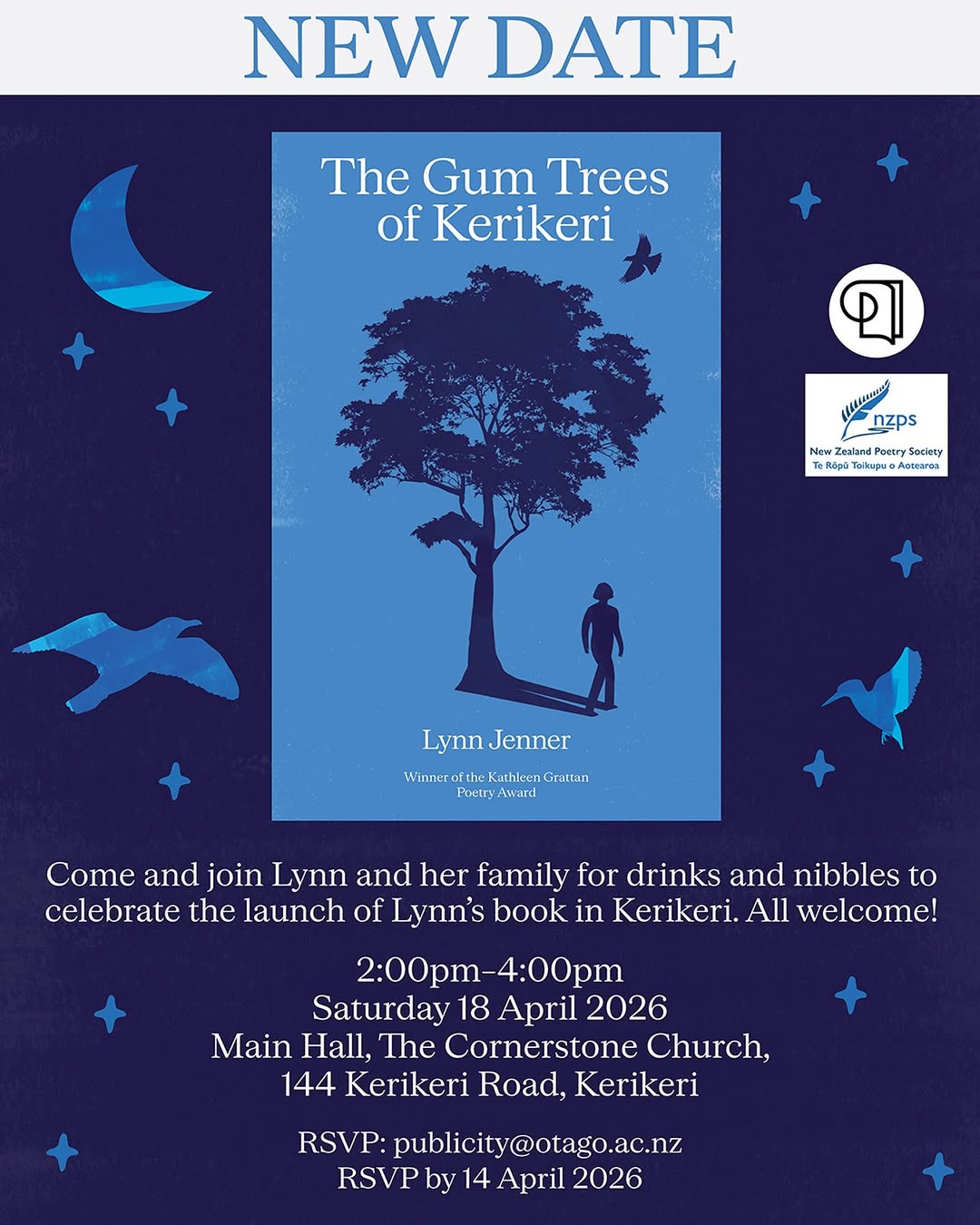
Poet and novelist Sue Wootton’s most recent poetry collection is The Yield (Otago University Press, 2017), which was a finalist in the 2018 Ockham New Zealand book awards. She has held the Robert Burns Fellowship, the NZSA Beatson Fellowship and the Katherine Mansfield Menton Fellowship. In 2025 she was awarded the Kathleen Grattan Prize for a Sequence of Poems, for a suite of sonnets called ‘Holding Patterns: Seven songs of pots, jars, bowls and vases’. Sue lives in Ōtepoti Dunedin, and is the publisher at Otago University Press. 

Poetry Shelf goes hiking: Te Araroa poems by Jillian Sullivan

Jillian at the Bluff signpost

Jillian Sullivan has just started walking the South Island section of the Te Araroa trail. I invited her to send poems whenever she felt inspired to do so, internet access permitting.

Friends are why we come home

Friends around the table and all
the glorious food and laughter.
Sometimes I yearned to run away
from here, I told Graeme. But I didn’t

want to leave this. He guessed the weight
of my pack closest, at 14 kilos. Some
said 17. It was 13. Achievable,
then.

The gifts they gave me of their eyes.
The gifts they gave me of their selves,
who know me. And so we said
goodbye. And so it is true

I am going. Margaret took a photo, as pack
on back I walked down the white line
of the empty road running through our village.
A metaphorical photo.

Now it is a thrush singing outside
my window. Bach, Ave Maria,
black coffee. The gentle easing into
leaving this life, for when I come

back, who will I be? Someone
dissolved into trees and rocks and sky?

It’s always Wednesday

It’s always Wednesday, it’s always
eight am,        it’s always.

One last morning in the hut, figuring
the right thing to do. What would you do?

Your younger, thoughtful look,
considering. You would tell me to listen.

The final walk along the stream
bearing the heavy pack. The final call in

at Gilchrists Store for the mail. The apples
outside my window growing into their appleness

after such a winter. A sparrow riding high
on the pale green under a grey sky.

The last morning I won’t be hanging onto
every word of the weather forecast.

The last morning casually making coffee
looking around at my books which are

everywhere. Yesterday two more shelves,
already full. The last morning

I will count the weeks to the ten months
you’ve been gone. There is ease in this world

of a physical kind, but then I will learn
how to keep walking. You said it first. Keep on.

While I’m away the sun will take all this
green and lushness and turn it gold, the hay

cut, dried, stacked. A whole season over.
Like another Wednesday.

That tramper

Yes, I am now that tramper
who, after the first day

bent under weight in rambunctious
wind, unpacks the pack, examines,

holds, casts away, takes back, casts
away. Gone: rescue remedy,

extra shirt, my darling’s hat, also,
his book of poems. I will have to cleave

them closer. My daughter laughs when I say
I packed a nighty for the huts. Now

I know I am a grandmother. Ok, gone
the nighty, the togs, the jar of magnesium pills,

also, the merino jersey. The wind held me
down and I was hardly a leaf. The photo

at the yellow signpost of Bluff – I’m not
staunch. My legs aren’t even

straight. My body saying,
“You’re going to do what?”

No regrets

The beach is a long wing, of course
you like it; the waves blue, white crests
blown apart by wind, the sand
tawny and firm. But now you have to
walk it as if this is a sentence,
for seven hours, actually, until you turn
from the jauntiness of one step after another,
like hope in the future, which is possibly
why you’re doing this, until about the|
six hour point it all becomes pain.
The thigh bone connected to the|
knee bone, intimately. There is nothing
to be done about the future now, except
keep walking. No-one will save you. Only
the memory at five hours when the young
tattooed builder from Western Australia,
who has caught up to your stride,
stops to swim in the lolloping waves.
You are longing, you are longing to, also.
You won’t regret it, he says. You
take off your clothes on a public beach.
You don’t regret it.

Jillian Sullivan

Oreti Beach

Jillian Sullivan lives and writes in Central Otago, New Zealand. She is published in a wide variety of genres and teaches workshops on creative non-fiction and fiction in New Zealand and America. Once the drummer in a woman’s originals band, and now grandmother of eleven, her passion is natural building. She finished a Masters degree in Creative writing in her 50s, and became builder’s labourer and earth plasterer nearing 60. Now home is the tussock lands, the tor-serrated dry hills and the white flanked mountains of the Ida Valley, where she has 20 acres bordering the Ida Burn, and plenty of room to store clay and sand for future earth projects. Her books include the creative non-fiction book, Map for the Heart – Ida Valley Essays (Otago University Press 2020).

Poetry Shelf celebrates Te Whāriki: Reading Ten New Poets from Aotearoa

Te Whāriki: Reading Ten New Poets from Aoteatoa
edited by Anna Jackson, Dougal McNeill and Robert Sullivan
Auckland University Press, 2025


Auckland University Press page

The poets: Sam Duckor-Jones, Tayi Tibble, Claudia Jardine, essa may ranapiri, Rebecca Hawkes, Chis Tse, Oscar Upperton, Joanna Cho, Ruby Solly and Nafanua Purcell Kersel

The critics: Amy Marguerite, Tru Paraha, Anna Jackson, Robert Sullivan, Mark Masterson, Stephanie Burt, Dani Yourukova, Dougal McNeill, Sophie van Waardenberg, Brigid Quirke, Robin Peters and David Eggleton

a collage celebration

“To read is almost to travel: to time travel, to move locations, to change who we are for a moment in time. And as Joy Harjo says, ‘Every poem has ancestors.’ Robin has done a beautiful job in her essay of bringing forth some of the whakapapa of my work, some of those people who put their hands gently on my shoulders while I move the pen. There is a weight to writing for Māori. We know so much of what it is to be perceived before we are known. I want Māori readers of my work to feel the opposite. I want them to feel that these pieces know them, deeply. I want my reader not to feel seen but to feel held. I hope one day I’ll get there. And I’m looking forward to one day just being a gentle hand on the shoulder of the next generation. Listen out for me, I will be the tipuna who sings.”

Ruby Solly

It is not often an introduction stalls me in my tracks and electrifies how I feel about reading and writing and sharing poetry. But the introduction to Te Whāriki: Reading Ten New Poets from Aoteatoa does exactly that. The three editors, Anna Jackson, Dougal McNeill and Robert Sullivan, sat in Robert’s lounge and crafted the piece over the course of two days. In a book delivering multiple weavings, the introduction is itself is a welcome mat, woven so thoughtfully with strands of aroha, experience, acumen, intuition. Yes, the metaphor perfectly encapsulates the width and depth of the book, but also offers a productive way of viewing poetry in Aotearoa. It mirrors exactly why I strive hard to be an ambassador for poetry and why poetry has helped me through the toughest year of my life.

The editors rightly acknowledge that ‘[p]oetry always renews itself’, that writers fossick in past traditions, writing with or against the grain of their discoveries. Across centuries, writers have experimented, paid homage, felt inspired, challenged and have written outside the status quo, questioned expectations, rules and regulations, and most importantly, damaging hierarchies. I sometimes wonder if an invisible torch is passed from one generation to the next, an ongoing flame to recondition the new, to absorb and respond to and with and against contemporary and past circumstances. It felt like this in the 1960s and 1970s when young men and women were experimenting with what poems could do, when women were moving out of the canon’s shadows, bringing the domestic and the personal with them if that was their desire.

Ah. This book’s introduction. We read in the first paragraph that, just as a whāriki is crafted from multiple strands, so to is contemporary poetry, its tendrils reaching into the past, invigorated by the present, foreshadowing the future. The editors like the idea of community building, with Te Whāriki boosting connections among readers, writers, teachers, students, critics, listeners, performers, bloggers.

This year I have witness the connectedness of poetry on the page, but also (by word of mouth) in myriad performances across Aotearoa: in cafes, bookshops, libraries, in Poetry Shelf’s online cafe readings. Burgeoning small presses and journals, both online and in print form, showcase voices of new writers, especially young writers. This sizzling connectedness is a vital strand in Te Whāriki. The editors use the word friendship, so let’s try approaching a book, a poem, a poetry scene, with this idea in mind. I had never approached it like this before, but I think over the past year I have experienced an extraordinary friendship with poetry, with poetry books and poems, with poets.

Markers of the current new wave of poetry are identified: romanticism, childhood, domestic details, anxiety, especially in view of a matrix of global and local crises. There are more, of course, there are so many pathways through the new poets’ work, so many ways to talk about new, but what I have found, more than anything, is that this is poetry that I feel, that I am moved by, that returns me to the world beyond my bush haven to experience new windows upon our world.

Ten diverse writers shine light on ten new poets, with each featured poet contributing a couple of poems and small piece of writing. What invigorates me about these readings is that although I am familiar and already deeply in love with the ten poets, the close readings open new pathways. And as I say on the blurb, this book makes my heart sing. The book shows so beautifully how critical writing can be in debt to academic traditions, but also how critical writing can open up a poet’s work with refreshing possibilities without trying to squeeze poetry into restrictive thought boxes. The attentive readings not only open pathways into a poet’s work but, through this critical alertness, open multiple possibilities for a wider terrain of reading and writing poetry.

I have lifted an excerpt that resonated with me from the editors’ individual readings, but I will also draw close to Sophie van Waardenberg’s ‘Reiterations’, her reading of Oscar Upperton. Honestly I could have selected any chapter to share highlights, but I have settled upon this chapter because it epitomises the utter of joy of reading and writing about poetry. Sophie draws us into Oscar’s two collections initially through form, moving in close to rhyme, repetition, vowel sounds, found material, twists and loops, double backs, reiterations, naming, frames upon which to hang things and the whole glorious art of recording and record creating. She drops a noun or verb or adjective into her sentence that catches me with its surprise and freshness: “It’s a villanelle, a poem requiring a sort of sandwiching rhyme – that is, a repetition of sound”. When discussing the move from the first collection to the second: “It’s also a jump from something mix-tape adjacent to a concept album”. Or this sweet arrival of personal experience: “Because of the incantatory qualities of repetition – and because I lived one of those prayer-heavy childhoods – I want to say this poem feels like a prayer. But is is not asking for anything, not even for the strength or patience to withstand something suboptimal, as most prayers do. It seems more practical than that.” You need to read the chapter yourself to get the thrill of an inspired close reading, but here is the final paragraph:

“In an essay called ‘Further Injury’, published in the online journal Too Little / Too Hard, British poet Emily Berry interrogates her resistance to the idea that poetry is a life-saving force.3 For her, writing poetry is like prying a wound further open. If it is a remedy, it’s a painful one. But she concludes that perhaps having your life saved is unpleasant, too. It might come not as ‘a luscious infusion of relief’ but in the form of ‘amputation, medicine that poisons you, untold sacrifices’. Upperton’s poetry, its working out through repetition, suggests that the only way we can save life is not really to heal, not even to relieve pain, but to record it. And maybe the best way to record it, truthfully, is to say, a lot of times: ‘I was here, I was here, I was here.’ James Barry was here. Oscar Upperton was here. We wanted things we couldn’t always have.”

I keep pulling poetry books from my review stack on my desk that send me into a lexicon of superlatives. This book is no exception and I have barely scratched the surface of its rewards. Read Stephanie Burt on essa may ranapiri (‘Teeth Shine in the dark’) or David Eggleton on Nafanua Purcell Kersel (‘Bone Pen and Blood Ink’). Tru Paraha on visual poetry through feeling and form and Amy Marguerite’s approach to a new generation of poets through a potluck dinner. To celebrate its arrival in the world, I invited a few of the featured poets to select a poetry book they have loved in 2025. I have also selected a small extract from each of the editors’ chapters that resonated deeply with me, and a couple of extracts from the poets’ contributions.

This is a book to pack in holiday bags and reap infinite rewards over summer.

There are no sensible words for the sensed world, the unspeakable gory-glory of being bodied by life. I was lucky to be born to a farm, or under a mountain, its mounds of crumbling rhyolite pink as raw flesh. So of course I’m a poet – farms are factories for sex and death. I shot from the dirt like a blackberry bramble, thorny but fruitful, glossy with dark sweet promise. I knew the snowline’s flowers and creekbed ferns like the hairs on my own arms, though didn’t yet have names for them. And I knew the names of poisons we used to keep at bay the invasive weeds – glyphosate, triclopyr, penetrant – like casting spells. Of course I was a wizard kid; that’s part of it. Big fantasy bookworm burrowed in a library beanbag.

Rebecca Hawkes

A tasting platter

from ‘A Quietly Italicised Yes‘, Sam Duckor Jones by Anna Jackson:

“‘I put play at the very very top of everything that is important in the world’, Duckor-Jones has said. This was in an interview with Eva Corlett for a Guardian article about the church Gloria, described by Corlett as ‘a campy pink wonderland with tinsel curtains and a neon “Gloria” sign’, and by Duckor-Jones as representing ‘a kind of quiet fabulosity. His poetry shares this kind of quiet fabulosity.”

from ‘Representation Is Important’, Tayi Tibble by Robert Sullivan:

“So, what have I learned from reading this text? As Lesley Wheeler’s introduction to her book of essays on poetics, Poetry’s Possible Worlds, eloquently and compassionately states, reading poetry personally runs the risk of subsuming a more interesting text to the mundanity of one’s own experiences. I am a middle-aged poet with family commitments. My reading practice prioritises enjoyment, cultural identifications and pleasure to be derived from a text. I love to immerse myself in a poem, or a collection of poems, and learn about that other world through another’s sensory life and cultural and cognitive experience. The transport to other worlds that Wheeler speaks of is sped up in Tibble’s text. The worlds within worlds are deftly evoked in short prose sections. The twelve sections might be a blue-black hair cloak, if such a cultural artefact ever existed. The altered mythopoetics here – the altered Māui, Pocahontas’s altered name, the altered Samson as younger sister, the matrilineal descent line as hair turned into Medusan snakes, Scherzinger as icon, and the speaker looking for love, and representation, and tino rangatiratanga – encapsulates female heterogeneity without encapsulating it because of the sisterly hair-cutting scissors and the soft-dissolving fluid collage of identifications, attachments and detachments. This opening poem in an exciting book of poems is a marvellous, ever-moving heart-sore and full-hearted achievement.”

from ‘A Vivid Dream’, Chris Tse by Dougal McNeill:

“Following a word’s connotations, here tracing the patterns of a word and allowing ourselves to desire language and to be desired by its folds, to limn a lover nestling inside the poet’s own name as a thumb nestled against a body in speech, is to give ourselves over to the big mood, the utopian, the will of this voice. The parents who, in He’s So MASC’s sonnets, might ‘perhaps’ be ‘taken aback’ by the present of the ‘unnamed male’ with whom the poet has ‘shared more than each other’s time’, are altered in the course of this encounter too. Now, in Super Model Minority, both father and lover and poet find ways of being together and recognising each other in the act of naming. The desire to be desired is, finally, in Chris Tse’s work, a desire for and in community. If his are songs of thanks, they are also, for us, opportunities for praise. 謝.”


For more than twenty years, I’ve used poetry as an act of way-finding, to trace lines backwards, forwards and sideways in search of something akin to home. I’ve always loved restlessness in poetry – when the voice of a poem or its intent can’t be pinned down, when the poem itself resists the boundaries or constraints placed upon it. Perhaps this explains why I enjoy creating trapdoors and hidden paths in my poems: as much as I want a reader to gleam where I have come from, I also want them to be surprised where a poem takes them. My ultimate goal as a poet is more than simply communicating an idea or a ‘message’ – it’s to show how all the worlds and timelines we collectively summon are connected.

Chris Tse

a 2025 poetry list selected by XX poets

essa may ranapiri

Clay Eaters, Gregory Kan, Auckland University Press, 2025

This book for me was like an ideal synthesis of his first two collections. The space and intimacy of Under Glass and the control and historiocity of This Paper Boat. I felt as a ghost leaving or returning to an island (can one really say they are arriving or leaving ever) by the end of the book.

Ruby Solly

If We Knew How To We Would, Emma Barnes, Auckland University Press, 2025

I was lucky enough to get to read at Emma’s launch, lending my voice to some of their poems, which felt very special. There is something gentle and surreal to this book, though it also has so many hard hitters that pull us to the the mirror and show us not only ourselves, but society; how we have made it and how it has made us. There are moments of radical dreaming. There are moments of forlorn acceptance. There are moments of queer joy and sorrow; this was a book I needed this year and I’m so glad Emma has brought it into existence.

Chris Tse

Symphony of Queer Errands, by Rachel O’Neill, Tender Press, 2025

What I love most about a Rachel O’Neill collection is the constant thrill of surprise that sweeps you from poem to poem. Symphony of Queer Errands is a tremendous feat of imagination, from its ensemble of invented queer instruments to its treatment of language as something elastic and uncontainable. There’s something both dangerous and joyous in its attempts to capture what it feels like to make something out of nothing and that constant need to reach for something that’s just out of reach.

Nafanua Purcell Kersel

Over Under Fed, Amy Marguerite, Auckland University Press, 2025.

This year I loved Over Under Fed by Amy Marguerite (AUP). I was honoured to be able to read early drafts of this book through our shared MA workshop. Even so, the final published collection caught me off-guard with its sharp language and timeless yet contemporary vibe. Marguerite’s poetry is generous but also restrained which makes for a beautiful and compelling collection. As a poet and a reader, I gain so much from the insight into her raw and tender experiences of ED, love and obsession. I feel close to her pain but still safe in the in the poetry where there is comfort in form and surprise in content. This allows me a vantage point that feels askew and still perfectly balanced. Marguerite’s skill as deep-thinking scholar of language and craft is also displayed in Te Whāriki: Reading Ten New Poets from Aotearoa in the form of a critical essay about independent literary journals.   

Rebecca Hawkes

No Good, Sophie van Waardenberg, Auckland University Press, 2025

I’ve thought often of Sophie’s poems we published in Sweet Mammalian a ways back – Poem in which I am good, Song of the Selfish Girl – wondering what kind of lives they’d lead in a full collectionThe book arrived in my life at just the right time. I too have been away and returned. I have danced to the end of love, and lived in my wrongness, my chastened salt. Grief has prowled and lingered. For years now, I’ve been thinking of the lines Everybody I love will live forever./ Everybody I love will love me. How one can cast a wish into the world and in saying it, know its impossibility. But the book isn’t fatalistic. Yes, fate (loss, grief, limited time spent without any extraordinary grace, the preciousness of early and middle and late love) permeates the poems.Sophie’s poems find many delights in the day – stonking blue afternoons, wedges of good fruit, enthrallments – but also don’t flinch from the longing to share the days, to describe the world to a listener who can understand the speaker for what they see, to belong in the body and the upturned seasons outside it, to go on but also to halt for the muchness of all that must in its time be felt and held with all the weight of a heart.


Sam Duckor-Jones

Moon Too Heavy, Jac jenkins, Pavlova Press, 2025

I feel quite blessed to have read a lot of wonderful books of poetry this year!  The one I will shout out is Moon Too Heavy, a slim volume by Jac Jenkins, published by Pavlova Press.  Because it has a confident musicality & an artful physicality, which I am always drawn to.  & because it contains just the right amount of poems, nothing more, which I am always impressed by & jealous of.  It’s kind of in the Rebecca Hawkes school of farmgirl poetry (Jac lives on a Far North beef farm) and as such there is a lot of BODY in her poems.  Tightly controlled floridity.  Sex, sexiness, pregnancy, girlhood, motherhood – these are not so much ‘written about’ as they are played with – I can imagine Jac playing.  Playing in her rural poetry lab.  Using languages of mathematics & science & nature to experiment & play.  My favourite poem in the collection is a sort of list poem, a dense evolutionary chant that begins broadly: 

Oceanic hydrothermal vent begat Last Universal Common Ancestor begat Eukaryota begat Unikonts begat….. 

etc etc etc until eventually narrowing in and ending with

…bore Jean bore Anne bore Jac bore / Kate

That a poem thick with complex scientific language can become, in three stanzas, so intimate and dear is miraculous & it’s a delicious poem to read quietly in ones head but very difficult to read aloud to a listening room (I tried).  Moon Too Heavy is a weird little book about life that I loved very much.

Poetry Shelf review: 28 days by Janet Charman and Elizabeth Anderson

28 days, Janet Charman and Elizabeth Anderson
Skinship Press, 2025

I am sitting at the kitchen table, the doors wide open, feeling the wind rustling in from the Waitākere ranges, the bird song racketing after all that rain, my flat white growing cold, and I slowly reflect upon 28 days. The book fits in the palm of my hand but expands in prismatic ways in both heart and mind. I have never experienced anything like it. It is pitched as a creative memoir. Elizabeth Anderson has produced 28 artworks, Janet Charman 28 texts. The artwork focuses on cafe scenes, drawing upon multi media, echoing Japanese ukiyo-e woodblock prints and Henri de Toulouse-Lautrec’s Parisian café paintings. The little texts – dialogue or poems or anecdotes – are like word kisses on the page.

The memoir is a collaboration, a contiguous relationship between word and image, between artist and writer, and this brushing close, this besidedness as the blurb says, is utterly fertile, utterly heart expansive in its reach. I am stretching for words, and they slip away. So I sit here on the rim of weeping, weeping at the way I’m brought cheek to cheek with the sharp edges of humanity. The shadows. My shadows. The unspoken. My unspoken. There in the cafe settings. There where dark brushes against light, where isolation and loneliness are rife. There where stories are shared, and equally stories are held back. Darkness and light.

Probably against the grain of reading a sequence of images and text, I look at Elizabeth’s images first. She produces all the drawings on her iPad using the Procreate drawing app, recording her observations in cafes or buses. I am absorbing the people frozen in a cafe moment, those on phones, those alone, those in groups, those with son or daughter, and each scene amplifies an intensity of mood. I can’t think when I have last felt portraits to such a degree. I feel the gaze of the eyes, the expression on the face. I feel the unspoken, and more than anything, the way we become a catalogue of memory, experience, pain, aroha, longing, recognitions.

In these tough times that can be so overwhelming, this book, I am feeling to its raw mood edges.

Now I return to the beginning and read Janet’s texts, these little patches of dialogue or poetry or anecdote, and again I am shaken to my core. It’s dark and light, its jarring and surprising. It’s gender relations and damage and patriarchy and femen and abuse and dressing wounds and how do we become and how do we be. Interior monologues, intimate revelations. Again I am feeling this book, feeling poetry to a skin tingling degree.

I am reading through the book for a third time, text alongside image, image alongside text, and the besidedness is extraordinary. It takes me deep into grief, into how we live, how vital our stories and conversations are, how connectedness matters, how listening to the person beside us matters. How important it is to nourish our children and ourselves in multiple self-care ways. And my words are a knot. How to re-view? How to speak? How to write?

Janet and Elizabeth’s collaboration began during the Canal Road Arboretum protest in Avondale, where the two artists first met. The book is in some ways a form of protest, in another ways a memory theatre, an intimate album. I haven’t felt a book this deep in a long time. This book is a gift. And I have ordered a copy to gift to a friend. Thank you.

Janet Charman is an award-winning poet, recipient of the Best Book of Poetry at the 2008 Montana New Zealand Book Awards. Her 2022 collection The Pistils was longlisted at the 2023 NZ Book Awards, and her 11th collection The Intimacy Bus was released in 2025.

Elizabeth Anderson is an artist and educator with an MFA from Elam. She has worked across design and television in Aotearoa and the UK, and now focuses on observational drawing and community-based creative work.

Skinship Press page

Poetry Shelf Monday Poem: Paranormal Phenomenon by Richard Reeve

Paranormal Phenomenon

My garden’s gum tree, creaking above my roof,
is nearly normal. By which I mean
the sound branches make when hit by weather,
rain, wind and the like, whinge of the limbs
bending to a gale, drizzle, or stillness
when the nut flowers bring in the bees.
All this is normal, scarcely worth commentary,

and yet, also, mysterious.

99 percent of all paranormal phenomena involve sticks,
shufflings in the wind, storms, shadows.
Sound or form first associated, then disassociated,
inflating superstition. The fact of weather.
99 percent of such occurrences being quietly remarkable,
the sound of the gum is quietly remarkable
(the one percent a mere statistic).

Richard Reeve


Richard Reeve is the author of seven collections of poetry, published variously by Auckland University Press, Otago University Press and Maungatua Press. His most recent publication, About Now, was published by Maungatua Press in 2024. A new collection is forthcoming. Reeve lives at Warrington, to the north of Dunedin, with his partner Octavia, cat Lionel, some hedgehogs, a selection of introduced bird species and a few mice.

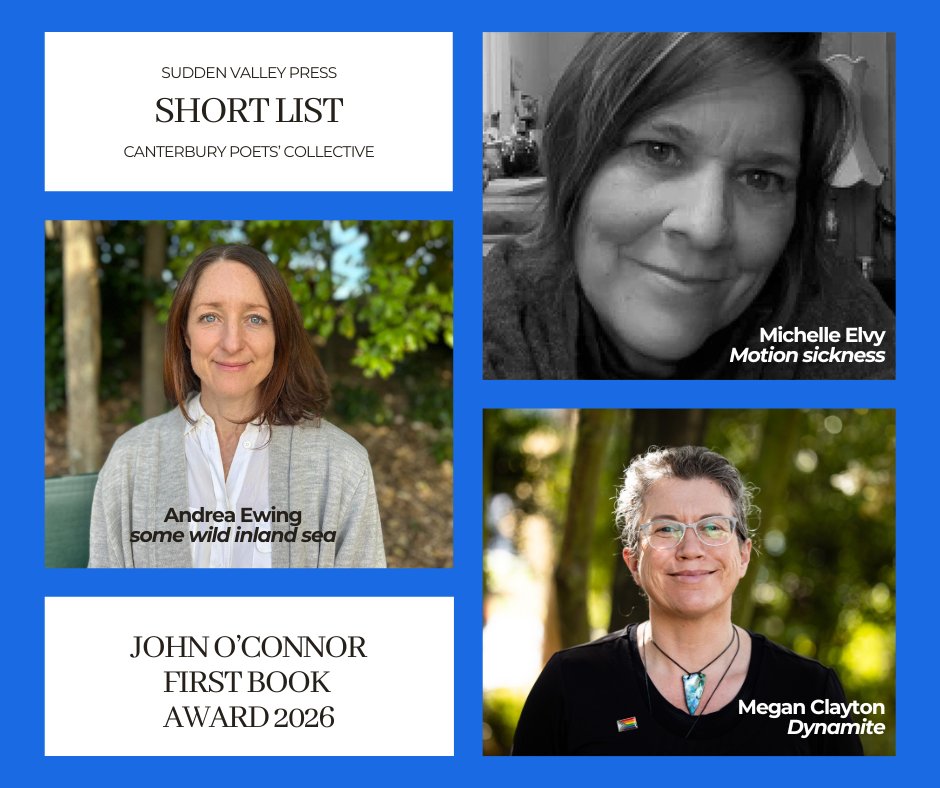
Poetry Shelf noticeboard: The 2026 John O’Connor First Book Award

Named after SVP’s co-founder, and offered in collaboration with the Canterbury Poets’ Collective, this biennial award offers publication to the best debut manuscript of a South Island poet.

The inaugural competition was judged by Elizabeth Smither, who chose My thoughts are all of swimming, by Rose Collins.

The 2024 competition was judged by Harry Ricketts, and won by not everything turns away, by Philomena Johnson.

The 2026 competition will be judged by Fiona Farrell, and opened on 1 November 2025.

Submissions close at midnight on 16th January 2026.

It is open to anyone resident in Te Waipounamu / the South Island who has not yet published a full collection of poetry – for the purposes of the competition, a “full collection” is defined as 24 pages or more. A chapbook of 24 pages or fewer is fine. (If in doubt, contact us to check.)

Entry fee is $30, and the prize is publication by Sudden Valley Press
on National Poetry Day 2026, with as much fanfare as we can muster!

Details here