Category Archives: Poetry

Poem Friday: Brian Turner’s ‘At What Stage’ — There’s an underlying notion that some things matter very much indeed.

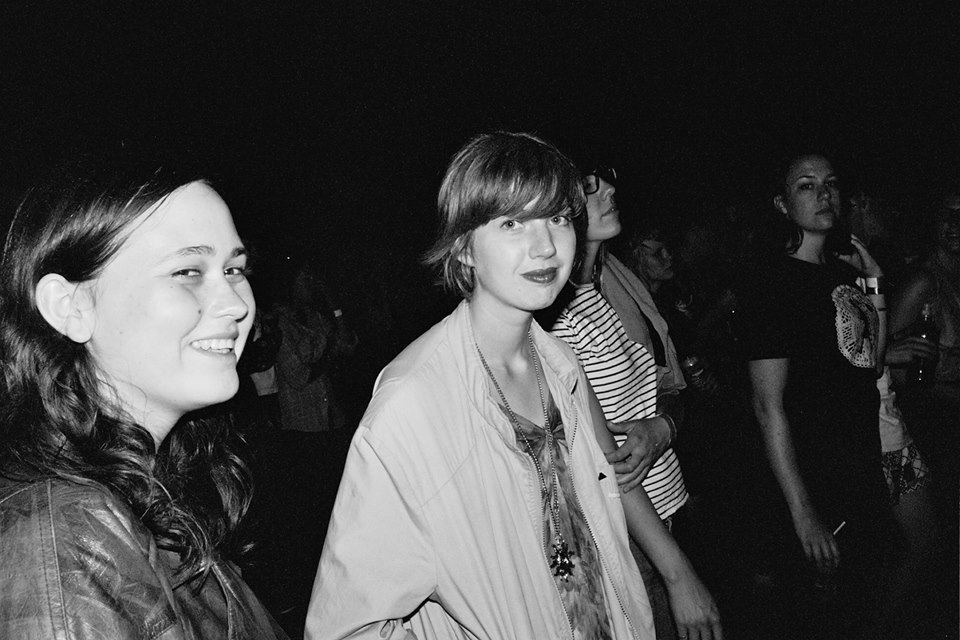
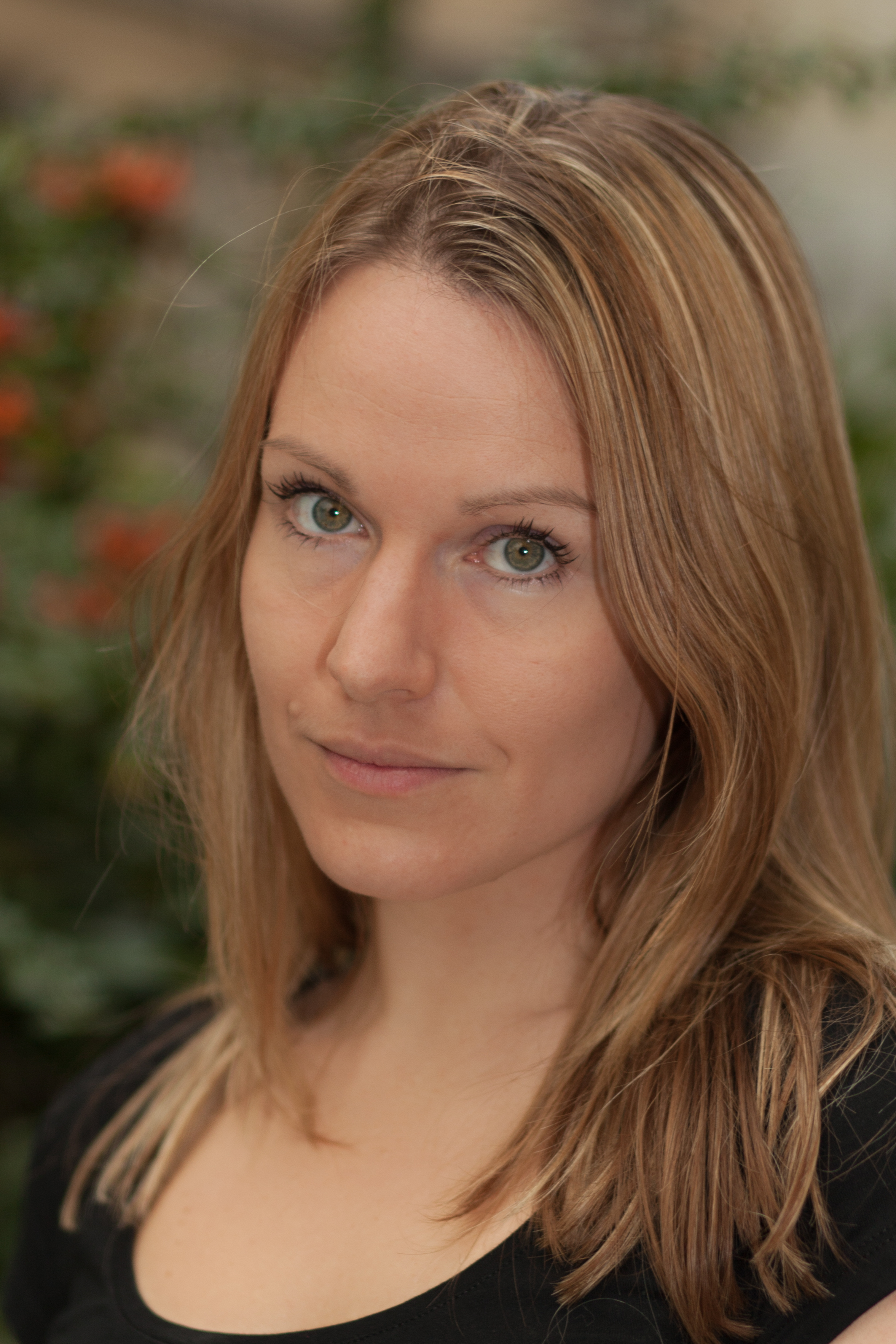
Camden-20110618-00119


At What Stage

Here’s a big question: at what stage
do we ask, not how to live, but for what?
It wasn’t something that troubled you
when you lived in an old wooden house
in North Dunedin in the 1950s, before
puberty thrummed and most of your ilk
walked or rode bikes to school or down
to the river mouth and the wharves to fish
for trevalli and mullet in their thousands.

To many Christ was still our Redeemer
and All Blacks the epitome of manhood
without appearing naked and tanned,
except for tight-fitting jocks, in days
when only academics went on sabbaticals.

Days before you witnessed both men
and women weep, and you’d yet discover
what greed undoes and acquisitions bury,
and you’d still to learn just how destructive
being so-called constructive can be. And
that innocence precedes despair
and what follows comes at you bitter as sleet:
full-frontal foreboding, then fear.


Author’s Bio: BRIAN TURNER is a well-known New Zealand writer and a member of one of his country’s most famous sporting families – his brothers, Glenn (cricket) and Greg (golf), were distinguished sports internationals. I mention this because I think it has given me closer contact with a wider range of New Zealanders and others elsewhere than I would have experienced otherwise. It has allowed me access to a wider world than many writers I know have enjoyed. As a result it has broadened my understanding of my country, my homeplace.

Turner is a former New Zealand hockey player (also captain of Otago and Wellington) and has published best-selling sports biographies (with Colin Meads, Josh Kronfeld, Anton Oliver and Glenn Turner). His many other books include the autobiographical Somebodies and Nobodies: Growing up in an extraordinary sporting Family; Timeless Land (with Grahame Sydney and Owen Marshall); and numerous collections of poetry, including Ladders of Rain (joint winner Commonwealth Poetry prize 1978), Beyond (winner NZ Book Awards for Poetry 1993), and Just This (winner NZ Post Book Award for Poetry 2010). He was the Te Mata Estate NZ Poet Laureate 2003-05.

In 1994-5 he held an Arts Council Scholarship in Letters. He was Robert Burns Fellow at the University of Otago in 1984 and Writer in Residence at the University of Canterbury in 1997. He was awarded the Lauris Edmond Memorial Award for Poetry in 2009 and ‘The New Zealand Prime Minister’s Award for Literary Achievement in Poetry 2009’. He received an Hon D Litt from the University of Otago in 2011. His most recent books are the best-selling Into the Wider World (shortlisted for the 2009 Montana Book Awards) which focuses on his love of and concerns for the future of this country’s natural environment, Just This, winner of the NZ Post Book Award for Poetry in 2010, and a further collection of poems, Inside Outside (2011). A major collection of new and previously published work, Elemental – Central Otago Poems (with photographs by Gilbert van Reenen) was published in August 2012.

Author’s note: Re ‘At What Stage’, hard to answer where poems come from. I’m a product of my roots and my reading. It’s in part ‘about’ where I come from, what life was like back then for me (1940s and 50s) and how much has changed and what I’ve made of it. It’s about our passage from who knows where to whatever follows. I have concluded that humankind has lost the plot, that we’re resolutely ‘shafting the future to serve the present’ (as George Monbiot put it), and that wilful blindness and delusion dominates our thinking everywhere. As Margaret Atwood pointed out we’re using up nature’s capital too fast and nature’s calling in her debt. A considerable proportion of the people who run NZ aren’t leaders, they are followers of that which is failing us and destroying much upon which all things depend. And so on and on…

Paula’s note: Brian has the ability, more than any poet I know, to catch the New Zealand landscape within the economy of a poem. As you read these offerings,  a richness of place unfolds; through light and dark, through the changing seasons. The poem becomes a transcendental point of contemplation. Beauty draws closes. Yet there is so much more to Brian’s poetry than the spectacular lift of Southern landscapes. Place might be fodder for the eye, but there is also that ongoing concern with how we occupy place. How we protect it and how we damage it. Thus amidst the homages you find the political edge across the spectrum of his work that highlights all shades of greed, apathy and ignorance. I love the way this poem reflects the way our relations and engagement with the world makes subtle shifts in our passage from youth to adulthood. The humour. The bite. The underlying notion that some things matter very much indeed.

Secondary school students find poetry chords

I have been keen to include poems by secondary-school students in my Poem-Friday slot. Just had a terrific morning at Lincoln High in Christchurch where we set about making poetry chords.

Loved the two interactive sessions and the workshop.

I have booked a slot for a student in two weeks but am meanwhile sharing this by Elin. Musical chords abound.

Am hoping to get our collective poems to share.

IMG_1135.JPG

Poem Friday: Amber Esau’s ‘Analogue’ —

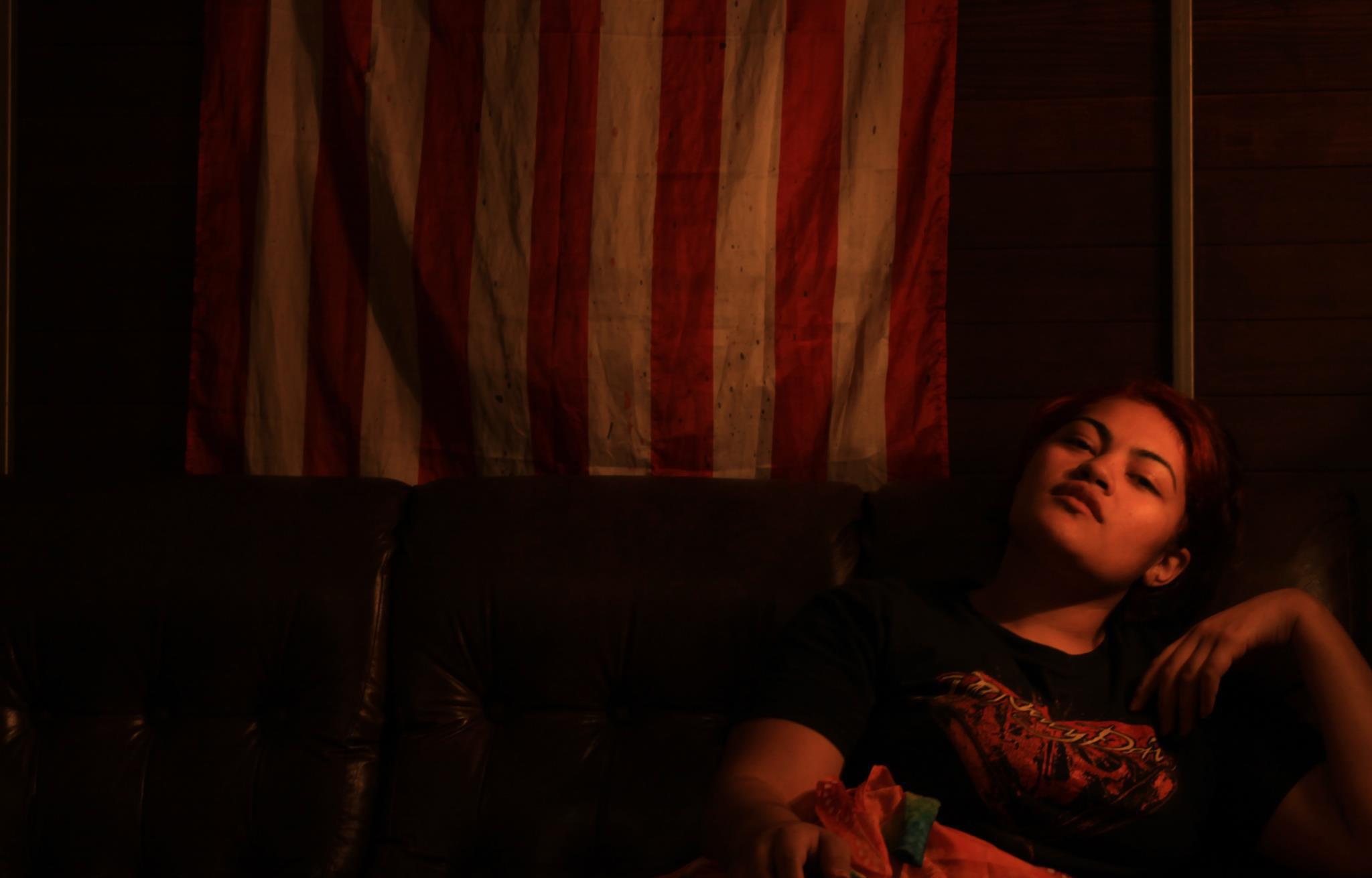
Amber_Esau

Photo credit: Christina Pataialii

Analogue

gravel
; shells

crunch kiss
and leave behind
the echo
in canon.

Road works
pinch at the waist

and I’ve noticed
orange peels
that pray like cracked tar rising.

No one came for me tonight
so I run to them

cigarette chopped between
fingers

smoking moonhair
even if it’s only in streetlight.

I can hear the ocean
in my mouth

as I walk to New(York-Lynn)
in the dark

swishing with va’a jaw
waiting on the rise.
Author’s note: The main road near my street is in a constant state of road works and I became interested in the rubble on a lot of the sidewalks. To me it sounded like walking on shells and in a way it became a sort of suburban sea. The word Va’a means canoe in Samoan and I feel like having a Va’a jaw is about movements between locating and dislocating yourself within your own sense of language as an almost reactionary element of physical location (in New Zealand and the wider world.)

Author’s Bio: Amber is a Samoan/Maori/Irish poet and aspiring novelist doing her final year of the Creative Writing degree at Manukau Institute of Technology. She has been published in the journals Ora Nui, Blackmailpress, ika, Hawaii Review and Landfall and will appear in the Maori poetry anthology Puna Wai Kōrero to be published later this year by Auckland University Press.

Paula’s note: Sound is what first hits you as you read this poem: the pitch, the chords, the beat. There is the way words shimmy together (‘crunch kiss’) and the way words shimmy apart (‘pinch’). A semicolon is carried over like a protagonist in the ambulatory beat — punctuation no longer invisible stitching. This poem brings every lucid detail to walking down the road yet walking down the road is not smooth sailing. I was reminded of Gertrude Stein as I read this and the way she breaks up language and puts it back together in ways that can be disconcerting, disconnecting, reconnecting, reasserting. This is that kind of walk. Amber’s line, ‘echo/ in canon’ resonates in my ear as echoing canon. There is the jarring step from New Lynn to New York. Similes lift and surprise (‘orange peels/ that pray like cracked tar rising’). This a walking poem that startles and cracks and never stops moving. I love it!

My Christchurch travel diary

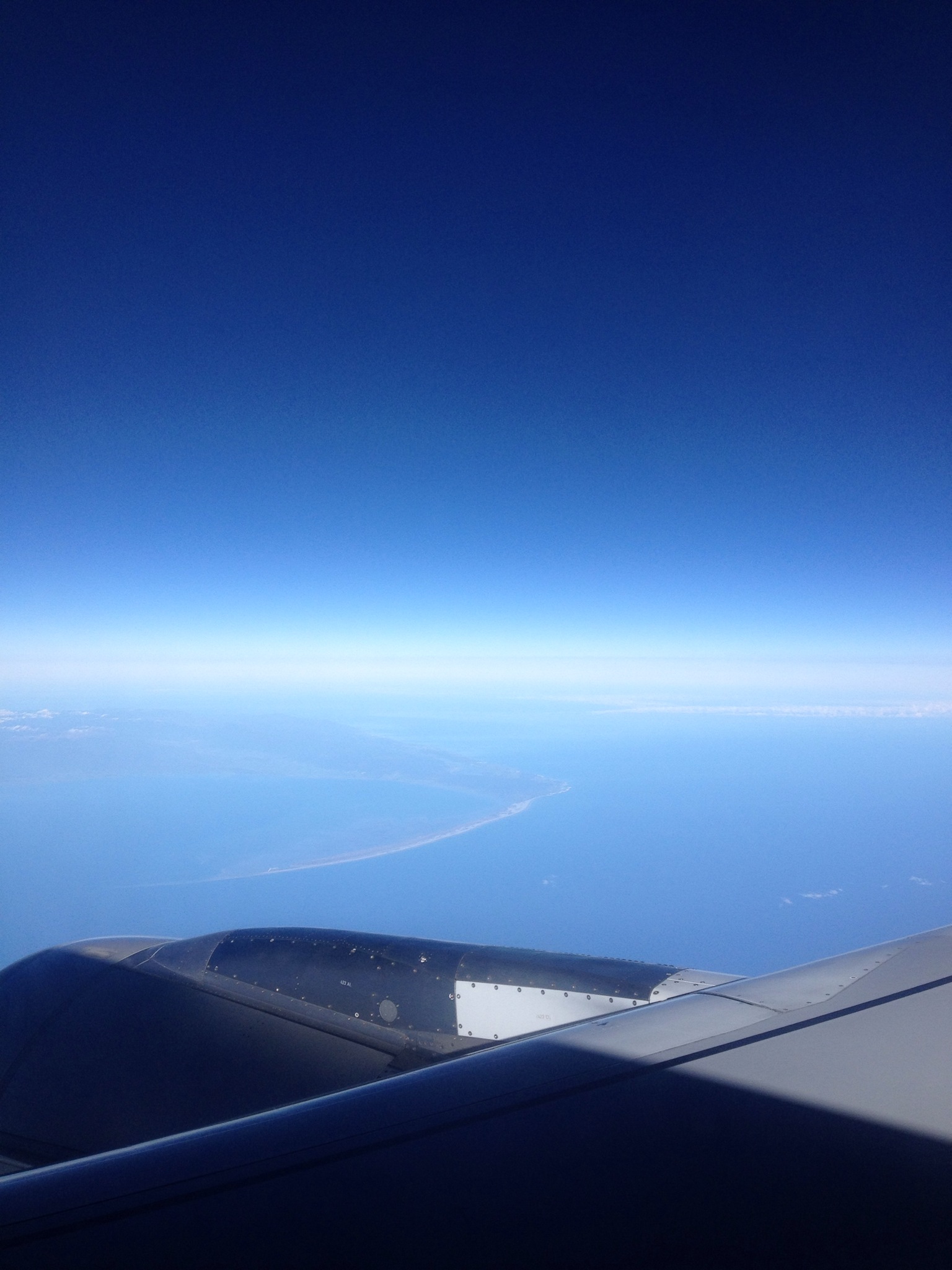
Yesterday I left home when it was dark which gave me an idea for a poem. Flying down I saw skinny strips of cloud like skinny strips of dental floss.

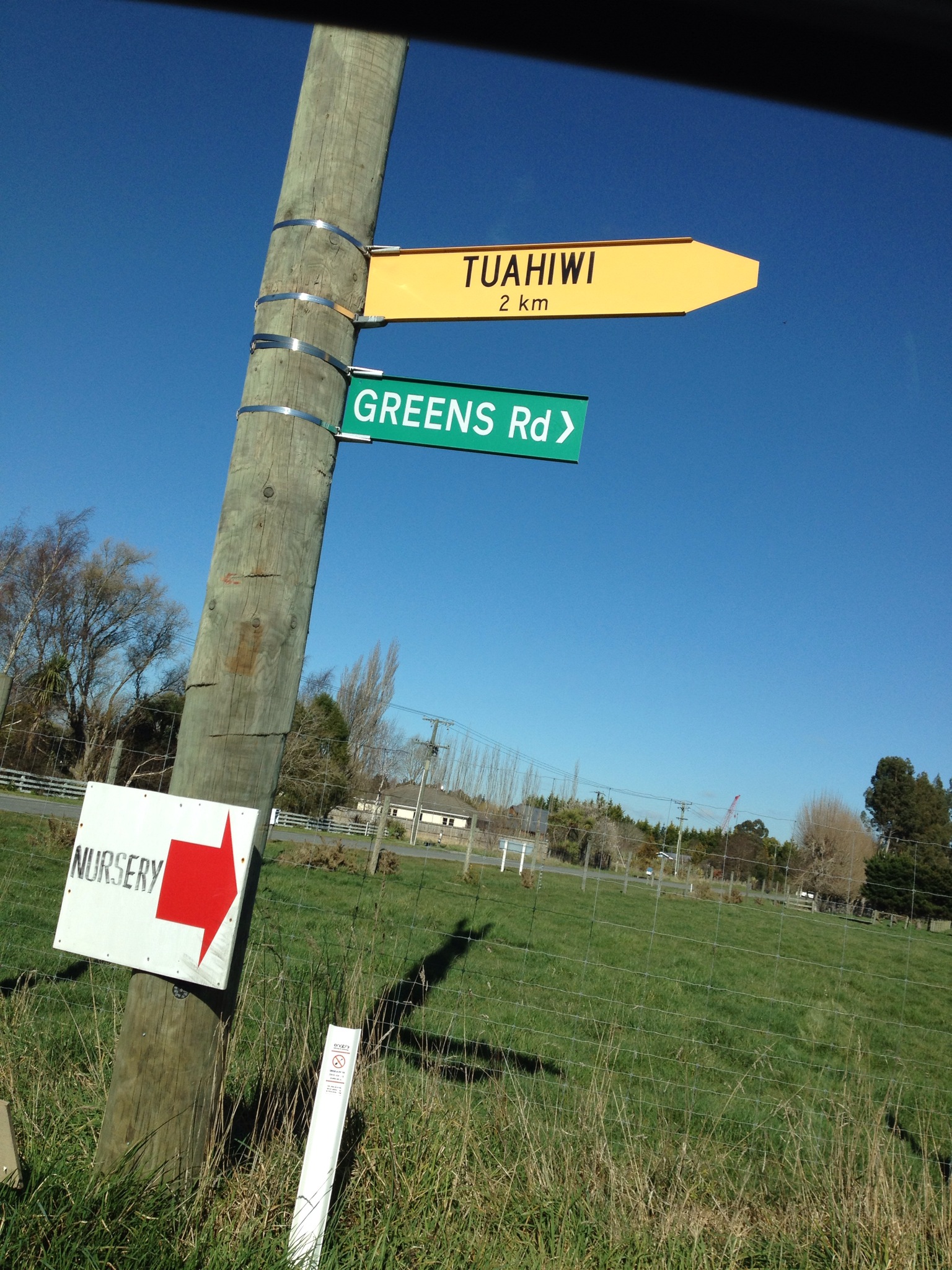
I drove straight to Rangiora High School from the airport. On the way I discovered Green’s Road. I made up poems with a Year 10 then a Year 9 class that I posted on my other blog, NZ Poetry Shelf. I really loved listening.

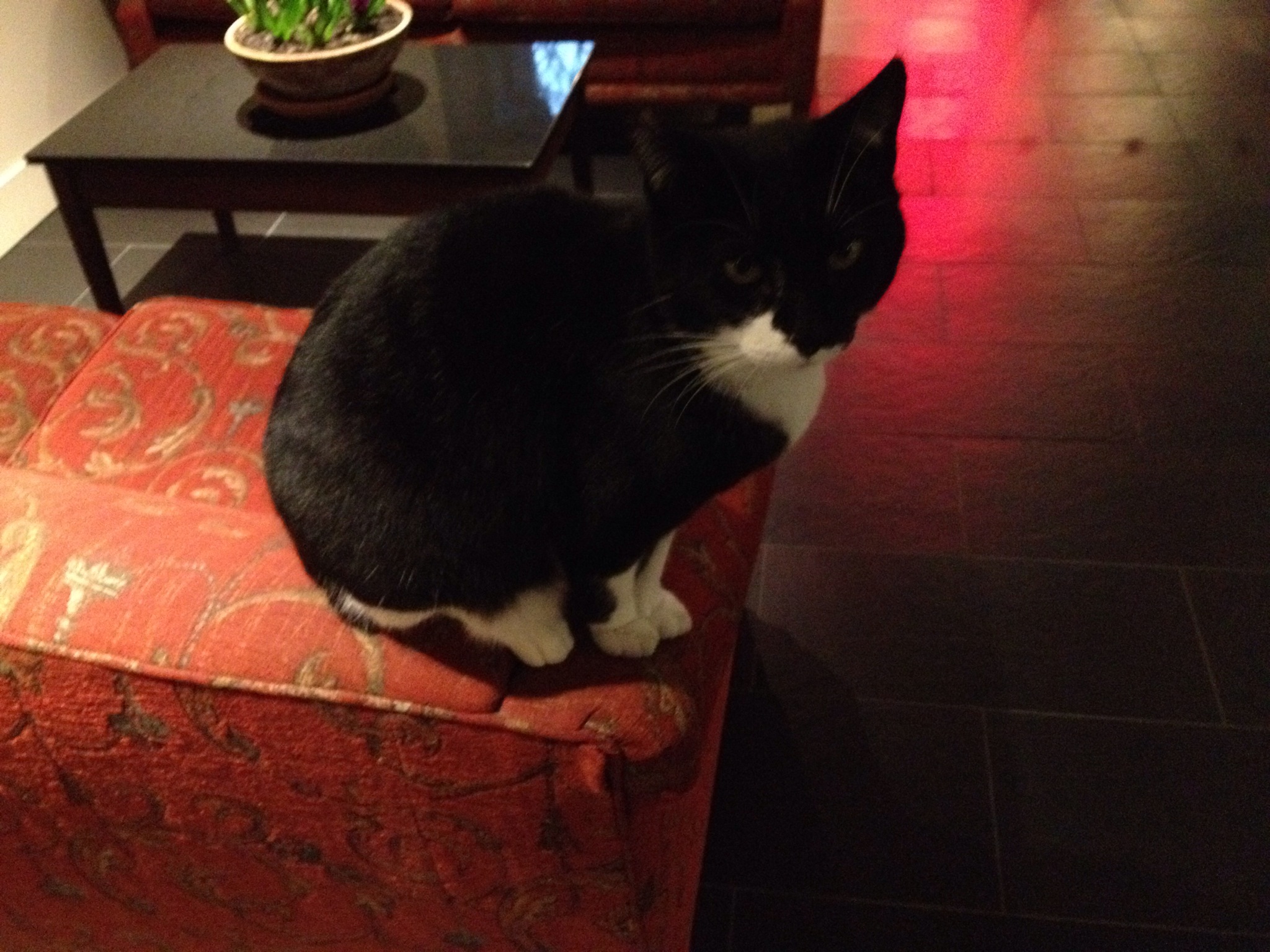
And then another idea for a poem because my hotel has a cat. It came and miaowed outside my door as though it knows my new book is called The Letterbox Cat. This cat needs a poem but for now it has a photo.

Yeah NZ Book Council. Thanks for bringing me south!

Talk soon,
Paula

IMG_1047.JPG

IMG_1111.JPG

IMG_1055.JPG

IMG_1106.JPG

Rangiora High School poems

I have always been keen to post poems by secondary-school students on Poetry Shelf and engage with them on various levels. Yesterday I visited a Year 10 and a Year 9 class at Rangiora High School. Having read some poems, I got them collectively making one up themselves. I really enjoyed the poetry energy when the lines started flying. Cheers!

From 10RKO

Rangiora

Seagulls flying high all day
clean wind whistles
paved jungle of machinery
scuffed up footpath
urban land
wind whispers
sun shining
a metallic desert
worn down houses
twisting clouds dance
friendly faces smiling
fresh air
erecting from the rubble
earthquake saved so many,
soon there will be a Pak ‘N Save.

Rain

Dark cloudy
falls so fast
round and wet.

Coming down rowdy
small, but falls loudly.

It starts, the flowering
buds light up.

From 9HVV

Mountain

Mass of grey
towering above
standing tall

it stands tall, over all

Rocky ridges,
abseilers hoisting down
moist slippery slopes

Large rocks tumbling
snow sliding down the ridges
stocky mountaineers accepting challenges
foggy clouds loom overhead,
mountain oysters.

Rangiora

Bustling street
empty street
skid marks down the road
boy racers causing trouble

Demolition centre
Saturday supporters

Big blue
blue bus travelling
sheep grazing in fields

Standing tall in rubble,
rumble of the diggers echo
across the plains.

On The Shelf in September: Poetry picks by Chris Tse, Hinemoana Baker, Karen Craig

Chris Tse

I emerged from a film festival-induced haze to find that my to-read pile has grown exponentially. (Fittingly, one of the books that I’ve recently finished and enjoyed is Helen Rickerby’s Cinema for its wistful and charming tales of reality colliding with the world of movies.) Near the top of my daunting pile are Maria McMillan’s Tree Space and Hinemoana Baker’s waha | mouth (both VUP, 2014), and Sam Sampson’s Halcyon Ghosts (AUP, 2014). I’ve also been itching to get stuck into When My Brother Was an Aztec by Natalie Diaz (Copper Canyon Press, 2012). I stumbled across her poem ‘My Brother at 3am’ and then went searching for whatever else I could find by her.

I’ve been dipping in and out of books by two American poets (there’s a spooky synchronicity with their titles): Scarecrone by Melissa Broder (Publishing Genius Press, 2014) and Scary, No Scary by Zachary Schomburg (Black Ocean, 2011). Both write deliciously dark poems, which read like fables that speak of how terrifying and confusing the modern world can be. At times these poems have an irreverent edge to them, and both poets use such precise language and ominous images to conjure up worlds of unease.

Chris Tse‘s first poetry collection, How to be Dead in a Year of Snakes (AUP), will be available in stores and online from 22 September.


Hinemoana Baker

Bird murder  When I closed this book after reading it for the first time, my exact words were ‘Now that’s how it’s done.’ Bird murder is a dark chronicle of close-packed language and noir thrills. Being a bird-lover from way back, I delighted in the book’s central murder, and I secretly hoped it was the Stellar’s Jay itself that did it. Overall, though, it’s simply the exceptional quality and music of the sentences that blows me away. An example from ‘Setting’:

Mrs Cockatrice, pink hair a-boule

sets the table for her guests.

Her ornamental milking stool


will do for a child.


And one more, from ‘Solar midnight’:


I came from a lake with an island on it

and on the island there was a lake.

The water was so silver. I had feathers then.’

– Bird murder by Stefanie Lash, Mākaro Press, Hoopla Series. Eastbourne, 2014.


The Red Bird I was alerted to Joyelle by Shannon Welch, whose Iowa Writing Workshop I attended at the IIML in 2003. It would be hard to overstate the effect it had on me reading these lines from ‘Still Life w/ Influences’:


Up on the hill,

a white tent had just got unsteadily to its feet

like a foal or a just-foaled cathedral.

I’ve been known to say loudly, on several occasions since, if I’d written that I could die happy. A glib hat-tip but the feeling is entirely genuine. This particular book travels from whales to guitarists to car accidents and beagles and doubles back. In the introduction, Allen Grossman says Joyelle ‘is a poetic realist. Her poems are neither reductive nor fantastic. But they are profoundly mysterious in the way any truthful account of the world must be.’

– The Red Bird by Joyelle McSweeney, Fence Books / Saturnalia Books. New York NY, 2002.

Hinemoana Baker‘s latest collection of poetry, waha | mouth, has just been released by Victoria University Press. I will review it on Poetry Shelf.


Karen Craig

Two poets I’ve been spending a lot of time with recently are Thom Gunn and Mark Doty, prompted by my job at Auckland Libraries, where we’ve been working on adding some lists of recommended reads in GLBTQI fiction and literature to our website. Thom Gunn is an old acquaintance who never ceases to awe me with the hard (yet supple — how they suited his poems, those black leather biker jackets) intelligence of his vision and the cool leanness of his language. The book I’m reading now is the Selected Poems edited by August Kleinzahler (Farrar, Straus and Giroux, 2009), which includes my favourite poem ‘Considering the Snail’, where the snail “moves in a wood of desire,/ pale antlers barely stirring/ as he hunts.” That’s already good. “What is a snail’s fury?” That’s genius, for me.

Mark Doty is a new find for me. A friend recommended his memoir Dog Years for a “Sadness” display we did at Central Library, saying it was the saddest book she’d ever read. If I tell you it’s over 200 pages and I read it all in one day and night, that will give you an idea of how this man gets inside your heart. He’s one of those people that when I was in high-school we used to call “beautiful”, and, when we used the term in our English essays, be told — rightly — that it was too imprecise. So to be more precise on Mark Doty’s beauty: a largeness of spirit, a sense of wonder and mystery, emotivity and desire, the musicality of the ordinary.  I’m reading Paragon Park (David R. Godine, 2012), a collection of his early poems, while waiting for the more complete collection Fire to Fire (New York : HarperCollins, c2008). To match Thom Gunn’s snail, an amazing “Turtle, Swan”, where he addresses his lover, at the start of the AIDS epidemic, “you with your white and muscular wings / that rise and ripple beneath or above me, / your magnificent neck, eyes the deep mottled autumnal colors / of polished tortoise —  I do not want you ever to die.”

On an other note, I’ve got Michele Leggott and Martin Edmond’s Beyond the Ohlala Mountains: Alan Brunton, poems 1968-2002 (Titus Books, 2013) from the library. I’ve just started dipping in, but I could see immediately that this is the kind of book which makes you really understand what is meant by “labour of love”. Beautifully composed, a careful, pondered – never ponderous – and, subtly, poetic introduction, which will have something for everyone. And the poems! A universe, no, a multiverse, of raptures and pandemoniums.

About me:
I work at Auckland’s Central City Library promoting fiction and literature both on the shelves and off the shelves, through book launches, author talks, lectures and — with great joy, always – poetry celebrations, including National Poetry Day evenings in conjunction with nzepc, Stars of Pasifika Poetry every March, and The Day of the Dead Beat Poets, every November 2. For the next 12 months I’m serving in a just-created role focussing on initiatives across the libraries to raise awareness of our collections. I write the Books in the City (http://albooksinthecity.blogspot.co.nz/) blog.

Poem Friday: Hera LIndsay Bird’s ‘Everything Is Wrong’ — a voice that hooks and tufts as it repeats and shifts

1779473_722846587735015_2139168024_n


Everything Is Wrong


Everything is wrong, I really mean it Isobel

Everything is wrong and love is wrong

I know you believe me

I know you believe me because I know you know it too

This life is changing me already

Running in the empty field behind the salmon hatchery

I think about you

I think about you and the green star of loneliness

Burning me alive

Isobel this life is a lonely life

& Billy Collins is still undressing Emily

Emily who?

She walked out of this life with white death streaming

She walked out of this life and left us her silence.

Isobel you are my best friend

Because you are teaching me to speak to pain

I thought I was mad at you, but I was mad at life

I thought I was mad at you, but I was mad at life

and what I couldn’t have of it

Oh Emily is gone, we never knew her

She wrote her book in invisible flames

And now the sun is burning and so are we

And the red flowers by the train tracks are burning too

I like to think of you somewhere far ahead

I like to think of you far ahead of me

What I say to you I say to me

I don’t care about subtlety

I don’t care about forgiveness or god

All I care about is looking at things

And naming them

The rocking horse rocking on the banks of the river

Animals in their soft castle of meat

None of us are getting out of here alive


Author Bio: Hera Lindsay Bird lives in NZ with her girlfriend and collection of Agatha Christie video games. She has a MFA in poetry from the International Institute of Modern Letters and can be found online here and here.

Author note: I wrote this poem when I had just moved to a small village neighboring a salmon farm, and was reading a lot of Dorothea Lasky. I’m still living in a small village neighboring a salmon farm and reading a lot of Dorothea Lasky, but a lot of things have changed since I wrote this, although I still dislike Billy Collins. As a general rule I don’t think there’s much value in explaining poetic intent, but I should say the Isobel in the poem isn’t my greatest Isobel, Isobel Rose Cairns. I tried changing the name for her sake, but it never stuck. She doesn’t have a poem yet, but when she does I’ll call it “ISOBEL ROSE CAIRNS” and emblazon it in capital letters across the top of the page. Size 30, Century Gothic. As Dorothea Lasky says: “A name has the residue of the person. So, in AWE, if I loved a person, I used their real name in the poem, because I wanted the residue of their name to carry my love with it.” I believe that, but I also believe Frank O’Hara when he says if you want to talk to someone, just pick up the phone and call them. The Isobels of poetry are very rarely ever being spoken to. Naming is usually a staged intimacy, like whispering all your secrets through a megaphone. Mainly when I think of this poem, I think of what isn’t even there: Billy Collins, standing wholly alone by the upstairs window, holding a suddenly empty crinoline and gaping like an asshole.

Paula’s note: This poem is voice — a voice that hooks and tufts as it repeats and shifts and insists and repeats again on the page. A skinny telephone wire of voice poem that snags and catches others as though it a party line. Catches the woman that may be real or invented; catches that love that may be fractured or tight as though this voice is wanting to strip away the artifice and games to get to the real thing, the intimate thing, the secret thing. I love the way the phrases reach you in rawness and bare bones, and then loop and curl one upon the other to make little flaps and creases where intimacy hides. Pain. Love. I feel like I am eavesdropping. I love the swerve of the final lines, surprising, challenging. Glorious.

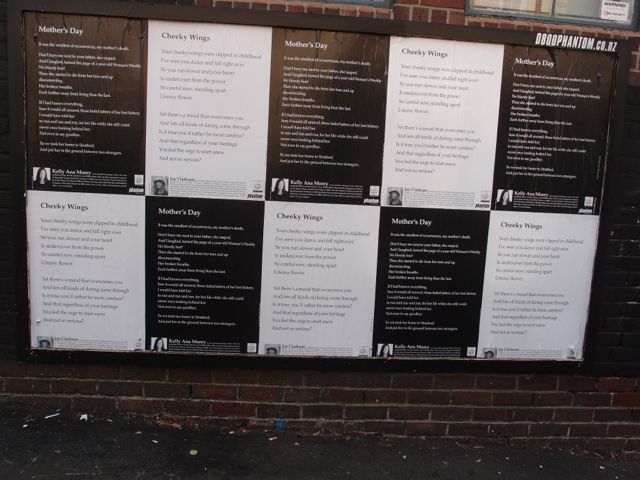
Poetry Shelf interviews Jim Wilson from Phantom Billstickers for National Poetry Day

To celebrate National Poetry Day I decided to do two things. Post a poem by the fabulous poet, Tusiata Avia, and run an interview with poetry benefactor extraordinaire, Jim Wilson.

Jim Wilson started Phantom Billstickers, a street-media company, in New Zealand in 1982. His aim was to draw audiences to music events and the wider arts. Since then he has started the Phantom Billstickers Poetry Project to ‘to use posters to share the hearts and minds of the Kiwi poet with people outside of New Zealand.’ Over the past five years the posters have gone up in cities across the world (Amsterdam, Barcelona, Chicago, Clarksdale (Mississippi), Glasgow, Hong Kong, London, NYC, Paris, Singapore, Sydney, and Vienna, among many others) and back home. They are pasted on walls, poles and in cafes and have featured an electric and vital feast of New Zealand poems and poets. He is an unsung hero of NZ poetry and it is time to sing his praises. I love the idea of poems appearing like glowing beacons in all kinds of surprising places. I love the idea that you can stand in a public place and stop in the midst of urban hubbub and get hooked it into a poetry gem. So thank you Jim Wilson. We salute you on National Poetry Day!

DSC01977  jim photo

All photo credits: Jim and Kelly Wilson

In a video interview, you say you want ‘to play it by my heart.’ The picking of poems. The putting up of posters. ‘Heart’ seems like a vital word when it comes to poetry. I also like the way it hides the word ‘ear’ and the word ‘art.’ Even the generosity of sharing our poetry around resonates with heart. What made you decide to put poems on posters?

I was going through a difficult stage in my life having been through two courses of interferon (for Hepatitis C) and having lost some key people in my life. I became clinically depressed and was looking for something ‘real’. I began reading Janet Frame again and then poetry. Then I thought I should take something meaningful into the streets. Poetry was it.

Reading poetry is usually such a private, intimate thing. I love the way your poem posters bring reading out into the open. Does the public airing affect your choices of poems?

I always try and give people pause to reflect. I am very intrigued by the idea of ‘beauty’. We live in such a caustic world and I aim for beauty. Some of our poems may have an anguished twist to them but I try to stay away from venting poems.

OLYMPUS DIGITAL CAMERA

I saw two men reading my poem on the pavement in Kitchener Street once. I hesitated and then told them I was the poet. They slapped their knees and whooped. Two Irish guys just off a ship. They thought Auckland was full of culture. Hilarious! ‘Get out of here!’ they kept saying. ‘Get out of here!’ Have you ever witnessed a stranger reading one of the poems?

I have seen lots of people stop and read the poem posters. I’ve seen groups of people gathering around lampposts in the USA reading our poem posters. Two separate places come immediately to mind, I saw a group gathered around a Michele Leggott poem poster in Northern Liberties in Philadelphia and then some people gathered around a pole in Lambertville, New Jersey. This is very gratifying.

FINAL JPEGNew Hope Poster-INTL   asburypark

Indeed. What kind of reactions are you after?

I like it when people look internally and feel something real. I imagine that’s what they do when they read poetry. I hope that’s the case at any rate.

Where is the most surprising place you have seen one of your poem posters?

You are asking me where I have been particularly happy to put a poem poster? I have been putting up posters for bands and the like since I was 16 years old. I am now 63 and I have heard the words ‘you can’t put that there’ more than anyone in New Zealand, I am sure. I was delighted to get a Hone Tuwhare poem poster right opposite the main gates of Parchman Farm (The Mississippi Federal Penitentiary) in Mississippi. You aren’t allowed to stop on that road for a mile or so either side of the main gates, but I did and the screws came running. The poem poster went up! Also I did a lot of Janet Frame poem posters in Baltimore and at Princeton University. I felt every single one I put up.

There are a thousand ways to write a poem (no rules, no recipes which is what is so appealing), yet poetry stalls each of us in different ways. What stops you in your tracks when you read a poem? Any examples?

I wouldn’t know what iambic pentameter is from a hole in the ground and I don’t know how poetry works, but I ‘feel’ it. In Tusiata Avia’s poems I feel every word (check out today’s Friday Poem I have posted by her!). I also feel everything Gerald Stern writes and Ben Brown too.

DSC01993


Yes! ironically words take you beyond words. On occasion you have launched a poster-poem series (for example in Christchurch, Auckland and New York). This brings the ‘ear’ of heart into play more. Hearing a poem read aloud means you get to play it in the poet’s voice from then on if you like. Have any poems had a new affect on you when you heard them performed?

Some of the best ‘readers’ I have seen are not the best poets. Reading is a ‘performance art’. Ben Brown combines both worlds I think. He sets the walls on fire.

Tusiata is like this. And Bill Manhire. When he reads a poem like ‘Hotel Emergencies’ time stops. Did you read poetry as a child (lay down rhymes and rhythms that stuck with you) or did you come to it later in life?

I probably read a lot of poetry when I was a kid but my dad read William Faulkner and he resonated in our house. Like I say, I don’t know iambic pentameter from a hole in the ground but I do think Bob Dylan liberated us all to be poets. I find more in poetry each and every day. I find my history in James K. Baxter.

Nice. I like  that idea. Poetry has many functions. What American poets are in your memory banks that you love?

I love Mathew Dickman who has just signed with our project and a San Francisco poet called August Kleinzahler who is now also involved. I remember seeing the emails from Lawrence Ferlinghetti himself when he became involved and that was profoundly moving. I also spent a bit of time with Gerald Stern and he has read to me lots of times. That experience is gold in the bank. Also to have involved people like Robert Creeley (we had the ‘sign off’ from Penelope Creeley), Jim Harrison, C.K. Williams, Robert Pinsky and W.S. Merwin… All this has lead me to think we are doing something with real purpose.

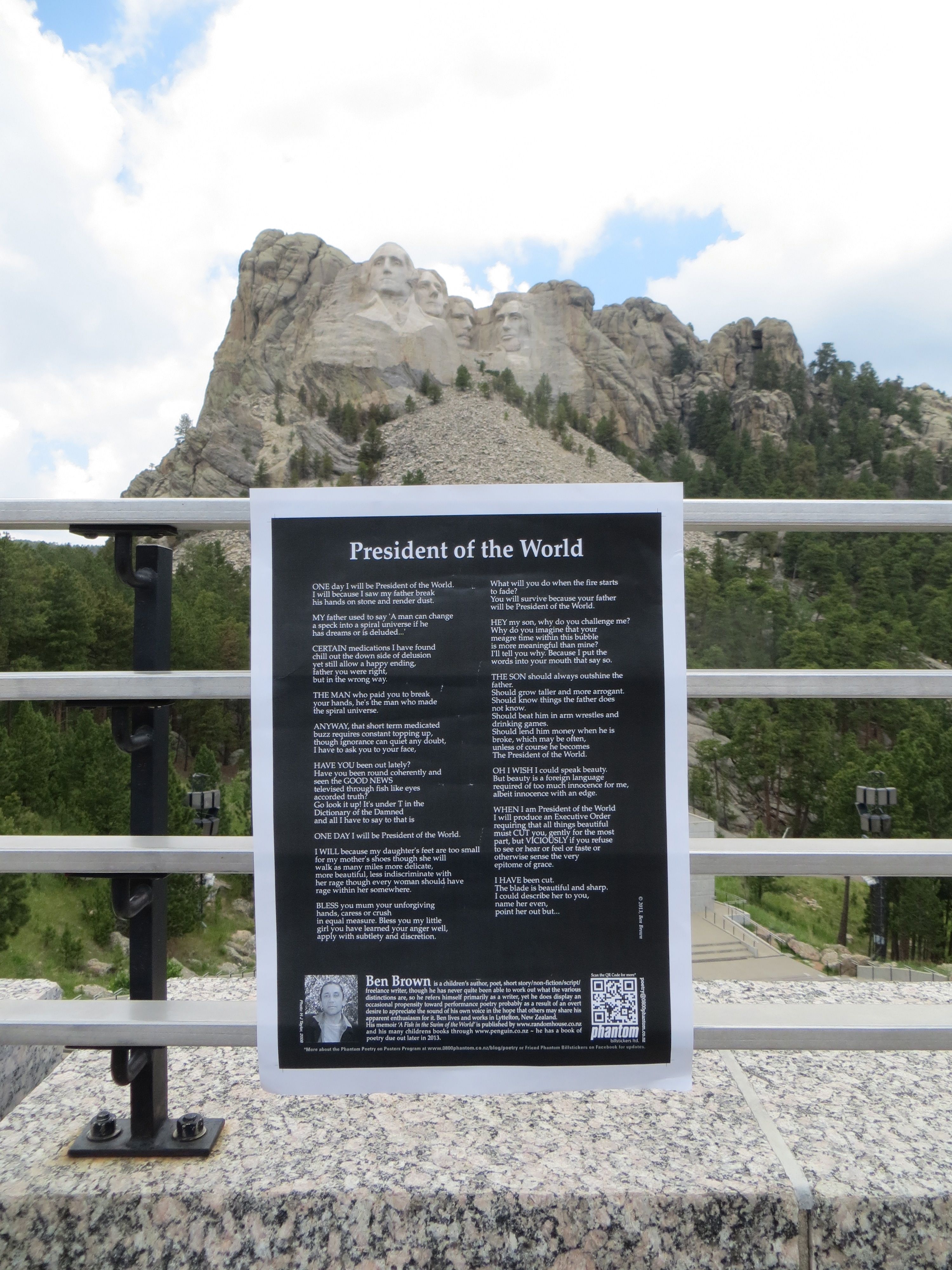
Ben Brown Mt Rushmore 

What New Zealand poets are in your memory banks that you love?

Tusiata Avia, Hinemoana Baker, James K. Baxter, Ben Brown, Bill Direen, David Eggleton, Sam Hunt, Frankie McMillan, Dave Merritt, Elizabeth Smither, Marty Smith, Hone Tuwhare… There are just so many of them…We have produced poems by just over 100 different Kiwi poets (from memory). This country has some of the very best poets in the world and I don’t know exactly how you measure their work… But if you feel something on the reading then that is good enough for me. As I keep on saying, I scarcely know anything about ‘technique’ and this is probably my strong suit.

If you were to describe poetry written in New Zealand to an American poetry fan, what sorts of things might you say?

That it is of the earth. That it is on the ground. That it all comes from being in a natural country and stranded in paradise.

Are you drawn to write poems? Or anything else?

I do a lot of writing and feel daunted almost every time I see a fresh poem poster come to us.

Poetry has many functions: to tell miniature stories, to make music, to make connections, to move people, to challenge people, to show the world in new lights, to share ideas, to speak out in a political way to surprise people, to soothe people, to startle people, to make people laugh. For a start! What functions matter to you?

That it all takes your body before it takes your mind.

If you had a completely free day today (NZ Poetry Day), and you could sit and read poetry all day long, what would you read?

Ben Brown, Tusiata Avia… Mixed with P. Larkin, Gerard Manley Hopkins, E.E. Cummings… Not to be traitorous but even if they are not Kiwis they are still pretty good.

If you were trapped somewhere (in a lift, in a waiting room, in an airport,) what poetry book would you read?

Always had to pick one. James K. Baxter’s Oxford Press collection. That’ll stop you being annoyed and ‘bring you back to yourself’.


Thanks Jim Wilson!


The Story of the Poster Poem on YouTube

The Poetry Project

Poem Friday: Tusiata Avia’s ‘Wairua Road’ — makes the idea of home sharp and vital

Performance photo Tusiata Avia[1]


Wairua Road

The Spirits love me so much they sent all the people in Aranui to be my friends or my parents.

We all walk the Big Path from Cashmere to the sea.

We run like lawnmowers on each others feet.

The Spirits rise up out of the footpath outside the Hampshire St pub. The space that a bomb took out of the ground walks about on a pair of legs with a ghost looking out.

The Spirits love me so much they turn me into a plastic bag.

I will live in a whale or a shrimp and kill it.

My mother rises up out of the lino wringing and wringing the blood from her hands.

The Spirits love me so much we all sit round to watch the sparklers in my brain, the beautiful sunset, the campfire burning, the jerking of my body.

My father rises up out of the carpet and down I go, like knees, like beetroot juice in the whitest of frigidaires.

The Spirits of the Big Path love me so much they have driven me back up to this house.

If the Spirits didn’t love me, I could live in a dog, in a wife, in a house, in a merivale or on some other shining path, far away from the hungry road.


Tusiata Avia has published two books of poetry, Wild Dogs Under My Skirt and Bloodclot and two children’s books. Known for her dynamic performance style she has also written and performed a one-woman poetry show, also called Wild Dogs Under My Skirt, which toured internationally. Tusiata has held a number of writers’ residencies and is regularly published in international literary journals and invited to appear at writers’ festivals around the globe. In 2013 Tusiata was the recipient of the Janet Frame Literary Trust Award. In October 2014 she will perform as part of ‘New Zealand in Edinburgh’.

Author Notes: Aranui: great path.
Aranui is one of the most deprived suburbs of Christchurch, Hampshire St is one of its most troubled areas.  Merivale is one of the wealthiest suburbs in Christchurch. This poem is published in Takahe 72.

Paula’s Notes: Tusiata’s poem reads like a chant and if you’ve been lucky enough to hear her perform you hear the sound of her voice as you read it. This poem takes you to a specific place — yet it takes you into the way place is a layering of physical and nonphysical things. What you see and feel and what you don’t see and feel. Layered and layering. How this specific place means different things to different people. How this is the place devastated by an earthquake and how people are connected and divided by what they have and have not, by what they have lost and lost not. What happens to love? How does love carry you on its back to the sea? Or the poet carry love? Tusiata’s is a voice on edge, edging you to see and feel the difficulty — clues are laid like tracks to the private and the public pain. It is also a poem that is tongue in cheek (‘If the Spirits didn’t love me, I could live in a dog’). It is surprising and tough and sings out with a joy of words, that makes the idea of home sharp and vital. Like much of what Tusiata writes, it affects me deeply. I am in the grip of this poem, and I adore it.

Off the Poetry Shelf: Emma Neale reviews the latest collections of Caoilinn Hughes, Alice Miller and Marty Smith

caoilinn-hughesweb-2            gathering_evidence_front__66501.1385936635.140.215

Gathering Evidence Caoilinn Hughes VUP $28

In densely packed poems bristling with knowledge, Hughes’s first collection shows a gift for delineating the empirical while simultaneously winnowing metaphorical value from it. Praised elsewhere for her precision, Hughes seems to me also a richly allusive poet. The span of her vocabulary, her ease with abstractions, metonymy, near-neologisms and heightened poetic rhetoric — (e.g. the “luciferean abdomen” of a firefly) — show a poet who both layers and layers, and tries to burrow ever deeper into her material, to really isolate its inner workings.

The book holds everything from an impish look at a game of Scrabble to narratives of scientific experiment and discovery. These in turn range from humanity’s first successful effort to begin and arrest a nuclear reaction, to the legal case taken up by the family of Henrietta Lacks, whose cervical cancer cells were cultivated without her permission into the ‘immortal’ HeLa line.

Hughes’s work manages to seem both compendious and yet compressed; each piece pulls in considerable, closely observed data, and yet avoids the prosey feel of Wikipedia entries, with spry, punning, psychologically apt metaphors, or the frequent tang of prosody: ‘slipping into the bullring of incandescence’; ‘launching Glory Bes/into the gluey hives and trenches of her head’; ‘plays chess with the evening’s reticence’.


THE LIMITS_CONCEPTS_01 IMG_8526 

The Limits Alice Miller AUP $24.99 

Alice Miller’s book acts as a cool ‘mental palate’ cleanser if read immediately after the Hughes. The Limits pushes for new archetypes through old. One poem, “Antarctica II”, reiterates ‘This is what we used to call a fairy tale’ — a gloss that could apply to many of the delicately wrought poems here. They read like fragments of cautionary tales, of psychodramas spun from love and fear, aspirations and disappointments. The poems offer intense, dreamlike evocations of mood and relationship dynamics through crisp, clean, yet elliptical and elusive phrasing. Each line is like a single drop of water sending out sonic and visual ripples, rather than the joyously hyperactive torrent of facts and analysis in the Hughes.

There is often a sense with Miller’s work that the reader’s version of the subject of the poem can only inch towards a partial translation from the eerie, haunting language of dream, which itself is a translation of the unspoken or inarticulate in the daily. The poems carry the psychological ‘fragrance’ of new foundation myths; of recent —or near-future — cultural crises whittled back down into the primal nouns of body, earth, apple, skin, fire, ocean. The slightly apocalyptic tremor along the skin of some of the poems can either return us to crises of the past (as in ‘After Battle’) or project us into eerie fusions of the now and the any-moment-now. There are the landscapes and mindscapes of city, trucks, forests, ATMS, border-crossings and terror that suggests a beleaguered present-day Europe; there are two ‘Waiata’ that seem to ventriloquise 19th century settler variations upon, or infusions, of the Maori form; ‘Ocean’ has idealism, fear and ecological crisis lapping at its edges: “point to lands that reach beyond the myth/but soon the water’s pouring up the hills/because we cannot map the ocean still”.

Good at finding metaphor and image for the nebulous, the inchoate, the shift and slide of emotional response to the relatively removed or abstract, Miller’s work embodies the idea that a poem should leave the world both a little more illuminated and a little more mysterious at its close. This reminds me of the surrealism of Michael Harlow in its sense of what we might call the accurate strangeness not just of language, but also of the workings of the subconscious.


 Horse_with_Hat_front_cover__77059.1385936731.220.220    good one 7 cat

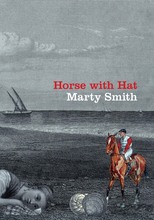
 Horse with Hat Marty Smith VUP $30

The tonal range in Marty Smith’s Horse with Hat is, I think, the widest of all three collections reviewed here. This is alternately comic, wry, downbeat, vernacular, lyrical: yet it is also at times dark, plangent and moving in its use of narratives distilled from extended family relationships. The collection gathers small yet vivid dramatic moments from the routines of farm work and a lost pre-digital world, where the children remember that “TV arrived like a Martian” (‘reception’) and ‘You only made phone calls if someone was sick or dead or married’ (as one typically long and cheekily, tartly inverted title has it).

With its imagery of “quicksilver silvery birds” and “eel thoughts” that “slide along our sides” (‘A mile here, a mile there’) the poems are gorgeously evocative of landscape and the sensation of, say, early dawn on the farm – where one natural observation infuses another with both physicality and emotion: “those horses talk to themselves/low, and tender as the fat wetness of roses” (‘dawn horses’).

The collection builds up the sense of how the vulnerable, sensitive child still sits inside the adult, and the animal or primal lingers inside the human. ‘Creature’ is a compellingly simple poem about the fusion between self and animal;

“I make the glorious mouth./It is a heart-blossom red I choose./I leave teeth marks.[….] The sun in my lungs/I put my tail up and go.”

Other poems slide into the animal voice, showing how close contact with working animals deeply influences the child’s sense of identity, time, imagination and land. The book also runs its fingers over the history of civilisation’s relationship with the horse (‘Lot 165’). It’s impressive to realise how much ground is covered in what is also a tightly themed collection. From Crusaders to gambling nuns and the fiery, unpredictable character of the poet’s returned serviceman father, the book dips in and out of the human use of horses, and the strange attractions and repulsions of family.

The father’s character bristles on the page with frustration, fury, and yet love; the poems weave and bob with the sense of complex individuals, and tangled, ingrown, or estranged relationships. All the while, the long contrail of war trauma chokes the family atmosphere.

Brendan O’Brien’s illustrations for the book are a dreamlike bricolage, with tumbled perspective and collisions of genre (Biblical engravings, coloured cigarette cards). The air of bewilderment and wonder, and of bizarre within the familiar, plays deft visual accompaniment to the poetry’s side-winding snippets of family feud and rural life.