Category Archives: Poetry

Poetry Reviews on Poetry Shelf

Poetry reviews are like hen’s teeth these days (okay where does that saying coming from!). Hardly any newspapers publish reviews of poetry (those that do? ODT and The Nelson Mail spring to mind). There is the wonderful Landfall-on-Line, NZ Books and the rare outing in The Listener. What have I missed?

I started Poetry Shelf to address this in part but I never set out to review every poetry book published here. But I do want to flag as many as I can along with events and poetry projects. Realising I can’t get review all the books I have on my desk I will start doing short snapshots. Poetry Shelf doesn’t fill the gap by any means.

What I can do is post the occasional review written by someone else. I am just about to post Emma Neale’s terrific review of three books.

If you would like to review a poetry book or two, let me know as I may make this an occasional series. The currency of this blog however is a love of poetry.

I will make a review page with details that are easily accessed.

paulajoygreen@gmail.com


GOING WEST FESTIVAL POETRY SLAM 2014 The heats are on


GOING WEST FESTIVAL POETRY SLAM 2014

CALLING SPOKEN WORD ARTISTS AND PERFORMANCE POETS!

On Saturday 13 September at 8pm, the annual Going West Poetry Slam takes place at the Titirangi War Memorial Hall.

Directed by Doug Poole and assisted by MC Zane Scarborough. Guest judges Selina Tusitala Marsh, Grace Taylor and Ben Brown.

The Grand Final prizes:

  • First prize $1000
  • Second prize $500
  • Third prize $300

There will be four heats and one Grand Final. Three finalists from each heat will compete in the Grand Final. 

HEATS

East and South

Friday 29 August, 6-8pm at Fresh Gallery Otara, Shop 5, 46 Fairmall, Otara Town Centre.

North and Central

Thursday 4 September, 5-7.30pm at Central City Library, 44 – 46 Lorne Street, Auckland Central.

West

Saturday 6 September, 7-9.30pm at Corban Estate Arts Centre, 2 Mt Lebanon Lane, Henderson.

Fourth and Final Heat

A fourth heat will take place on Poetry Slam Grand Final night, Saturday 13 September, registrations from 7.30.pm for an 8pm start. There are a limited number of registrations available for this heat.

Grand Final

Poetry Slam Grand Final, Saturday 13 September, Titirangi War Memorial Hall, 8pm.

Register to perform from 7.30pm.

Email for information: poetryslam@goingwestfest.co.nz Ph: 021 02794173

Going West Poetry Slam Director Doug Poole: Dougpoole3@gmail.com

Tickets: eventfinder.co.nz                   Going West Festival: www.goingwestfest.co.nz

Media enquiries: Angela Radford: angelaradford@xtra.co.nz Ph: 0275 401104

……………………………………………………………………………………………………………………………………

Associated Youth Event – WORD UP!

Corban Estate Arts Centre and Going West Books and Writers Festival, are proud to present WORDUP! 2014.

Word Up is an exciting word-based performance competition which gives 13-20 year-olds the opportunity to present their original work in any word based genre, from rap, poetry, spoken word, music or even stand-up comedy.

* The Word Up! winner will perform at the Poetry Slam Grand Final.

For Word-Up Development Workshops and Audition details: www.ceac.org.nz/youth_arts/word_up!.aspx

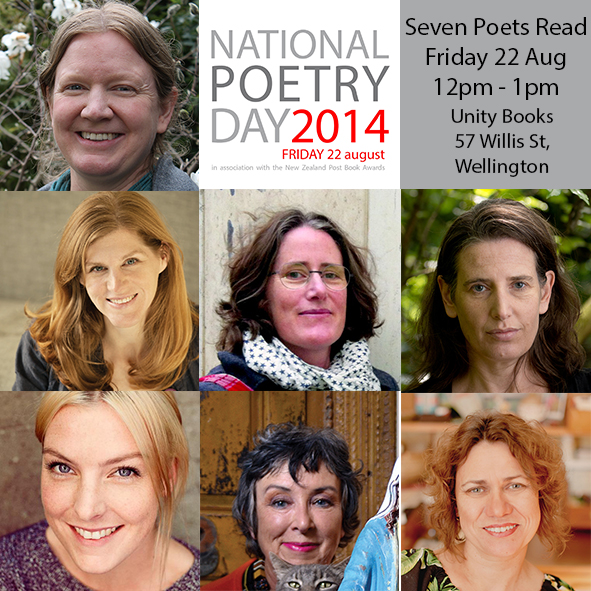
This is looks great! Seven Poets Read at Wellington’s Unity Books for National Poetry day

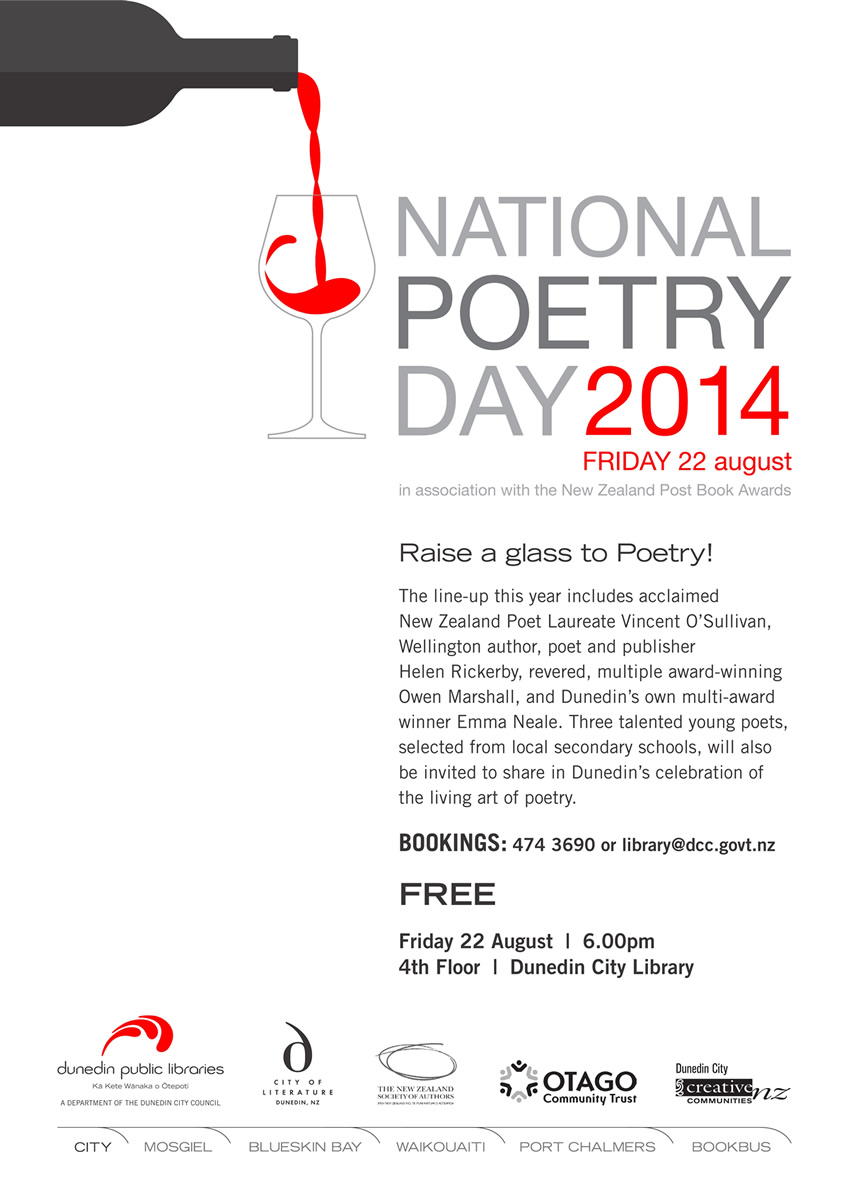
Poetry Day event

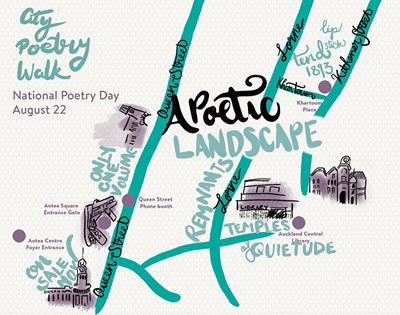
Auckland City Poetry Walk on National Poetry Day August 22nd

10367684_10152335535906903_6238454205185318157_n


Anna Forsyth has created a small walk around the city (5 spots). At each spot, she wrote a poem, which she then recorded. She will be putting the Soundcloud link up here on Poetry Day, along with a beautiful map drawn by her friend Jess van Zyl. You don’t have to do the walk on Poetry Day, and you don’t have to go to all the spots.

Poets at Te Papa

   
WRITERS ON MONDAYS: Best New Zealand Poems 2013

What better way to anticipate National Poetry Day* than with a line-up of nine of the best? Come along to hear Kate Camp, Mary-Jane Duffy, Dinah Hawken, Anna Jackson, Therese Lloyd, Greg O’Brien, Rachel O’Neill, Chris Tse and  Ashleigh Young read their poem selected for the annual online publication Best New Zealand Poems,  plus a favourite NZ poem. The editors of this year’s selection, Mark Williams and  Jane Stafford, will introduce the poets.

(*National Poetry Day is on 22 August).

Writers on Mondays is presented with Museum of New Zealand Te Papa Tongarewa, the New Zealand Centre for Literary Translation, and National Poetry Day.

DATE:    Monday 18 August
TIME:     12.15-1.15pm
VENUE: Te Papa Marae, Level 4, Te Papa
(please note that no food may be taken onto the Marae).

Friday Poem: Rebecca Palmer’s ‘Dear Grandma’ — now I have read the author’s note the poem shifts slightly on its axis

 OLYMPUS DIGITAL CAMERA

Dear Grandma

Albino, prune like
demoralizing the years
of hard work past,

B flat serenades
chitter chatter through
the teeth of an elephant.

African plains, vast, moonlit,
red eyes glinting –
is it Chopin’s waltz,

or your other love,
Rachmaninoff?

Poised, silent
“Shhh”, you whisper,
“Can you hear the musk deer?”


Author note: I wrote this poem from an exercise about describing a person’s hands in a workshop run by Joanna Preston. It was the beginning of summer, when the sun lingers on your shoulders in the evenings and instills in you a kind of thirst for adventure. The exercise got me thinking about how the world looks to a child and how, through the eyes of the young, the achievements of the elderly are merely fleeting impressions of an untouchable Savannah.

Author bio: Currently studying towards an undergraduate degree in English and Russian at Canterbury University. I have been published in The Fib Review.

Paula’s note: This poem hooked me. I love the surprising juxtaposition of detail and sound effects. Try, for example, writing a poem with a prune, B Flat, a grandmother, the African Plains, elephant’s teeth, the moon. This is an subtle portrait of a moment, a grandmother and a relationship. It reaches out from the intimacy of listening and sharing to the African plains — it is a poem of the wider world and the world at hand. I love the way a phrase (‘years/ of hard work past’) embeds a secret narrative that instils a sense of the buried lives of the elderly. I have used this analogy before, but this poem is like lacework: ethereal, delicate, intricate, as dependent upon holes as it is web. Interesting too how now that I have read the author’s note the poem shifts slightly on its axis. I like the idea of fleeting impressions through the eyes of a child.

Anne Kennedy and Iain Sharp in conversation

      kennedy_180 sharp_180  
Anne Kennedy has had success in every genre she tackles – fiction, poetry and film.  Her latest volume of poetry won its category in the 2013 NZ Post Book Awards. Her latest novel The Last Days of the National Costume is a finalist in the fiction category of this year’s awards. She holds The University of Auckland Residency at the Michael King Writers’ Centre, working on her next novel.
In his day job Iain Sharp is a manuscripts librarian in the Sir George Grey Special Collections at Auckland Library. He is well known as a reviewer and writer, as a poet and he has authored two books. 

 
Join them in a conversation about the world of writing over a glass of wine.

Sunday 24 August 2014, 4 pm
Michael King Writers’ Centre, Summit Road
Takarunga Mt Victoria, Devonport (off Kerr St)

Entry by koha ($5)
Bookings recommended (by August 22)

Ph: 09 445 8451
E: assistant@writerscentre.org.nz

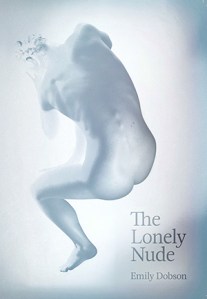
Emily Dobson’s The Lonely Nude — The collection allows the imagination to corkscrew slightly, leaving the poem ajar for other things.

cv_the_lonely_nude                 IMG_2664

Emily Dobson, The Lonely Nude Victoria University Press, 2014

Emily Dobson’s debut collection, A Box of Bees, gathered much critical praise and was named as one of The New Zealand Herald’s Books of the Year in 2005. That same year she took up the Glen Schaeffer Fellowship in Iowa.

Emily’s new collection, The Lonely Nude, is a collection to read as a whole as much as it is a collection to read in pieces. Like a symphony in parts, or a poetic memoir that doesn’t reside solely in self-confession, experience or anecdote. The collection allows the imagination to corkscrew slightly, leaving the poem ajar for other things. Connections, disconnections, vulnerabilities, epiphanies, fantasies. It is as though the poet’s pen is driven by the real and outsidethereal. Musings, sidetracks, daydreams, anxieties. The seven sections establish thematic clusters as the titles suggest: ‘Prehistory,’ ‘The Lonely Nude,’ ‘A Holiday in Mexico,’ ‘Fall in America,’ ‘Winter,’ ‘Spring,’ ‘Going Home.’ These titles suggest an arc of living and travelling, yet the book title underlines the fragility of movement. Yes, the poet has posed as a life model (and there are poems on this topic), but there are various other nudities rippling through the lines. Scandalous gossip stolen from a women’s magazine in ‘Rude Jude goes nude.’ Or the nightmarish scenario of a house being blown away while showering in ‘Unfamiliar weather.’ (‘Foreignness is just things we’ve forgotten/ ways we could have been.’)

These new poems share the restraint and elegance of a Jenny Bornholdt poem. The line breaks are exquisite as though the poems are breathless. As though the poet has slowed the reading right down to snail’s pace so we can stall and ponder. This is nowhere more evident than in the perfect little poem, ‘Hotel Mexico.’


Hotel Mexico

The bedspread is red

like ink

in the room

with small breezes

we’re sprawling

and a few small drops

of rain are falling

on the dust

on the concrete

small buds

are opening

in our lips

spreading carelessly


These new poems shift and settle on the page in myriad ways, with or without punctuation, with or without hesitancy. At times there is a spark of humour. Often there are lines that Emily acknowledges as ‘stolen’ in her detailed footnotes. These poems emerge out of reading the world and merge into a world of reading. There is an anchor in daily life, yet the poems float and fly like a poet’s mind on the move without limitation. Lyricism is the ink in the pen. So too are the shifting forms. The ability to catch just the right modicum of detail to make a moment shine. As James Brown said of Emily’s first book, these poems are a joy to read.


I want to end with another poem that caught me:


The house

The house faces south

and we are couched in the dark side of a hill.

The grass is long and always wet.

We envy the hill opposite: we long for its sun.

There are holes in it, tunnels,

like a pencil has been poked through.

The two pines are always black as pitch.

A guitar in the corner keeps creaking.

At night the little train all lit up inside

rattles briefly around the hill,

in and out of the tunnels.


Victoria University Press page

New Zealand Book Council page