
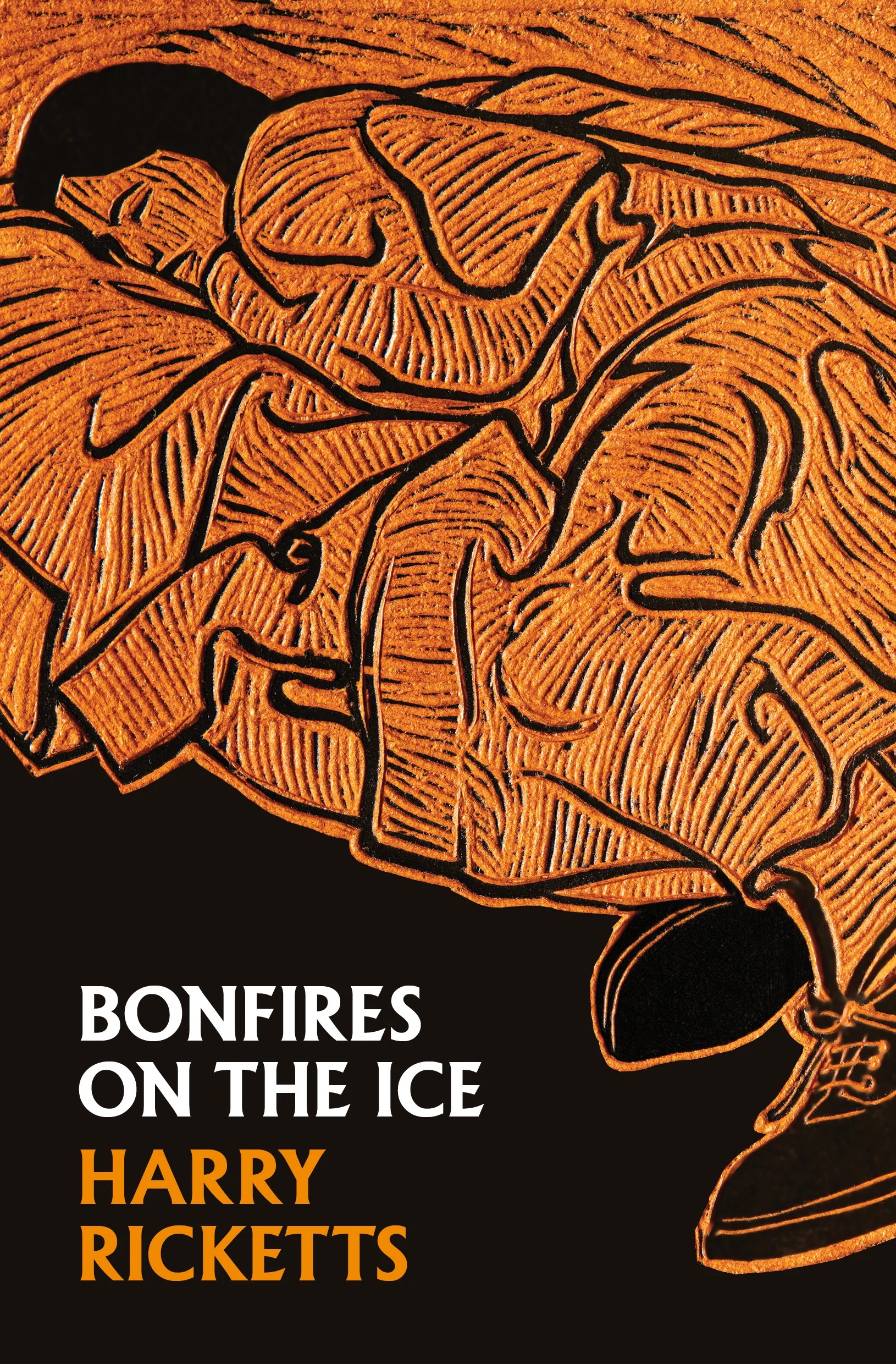
Bonfires on the Ice, Harry Ricketts
Te Herenga Waka University Press, 2025
Harry Rickett’s poetry collection delivers multiple heart loops, beginning with a poem entitled ‘Happiness’, travelling though terrains of grief and loss, and then reaching sparks of hope, with the grief bonfires and the grief ice easing, just a little, just a very little. Happiness, as the poem indicates, is illusory: “we cling to the thing with wings” and “It’s no potato you can grow”. The poetry is deeply personal: love and death is personal, the world is personal, politics is personal. I am feeling this book to the edge and depth of what matters, to the edge and depth of being alive, to the edge and depth of not being alive, being present and human and humane. I am recognising the difficulty of writing when happiness and equilibrium is in jeopardy. And how poetry can affect us so much.
The first poems are dedicated to friends no longer here, with each poem offering a savoured memory, a phrase, a place, a miniature portrait of dear friend (especially Lauris Edmond). In ‘Aro St Again’, a poem for Juliet, for me, the final lines resonate throughout the collection: “You paused, smiled, said / quite distinctly: ‘Aroha and ambiguity.'” This bloodline of writing, this love, these smudged edges of life and living. This aroha, this ambiguity.
How to write within the throb of grief and loss? What to hold close, what to let go? The poem, ‘Tangle’, strikes a chord. I am reading tributes to dear friends but I am also reading how the tangle of life, and I infer grief, might be reflected in the tangle of a poem, in an acute writing-life-writing tangle:
The past’s shifting scalene triangles
tease us to adjust their angles,
though geometry won’t put it right.
Harry gets me thinking about the poet as architect or builder in his couplet, ‘Poetic Architecture’, a poem that likens poems to rooms: “some poets prefer walls and a door, others open plan.” I am musing on the process of writing – how we may have a sense of walls and doors from the outset, and how we might also (or instead) write and read within a form of open plan. ‘Down There on a Visit’, a Rakiura poem penned for Belinda instead of a valentine, where the depiction of a shared experience of place becomes a tender gift, gets me musing even deeper. On the walls and windows and open expanse of writing.
If this is poetry as a series of rooms, with windows and doors opening onto and out of grief, onto and out of living, then both the exterior and internal views are paramount. Take the room where the poet is teacher, with the students sidetracking diverting moving into and beyond literature. I am back there in the heart loop, catching up on the ancient mariner, or listening to the lesson in “Another Footnote to Larkin”:
But if we hand the misery on
from self to others every day,
there’s this to say (Larkin again):
we should also be kind while we may.
The poetry draws me again and again into that ricocheting phrase love and ambiguity. And let me lift the word crochet, a craft that depends upon holes as much as it does thread. Take the poem ‘Bits and Pieces #3’ for example. It is not just a matter of crafting the missing pieces, but holding them as they jiggle, switching between sky and water, or hill and undergrowth. Is writing a continuous state of being, replete with ambiguity and flux, etched and anchored with love? Ah. How to face the silence, the blankness, the missing and ambiguous pieces? I utterly love the sequence that introduces Stella, an invented poet who is learning the grammar of grief, who is coming in from the garden, embraced by books, cooking badly, looking at hills and sky with infinite wonder.
The Garden (Stella)
Here you are, in from the garden,
smelling of yourself.
In your left hand is a present,
a tiny black box.
Inside is a single, perfect,
pointy leaf of thyme.
Bonfires on the Ice is a gift, in the bright light, the half light, the dream light. It is a lyrical record of living and loving, reading and writing, whether there are windows and doors or open plan. Yes there is the pain of bonfire and ice, but there is also the gradual breaking of ice in the flowing river. Near the end of the collection, a handful of poems draw Belinda closer, from the first long-ago meetings to the nearness of the hospice setting, her chemical life, their shared routines. And there in in the fading light, with the grief in me mounding, I read a couplet poem dedicated to hope. And inside the fragile dimensions of hope, I recognise the insistent infusion of love across the heart loops of the poetry. How this collection makes me hold these two precious words even closer. Sometimes when I review a book I might focus on the craft, but today what matters more than anything, is the way poetry can affect us so very deeply. And this book does exactly that.
Hope
Hope is a grey warbler,
that whistles down our street,
the tune is thin and sweet,
but always on repeat.
Harry Ricketts has published thirty-five books, most recently First Things: A Memoir and (co-written with David Kynaston) Richie Benaud’s Blue Suede Shoes: The Story of an Ashes Classic (both 2024) and his thirteenth poetry collection, Bonfires on the Ice (2025). He lives in Wellington Te Whanganui-a-Tara, loves cricket and coffee, and teaches a creative non-fiction course at the International Institute of Modern Letters at Te Herenga Waka Victoria University of Wellington.
Te Herenga Waka University Press page
 NZ Poetry Shelf