
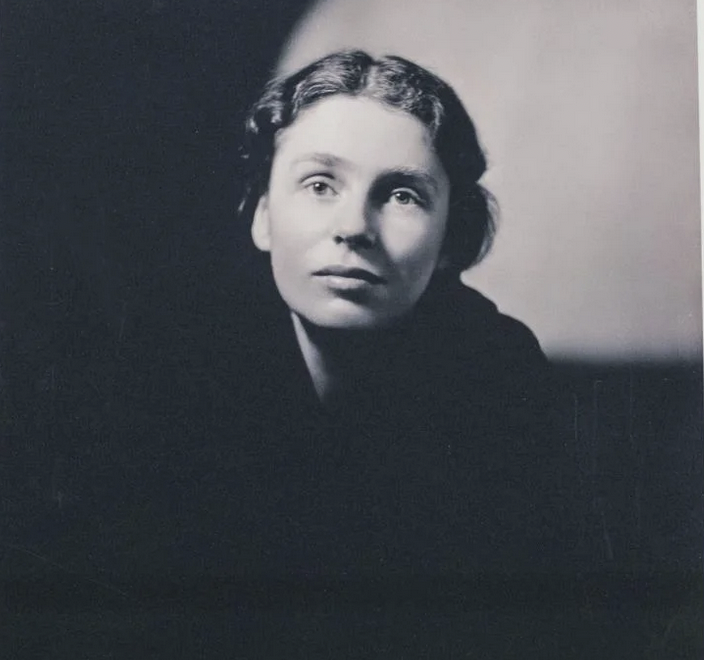
What would the response be in Wellington if you were waking up to find that the Katherine Mansfield house had fences and a demolition sign on it? Would important people reverse the decision with in days? Yes of course they would.
But here in Auckland they are pulling down the Hyde House. Penman House – the house where as a voluntary patient Robin Hyde wrote most of her published work ( Godwits, Wednesday’s Children, Passport to Hell, Nor the Years Condemn ++) – and kept writing journalism when recovered! Auckland has always been considered the money town not the cultural and political one. Iris Wilkinson \ Robin Hyde was Iris’s plume de guerre) always questioned that – questioned it about Orakei for example. She would have been delighted that the land the house stands on is being returned to an Iwi – albeit commercially – a collective of iwi who are able to buy the land from government as part of treaty settlements. And the particular iwi would have liked to have been able to keep the house if they had been offered support to preserve and maintain it. The collective of iwi that are developing the land have a complex mix of housing ( town houses, commercial and social housing) that should be really useful in the area but the MHUD needed to act on heritage advice before handing over planning. Because any building that gets excluded from an individual iwi alters the proportionality of the deal and triggers court cases! What a mess! And this absolutely beautiful house to go.
A house that would be a community asset and whose graciousness ( I must be upset this is not a word i use!!) contains memories of bravery that binds nga tangata across our isthmus! The story of the brave young woman who took the tram to Queen St and limped to her old newspaper office to deliver her critique of government plans to evict Ngati Whatua from what was left of their housing at Orakei. Who went to Grays Ave to interview returned soldier John Douglas Stark (Starkie – amongst his children and chickens) about his horrendous and hilarious experiences as Bomber Fifth Regiment of NZ Expeditionary Forces -a peace work – Starkie is also the lead character in her novel Nor the Years Condemn). Who left Auckland in 1938 and sent journalism back from China – acting as an informal war correspondent. A wonderful verse biofiction Iris and Me tells this story.
Hyde died in London in 1939 – news of her death was on the front page of the New York Times. She was only 33!
Arohamai i am going on – but where is the head and where is the heart? Our tamariki and mokopuna need these stories and the houses and community preservation that reassure them they are important. It’s not only this government but it is worse now.
Please comment and share this post. And please other Hyde lovers and patrons of the Arts there might be a chance to save this house if we act speedily.
Mary Paul, October 8th, 2025
“‘A feminist a fighter’: the extraordinary life of Wellington writer Robin Hyde”, Andre Chumko, April 2021, STUFF
Chapter on Robin Hyde from
Wild Honey: Reading New Zealand Women’s Poetry, Paula Green
(Massey University Press, 2019)
Robin Hyde was born in Cape Town, South Africa, in 1906, to an Australia mother and an English father; the family moved to Wellington a year later. She was named Iris Guiver Wilkinson, and later assumed the name ‘Robin Hyde’ not as a name to duck behind, as Ursula Bethell did with ‘Evelyn Hayes’, but rather because it was the name she gave to her firstborn son (Christopher Robin Hyde).
As a student at Wellington Girls’ College, Hyde resisted a schoolmaster’s plea to drop ‘this verse nonsense’. She kept at it, and won prizes for her poems, but she did not enjoy school. To Eileen Duggan, a slightly older poet with a growing reputation, with whom she exchanged periodic letters, Hyde confessed that school demanded ‘feminine’ discipline as young girls were trained to be women: ‘I disliked it a great deal, and ceased to pay any attention to what was told me.’ By sixteen, she had assembled a manuscript of poems; by eighteen, she had a job as editor of the Children’s Page of the Farmers’ Advocate. By then she had also fallen in love with Harry Sweetman, an avid reader who worked with her father in accounts at the Chief Post Office. Sweetman moved away, first to other North Island locations as a rural linesman and then to England to embark on foreign adventures; they wrote copious letters to each other until his death in 1926, but to Hyde’s disappointment he never proposed marriage. Sweetman died in Manchester of complications from pneumonia, and from then on became a lover-ghost stalking her poems.
In 1924, Hyde was admitted to hospital in Wellington with inflammation of the knee; the condition resulted in a permanent limp, a need for pain relief and a series of unsuccessful operations over the course of her life. A year later she became pregnant but she was reluctant to marry the child’s father, Frederick de Mulford Hyde. They had had a brief relationship that meant little to either party, during a time when Hyde was having treatment for her knee at the Rotorua Sanatorium. She fled to Sydney, where her baby, who she named Christopher Robin, was stillborn. In ‘The Secret Child’, an autobiographical piece from 1934, Hyde avowed: ‘But Robin: buried, and for my safety and the family comfort more deeply buried still, in silence and secrecy.’3 The Christian name she then adopted was to make her son a visible part of herself, even if only her closest friends knew: ‘Don’t you see, it was because he was so utterly denied and forgotten, buried so deep — for my safety! I wanted that lost name to have its significance, after all.’ The loss of the baby marked the start of increased journalism work for the Dominion and the Women’s Mirror, shifts between New Zealand towns, and ongoing hospitalisations after psychiatric breakdowns.
Derek Challis, Hyde’s second baby, was born in 1930 after she had a short relationship with journalist Henry Lawson Smith. She cared for Derek for short periods, but he mainly stayed in foster homes, in secret, away from societal shame. Hyde continued to publish novels, poetry books and autobiographical pieces along with her journalism work, always mindful that she had to pay for her child’s care. In 1936 Passport to Hell was published; acclaimed as one of New Zealand’s finest war novels, the story documents the real-life war experience of James Douglas Stark. In 1938, Hyde travelled as a freelance journalist to Hong Kong, China and Japanese- occupied Hsuchow. After recovering from a debilitating bout of coeliac disease in Hong Kong, she travelled to London to further her writing career. The Godwits Fly — her largely autobiographical depiction of a young woman in Wellington in the 1930s — was published in 1938, her travel book Dragon’s Rampart was completed, and poetry was written. Friends were worried about her fragile state, however, and on 23 August 1939, at Pembridge Square in London, aged thirty-three, she committed suicide by benzedrine poisoning.
Many people supported Hyde and her writing during her challenging life, among them her psychiatrist, Dr Gilbert Tothill; the editor and compiler of the annual New Zealand Best Poem series, C. A. Marris, who sorted and submitted poems for her first collection; and John Schroder, the editor of Christchurch’s Sun, who employed her and published her poems. Charles Brasch, poet and founder of Landfall, attempted to boost her fragility and confidence when she stayed for a brief time with him in Kent near the end of her life. It is far harder to find those who supported her as a mother. Her school friend Gwen Mitcalfe was the one person with whom she could share secrets, especially a secret such as Derek.
I am not the first writer to absorb Robin Hyde’s poetry glow. Gloria Rawlinson adored the older Hyde as both poet and mentor. In 1952, the Caxton Press published Houses by the Sea, a posthumous poetry collection, with an introduction by Rawlinson.5 Michele Leggott made her misgivings about this volume clear in 2003, when she highlighted a series of ‘insidious’ misrepresentations in Rawlinson’s introduction: ‘Not only the “letters” from her travels in China but most of the quotations attributed to Hyde do not match their sources,’ Leggott wrote. The poems also suffered from mistranscriptions and the deliberate editorial alteration of words and punctuation ‘with no obvious authorial source’. However, in his 1966 essay ‘New Zealand Poetry and the Depression’, Terry Sturm acknowledged that Rawlinson’s anthology brought the best of Hyde’s poetry — that of her last five years — to public attention and underlined its significance: ‘Her actual place in the development of poetry in the thirties is also more central, and her achievement more substantial, than is commonly supposed. Only Ursula Bethell and Fairburn in the thirties produced poetry of comparable substance and quality.’
By the 1960s, Hyde was out of print, with only a handful of poems in New Zealand anthologies and little currency as a poet. In 1960, in his introduction to The Penguin Book of New Zealand Verse, Allen Curnow had suggested that ‘in verse [Hyde’s] worst enemy was the passionate crush on poetry with which she began. Her writing was near hysteria, more often than not, and she was incurably exhibitionistic . . .’ In 1984, Lydia Wevers edited Robin Hyde: Selected Poems. In her introduction, Wevers suggested that Hyde’s best poetry was in Houses by the Sea, but that the three collections published in her lifetime — The Desolate Star (1929), The Conquerors (1935) and Persephone in Winter (1937) — also contained work of merit.10 Wevers wanted to represent ‘the range and progression’ of Hyde’s poetry, alongside ‘the shape of her life as it is revealed by the subject and style of her writing’. When, in the same year, Derek Challis published his mother’s revelatory autobiographical piece A Home in This World, a new readership flourished. Until the autobiography, little was known of Hyde’s periods of poverty, her psychiatric illnesses, drug-taking, attempted suicides and, most importantly, the death of her first baby and her inability to care for her second child full-time. To overlook any of these biographical factors is to miss essential aspects of her writing.
In 2003, having combed the Hyde archives, Michele Leggott published Young Knowledge: The Poems of Robin Hyde, the most comprehensive anthology to date of Hyde’s work. It included substantial online notes and an illuminating introduction. Leggott singled out the prose poem ‘The Book of Nadath’ as ‘arguably the crowning achievement of Hyde’s poetry’; she had already showcased the work in a book of its own in 1999, also with extensive notes and introduction. Leggott’s scholarship on Hyde is a labour of love that radically changes our reading experience of her poetry. It also influenced Leggott’s own poetry. In 2002 Rawlinson and Challis published the substantial biography The Book of Iris: A Life of Robin Hyde to coincide with Leggott’s anthology, and the dual arrivals placed the poet and her poems in clear view.
When you look across the scope of Hyde’s poetry you cannot escape heart. Readers such as Allen Curnow considered that an excess of feeling swamped her early poems, while Lydia Wevers looked to Hyde’s best poetry and found ‘no trace of an over-indulgent heart’. Illness pulled Hyde close to the precipice between life and death, to crippling states of mind that linked a broken heart to the threat of self- erasure. Yet she also admitted to Eileen Duggan that illness enabled her to write: ‘At first I thought it desperately bad luck when I was smashed up at eighteen, and left in a more or less permanently “nervy” condition, but the fact remains that it has been responsible for nearly all the leisure to write that I have ever had.’
In the midst of forgetting so much, the poet recalls a youthful heart carved on a tree bough in ‘Hospital’; there is the heart bruised ‘with the long dark glances of dream’ in ‘Fragment’, the faltering and misunderstood heart in ‘Unsought’:
If men could feel you, heart of mine,
Dying, under their hand —
(Lie still, heart! It will never be dawn!)
They would not understand.
When Hyde writes of sealing up a ‘desolate’ house, she leads the reader to her desolate heart and the secret little infant body that will not let go:
We have been sad too long. Close up this desolate house,
Seal the ivied chambers, leave them to the snarling
of the garoul wind at night, to the titter of the mouse
[. . .]
Kiss not ever again the lily-white silenced face
Of that one hour you loved. Leave it alone to rot.
But Hyde does not seal her heart; she leaves a trail of grief crumbs for the reader. When you know the biographical details the poignancy is compounded, as in ‘The Message’.
[. . .] If you tried
To shutter half your heart in cypress glooms
Learning the old faint hopes of lonely tombs,
Still, days being fleet, you must needs leave unread
The heart of one lost snowdrop by your side.
Hyde bears the child, ‘curved under your heart’ in ‘Margaret’. In ‘The Dream Child’, she evokes a dream where ‘a wee head lies by your own’ yet ‘[c]louds are the stairs he shall lead you by’. The child is painfully absent but she cannot resist imagining what she has lost. Hyde keeps her secret but cannot block out maternal grief and longings.
In ‘Home’, she assembles trustworthy physical details that form a haven for memory: the grasses, the bell flowers, the dark cherries, the larkspurs, the coprosma berries. Concrete detail becomes a security net, a way to hide the reasons for flight, the heartbreak: ‘Here’s where the love that breaks its heart and passes / Sobbed for an hour alone in the hushed, dim grasses’. Home, ever elusive, ever desired, is Hyde’s dream:
Here there was love . . . Well, over the hills and on.
But there’s never a sweeter haven day looks upon,
And when the night grows suddenly dark and steep
Here’s where my heart will sleep.
Hyde was always on the move, even as a child, moving from house to house in Wellington, and from city to city as an adult. Her poetry is full of sky and flight as though she yearned to escape multiple imprisonments: the pain in both body and heart, the multiple losses, the professional writing that took her away from poetry, the mind that kept breaking, the expectations of what a woman ought to do, the self-doubt.
For Hyde, there is the constant inconstancy of dream as in ‘Letters’:
Did the candle-flame warm my heart? I hardly remember . . .
But my hands, as I kindle old pages, are shaken and cold,
For I see, scorched through by the scarlet kiss of an ember,
The wings of a dream quiver upwards and slowly unfold.
As much as she takes flight in her poems she also yearns for the ground and to be grounded, because of ‘the loveliness of earth which touches me and beguiles me as nothing else can do’. In 1935 she wrote in her journal: ‘I am divorced from all consciousness except the consciousness of the earth, such as may be found in the wild shrubbery: and a little, and lessening longing for human love — Even physically that isn’t so acute as it was.’
The tug of wings is countered by earth, particularly hills, as much a reference to the childhood imprint of Wellington’s hills and home as it is a notion of stable ground. In an early poem, the hills are anthropomorphised into the solidity of embrace. This is not just the beguiling view, the nostalgic memory, the beauty trope; the hills are also an antidote to the unstable terrain of self. Hyde entreats: ‘I’ve come back to you, hills — / All your wet gorse gleams around me’. Hills act as the antithesis of sky and drifting: ‘I lie cradled close / In the arms of a friendly giant’. Perhaps, as Fiona Oliver suggested to me, the hills enfold like a longed-for maternal embrace while the gorse marks the mothering that has eluded her.
As Michele Leggott has noted, it is difficult to separate the writing from the life of the poet when it comes to Hyde because her story is utterly involved in the poem’s making. To ignore the story of her life feels like embracing the ‘little ways and narrow / That are made by men’ that appear in her poem ‘Hills’:
Just for a moment, hills,
Hold me — hold me —
Let your calm white quietness
Of mists enfold me!
Then I’ll go back to the world
And walk again
In the little ways and narrow
That are made by men.
In The Godwits Fly — Hyde’s highly autobiographical novel — the protagonist, Eliza, has an epiphany after her baby is stillborn:
The morning after her baby was born dead, Eliza, still heavily drugged, recognised in her mind an old companion. She felt neither happy nor unhappy, merely still, as the nurse moved about the room. When she was alone, words ran in her mind, measured themselves, a steady chain of which no link was weak enough to break. Long ago, she had called the power ‘it’. It was years since her poems had fallen into a foolish little rubble of shards and ashes, schoolgirl sentimentality. This was different. It was the old power back; but with a stronger face, an estranged face, it sat down in the house of her mind.
For Hyde, as she confessed to Duggan, the art of writing poetry drew upon the body: ‘Poetry, if it is poetry, comes from body, mind and spirit too.’ Abstraction in poetry, if it is to exist at all, must be ‘the distillation of one’s most inward and secret self’. She claimed that ‘[t]his essence fluid, once released, is the correct colour-basis of poetic landscape, sky-scape, dream-scape’.
Rather than the microscope, telescope or gyroscope that the moderns favoured, Hyde aligned herself with Elizabeth Barrett Browning’s stethoscope and the music and anatomy of late Victorian poetry. A poem’s heartbeat took precedence over ‘startling’ technique. Hyde wrote: ‘I myself write botched attempts at poetry still from a starved strange body. I have not distilled my abstract, maybe never shall.’ She is scathing that the moderns have tossed emotion on ‘the dust heap’. She, like many other New Zealand women writing at the time, was prepared to write a dissident poetic script, outside the mainstream rebellions of Modernism or pioneering endeavours of the New Zealand men. Hyde makes writing personal, compressed, physical, intimate, musical: ‘But if I ever write, I shall write from every nerve and tissue of this body: did and from all its long experiences, all these distilled and cooled and an essence.’
In ‘Running Water’, she sits by a stream and grapples with the words she needs; the resulting poem is alive with visual details and ear-catching words: ‘The running waters quiver, beckon, gleam, / The running waters glitter through my brain, / Dragon fly blue’. Hyde links the fragile iris petals she sees to the equally fragile words she struggles for. She watches both words and irises fall into the stream.
So one by one my petal fancies drown,
And all my foolish words
Flutter, and float, and sink like wounded birds.
Cool waters close above them, silver-grey,
The running water carries them away.
Like Michele Leggott, I am struck by Hyde’s only book-length poem, ‘The Book of Nadath’. In her introduction to The Book of Nadath, published in 1999, Leggott meticulously explains the genesis of the version she edited, its incompleteness and her reliance on a manuscript and a typescript with missing pages and unconfirmed order. Nadath is a ‘false prophet’ delivering his prophetic words of war in 1937, not from some far-flung eastern or western mountain peak, but closer to home.
The words of Nadath, the false prophet, written in the year 1937, in a house that stands on a bay of New Zealand: a house of wood, iron and glass, and with the sea outside.
The poem is steeped in mystical and philosophical undercurrents. Nadath might be part Hyde in disguise, pure invention, or an allegorical figure warning of a darkening world. It seems as if all writing roads led Hyde to this poem, as it interweaves the persistence of dream, social conscience, philosophy, personal experience, grief and a hyper-awareness of the status of women. The poem revels in allegory, opaque side alleys, biblical overtones, descriptive anchors, and the pull of song.
This is song from a world in turmoil, in which the past and the future are corrupted by violence and war and in which the narrator hungers for peace, light and stillness and for weapons and enemies to be made redundant. The unfolding poem offers a voice of protest.
So with a world that is sick: it cannot know the face of its truth.
The men in the courts cried twilight, but the men in the tower
cried dawn. And there is war between them. Yet it is dawn,
though the dawn be red.
Words are Hyde’s hot, complicated current, but silence, in the eyes of Nadath, is wisdom. The poem, and remember we are reading an incomplete manuscript, is a whirlwind of confusion, oxymoron and difficulty. It mimics a world in upheaval that is impossible to understand. The sense of the poem is elusive but truth comes in flashes. The wisdom of Hyde’s prophet might fall on deaf ears in the sickening world but I recognise enduring truth in what he says:
Nadath says: It is a time of much knowledge, but little wisdom: of much might, but little power.
Stillness is Nadath’s pathway to peace: ‘Lift no heaviness in your arms, for the world hates your labour: / yet it will be lifted, if you will be still.’ What do these lines mean? On the one hand, this is the call of the activist demanding a better world, a world without armed conflict. Then again, the voice might carry autobiographical traces: ‘Lie still, my heart, lie still: the world is full of voices.’ The voices rattle and chime, are dead and present, are difficult to pin down. ‘You’ is an open pronoun that absorbs Hyde’s missing loves as much as it belongs in Nadath’s narrative: from the dead lover, Harry Sweetman, who promised to return, to the young besotted Hyde, to the missed and missing babies. To whom does Nadath speak in the sequence ‘Nadath Speaks to His Love’?
On the first day, after you were gone away, and I knew you would
not come back: and if you turned back to smile, I might not see
you across the distance: reason left me, I knew not what I said, or
what I did: I beat my hands against the airy gates.
All the dead and beautiful came thronging between us, all the
slow dead, anointed in their shining hair: and their lips, like
flowers whose touch is ice, spoke to me, and said, Why should
you complain?
It happened so, between us and whom we loved.
The fragmentation of this sequence, with its tentative order, entangled meanings and missing pieces, is heightened by denseness and secrets. The pronoun ‘you’ is ambiguous; the sequence unfolds like a biblical parable, with its first day, second night and third and fourth days, and little teachings: ‘And it / was so’, we read. ‘You’ intermingles with ‘he’/Nadath, and the reader faces an evasive pronoun. I detect Hyde stepping outside the voice of Nadath and inserting her own pain into ‘I’: ‘It happened so, between us and whom we loved.’ When Nadath claims love, it is as though Hyde claims love:
But Nadath thought, I cannot let my love go out of my heart.
I will be a still house: day by day my love will come to me. And it was so.
Throughout the poem’s revelations and teachings truth is a desired target, yet any clear sense of truth eludes. Truth is a matter of dreams and stalking phantoms. Nadath’s tree bears dreams not fruit, but his Singers of Loneliness, the poets perhaps, sing to be heard, ‘by rote’, ‘to flatter men / and to flatter iron’, without mystery. Dreams cloud things, make things strange or hyperreal, yet some kind of truth sticks in the personal story and the ideas.
The section that affects me most is ‘The House of Woman’, in which Hyde sets the undermined status of women within a parable. Nadath seeks to build ‘the house of woman’ but nobody will help him, neither squirrels, swallows, men nor women. Woman is deprived of her own ground, sons are favoured over daughters, and she is continually defined in relation to men: ‘In her father’s house she is a daughter: in her husband’s house, she / is a wife: and at last in her son’s house, she is his mother, who has / grown old.’ Her role is to give comfort and pleasure and make herself beautiful. The section sounds out as a wail and is pulled from life experience and women’s subjugation: ‘For else, she shall be left desolate. There is no place for her in the / world.’
Hyde returns to the limits placed on women:
In the east was the binding of the feet, that she should not run again: but in the west was bound and holden more than her feet,
Her heart, her dignity and her grace: lest she should move alone.
When Hyde was in psychiatric care, she and her doctor preferred the word ‘asylum’ to ‘mental hospital’ because it denoted a place of sanctuary. The house of woman is also a sanctuary:
It shall be a fair house, and your own. In it you may live.
It is sanctuary also for the seekers of this world, the fugitive and the oppressed: for all who cry out, and are unappeased.
In this place of refuge, fear and loneliness would be eliminated. She, woman — perhaps Hyde, perhaps a universal figure — sings in the next section, ‘The Singers of Loneliness’: ‘She was dumb before and bound, her chords were kept in her / heart, but now she has a voice.’
One part of me wants to sit in the kitchen and drink tea with Hyde, talking through the plight of women, making a bridge between then and now, bringing personal circumstances to feminist ideas and persistent examples of inequity and constraints. Hyde lays down a challenge: ‘The house of woman is built. And one day she shall be called the / conqueror of the sands.’ For me the image, both strange and rich, pulls in directions that are political, philosophical and heart-warming. To build a house from sand is to evoke the impossible. Hyde was desperate to make a home for herself and her son, and she held on to the notion that women would make homes of their own in this world.
Houses by the Sea, originally published in 1952, has captivated readers, including me, with its reduction in rhyme, its vivid physical detail and its strong autobiographical threads. Written in Hyde’s final years, here is the hearth with its heart and heat and its need to anchor self. The writing in its three sections — ‘The Beaches’, ‘The Houses’ and ‘The People’ — is bright with image and with sound effects that connect. The ‘blue-bubbling air’ joins the ‘old tar-bubble’ in ‘The Beaches I’, and short and long syllables drive the rhythm as daughter and father sit dreaming on the sand:
We liked being quiet then. To move or call
Crumpled the work of hands, his big red hands:
(It was he, our father, piled the mounds for us):
He sat and read, dreamed there against the wall,
Thinking perhaps how rocks are not quite lands,
Housing old barnacles and octopus;
How the wet gold soups back, strains into seas.
This last line, with its single-syllable words, taps a shift in beat that introduces the section’s final unsettling line: ‘You’re playing safe, to stay a ghost.’ The beach scene is accessible, utterly familiar, but the arrival of the ambiguous ‘you’ connects the sequence to the more ethereal ‘Book of Nadath’. Is the ghost Hyde herself, a phantom spectator who speaks of the family but withholds the complete story? Her internal havoc is kept at a distance, but I am wondering if this is Hyde, writing and rewriting the family sequences, in Wellington and London, over a number of years, in order to capture a fleeting internal stillness.
Hyde lists Wellington beaches as if she is drawing a road map of her childhood, and she openly situates herself as spectator of a real and true life, not a faked and secret life: ‘You can’t lie still, pretending those are dreams / Like us . . . Or watch, I’ll show you’. She returns to sands, again making that polyphonic bridge between Nadath and this sequence when she sings the sands of her father’s town and her mother’s town. Out of sands, she rebuilds home:
What must I do, my sea?
(With empty hands, quiet heart, little else, O sea)
Still be my child — my child to me.
The sea falls through fingers; Hyde’s melancholic words fall slantwise down the page, repeating the state of homelessness. Hyde is the itinerant poet, travelling in and out of her asylums, at home and overseas, with a paltry income, few visits to her son, and few people knowing her full story. Home is the phantom that haunts:
Hush your singing and hand me back
For a bed and a lamp at home.
‘White bed,’
sea said,
rocking,
‘White bed,
but not
a home.’
Hyde guides us back to the nostalgic glow of her childhood, to a time when voice was testing itself in poetic form, rebelling against the strictures of school and parental control. Amid the mental turmoil and the emotional anguish, she offers the freshness of endless possibilities with ‘heart flying’:
This is my secret, this is the chord most perfectly strung:
There lay the dunes: I cleared them in one white stride,
Feet flying, arms flying, seagull-swift, hair and heart flying, Smiting my feet on sand, I was into the tide:
Catching striking and streaming the harp-chords: for I was young.
The sequence, full of movement and physical detail, hints at the toughness of life. The ghost writer is the ghost mother who leaves home to write with her reserved secrets. Her writing draws upon the senses, and she both stumbles and soars.
All that her dream might flag upon;
(The song gat eyes and wings);
Till the chords of the wooden heart,
The low slow messenger strings,
Gave her an art, where dwelt no art,
And songs the singer sings.
[. . .]
Slowly, solemnly, stately, she thrummed them into view —
the flocks that would feed the dead.
To read Robin Hyde is to read a woman writing outside of her time, not beholden to the authority of men, or interested in pushing across poetry borders into Modernism or the fledgling New Zealand canon. She is the young girl bursting with sentiment who from an early age has to cope with major challenges with very little parental support. At the end of ‘Houses by the Sea’, Hyde remembers the ‘Faraway’ place that she invented as a child. The image reverberates through her lifetime of writing:
I played alone, till hills quaffed down the sun:
Then, hand torn free, three miles through the breathless city Home — run and run!
 NZ Poetry Shelf