The sun flashes pocket mirrors off the sea; sweet, gritty coffee; cicadas; heat; old stones; lost gods; ghosts and griefs.
The water smooth as liquid silk. Jamie strikes out for the horizon. The sun flashes pocket mirrors off the sea.
Icarus still hang-glides in the empyrean; Theseus and Ariadne hurry down to the ships. Old stones; lost gods; ghosts and griefs.
‘So,’ says Jessie, ‘what are the plans for the day?’ Scruff miaows; Scrap sidles; cats everywhere. The sun flashes pocket mirrors off the sea.
Down here, the remains of a German plane; up there, partisans and Kiwis hid out in the hills. Old stones; lost gods; ghosts and griefs.
Bene wins every hand at O Hell. Francis and Arya like the jet skiing best. The sun flashes pocket mirrors off the sea. Old stones; lost gods; ghosts and griefs.
Harry Ricketts
Harry Ricketts is a poet and literary scholar and has published around 30 books. He has lived in Wellington, Aotearoa New Zealand, since 1981. Until his retirement in 2022, he was a professor in the English Programme at Te Herenga Waka—Victoria University of Wellington. His books include the internationally acclaimed The Unforgiving Minute: A Life of Rudyard Kipling (1999) and Strange Meetings: The Lives of the Poets of the Great War (2010). Recent poetry collections include Winter Eyes (2018) and Selected Poems (2021). With historian David Kynaston, he is the co-author of Richie Benaud’s Blue Suede Shoes: The Story of an Ashes Classic (Bloomsbury, 2024). His two most recent books with Te Herenga Waka University Press are the memoir First Things (2024) and the poetry collection Bonfires on the Ice (2025).
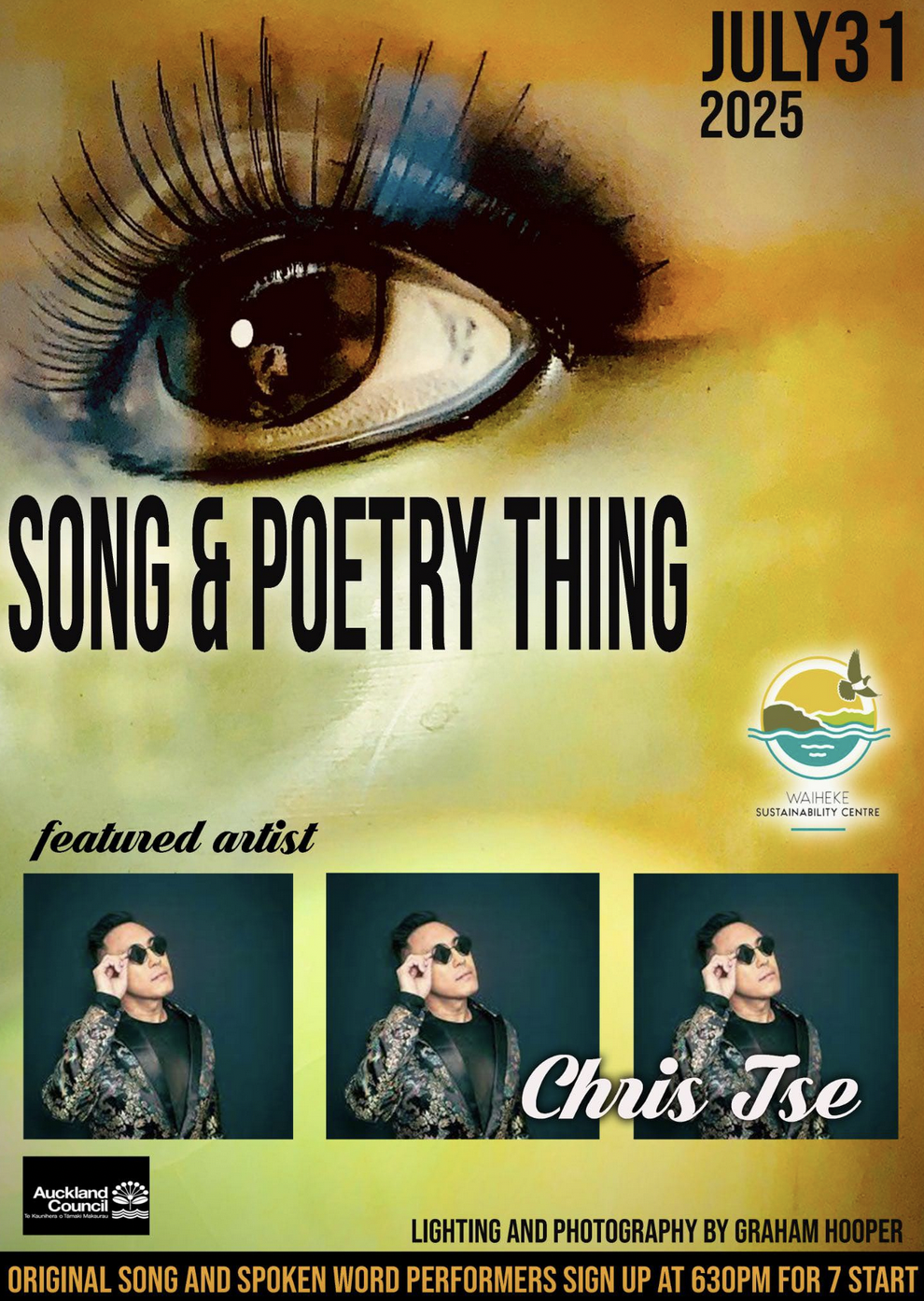
Chris Tse is thrilled to be performing as guest poet at two long-running poetry events in Tāmaki Makaurau at the end of July. These will be some of his last events during his term as Poet Laureate. Looking forward to hearing from local poets at the open mic section of both events!
there’s no gravity around u I am loose threads and concern floating in your wake everything weightless when u speak a song echoing deserted corridors
something’s wrong can taste it in the air yet nothing phases u like you’ve read the last page of our lives already
the stars watch as everything breaks apart money and promise reborn as wreckage but I been filling them long nights with thoughts like maybe this is a heaven knowing your fate so certain and to be adored even for a breath as close to god as any sane person gets
sharing the last of our oxygen we drift out together beyond the imaginations and dreams of everyone we ever loved
Dominic Hoey
Dominic Hoey is a poet and novelist trying to write love poems in late stage capitalism.
What if I made up a poem about a house on a hill with views of the sea and passionfruit vines laden, and a woman knitting stories of family connections and sublime epiphanies into socks and scarves and comfort blankets with an abundance of vegetables in garden plots and fruit on the trees and soup simmering whatever the season and how she is always content in her own company but one day she opens a newspaper and it is full of war and plague and bullies and hunger and racism and side-lined histories and abusive relationships, underfunded hospitals and underfunded schools, and she looks at the olive-green sea and she smells
the tomato soup simmering the fresh basil aromatic in the air and she turns on her radio and hears the voice of a young Palestinian student begging the world to listen, begging for freedom for her people and how the relentless bombs trap everyone in houses and how aid can’t get through and how nowhere is safe and how everywhere is under attack, and the woman on the hill tries to imagine the terrified children, the lack of news and power and water, and how the catastrophe goes deep into roots and land and home, and how they cannot pray safely in mosques, and how when Palestinians resist they are terrorists and their resistance is deemed invalid, and the woman on the hill looks
at the patch of blue sky and the free-floating clouds and puts down her knitting with its happy stitching its loving connections and storytelling skeins and tells the olive-green sea that we are all human, and we all need to eat and feel safe, to stand on soil we call home, to speak our mother tongues, tell our grandparent stories, and to feel the depth and caress of peace
Paula Green 20 May 2021
Every Thursday in 2021 I wrote a poem, and now have a manuscript sitting in my drawer called ‘Thursday Poems’. I was flicking back to see what I had written in July but stalled on this one. It felt like I could have written it today. What has changed globally or locally? How have things improved in Aotearoa as the gap between the rich and the poor widens? Our environmental aims deteriorate? As the situation in Gaza is even worse? As peace in the Ukraine is elusive? I recently signed an open letter, along with other writers and publishers, calling for an immediate ceasefire that Mandy Hager organised. I would like to see an open letter addressed to our Coalition Government demanding to see how they will repair our country rather than damage it so cruelly. Nest year we will be voting.
The Anatomy of Sand, Mikaela Nyman Te Herenga Waka University Press, 2025
I often ask poets how what is going on in the world affects their writing, if not their ability to write. Their answers occupy myriad points on a spectrum, from writing as solace to writing as protest. Mikaela Nyman’s new collection, The Anatomy of Sand, draws our environmental relationships into view. It’s a version of holding up protest placards (and we are doing much of this on the streets) by using poetic forms to revisit human impacts upon nature, both good and bad. Mikaela draws upon many sources to furnish and advance her poetic spotlight: scientific research, Finnish myths, the work of other poets, artists, inventors, engineers.
The cover image is as haunting as the collection’s title. The enigmatic glass sculpture by Ellie Field, photographed on a beach setting, is open to multiple readings. I jot down words: fragility, sur-real, melancholy, intense mind and heart concentration. The image sets the title vibrating as the word and idea of “sand” explodes in multiple directions. Hmm. I am standing barefoot on the beauty of beach sand. I’m holding a sand timer wondering if time is running out, recalling the way sand slips through fingers, is dredged and transported elsewhere, is conserved by locals as a vital home for native birds under threat.
I read the first poem, ‘Lonely sailors’, and am again caught in a matrix of melancholy, enigma, physical and historical debris on a fragile shoreline. The final line sticks to me as I read the whole collection: ‘knowing // that we’re sailing too close / to the wind’. We are simply sailing too close to the wind and it hurts.
I shuffle back to the preface quotation by Rachel Carson from Silent Spring and it feels like a lifeline for us all: ‘In nature, nothing exists alone.’ And herein lies a reason to keep writing, to keep connecting, whether for solace or protest and everything in between. I add to that Margaret Mead’s declaration: “Never doubt that a small group of thoughtful, committed citizens can change the world. Indeed it is the only thing that ever has.” And I want to say, clearly and insistently, Mikaela’s precious book promotes the idea that poetry does not exist alone.
Poetry has the ability to be the glass sculpture on the beach, a prismatic form that might be personal, political, philosophical, elliptic, searching, intertextual, rich in narrative, surreal. Pick up the book. Move from the seed collectors to the tree planters, from the separation of metals to the disposal of milk on the land, from the ownership of sand to feeding on Hope Cafe’s sandwiches and leeching on hope. Circle around notions of balance, the sight of shoreline debris, prophesies in a gallery soundscape. Flick back to ‘Cilia’, and revisit the weight of the world, not just today, but across generations (Mormor means ‘mother’s mother’ in Swedish). How this glorious poem catches me:
Unable to heed the warning I carry the world’s worries on my hips. Too late
to tell Mormor I now understand what she was on about, why her hips were so wide you could spread one of her fine embroidered tablecloths over them and invite the whole neighbourhood for a feast.
Mikaela writes with a multi-toned pen, her lines delivering technical information alongside moments of awe, wonder, contemplation. Listen to her read below, listening to the shifting tones of ache and gentleness, jagged edge and lilt, the sonic flurry dancing in the ear, urgently. Oh so urgently. Perhaps we are all standing on the shoreline as we read, as we reconsider our actions and choices, yes absorbing beauty and life, but re-examining how to heal rather than damage the environment. Our environment. In reading this collection, we inhabit the poem, and then, with Mikaela’s visible signposts, we move beyond the poem, mindful of past present future, to the collective power to do and to hope. Thank you.
a reading
‘pear lizard plumage’
‘Mudlarking’
‘Of orfes and alder’
an interview
Were there any highlights, epiphanies, discoveries, challenges as you wrote this collection?This is your first book written in English – how was that?
Someone wise said “every poem is in search of a collection,” which may or may not be true. What is true, is that every poem that elicits a response from someone along the way gives me a boost and strengthens my resolve to stick with the more expansive project. I do become obsessed with certain issues, themes and observations, and tend to follow that enquiry to the end. Sometimes there’s a happy ending. At other times there is no end in sight, so I have to draw a line and say enough. What this means, is that some poems end up being closely linked – in theme, tone, place, imagery, format – as they emerged around the same time. Over time, however, when the focus shifts to new territory, older poems may feel obsolete, or they don’t quite fit in. Just because poems have been individually published or placed in competitions doesn’t mean they should automatically be included in a collection.
And then we have the whole problem of translation. Since I write in both English and Swedish, I play around with words a lot. I don’t always know if a poem sparked to life in English or Swedish. I waste a lot of time translating myself into the other language and back again, continuously polishing it. In the process something alters, it becomes a different beast. With The Anatomy of Sand, I was never sure how much of my own Nordic ancestry, history and mythology to include. Would it even be remotely interesting to anyone else? At one point, all the Nordic elements were taken out. Self-doubt is a constant companion.
I find moving between other languages can create such different music! Along with everything else.What matters when you are writing a poem? Or to rephrase, what do you want your poetry to do?
Each poem is its own contained world, it has to carry its own emotional truth. The aural quality of hearing a poem read out aloud, how the words roll off the tongue, the rhythm and sounds, and how it impacts the listener matter to me.
Are there particular poets that have sustained you, as you navigate poetry as both reader and writer?
I read widely, in several languages. Some of the poets that have sustained me over the past few years include Tua Forsström, Finland’s most celebrated contemporary poet. Like me, she also belongs to the linguistic Swedish minority. Her poetry can be dream-like and moody. Reading her makes me want to row out on a lake at night, light candles in the snow, and watch Andrei Tarkovsky films.
Swedish poet Tomas Tranströmer’s poems tracks the changes of seasons, using surprising word choices and imagery. His poems ooze with nature’s atmospheric beauty and a sense of mystery that fills me with wonder and awe when I read him.
Padraig O’Tuama’s podcast ‘Poetry Unbound’ has steadied my ship and kept me company when I wake up at dawn and wonder if the world is still intact. I’m grateful to Hinemoana Baker for putting me onto Padraig. Hinemoana’s Funkhaus is one of my favourite New Zealand poetry collections.
Ada Limón was the first Latina to be named Poet Laureate of the United States. I wonder how she is faring now… I love how she can pick up some mundane detail and turn it into something astonishing. The way she depicts human relationships with nature evokes an Oliverian sense of gratitude for being alive. I think we need that, more than ever.
We are living in hazardous and ruinous times. Can you name three things that give you joy and hope?
My family, nature, collaboration with generous creative human beings across all art disciplines.
And for me your book! And picking up on poets and filmmakers to return to (Tarkovsky and Limón) in interviews and the poetry books I am reading.
Mikaela Nyman is from the autonomous, demilitarised Åland Islands in Finland and lives in Taranaki. Her climate fiction novel SADO was published by Te Herenga Waka University Press in 2020. Her two poetry collections in Swedish were nominated for the Nordic Council Literature Prize in 2020 and 2024 respectively. Her second poetry collection, To get out of a riptide you must move sideways (Ellips), connects Taranaki and Finland and was awarded a literary prize in 2024 by the Swedish Literary Society (SLS) in Finland. In 2024, she was the Robert Burns Fellow.
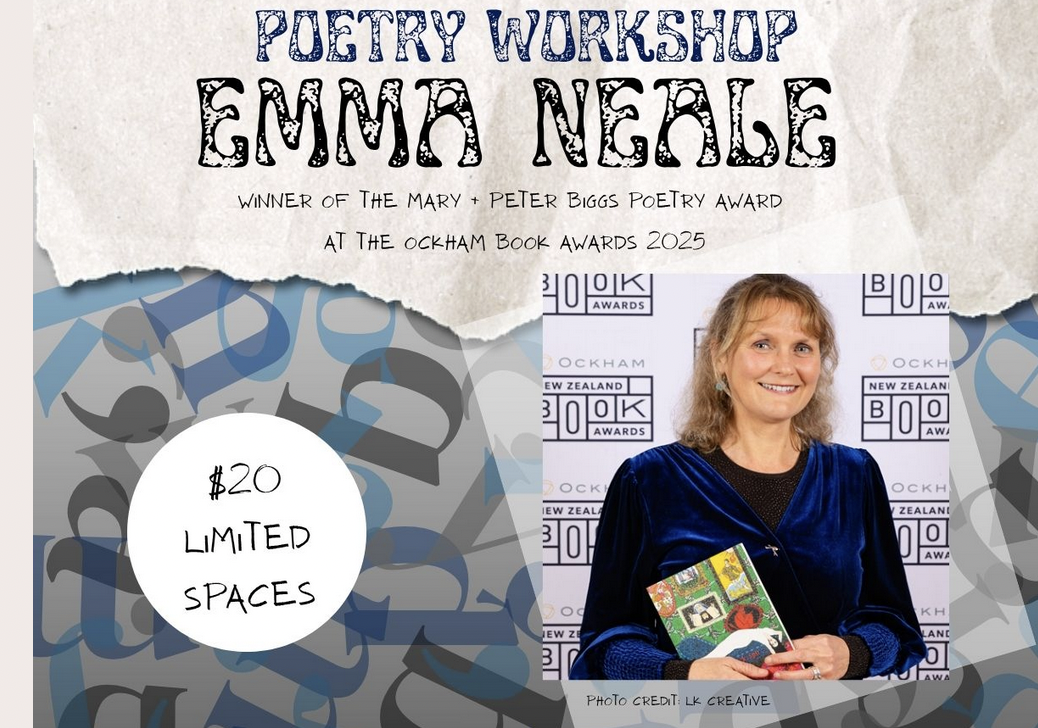
Brought to you by the Dan Davin Literary Foundation. Enhance your poetry writing skills with award-winning poet Emma Neale. Emma is the author of six novels, seven collections of poetry, and a collection of short stories. Her sixth novel, Billy Bird (2016) was short-listed for the Acorn Prize at the Ockham New Zealand Book Awards and long-listed for the Dublin International Literary Award. Emma has received several literary fellowships, residencies and awards, including the Lauris Edmond Memorial Award for a Distinguished Contribution to New Zealand Poetry 2020. Her latest poetry collection, Liar, Liar, Lick, Spit (Otago University Press) won the Peter and Mary Biggs Award for Poetry at the Ockham New Zealand Book Awards, 2025. The mother of two children, Emma lives in Ōtepoti/Dunedin, where she works as an editor.
Entry Details: $20.00 entry. Suitable for teens (15 year old and up) and adults. Limited spaces, book by Friday 22 August.
Dates/Times: 10am-12:30pm, Sunday 24 August
Location: Meeting Room, Invercargill Public Library
Here’s a placard Here’s a protest placard It’s so big you can see it from the moon It’s made of oceans mountains forest bush I can see it from my backdoor
I am squatting next to a small girl squatting next to an old woman squatting in the Gaza ruins
everything is ruined as far as we can see but we are looking at a tiny bud growing
If everyone gives it a drop of water it will survive, the old woman whispers
If everyone chooses peace it will grow, says the small girl
Paula Green from The Venetian Blind Poems, The Cuba Press, due August 2025
Mandy Hager has written an open letter calling for an immediate Gaza ceasefire. She was inspired by writers in UK and Ireland to create a similar letter and collect signatures from other writers and publishers. She writes: “In May 2025, 380 UK and Irish writers signed an open letter calling for an end to this. They have kindly allowed me to use their wording, which, in turn, was adapted from a similar open letter drafted by France’s writers.”
“We refuse to be a public of bystander-approvers. This is not only about our common humanity and all human rights; this is about our moral fitness as the writers of our time, which diminishes with every day we refuse to speak out and denounce this crime.”
Please note, if you can’t access comments for some reason, you can email Mandy and she will add your name: mandy@mandyhager.com
The letter where you can add your name can be found here.
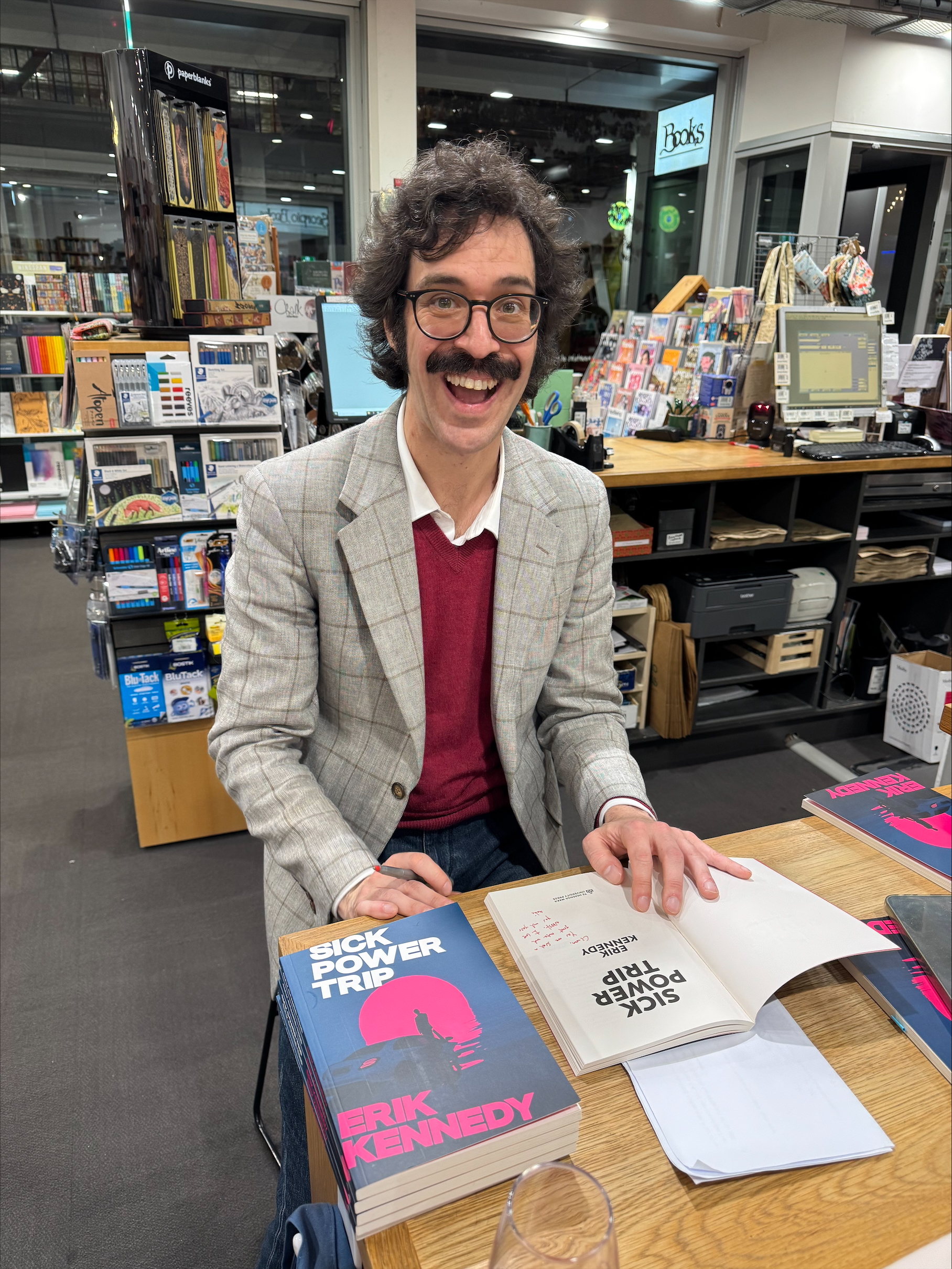
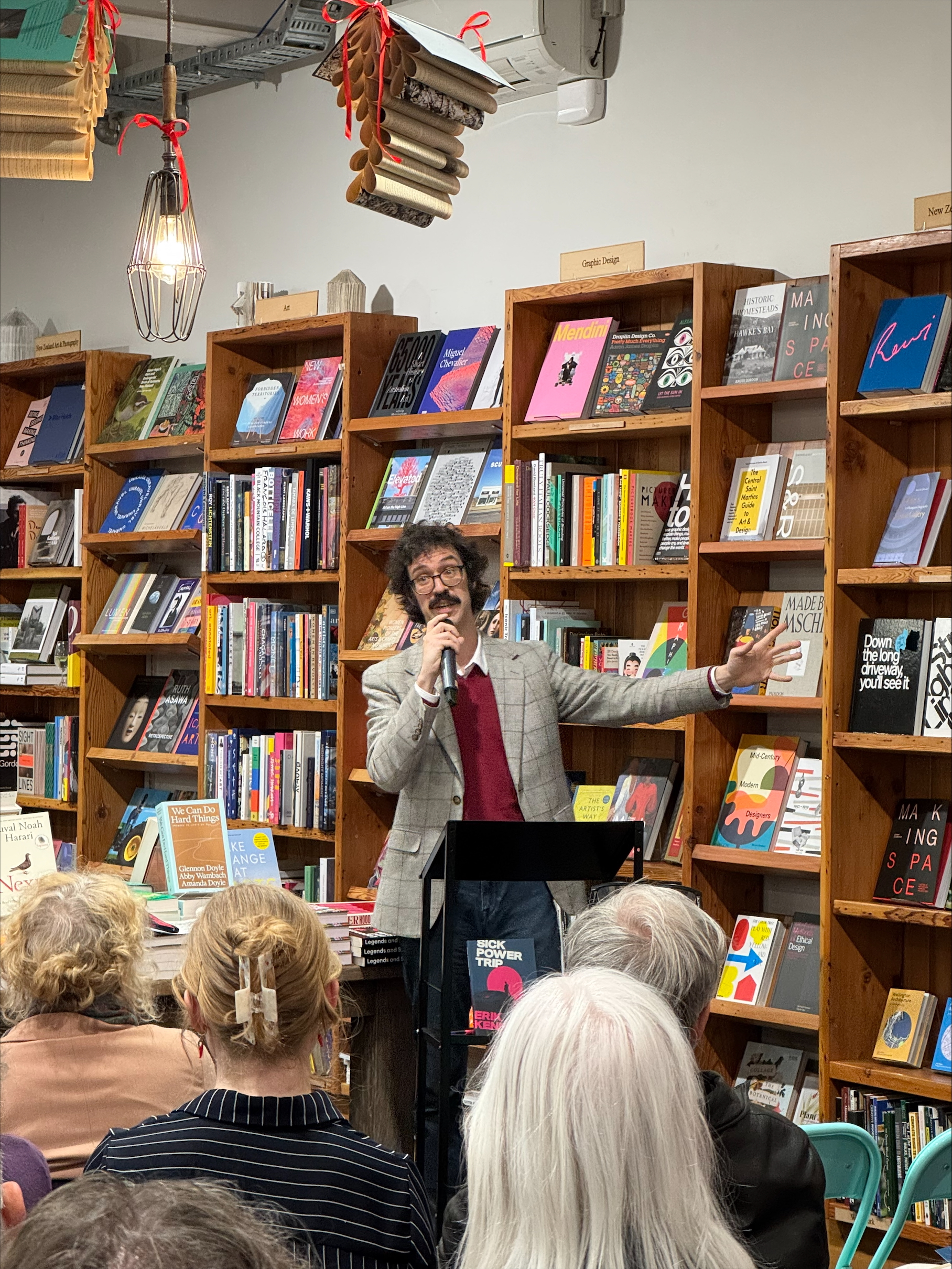
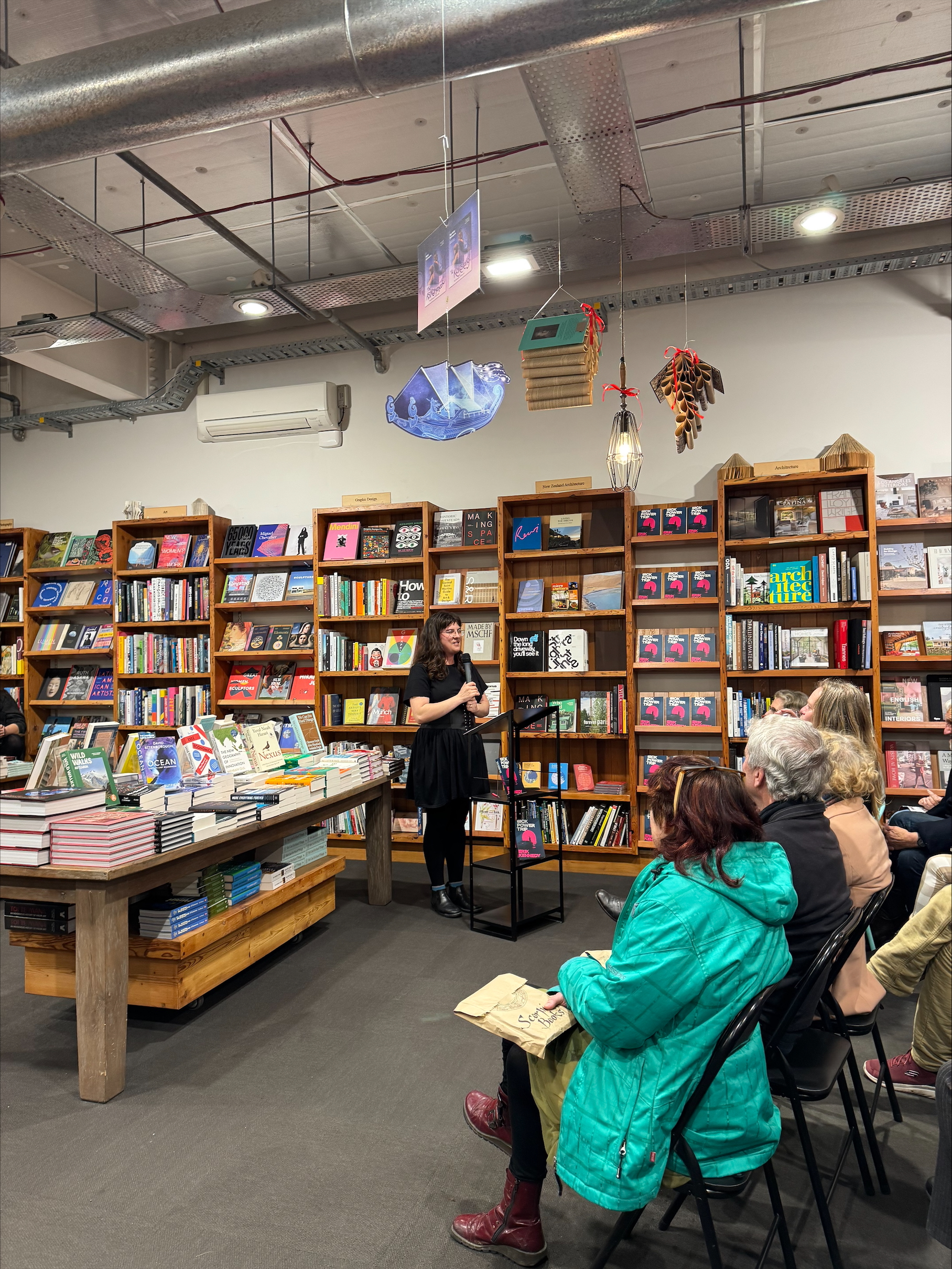
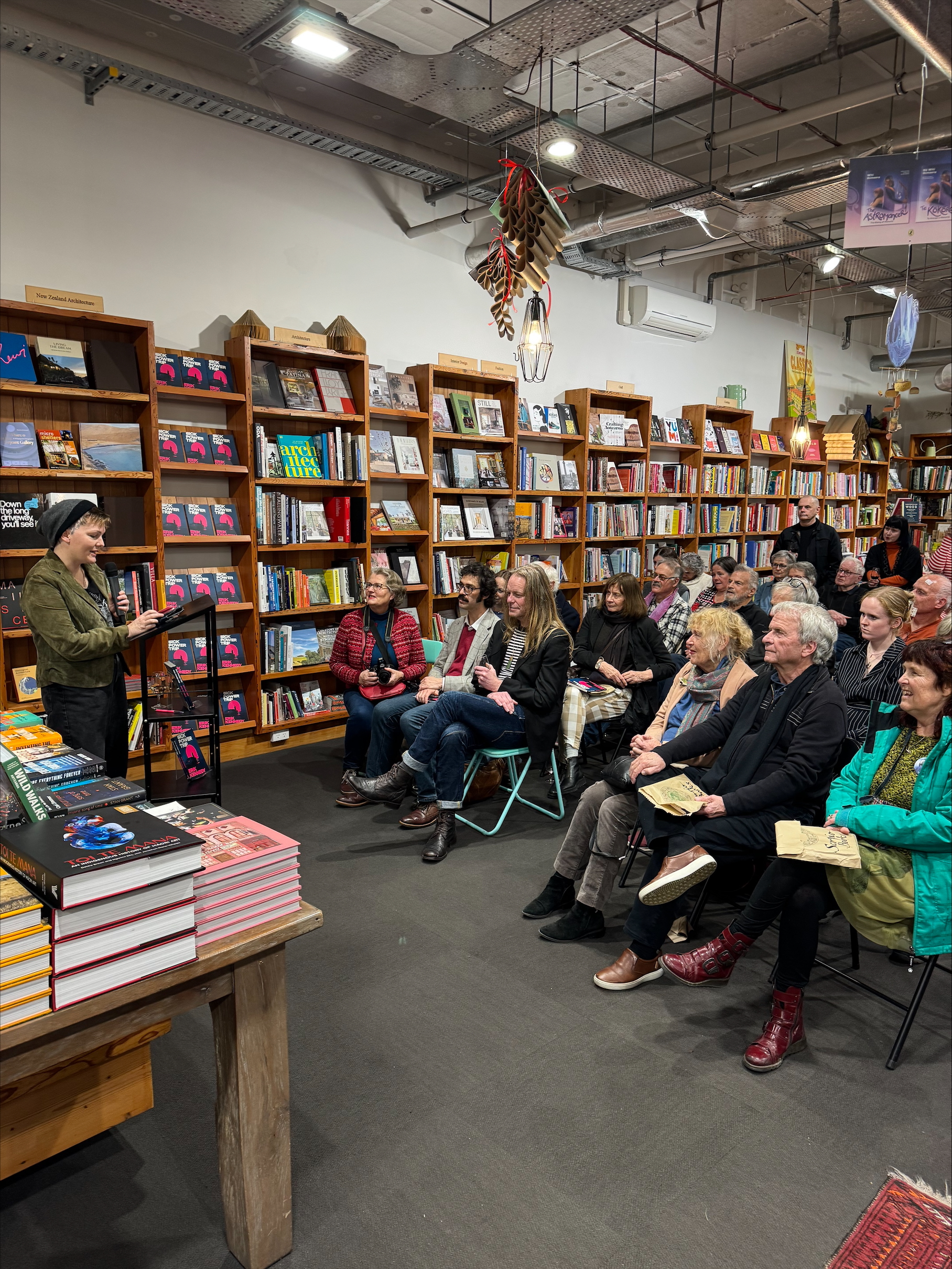
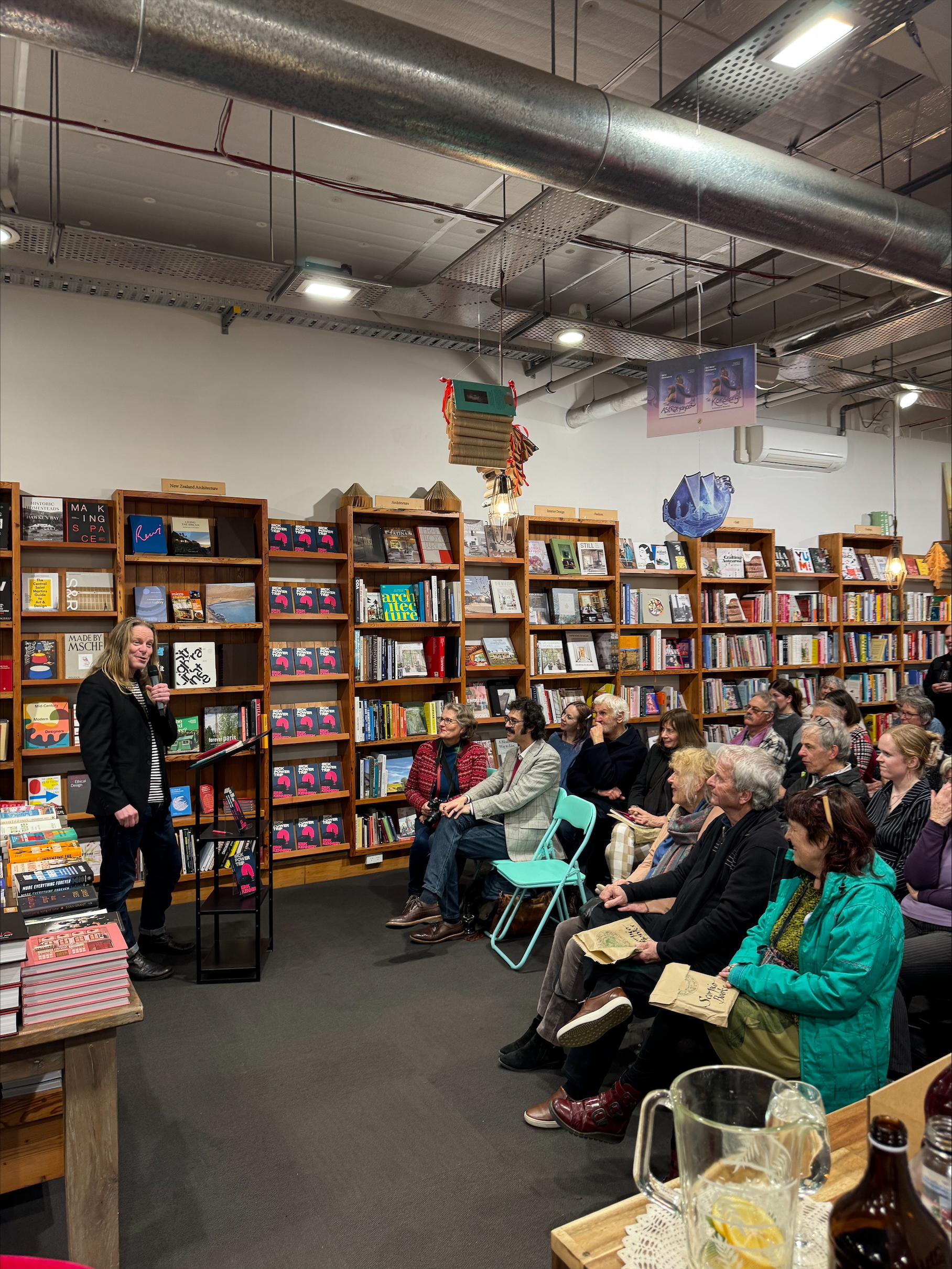
Sick Power Trip, Erik Kennedy, Te Herenga Waka University Press, 2025 (photos courtesy of Scorpio Books)
Tēnā koutou katoa. Ki ngā mate, haere, haere, haere atu rā. E mihi ana ki te iwi e tau nei, Ngāi Tūāhuriri, tēnā koutou. Ki a tātou e tau nei, kia ora koutou. Nō Mīere me Ingarangi ōku tīpuna. Kei te noho au ki Ōtautahi. Kei kaituhituhi ahau e mahi ana. Ko Claudia Herz Jardine tōku ingoa. Tēnā koutou katoa.
Hello, everyone. Thank you for coming. A caveat that these things aren’t expressed so gracefully in reo Pākehā; with my opening remarks I acknowledge the deceased, notably the poet John Allison; I recognise Ngāi Tūāhuriri, our local iwi and tangata whenua; I welcome you all here, in Scorpio Books, to this celebration of Erik Kennedy’s pukapuka Sick Power Trip.
My name is Claudia Herz Jardine. My ancestors, like Erik’s, came from far away- and, also like Erik, I call Ōtautahi Christchurch home and am prepared to defend it from further environmental assault with my life, my poems and my needle-nose pliers.
The first image of Sick Power Trip that wedged itself in my head was the “absolute possibility engine”- a ferret on a leash as observed in the poem ‘Animals On Leads’. At the time, my brother-in-law had his girlfriend’s dearly beloved and deceased pet ferret in his freezer as they waited for the cost of taxidermy to go down – this going down in price could be enabled by free market conditions, or the death of another ferret i.e. taxidermy at a quantity discount. All the ferrets in my life were distinctly lacking in possibilities, and then Erik came along to our critical writing group with his poem. I didn’t have much critical feedback for Erik- I only recall scrawling, “love ‘the energy of a ten-man brawl in a two-man toilet’.” A phrase that feels like it has the same amount of plosive consonants as a ferret should have claws.
Many months later Erik mentioned he had a manuscript ready. He emailed it to me. I made approximately five suggestions. My email sign-off was: “It’s a stacked deck! A pack of heavyweights! An all-star team!!” This ratio of suggestions to compliments bodes well for Erik. I read it all in one sitting, and by standing before you all tonight, I declare that me and my poetic sensibilities were wholeheartedly entertained and intrigued by this book.
To make some hazy, summative stabs at the book now, Sick Power Trip is a sort of wealth redistribution weathervane. The poems in this book, together, seem to say- if you have THIS much money, can you please do the decent thing and use it to make THESE lives better? Though the poems are stacked with ‘I’ statements, the ‘I’ is always asking; why aren’t we kinder to each other? Why do the people with the most get away with caring about others the least?
We live in an age in which any possible friction in our daily lives is viewed by Big Tech Companies as a money-maker. We have computers in our hands, a supermarket monopoly willing to visit us at home, and apps that write small talk and argumentative rebuttals for us. The narrator of ‘Individualistic Societies’ (page 11) states: “I fixed every problem I ever had until I couldn’t, at which point I became the problem.” For as long as we are encouraged to remove friction from our lives by paying money, the environment and its indigenous populations will be exploited. Skip ahead to page 93, ‘Someone Put an Ancient Burial Ground Right Where a Hotel Needs to Go,’ and an archaeological worker has a vision of excavated bones filling the city- “One day this project will be done and the building that even / its designer’s mother doesn’t love will spend its seasons here… What is allowed to endure is sometimes a second-choice thing / and the ones choosing are as likely to be thinking about the weather / as the future. Is it going to rain? Is the smart oven set?”
Yes, these poems are fringed with scathing, cynical Erik-ness. They also serve as an untraditional curriculum vitae for why, in the end times, Erik Kennedy will be on the shortlist for holding the newly-designed flag while jumping up and down on top of the bunkers as we sweep through Central Otago, shelling billionaires from their boltholes. This will be a pointy time, and unlike the narrator of ‘Notes Towards a Theory of Fun’ (page 50), no one will be getting arrested for kidnapping fossil fuel executives and shouting (quote) “Imma rubber-band this motherfucker up like a bunch of kale.”
Some notes on craft; Erik knows when to end a line, use an adverb, when to turn up the dial on the presence of the narrator and how to get out of the way. Erik and I share a love of whittling the pointy end of the poem first and then making the grip as comfortable as we see fit. So, watch as he casually wraps serious themes in humour to make the weight a little easier to bear- you could “die in a hail of 5-inch shells / or mild social disapproval,” you were either “raised by scorpions,” or you can care about the people of Gaza, you can be sad and lonely, or you can get involved in your local dogging group- just get out there and network!
Importantly, these are poems about thinking and caring. Erik cares about us. Erik cares about all animals. Erik cares about the planet. And Erik, in his day-to-day ways, turns up for other poets and throws his support behind our scene. When Erik had long Covid and stayed home, we missed him, and it was nice of him to invent the word “wonkening” while he was away.
Thank you all for listening to my speech. Congratulations, Erik, on another fantastic volume of poems. Can we all give him a big round of applause?
A warm thank you to Te Herenga Waka University Press and our speakers for this evening – and please join me again in congratulating Erik Kennedy.
I leave aside for the moment Ms. Kael’s incessant but special use of words many critics use a lot: “we,” “you,” “they,” “some people”; “needs,” “feel,” “know,” “ought”—as well as her two most characteristic grammatical constructions: “so/that” or “such/that,” used not as a mode of explication or comparison (as in, e.g., he was so lonely that he wept), but as an entirely new hype connective between two unrelated or unformulated thoughts; and her unprecedented use, many times per page and to new purposes, of the mock rhetorical question and the question mark.
— Renata Adler, ‘The Perils of Pauline’
How to escape the chains of your grammatical character? The consequence imposed by hypotaxes? Subjection of subordinate clauses, the clutter of your articles? The lockbox of your vocabulary? How, in short, to lose a voice? By panelbeating or careful dismantling? Shouting till you’re hoarse, unpunctuation, lack of closure? By repetitive exercise of neglected syntactic muscle? Systematic sensual derangement? Artificial flower arrangement? The taking of assignments? Pressure of confinement? Realignment? Rhythmic shift? Power lift? Urban grift? Country manners, superscript?High tone? Low diction? Fragmentation? Ornament? Scatology? X, or Execration? Crack up, crack down, abstinence or incontinence? Common sense? The other five senses? Firepower, slow burn, formal feeling, fast churn? Wind up, wind down, window on the world, windward wend your weary way back home or stay afloat — unmoored adrift and all alone? Rhetorical questions.
Chris Price
Chris Price is struggling to escape a voice it’s taken decades to make.





 NZ Poetry Shelf