I was licking the moon like a streetlamp before the water razed the city — people, jobs, lovers, I feel your movements glowing and reckoning with me. Some people say the loss I felt
with you was inevitable, a foregone conclusion, but I can still breathe the air around the dark shape of your body.
The life I’ve felt has been larger only than this tide; tonight, messages from family reach me, surreal, on my phone.
My cousins in Beirut can feel the terror in the air, I go on with so little left to speak; listen to my heart, these songs of loss I write while I cannot hear the bombs.
Jackson McCarthy
Jackson McCarthy is a poet and musician from Auckland currently studying in Wellington. He is of mixed Māori and Lebanese descent. His work has been published in Ōrongohau | Best New Zealand Poems, Landfall, Starling, The Spinoff, and elsewhere, and he currently serves as an editor at Symposia. You can read more of his work here.
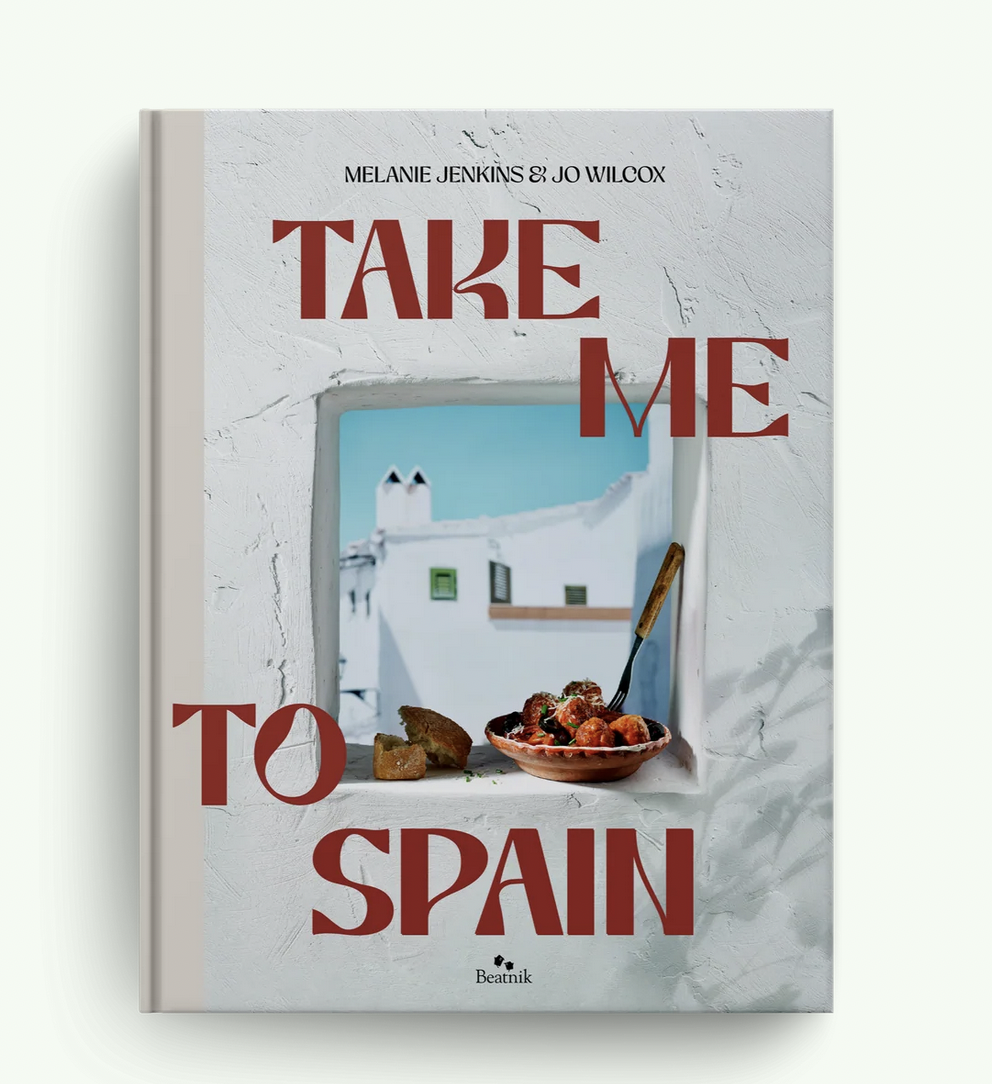
Take Me to Spain, by Melanie Jenkins and Jo Wilcox Beatnik Press, 2025
Food is a vital part of my day: harvesting, planning, cooking, nourishing, sharing. Food is also a significant delight when I travel, a way of drawing closer to a place My last trip to Spain was with my family, a week in Barcelona savouring mouthfuls of food, art and architecture. I stored tastes in my mental kitchen, wanting to recreate versions back home.
Cookbooks are a vital part of my cooking – I have a library of cookbooks, across cuisines, ingredients, proteins, from home-style cooks to celebrity chefs, and everything in between. Flicking through a good cookbook, I will be attracted by a sense of freshness, herbs and spices, tradition and innovation, simplicity and complexity, satisfying taste combos, and that all important marriage of comfort and delight.
Sometimes I reproduce a recipe exactly, but I often use it as springboard. I am often reminded of the link between me as cook and me as poet. You make a poem your own, just as you make a recipe your own!
Take Me to Spain by Melanie Jenkins (photographer) and Jo Wilcox (writer and food stylist) is a culinary delight. When Melanie travelled to Spain for an exhibition of her contemporary fine-art photography, her husband was unable to go, so she went with her friend Claudia. Back home, Jo was so infected by their Spanish stories, she set out to recreate a culinary version of their travel experiences . . . researching and cooking and sharing food! Melanie and Jo worked together to produce a book that does indeed take me back to Spain.
Melanie’s photographs catch the dishes so beautifully, my mouth is watering, but she also evokes the Spanish setting with her on-location photographs. I am soaking up the blue sky, the terracotta roofs, the white-washed buildings. Perfect!
A number of my favourite ingredients make an appearance: paprika, saffron, fresh dill, rocket, spinach, honey, olive oil, fish. Yep this book ticks all my boxes so it is time to get cooking! I carefully follow a number of recipes with terrific results – and I also use some as creative launchpads.
Here is a sampling of some of the dishes I have cooked and shared with my family.
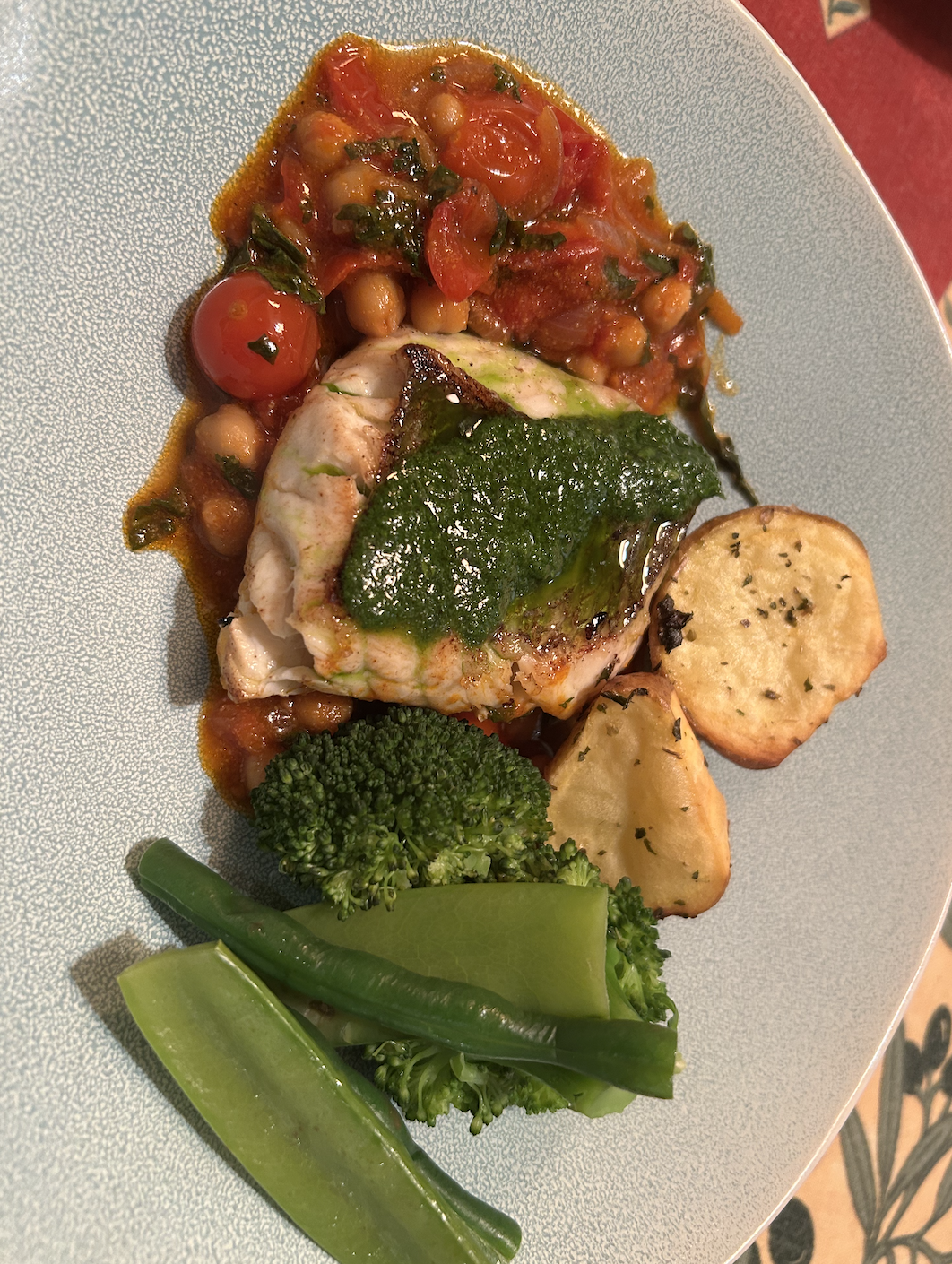
‘Crispy skinned fish with smoky chickpeas & lime & herb oil’. Super tasty, super harmonious, with spinach, dill and parsley from the garden, it’s a family hit.
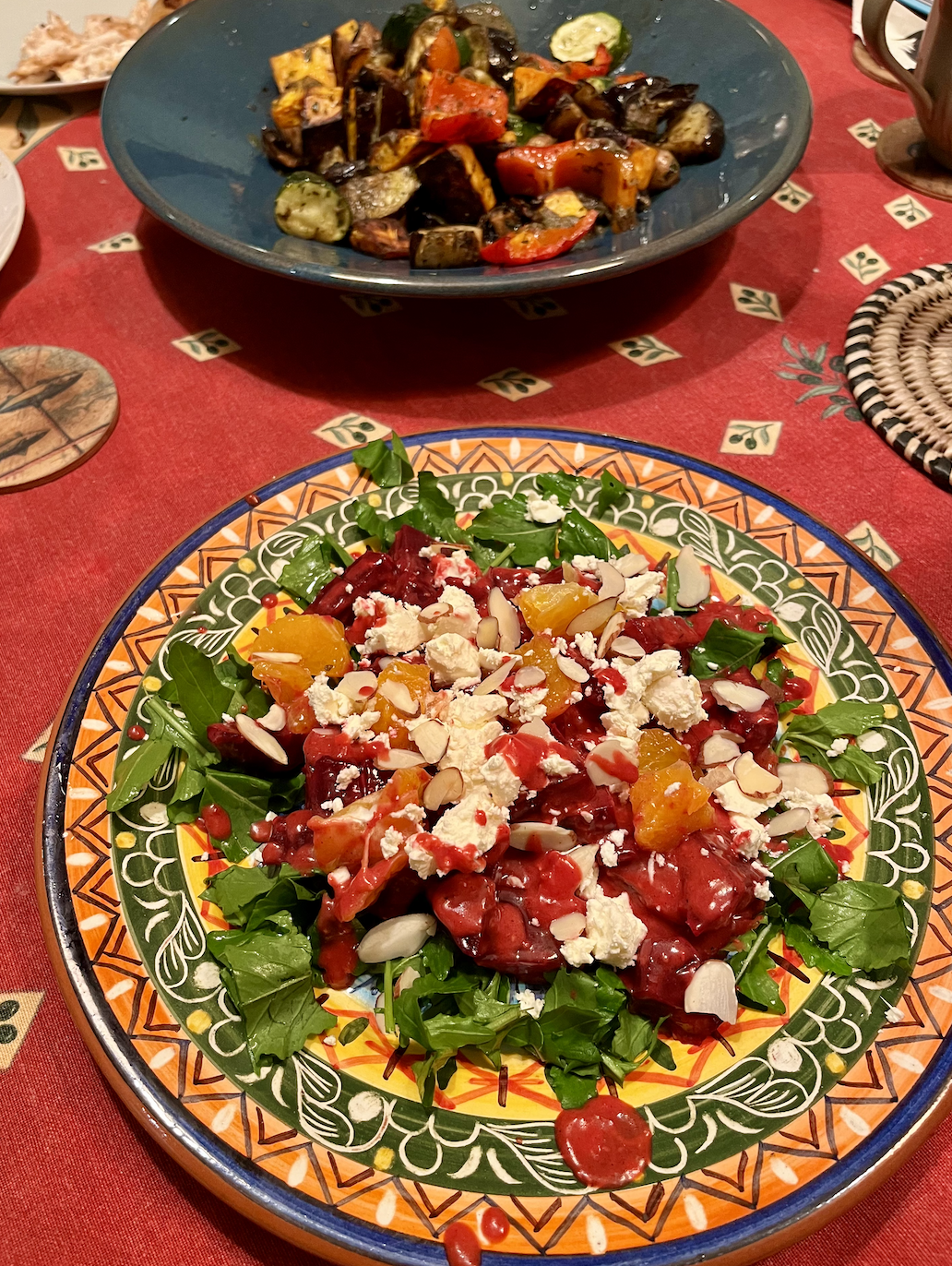
Two supremo salads. ‘Grilled vegetable salad with crushed olive dressing’. The kind of recipe you can adapt to fit what is in your fridge or cupboard or garden. So I used zucchini, eggplant, mushrooms, red peppers – and fresh garden rocket. Loved the dressing. No sherry vinegar so I tried cider vinegar with a splash of honey. Yum!! Also made ‘Roasted beetroot & orange salad with a berry dressing’. It’s winter so I used nz mandarins instead of imported oranges, and thawed some organic raspberries for the dressing.
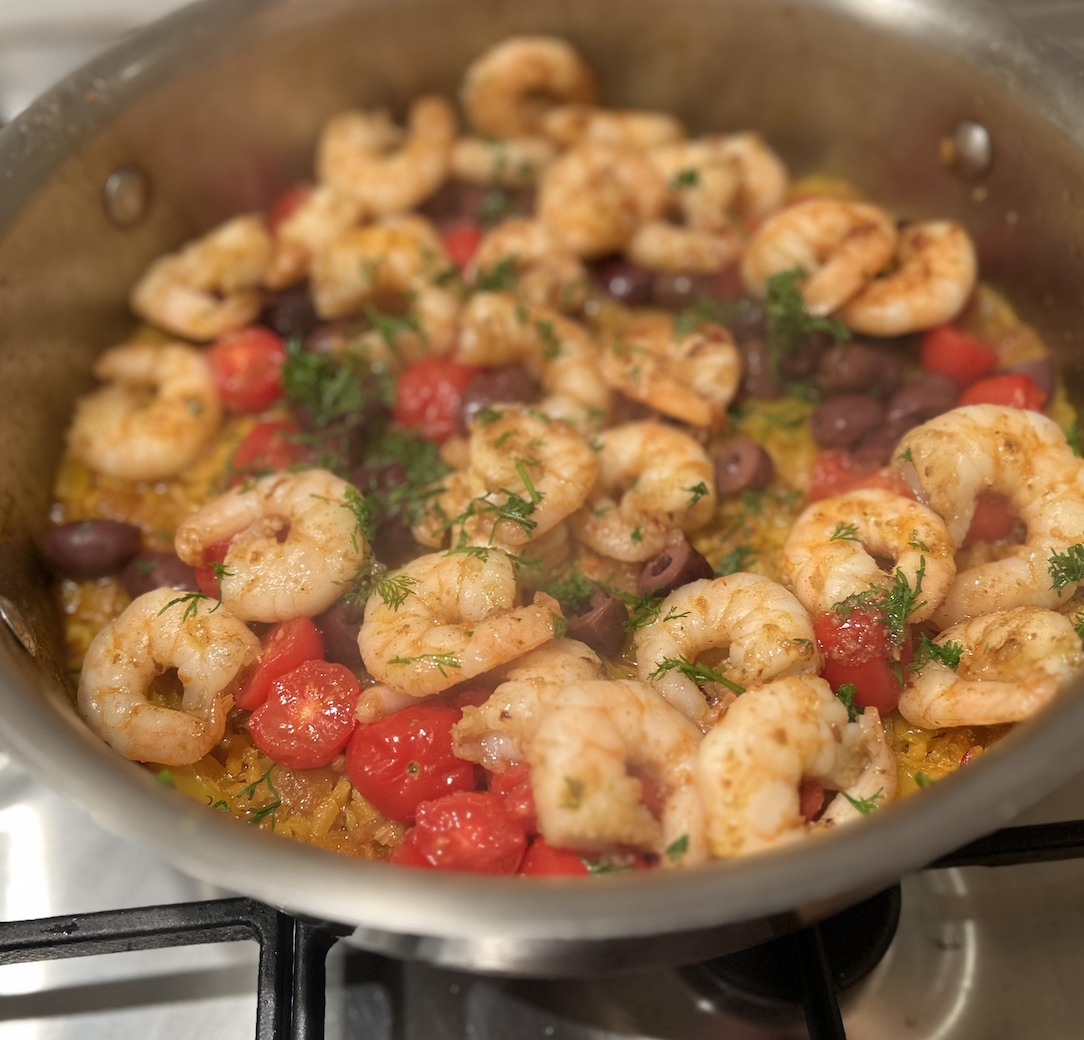
Another night I used the paella recipe as a launchpad, partly because I can’t use a BBQ at the moment, and also because I only had prawns on hand. I made a paella, with the divine presence of saffron and paprika, scattered over some baby tomatoes and halved black olives, then side-stepped and sautéed the prawns quickly in rose-harissa paste and tossed them on top with a good handful of chopped dill. Excuse the steamy photo!
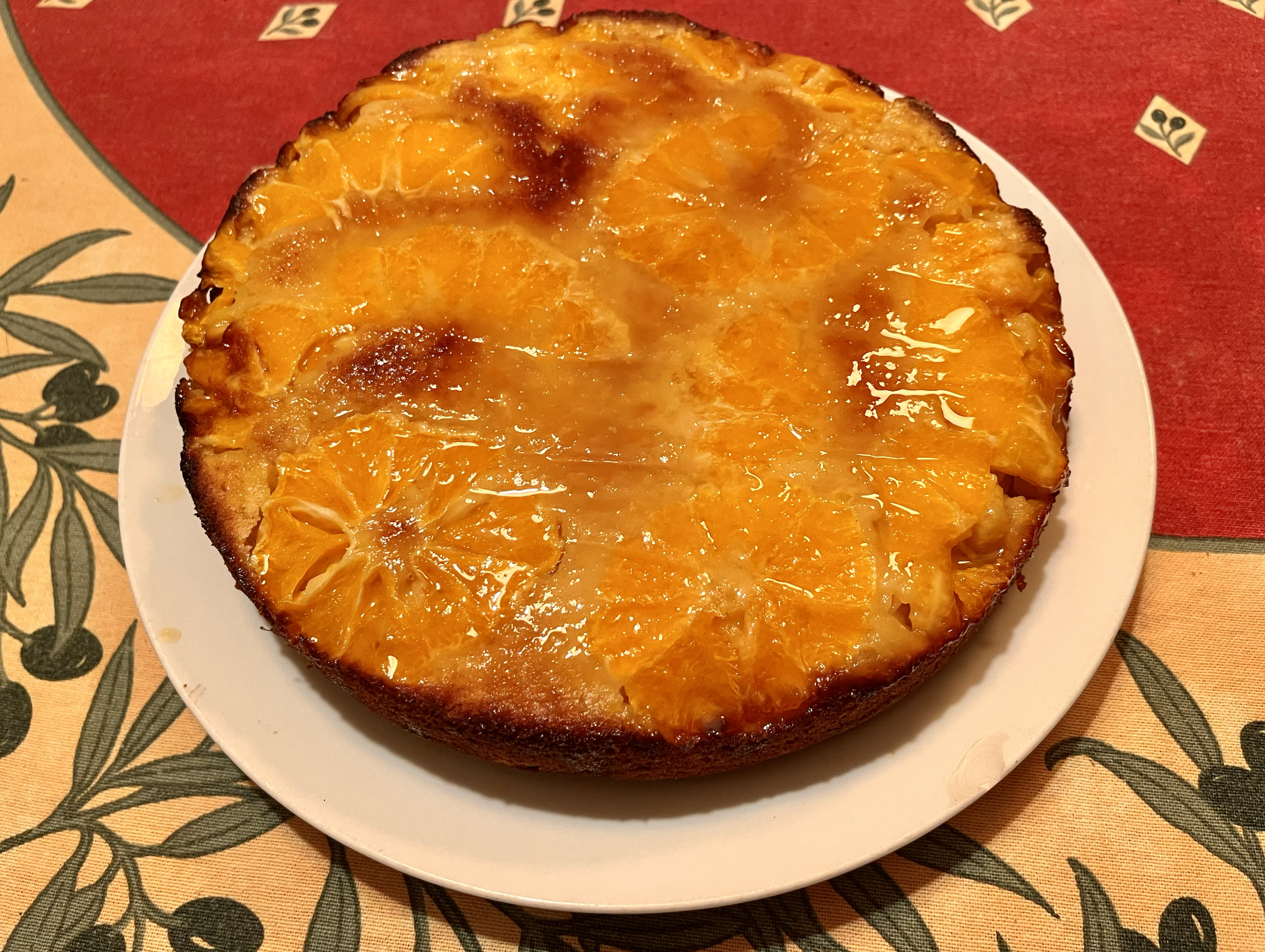
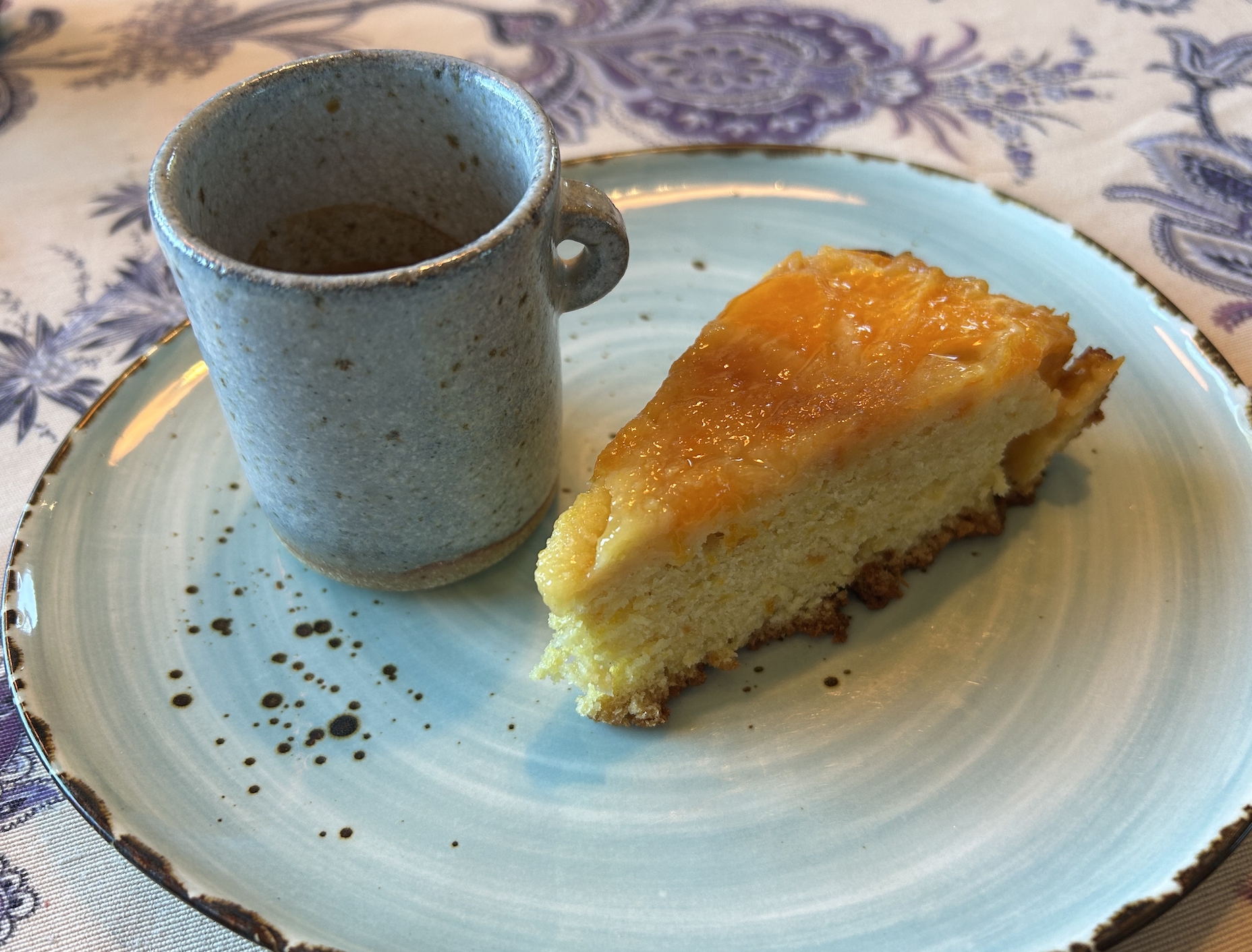
Finally, ‘Boiled orange & olive oil cake’. Wow! This is absolutely stunning. I put mandarins on the top as they are more flavoursome at the moment. Easy to make, easy to eat, perfect to share with your family in the midst of a tough week!!! The next day, with a short black it is extra yum.
So YES! This gorgeous book me right back to Spain. The recipes are easy to use and easy to adapt! But my Spanish travels are not yet over. This week I aim to cook: ‘Smoked fish cakes with creamy feta dressing’, ‘Potato and zucchini tart’, ‘Mushrooms stuffed with ricotta and pinenuts’.
I highly recommend this cookbook as a way of vacationing in Spain within the comfort of your own kitchen, whatever the season! I think I have a Spanish poem simmering!
MELANIE JENKINS is an acclaimed photographer known for her ability to capture the essence of culture and cuisine through her lens. Her passion for storytelling has taken her around the globe, and her fine art photography has been featured in exhibitions and publications internationally. Take Me to Spain is a deeply personal project, inspired by her travels to Spain and her love for vibrant, authentic experiences.
JO WILCOX is a celebrated food writer and stylist with a career spanning decades in the culinary world. From crafting recipes for top publications to cooking for royalty, Jo’s expertise lies in creating dishes that are both approachable and full of flavour. Her passion for fresh ingredients and the art of sharing meals shines through in this collaboration with Melanie, blending photography and recipes into a feast for the senses.
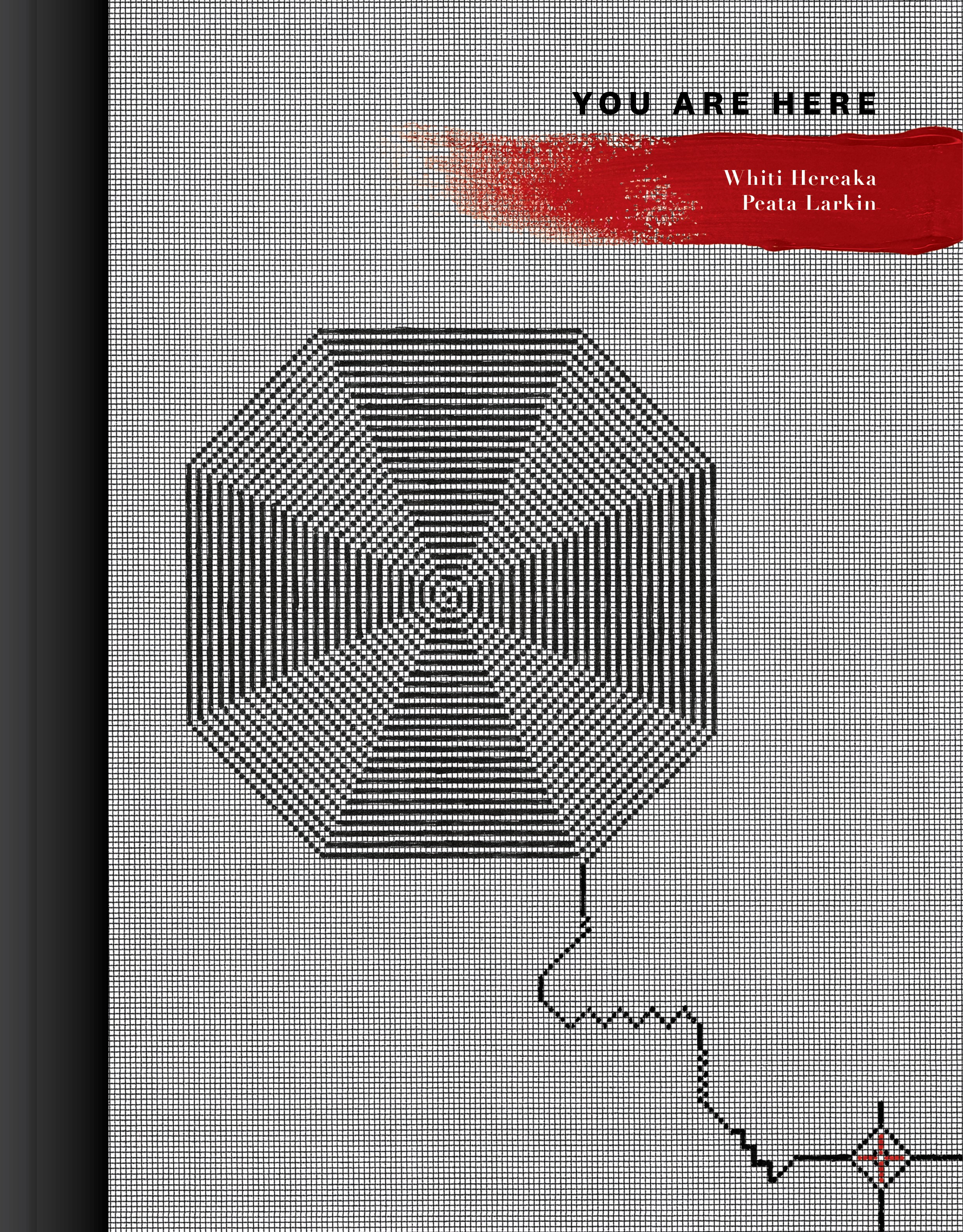
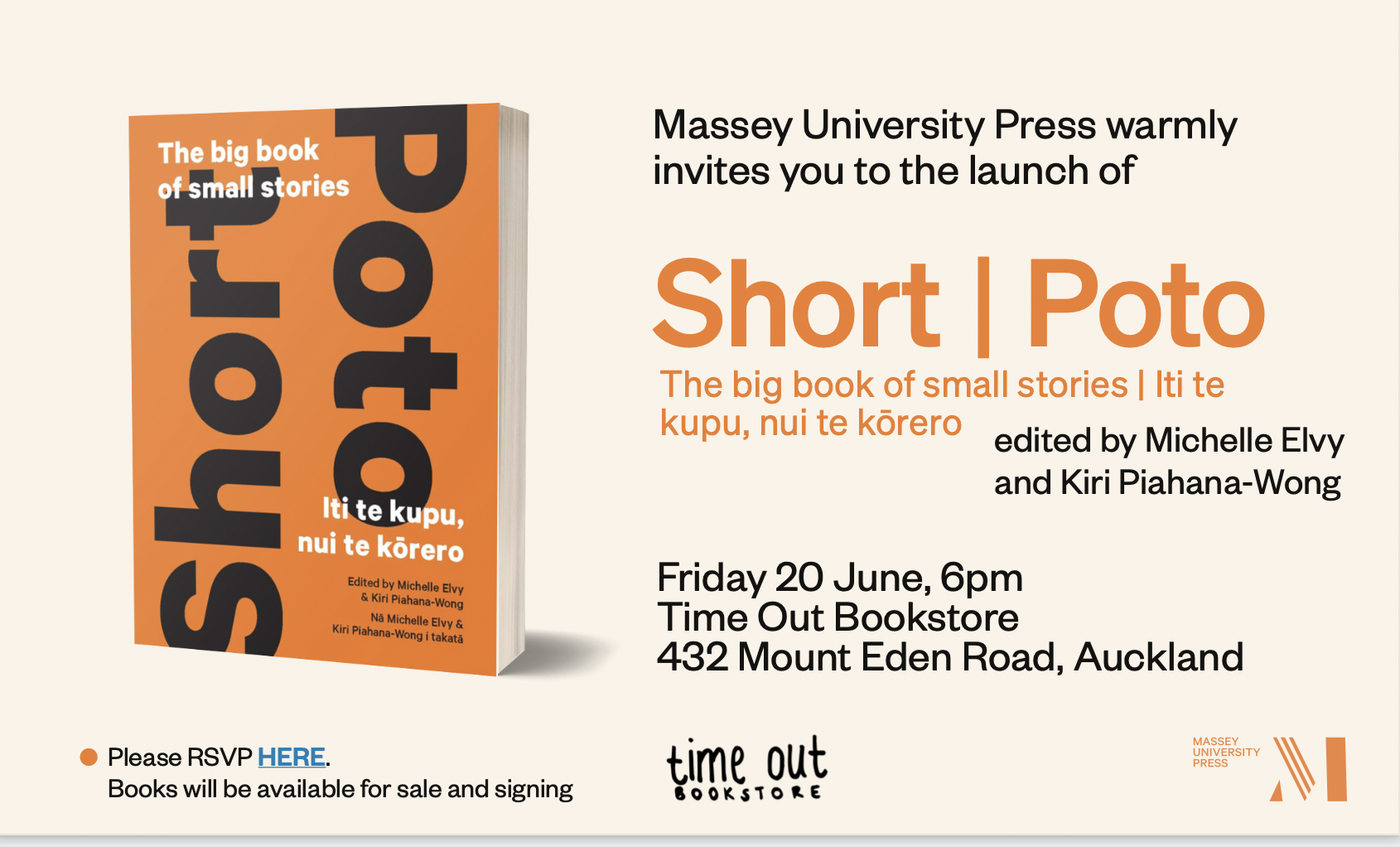
You Are Here, Whiti Hereaka and Peata Larkin Massey University Press, 2025
The map of your mind can be redrawn; there is no need to keep to the narrows of an old-world view. You can be expansive. You can make new pathways; you can broaden the old ones you already have. You can delight in the kupu shaping your mouth, the physicality of language: tongue and teeth and breath and throat. You hope that one day you will connect it all: sight, sound, meaning.
Whiti Hereaka
Massey University Press’s kōrero project invites collaborations “between two different kinds of artistic intelligence to work away at a shared topic”. You Are Here , by author Whiti Hereaka and artist Peata Larkin, is the sixth volume in the terrific series.
In her endnote, Whiti talks abut their shared topic, the Fibonacci sequence – how the book adopts a spiral structure, and how she has been drawn to the spiral as a way of creating stories. She muses upon the influence of DNA and the double helix on Peata’s earlier work, and lingers over patterns in both tāniko and whakairo. She embraces te takarangi the double spiral’s shape, and the unfurling connections between knowledge and wairua.
And here we are as reader, here, at a resonant starting point, in this beautifully designed book, ready to enter a spiralness of reading, with a fecundity of movement, exposures, insight. I think of here as a pivot and then find myself likening it to home, to home as a fulcrum: a physical location, state of mind, an intellectual axis. Think of the way tendrils reach out from here, drawing upon past present future, feeding upon epiphany and challenge.
I am entering the infectious spiral of Whiti’s writing and it is to enter an opening of self, with room for anxiety, doubt, with fragility alongside recognition, navigation and strength. There is so much to draw close to in this unfurling spiral: the way the bone of telling is fleshed out with experience, contemplation, questioning. How we might depart from here, but how here may never leave us. And how an opening of self might be personal but it might also be political. How, for example, the children punished in an education system that privileged one language, one knowledge, one limiting set of customs, are speaking here. How you can be both a stranger and estranged with feet in your own soil, upon your own land.
What draws me deep into the heart, and yes this writing is heart fuelled, is a primacy of connections, recognitions, feelings, expansions, mappings. Begin with the bloodline connections between Whiti and Peata, the two cousins, the writer and the artist.
Breath. A recurring motif. We will breathe in. We will breathe out. We will pause and find multiple ways to absorb and travel through the book. Breath a fundamental ingredient as we read and write.
In her endnote, Peata reveals her media: ink pens, a transparent medium and pure pigments, a lightbox, embroidered silk, acrylic paint. Her artworks, as captivating as the text, offer drawing as a form of navigation, embroidery, cross stitch, kinetic pattern making with multiple textures. It’s like a visual viewfinder with shifting settings that send me freewheeling down the diagonal and retracing the diamond. Glorious. Addictive. I am moving from honeycomb to marshmallow pink, from smudgy cloud to abstract mountain.
Why do I love this collaboration so much? I love its prismatic openness (is that such a thing?), its myriad relations enhancing myriad things, its ability to question, return, reclaim, expand bridges between here and here, to strengthen self-nourishment. In her endnote, Whiti invites us to create our own unfurling spiral (“by forming your thoughts into a group of three words, then five, then eight . . . “), so I did exactly that as the morning light lifted upon a world on the knife-edge of catastrophe. This gorgeous book, unfolding. This fragility, this strength, this succulence, this openness.
Unfurling
the morning fog onions pumpkin harissa ginger simmering there’s a new notebook in my miracle lap a pīwakawaka tūī bush soundtrack the dawning light
Paula Green 21 June 2025
Whiti Hereaka (Ngāti Tūwharetoa, Te Arawa) is a playwright, novelist, screenwriter and a barrister and solicitor. Her fourth novel, Kurangaituku, won the Jann Medlicott Acorn Prize for Fiction at the 2022 Ockham New Zealand Book Awards.
Peata Larkin (Ngāti Whakaue, Ngāti Tūwharetoa, and Ngāti Tuhourangi) graduated with a Master of Fine Art from RMIT, Melbourne, in 2009 and has a BFA from the Elam School of Fine Arts, University of Auckland.
Poetry Shelf reckons this is a must-support series of events – what a terrific set of readings and talks for those of us who love books of all genres.
Writers on Monday is back! The event is run by the International Institute of Modern Letters (IIML) in conjunction with Te Papa Tongarewa and Circa Theatre and is the perfect opportunity to warm up out of the winter weather by hearing some of our best and emerging writers.
Award-winning books and authors feature heavily in this year’s programme being held each Monday from 7 July to 29 September. Damien Wilkins, winner of the 2025 Jann Medlicott Acorn Prize for Fiction, will be joined by last year’s winner Emily Perkins to chat about his bestselling novel Delirious, which Newsroom declared “the book of the year’” in 2024. Michelle Rahurahu, fresh from winning the Hubert Church Prize for Fiction at the Ockham Book Awards, will be joined by fellow debut author Gina Butson to take us on a whirlwind tour of their novels Poorhara and The Stars are a Million Glittering Worlds.
Many of the authors in the programme are traveling from across New Zealand and even further afield. With Verb Wellington taking a pause on their readers and writers festival for 2025, Writers on Mondays co-ordinator Chris Price says the Monday events offer Wellingtonians a unique opportunity this year to hear literary stars discuss their work. “High-flying Wellington writers are in the spotlight alongside writers from across the motu and beyond: Nina Mingya Powles on a flying visit from London; Mikaela Nyman, fresh from her standout Auckland Writers Festival appearance, making the journey from Taranaki; and poet Nafanua Purcell Kersel traveling from Hawkes Bay. Several Auckland writers will also be in town for especially for the series.”
Randell Cottage Writer in Residence Saraid de Silva and journalist-turned-fiction-writer Michelle Duff will be in conversation with Tina Makereti to explore their stories about multi-generational women and how we excavate the past to inform the present. de Silva’s Amma has had international success, longlisted for the Women’s Prize, while another featured writer, Jennifer Trevelyan, has had huge international success with her debut novel A Beautiful Family. She caught the attention of a renowned literary agent who secured her a worldwide publishing deal and Allen & Unwin has published her book in NZ. Duncan Sarkies and Brannavan Gnanalingam will be in discussion about their new novels, and why political satire is more important than ever in current times.
Poetry offerings include Nick Ascroft hosting poets from his edition of Ōrongohau | Best New Zealand Poems in a reading, a conversation between Mikaela Nyman and Nafanua Purcell Kersel, and poet laureate Chris Tse talking to poets about how poetry might be reinvented. Anna Jackson, an Associate Professor at Te Herenga Waka—Victoria University of Wellington, will speak about her new collection of poetry which has been described as “extraordinary, in both concept and form”.
For a glimpse of the further talent soon to emerge from the IIML’s MA workshops, scriptwriting students will have their words brought to life in lunchtime performances at Circa Theatre, while the next wave of novelists, poets, and creative nonfiction writers will read in special evening events at Meow.
Writers on Mondays will run from 12.15—1.15 pm each Monday from 7 July to 29 September 2025 at Te Papa Tongarewa and Circa Theatre, with two special evening sessions at Meow. Admission is free and all are welcome. The series is supported by the Letteri family. The full programme can be viewed here. Come celebrate Aotearoa writers with us at Writers on Mondays – we look forward to seeing you there.
Jack Ross is the author of six poetry collections, four novels, and five books of short fiction, most recently Haunts (2024). He lives with his wife, crafter and art-writer Bronwyn Lloyd, in Mairangi Bay, on Auckland’s North Shore.
as our dead rise heading for the stars what if they get snagged on a satellite
will they be caught forever in a rotating purgatory-like state as if stuck on a glaring
disco-blaring merry-go-round that no-one can get off what if they land on the celestial star-link waka –
this is a genuine concern
i imagine a static-y incoming msg from my mum trying to give me her beauty tips
but they’d come in 90 mins apart fits & starts ////// don’t ////// for ///// get
your ////// lip ///// ////// stick ///// and //// re///// member lux//// soap ///// ponds
dry ///// skin //// cream ///// after ///// rins //// ing with ///// cold ///// water
i think i’d prefer ‘te huka mate’ were offline most of the time
Ariana Tikao
The first of the stars
Ask the wind why it howls Ask the storm cloud why it thunders Ask the Living Earthly Things why do they seek shelter from the lashing rains
Little Brother he will answer ‘Kua riri au ki ōku tuākana!’ I am angry with my brothers
You know how brothers are Sometimes they fight like only brothers fight With terrible ferocity
Ask Little Brother ‘He aha koe i riri ai?’ Why are you angry?
Little Brother he will answer ‘Kua hīanga rātou i tō mātou matua Kua hiki atu ki te pōuri kei runga’ They have betrayed our father lifting him to the gloomy darkness above
So Little Brother rages even as his mother weeps and all his brothers fall before him All except one
Ben Brown 2025
Puaka
Set in the blackness of space your glare is a whisper, a glimmer, a sliver, your gleam a loosened feather of flame,
your light a phantasmagorical ghost to haunt our fire-eating solar system through light years that in earthly time measures
four and a half centuries before your light and fire finally makes land as a pre-dawn solitaire
diamond nestled bright in a cushion of dark velvet sky above my door, your gleam as factual
as science, or time and far too real for myth or song alone. Puaka, you are family,
each winter rising again early in our southern sky to blaze blue, singular, easy to locate and kind enough to draw near
as we eat or pray or sing, your appearance so vast, your light so ancient, yet somehow, new and near and small enough to fit my eye.
Kay McKenzie Cooke
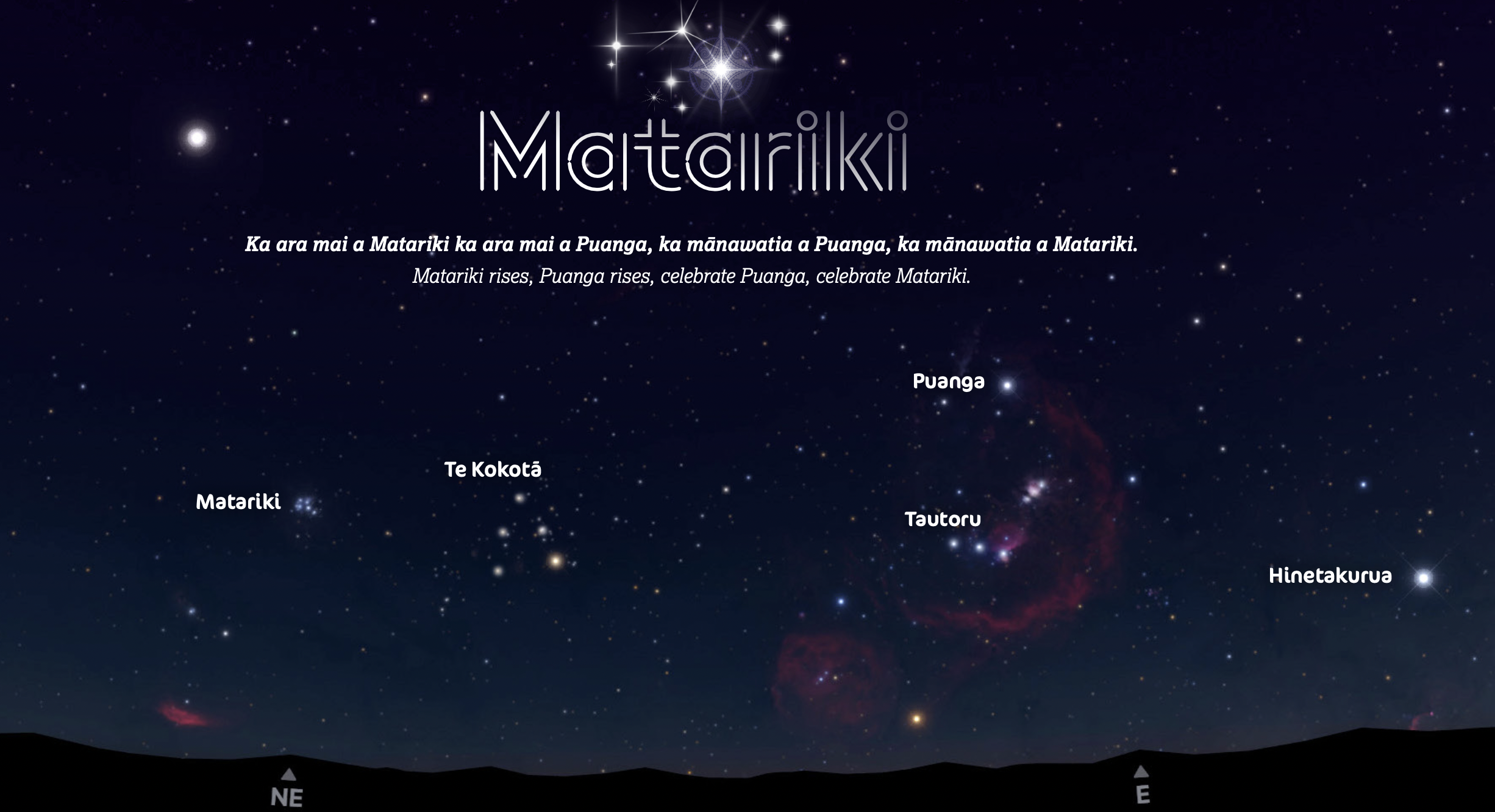
NOTE: Puaka (Puanga, sometimes Poaka) Rigel, is the star southern Māori iwi and hapū look to as a harbinger for the Matariki cluster. More information can be found here.
What the stars say
I hear bird bones crack, splinter. I hear offal slosh in a bucket.
Matariki have seen it all before — my star companions remain silent. Have they gone mad?
Yes, mad as a meat axe.
I hear gunshots at the growing wall, I hear laughter at cocktail hour out of mouths as wide as mako shark.
The bleached face of Sirius gives no clue, all are catching a ferry to the Isle of the Blessed.
My ageless self, trapped in a maimai — who knows how temporary?
It seems I am lasting forever, as long as stories repeat.
I blush and quiver to see myself related to this pale imitation of the gods.
Reihana Robinson from Auē Rona, Steele Roberts, 2012
The poets
Ariana Tikao is a Kāi Tahu writer, musician, and curator from Ōtautahi. She was a 2023 Ursula Bethell Writer in Residence at Canterbury University, and was awarded as a New Zealand Arts Laureate in 2020. She has co-written two books Mokorua (2022) and Te Rā: The Māori Sail (2023), and her first poetry collection Pepeha Portal will be published by Otago University Press in 2026.
Ben Brown (Ngāti Mahuta, Ngāti Koroki, Ngāti Paoa) writes children’s books, short stories and poetry for children and adults, general non-fiction, freelance articles and memoir. In 2006 he won Best Picture Book with artist/illustrator Helen Taylor in the NZ Post Children’s Book Awards with their book A Booming in the Night. His poetry has been published in various anthologies here and around the world and Radio NZ and The Radio Network have also recorded him. In 2011 he was the Maori Writer in Residence at the Michael King Writers Centre in Devonport Auckland. His poetry collection Between the kindling and the blaze was shortlisted in the 2014 Nga Kupu Ora Aotearoa Maori Book Awards. In 2021 he was appointed inaugural Te Awhi Rito New Zealand Children’s Reading Ambassador. He was the Te Kaipukahu University of Waikato Writer in Residence in 2024. He is also a father of two, which he considers his best work to date.
Kay McKenzie Cooke (Kāti Māmoe, Kāi Tahu) lives and writes in Ōtepoti. She is the author of four poetry collections. Her first poetry collection Feeding The Dogs won the Jessie McKay prize in 2003.
Reihana Robinson’s latest poetry volume BE THE RISING HUMAN is available from Carson’s Bookshop in Thames, Paradox Books in Devonport and on Amazon and KDP.
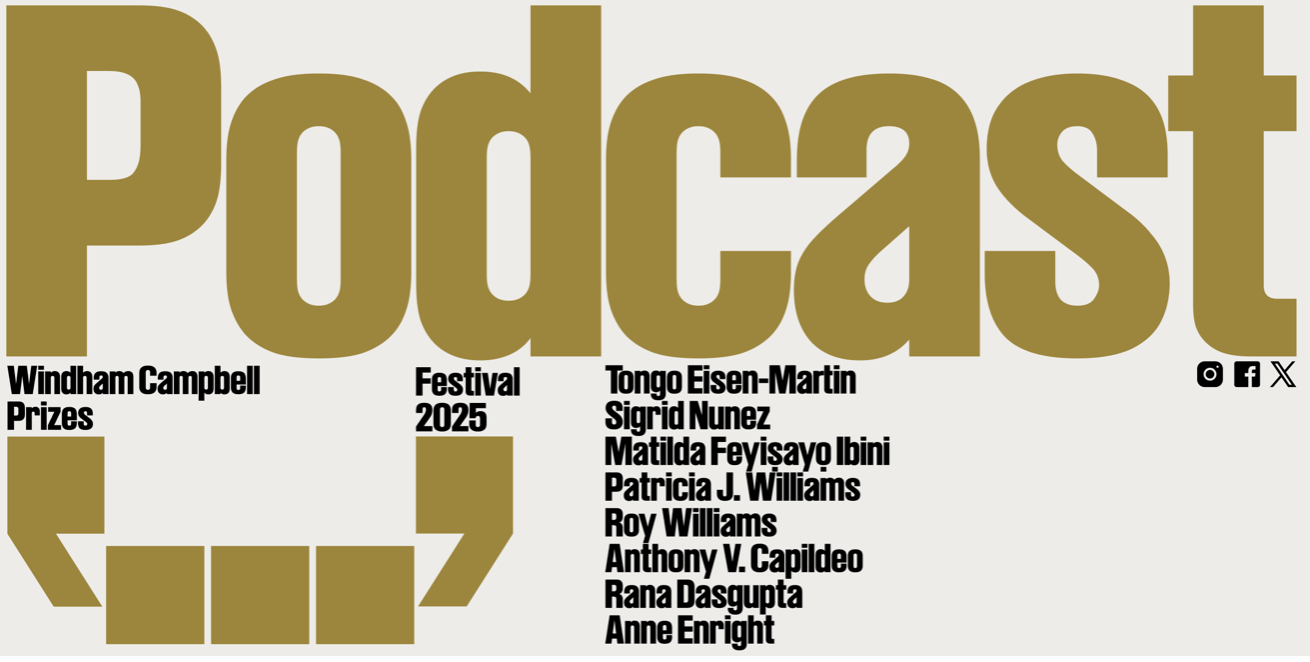
The fifth season of the Windham-Campbell Prizes Podcast has arrived! Each episode features one of this year’s prize recipients in conversation with Mike Kelleher, Director of the Windham-Campbell Prizes, on the one book they can’t stop thinking about.
So far, we’ve talked to Tongo Eisen-Martin about Ayi Kwei Armah’s novel The Healers, which speaks out against division-based ideologies and puts forth a pan-African vision of healing. And, discussed F. Scott Fitzgerald’s The Great Gatsby, a novel that looms large over American literature, with Sigrid Nunez. New episodes drop every two weeks on Wednesday. Here’s the lineup:
Matilda Feyiṣayọ Ibini on Bola Agbaje’s Gone Too Far!
Patricia J. Williams on Martha Jones’s The Trouble of Color: An American Family Memoir
Roy Williams on Dael Orlandersmith’s Yellowman
Anthony V. Capildeo on Kimberly Campanello’s An Interesting Detail
Rana Dasgupta on Giuseppe di Lampedusa’s The Leopard
the hanging moon, the star’s tinsel light and a pink streak cloud’s unbuttoning the dawn.
the world’s a hyperreal cup of shining beauty. i’m seizing the moment by the bucketful. the ugly morning news switched off. it’s 6 am on the motorway and everybody’s moving like liquid honey.
nouns and verbs lifting the lid on kindness and I’m watermelon thinking. the fog pooling in the distance. it could be a metaphor for getting lost but it’s just fog pooling in the distance. it’s you and me at home. it’s me and my notebook writing love in the present tense.
i misread the calendar and i’m an hour early in the waiting room but this is beneath-the-light-of-the-world. making it through to somewhere. asking the fog lake for directions to my imagination. a dream aquarium. i am holding peace in my head. a recipe for paella. whiti and peata’s book.
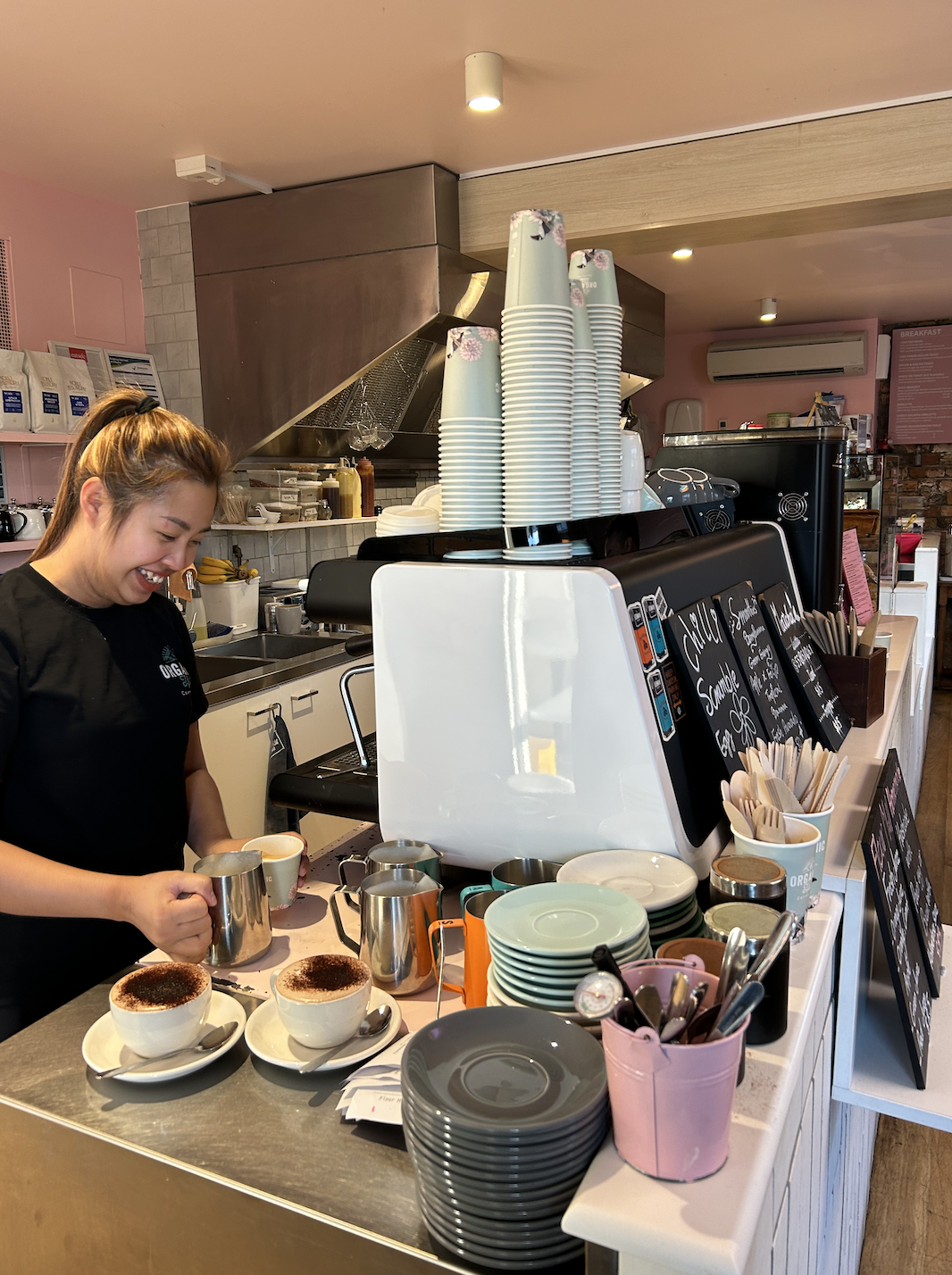
it’s discovering Flour Mill café and ordering coffee and Nita’s beaming as she froths oatmilk. her sublime latte carries me to Firenze before i confess to wavelength road trips and for just one moment i am spelling hope on the edge of this miracle beauty day.
The week of interviews, twenty minutes each to face a panel for my disappearing job.
I went into a shop called Accessory House and bought a flamboyant fabric rose
of the most arresting red as arresting as Liverpool F.C.’s elite Garibaldi red
and pinned it to my black linen jacket. I sat on a chair in the corridor, waiting
wondering what I would say. I had prepared nothing, it would have to be
spontaneous, from the heart, like the rose or the Garibaldi goalkeeper with his gloves
straining for the crossbar of the goal or diving like a salmon in its death throes.
Protect me, rose, I said, as the bell sounded and I walked in, stiff-backed and sat.
Good morning, good morning. We like your rose. Was that a point on the score sheet?
I’m sure I said something foolish. The rose was causing me to relax. I told it
to keep it together. Remember the worm that flies in the night. It settled back
on my lapel and nestled against my cheek In the corridor again I unpinned it
and held it to my nose. A little perfume from my wrist had climbed inside it.
Elizabeth Smither
Elizabeth Smither has just completed a collection of four novellas, titled ‘Angel Train’ which will be published later this year by Quentin Wilson. ‘The interview rose’ is the title of a new collection of poems for Auckland University Press.

 NZ Poetry Shelf