sitting here at the junction box of war and peace and flowing waters hearing the soundtrack of bush haven hearing the dawn bugle the flyover the kōrero the silence searching in the manukā for remedy cables mourning every raised weapon every sacrifice every empty stomach displaced refugee every cruel act the weasel words from weasel politicians jamming our children in square learning boxes slamming our hospitals in low voltage budgets cramming our planet in polluted circuits extinction coils feeling in this breaking dawn the connecting calls for peace picturing protest placards holding voices of resistance past and present picturing aid workers risking life to nurse and feed and shelter picturing a global jigsaw puzzle of greed and smash and grab for how long have we imagined peace have we called for peace for how long have we imagined blue sky transformation today we are standing here holding our currents of hope and yes today we are joining in calls for peace calling calling calling
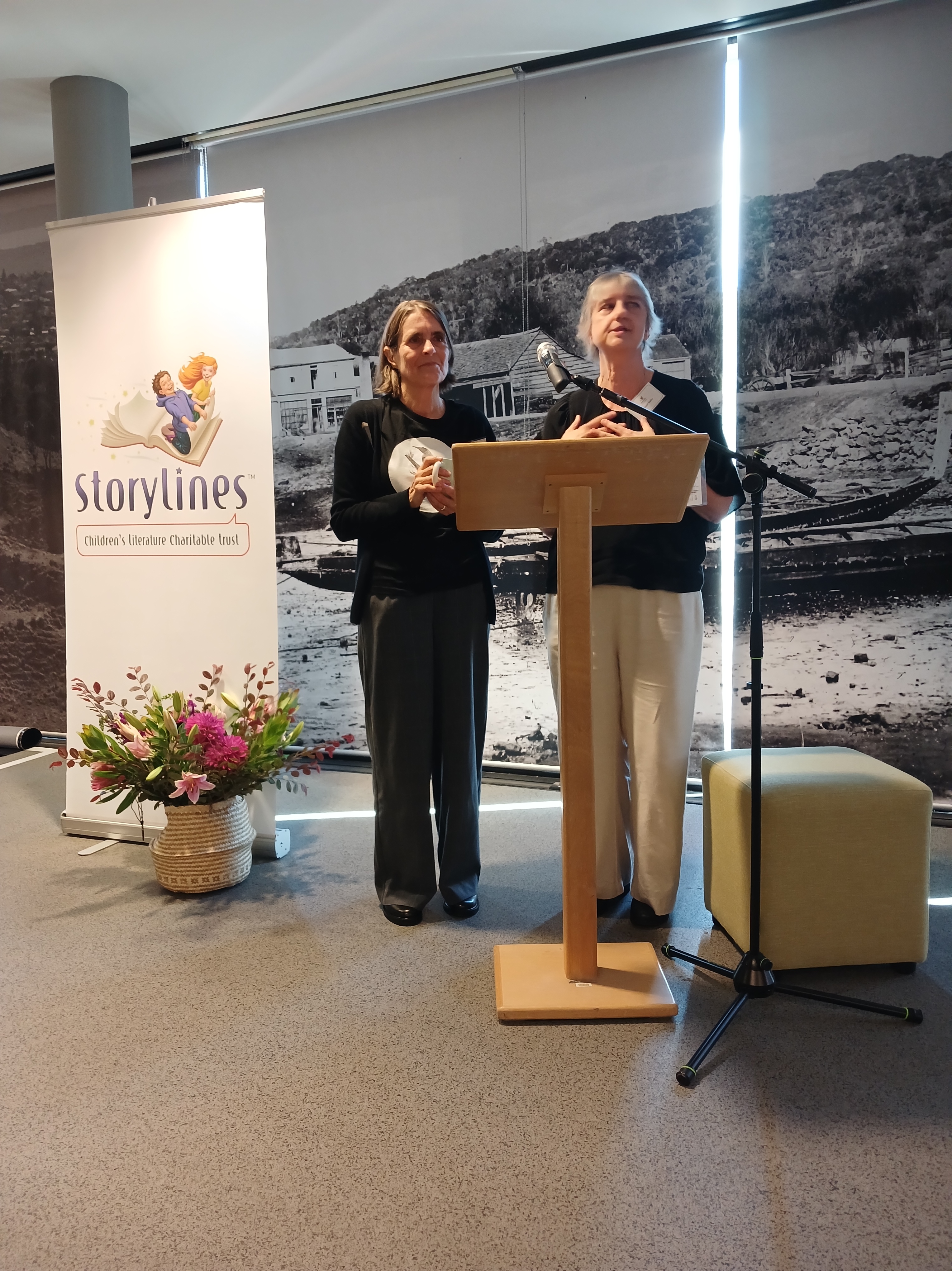
Paula Green and Bridget Mahy, 6 April 2025, National Library, Parnell
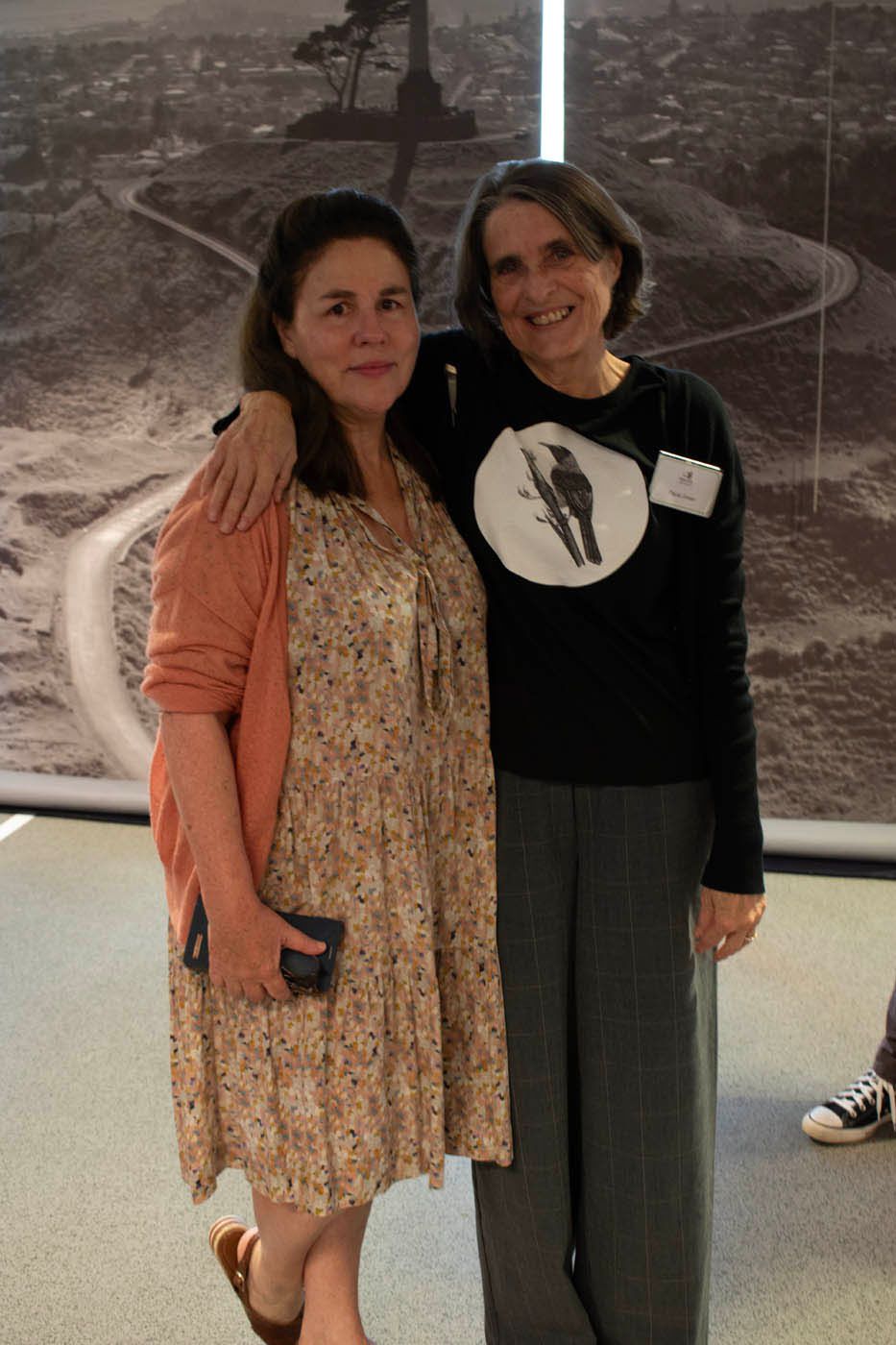
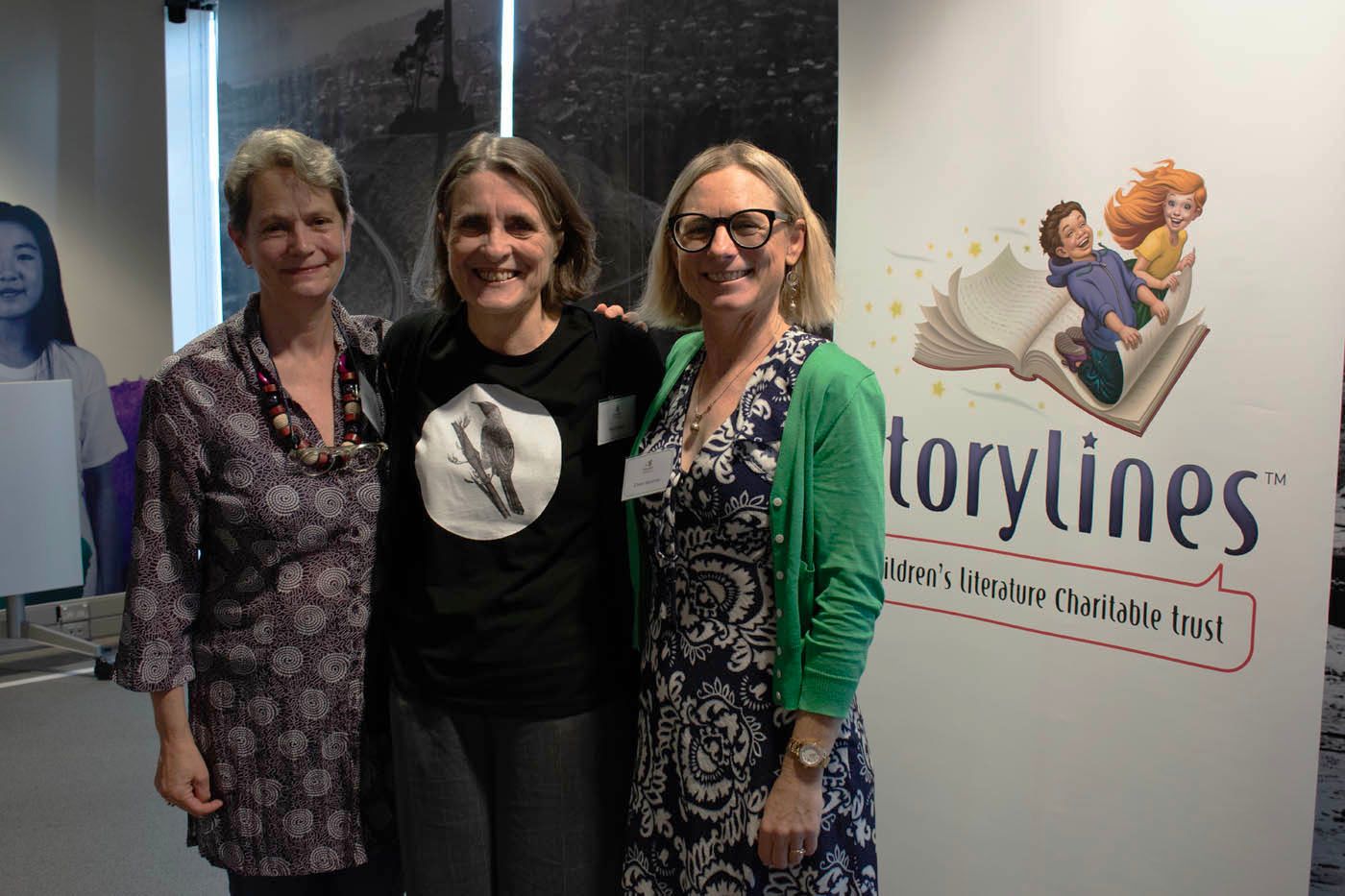
What an honour to receive the Margaret Mahy Award 2025. What mattered to me more than anything was writing and delivering the lecture. I decided to celebrate why I love writing poetry for and with children, why I love reading and writing children’s poetry (and other genres), as much as I love reading and writing adult poetry (and other genres). And I wanted to fill the room with children’s voices as much as I filled it with my own.
To activate a child’s love of reading and writing within poetry playgrounds feels even more vital at the moment. Poetry is an excellent way to get children falling in love with the possibility of words, to see and engage with the world in new and nourishing lights, to grow stories, to build empathy, knowledge, fascinations, curiosity.
I created a patchwork-quilt lecture – in keeping with my tiny patchwork quilt mornings – and explored poetry, in ten patches, as both kite and anchor. I got personal and maybe I got political.
To stand in a packed room after almost three years was like a small miracle. To have sixty-second conversations with so many people felt like a second miracle.
I am so grateful to Storylines for this opportunity. To Libby Limbrick and Bridget Mahy for their thoughtful, insightful words. To the National Library for their care and support as event hosts. Especially dear Elizabeth Jones and Crissi Blair. I just loved it. To friends, family and fellow authors. Yes the occasion did smash me, as I have not yet left my recovery road, but it was so very special.
We are all finding ways to navigate and respond in these times, global upheavals (what word to use?) that take me back to my lengthy Italian studies, to the rise of Hitler, Mussolini and fascism. To our coalition government that is endangering our wellbeing and that of the planet. I witness our stretched health system, our incredible nurses and doctors, underpaid, working long hours, without access to new/newish drugs, equipment and trials available overseas 9life-saving, life-extending). It is just not good enough.
What to read? What to write? What to say and do and choose? Do we need comfort or challenge or a vital mix of both?
I feel like my energy jar is on empty.
Sadly, I am going to put both my blogs on recharge for maybe two weeks – but I do want to maintain these sites as nourishing hubs for children and adults in Aotearoa who love reading and writing.
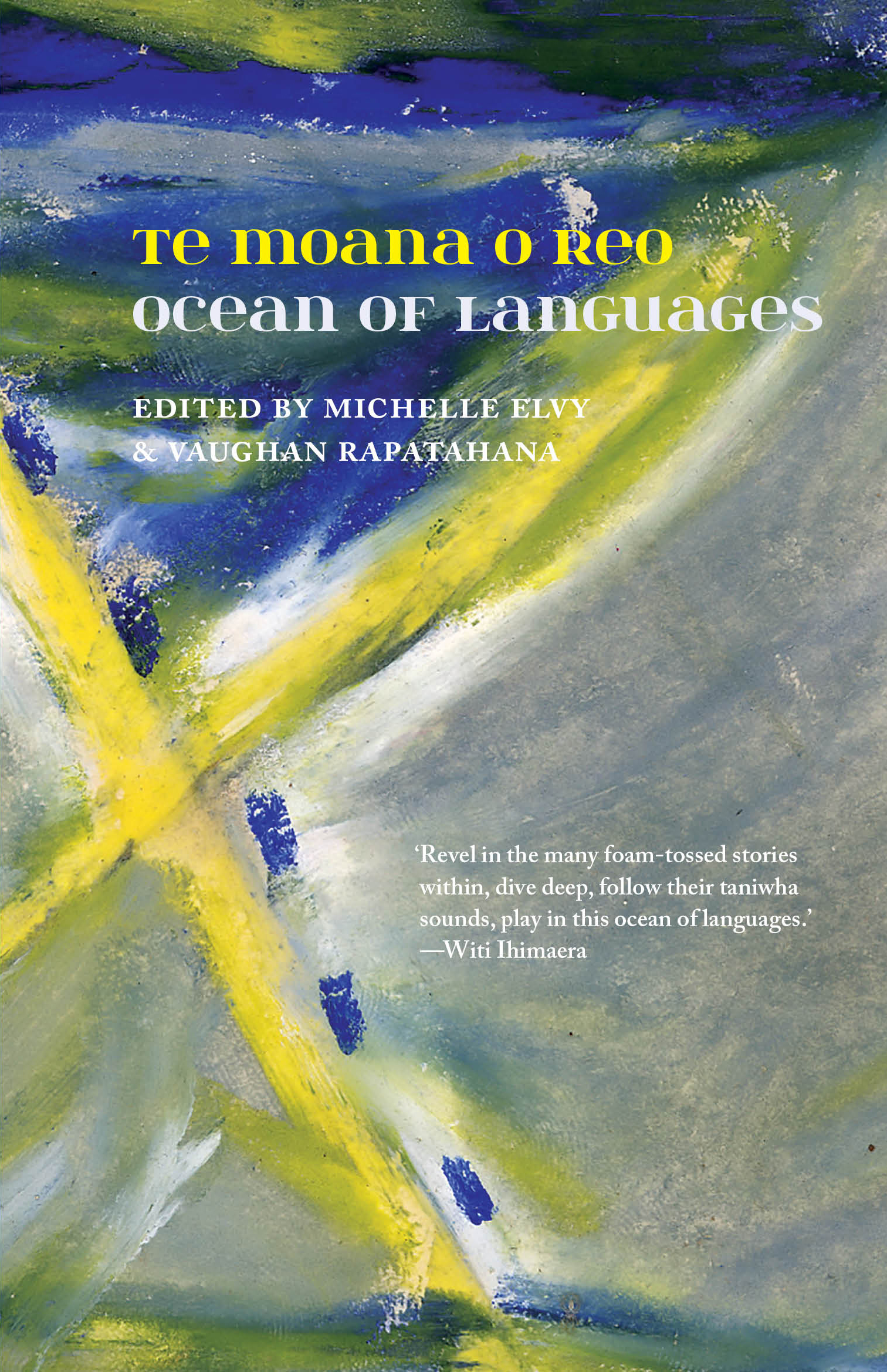
Te Moana o Reo: Ocean of Languages editors Michelle Elvy and Vaughan Rapatahana
To celebrate the arrival of Te Moana o Reo: Ocean of Languages, I invited nine authors to read their introductions and their pieces in both languages (where applicable). I also gave the editors three questions to answer. To hear a language spoken is an uplift, to hear its music and rhythms, the word endings, the differing vowels and consonants, is aural nourishment.
I began my recent Margaret Mahy lecture on writing poetry for and with children by describing a scene. I was sitting in the shade at the beach cafe at Te Henga Bethells writing the lecture when an Italian family turned up. We started a conversation in Italian and it felt like the Italian room in my head at opened up again. There we were speaking of books and art and food and cities. And I felt alive with the Italian cadences. Just as I feel switched up a level when Scottish words and accents lead me back to my Scottish grandmother, my father’s linguistic heritage. Having spent over a decade at the University of Auckland doing Italian degrees, I have always felt this: we are what we speak as much as we are what we eat.
So Te Moana o Reo: Ocean of Languages, edited by Michelle Elvy and Vaughan Rapatahana is very special to me, this lovingly assembled anthology. More than forty languages come together, across multiple genres. As Chris Tse says on the blurb: ‘Although language is the common thread that binds these pieces together, the range of stories contained is as broad as the languages represented, each a surprising burst of colour and sound.’
Each contribution is prefaced with a tiny introduction by each author. There are twelve essays that reflect upon myriad ways language matters: how it connects, forges identity, is organic, the bearer of narratives, myths, history, genealogy, politics, culture, home anchors.
This is a book that will enlighten, set your ears and heart travelling, get you thinking, communicating, sharing. As Emma Neale says on the blurb: ‘This polyphonic, polyglot collection reminds us that we underestimate the small at a cost: the cost of joy and wisdom.’ Indeed. A storehouse of colour and sound, joy and wisdom. Settle into listening. Renee Liang’s terrific reading ends with the word ’embrace’, and that is the word I am offering you, a sublime anthology offered as warm embrace. Thank you.
The readings
Iona Winter
‘Tōrea’
Kay McKenzie Cooke
‘Language as Species’
Lynn Davidson
Lynn reads ‘When Yellow’s on the Broom’
Gina Cole
Gina Cole reads ‘na suluwanu e sega ni mate rawa’ ‘immortal deepstaria’
John Geraets
John reads ‘Whangarei Walks’
Mikaela Nyman
Mikaela reads ‘Hålla Fast’ ‘Holding On’
Nod Ghosh
Nod reads ‘Kokrano Chul’
Serie Barford
Serie reads ‘The Temptation of Apples’
Renee Liang
Renee reads ‘Embrace’
The readers
Gina Cole is a Fijian/Pākehā writer living in Tāmaki Makaurau. Her short story collection Black Ice Matter won Best First Book Fiction at the 2017 Ockham New Zealand Book Awards. Her fiction, poetry and essays have been widely anthologized. Her science fiction fantasy novel Na Viro is a work of Pasifikafuturism. She holds an LLB(Hons), an MJur and a Masters of Creative Writing from University of Auckland, and a PhD in creative writing from Massey University. In 2023 she was appointed a Member of the New Zealand Order of Merit (MNZM) for services to literature.
Iona Winter (Waitaha/Kāi Tahu) is a poet, essayist, storyteller and editor. She has several published collections of poetry and short fiction; most recently In the shape of his hand lay a river (2024). Her upcoming book A Counter of Moons, creative non-fiction speaking to the aftermath of suicide, is due for publication in 2024. In 2023, Iona founded Elixir & Star Press, as a dedicated space for the expression of grief in Aotearoa New Zealand. The inaugural Elixir & Star Grief Almanac 2023, a liminal gathering, included over 100 multidisciplinary responses to grief. Widely published and internationally anthologised, Iona creates work that spans genre and form, and lives in the Buller region.
John Geraets lives in Whangārei and his personal work plus a range of group projects can be found at johngeraets.com. His Everything’s Something in Place was published in 2019 by Titus Books.
Kay McKenzie Cooke (Kāi Tahu Kāti Māmoe) lives with her husband Robert in Ōtepoti with their tamariki and mokopuna living close by. She is the author of four poetry books and three novels. Currently, at the request of whānau, she is working on collecting memories into some semblance of order.
Lynn Davidson was 2021 Randell Cottage Creative New Zealand Writer in Residence. In 2023 she was Mike Riddell Writer in Residence in the Ida Valley, Central Otago. She had a Hawthornden Fellowship in 2013 and a Bothy Project Residency in the Cairngorms in 2016. Her memoir Do you still have time for chaos? was published by Te Herenga Waka University Press, Wellington, in 2024. Lynn calls Aotearoa New Zealand and Scotland home.
Mikaela Nyman is from the Åland Islands in Finland and lives in Taranaki. A critically acclaimed writer of poetry, fiction and nonfiction in Swedish and English, she was honoured to be the 2024 Robert Burns Fellow. As an adult, she decided to write herself back to the language universe she’d been born into. She is the author of the climate fiction novel Sado (2020) and co-editor of Sista, Stanap Strong! A Vanuatu Women’s Anthology (2021). Her first English-language poetry collection The Anatomy of Sand is forthcoming with Te Herenga Waka University Press in May 2025.
Nod Ghosh is a graduate of the Hagley Writers’ Institute, Ōtautahi Christchurch, and has had work published extensively in New Zealand and overseas. “How to Bake a Book”, a creative writing textbook with a difference, is due soon from Everytime Press. Further details on Nod’s other books can be found on the website: http://www.nodghosh.com
Renee Liang is a poet, playwright and essayist. She has toured eight plays and collaborates on visual arts works, dance, film, opera, community events and music. Some poetry and short fiction are anthologised. A memoir of motherhood, When We Remember to Breathe, with Michele Powles, appeared in 2019. In 2018 she was appointed a Member of the NZ Order of Merit for services to the arts.
Serie Barford was born in Aotearoa to a German-Samoan mother (Lotofaga) and Pālagi father. Her most recent poetry collection, Sleeping with Stones (Anahera Press), was shortlisted for the Mary and Peter Biggs Award for Poetry at the 2022 Ockham New Zealand Book Awards.
Questions for the editors
Editing an anthology can offer multiple joys as you scavenge your shelves, libraries and the archives for contributions across genres. What surprised or delighted or challenged you?
Michelle: I was delighted by how many authors took on the challenge to write something that held personal meaning (exploring family history and culture, traditions and frictions) while doing it with such intensity – the demand of the small form. Even the fictions are an exploration of our realities. The creative nonfictions blend so well with the small fictions, and this is a wonderful outcome of this book.
The challenges lay, first, in the attention to detail that was required with so many languages. Many people played a role, including translators and language experts who worked with the authors and editors, and then the font selections that happened on the design end. As well, there were challenges for the final presentation, beyond fonts: how to give space to each author and their commentary, plus their biographical information. We began with an idea for micros but each piece is supported by various parts, many of them presented with two languages. We also made the important decision to grant the needed space to each piece; these are not stories that can be crowded on the page. This book demonstrates how space can be a meaningful contribution to contents, and the designer gave careful consideration to all these aspects in this ambitious and beautiful collection.
Vaughan: I was/am delighted that there were so many willing participants, from a multitude of language backgrounds in Aotearoa New Zealand, who expressed themselves so articulately via a range of genre. Indeed, I was a little surprised by the plenitude of languages we – the editors – were able to include, realising along the way that there were/are still more tongues to wag, as it were!
I love how the anthology is prismatic in its reach. It feels absolutely vital we hold Aotearoa’s multiple voices and languages to the light. How what we speak matters. You have written an excellent introduction that responds to the question, ‘Why this anthology?’. What motivated you to create this rich gathering?
Michelle: It began when we hosted a Phantom Billstickers series for National Flash Fiction Day in 2022. Those posters included 10 writers whose work shines for the language(s) it represents, and they were shared nationally, also representing the varied geographies of the authors: Ivy Alvarez, David Eggleton, Vera Dong, Teoti Jardine, S J Mannion, Selina Tusitala Marsh, Neema Sing, Piet Nieuwland, Mikaela Nyman and Cristina Schumacher. That series inspired us to think further on this idea – we knew there would be many gems representing the many more languages of Aotearoa. And we were right: we put out a call for submissions and found many finely tuned works representing such a wide range of voices. We also invited some writers to send work so we’d have excellent balance between new voices and some of our already known poets and writers. Some of the pieces are previously published, some are new; the original 10 from the Phantom Billstickers series are also included, of course.
We state this in the introduction, which you’ve referenced: We live in an increasingly multicultural and multilingual society…. In the twenty-first century, we navigate an ocean of languages in this country. And so, we set out to tune in to the many languages around us, to hear how they might ring out on the page.
We wanted to create a book that would bring into focus just how multicultural our world is – and how this is the dynamic reality of Aotearoa. Little did we know then how this book might matter even more by the time it was published.
Vaughan: I must stress that the idea for this anthology, the constant driving force, was from my co-editor Michelle Elvy, who kindly invited me to join the project. I was more than happy to assist, especially as my own background has been so strongly emphatic of the need to realise that the English language or rather agents of it, is a veritable Hydra whereby Indigenous tongues have for so long been and continue to be usurped by it. All the more important for me, then, was to stress the viability and versatility and visibility of other languages in – and of course beyond – this country. Tēnā koe mō tēnei kōwhiringa a Michelle.
You both write terrific poetry. Go voyaging in poetry oceans. What matters when you are writing a poem? Does it change things when the world is so awry?
Michelle: Thank you! The world is off-kilter these days, yes. How to write in such a time? For me, poetry offers a space to consider our world in both real and imagined terms. It’s a space where we can express direct observations as well as intentions, or desires. In a class just this week, we were talking about working at the ‘edges’ and how this opens possibilities. The most interesting, and most gratifying, thing is to see how we can hang there on the edge, sometimes a sheer cliff; we sense the vertigo, the off-balance nature of things, yet find a way not only to express it but to live in it. Uncertainties permeate our world; poetry offers new spaces for those voyages you mention. I love that idea of poetry oceans; it implies calm and storm, and poetry allows for all of it.
Vaughan: For me, writing a poem is almost always a vital existential action, a form of personal solace. Penning a poem for me is akin to breathing. More, doing so certainly enables better navigation across this Antipodean cultural ocean, as well as the cultures I am fortunate to also take part in when back in Asia for long periods. By the way, I do not subscribe to the point that the world is ‘so awry’. Complex, contradictory, exasperating at times – but this is an historical constant, where poetry can be, should be, panacea.
It is on my mind every day. How to navigate this toxic world? What gives you joy? Hope?
Michelle: We can find joy in the quiet. We can find joy in the spaces between us. We can find joy through collaborations and connections. We can find joy in the act of sharing. For me, joy comes when there are no other distractions – it’s often private but sustaining. This is a noisy world, with baffling and destructive forces all around us. And so: I find joy in small, good things. Which brings me back to this ocean of languages.
My hope is that people will pick up this book, share it – and find ways to think more deeply about who we are and about why our many voices matter. My hope is that beyond a single book there is a much bigger message. With the threats against individual freedoms, with the attacks on spaces where we express ourselves, this is a book for our times. (In my dreams, I fly across the US and launch a coast-to-coast book drop. I’d skip Texas and Florida but collaborate with the Little Free Library and their efforts to counter the banned books policies.) My hope is that this will sing out as an important chorus from Aotearoa New Zealand. It’s something vital, I think.
Vaughan: Again, I do not believe that this is a ‘toxic world’. There is so much to be thankful for. In my own case, it is still being alive after my recent diagnosis of high-grade cancer and the ongoing treatments. Joy and hope spring from seeing another sunny day; being with my wife and our whānau – including our dog; being supported by many; laughter; nga karakia me nga inoi te wā katoa.
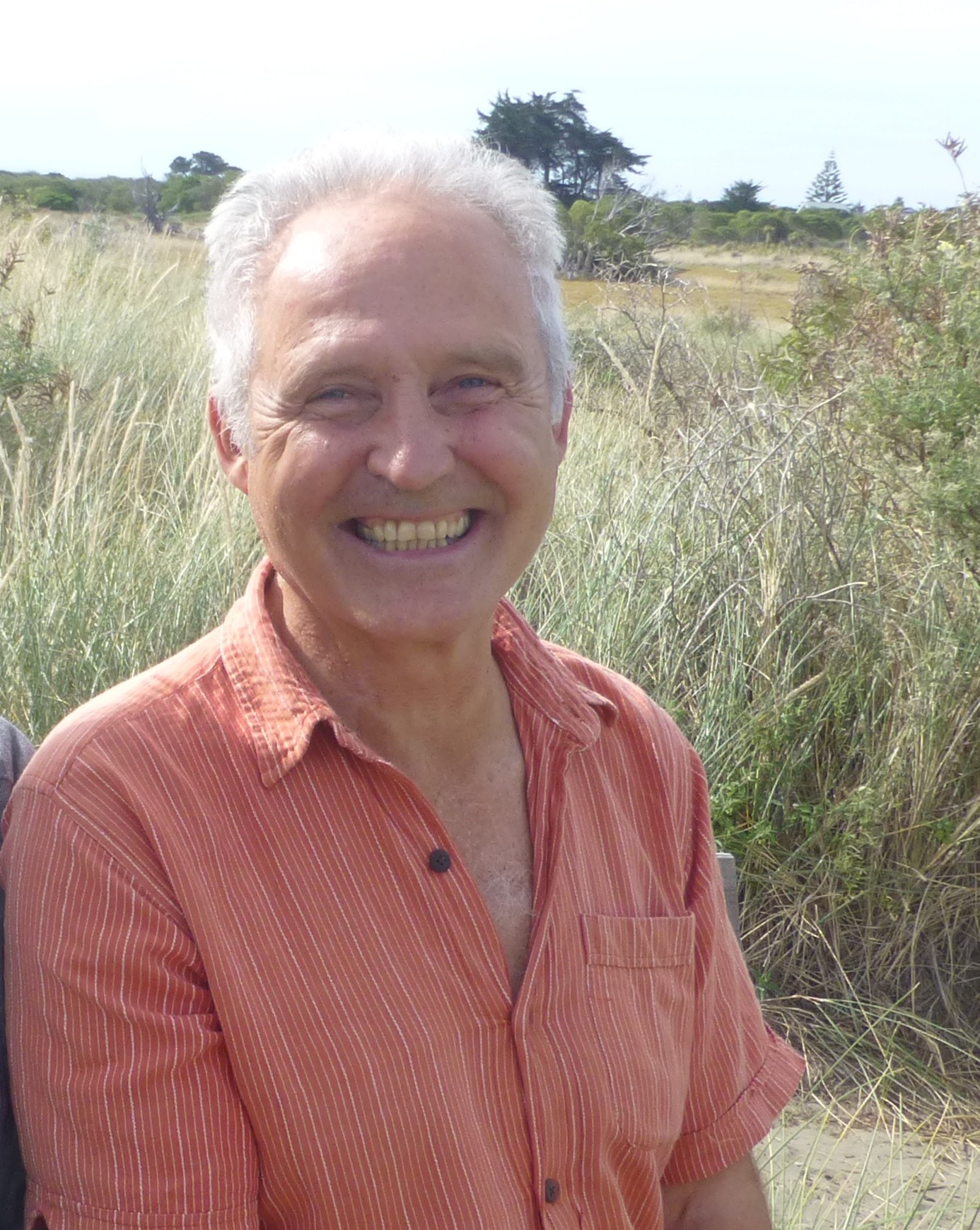
Michelle Elvy is a short story writer, poet, editor and teacher of creative writing, working across many genres. She is founding editor of Flash Frontier: An Adventure in Short Fiction, and her anthology work includes, most recently, Ko Aotearoa Tātou | We Are New Zealand and A Kind of Shelter Whakaruru-taha. Her books include the everrumble and the other side of better. She has edited numerous anthologies, including the forthcoming Poto! Iti te kupu, nui te kōrero| Short! The big book of small stories, edited with Kiri Piahana-Wong (MUP). She is currently sending a weekly poem dispatch rom the USA to post on Poetry Shelf.
Vaughan Rapatahana (Te Ātiawa, Ngāti Te Whiti) is a poet, novelist, writer and anthologist widely published across several genres in both his main languages, te reo Māori and English. His most recent collection as co-editor is Katūīvei Contemporary Pasifika poetry from Aotearoa New Zealand (Massey University Press, 2024). Co-edited with David Eggleton and Mere Taito. Vaughan has embarked upon a long term critique of agents pushing the English language globally, as is evidenced by his inaugurating and co-editing English language as Hydra (Multilingual Matters, Bristol, UK, 2012) and Why English? Confronting the Hydra (Multilingual Matters, Bristol, UK, 2016). A book he considers his most important book is this year’s Sexual Predation and TEFL (Teaching English as a Foreign Language) (De Gruyter Brill, The Netherlands) for which the link is here.
The Companion to Volcanology, Brent Kininmont Te Herenga Waka University Press, 2025
4. Sanbe
For the summit her mother packs toothpicks for the peeled slices of nashi. Half pear, half apple. Also meaning without. Plucked from her grandmother’s altar, the fruit is still firm after three days bathing in incense for the leftover bones each of us (even the youngest) carefully placed in the urn with chopsticks.
‘I would not, as my father saw it, exchange our old way of life for the new way but would learn to be part of both . . . ‘ Patricia Grace, Mutuwhenua
This is not, as you might imagine, a book on volcanoes but volcanoes are a shadow effect, a missive, an ongoing motif, a haunting. It is a poetry collection that depends upon mountains, travel, climbing, running, discovering. Various mountains, from Etna to Erebus to Taranaki to the unnamed. Multiple ascents, multiple crossings. Poetry writing as ascent. Poetry writing calling into and from and because of an abyss. A volcanic plume on the horizon. Pyramid ramps.
Some poetry resembles a wide open plain where you get to stand stock-still and absorb the open sky, but some poetry leads us into denser terrain, an undergrowth, the thicket bush. This is sublime poetic intricacy, rich in physical detail. I am finding myself reading and climbing and traversing. And the word archaeology comes to mind. This digging and delving into memory autobiography encylopaedias imaginings.
The collection is in two parts. The first half is rich in the presence of child. In the opening poem, ‘The Companion to Volcanology’, a child is carried up a mountain, the setting a mood vibration of harmless snakes, homeland talk, melting snow, a hissing caldera. Hazy identities. Companionship. Contiguity. Proximity. And it is proximity to the child as much as the mountain in these first poems, whether the poet’s daughter, the poet himself as child, or child imaginings, that intensifies the reading experience. In the thicket of recall, there’s the playground, the drawing, the bouncy castle, the swimming lessons versus Sunday School, the leaf boat. The child, like the mountain, is an ubiquitous presence and I am so utterly moved by this.
The second part shifts to tectonic plates of the adult. Craig Arnold, a hiker poet missing on Kuchinoerabu. Pheidippides and his alleged ‘long dash’ from Marathon. Haruki Murakami running the same ancient route. Ekiden, Japan’s long-distance relay. And then family. The moving father presence. Birth mother. Parents. Illness. Affections. And then place. Poetry as poignant bridge between Japan where Brent now lives and Aotearoa where he once lived. Especially the sequence entitled, ‘Range of Affection’.
Am I easily moved by poetry? Am I easily transported to moments of scale and shiver and leaf shine. Yes I am moved. This sublime collection moves me. This intricate thicket where home is here and there, this mountain and that mountain, this child and that child, this abyss and this footwork. This book that is companion to volcano, to life and to living, to loved ones, here and departed. This book that delivers poetry as companionship. No question. I am moved.
The Readings
‘The Lift Has Two Decks’
‘Twelve Short Talks on Aspects of Origins’
‘Swim!’
ThreeQuestions
The Impressionist
Worn down by the Pont du Gard, you have earned this breather
in the river it straddles. Still, your friends at home are all
in school, and you have not answered yet: What holds
the blocks together? No swifts appear to thread
the limestone arches, like those legions nesting
in Segovia’s aqueduct. And doubtless the bond
isn’t chemical, like the one in Ostia, where ever-stronger
grow the Roman piers still cemented in seawater.
But how can you focus on my thoughts
with your head submerged in the Gardon again?
Stop fixating, daughter please, on that slate behind
your squeezed eyelids. All those marvellous arches
the sunlight, you say, has outlined there.
Brent Kininmont
Were there any highlights, epiphanies, discoveries, challenges as you wrote this collection?
I began the book with the intention of writing about movement: hiking, running, swimming, and travelling. And there are a lot of references to these in the collection, especially in the second half. I wasn’t expecting a daughter figure to feature quite as prominently as she did. My child was already the focus of the final section of my first book, Thuds Underneath, and I had wanted to move on. However, in the initial poems I was writing about solo trips, it was challenging to raise them above mere tourist observations. I fixed this by injecting the daughter figure into the poems. “The Impressionist”, above, is an example of this. I had hiked around the Pont du Gard aqueduct, and I struggled to give the resulting lines the necessary heft to justify their existence, for a public readership that is. But once I plonked the daughter in the scene, and started engaging with her on paper, the poem found a satisfying form. In the end, a daughter featured throughout the first half of the book. Sometimes the poems are drawn from true encounters and observations of my own child, and sometimes they are not. She is one of several meanings of “companion” in the book’s title.
Volcanology is also a “companion” of sorts to my first collection. I’ve been based in Japan for a long time, and both volumes include poems that comment on living outside of a homeland while also engaging with it. I resisted the temptation to order Volcanology into sections based on physical location, like I did with Thuds Underneath. Instead, Volcanology is ordered in a way that echoes a mind divided between two cultures. A poem clearly taking place in Aotearoa, for example, might sit beside another located in Japan or elsewhere. Such a juxtaposition can bolster both poems on facing pages.
Another challenge, one which I failed to overcome, was the pace of my output. It took a decade to bring this second collection together. And I cannot adequately explain why that is, except for a sense that time was on my side and that the creative impulse wouldn’t easily diminish. So naïve! I’m determined the next book will be wrapped up far sooner.
What matters when you are writing a poem? Or to rephrase, what do you want your poetry to do?
I like poems that teach me something new. And I like poems that connect disparate ideas or facts in an unexpected, but logical, fashion. A poem needn’t display a sense of humor, but I respond very favourably to a collection of poems that doesn’t take itself too seriously. Touches of irony and absurdity are also very welcome.
Although I try to achieve the above in my own work, the tone of my poems is often a kind of reporting. Quotes from people and written signs appear throughout Volcanology, sometimes as leaping off points, and sometimes as a way of wrapping up. I only noticed this tendency when I was honing the collection’s order and was trying to ensure poems didn’t repeat or overlap unnecessarily.
Are there particular poets that have sustained you, as you navigate poetry as both reader and writer?
Erik Kennedy is among the local standouts for me. His work frequently fulfils the requirements that I mention above. His poems are often places where humour and insight and poignancy intersect. And he does this with deceptively clean sentences. (He seems to be running with a baton that poet James Brown could have passed to him.) Here’s a superb example.
I also keep returning to volumes by Lavinia Greenlaw, Ilyse Kusnetz, and Jack Gilbert. Greenlaw injects such superb creativity and intelligence into her work. She’s a writing allrounder, and she tells stories in poems that could have been developed into novellas instead. Night Photograph is my go-to collection. Kusnetz, meanwhile, is an American poet I hadn’t heard of when I came across her marvellous first collection, Small Hours, in a used bookshop in Tokyo. She died relatively young but had landed fully formed with that book. Finally, Gilbert, another American, was married to a Japanese and spent much of his life away from his homeland. His poems invite the reader deep inside his life story in a way that I couldn’t pull off comfortably. He manages to do so with ordinary sentences that look easy to make, but weren’t. I admire his dedication to quality – he wrote just five books across five decades.
Brent Kininmont is from Ōtautahi Christchurch and lives in Tokyo, where he leads seminars in intercultural communication for Japan-based companies and organisations. His poems have appeared widely in Aotearoa, including in Best New Zealand Poems. He has written two books of poetry, a decade apart: The Companion to Volcanology (2025) and Thuds Underneath (2015), both published by Te Herenga Waka University Press.
lift-off among the quiet houses a scent of mint in steam coming off potatoes rolled in butter evening tilts shadows across the deck warm air knocking the blind chicory leaves and the benrina slicing fennel or witloof into the huge bowl lifting a paw the bear sails on the bowl of the sky barely there stars coming out comet Atlas passing far to the south beyond light pollutants beyond the astronomers sitting on hilltops citizens parked up with their naked eyes and tripod cameras all of them rolling words like perihelion coma and apparition sixty Moons) across the sky imagine that imagine this subtending the truly extraordinary houses by the sea houses between hills smokes ascending steam rising over pots and bowls blackberry Atlas into the maw of the cosmic oven what have you what would you where with all the slicing and dicing rolling and knocking sixty moons across the sky one drop of dew falling tears flowing backwards forever uplifted an endless assent the minty breath of heaven on earth a pot of new potatoes
*
Michele Leggott
Michele Leggott was the New Zealand Poet Laureate 2007-09 and received the Prime Minister’s Award for Literary Achievement in Poetry in 2013. Recent collections include Mezzaluna: Selected Poems (2020) and Face to the Sky (2023).
Symphony of Queer Errands, Rachel O’Neill Tender Press, 2025
‘Dress us, Oh Errands, in mellifluence, as we are honey flowing, effortless, unbroken.‘
from ‘Chant for Queer Errands’
Rachel O’Neill’s new collection, Symphony of Queer Errands, is a book that takes you by surprise. It is mysterious mesmerising memorable. How to lay my engagements on the screen for you without smashing or corroding the reading effect? This book, that traverses the wide stretch between predictability and obscurity, between resistance and embrace, is akin to a transposition of the creative process, of life itself. We are drawn into the interlaced polyphonic collaborative composition of a symphony, with instruments, musicians, rehearsals, trials, suggestions, score sheets. And everything strange, incredibly and wonderfully strange.
I am thinking this morning how these incomprehensible toxic times that we inhabit can infect slant intensify what and how we read. So this astonishing book, in this utterly vulnerable point in time, becomes fablesque, dystopian, surreal, hyperreal. And then, here I am in the heart and thick of the creative process. The heart and intricacy of love and life and how that matters so very much.
This is a book of first lines, of beginnings. It is a book of a guitar’s open tunings, say, where the chords shift and splice. We are listening to arrivals of the intangible, to energy and ether, to suspension and tendency. Or to ‘the ash of silence’. Listening. Listening. I cannot stop listening. And the musical key moves, and the wardrobe arrives with its physical store of clothes and dirt and flies. It’s personal effects and intimate affects.
Ah the lines that ring out as solo instruments: ‘all the voices yet to reach us’. ‘We who lavender time / are more essential than oils’.
Ah the queer instruments: for example, The Cathedral, The Wave, Bass Narcissus, and The Hard Soft Revolt. The latter is a pianoforte made of revolting parts that are neither plucked nor strummed but guillotined.
Old women are best. Generations matter. Pronouns matter. Tremulous holes matter. Sampling. Stolen land matters. Colonisation. Queer matters.
Queer errands are the sonic visual philosophical physical and deeply personal arrivals that score this symphony, this long-form poem. Queer errands that might be musical instruments or vital notes of gathering protest rally disobedience hotness dialogue collaboration . . . and yes, heart.
Symphony of Queer Errands is a sensory prickling, heart-and-idea stirring, body rippling, queer read, and I absolutely adore it. Thank you.
a reading
‘The Hard Soft Revolt’
‘The Wave’
‘Anti-gaslighting Bowls’
four questions
Were there any highlights, epiphanies, discoveries, challenges as you wrote this collection?
While Symphony of Queer Errands is curious about the intersection of poetry and music, I increasingly feel that curiosity for collaboration shapes the experiential energy of the book.
Contrapuntal poems, and poems inspired by contrapuntal music feature in the book. Contrapuntal poems involve bringing two distinct texts together to create another entire poetic experience out of their conversation. Contrapuntal music involves distinct melodies playing at the same time and interacting harmonically. Throwing in some creative licence here, I feel both point to an elsewhere through and beyond binary relationships.
Sound and language operate vertically and horizontally, as noise and silence, knowably and anonymously, yet in collaboration become multi-dimensional.
It’s a risky business. Collaboration involves trust and uncertainty, a deep understanding of oneself and other people and an openness to not knowing or knowing the least and needing to learn the most, it requires repair from failure, celebration, grieving, laughter and joy.
For me collaboration is a practice. Alongside a suspension of false hierarchies of human worth, we breathe life into alternative realities together, embodying these in the present.
What matters when you are writing a poem? Or to rephrase, what do you want your poetry to do?
Over the last year or so I’ve been experimenting with ‘audial’ poems by recording sounds in my immediate environment and making sound design works that become the seed for a new poem or sequence. My friend Andy Hummel invited me to open at his gig last year and I held a listening party, sharing some of the sound design works and reading poems inspired by them. While some poems are irreverent—Alexander the Great getting therapy in the afterlife; a poet planning to propose marriage to a melody; a music journalist conducting interviews as you would an orchestra—others reflect how, for me, writing through sound enables me to unlock potent emotions and memories. I want to continue to deepen and expand this practice.
Are there particular poets that have sustained you, as you navigate poetry as both reader and writer?
Right now I’m relishing reading local poetry and fiction, including Manuali’i by Rex Letoa Paget, Amma by Saraid de Silva and Slanted by Alison Glenny. Other recent highlights include Chinese Fish by Grace Yee, All That We Know by Shilo Kino, Hine Toa by Ngāhuia te Awekōtuku, A Breed of Women by Fiona Kidman and The Raven’s Eye Runaways by Claire Mabey.
A recent book that continues to be revelatory to me due to its deep articulation of repair is when I open the shop by romesh dissanayake. In my journal I wrote that in addition to the sometimes strange emancipations of grief, the liminal zones of keeping promises and forgiving human mistakes, and the empathy and humour of the writing, I really appreciated the open celebration of friendship/chosen family. I was reminded of the friendships in which I receive unconditional love and how grateful I am to friends who give generously, are accepting and whose manaakitanga comes in many forms, from cooking to laughter, listening and dancing.
On the local music front, some forever favs are Brown Boy Magik’s Trans Pacific Time, Mo Etc.’s Buoys, and albums by Te Kahureremoa and JessB.
We are living in hazardous and ruinous times. Can you name three things that give you joy and hope?
Composers from Aotearoa really fill my cup—Salina Fisher, Victoria Kelly, Gillian Whitehead, Elliot Vaughan, Ruby Solly, Ariana Tikao, Al Fraser, Rob Thorne, Tabea Squire and Jerome Kavanagh. I really enjoy going along to STROMA events and the Pyramid Club to hear contemporary works.
It was a real privilege to collaborate with local composer and musician Lucky Pollock recently. They premiered a new piece at the launch of Symphony of Queer Errands inspired by a poem from the book about a riotous piano called The Hard Soft Revolt. Lucky reprogrammed a keyboard with metallic samples and synths and played Chopin’s Tristesse. It was brilliantly bombastic!
Participating in collective movements is galvanising and nourishing. I’m grateful to human rights activists and connective organisations like ActionStation Aotearoa for keeping us all grounded and empowered across the various stages of reaction, response and repair involved in organising change.
Walking is also my happy place. Composer Torū Takemitsu said ‘my music is like a garden… I am the gardener. Listening to my music can be compared to walking through a garden and experiencing the changes in light, pattern and texture.’ I enjoy the simple sensory pleasures of letting one’s atoms merge with other atoms, dissolving into a moment, hopefully without tripping on a heap of sand, seagull or silicone mannequin head washed up on the tide (true story).
I think it’s also important to grieve what needs to be grieved. Not everything can be replaced or recovered. Grief points to what you care about, which helps you commit to the fight to protect what you love. Having some rituals to move through the snotty, raw and thorny parts of the process can help a lot.
Rachel O’Neill is a filmmaker, writer and artist based in Te Whanganui-a-Tara, Aotearoa. They are Pākehā, queer and non-binary (they/them/she/her). Their debut book One Human in Height (Hue & Cry Press, 2013) was followed by Requiem for a Fruit (Tender Press, 2021). Rachel was the 2023 Creative New Zealand Randell Cottage Writing Fellow. For more, visit their website.
International Writers’ Workshop NZ Inc (IWW) is delighted to announce that Te Whanganui-a-Tara / Wellington poet Anna Jackson has accepted our invitation to judge The Kathleen Grattan Prize for a Sequence of Poems in 2025. The competition, with a first prize of $1000 for the winner, is for a sequence of completely unpublished poems with a common link or theme.
Anna has written seven collections of poetry, most recently Pasture and Flock: New and Selected Poems, and a book about reading poetry, Actions and Travels: How Poetry Works.
She was editor of the AUP New Poets series from 2019 – 2022 and teaches poetry courses at Te Herenga Waka / Victoria University of Wellington where she is an Associate Professor. A new book, Terrier, Worrier: A Poem in Five Parts, will be published by Auckland University Press in June 2025.
The Kathleen Grattan Prize for a Sequence of Poems, which has been made possible by a bequest from the late Jocelyn Grattan in memory of her mother Kathleen, has been run by IWW since 2009 for its members. The competition is free for IWW members to enter, and it is very easy for aspiring poets and writers to join IWW by the third Tuesday in June (17 June 2025) to be eligible to enter the competition.
Anna will host a preparatory one-hour Workshop on Zoom on the morning of Tuesday 6 May, 2025. This Workshop is also free for IWW members, but non-members are welcome to attend the Workshop for $10. Email iww-writers@outlook.com to register.
The competition opens for entries on 1 September 2025 and closes on 7 October 2025. The winner will be announced on 18 November 2025
The rules for the Prize, past judges and winners, details of how to join IWW, meeting times and other activities of the Workshop, are available from the IWW website.



 NZ Poetry Shelf