
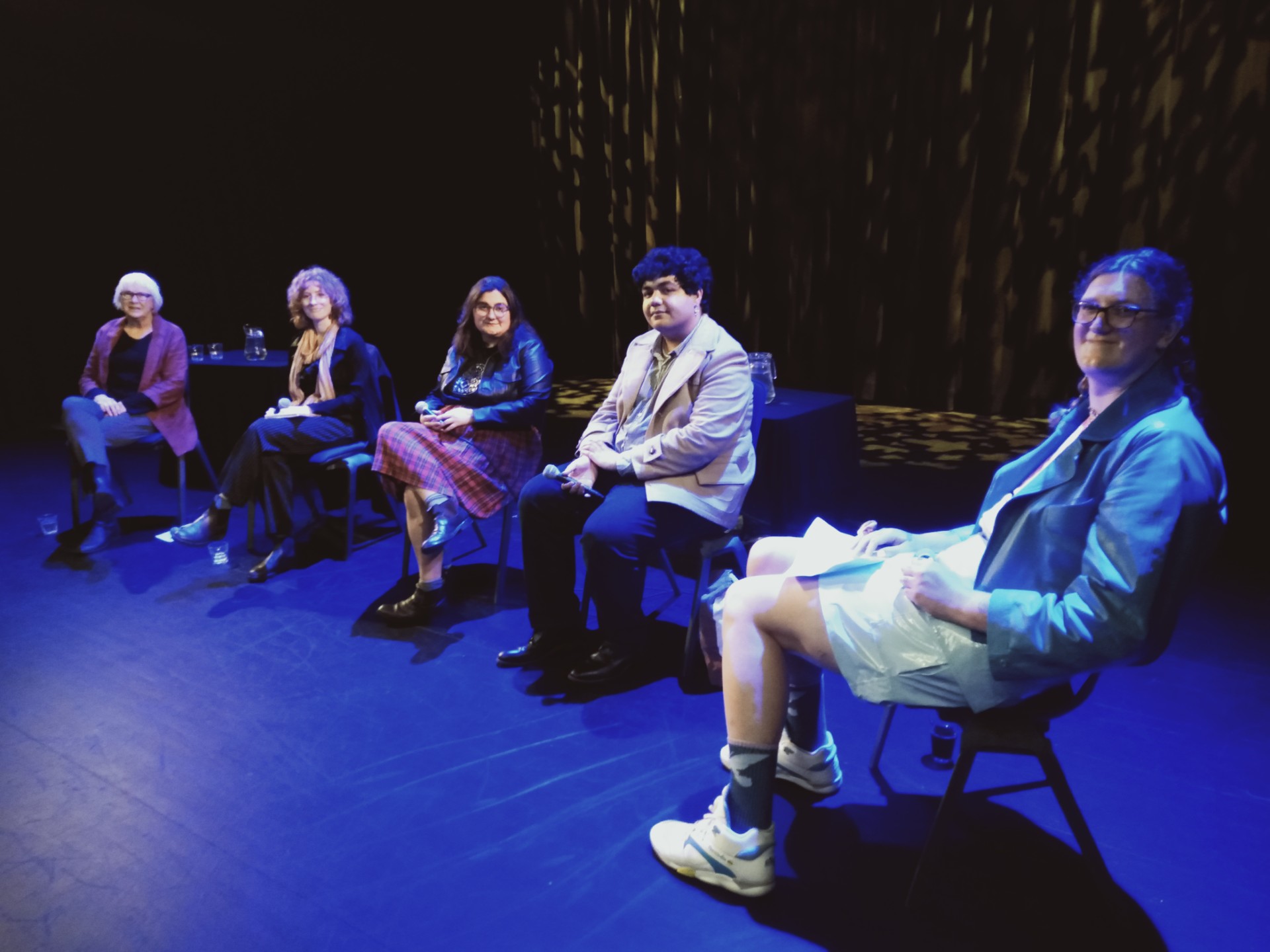
Adrienne Jansen, Brooke Soulsby, Ruby Solly,
Joshua Toumu’a, Always Becominging,
The Secret Art of Editing Poetry, at Verb
On the Friday night of Wellington’s 2024 Verb Readers and Writers Festival, award-winning poet and publisher Always Becominging seeks answers from Adrienne Jansen, Ruby Solly, Josh Toumuʻa and Brooke Soulsby about The Secret Art of Editing Poetry.
Adrienne is a writer, editor, teacher, and co-founding publisher at Landing Press, who brings a wealth of experience to the subject of editing and being edited. She has also brought a visual prop in the form of an old poem draft of her own, which poet and poetry teacher James Brown had liberally marked up in pen, to prove she was no stranger to being on the receiving end of the process.
Brooke Soulsby is a writer and publishing professional. She did the Whitireia publishing course in 2021. She is one of three founding co-editors of circular. Brooke’s work has been published in Salient, bad apple, circular, and 4th Floor Journal.
Dr. Ruby Solly (Kāi Tahu, Waitaha, Kāti Māmoe) is a musician, taonga pūoro practitioner, music therapist and writer. She co-convenes the CREW Māori and Pasifika Creative Writing Te Hiringa a Tuhi CREW 260 at Te Herenga Waka Victoria University’s International Institute of Modern Letters with Victor Rodger.
Joshua Toumu’a was the winner of the 2022 Schools Poetry Award, and a finalist in the 2023 Mansfield Short Story Competition. His work has been published in Starling, Symposia Magazine and The Spinoff.
Always kicked things off, seeking definition around the question: What is poetry?”
Ruby said: “It’s me at 2.30 this morning. Poetry, or toikupu, as it can be referred to in Te Reo Māori, can be translated as ‘art words’ in that language, which I think is a really beautiful way to explain all of what poetry can do without restricting what we think of it in terms of what it looks like on the page or what the length is. It can also be used as a technique within other writing, as well as being a thing on its own.” Ruby’s book The Artist demonstrates the former point; her book Tōku Pāpā the latter.
Brooke said: “I think poetry is a way of expressing particular emotions or capturing certain images or experiences with words and sharing them.”
Josh offered: “Poetry is an expression of the love of language.”
Always turned the question to defining editing.
Adrienne suggested: “Editing is about letting the work be the best it can be, and being itself; strengthening the work. For the editor, it’s actually about paying attention to the work, to what the writer wants and intends, and their voice.”
Brooke said: “Finding a balance between the house style of where it’s going and the intentions of the poet, helping them to bring it out. Grammar and syntax doesn’t always apply with poetry.”
Joshua said: “Find what sings in a piece and make it scream.”
Ruby said: “I was a session musician for quite a long time, and there’s a saying in session work that your job is to make the music more of itself. I think that’s a really good thing when you’re editing – instead of making it what you want it to be, bringing out what it already is.”
Always asked: “When a poem comes to you to edit, how do you ‘make it scream’ or make it more of itself?”
Joshua said: “It depends on the piece, and on what the person is asking of you. If you’re editing pieces other than yourself, you need to know what they’re asking, and if you’re editing your own work, you need to know what you’re asking of yourself. You can’t just look at this and think, Okay, how can I make this better? You need to really think, I’m gonna fix it.”
Always asked, “Adrienne, how about you? What’s your responsibility?”
“To absolutely focus on that poem,” Adrienne said. “Only ever make suggestions, then give the writer the time to think about them. I often find our first reaction is quite defensive, and then with time, we come to our own agreement or disagreement.
Brooke said: “For circular, I think that sometimes poets think they have to accept all of our changes, even though we’ve already accepted them, and you really don’t. So, I it’s about making it really clear that they are suggestions.
“I think it’s also really important to see the potential in a piece. But asking them what their intention was is really important as well, just being really open about it, because it’s a two-way relationship.”
Joshua said: “You have to be sort of passive with your language, and very deliberate with what words you choose. If I say, ‘I think that this part needs improvement,’ people would be less open to hearing my thoughts on this, because I am imposing it, that I am right and you are wrong about your art. That is not the approach you want to take when editing.”
Always suggested presenting questions is a good way of doing it.
Joshua agreed, suggesting “the compliment sandwich” approach: starting with praise, followed by constructive criticism, followed by more praise.
Brooke acknowledged one error an editor can make is thinking they have to find a mistake in every poem they are given. “Some of the poems I have accepted don’t need anything, they are just great as they are,” she said. “Perhaps all they need is a bit of support in getting it out there. You don’t need to be too heavy-handed.”
Always asked: “How is editing poetry different from editing other things?”
Ruby said: “One way is that poetry is often all about the moment. The ‘Friday Poem’ on The Spinoff, for example; it’s like, something big has happened this week that affects somebody in the community. So, the person who is editing that needs to be the thinking brain, not the lizard brain, and be like, ‘Hey, this sentence here might get you in trouble this way.’ And that is a big difference than, say, editing a whole novel that could be inspired by an event that happened now, but you won’t see that book for another five, six years. I think the timing is everything.”
Brooke referred to advice Adrienne brought to her Whitireia cohort when she visited them in 2021, which Adrienne credits to two-time US Poet Laureate Billy Collins. Collins has said it’s important for a poem to know which cards to turn over, and which to leave face down. The idea being, in impenetrable poetry, too many cards are face down.
Always asked the panellists how best to approach editing a piece that isn’t necessarily written for you?
Ruby’s answer was firm: ” You don’t edit it,” with Brooke and Adrienne supporting her stance.
“Ask for another opinion,” said Brooke.
Ruby expanded on what this requires: “I think the wider part of that conversation is that we need editors from all backgrounds. Jasmine Sargent [(Ngāti Porou) Editor (Māori) at Te Herenga Waka University Press] edited my second book. She’s absolutely incredible. She works really hard. She’s passionate about it, about the kaupapa and about the writers, but she’s also one person in that space, and we need more people, so I can write something where I don’t have to explain everything, because it’s it’s already understood, and it’s already going to go to an audience that’s like us anyway, and that’s who it’s for. So, yeah, that’s not a problem that we can solve easily without solving all of the problems. But it’s also important to mention that.”
Always asked: “I’m wondering how you all manage the different power imbalances that often come up in publishing between editor and poet, and publishers. Obviously sometimes the editor has more power and sometimes the writer has more power.”
Ruby said: “My whole life is a power imbalance. It’s funny, but it fucking sucks. I just have to deal with it. I’ve got nothing else I can do. And yeah, it’s exhausting and it’s constant.”
She gave the example of being asked to remove the entire first section of The Artist. “It’s 13 poems, but it took me a year because I had to go and talk to everybody to write the history of Te Wai Pounamu, from the beginning of creation to settlement. I had to really fight to get that kept, which was totally worth it, because it’s used in kura kaupapa Māori now to teach the history of the South Island. But the thing is, somebody has to do the big fight for stuff. Sometimes people are doing the big marketing, but not having to do the big fighting. And that’s one of the things that makes me cry when I wake up.”
Adrienne took the question, and the light Ruby had shed on it: “I so deeply believe that we’re all in it together, you know, the writer and editor and everybody else, and I suppose it is a power imbalance that I need to be aware of, that, you know, I have some power suggesting things, but it’s not the way I operate.
“I worked for about 10 years at Te Papa writing, and there’s a great head writer who said…” She pauses to consider the job title ‘head writer’; “See, that’s kind of a contradiction,” she said. “But he took the view that what we were about was just refining the text. All of us were just refining the text, which is great in that context. If you have that philosophy that really you’re just all refining the text, you all just want it to be the best that it can be, then I hope that those kinds of inequalities don’t exist so much. But maybe I’m being naive about that. Maybe I believe that, but it doesn’t happen in practice. Maybe I’m aspiring to something.”
Joshua said: “I think that is a really interesting take on it. I think that’s a really good start on history and historical writing, but poetry has a person, a single person, behind it, and when you consider the act of editing as refining, it feels like it is taking emphasis away from the original object, which is the piece, and this is where I feel the poetry power imbalances of editor versus poet, because it’s an incredibly intimate act showing someone a poem, let alone one they consider unfinished. It’s sort of unclothing a story that they are sharing. And they’re asking for advice on how they can communicate their own story. This is where the importance of the language that you use is used to support language, because you need to present yourself not as someone who’s trying to reinforce this power imbalance.”
Ruby said: “I think a refusal to acknowledge the power imbalance is a big part of the problem. So, when I mark my students’ work, I say, ‘Yes, I am in charge of you right now. I have this power. I can fail you or pass you. I’m not going to do that over these comments. However, here’s what I think, here’s where this fits in the wider thing.’ But you do have to acknowledge it, or else, it’s not that it doesn’t exist, it’s that you are refusing to see it. It’s not cute to be, like, ‘I don’t see race.’ None of those things work because it just means you get a choice, but I don’t get a choice. We don’t get a choice.
“So, I think there’s a really important point where you have to say, ‘Hey, I’m offering you an opportunity, and I have been dealt a card of hands where I have a handful of cards, and you have nothing. Am I going to let you see them or not?’ You’re not just collecting somebody’s work, like you do with bugs. You’re trying to build whakawhanaungatanga.”
Brooke agreed: “You have to respect the poet.”
The conversation circled back to Adrienne, who returned to Josh and Ruby’s points about power: “I thought about what I just said, Josh. Because refining has a lot of connotations. Refining isn’t the right word, you’re quite right,” she said. “It’s a bad word, and we’re talking about language. Let’s say you write a poem. You bring what you bring to the table your experience, knowledge, you bring all that to the table. And I [as the editor] bring something else. We both bring different things to the table. And I do see the editing process like that. But for all that, Ruby, I absolutely take your point that we have to be aware of what can happen in a relationship, because editing is all about relationships.”
As for creating the poetry that leads us to those relationships, Joshua’s advice to himself, regarding editing, offered some great instructions for the writing life in general. “I wrote a lot of really bad middle school poetry because I didn’t really know what I liked. I didn’t read nearly enough,” he said. “You need to read to be a good writer. And you need to write to be a good editor.”
Bee Trudgeon
Bee Trudgeon is a writer and children’s librarian previously published in RipItUp, The Sapling, The Spinoff, Audioculture, A Fine Line, NZ Poetry Box, and NZ Poetry Shelf. She recently completed the IIML CREW Poetry course. She lives with her whānau in a haunted house in Cannons Creek, and on the Patreon page of her alter ego, Grace Beaster.
 NZ Poetry Shelf
great pātai from Always. Insightful as usual Doc (Rube)
LikeLiked by 1 person