
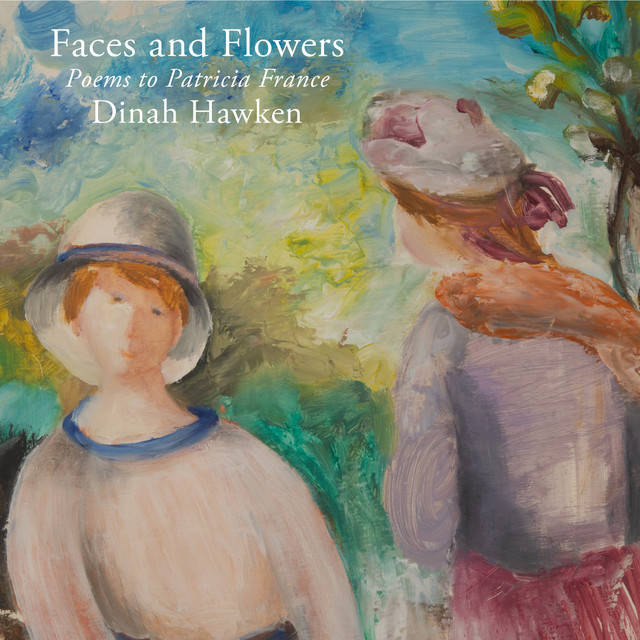
Faces and Flowers Poems to Patricia France
Te Herenga Waka University Press, 2024
I search your paintings of flowers
and see nothing fragile in their colours.
Flowers are delicate by nature, in their opening selves.
But you added to that. You added ferocity
and strength. Orange, blue, yellow, white, rising
from a dark vase and a dark past.
Dinah Hawken
from ‘Consider the future and the past with an equal mind’
Dunedin artist, Patricia France (1911 – 1995), was a cousin of poet Dinah Hawken’s father. I have long admired and loved the work of both women, the paintings of one, the poems of the other, so to hold this book is precious.
After self-admission to the psychiatric hospital, Ashburn Hall, Patricia began to paint, and from that point, continued to paint and develop her career as an exhibiting artist. As Dinah’s collection title suggests, Patricia was known for painting women, girls and flowers. A number of artworks are included in the book. The paintings and poems form an exhibition at Waikanae’s gallery, Toi Mahara, from 20 September to 8 December 2024.
I begin with the production of the book – the shape, the layout, the font size, the paper stock, because each choice serves the paintings and poems beautifully. I think of the book’s design as a breathing space, because here the art and poetry have room to breathe, and that makes all the difference for both reader and viewer. Sublime.
Books are often dedicated to loved ones, and there is a long tradition of poems written for named or unnamed recipients. With Faces and Flowers, Dinah underlines that these poems are written to Patricia. Writing in this context is a way of speaking to someone, and out of that speaking, a loving portrait of a woman emerges, the artist, the relation. Dinah assembled her portrait through research and delving. She drew upon Patricia’s letters in the Hocken Library and by viewing her artwork, by listening to T. S. Eliot’s Four Quartets as Patricia did when she painted. Contemplation and memory are working in tandem. By placing these paintings and poems together as an exhibition, the fecundity of conversation between poem and painting, past and present, is heightened.
The poet as portrait artist works on multiple levels. Dinah’s poetic pen is infused with family history but it also includes the ink of contemporary circumstances. She cannot speak to Patricia without signalling a world awry, without acknowledging the tragedy of climate change, the impact of Covid, how the world tetters and topples. Today I could add the war in Gaza and Lebanon.
I am musing on how this book fills me with both wonder and comfort, concern and discomfort. To linger upon the faces and flowers is transfixing: the extraordinary eyes of the women and girls mesmerise as transmitters of emotion and guardians of experience. Dinah considers the enigma, the building questions, in these faces that haunt and endure. She decides, she declares for the first time publicly, that colour has been her ‘silent, / vital, lifelong partner’ (‘Colour’). And yes, Patricia is much admired for her colour palette, the balance, harmony, softness, mood shimmer. When Dinah writes that ‘vowels are my colours’, I want to reach back through her collections and see how her poetry exudes colour as it draws the natural world close. I delight in this colour. This vital bloom. In both the paintings and the poems.
Ah. Comfort and discomfort. Reading Dinah’s collection returns me to an issue that unsettles me every day: how to write, and indeed how to blog, in a world plagued with catastrophe? What to write, what to blog? I hold this book and I savour so deeply the comfort it delivers, the wonder and delight, and then, at the same time, I recognise how important it is to speak up and to speak out, to use our pens and our voices to shine light upon and to help our wounded planet and people. When Jacinda makes an appearance in the poem, ‘The two girls’, I am aching. I am thinking yes, we will lift each other up, yes we have lifted, and yes we will continue to lift. I am thinking how writing poems and making art and maybe even creating blogs is a vital lift, for ourselves and for each other.
Now I think of the prime minister. For me
she is a breakthrough. For her, kindness is not
a sweet, or exhausted, word: it is naturally
entwined with acuity and strength.
Faces and Flowers underlines the necessity of conversation. Of memory. Of creativity. Of connections. Of care. Last week I posted a cluster of harbour poems, much loved by Poetry Shelf readers, and here in Dinah’s new collection is a heart-in-the-mouth, hold-your-breath harbour poem, ‘The still point, there the dance is’. Ah. This poem. It touches so exquisitely on why the harbour is vital as a physical presence, as a metaphor, as an idea. Dinah’s poem is like the heart of the book, in its pulse, its reverberations. As she has done across all her collections, she creates moments of stillness where we might enjoy miniature residencies. She writes with such craft and wisdom, with such nuances, richness, quietude. Every book she writes, reminds me why poetry matters. And this gift of a book is no exception.
The still point, there the dance is
Now I’m in the boatshed. On a calm Otago harbour.
Even in winter, even in wind,
the glass walls will protect whoever is here
and still give warmth and light. In time present
the harbour is the source of any creative act.
It’s as if each artist waits like an upturned boat
for their season and their oars. There is nothing other
than waiting. Waiting alone is boat and breath and venture.
An albatross flies overhead on motionless wings.
Bellbirds gather round a feeder and forget to sing.
I sit over a sheet of water and, while in time future
the harbour is quietly, disruptively rising,
in the waiting room, in the meantime,
water itself is the vital and telling element.
Dinah Hawken
I would like to gift a copy of this book to a reader – leave your name here, or on my social media feeds with the name of a poetry book you love by Tuesday November 5th. I will draw names out of a hat on Wednesday 6th.
Dinah Hawken is one of New Zealand’s most celebrated poets. She was born in Hāwera in 1943 and trained as a physiotherapist, psychotherapist and social worker in New Zealand and the United States and has worked as a student counsellor and writing teacher at Te Herenga Waka—Victoria University of Wellington. Of her ten collections of poetry, four have been finalists for the New Zealand Book Awards. Her first book, It Has No Sound and Is Blue (1987), won the Commonwealth Poetry Prize for Best First Time Published Poet. Her latest poetry collection is Faces and Flowers: Poems to Patricia France (2024), and other recent collections are Sea-light (2021), longlisted for the Ockham New Zealand Book Awards, There Is No Harbour (2019), and Ocean and Stone (2015). Dinah lives in Paekākāriki.
Te Herenga Waka University Press page
Toi Mahara gallery page
 NZ Poetry Shelf
Hi, I love Elizabeth Brooke-Carr’s book of poems, Wanting to tell you Everything, 2020 Caselberg Press. Jean Sims
LikeLike
Pingback: Poetry Shelf celebrates The Venetian Blind Poems with a collage conversation with nine poets | NZ Poetry Shelf