

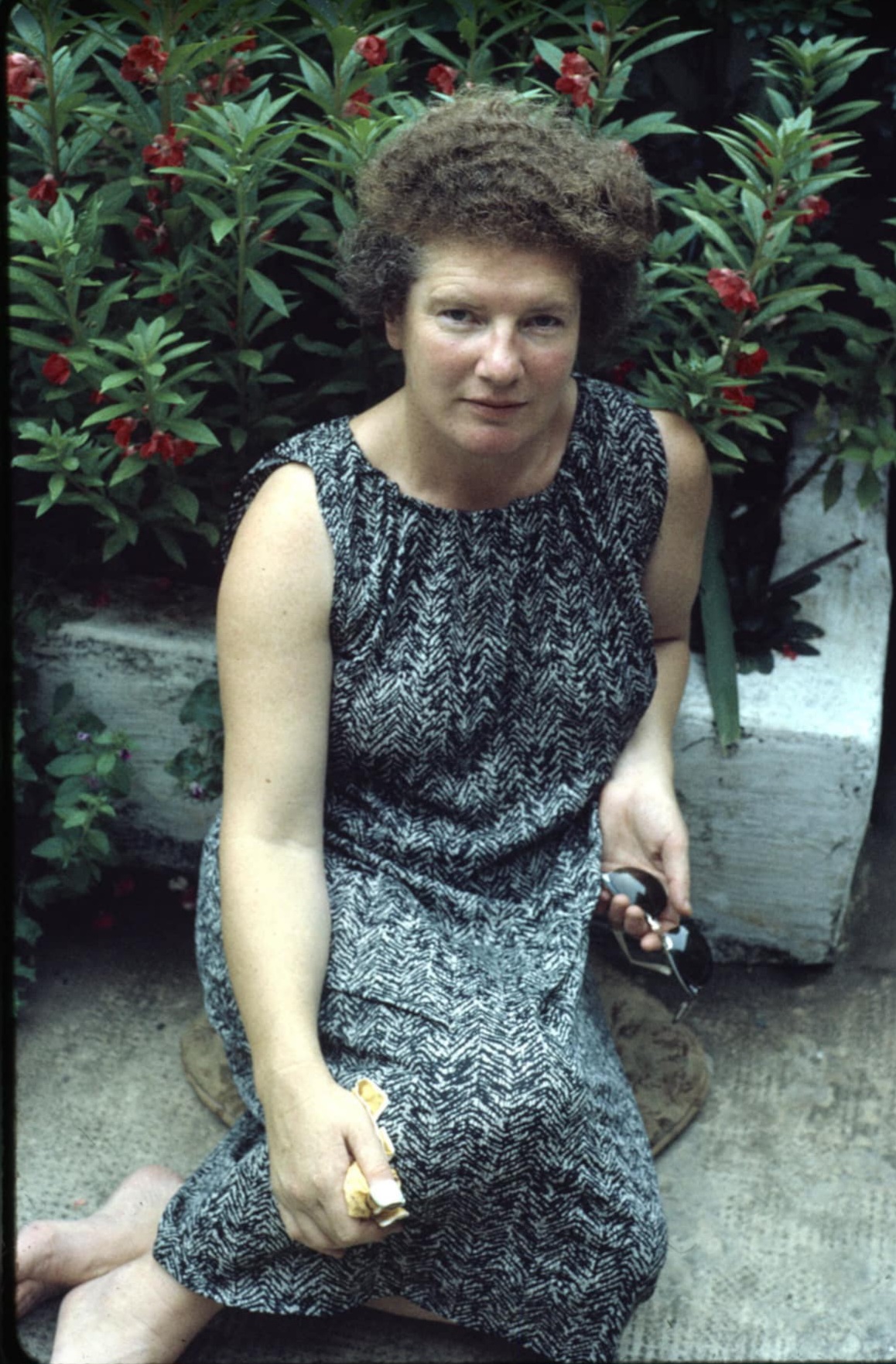
“Poetry is attendance upon the world.”
Janet Frame
∗ an intro and three poems chosen by Paula Green
∗ a poem written by Bill Manhire for Janet
∗ three poems chosen by Pamela Gordon with comments
The sweet daily bread of language
Smell it rising in its given warmth
taste it through the stink of tears and yesterday and
eat it anywhere with angel in sight
Janet Frame, from ‘I Write Surrounded by Poets’
in The Goose Bath, Random House, 2006
Usually on Poetry Day I organise a suite of audios, bringing together voices that inspire move surprise . . . that fill us with the joy and delight of poetry. On this occasion however, I showcase a poet whose writing has travelled with me for decades. I have been hankering to do this for ages . . . to revisit the work of writers whose work has affected me deeply, in multiple ways, on repeat occasions, offering heart, surprise, daring, comfort, wit. I begin with Janet Frame.
Janet Frame (1924-2004) is one of New Zealand’s most internationally acclaimed authors. She won numerous prizes and accolades for her poetry, fiction and non-fiction, and was awarded Aotearoa’s highest civil honour the Order of New Zealand. In 1990 her bestselling autobiography An Angel at My Table was adapted for cinema by Jane Campion. Janet Frame bequeathed her ongoing royalties to the Janet Frame Literary Trust and directed that the fund be used to support New Zealand authors.
Pamela Gordon, Janet’s literary executor, has kindly picked three favourite poems by Janet and included some comments, and Bill Manhire has contributed a poem he wrote for Janet for An Inward Sun, ed Elizabeth Alley. It was a book of tributes that was published in 1984 to mark Janet Frame’s 70th birthday. This month we are mindful it is one hundred years since her birth.
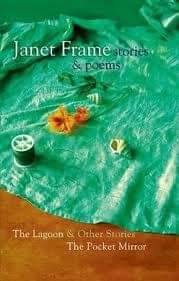
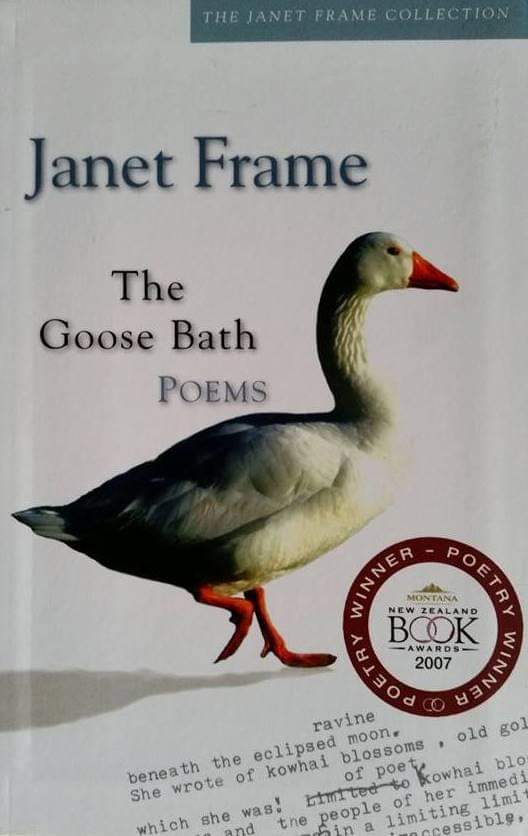
The poems Pamela and I have chosen appear in:
The Goose Bath: Poems, Janet Frame, eds Pamela Gordon, Denis Harold and Bill Manhire, Random House, 2006
The Pocket Mirror, George Braziller, New York, 1967
When I was an awkward teenager devouring Hone Tuwhare, Doris Lessing, Richard Brautigan, Joni Mitchell, Sylvia Plath, Emily Dickinson, reading Janet Frame was an electric and vital charge.
Now, all these decades later, when I am reflecting on how much I love Janet’s poems, I am curious as to why some critics have sidelined her poetry. Maybe it’s because there is a resistance to writers who cross borders, who write novels and poetry, or writers who resist the constricting paradigm of model novelist or model poet. I am thinking immediately of the astonishing Anne Kennedy whose novels and poetry both inspire and delight me. And of Emma Neale, Anna Smaill, Keri Hulme, Elizabeth Smither, Vincent O’Sullivan, Robin Hyde.
But today I am musing on why I love the poetry of Janet. Let’s start with the idea of alchemy, a practice of transformation, the recasting of base ingredients into something precious, awe-inspiring, succulent. In this case, in the case of poetry, words are the base elements: nouns, verbs, adjectives, ellipses. With Janet there’s a metamorphosis into a poetry of feel, sound, stretch, freshness.
More than anything I feel Janet’s poetry. I feel it on the level of texture, heart, self and joy. The physical detail is a sweet tang on the tongue as I read. Take the opening stanza of ‘Moss’ for example:
The Spring moss
the plush lining of the jewel-box
rediscovered beneath the snow.
Fever-green surfacings.
Ice with its edges smoothing
shaping in the lick-tongue of the sun
transparent white-green sweet
from The Goose Bath
To that I add the sound of poetry, the deft step of words on the line that spring and spin in the ear as I listen, as I read the moss stanza with its aural rewards for example. More than anything, there is a revelation of self across the writing: as a woman, a child, a poet, though living, writing, moving in the world. One of the three poems I picked below, ‘Child’, is a poem I feel on so many levels: the lyrical flow, the physical presence, the portrait of both child and grandmother.
How I love the stretch of Janet’s poetry. There is the eclectic subject matter, the diverse locations; we move from a tourist in Mexico City to Baltimore streets, from layered snow to dandelions in the grass, from not being able to write to the ink flowing. The motifs are equally ranging, with sun and rain, light and sky, wind and poetry making, incandescent gleams as you read. Yet more than anything, there is the sweet prismatic stretch of what poetry can do, how it might describe sing pirouette confess dance mourn ponder reflect light and dark explore . . . multiple fluencies. There is a sense of this stretch when Janet writes of poetry making, as in ‘Some of My Friends Are Excellent Poets’:
Poetry has not room for timidity of tread
tiptoeing in foot prints already made
running afraid of the word-stranger glimpsed out of the corner of the eye
lurking in the wilderness. Poetry is a time for the breaking habits good or bad,
a breaking free of memory and yesterday
to face the haunting that is.
from The Goose Bath
Finally, the words ‘fresh’ ‘original’ ‘invigorating’ come to mind. Janet sometimes speaks of the practice of poetry making. Sometimes she will hold out the most ordinary thing, offer a moment of self doubt, trace multiple dimensions, the flashes and the fancies that arrive as she writes, and as I read, I am transported, inspired, itching to create poems. I am viewing the world, and indeed, poetry afresh.
On NZ Poetry Day, I am offering you three of Janet’s poems I particularly love, that demonstrate so beautifully how her poetry is a poetry of feel, sound, stretch and freshness . . . poems for you to find your own reading trails within.
Child
When I was a child I wore a fine tartan coat
that my grandmother, woman of might,
magnificent launcher of love and old clothes, had set afloat
on a heaving relative sea
of aunt and cousin and big enfolding wave of mother
down to small wave of me.
Oh happily I stood that day in the school playground
near the damp stone wall
and the perilous nine o’clock wind
grabbed at my coat-sleeve, waving it in a bright wand
of yellow and green and blue
—all colours, and the other children loved me
and the little girls pleaded to lend
their skipping-rope and the boys their football.
But the spell soon broke in my hand.
Love and sleeve together fell.
The wind blew
more perilous when the world found
my tartan coat was not even new.
from The Goose Bath
The Birch Trees
Mysterious the writing on the birch-bark
a tune of growth with hyphenated signature,
coded rolls a pianola might play,
a computer accept as mathematical formulae,
surrendering the answer, the question lost.
They tell me the birch tree is delicate
they tell me so often I believe it.
I have seen birches like grey rainbows washed of colour
arched beneath the storm
backbending not breaking,
and the young trees their stick-limbs announcing
all deficiencies beside the one prolonged
nourishment of survival.
Birch trees never ask: Why are we here? They know.
Opportunity trees, their business is the beautiful
disposal or draping of weather
especially of snow distributed across their
grey branches in such a way
their bark becomes a calligraphy of scars and stars.
Reading it suddenly in the woods one is astonished
to find engraved on pages of birch-bark the fiction
and fact of men in their cities.
from The Goose Bath
How I Began Writing
1
Between myself and the pine trees on the hill
Thoughts passed, like presents. Unwrapping them, I found
words that I, not trees, knew and could afford:
lonely, sigh, night. The pines had given me
my seven-year self, but kept their meaning in the sky.
Now, in exchange of dreams with this remote world
I still unwrap, identify the presents;
and always tired recognition gives way to hope
that soon I may find a new, a birthday shape,
a separate essence yielded without threat or deceit,
a truthful vocabulary of what is and is not.
2
Vowels turn like wheels: the chariot is empty.
Tall burning consonants light the deserted street.
Unwrapping the world,
unwrapping the world
where pine trees still say lonely, sigh, night, and refuse,
refuse, and their needles of deceit drop in my eyes.
I began to write.
from The Goose Bath




from An Inward Sun, ed Elizabeth Alley, Daphne Brasell Associates, 1994

Pamela Gordon’s three poem choices and comments
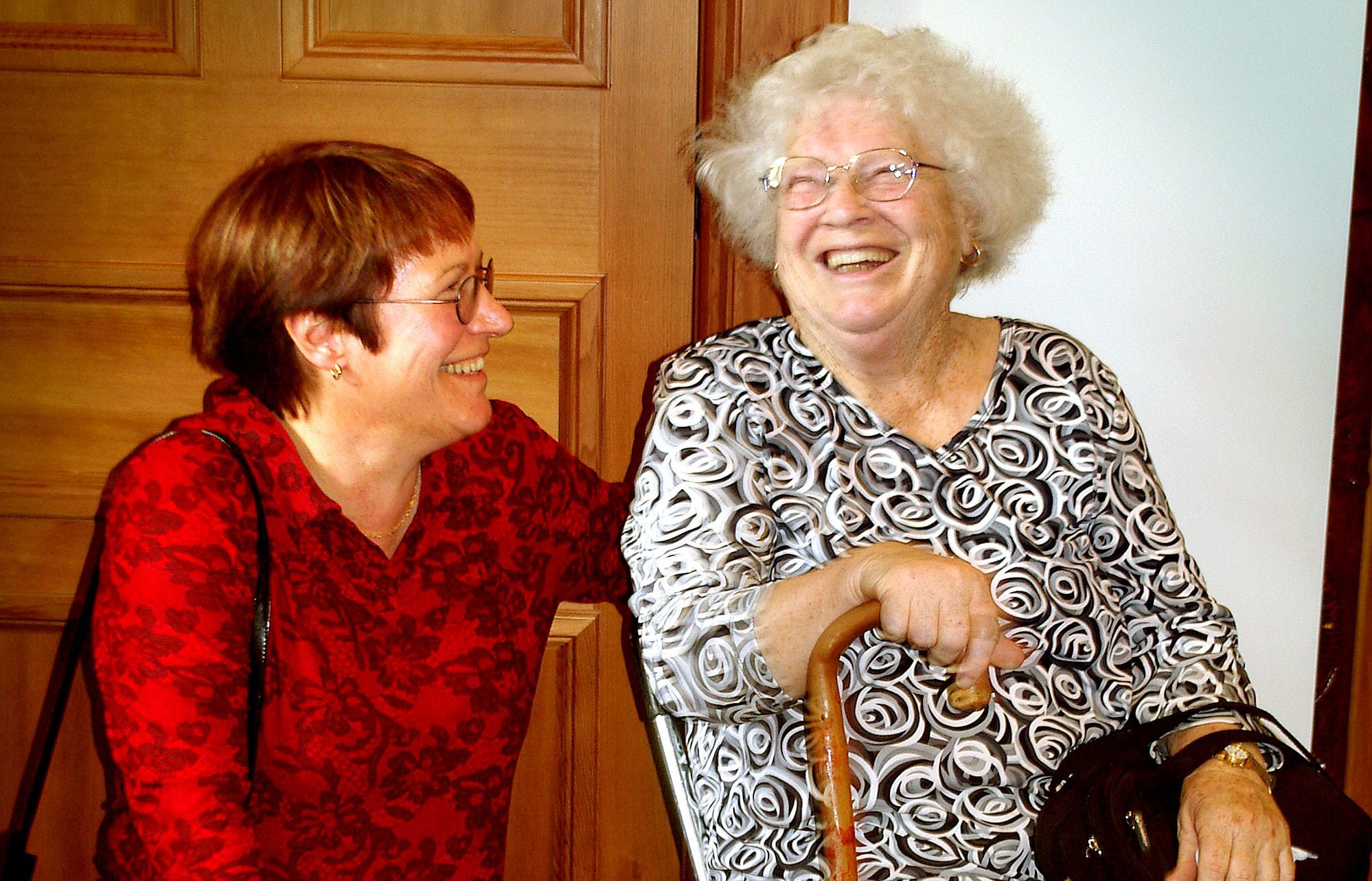

Here are some thoughts about three of my favourite Janet Frame poems. I love each one for very personal reasons.
When the Sun Shines More Years Than Fear
When the sun shines more years than fear
when birds fly more miles than anger
when sky holds more bird
sails more cloud
shines more sun
than the palm of love carries hate,
even then shall I in this weary
seventy-year banquet say, Sunwaiter,
Birdwaiter, Skywaiter,
I have no hunger,
remove my plate.
from The Pocket Mirror: Poems by Janet Frame
This magical multi layered piece has always been my favourite. I do think this is one of Janet’s best, and she herself counted it among the ones she was most proud of. When she was planning her funeral she chose this to be read aloud and it was her bff Jacquie Baxter (JC Sturm) who did the honours at the service. Jacquie was my friend and mentor and so now the poem carries extra emotional freight for me.
For me the metaphors speak of Janet’s remarkable strength and perseverance in the face of adversity and disappointment. In a literal sense it is amusing because one of our family catchphrases was “Baby Frame is hungry”, from a comment written down by New Zealand’s first female medical graduate, Dr Emily Siedeberg, who delivered Janet at St Helen’s Hospital in Dunedin, 100 years ago this week. Janet had such an enormous appetite for life. As she said once in an interview: “Every thing I do, I want to do to the full.” She was NEVER going to say “remove my plate”, and that is what this poem embodies for me.
Small Farewell
Writing letters of goodbye
we are inclined to say
because we have read
or heard it said
or knew someone who likewise went away
that small details pester the memory.
In the corner closet of your eye
in the back room of seeing
that looks out on the backyard of yesterday
who can pretend to say
what you will muffle in moth balls
or soak with insect spray
to stop the spread of memory’s decay?
I think all I can say
from hearing a ghost speak in a Shakespeare play
is, if you were Hamlet, and I your father’s ghost,
–Remember me.
from The Goose Bath
In late 2003, when she was dying, Janet asked Bill Manhire to agree to help me edit a selection of her unpublished poems. And she tasked me with getting them published. It meant a lot to her. Poetry was her first love.
After she died, I ventured alone, grieving, into her study. There was a tidy pile of cardboard folders stacked on the edge of the desk. They were from the stock of poems she had named ‘The Goose Bath’ after a previous storage container. I opened the top folder, and the first poem I saw was this one. A ‘Small Farewell’. Since she had appointed me her literary executor, it was hard not to take that as a message. The study was in a back room looking out over her backyard, and while I read the words “in the back room of seeing / that looks out on the backyard of yesterday” I felt a shock of the weight of responsibility I now carried.
It can never be predicted what traces of a person and their work will remain, and the poem speaks to me of that letting go of ego and control as one approaches death. You do your best and let the winds blow as they will. You just have to trust that your loved ones will make good decisions, but accept that nobody can determine the outcome. There are so many random factors, accidents as well as felicities. And in the end, it’s all about love.
Before I Get into Sleep with You
Before I get into sleep with you
I want to have been
into wakefulness too.
from The Goose Bath
I love this punchy and wise little piece, and I have enjoyed promoting it vigorously, because it confounds the widespread misconceptions about who Janet Frame was as a person. Janet Frame said of the “myth that some people in New Zealand have created to represent me”: “I resent this myth. I have even contemplated legal action to subdue it.”
As her niece and close friend, I was lucky enough to have been one of Janet’s confidantes from my teenage years onwards, and party to intimate details about the various relationships that she had engaged in over her lifetime. She did make a conscious and difficult decision to sacrifice her personal happiness in order to devote herself to her writing. She deliberately chose not to marry or to have children. That does not mean she was averse to or incapable of human connection and the claim that she was socially inadequate is just another of the injustices that she endured. Some members of the New Zealand chattering classes still perpetrate malicious gossip and this delightful poem, already a classic, is her riposte from beyond the grave.
Pamela Gordon
Pamela Gordon is Janet Frame’s literary executor. She was appointed to this role by the author, who was her aunt, close friend and travelling companion. They lived near each other in several locations around New Zealand. Since 2004 Pamela has co-edited and overseen the posthumous publication of ten new Janet Frame titles: novels, stories, poetry, non-fiction and correspondence. Pamela is also chair of the charitable trust that Frame founded in 1999. The Janet Frame Literary Trust makes financial awards to New Zealand writers from Frame’s ongoing royalty income as funds allow.
Poetry is Pamela’s first love just as it was Janet Frame’s, and she is the most proud of having been able to fulfill Frame’s dying wish that the collection of poems she had named THE GOOSE BATH should be published. It was also very satisfying to bring two new Frame novels to light and to publish many new stories.
 NZ Poetry Shelf