
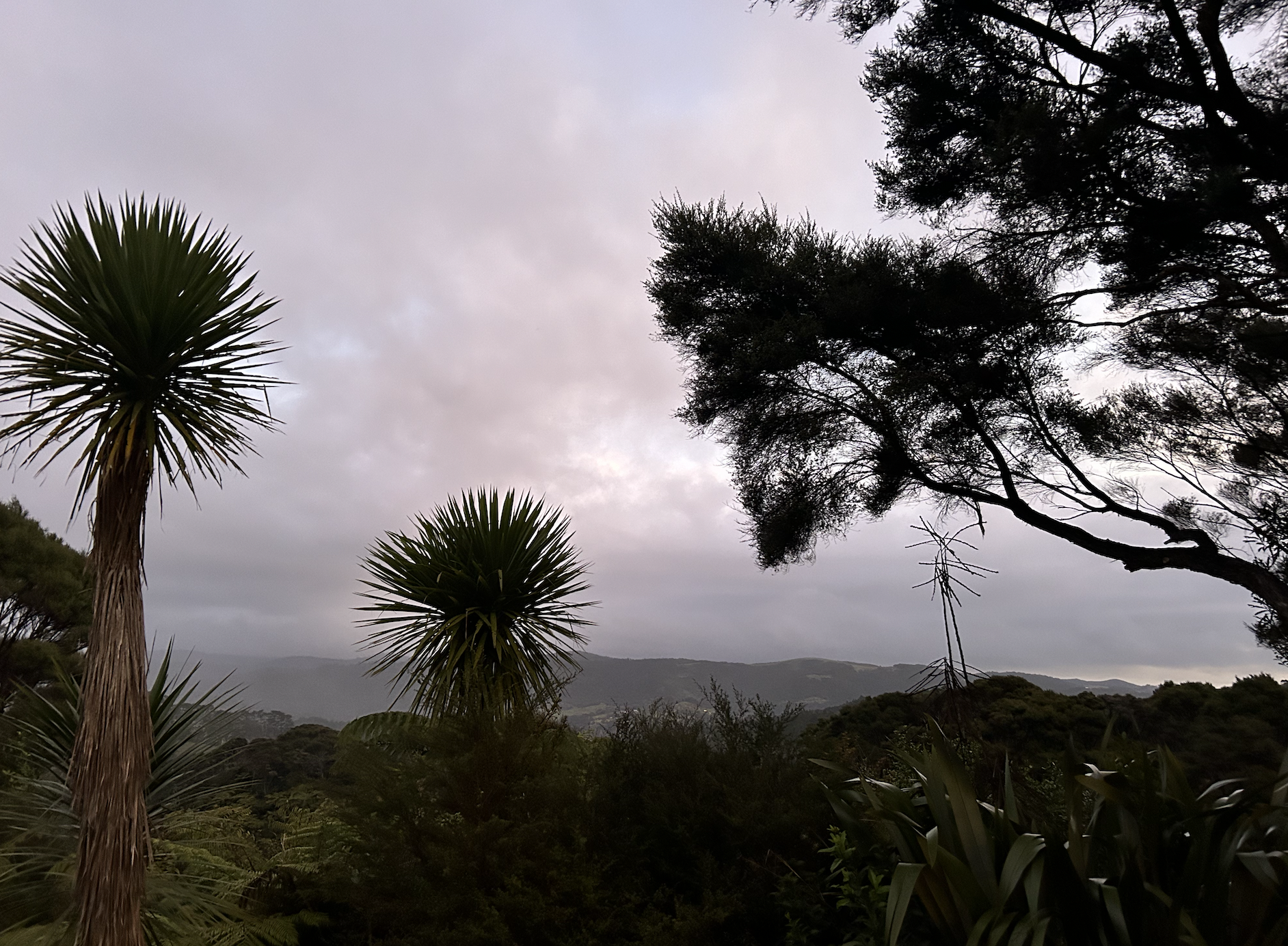
The day I decide the second Poetry Shelf theme will be rain – and I still have Hone Tuwhare singing his sublime rain poem in my head – there is a sudden deluge of rain slam. Again we lose power out west, and I am sitting in the morning gloom with the slanting storm, musing on how much I love rain poems. Whether it is there in the kinetic water dance on the lawn, in the bulging black clouds in the wintry sky, or a spiral of metaphorical possibilities.
The poems
Rainlight
sun bows
mirrored colours
over
to join beneath us
to hold the water
calm in a bowl
such light
our bread
and honey
Cilla McQueen
from Axis: poems and drawings, Otago University Press, 2001
Hoata: ‘Today’s rain is like television static’
(((((((Medium Energy)))))))
Today’s rain is like television static
so hard to believe that pine trees, swishing
traffic, young harakeke, chirruping
blackbird warnings, are real.
The water tank beyond the macrocarpas
is beautifully round, a rondeau?
While there’s a pile of whenua
dug by the farmer next to it
with a yellow digger
that my boy would love to see
when he’s here next except the digger
has gone for now. The radiata
hold out their hands like candle
holders in the rain——new cones.
Robert Sullivan
from Hopurangi: Songcatcher, Auckland University Press, 2024
Two Waters
All winter the rain blubs on the shoulder of Ihumātao.
The main drag splutters under people’s gumboots.
Children squeal and catch raindrops on their tongues
in the place where the cat got the tongue of their ancestors.
Everything is going on. Laugh and cry and yin and yang,
kapu tī and singing in the white plastic whare.
On the perimeter people hold hands in a tukutuku pattern.
The plans of the developers hologram over the lush grass.
Day and night, police cars cluster like Union Jacks –
red white and blue, and oblique, and birds fly up.
A hīkoi carries the wairua across the grey city.
Auckland Council can take a hike. It’s the wettest winter.
The signatures of the petition sprout from the two waters.
The sky falls into the earth, the earth opens its memory.
Anne Kennedy
from The Sea walks into a Wall, Auckland University Press, 2021
On March 15
A man had taken a knife and sliced straight through the
fabric of the sky.
He made it rain buckets of blood and iron, it clung to the
air like thick glue. Its residue coated every road, pavement
and kōwhai tree in the country. It covered the palms of my
hands and the skin of my teeth and when I walked through
the streets of Newtown it felt like treading through layers
of cement. A stranger had stopped me in the street near
my house, where her face was glowing yellow from the
flickering street lamp above her. She clasped two hands on
my shoulders, with despondency filling the whites of her
eyes and threatening to drown my entire existence. I’m so
sorry, she said, over and over again till the words tripped
and tumbled over each other, bleeding into sentences I
could not dissect.
All I could do was nod and say, Thank you,
because I didn’t want her to take me under.
Khadro Mohamed
from We’re All Made of Lightning, We Are Babies Press Tender Press, 2022
Rainy Country
First on concrete, polka dots appear,
in steady tick-tock to pock dry ground.
Rain begins to throw its weight around:
those tiny splashes that mist the air.
Draw it in pencil, with tentative hand,
squint at its fume, its haze of distance.
Farmers, oilskin clad in drab weather,
are squinting upwards for love or aroha.
The raindrop harbour brings a soakage;
water curves to globes flung along a leaf;
let it weep, blub, gurgle what it believes.
A stone church preens in rain’s light sheen.
From blinked smirr to blind cataract,
never disdain to feel and taste fresh rain’s
nebulous champagne from popped corkage,
as streaks of moisture run and sidle in fine,
crooning triumph from a far corner
of the sky, where they first kept hidden,
among hurl and whirl of low-hung clouds.
On tyre skim, a nimbus shine tells
of roads black as submerged mussel shells.
Park up beneath dripping fern fronds
to watch run-off make tar-seal ponds.
Water slides from slate roof eaves,
backyards brim with sopping fennel,
long grass might be wrung like laundry.
In early hours we hear winter rains
gush through the echo-roar of drains.
Rains sound in chorus, sudden and slow,
or high and faint, or deep and low.
Rains will drench, then are hardly there.
Pristine streams go coursing down
to the cadence chant of drunken rivers,
or else pool and darken in a mountain tarn.
Those afternoons of rain being recollected;
when I’m right as rain, rains make strange;
beyond house windows, their ghosts estrange.
For in the drought we pray for rain, then curse
seven days later when it hasn’t stopped.
David Eggleton
from Respirator: A Laureate Collection 2019 -2022, Otago University Press, 2023
Rain
She’s been lying
on the jetty for weeks,
cheek flat on the wet
wood, mouth an inch
from a fishgut stain,
knife at her elbow.
The rain just keeps
coming down.
She’s as naked
as a shucked scallop,
raw and white
on the splintered planks.
Her breath is as slight
as the sea’s sway.
Up there in the bush
all the trees lean down
and inwards, longing
for the creek,
which longs
for the sea.
And the grey ocean
nuzzles the sand,
its waves as gentle
as tiny licks or kisses,
their small collapse
an everytime surrender.
Don’t touch her.
Let it rain.
Let it rain.
Sarah Broom
from Tigers at Awhitu, Auckland University Press, 2010
Avaiki Rain
as the spring rain
caresses my face
on a distant shore
I find myself longing
for Avaiki
the way
she used to rock
me to sleep
cradle me
in her midnight
embrace
take my muted grief
and grant it the right
to echo
among her slender peaks
in the presence of great chiefs
and fallen warriors
the solace she gave me
when all that was left
was the rain
Leilani Tamu
from The Art of Excavation, Anahera Press, 2014
Blackbird
The rain came in waves all night,
washed leaves from the guttering,
turned trees into disciples of tai chi.
Afterwards, in the swollen darkness
before dawn, before cat stalking
or man and woman rising,
a blackbird sits in a bareness of branches,
like a brushstroke in thin bamboo—
and the man and woman
know nothing of this,
tucked in dreams at the edge of morning.
As the sun pours into the land,
the man rises.
the woman pulls back the curtains
and marvels at the bird,
so still after the storm—
in her beak
the first straw of spring.
Jan Fitzgerald
from A question bigger than a hawk, The Cuba Press, 2022
The poets
Recipient of a Prime Minister’s Award for Literary Achievement, Anne Kennedy is the author of four novels, a novella, anthologised short stories and five collections of poetry. She is the two-time winner of the New Zealand Book Award for Poetry, for her poetry collections Sing-Song and The Darling North. Her latest book, The Sea Walks into the Wall, was shortlisted for the 2022 Ockham New Zealand Book Awards.
Poet, teacher and artist CILLA McQUEEN has published 15 collections, three of which have won the New Zealand Book Award for Poetry. Her most recent work is a poetic memoir, In a Slant Light (Otago UP, 2016). Other titles from OUP are Markings, Axis, Soundings, Fire-penny, The Radio Room and Edwin’s Egg. In 2008 Cilla received an Hon. Litt.D. from the University of Otago, and was the New Zealand National Library Poet Laureate 2009–11. In 2010 she received the Prime Minister’s Award for Literary Achievement in Poetry. Cilla lives and works in the southern port of Motupohue, Bluff.
David Eggleton lives in Ōtepoti Dunedin and was the Aotearoa New Zealand Poet Laureate between August 2019 and August 2022. Respirator: A Laureate Collection 2019 -2022 was published by Otago University Press in 2023. A limited-edition chapbook of political and satirical poems, entitled Mundungus Samizdat, with drawings by Alan Harold, has been published by Earl of Seacliff Art Workshop for National Poetry Day 2024.
Jan FitzGerald is a full-time artist and poet who lives in Napier. She is the author of four previous poetry collections, the most recent being ‘A question bigger than a hawk’ (The Cuba Press, 2022), and she has been shortlisted twice in the Bridport Prize poetry competition.
Khadro Mohamed is a writer and poet residing on the shores of Te Whanganui-a-Tara. She’s originally from Somalia and has a deep connection with her whakapapa, which is often a huge source of inspiration for her poetry. You can find bits of her writing floating around Newtown in Food Court Books and in online magazines such as: Starling, Salient Magazine, Pantograph Punch, The Spinoff, Poetry Shelf and more. Her debut collection, We’re All Made of Lightning, won the 2023 Jessie Mackay Award for Best First Book of Poetry.
Leilani Tamu is a poet, social commentator, Pacific historian and former New Zealand diplomat.
Robert Sullivan (Ngāpuhi, Kāi Tahu) is the author of nine books of poetry as well as a graphic novel and an award-winning book of Māori legends for children. He co-edited, with Albert Wendt and Reina Whaitiri, the anthologies of Polynesian poetry in English, Whetu Moana (2002) and Mauri Ola (2010), and an anthology of Māori poetry with Reina Whaitiri, Puna Wai Kōrero (2014), all published by Auckland University Press. Among many awards, he received the 2022 Lauris Edmond Memorial Award for a distinguished contribution to New Zealand poetry. He is associate professor of creative writing at Massey University and has taught previously at Manukau Institute of Technology and the University of Hawai‘i at Mānoa. His most recent collection was Tūnui | Comet (Auckland University Press, 2022).
Sarah Broom (1972 – 2013) was born and educated in New Zealand before moving to the England for post-graduate study at Leeds and Oxford. She lectured at Somerville College before returning home in 2000. She has held a post-doctoral fellowship at Massey (Albany) and lectured in English at Otago University. Broom published her first book of poetry, Tigers at Awhitu, with Auckland University Press in 2010 and is also the author of Contemporary British and Irish Poetry (Palgrave Macmillan, 2006).
 NZ Poetry Shelf
Love your selection of rain poems, they arrive on our first rain morning in over 2 months, craving it! 🌧️
LikeLike