Ah. What pleasure it was this week assembling a feature to celebrate Katūīvei: Contemporary Pasifika Poetry from Aotearoa New Zealand, edited by David Eggleton, Vaughan Rapatahana and Mere Taito (Massey University Press). Listening to the audios, reading the conversation the editors contributed to, it was skin-pricklingly good. Inspiring.
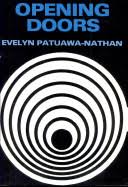
I also listened to a terrific conversation that originally aired on RNZ National in 2010 as part of the ‘Books that Built New Zealand’ series. Justin Gregory asked academic Dr Alice Te Punga-Somerville: how can a book that was never published, and never read, tell us about who we are? In my research for Wild Honey, I had come across the author of the missing novel, Evelyn Patuawa-Nathan. She had published a collection of poetry, Opening Doors. I went back to my copy of Wild Honey and reread what I had written. I would love to give a few signed copies away (message me or email paulajoygreen@gmail.com), but here is an extract:
Patuawa-Nathan grew up in Maropiu, Northland. When she was twelve, she left home and worked in hospitals, hotels and factories. Twenty years before her debut and, to my knowledge, only poetry collection, she wrote a novel that Collins in London was keen to publish, but the edited manuscript got lost in the post and she abandoned it. With poet Hone Tuwhare and author Harry Dansey, she tried unsuccessfully to establish a society for Māori writers. After periods abroad, she moved to Sydney permanently, where she taught in a private school and worked with women prisoners, and apparently wrote under another name. I find scant mention of her in New Zealand archives, have a single book of her poetry, and her poetic melodies cling to me. Like so many other women writers, she is a puzzling gap.
Patuawa-Nathan’s poetry, moving with grace and exquisite economy, reveals a formidable attachment to home. Like Vernice Wineera, her poetic return to origins, throughout the collection, resembles a tidal movement that both reveals and conceals: a return to her village and valley, with its summer hues, ‘holds aloft scarlet-tipped fingers/ halting the hours/ so I may know again/ this hesitant valley of my birth’.[i] In ‘Distant Village’, separation is an ache-channel across the Tasman Sea that poetry fertilises with poignant detail, with little repetitions like the breath of the wind returning: ‘Distant village/ your essence reaches me/ from the broad hill sounds/ hung over northern valleys.’[ii] But the detail carried on the breath of the wind, like the detail carried on the force of the line, is surrogate, a pale substitute where words grapple to hold the physical anchors of home. As readers we are left with a melancholic trace: ‘You reach me/ touch me/ find I am of stone.’[iii]
Many of Patuawa-Nathan’s poems are evocative postcards on the surface, but as you delve deeper, and like the kumara she references, tendrils of ideas stretch and search: this is who am I, this is where I am from. In ‘Waikato Lament’, the poet calls upon repressed stories that need to be told, in melodious lines that counterpoint the ghostly violence, the damaged people, the smothered and unjust events: ‘Green wandering fingers/ of kikuyu/ prying into an old kumara pit/ playing over limestone belly/ and naked rock/ have not quite covered,/ cannot hide,/ the faded emblems/ of a land lost people.’[iv] The poet stitches the essential heart-hit of narrative into her poem, and the legacy of oppression that she carries along her ancestral bloodline, as she sings:
Blood soaked, in time’s memory, spirits of Taupiri raise keening voices anthem of injustice echoing down through the night.[v]
On other occasions, the injustice is made bitingly, and sometimes sardonically, clear. In ‘Aboriginal on the Last Train Home’, a tiny anecdote harbours the greater, national injustice. The Government pays for an Aborigine’s train ticket back home to the mission. Patuawa-Nathan turns it into wry and caustic joke: ‘Another ten such years of travel/ and they would have paid him a fair price/ for New South Wales.’[vi] In ‘Education Week’, a group of students are taken to visit the local jail, and in that moment of checking, a prescient mirror glass suggests social injustice infects both education and crime statistics: ‘In a small concrete cell/ bare/ but for the humour/ of wall graffiti,/ they reach among comments/ for names of cousins/ and brothers/ and fathers.’[vii]
The blurb of Opening Doors, suggested Patuawa-Nathan had a new collection for publication in Sydney, but sadly, I can find no trace of it; sadly, because her slender debut of 24 poems signalled a poet to savour and invite more from. Her succulent detail coupled with crafted melodies forms a way of anchoring home, and in that anchorage, the poems shelter strong opinions, reclaimed history and familial connections. In the final poem, ‘Taraire Berries’, with te reo words italicised, the words form a skinny spine on the page, akin to a family back bone.[viii] The music resonates on the tongue, sibilant sounds brush against sharper consonants, single-syllable words are adjacent to longer word-notes. Visually the effect is equally sumptuous:
Blue-black taraire berries tart on the tongue. Bush tracks sun-dried and hoof-worn to powdery earth by grazing cattle.[ix]
The poet’s harmonies echo the way home dreams down through her writing pen, just as she passes memory and dream to her son: ‘Memory/ dreams down/ through a son/ seeking his mother’s country./ Seeking the taraire,/ the titoki and karaka.’
This week I have devoted large chunks of time to reading the poetry collections by Vincent O’Sullivan on my shelves in preparation for next Friday’s tribute. I also found a few more in second-hand bookshops. I think I might do more of this second-hand book shop trawling for poetry! I spotted Twenty-Five Poems of Protest by Rewi Alley (Caxton Press, 1968) in Jason’s Books and nabbed the copy. Such a spiky book to read now, when all these decades later, there is still so much to protest about. Rewi protested the inhumanity of the war in Vietnam. You can feel his rage, his helplessness and his need to speak out. In his introduction, Gordon McArthur writes: “One of the poems is about love, a love that goes deep and selfless and does not slam the gate on outsiders, or forget the loved flesh littering Vietnam fields. Hard to take, rough, brutal and honest. You may not like the bitter medicine; but for some of us, these poems of protest are an alarm that rings in the sleeping conscience. This is the time to be awake.”
Rewi writes in his preface: “If these lines that have been written can do a ploughing job so that the seeds of understanding can be sown, if they can stir some hearts and minds to see reality as it is, and too, if they can help some hands to action, they will have been worthwhile.”
ON LOVE . . .
Love makes a man dare to fight— Love for the many looted of so much love. Yet love can grip a man so that he turns deaf ears to the cries of Vietnam children burnt, while thinking only of his own, his precious ones, slamming the gate on all outsiders. A queer thing, this love! Love for the good woman who is all good things brought together. Love for a whole world of lovely things: white seagulls over blue seas, children under apple trees, or swimming in the river. The love of the close-knit family living as part of one another— the perfect mother, the understanding friend. All these are loved as part of living. But what of the world of the denied, where anxious children watch each morsel others eat? The two thirds of the world where sickness strikes the helpless—where practical and down to earth love is the crying need? All must join together in their basic cause and fight, or be enslaved for long to come. So easy to prate of love, the magic of her touch— life taking on new meaning, and all the happy things of love! But remember too that loved flesh littering Vietnam fields, scattered there by enemies of all good men.
Editors Mere Taito, David Eggleton and Vaughan Rapatahana Katūīvei Contemporary Pasifika Poetry from Aotearoa New Zealand cover art: Dagmar Vaikalafi Dyck ‘a gift of thanks’ Massey University Press, 2024
Violet puts down the paperback. Those stories have been imprinted over the veins in her wrist. Over and over. Again and again. So much has been written over the margins of her stories. She can no longer read her own writing. The blue ink against caramel wrists, smear into the waves that lapped against the shores of her homeland, the waves that battered the boat across the South Pacific. Waves goodbye.
Ruby Rae Lupe Ah-Wai Macomber from ‘Storytelling’
Thank you to the poets who made audios, and to the editors, Mere, Vaughan and David, who have answered a few questions with both heart and care – you have made this post special. So moving. So very moving. I imagined being able to listen to an audio book, as I often do with a poetry collection or anthology I love so much. Thank you.
Many peoples of the Pasifika diaspora now live in Aotearoa, multiple generations that have come from multiple departure points. The editors of a new anthology of Pasifika poetry, David Eggleton, Vaughan Rapatahana and Mere Taito, have assembled a vital and magnificent weave of voices. Katūīvei is lovingly produced in a hardback version by Massey University Press. In their introduction, the editors write: ‘Pasifika peoples represent almost 10 percent of the population, are one of the fastest growing demographic groups in the country, and contribute profoundly to New Zealand society in all kinds of ways, including through a vibrant efflorescence of cultural activity, from music and dance to art, theatre, film and literature.’
The editors acknowledge poets who have paved the way – with publications, performance spaces, mentoring, teaching. From the first Pasifika poet to be published here, Alistair te Ariki Campbell, with his Mine Eyes Dazzle (Pegasus Press, 1950) to Albert Wendt whose writings, poetry, teachings and mentorship have been a touchstone for generations, to Grace Iwashito-Taylor, Daren Kamali and Ramon Narayan forming the South Auckland Poetry Collective, to Selina Tusitala Marsh who has inspired new generations of poets through her own writing, performances, teachings and honours, to Doug Poole’s Blackmail Press, to anthologies edited by Albert, Reina Whaitiri and Robert Sullivan. To the ongoing wave of poets who, with new books published, slam, spoken word and festival appearances, enrich our writing communities. As David Eggleton writes: ‘By the beginning of the second decade of the millennium, Pasifika poetry had undeniably become a major presence in New Zealand literature, helping to illuminate our understanding of Aotearoa New Zealand and its place in the world on a number of levels and in a variety of ways.’
‘Katūīvei’ is a hybrid term, especially coined for the occasion, bringing together ‘kavei’ – meaning navigate, and the double voice box of the ‘tūī’. A perfect word for a collection of writing that is an act of ‘wayfinding’ between cultural spaces and creative discoveries. Katūīvei is an anthology of multiple forms, melodies, subject matter, visual images, epiphanies, confessions, challenges, grief, wounds, healing, but there is a connecting current, a deep and shared love of words, of poetry, kinship, self navigation.
As I read, I am gathering words like talismans, as steeping stones, like echoes that connect and enhance and draw me in deeper, deep into the richness of this sublime meeting place.
I am moving with the political Emalani Case navigates ‘On Being Indigenous in a Global Pandemic’, and challenges the mantra that ‘we’re all in this together’, calling this, ‘But in a global pandemic / being indigenous means / writing, / speaking, / crying, / and protesting // your people into existence’.
. . . to the personal In ‘Straightening Out’, Luke Leleiga Lim-Cowley navigates homophobia though a tangle of hair – ‘Our hair is poetry. / Don’t forget this. / Even when / words land in you like wounds / There’s a poem here / So I write this to you’.
. . . to names and naming such wounds, such vital pathways into how names and naming matters, from the searing brilliance of Selina Tusitala Marsh to Denise Carter, Aziembry Aolani, Aigagalefili ‘Fili’ Fepulea’-Tapua’i, Serie Barford.
. . . to family the anthology is infused with family, giving presence to mothers fathers brothers sisters cousins genealogies kinship. Listen to Schaeffer Lemalu‘s breathtaking ‘im’:
i guess a lot of younger people are discovering their pasts and what it means for their future
thats beautiful
i feel stuck in the blotchy pigments of michael jacksons face
unsure of who i am now that i im who i always was to begin with
just me
a constantly evolving entity
Schaeffer Lemalu, from ‘im’
. . . to body I am splintered splattered recast by Serie Barford‘s ‘Into the world of light’ and its ripples of wounded heart – ‘I resolutely lanced my heart / a swollen fist about to burst / with a shark tooth plucked from a dream // poured honey into the first chamber // soothed gnawed memories / sent them west with wild bees’.
. . . to the compounding questions What is your name? Where are you from? What do you speak? Who are you? Where are you from? I am thinking of Tusiata Avia‘s ‘We are the diasporas’ and Audrey Brown-Pereira‘s ‘who are you, where you come from, / where have you been your ()hole life’. For a start.
. . . and to love and loving whether it is the love of home and place in Daren Kamali‘s ‘Duna does Otara’ or Grace Iwashita-Taylor‘s ‘Dear South Auckland’, or Lana Te Rore‘s ‘A Letter to a Younger Self’, or Karlo Mila‘s loving ode to Albert Wendt:
You’ve traversed it all, charting outsider territory with black star after black star, before us. The relief of another way of mapping.
Karlo Mila, from ‘After Reading Ancestry’, for Albert Wendt
Katūīvei is an extraordinary weave of experience, ideas, issues, challenges, recognitions, community. It is a book to travel with, to hold to your heart, to talk about, to set you in search of collections by individual poets, to savour the familiar, and to set sail with the new. Every time I open the anthology, I discover a new reward. This book is a labour of infinite love, by the editors, by the publisher, by the contributors, and now it is over to us as readers, to navigate, to map, to imagine and to realise how good our place, in all its awe-inspiring and humane dimensions, can be.
Looking at rain too long has given me eternity. A mirror cut away from my country and sea. I lived in a fruit that fell from a child’s hand, now I cry when the moon is in my dream.
I was made out of wood and my heart was full of saltwater; chasing a shadow from my body led me to this secluded room, here I watch the horizon be a photograph
John Pule, from ‘Looking at rain too long has given me eternity’
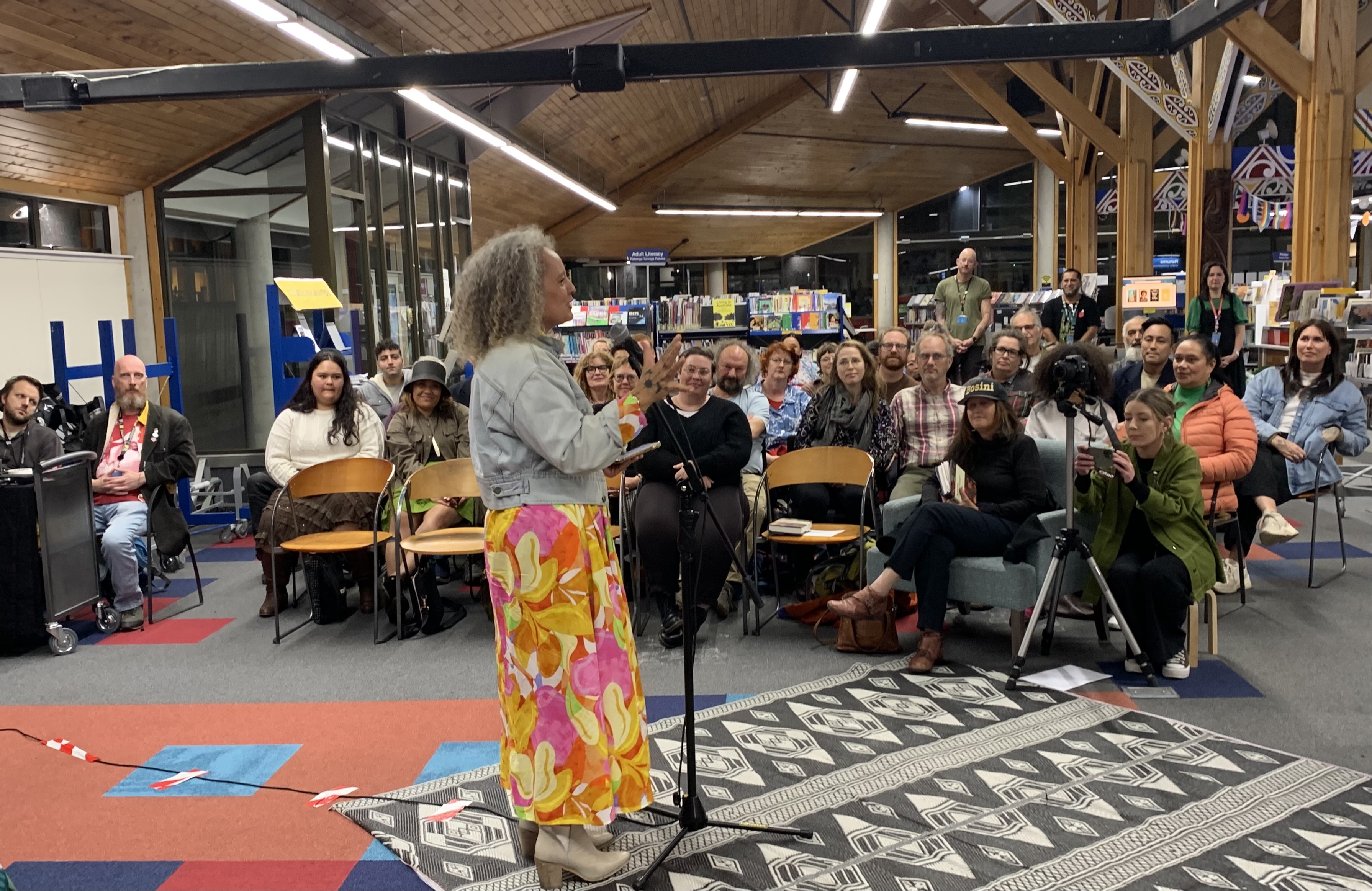
Launch at the Newtown library
Karlo Mila
The readings
Daren Kamali
Photo by Julia Mageau Gray
Daren reads ‘Duna Does Otara’
Daren “dk” Kamali – poet and multidisciplinary artist based in Aotearoa. Wrote this poem “Duna Does Otara”, while studying a Bachelors Degree in Creative Arts at MIT, Otara in 2011, also featured in Landfall Journal under South Auckland.
Working on my next collection of poems “I’m Not Your Coconut” inspired by James Baldwin. Also indulging in a research-revival-art, a touring exhibition and series of self published books known as the “Ulumate Project: Sacredness of Human Hair” since 2013 with a collective known as Na Tolu.
Emalani Case
Emalani reads ‘On Being Indigenous’
Emalani Case is a Kanaka Maoli writer, teacher, and aloha ʻāina deeply engaged in issues of Indigenous rights and representation, colonialism and decolonisation, and environmental and social justice. She is the author of Everything Ancient Was Once New: Indigenous Persistence from Hawaiʻi to Kahiki (2021). She is from Waimea, Hawaiʻi.
Joshua Toumu’a
Joshua reads ‘Veitongo’
Joshua Toumu’a is an 18 year old poet of Tongan, Papua New Guinean and Pākehā descent studying at Te Herenga Waka. He was the winner of the Schools Poetry Award in 2022, and a finalist in the Katherine Mansfield Short Story Competition in 2023. His work has also been published in Starling and The Friday Poem.
Serie Barford
Serie reads ‘Into the world of light’
Serie Barford was born in Aotearoa to a German-Samoan mother (Lotofaga) and a Pālagi father. She was the recipient of a 2018 Pasifika Residency at the Michael King Writers’ Centre. Serie performed from her collections at the 2019 Arsenal Book Festival in Kyiv, where the Ukrainian translation of Tapa Talk was launched. In 2021 Serie collaborated with film-maker Anna Marbrook for the ‘Different Out Loud Poetry Project. Her most recent collection, Sleeping With Stones,was shortlisted for the 2022 Ockham NZ Book Awards. In 2022 she collaborated with Dutch artist Dorine Van Meel, whose video and performance piece, ‘Silent Echoes’, was exhibited in various European cities to address colonial practices and climate crisis through poetic contributions.
Amber Esau
Amber reads ‘Liminal’
Amber Esau is a Sā-Māo-Rish (Ngāpuhi / Manase) writer of things from Tāmaki Makaurau. She is a poet, storyteller, and professional bots. She is co-editor of Queer Poetry Anthology, Spoiled Fruit (Āporo Press, 2023). Always vibing at a languid pace, her work has been published both in print and online including in Puna Wai Korero, Rapture, Te Awa o Kupu, Skinny Dip! and Annual, NZ poetry Shelf, Ora nui, Poetry New Zealand Yearbook and Going West Poetry Videos. She is a recipient of the emerging Pasifika writer’s residency from the Michael King Writers Centre and the ideas in residence residency from the Basement Theatre.
Tulia Thompson
Tulia reads ‘The Girl That Grew into a Tree’
Tulia Thompson is of Fijian (Rukua village from Beqa), Tongan, and Pākehā descent. She has a Master’s degree in Creative Writing from Auckland University and a PhD in Sociology. Her book Josefa and the Vu, a fantasy adventure for 8-12 year olds was published by Huia in 2007. She writes poetry and essays.
Aconversationwith the editors
Paula: What were the key joys in assembling this special anthology? The challenges? The surprises?
Mere: A high was discovering poets who were writing outside the scrutinising glare of the literary establishment. I am referring to poets (and there are many of them in Aotearoa!) like Maureen Fepuleai, and Faalavaau Helen Tau’au Filisi who take on print publication projects on their own without the involvement of presses like AUP, and OUP, or poets who write/perform/publish on social media. I thought of Janis Freegard’s research during the reading phase of Katūīvei and I wondered if our narrative of ‘publication’ was really a story of deficit especially if we consider other ways in which Pasifika poets are ‘publishing’. Another joy, was finding poets who have incredible range of voice like Cook Island writer Rob Hack. He can be belly-aching funny and deathly serious in his work. Buy his collection Everything is Here. Finding contacts of a few poets was a challenge but we were determined and treated this almost like an operation by sharing networks and leads. Surprises? – the volume of Pasifika poetry produced in the last 10 years! On that note, a big vinaka vaka levu to Massey University Press for taking on this project!
Vaughan: There were many joys, among them discovering and exploring the sheer range of topoi, the diverse range of approaches to writing a poem – the styles – as displayed, for example, by the intricacy of the work of Pelenakeke Brown, and the pleasure I found in the work of poets whom I did not earlier know much about, such as Rob Hack and his fine toikupu. Indeed, his work was a surprise and brought home firmly for me the fact that there are many very gifted Pasifika poets residing in Aotearoa. Younger poets such as Rhegan Tu‘akoi, who are the next generation of Oceanic poetasters. More awe!
Another joy was the fact that we three editors were able to locate and include a wide range of poets from young, new, exciting talents, to poets with little if any publishing record, to the esteemed founts of Pasifika poetry within Aotearoa New Zealand, such as David Eggleton himself, Tusiata Avia, Albert Wendt, Selina Tusitala Marsh, Serie Barford, Karlo Mila, Courtney Sina Meredith, John Pule, Daren Kamali, Grace Iwashita-Taylor, Simone Kaho, Leilani Tamu, among several others – indeed that list is lengthy!
Challenges? The only wero I faced was ensuring we could include as many gifted poets as possible in Katūīvei, especially after we continued to discover more and more of them.
David: The aim in putting Katūīvei together was to celebrate the intertwining currents of Pasifika poetry connecting Aotearoa to the peoples of the Pasifika diasporic migrations and their descendants. We knew there had been a lot of Pasifika poetry published in the past decade, with important collections from Selina Tusitala Marsh, John Puhiatau Pule, Leilani Tamu, Tusiata Avia, Simone Kaho, Daren Kamali, Karlo Mila, Courtney Sina Meredith and others, but between us we uncovered a great flowering of very recent poetry that we felt it important to acknowledge as transformative in novel and exciting ways. We wanted to showcase these poems not only as a form of truth-telling about the diasporic experience, but we also wanted to show how various Pasifika innovations — the cross-overs, blendings and provocative fusions, with the English language as the common denominator — are helping to re-energise and re-direct New Zealand’s poetry traditions at this point in the nation’s cultural narrative.
Paula: Did you discover things about yourself as a poet? About writing, reading, who you are?
Mere: My practice was already shifting when we started work on Katūīvei. I have been working with archival texts in my doctoral research and responding in kind with multilingual visual poetry via digital platforms so during the reading for Katūīvei, I found myself drawn to collections and writing that experiment with visual forms such as typeface, spacing, text arrangement, and graphics. Pelenakeke Brown’s work and Selina Tusitala Marsh’s graphic poem ‘Ransom’ in Dark Sparring are form-focused and visual examples. Writers who are bilingual also got my attention. It is wonderful to see other languages on the page other than English. I also discovered that I am drawn to writing that brings fresh and new perspectives to familiar tropes such as atua, ancestors, vaka, sea, and identity. These new approaches got me sitting up straight. The fresher, weird and more off-centre the poems were, the more appealing and interesting they were for me.
Vaughan: I guess I was reminded that poetry, ngā toikupu, is such a wide-ranging activity and that one always must be expanding one’s own craft outwards, as to encompass as many new directions – subjects, themes, stylizations, socio-political stances – as are relevantly viable. That I have many potential vistas to visit and visions to vivify, some of them in response to and as te tautoko o Katūīvei and especially the more politicized pieces proselytizing its pages. As for example the fine first poem in this anthology, Marina Alefosio’s Raiding the Dawn and also many others such as Sala‘ivao Lastman So‘oula’s Blackbird. Indigenous peoples share so many experiences, and they are not all salutary: indeed, some have been, continue to be, and need to be confrontational.
David: Well, this is not a book about one poet. This is a book about bringing poets together and how we might do that. It is an anthology responding to poetic expressions of a sense of community identity, and what that might be. The three of us worked with talanoa, with dialogue, with protocol: to try to reach out to all the interesting poets in the Pasifika community in New Zealand. This was not easy and we did have to have some practical constraints in terms of choices to make the project feasible. We began work on this book at the beginning of lockdown, so it has been a long journey, checking and double-checking. We have not tried to force any messaging or impose any theoretical framework, but instead we responded to the richness and complexity, and tried to represent it correctly. If we have an emphasis, it is one that is specific to the Pasifika way of doing things, of seeing, listening and telling. We might talk about new work, ground-work, story-work, blood-work, heart-work: this is what the poets themselves had to do, and make it manifest. I include myself here.
What I get from this assembly of poems is a sense of diversity with an underlying unity, which comes from an implicit outsider status that most Pasifika poets have felt in the past, certainly. So, there are poems that celebrate, that remember, that investigate, that recriminate, that affirm, that argue. There are poems about rejection and poems about acceptance. There are poems that show us language’s capacity to empower, or that return to the succour and solidarity of family, or that show the conflicts and the uprooting — the wrench — associated with re-location to a place where you had to measure up to different standards. There are poems that deal directly, or else obliquely, with the pledge and promise of life in a different country, and with the baggage of old colonial hierarchies and assumptions. Two takeaways: the ocean is central and so is resistance, in myriad forms.
Paula: Like so many people in these troubling times, I keep agonising over what and how to write, what and how to blog. Your anthology is a gift. Is the local and global inhumanity affecting you as a writer, as reader?
Mere: For sure. I mean the vulnerability of my mother tongue Fäeag Rotuạm Ta brought on by the globalisation of English is a key factor in my going ‘multilingual’. I have made it a life-time mission to include at the very least, a Rotuman word in all of my works going forward. My research focuses on Indigenous texts so I have been reading writers like Natalie Harkin’s archival poetics that broadly looks at institutional trauma on Australian Aboriginal people and re-discovering and re-reading Naomi Shihab Nye’s poetry against the atrocities of the Palestinian genocide. Reading works of writers like Harkin and Nye allows me to recentre and appreciate communities and people who have been ‘occupied’ and ‘unceded’. I think of my ancestral home Rotuma and its political relationship with Fiji and how our position of dependency could turn ‘occupied’ in the hands of a problematic government. I shove this at the back of my mind and cross my literary fingers because it is too traumatic to imagine.
Vaughan: Inhumanity! Affecting me? Always has done, always will do, especially as he kaituhi Māori writing in te reo Māori against an all-too-often monotonously monolingual and monocultural backdrop. Katūīvei does make me feel better, as so much of its content is a bastion of Pasifika mana and indeed humanity, is a crucible of individuals both seeking and confirming their Pacific/Aotearoa identities, in the face of the above-mentioned majoritized backdrop both within and outside this skinny country we reside in. Accordingly, I want to continue to write as a repeller against inhumanity, wherever it may be, and not only via poetry either. *
* More especially nowadays, as I continue to combat this bloody cancer invading my body and which I am currently being zapped via radiotherapy every day for!
David: Lawrence Ferlinghetti once said ‘the state of the world calls out to poetry to save it’. However, Percy Bysshe Shelley claimed: ‘poets are the unacknowledged legislators of the world’. But his friend and contemporary Thomas Love Peacock mocked him, saying poetry is: ‘minds capable of better things, running to seed in the specious indolence of these empty aimless mockeries of intellectual assertion’.
The sad truth is that history shows even ruthless authoritarians and regime tyrants virtue-signal by writing poems, and then get books of them published. In the end, poetry is the most paradoxical of art forms: it is there to provoke, but also to console; it is the music of what happens. As W.H. Auden wrote: ‘Will you wheel death anywhere in his invalid chair? … Time will say nothing but I told you so.’
Mere Taito (Malha’a, Noa’tau (Rotuma)) is a Rotuman Island scholar and creative writer (Poetry, flash fiction, short story) based in Kirikiriroa. Her creative work has been published widely in anthologies and journals such as Landfall, Bonsai, and Best New Zealand Poems. Her PhD studies at the University of Otago focuses on the contributions of Rotuman archival texts and digital technology toward the writing of visual multilingual Rotuman poetry.
Vaughan Rapatahana (Te Ātiawa, Ngāti Te Whiti) is a poet, novelist, writer and anthologist widel published across several genres in both his main languages, te reo Māori and English. He is a critic of the agencies of English language proliferation and the consequent decimation of Indigenous tongues. His most recent poetry collection, written in te reo Māori (with English language ‘translations’), is titled te pāhikahikatanga/incommensurability. It was published by Flying Islands Books in Australia in 2023. Vaughan lives in Mangakino.
David Eggleton is a poet and writer of Rotuman, Tongan and Pākehā heritage. His collection The Conch Trumpet (Otago University Press, 2015) won the 2016 Mary and Peter Biggs Award for Poetry at the 2016 Ockham New Zealand Book Awards. He also received the 2016 Prime Minister’s Award for Literary Achievement in Poetry. David was the Aotearoa New Zealand Poet Laureate from 2019 to 2021. He lives in Dunedin.
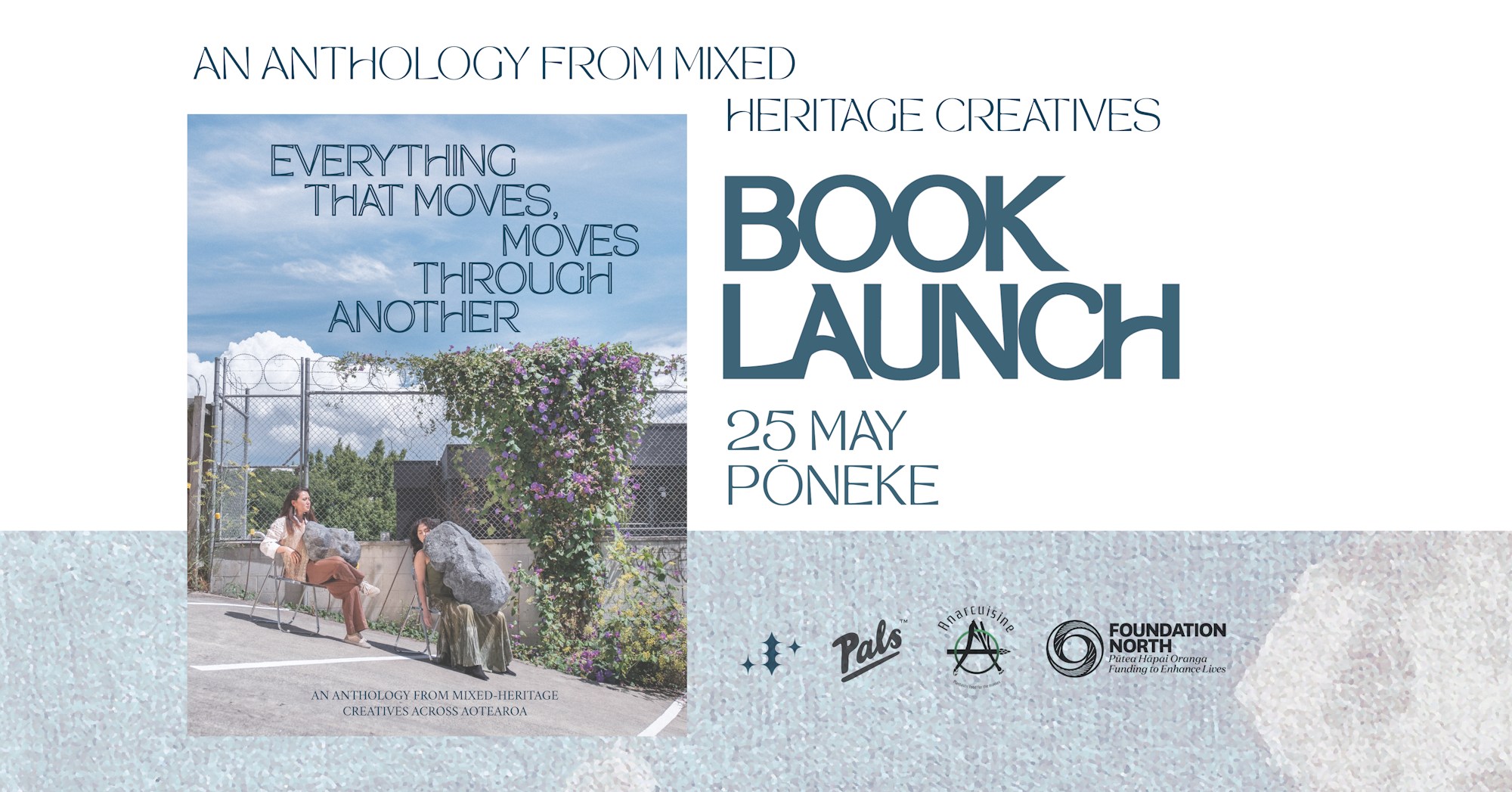
Please join us to celebrate the launch of ‘Everything That Moves, Moves Through Another’, edited by Jennifer Cheuk 卓嘉敏.
This pukapuka is a landmark anthology that brings together the creative work of twenty-seven mixed-heritage creatives from across Aotearoa.
Saturday 25th May 113 Taranaki Street PŌNEKE / WELLINGTON 6:30pm – late Free entry, all welcome
Featuring poetry by Cadence Chung and romesh dissanayake Performance by The Nooklings and Cecilia’s Crop
Nibbles will be served thanks to Anarcuisine, and we have sponsored drinks from our pals at Pals!
Free entry, all welcome Immense thanks to Foundation North for the putea that made this all possible, and to Pals for providing the drinks for our launch night!
Books will be for sale, or can be purchased presale here
The Nooklings Smooth jazz standards played by sweet selection of musical friends — Alex, Bonnie and Jared — formed around the voices of two wāhine who share delight in the songs they have sung through life.
Cecilia’s Crop Cecilia’s Crop is a groovy little band based in Aotearoa’s capital. Blending funk, RnB, some acoustic soul, and an odd dash of pop punk, we love to write music that gets people dancing, swinging, and maybe even falling in love. The band usually consists of Carlin, Jack, Rodney, and Sam but this will be a stripped back set with just our guitarist, Carlin, and Sam, the singer.
ABOUT THE BOOK
EVERYTHING THAT MOVES, MOVES THROUGH ANOTHER is a landmark anthology that brings together the creative work of twenty-seven mixed-heritage creatives from across Aotearoa. Weaving together a range of artistic mediums and giving space to both emerging and experienced creatives, this anthology lays the groundwork for deeper and more empathetic conversations around the experience of mixed-heritage individuals.
Through an open call for contributors in 2023, this publication was created in response to the lack of authentic representation for biracial, mixed-heritage and multi-ethnic individuals living in Aotearoa. Everything That Moves, Moves Through Another features photography, comics, essays, poetry and multimedia art.
AUTHOR AND CONTENTS LIST
Nina Mingya Powles – a creative response Kim Anderson — Where r u really from? Cadence Chung — Visitations Kàtia Miche – What melts into air? Damien Levi — Ngā mihi Jefferson Chen — blending in standing out Ivy Lyden-Hancy — te manu and the sky waka Jessica Miku 未久 — What Kind of Miracles Ruby Rae Lupe Ah-Wai Macomber — My Moana Girls Ying Yue Pilbrow — Wayward Emma Ling Sidnam — Sue Me Jimmy Varga — The Asian Jill and Lindsey de Roos — What are you? Daisy Remington — What Makes Up Me Chye-Ling Huang — Black Tree Bridge Evelina Lolesi — Self Portrait: Mapping Tidal Whenua Eamonn Tee — Innsmouth Emele Ugavule — For Ezra Harry Matheson — Between A Rock And A Hard Place kī anthony — Never Quite Home Maraky Vowells — Created Communicated Connected Dr Meri Haami and Dr Carole Fernandez — Kechil-kechil chili padi: Ahakoa he iti, he kaha ngā hirikakā Nkhaya Paulsen-More — Walking Between Two Worlds Yani Widjaja — Oey黃 is for Widjaja Chyna-Lily Tjauw Rawlinson — My Whānau romesh dissanayake — A Remembered Space Jake Tabata — STOP FUCKING ASKING ME TO WATCH ANIME WITH YOU
EDITED BY: Jennifer Cheuk 卓嘉敏 PUBLISHED BY: 5ever books
Needlepoint rain is static against the pines running alongside this endless beach that stretches further to my left and then to my right With no way to turn I must stand very still
There is detritus all around: a motorbike’s green rusted petrol tank, a bright pink single mattress half buried in the sand blue and white ice-cream containers scattered like impossible stepping stones
There is theme music too: fantails’ song and the whoops and cries of men playing cricket A fallen pine gathers seaweed and plastic bags in its rib-cage A man riding a horse talks on a cell phone
The rate of teenage suicide is at its highest ever The local kids drag race their souped-up Ford Escorts leaving thick black stripes that come to abrupt endings
Therese Lloyd from Other Animals, Te Herenga Waka University Press, 2013
It’s a strange experience to live with a poem for almost two decades. I must have read this one first in 2007 or so. It came in as a submission for an issue of Landfall I’d been asked to edit, and I could see at once that it had to go in.
Why? Because it stopped me dead in my tracks.
With no way to turn I must stand very still
And why must this speaker stand so very still? Because they have nowhere to turn to, that’s why. There’s so much activity going on all around – cricket, cell phones, motorbikes – and yet they’re stopped still by something, something unnamed: just the sheer extent of the vista, perhaps; or by something else, off the edge of the screen.
A bit later on, I needed some poems for a class anthology I was editing. It was for Stage One Creative Writing students at Massey University, and I’d broken down the “poetry” section into a series of weekly themes. Therese Lloyd’s poem came in under “Figures of Speech.”
That may sound a bit reductionist, but I was very struck by the way she’d folded so many strategic metaphors and similes into this otherwise seemingly photo-realist description of a local scene:
“Needlepoint rain” – with the implication of embroidery (of course), but also of a certain stabbiness in the narrator.
“ice-cream containers / scattered like impossible stepping stones” – it’s that extra word “impossible” which (I feel) conveys the sense of futility, tragic waste which pervades the poem.
“A fallen pine gathers seaweed / and plastic bags in its rib-cage” – that’s a personification, rather than a metaphor, if you want to be pedantic (and I usually do). It projects the fallen pine as an animate being with a ribcage – which, after all, is what it is. The poem as a whole is full of a sense of animism: of things which seem at least as alive as people.
I don’t recall any Levin patriots protesting at the picture Lloyd painted of the place. I think it had just come top of some nationwide poll of youth suicide rates at the time, but it’s really the coast to the west of town which is the setting – a postcard-perfect Kiwi beach setting.
I called the picture it paints “photo-realist” above, but perhaps a better term would be “hyperreal.” It has the air of a place that you see with exceptional vividness because you’ve just had a terrible shock of some kind. I don’t know what that shock could be, but those last lines about the “souped-up Ford Escorts”
leaving thick black stripes that come to abrupt endings
might give us some sort of clue.
This is a poem to read when you need to be reminded of the intensity, the momentousness of the things all around you. Fantails, logs, raindrops all live side by side with more human relics in Lloyd’s vision: the mattresses, ice-cream containers, petrol-tanks we leave behind us.
You can ride on by on your horse if you need to, wheeling and dealing on your phone, but if you’re prepared to invest in the world of “In Levin”, you have to stop, look around, and try and see all there is to see.
Jack Ross is the author of six poetry collections, four novels, and four books of short fiction. His latest book of short stories, Haunts, is due out from Lasavia Publishing later this year. He lives with his wife, crafter and art-writer Bronwyn Lloyd, on Auckland’s North Shore, and blogs here.
Therese Lloyd lives in Wellington and grew up in Christchurch and Napier. She is the author of two collections of poetry, Other Animals (VUP 2013), and The Facts (VUP 2018) which was shortlisted for the Ockham Book Awards in 2019.
Have you submitted your funding application yet? If not, be sure to do so by the deadline: 5pm on Tuesday 4 June! To register, here.
About National Poetry Day
First established in 1997, National Poetry Day is a one-day countrywide poetry event extravaganza held on a Friday in late August each year. In 2024, Phantom Billstickers National Poetry Day will be held on Friday 23 August.
An extraordinary array of events soothed, delighted and uplifted poetry lovers and the public alike. Poetry popped up in churches, art galleries, bookshops, libraries and out on the streets. Poetry through music, open mic, book launches, poetry walks and so much more took place!
To find out more about what happened on National Poetry Day 2023, see here:
Phantom Billstickers National Poetry Day is governed by the New Zealand Book Awards Trust Te Ohu Tiaki i Te Rau Hiringa, and supported by Phantom Billstickers. To find out more about our amazing sponsor, click on the bulldog below.
First offered in 2019, the Sargeson Prize is New Zealand’s richest short story prize, sponsored by the University of Waikato. Named for celebrated New Zealand writer Frank Sargeson, the Prize was conceived by writer Catherine Chidgey, who also lectures in Writing Studies at the University.
There is no entry fee, and entries are limited to one per writer, per division.
Entries for the 2024 competition open on 1 April 2024 and close on 30 June 2024.
The Open Division is open to New Zealand citizens or permanent residents aged 16 and over who are writing in English. Published and unpublished writers are welcome to enter. Entries must be single stories of no more than 5000 words. They must be original, unpublished pieces of work.
First Prize: $10,000
Second Prize: $1,000
Third Prize: $500
The winning stories will be published by Newsroom in its literary section ReadingRoom.
Welcome to an ongoing series on Poetry Shelf. I have been thinking a lot about the place of poetry in global catastrophe and the incomprehensible leadership in Aotearoa. How do we write? What to read? Do we need comfort or challenge or both? I am inviting various poets to respond to five questions. Today, poet Rhys Feeney.
1. Has the local and global situation affected what or how or when you write poetry?
The local and global situation has always been at the forefront of what and why I write. The climate crisis, social justice movements, & mental health awareness got me into writing poetry in the first place. The idea that poems are mostly published first online, where they sit next to fake news & propaganda, pushed me to be direct and honest in my poems. Now I’m nearly 30, that’s changed quite a bit. I’ve been writing more about the “situations” which impact me the most, e.g. the state of the education system & anti-trans politics. Looking at my draft manuscript, I can see repeated references to overwork and the physical cost of labour. Even if these are unintentional, they seem to slip in. When the government is cutting funding for education in the middle of what feels like a crisis in the profession, it’s hard to ignore.
As for “when” I write: I don’t. My creative energies are funnelled entirely into helping my tauira.
2. Does place matter to you at the moment? An object, an attachment, a loss, an experience? A sense of home?
Place matters very much. I’m about to move back to the UK, which is where I was raised as a kid. So, I’ve been thinking about how the environments of these two countries are so similar; how colonisation has made Aotearoa a cookie-cutter version of Welsh farmland. It’s strange to place yourself in a settler-state simulacrum and call it your home. Yet, I really do love Aotearoa – the wide sky, hugging wind, and the deep stars at night. So, I’m worried about how it will have been hurt (more) by time I’m back. For instance, with more mines on conservation land.
At the same time, now I’m fully into my transition, it’s frightening moving to the TERF motherland. I suppose I’ve been questioning my sense of home and nationality – how to love a homeland that actively legislates against your existence?
3. Are there books or poems that have struck a chord in the past year? That you turn to for comfort or uplift, challenge or distraction.
Audition by Pip Adam, which I read over the summer, left a deep mark on me. It’s a beautiful SF book which made me reflect a lot on the roll of the education system, and the imported British-style pedagogy, in the justice system. How do I avoid being part of a school-to-prison pipeline?
The Remembrance of Earth’s Past (Three-Body)series by Liu Cixin. At first a comfort read, but then a challenge. It’s incredibly refreshing reading Liu’s take on alien-human conflict, which avoids or re-writes almost every trope that SF authors have been using since the ‘60s. It got me thinking a lot about the history of the human race as a whole and the forces which shape our histories.
“0800 SEA ORCA” by Leah Dodd – which I swear I think about every week. A poem which so much grief and also orca-hotline-phone-sex (!): incredible.
4 What particularly matters to you in your poetry and in the poetry of others, whether using ear, eye, heart, mind – and/or anything ranging from the abstract and the absent to the physical and the present?
I’ve been focusing a lot on the senses and having a concrete basis for imagery when I’ve been helping my junior students write poetry. My favourite poems by other people tend to have a moment of direct honesty from the heart buried in images for the mind. It’s great to think about things; but better just to feel.
5 Is there a word or idea, like a talisman, that you hold close at the moment. For me, it is the word connection.
Narrative. It reminds me that everything is a story, and language always has a purpose. It reminds me of why I do my job and why I write.
I suppose it’s comforting to know that perhaps the trans narrative might change, and we might be loved.
Here’s a poem which I think touches on a lot of the things I’ve talked about here. It was written for an exhibition my sister had down in Ōtautahi.
Today, we are learning how to read the landscape.
First, follow the track to ridgeline & try to imagine the whenua without people. Plant trees deep & pour life back into the wetlands. Turn the clock back until before you could smell the industrial estate. See how the light lands on the hillsides, picture the plants reaching for its power, growing & dying & growing from the death. Take heed from the coelacanths – those living fossils found millions of years after they were thought to be extinct & lengthen your gaze. Skim over the billion livestock bones, melt the plastic back into oil. Then, notice the rocks. The lithosphere is an exercise in memory. Kick over smooth beach stones & investigate the ammonite archives of the world. Go back further than Antarctic lead & atmospheric carbon, fractures of pottery & handprints in caves – before healed femurs, damaged molars & discarded seeds. Before the dinosaur imagination & the apes coming down from the trees. Descend through the Permian, the Carboniferous, the Devonian, let retrospect heal your brain of its rot. Before there was rot, there were trees piling up & burning for weeks. Giant insects fleeing to the coasts. Their cries trapped in coal. Before there were trees, there were mushroom forests, pteridohytes & anthropods spreading over the land. Before the mushrooms, there was only soup & a thousand forgotten extinctions. The land cooling & waiting to remember.
Rhys Feeney
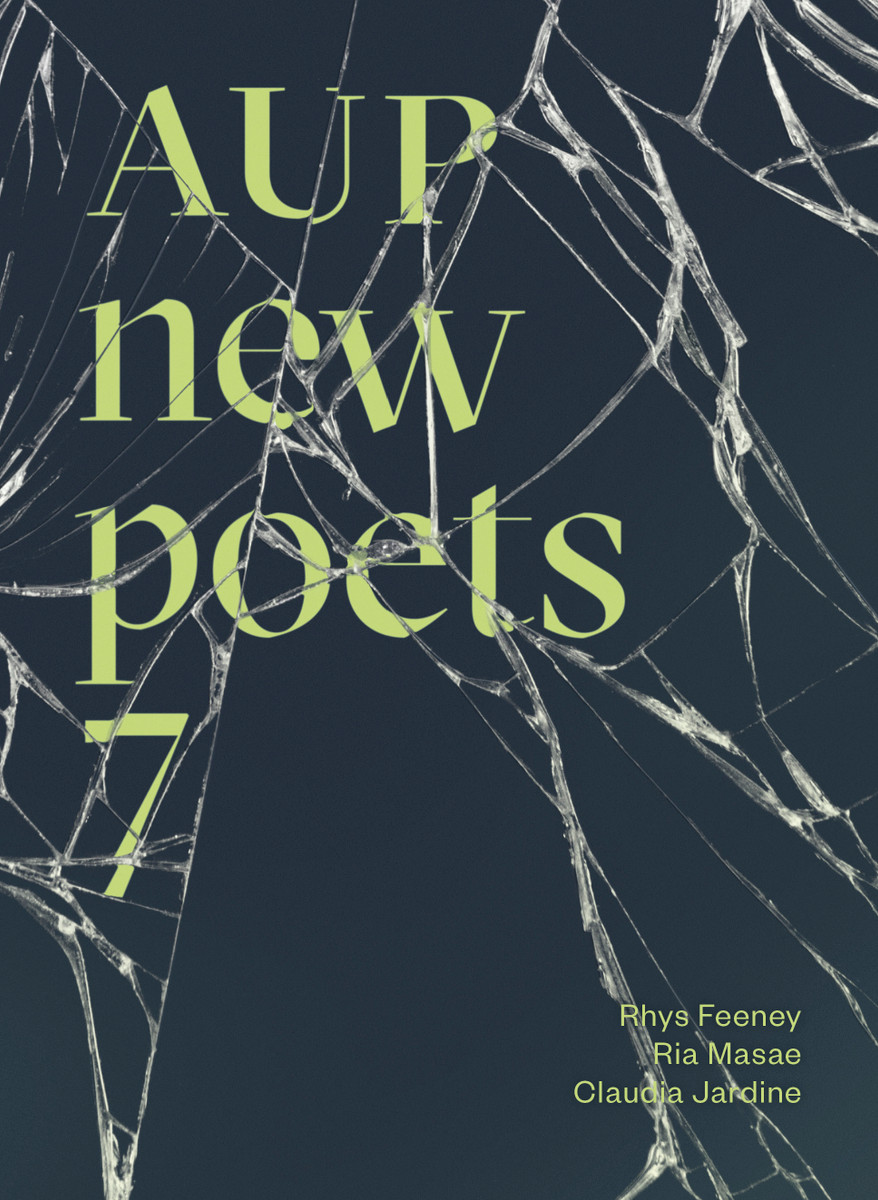
Rhys Feeney (she/they) is a high school teacher in Te Whanganui-a-Tara. Their debut chapbook “soyboy” was published in AUP New Poets 7 (2020). They’re currently finalizing their first full collection manuscript (they’ve been saying this for two years.)
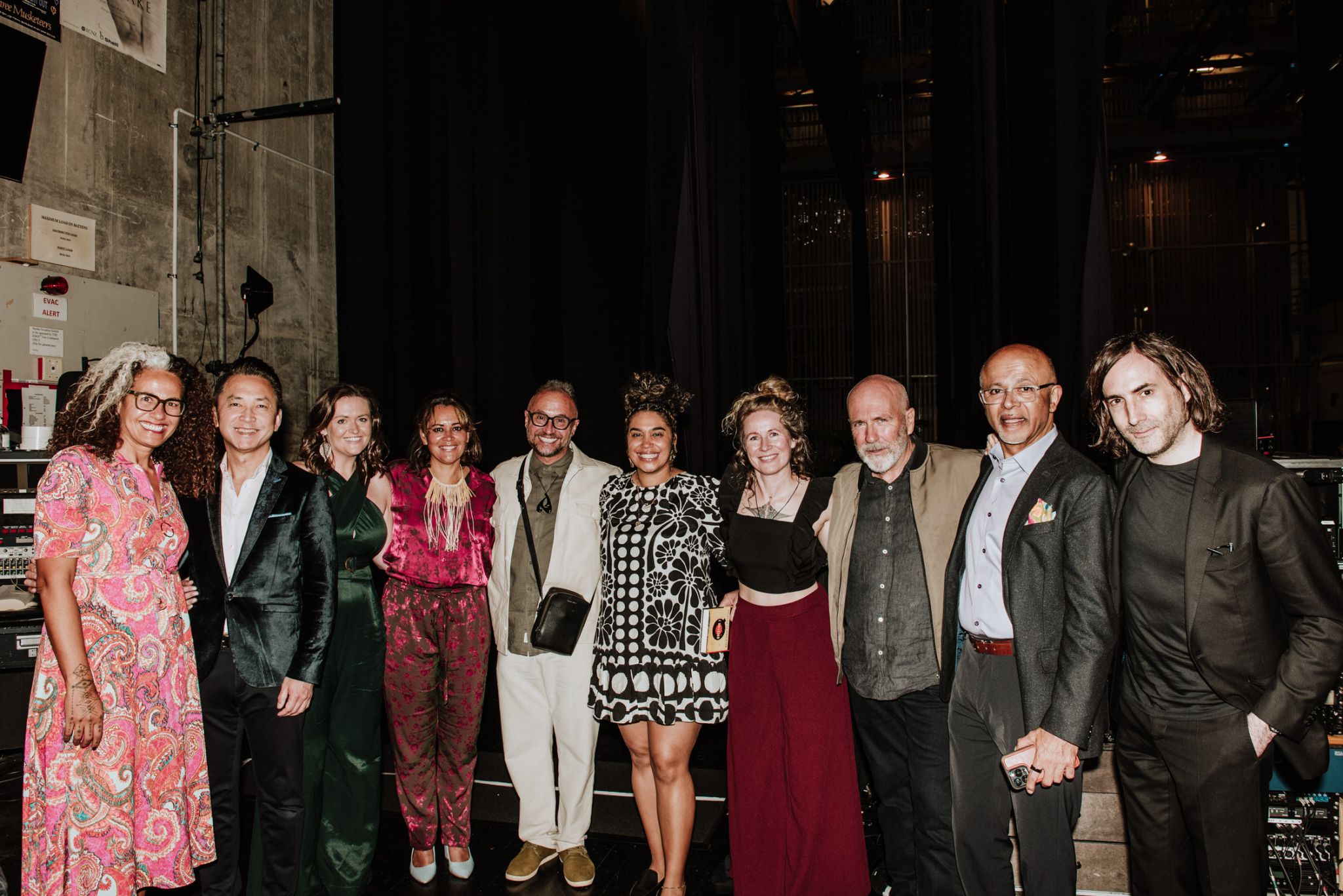
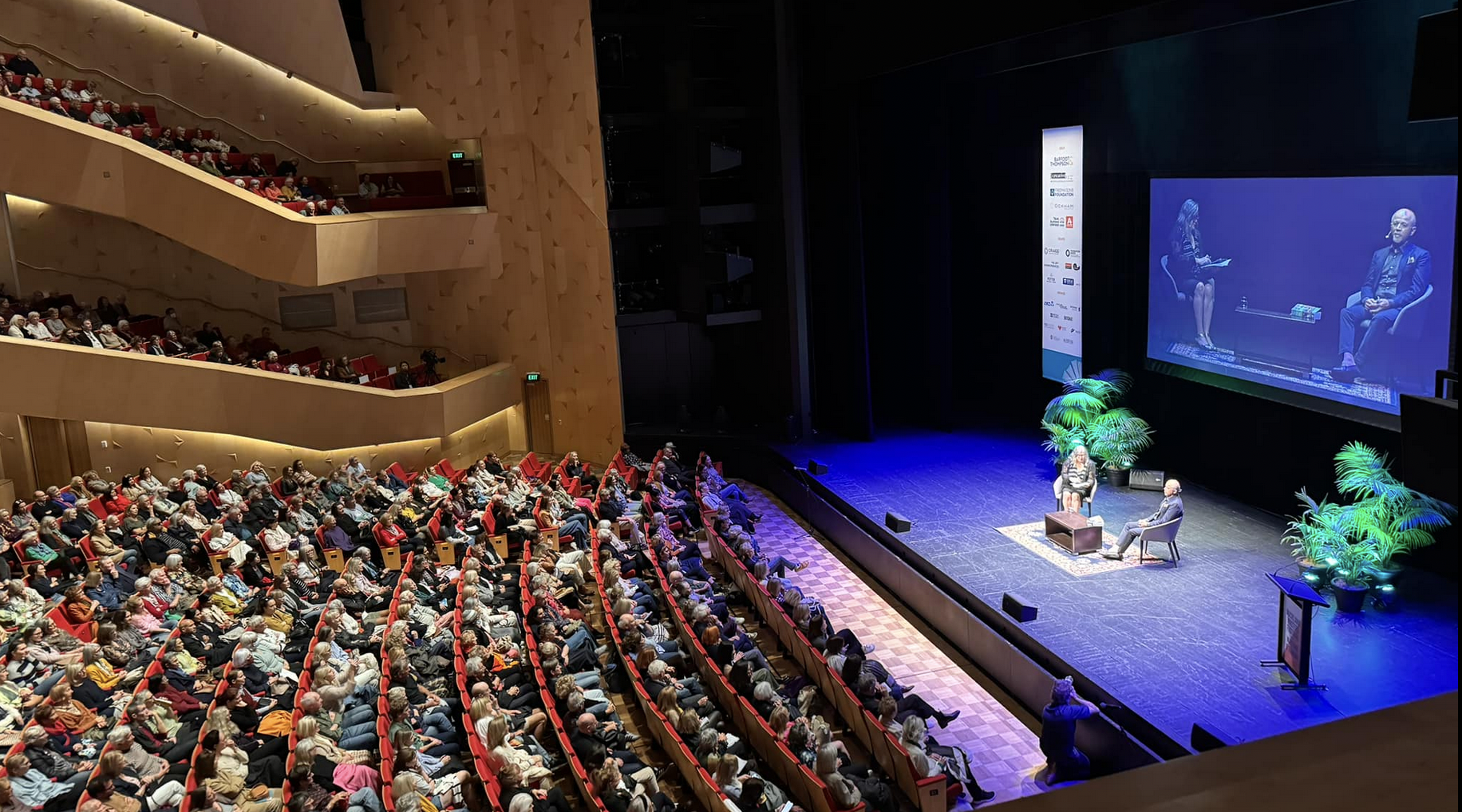
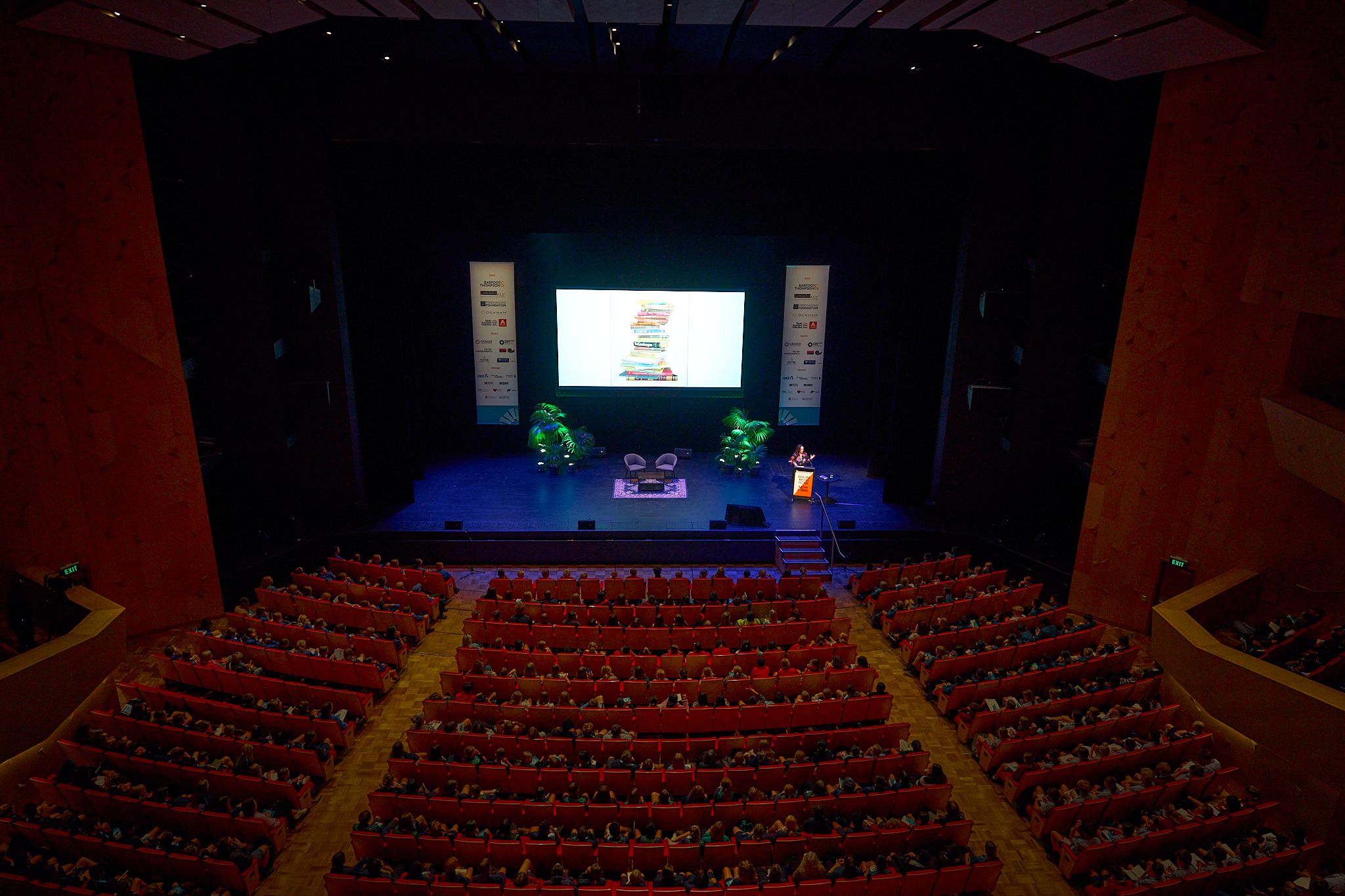
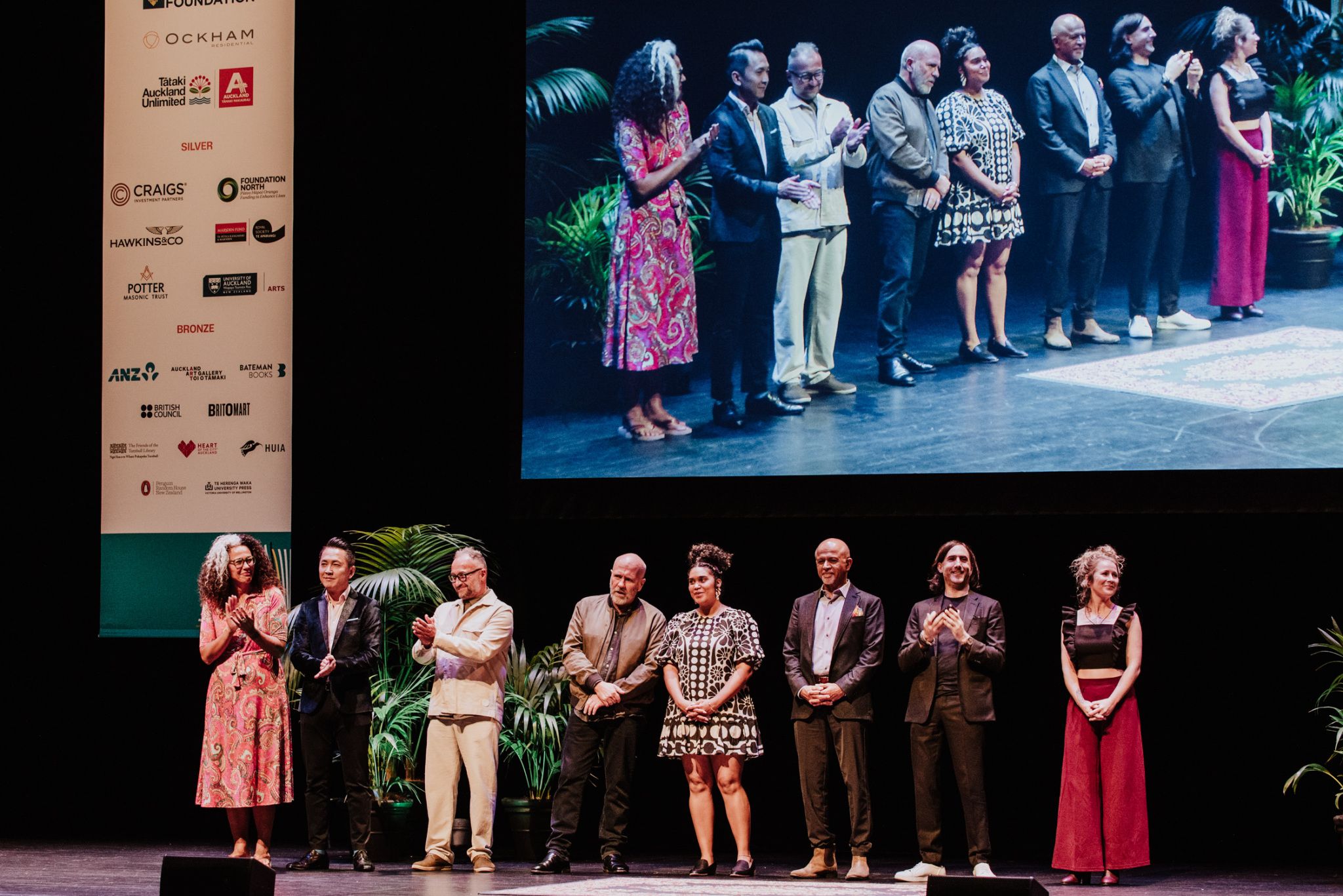
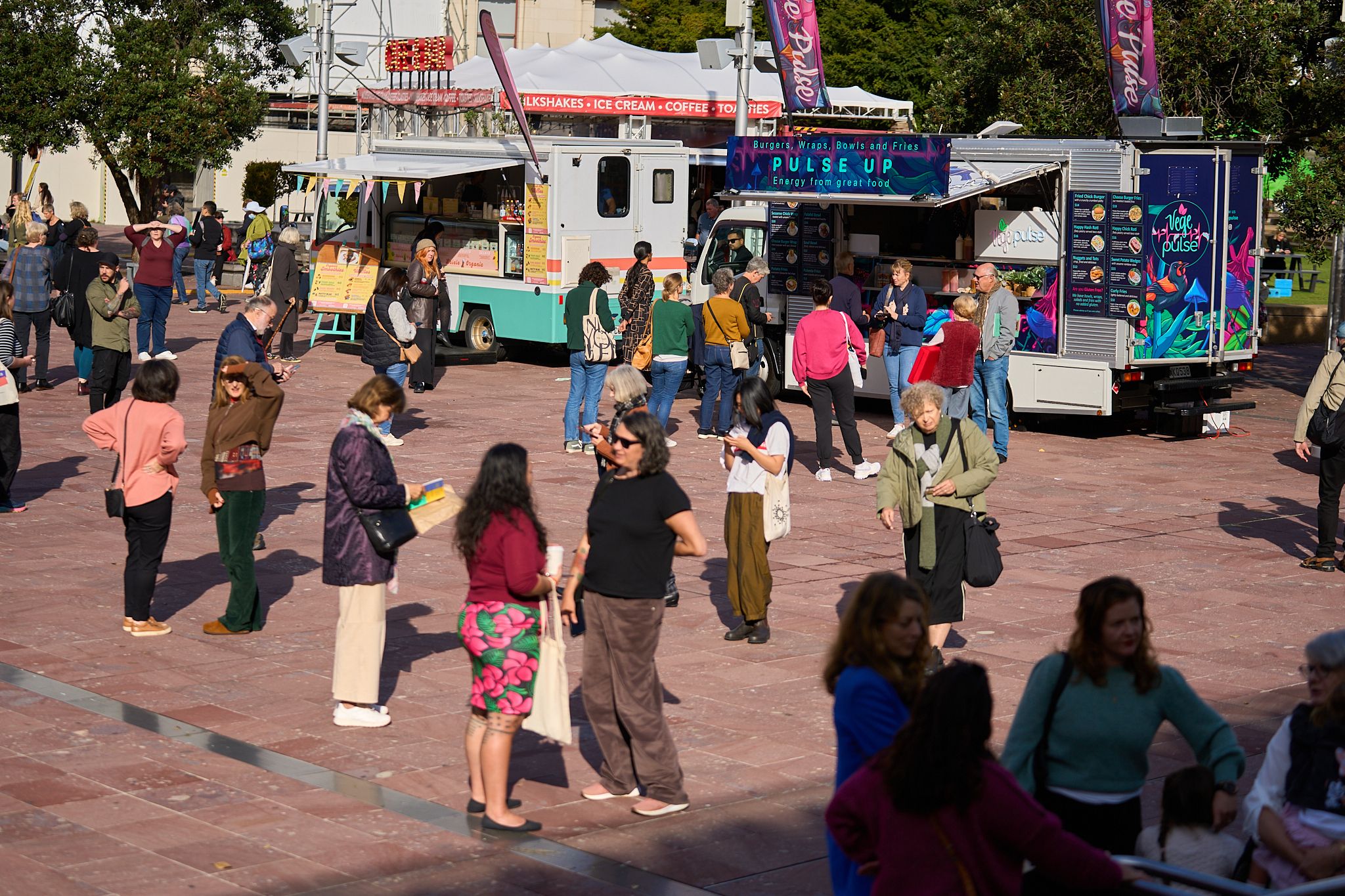
The Auckland Writers Festival Waituhi o Tāmaki (14 – 19 May) drew record breaking crowds, with more than 85,000 attendees, 25 sellout events, and 167 events featuring 240 participants from across Aotearoa and overseas. The festival included multiple genres, ranging subject matter and captivating voices. Over 25% of the programme was completely free and unticketed. Over 6000 school students were inspired by authors in the days leading up to festival, and Level 5 of the Aotea Centre became Pukapuka Adventures at the weekend, with story, song, dance, art and play events for young book lovers. The pop-up bookstalls, run by The Women’s Bookshop, reported their biggest year for book sales in the Festival’s history.
The new Festival team included Artistic Director Lyndsey Fineran, who joined the team in August 2023 after a successful tenure at the UK’s Cheltenham Literature Festival. Catriona Ferguson came on board as Managing Director in January 2024. Plus there were three guest curators: Michael and Matariki Bennett (Ngāti Pikiao, Ngāti Whakaue) whose innovative programming celebrated storytelling in all its forms, and Professor Damon Salesa who brought a strong Pacific-focus to his line-up.
I live streamed the book awards. It was a terrific occasion that honoured sixteen books shortlisted in the four categories, and the three best first books. This year included Te Mūrau o te Tuhi, a special award given for a book written originally and entirely in te reo Māori. Watch online here.
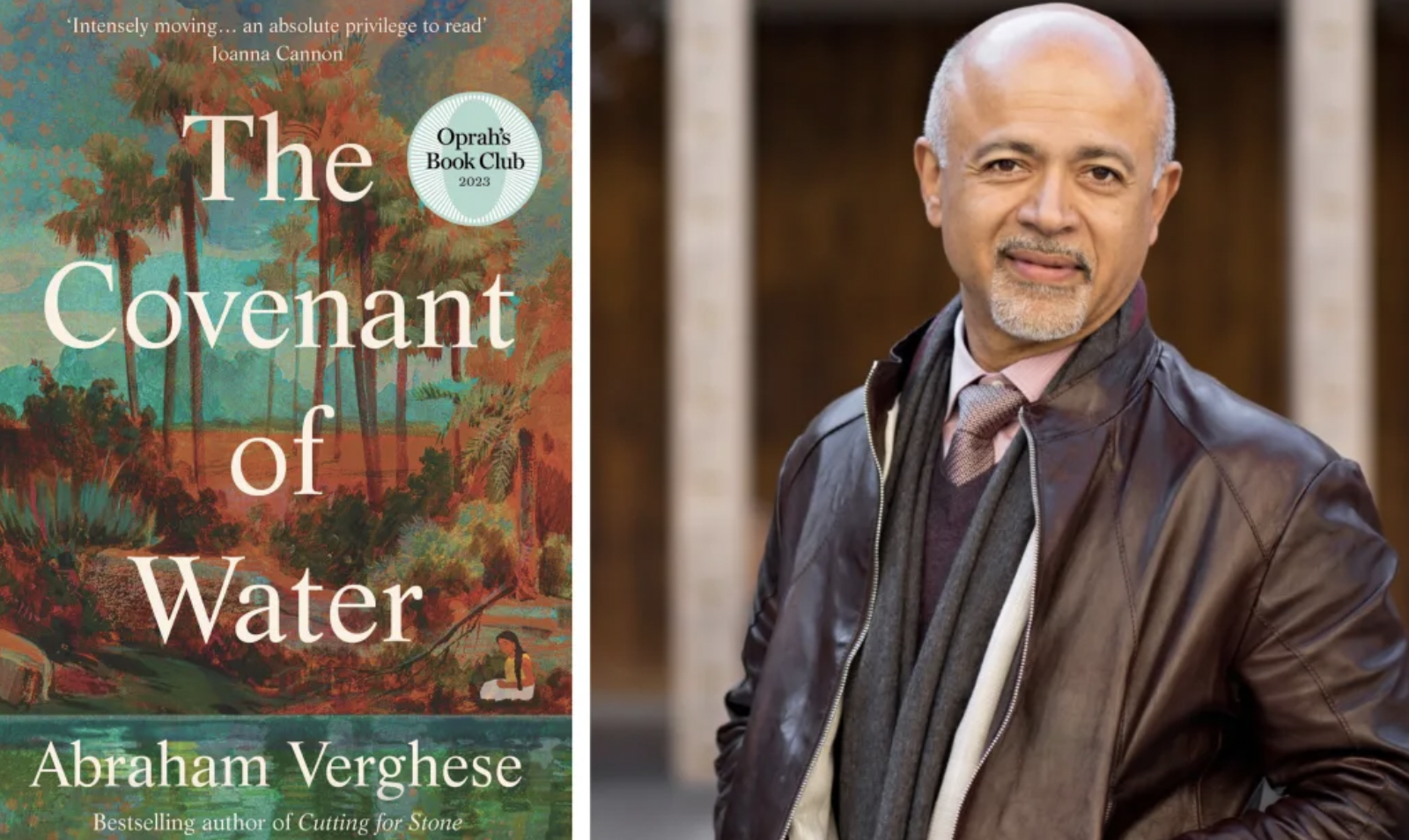
From afar, it felt like the festival was buzzing with ideas, stories, connections. I love how festivals reconnect you with books you have read and loved, and introduce those unfamiliar to you. I invented a pop-up festival at home, reading and loving Rachael King’s novel Gremlings, listening to Sinéad Gleeson’s wonderful Hagstone, catching a few interviews with participants that had aired on Radio NZ National (see links below), ordering some books online. Madeleine Slavick had posted a photo of the poetry table at Unity Books in Wellington and I snapped up a few collections I had not heard of. (Ah! Do send me photos of poetry book tables in your favourite bookshops!) A highlight? I was blown away by Abraham Verghese in conversation with Kathryn Ryan, as he spoke of the joys of medicine and writing, such empathy and wisdom. So resonant for me. Would loved to have gone to his session, crossing fingers it appears in podcast form.
What I was loving in the festival snippets I read on social media was how writing, whatever the genre, was bound by neither rules nor pigeon holes, but was an open ticket to self and world travel, to storytelling with vibrant threads to past, present and future, to building multiple melodies and rhythms, reading tracks and side roads, to challenging dogma and ignorance, to forging sustaining relationships with the books we produce.
I mention this because I am heartened by the way the Auckland Writers Festival celebrates and connects multiple writing communities. We are still drawing hidden voices from the shadows, but I am absorbing such a satisfying richness of books, poetry, storytelling, documentation, essay writing, children’s writing. And I am all the better for it.
Abraham Verghese, photo courtesy of AWF
Some RNZ National links
Best-selling author and Stanford University medical school professor Abraham Verghese in conversation with Kathryn Ryan RNZ National on the joys of medicine and writing
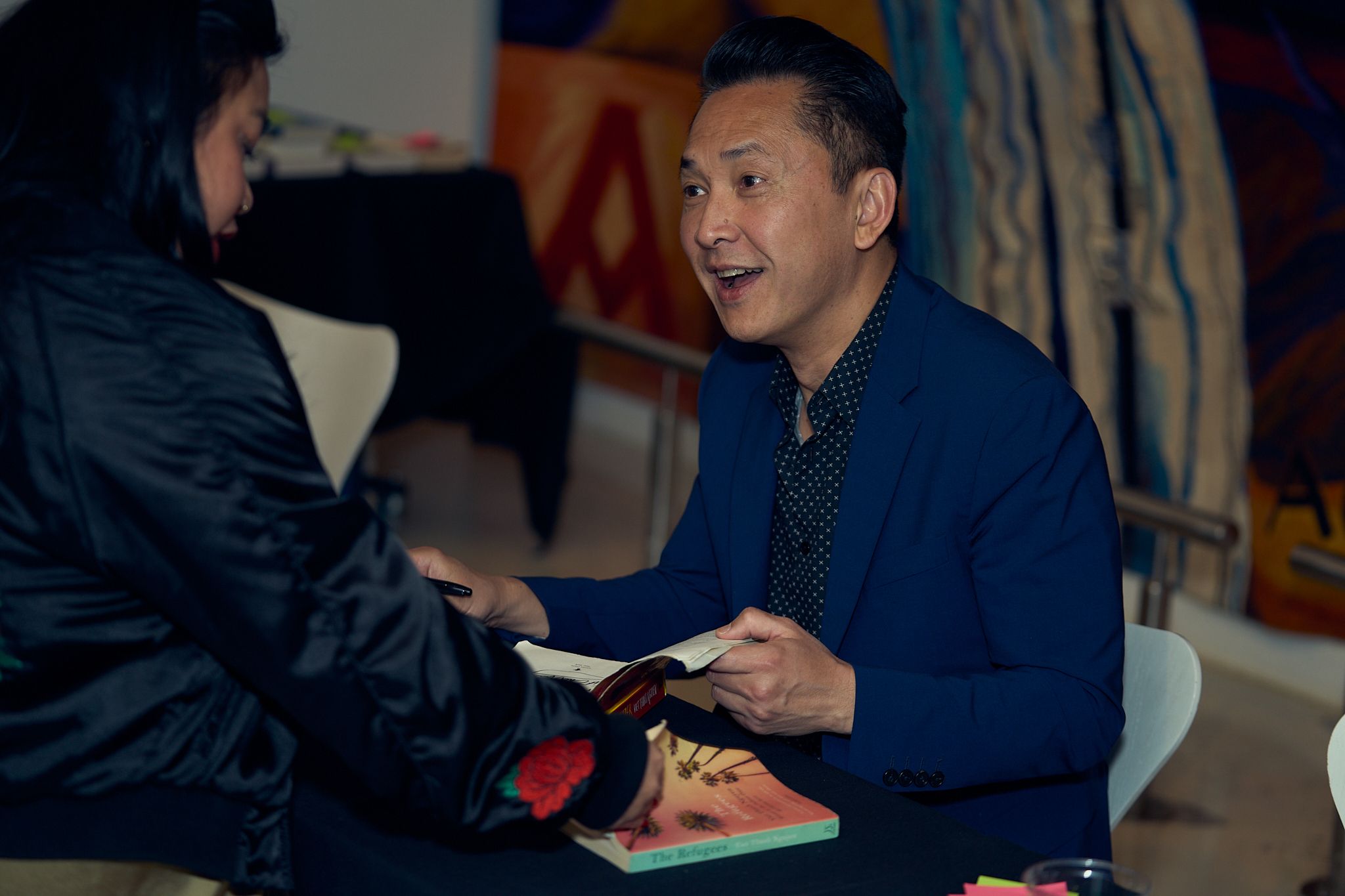
Viet Thanh Nguyen in conversation with Susie Ferguson RNZ National
Leslie Jamison in conversation with Kathryn Ryan RNZ National
Kiran Dass, Jenna Wee, Michael Bennet and Matariki Bennett discuss Best of the Fest on RNZ National’s Culture 101.
Poetry Shelf invited a number of readers and writers to share a takeaway highlight, a special event, quotations they jotted in their notebook. Thank you all, especially in post festival tiredness, to contribute to this collage. Thank you.
A festival collage
Kiri Piahana-Wong
I enjoyed the session ‘Still Wanted: A Room of One’s Own’ with Anna Funder, Leslie Jamison and Selina Tusitala Marsh interviewed by Paula Morris. Leslie said that being a mother artist has challenged the notion that art has to be produced in pure spheres of time, rather she now has a messier more ragged idea of where art comes from. She believes her art/writing is more complex, layered and interesting as a result. She said: ‘Don’t be afraid to embrace scattered hectic time as full of the richness of the layers of living. Your life is not ‘on pause’ when you are engaged in all those domestic tasks.’
Leslie was asked if she uses affirmations. She said no, but said she might start using Selina’s poetry as her morning affirmations in the future And she expressed a wish that Selina speak to her students.
I found Viet Thanh Nguyen’s session profoundly moving and I cried a few times. He said a reviewer said his work was giving ‘a voice to the voiceless’ or that he should ‘be the voice for the voiceless’. He challenged that, saying that people are not voiceless, rather when this word is used it means ‘the deliberately silenced or the preferably unheard’. He said that what is most important is abolishing the conditions of voicelessness.
Carole Beu, The Women’s Bookshop
What a buzz! I was inspired, exhausted and utterly invigorated by the festival. I attended a total of 19 brilliant sessions while my gallant staff ran the festival bookstall (We employed a total of 40 booksellers over the week!)
I was thrilled by Bonnie Garmus, Anna Funder, Celeste Ng, Anne Salmond, Lauren Groff, and finally Ann Patchett in a witty, spontaneous, enthralling conversation with Meg Mason that was a stunning closing event.
I also encountered some truly lovely men. Trent Dalton made 2200 people weep as well as roar with laughter. Richard Flanagan, Abraham Verghese, Paul Lynch, and Viet Thanh Nguyen were intelligent, sensitive and aware.
The whole event was sensational. The best line – ‘Fiction is the lie that tells the truth’.
photo courtesy of AWF
Nat Baker
“All books are political, and if they say they’re not then they’re political in the worst way”, from Lauren Groff at her awesome session on Friday. I’ve been too sick to attend more than two sessions, but this one was wonderful.
Viet Thanh Nguyen, photo courtesy of AWF
Susanna Andrews
Viet Thanh Nguyen at Thursday’s Gala night: ‘being a refugee has given me the requisite trauma to become a writer’.
Carl Shuker
Leslie Jamison with always excellent chair Noelle McCarthy on how you can fold the chaos of life RIGHT NOW – whether it’s kids or whatever your particular chaos – into your art practice and it can enrich and deepen the work. Nietzschean radical acceptance rather than living in frustration and a sense of distraction.
Noelle McCarthy
‘I know a man who knew a man who knew a locksmith,’ a line by Janet Frame, referring to the doctor who is a dedicatee of many of her books, who opened up her writing life.
Read aloud by Peter Simpson, from the beautiful session on Janet Frame with Meg Mason and Pamela Gordon.
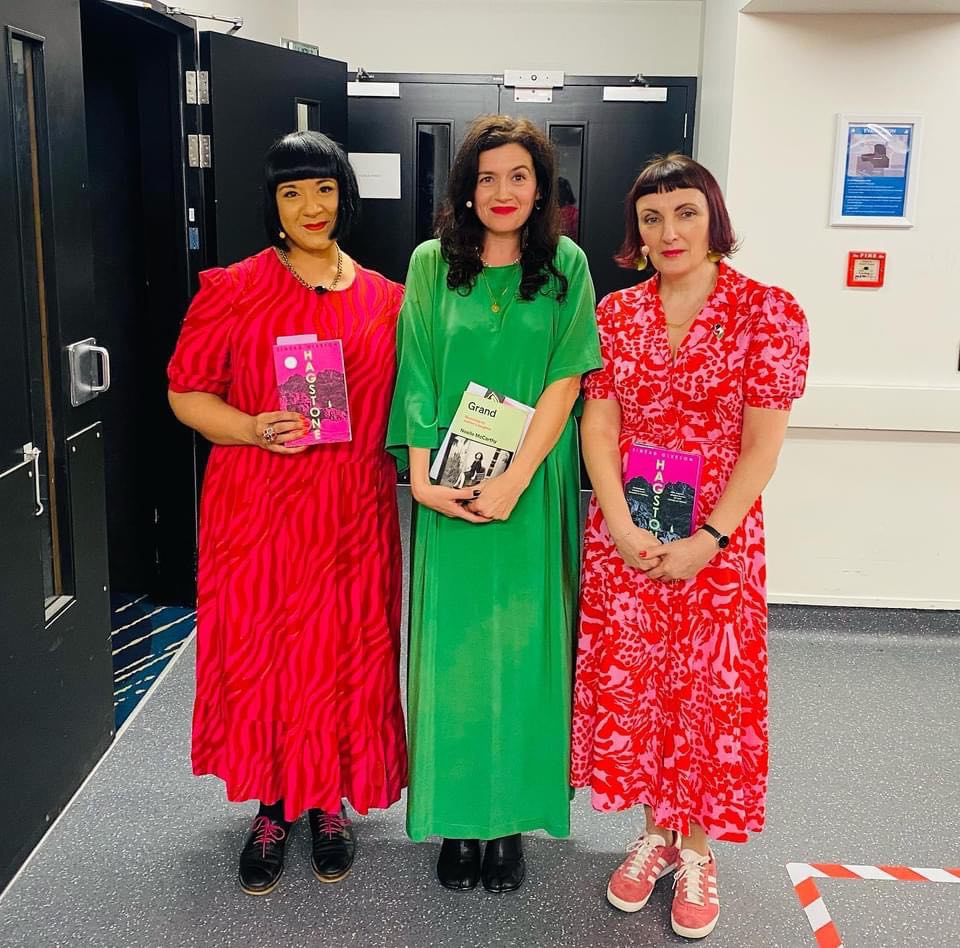
Chair Kiran Dass with Noelle McCarthy and Sinéad Gleeson (Ireland) for the session ‘Ireland: Small Island, Literary Powerhouse’. Photo courtesy of AWF
Kiran Dass
Wow, what an absolutely sensational festival the 2024 Auckland Writers Festival was. A glorious and happy dream of minds and hearts coming together. Everywhere I looked I just saw smiling faces. I loved being in conversation on stage with such talented, thoughtful and smart writers, and loved the many off stage chats with old friends and new. The writing community really is the greatest. I feel so energised, brain-fed, heart-filled, and fired up. Congratulations to Lyndsey Fineran, Catriona Ferguson and their amazing team for delivering a remarkable festival. I’m so grateful to have been included. Putting on a festival is a huge amount of work! So much thinking, care, and mindmelting logistics go into putting on the seemingly effortless magical sessions audiences see take place on the stage.
Lynn Davidson
A special AWF highlight for me (among many highlights) was the fire and energy and humour in the room during the ‘If Not Now, When: Midlife Realisations and Rebellions’, event. Sharing the stage with Emily Perkins and Claire Mabey as we talked midlife shifts and the possibilities they can open up felt like being part of a necessary and welcome conversation.
Pip Adam
The highlight of my week was Emma Wehipeihana’s acceptance speech for best first book. She spoke directly about working in a stretched health system, I was so glad the Prime Minister was there to hear this. And this quote made me cry: “As a doctor, I’ve seen the inside of most orifices of the human body and held the viscera of the living and the dead and I can tell you without a doubt that it’s the arts and artists who elevate our existence from being sacks of meat circling a dying star to something magical …”
Claire Mabey
I loved what Jane Campion said about writing which was ‘writing is being in a relationship with the subconscious’. And I also really loved the banned books session — some books can be dangerous and troubling but those books help us think — we can’t eliminate ideas that trouble us, we just have to think against them and talk about them
Amber Esau
In The Science Behind Science Fiction session Dr. Octavia Cade asked ‘Are we still going to be the same kind of human without them’ on leaving behind kākāpō, kauri trees, and the environment we already have a relationship with in pursuit of a new planet. This echoed back to me when Sascha Stromach, in the We Can Be On Other Planets: Māori Speculative Fiction session, said, “So much sci-fi is inherently colonial… a Māori approach would be learning to be a kaitiaki of another planet.” There was something sparked for me from these kōrero about the implications of ownership, our responsibilities to who and what gets left behind, and our ethical considerations for exploring new worlds in fiction.
Catherine Chidgey
I’ve loved being in amongst the buzz of this bumper festival…and I was delighted to have a very dedicated 12-year-old taking part in my workshop on writing child narrators.
Harriet Allan
I hadn’t consciously planned it this way, but I went to a string of events by lively, intelligent, talented women, starting with Rebecca Vaughan performing Virgina Woolf’s A Room of One’s Own (it was terrific to be reminded of this work). Other books I had loved and were featured included Anna Funder’s Wifedom and Sarah Ogilvie’s Dictionary People, and neither author disappointed in person. Anne Salmond, Roimata Smail and Katy Hessel all shone, and there were several stimulating line-ups, including three lots of three women, two of which featured authors I have worked with – Patricia Grace and Lauren Keenan – so of course I am biased in loving hearing them. There were a few other (also enjoyable) sessions I attended, and many more I wished I could have seen if money, time and brain-fatigue hadn’t had to be allowed for, but I came away thinking Virginia Woolf might well have felt pleased with the plethora of excellent books now being written by women.
Rachael King
photo courtesy of AWF
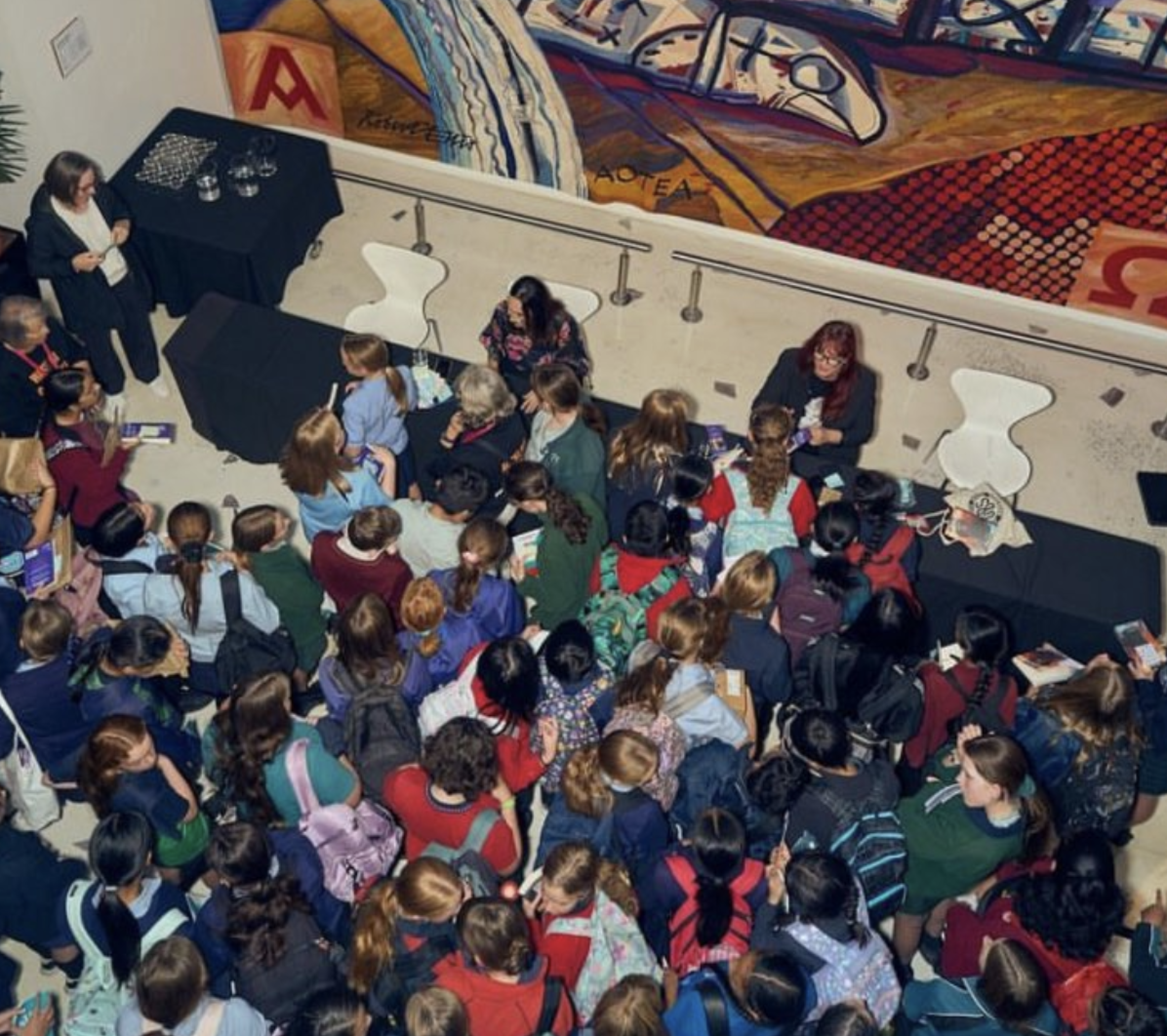
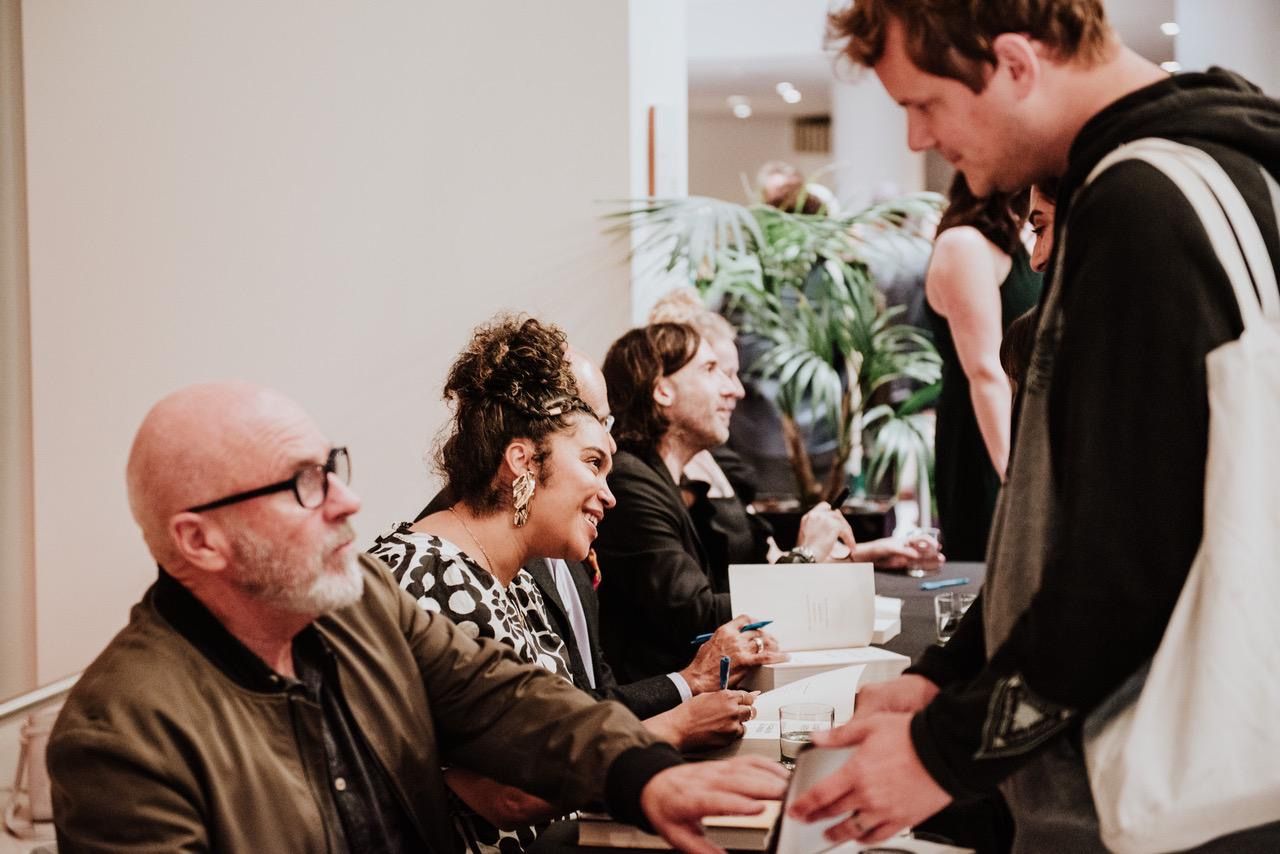
The schools days were incredible! So many hungry young minds, eager to meet writers. This photo says it all.
A school session, photo courtesy of AWF
Eileen Merriman
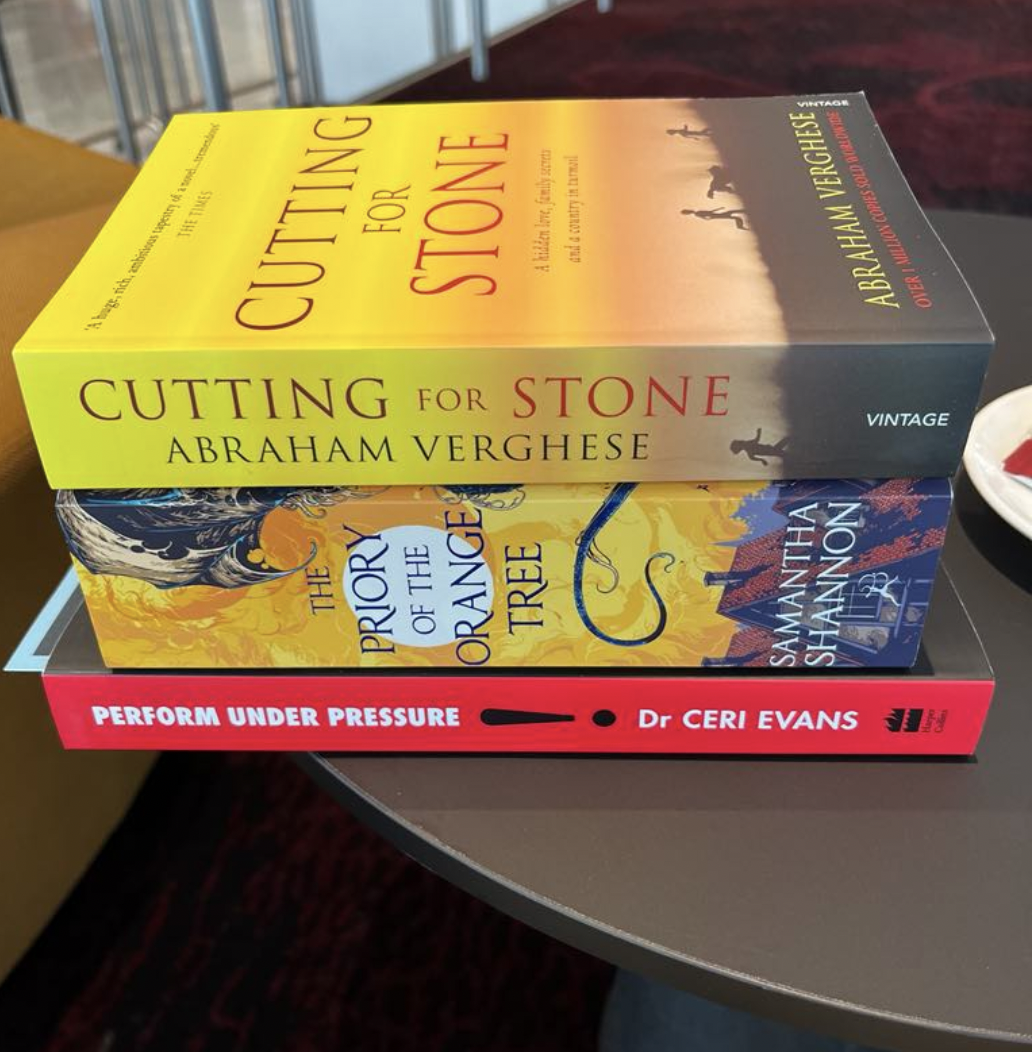
Sadly I didn’t have long at AWF this year but purchased these three beauties on my way to chair a Crime Writers Panel featuring the fantastic Michael Bennett, Paul Cleave and Gavin Strawhan. The book on the bottom helped soothe the nerves beforehand!
Mary McCallum
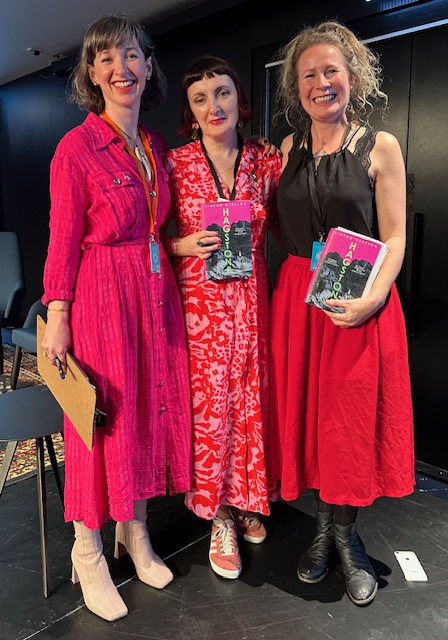
Jenna Todd, Sinéad Gleeson, Becky Manawatu
Auckland and the Auckland Writers Festival were in the pink yesterday on my first full day at this huge, exciting and at times overwhelming event — Becky Manawatu, Irish writer Sinéad Gleeson and bookseller Jenna Todd matched up with Sinéad’s glorious book to talk about it and Becky’s Auē and upcoming Kataraina (and oh so much about speaking Irish and Māori, living on islands and women finding their best selves, beautifully steered by Jenna). The sky tower pinked in sympathy and so did one of the thousands of people filling the Aotea Centre looking for a literary fix.
Anna Funder was a joy talking with Susie Ferguson about her extraordinary book Wifedom, which tells the life of the “invisible” woman who was the wife of George Orwell and brilliantly dissects the patriarchy as it goes. No pink on her! The book, though, is a pink-adjacent bright orange.
Becky talked about seeing Ana Scotney’s play ‘Scattergun’ in her Gala Night speech:
“Ana Scotney’s Scattergun was not one woman. She was a room of women, a room of people. But I did not know that yet.I was not prepared for how expansive, detailed, how wild, forested, rivered and wholly alive, Scattergun’s world would be. Gorgeous defibrillate your heart, bring-you-back-to-life art. Art. What a wasteland this world would be without it.”
The Gala Night, photo courtesy of AWF
Melinda Szymanik
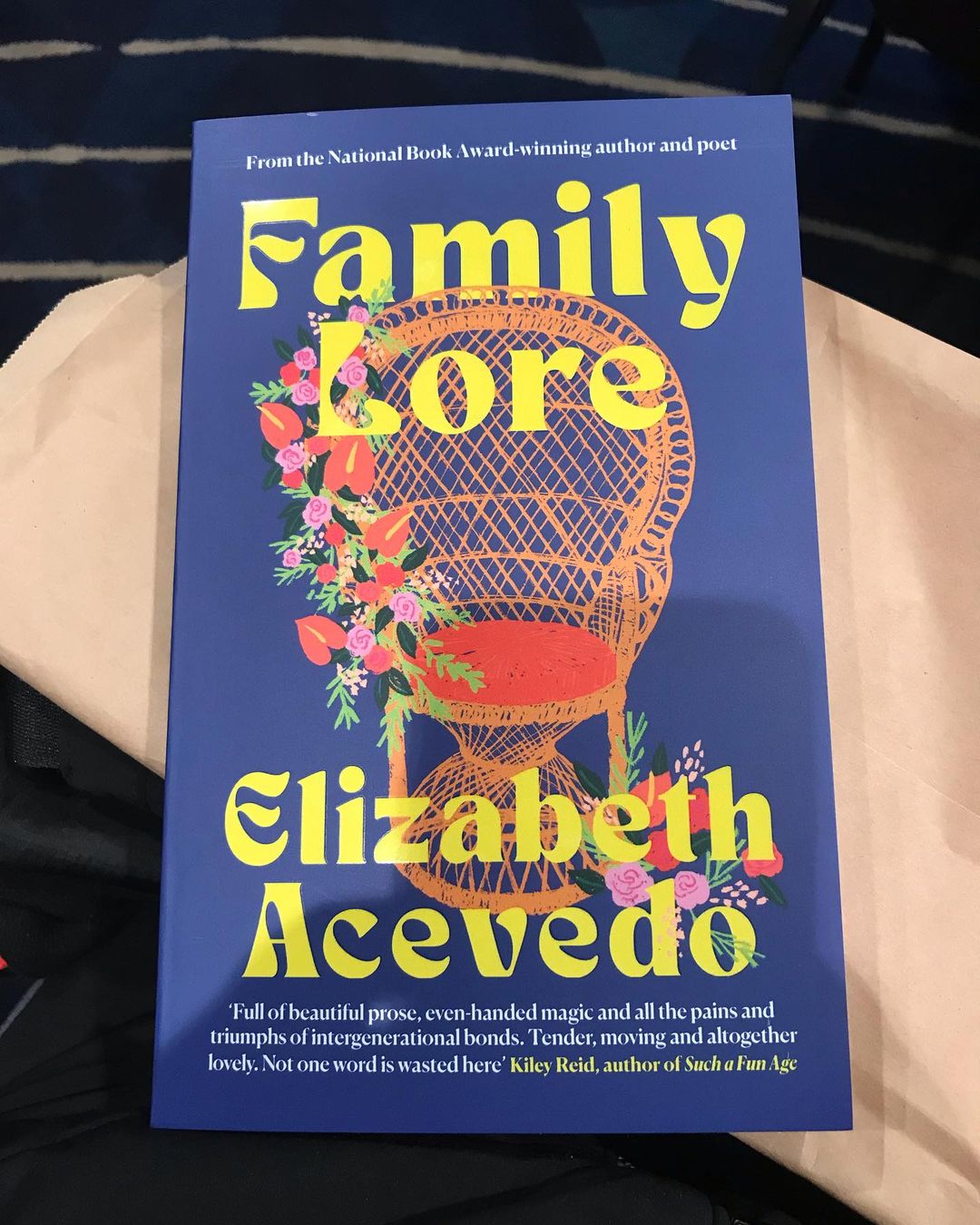
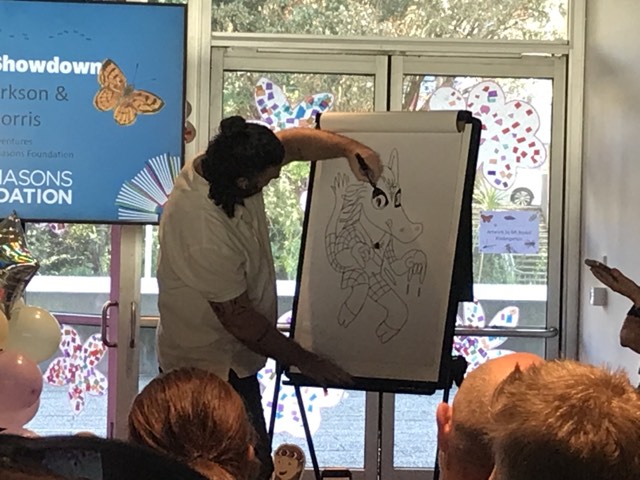
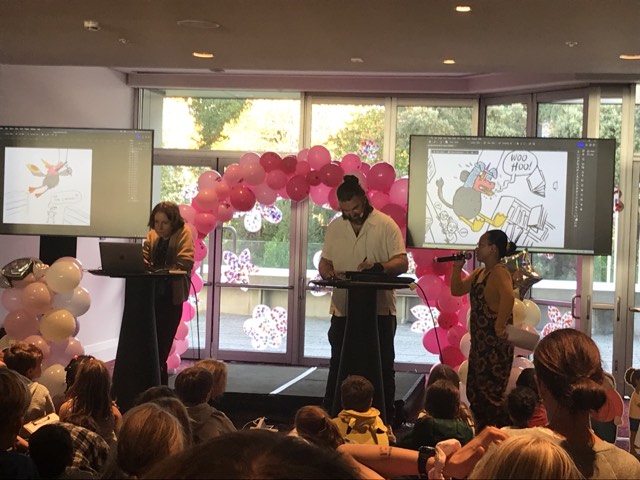
On my way to my Saturday session with Elizabeth Acevedo, Saraid de Silva and Tsitsi Mapepa – ‘Writing across Generations’ – I spotted Gareth and Louise Ward and stopped to say hi because this is one of the best things about the Festival – connecting with other passionate book folk. Louise proceeded to demonstrate her bookselling skills and I went straight off to buy Acevedo’s new book Family Lore. The session was wonderful, all three writers sharing generously on family and their fab books. Later I met up with fellow writer Jane Bloomfield for a good natter and then I was off to the Illustration Duel between Toby Morris and Giselle Clarkson. This theoretically was for the younger set but the adults in the audience were enjoying it just as much as the children. So much talent, so much networking, so much fun.
Jenny Powell has published six poetry collections, two chap books collections and two collaborative collections. She has been a finalist in the UK Plough Poetry Prize, two times finalist in the Aesthetica Creative Arts Award, finalist in the Lancaster one minute monologue competition, runner-up in the Plough Poetry Prize, runner-up in the Mslexia Poetry Competition, short listed in the Welsh Poetry Competition, shortlisted in the New Zealand Society of Authors Janet Frame Memorial Award and in the inaugural NZ Book Month ‘Six Pack’ Competition. In 2020 Powell was the RAK Mason Writing Fellow.






 And she expressed a wish that Selina speak to her students.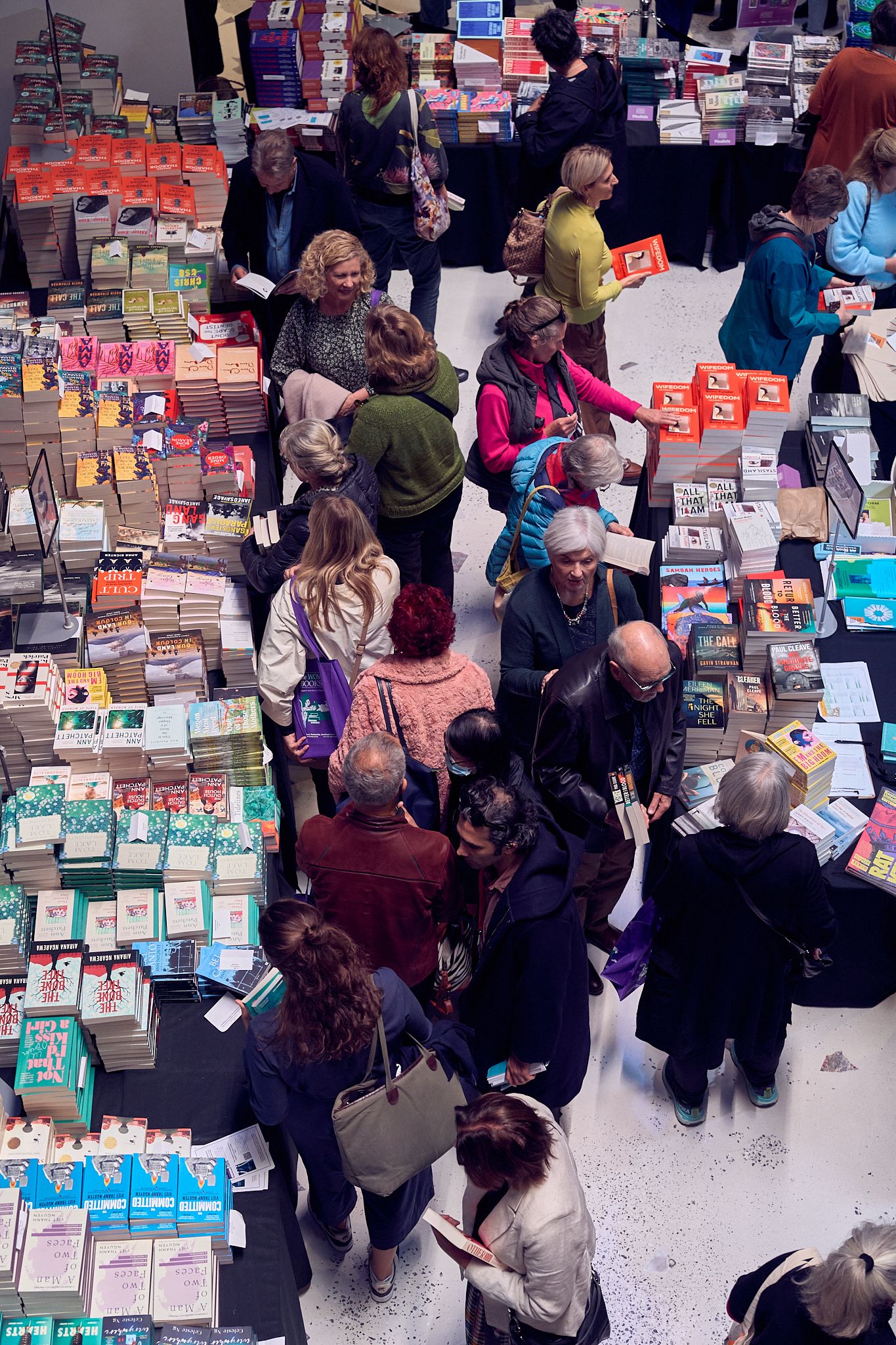

 NZ Poetry Shelf