
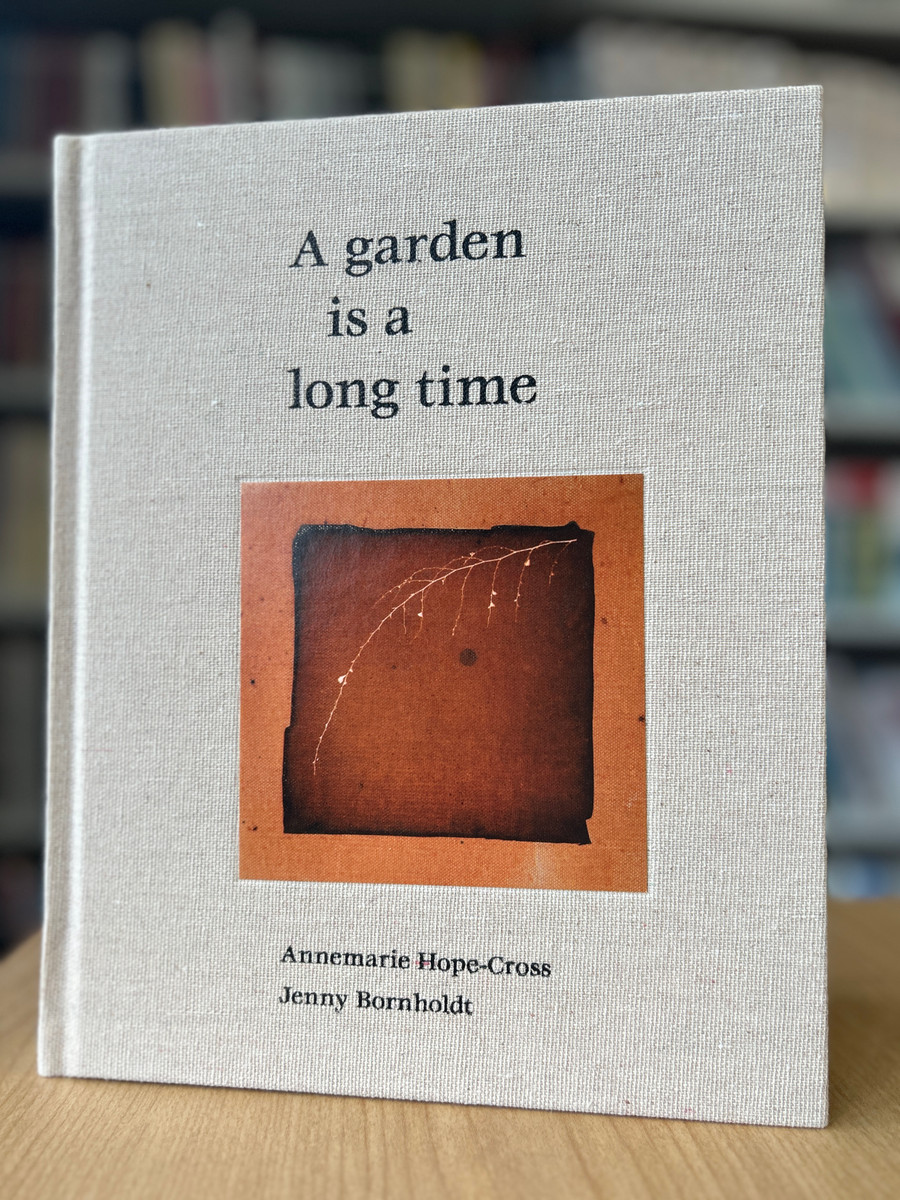
A Garden Is a Long Time, Annemarie Hope-Cross and Jenny Bornholdt
Te Herenga Waka University Press, 2023
View
You’re up to your knees
in grass, bent
for scent or form
framed by the window, held—
as a cellist might draw
a note to the end
of sound.
Jenny Bornholdt
A Garden Is a Long Time brings together photographs by Annemarie Hope-Cross (1968 – 2022) and words by Jenny Bornholdt. It is a sublime book. It is a book generating admiration and wonder.
Firstly the title. The title resonates so beautifully, like a tiny poem held in the palm of your hand. I am moving in all directions, along multiple paths, holding the ideas and mood it generates: seasons, attachments, necessity, beauty, growth, the power of the senses.
Secondly the cover that features Annemarie’s photogenic drawing on canvas is placed on natural linen (from ‘Tupare Leaves’, 2016). I run a finger over the smooth surface of the photograph and then delight in the textured surface of the linen. There is no blurb on the back of the book, no sales pitch, just the linen expanse. The book, so lovingly created, is a work of art. I prolong the moment before opening the book.
Thirdly the words, at times biography, at others art appreciation, art ideas and processes, a photography manual, Jenny’s poetry. Annemarie’s father used to develop photographs at the kitchen sink (later had a darkroom) while her mother sang in a choir. Annemarie was driven to create photographs from a young age, resisted digital photography at Art School, studied various photographic techniques at Fox Talbot Museum in the United Kingdom. She went to live in Alexandra, fell in love with Eric Schusser, had an ambulance job, gardened, and kept exploring her favoured medium.
Jenny writes with the deft touch of a poet, her words drawing us into a life and into the photographs. Jenny’s exquisite poems, penned with a handful of elements reverberate so sweetly for ear and eye, holding out a scene or a fleeting moment. I find myself lingering over each one, letting the poem shimmer and grow. Each a touchstone for contemplation. i have included a whole poem with permission for you to absorb. In your own way. In your own time.
And fourthly the photographs. My daughter currently has a fascination with extremely old cameras she finds in junk shops. Her black and white photographs are sublime. I can’t wait to show her the book because Annemarie’s photographs are inspiration staircases. Touchstones. She used old cameras, printed by hand on paper, had a long engagement with the work of Anne Noble, and was inspired by William Fox Henry Talbot, claimed as the British inventor of photography. His aim was ‘to reproduce what he saw’. Perhaps seeing is like a vibration, where what we see is both fleeting and unstable, the oxymoron of looking.
Annemarie’s photographs are a form of bliss, a cousin of contemplation, a grandmother of wonder. Shadows fall. Light catches. We are viewing an object, a leaf, a flower, a bottle, through misted veils. There is an eerie feel, heightened by the shadowy texture, the blurry lines, the smudged solids, the indefinite horizon, the silhouetted forms. The ‘Cloister’ series brings to mind the interior of a chapel, the shape of the nuns. Again the artwork offers multiple tracks to contemplation, as though we are seated beneath the stained glass window. Jenny writes this: Or the shape might suggest nuns holding the peace of a garden within themselves’. And I am caught up in reverie. The Italian painter and printmaker, Giorgio Morandi (1890 – 1964), whose paintings smudged vases, jars, occasionally fruit, comes to mind. Annemarie was also captivated by this artist, dedicating works to him. I am also catapulted back to Jude Rae’s still lifes.
I am snared on the idea that poems can do this too. A poem might blur or smudge or waver and offer you an uplifiting sense of objects, still life, place, even narrative. I am thinking of the poetry of Dinah Hawken, Sue Wootton, Kiri Piahana Wong, Bill Manhire.
And fifthly, the effect upon me as reader and viewer. The glorious lingering effect that brings together fragility, the uncertain, anchors and stalled time, veils and hints, light and dark, movement and stillness. And yes the sweet peace of viewing and reading, the peace of a long-time garden that is an inner touchstone. This is a breathtaking and precious book.
Annemarie Hope-Cross was born in Upper Hutt in 1968, obtained a Diploma of Photographic Arts from Whitecliffe Art School in 1989, and in 2011 and 2013 studied photogenic drawing, wet and dry plate collodion and the daguerreotype technique at the Fox Talbot Museum in the United Kingdom. Between 2010 and 2021, she held 13 solo exhibitions at public and private galleries in the Otago region, and her work has been included in numerous group exhibitions in New Zealand and internationally. She held an artist’s residency at the Fox Talbot Museum in 2013), and her series of ‘Still’ photographs is in the collection of the Museum of New Zealand Te Papa Tongarewa. With Eric Schusser, she produced two photo-books, Still Intrusion (2019) and Dissolving Margins (2020).
Jenny Bornholdt has published over a dozen books of poems, most recently Lost and Somewhere Else (2019). She has edited a number of anthologies, including Short Poems of New Zealand (2018), and has worked on numerous book and art projects with artists including Pip Culbert, Mary McFarlane, Noel McKenna, Mari Mahr, Brendan O’Brien and Gregory O’Brien. In 2018 she was the co-recipient, with Gregory O’Brien, of the Henderson Arts Trust Residency and spent 12 months in Alexandra, Central Otago, during which time she met Annemarie Hope-Cross.
Te Herenga Waka University Press page
 NZ Poetry Shelf
Pingback: Poetry Shelf Monday poem: Luck by Jenny Bornholdt | NZ Poetry Shelf