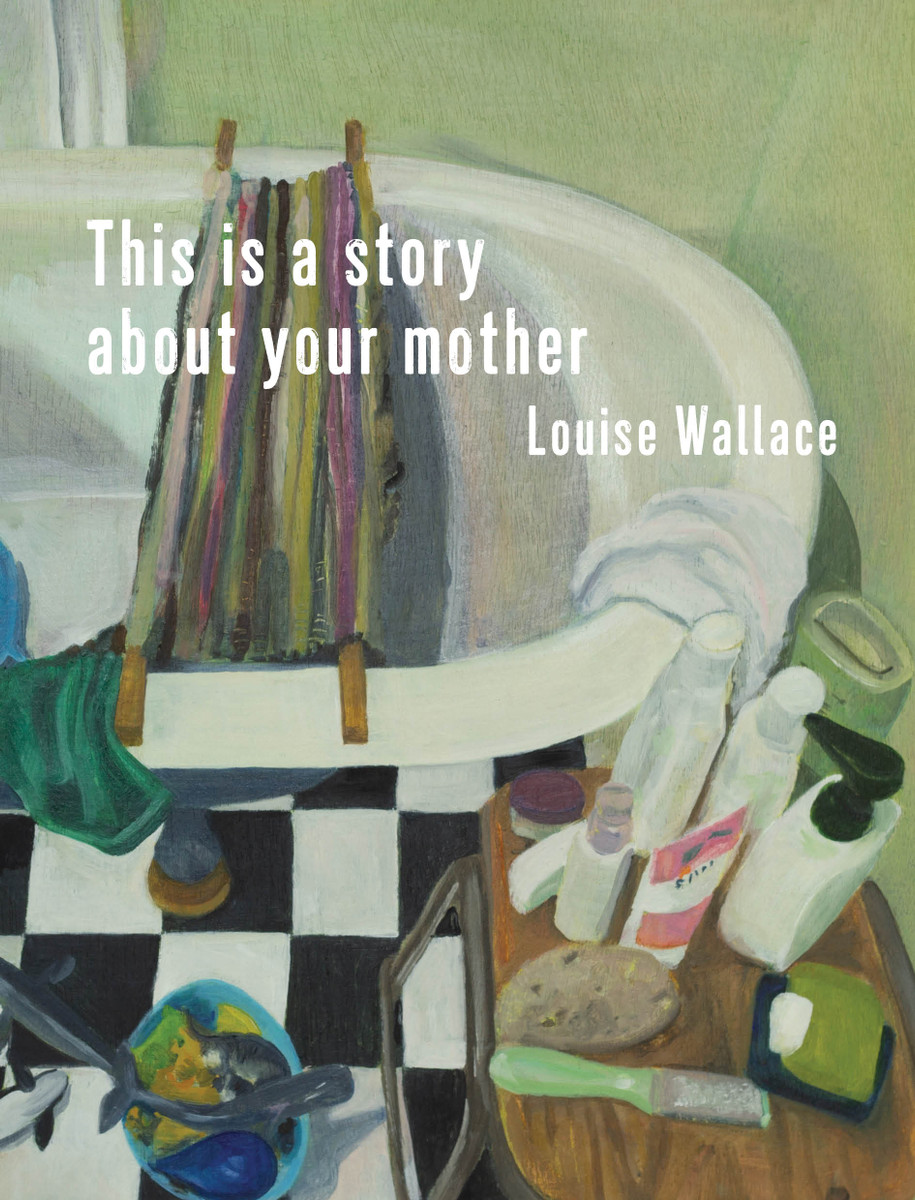
Poetry Shelf readings is a new series that celebrates recently published poetry collections with an audio performance. Louise Wallace’s collection, This Is A Story About Your Mother, is published by Te Herenga Waka University Press, May 2023. I will be posting a review of the book in the coming weeks. In the meantime take a listen to two poems:
‘Self portrait’
‘Blesséd goddess’
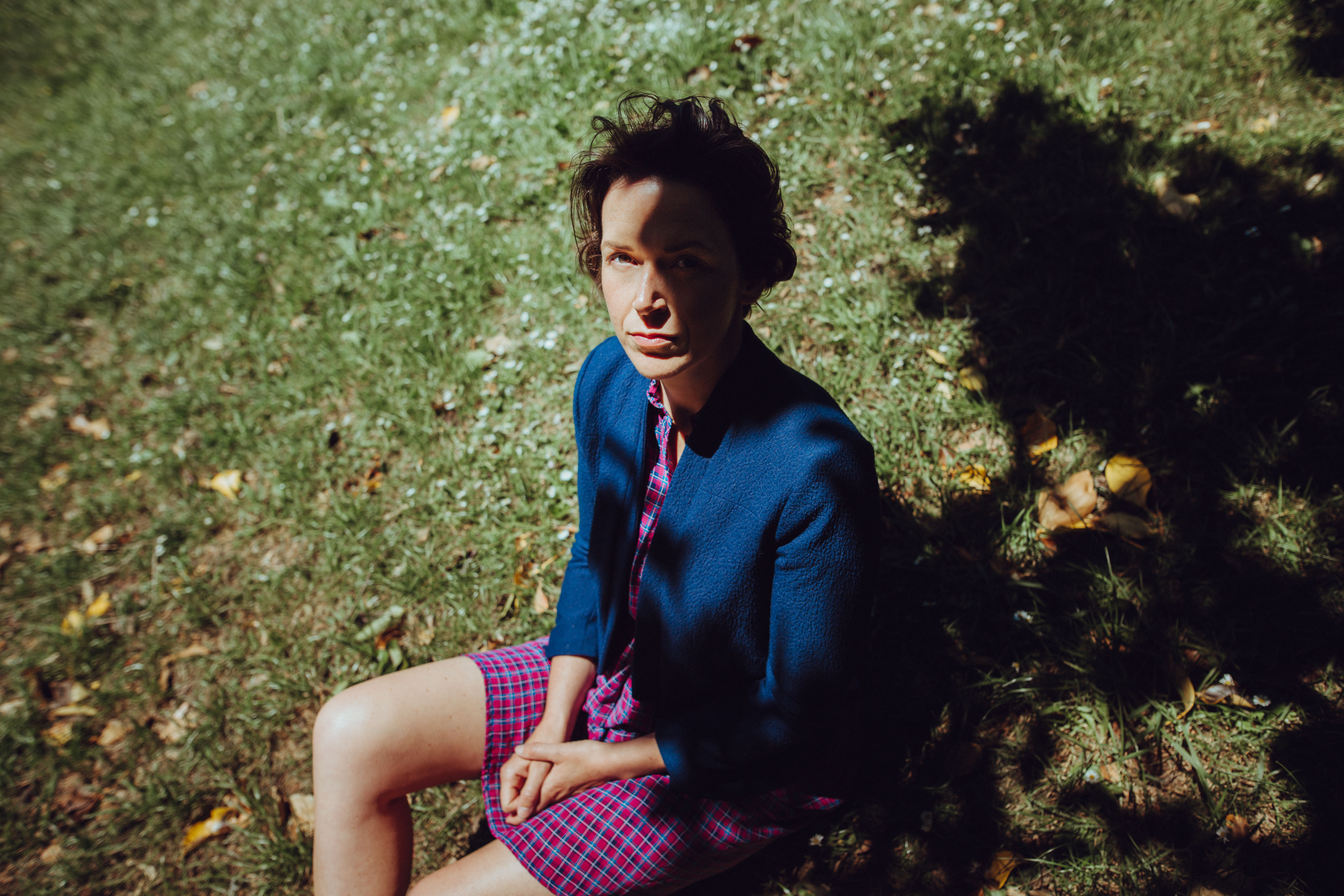
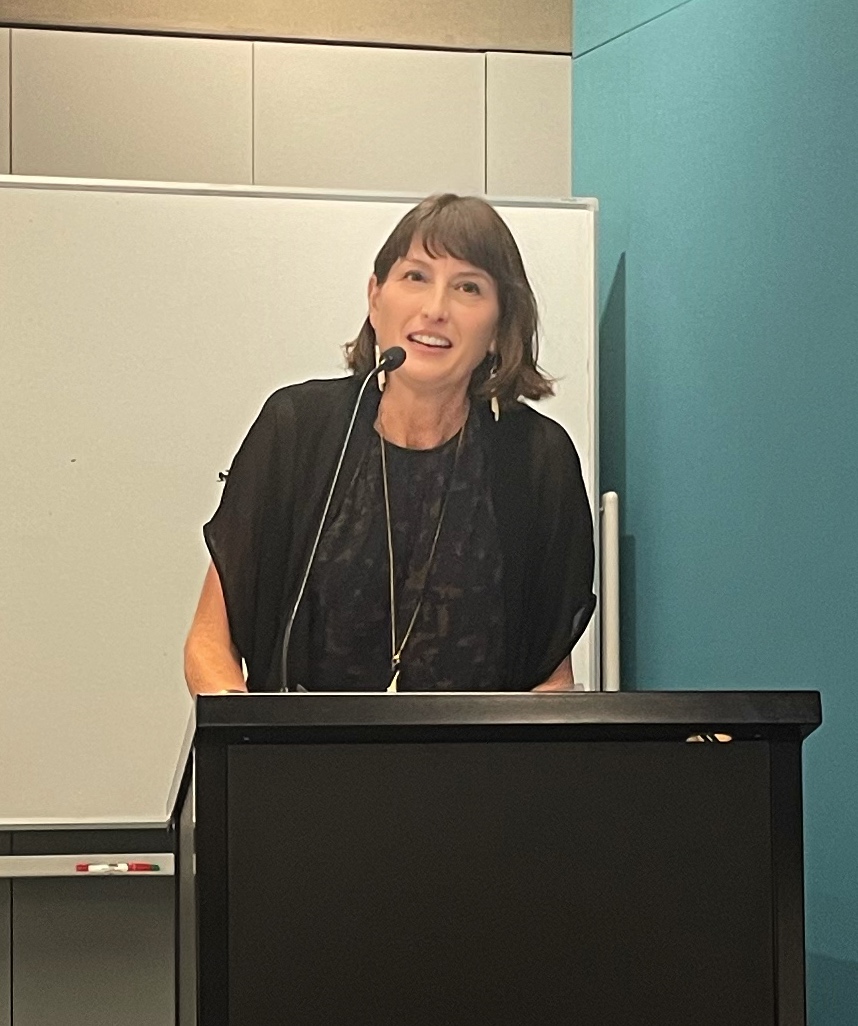
Louise Wallace is the author of three previous collections of poems. She is the founder and editor of Starling, and the editor of Ōrongohau | Best New Zealand Poems 2022. She completed an MA in Creative Writing at the International Institute of Modern Letters in 2008, winning the Biggs Prize for Poetry, and was the Robert Burns Fellow at the University of Otago, Dunedin in 2015. She grew up in Gisborne and now lives on the Otago Peninsula in Ōtepoti with her husband and their young son.
You can hear the chants, the fervent pitch of girlish voices. Banners like waves ripple down Cuba Street. You imagine their heads bowed together, small groups of women on wooden floors, gathered around sheets and stencils and ink. ‘Housewives areunpaid slaves’ – how about that? Yes! Yes, and what do you think – ‘Abortion A Woman’s Right’? They sway and swing their long brown hair, furrow their brows, wear corduroy flares, their bras are flung. They will
change course soon enter offices in pencil-line skirts, tick-tick through timeworn government halls in stiletto steps become ‘working women’, and ‘solo mums’ on the benefit, taking all the jobs, taking
selfies in low-cut tops for ‘likes’ on Facebook, swinging pink feather ponytails while mothers don’t seem to bat an eyelid
yet you hear this tap – tap-tap of hashtags – me-too and blue- pink-and-white tweets rising like banners about to ripple in a new wave down Cuba Street.
Gail Ingram
— from Some Bird (Sudden Valley Press) launching August 2023
Gail Ingram is an award-winning writer from the Port Hills of Ōtautahi and author of Contents Under Pressure (Pūkeko Publications 2019). Her second poetry collection Some Bird (Sudden Valley Press) is forthcoming. Her work has appeared in Landfall, Turbine/Kapohau, The Spinoff, The Poetry Shelf, Poetry New Zealand, Cordite Poetry Review, Blue Nib, Barren Magazine and others. She has an MCW (with distinction) from Massey University, is managing editor for a fine line, and a short fiction editor for Flash Frontier: An Adventure in Short Fiction. Website
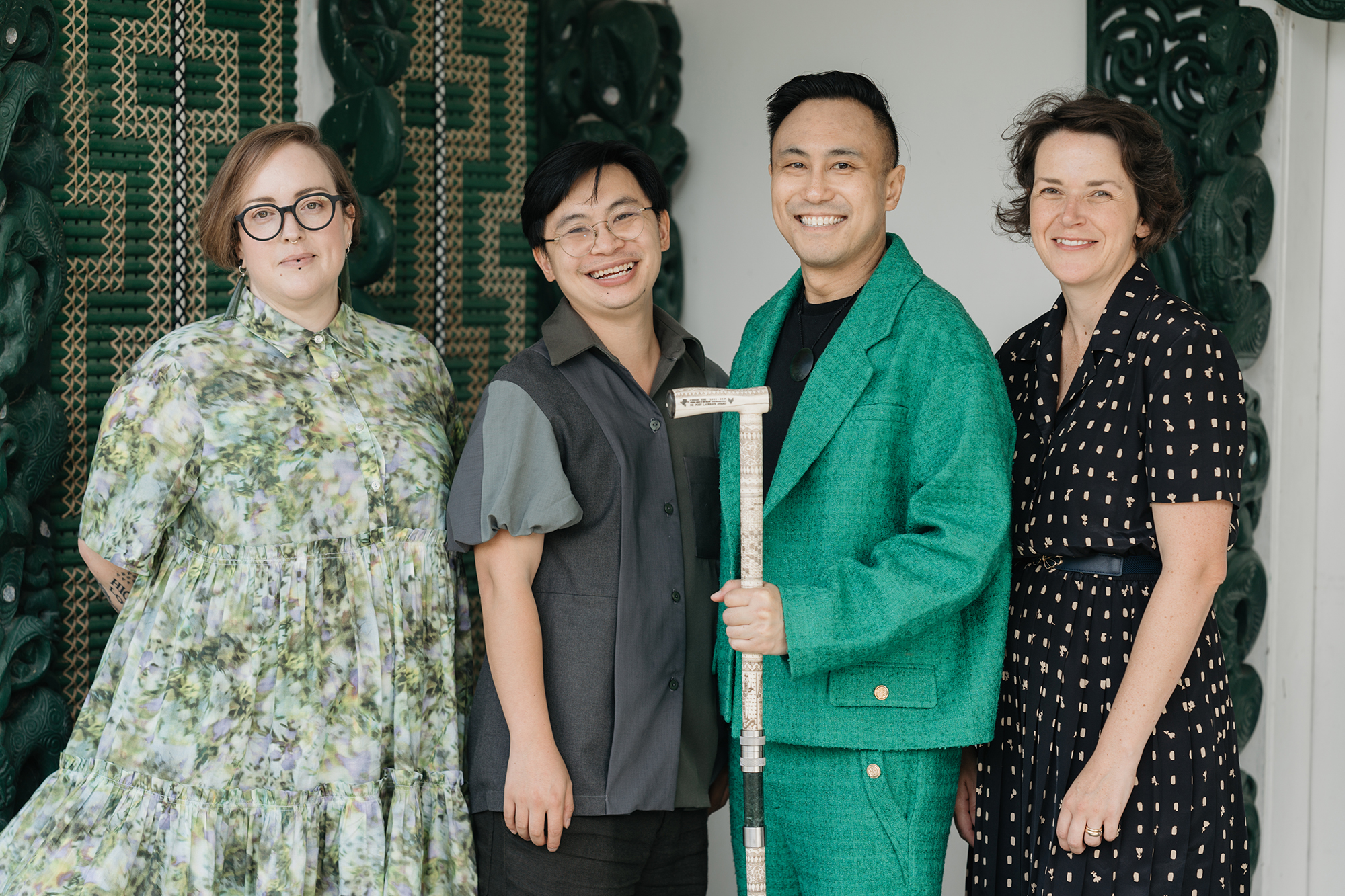
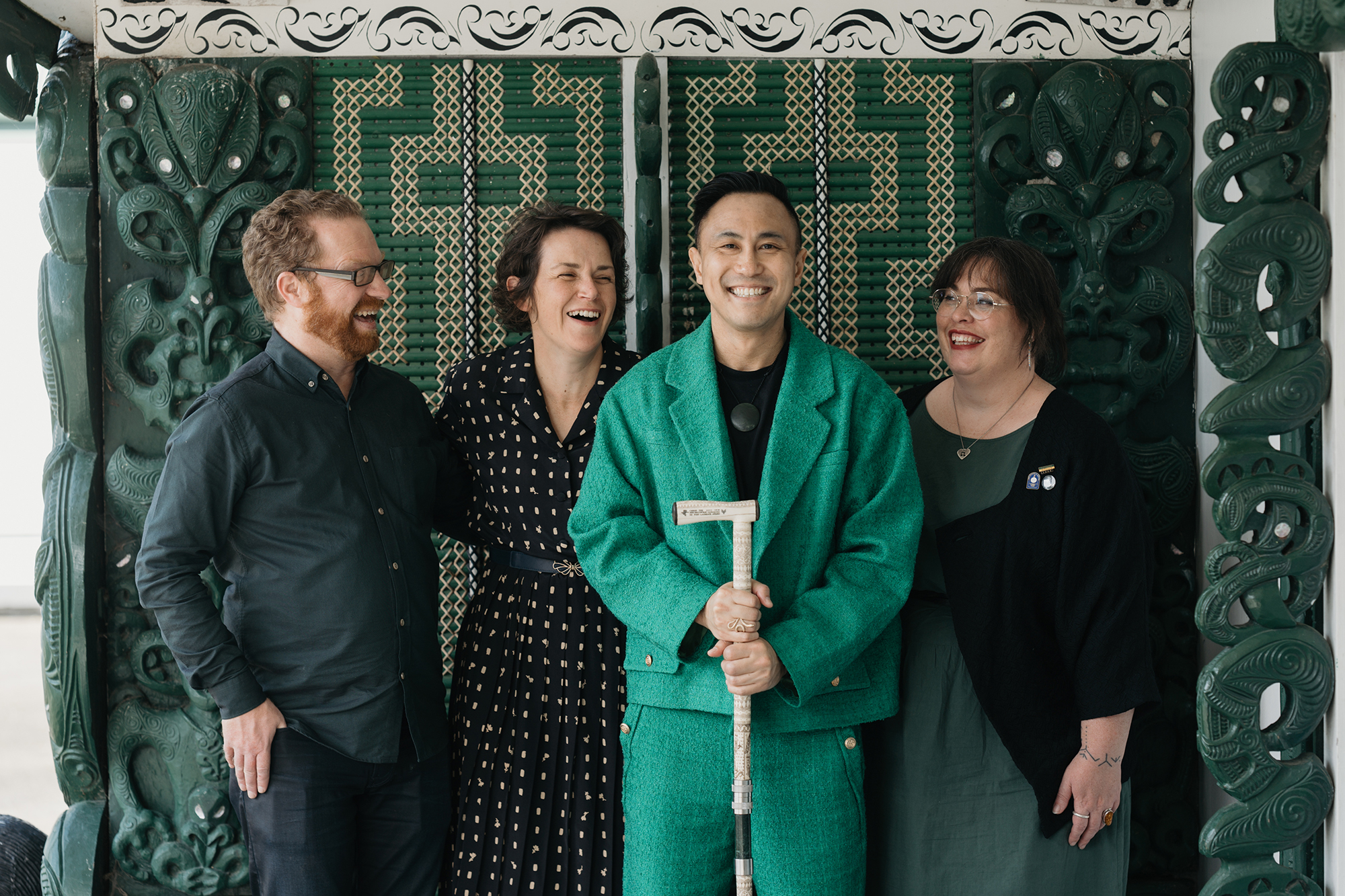
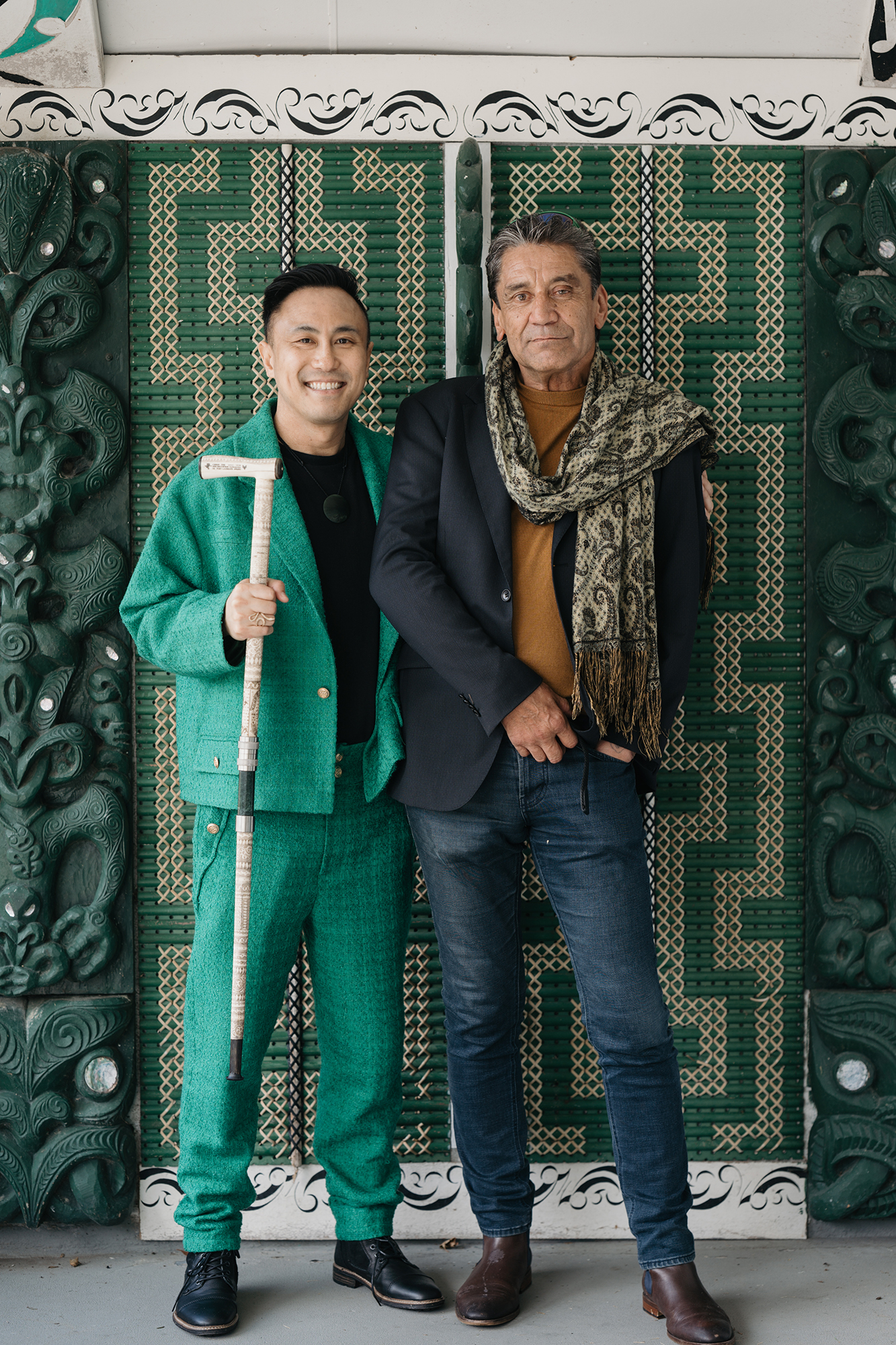
On a drizzly Saturday at the end of April, I travelled to Matahiwi Marae in the Hawke’s Bay with friends, family, and whānau to be officially inaugurated as New Zealand Poet Laureate. Although I’ve been in the role for just over eight months, the inauguration is a significant and special milestone – not only is it when I receive my tokotoko, it’s an opportunity to recognise the Poet Laureate role’s connection to Te Matau-a-Māui, where it all started.
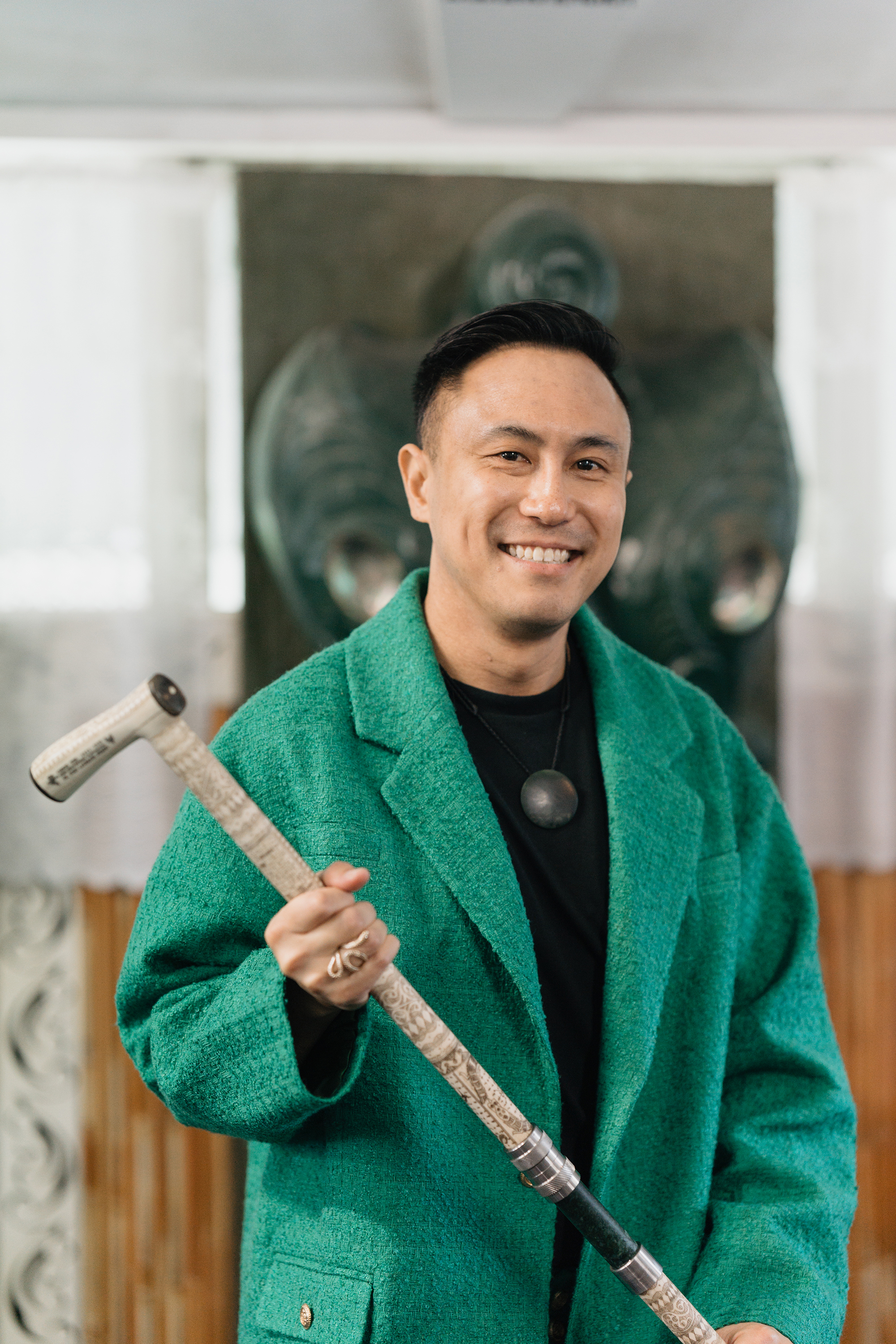
My tokotoko was presented to me by Jacob Scott, who has created the tokotoko for all the previous Poets Laureate. Mine is made of bone and pounamu, and features carvings that are reminiscent of symbols from ancient Chinese calendars and almanacs. Jacob named the tokotoko “知識”, which means “knowledge”. He spoke of the mystery in the carvings and how it’s my job now to untangle the meaning behind them. There’s something very poetic about being guided by the unknown into knowledge and understanding.
Naturally the weekend was filled with poetry – my guest poets Emma Barnes, Louise Wallace and Nathan Joe read beautifully at all of the weekend’s events, introducing people to the breadth of contemporary Aotearoa and world poetry. (Nathan’s reading of Chen Chen’s ‘Winter’ is going down as a capital-M Moment in New Zealand poetry history.) I was also delighted to be able to include other writers in the line-up for the Saturday night public event: David Chan, Leah Dodd, Gem Wilder (who also read a poem by Claire Mabey), Ash Davida Jane, Rose Lu (who read a new poem by Nina Mingya Powles) and Rebecca Hawkes. One of the new poems I read is an 85-line acrostic acknowledging the Poets Laureate who have come before me. You can read it on the New Zealand Poet Laureate blog.
It’s safe to say I wasn’t quite prepared for how emotional the whole weekend was – many happy tears were shed and I tried my best to not look embarrassed as people said very nice things about me all weekend!
I’m so grateful to everyone who played a part in making it all happen: Matahiwi Marae, the National Library, Hawke’s Bay Readers and Writers, Toitoi Hawke’s Bay Arts & Events Centre, Wardini Books, Ben Fagan, Emma, Louise and Nathan, and everyone else who spoke or performed during the weekend. Thank you to you all.
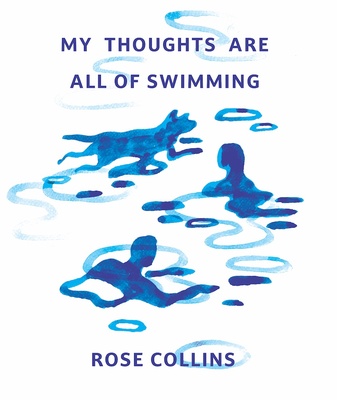
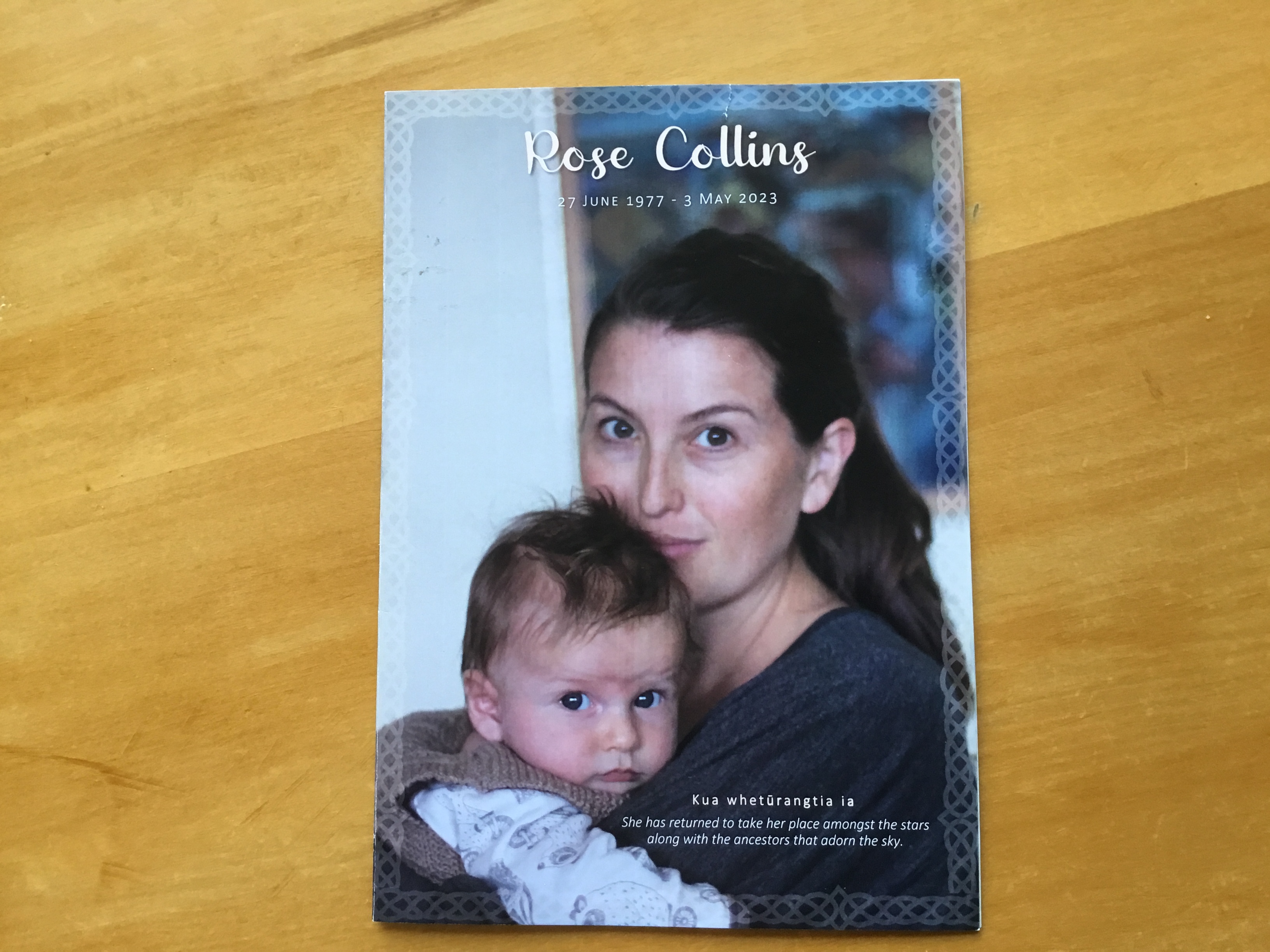
Poetry Shelf has offered a space to celebrate, to grieve and to pay tribute to Rose Collins – poet, mother, beekeeper, lawyer. Rose sadly died on 3 May 2023 of cancer, and many of us are feeling her loss deeply. Her poetry and her presence has touched the lives of many – her friends, family, fellow poets, the readers and fans of her much-loved poetry. Especially in Ōtautahi Christchurch where she was deeply involved in the Canterbury Poetry Collective. Along with tributes, Morrin Rout’s funeral eulogy, and some photographs, the celebration includes three poems from Rose’s collection, My Thoughts Are All of Swimming, and my recent review.
Born in New Zealand and of Irish descent, Rose was a poet and short fiction writer. She worked as a human rights lawyer before completing the MA in Creative Writing at the IIML in 2010. She won the 2022 John O’Connor Award and the 2020 Micro Madness Competition, and was shortlisted for the UK Bare Fiction Prize (2016), the Bridport Prize (2020) and the takahē Monica Taylor Poetry Prize (2020). Rose was the 2018 Writer in Residence at Hagley College. She was a some-time litigation lawyer, a beekeeper and a mother of two. She lived in Te Whakaraupō Lyttelton Harbour with her family.
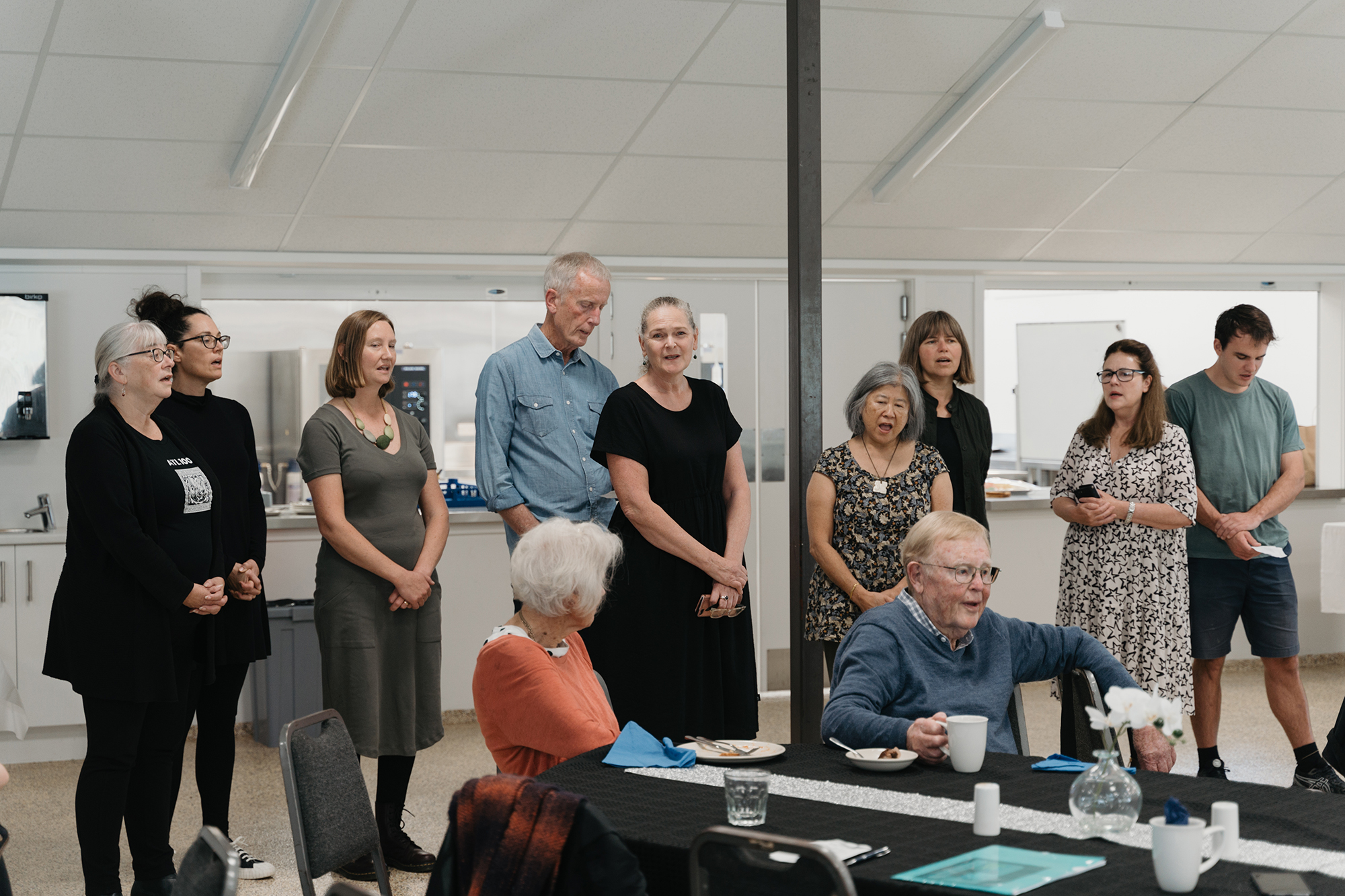
We come together, we come together hands held, with poetry and conversation, images and words, grief, celebration and infinite aroha.
My Thoughts Are All of Swimming Rose Collins, Sudden Valley Press, 2023
3 Poems
Returning North
after ‘North’ by Seamus Heaney
To those great trees that hang on still
to mountainsides in Wicklow
or in Derry, where the troubles began,
you offered up your pen.
You have to work, you knew
the unlooked-for reward, the hunger, stroke
or family calamity set to one side –
so hammer on, clear-eyed.
No longships coursed these bays
but those hoarse oarsmen, gripping the kerling,
feeding the yoke of anchor out over
drowned Doggerland, still whisper
in my blood – their curdling muted
by the wash and wrench of oceans:
deep in the shallow-draft hull, the world
and all its words will roll at your feet.
Composing in this crackling southern light –
clinker lines, sail split, the hemp-warp flapping –
while you spun the anchor wider than geography,
a green-oak branch weighted with a stone
to dig fast into mud or sand.
In turf fields, bog-black thunder
clouds and icy glints of rain circle
the muddy hoard –
a father might shovel
roots and green saplings
in the storm, a lover might intone
in sonorous Latin – like the messenger angel
blowing open the dark to the light
a crowd of upturned faces,
hear this –
‘Do not be afraid.’
The Kitchen
I like to throw out my hand
and have a rolling pin fly at me.
It makes me feel like an automaton, a kitchen
robot, mechanically efficient, in constant motion
except when I stop, like a subway train on its dark tracks.
Never trust a thin cook,
though I am thin as glass, stooping at the oven door.
It’s in the pause that I lose my faith,
drop a kilo of diastatic malt
let the sourdough starter bristle with mould.
I like to chop fast. If I slow
down I’ll start to question my instincts.
What good is an endive? Do oysters know loneliness?
Am I a slow motion clown
tripping over my own spaghetti legs?
I can catch a finger-full of salt and rub
it in the cuts: the aim is to avoid stillness.
I move like a blind woman baking sorrow cake
blindfold, following the recipe
spooning in what’s lost.
My thoughts are all of swimming
the tide is a thing that moves
lean and sometimes hungry
for sand, silt or grit
the foam and the form of it
and you, mirrored there against the hills
your hands under me as I hang
on the rippled hide
of water, dear life
it won’t be long now until I’m back in the sea.
Tributes
Rose wrote like an angel, one of those angels that wait at the side of a painting. Delivering a message, folding her wings, waiting for the answer. Poised as if every moment is eternal. Sure on this shining night Kindness must watch for you.
Elizabeth Smither
Rose Collins
It is with deep sadness that we report the untimely death of award winning poet, Rose Collins. While this is a tragedy of immeasurable proportions for Rose’s family and friends, it is also a loss to the writing community.
What we have lost is not just a talented writer, teacher and friend, but we have lost possibilities. Rose’s debut book of poetry, “My Thoughts are all of Swimming” signaled a distinct developing poetic talent.
We mourn Rose’s passing. We miss her and what might have been.
David Gregory
Ōtautahi is a place of many writing groups and I’ve been fortunate to have been in three of them with Rose over the years. I will miss you, Rose. Your warm, beautiful, perceptive self. Your writing which showed such talent. Your intelligent and discerning comments in giving feedback to others and your delight when you read something that ‘rang true.’ You will live on in your words and in our hearts, dear Rose.
Frankie McMillan
I was so lucky to know Rose. She was magic. Over the last few days, people have been taking about the qualities she brought to critique groups, teaching and mentoring: her insight, curiosity, warmth, humour, and humanity. I’m so grateful that we have a collection of her writing to treasure and return to. Also she gave top quality hugs. We will miss you for a long time, dear Rose.
Zöe Meager
Rose has left a legacy of her poetry and short stories but many of her most powerful words were never put onto the page, they were spoken into the ears of young and aspiring writers— words of encouragement, wisdom, and practical guidance. Her legacy will continue to live on through the countless words that they will go on to write.
Heather McQuillan
I had the privilege of running a launch event last August for Rose’s glittering first book, My Thoughts Are All of Swimming. I remember, when we were roughly blocking out the time we should allot for various bits, I suggested fifteen to twenty minutes for Rose to read and she looked aghast. As if only a preening stage-hog would want that much time. Her counter-suggestion was five minutes. At her own book launch! I’m not sure Rose knew how good she was. In my experience, it’s often the most thoughtful, reflective poets who are mic-shy. I know if I wrote poems like Rose Collins did, I would take my time, and people would listen. In her unsettling and endlessly productive poem ‘Everything that we are afraid of’, she notes, almost offhandedly: ‘All sorrows can be borne.’ I hope you’re right about that, Rose. I’m going to trust that you are.
Erik Kennedy
Dear Rose, you brought so much to our small sphere, your voice in a choir in an airy hall, your flash, your grace, your way with words swelling our Tūranga with brightness, and again, and now all swimming through a blue book of you, your melodies of Te Whakaraupō, ghosts and European history, tamarillo teardrops, mud flats, and here you are holding the sapling kōhūhū you nursed through the storms on your property, words humming like your bees, you sang to us, and across the harbour I hear you, that high sweet song.
With love to Rose’s family and friends at this sad time –
Gail Ingram x
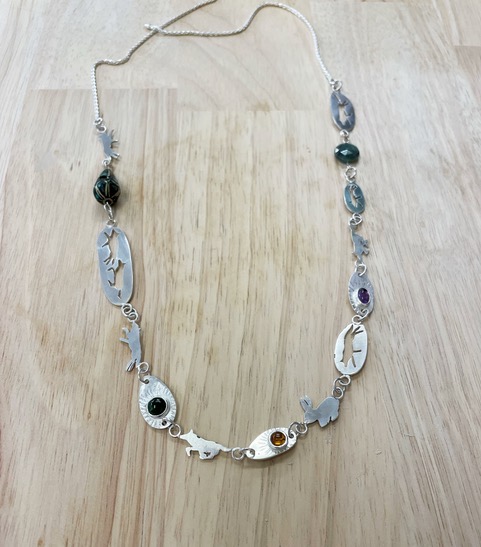
I met Rose in May 2020 when she joined my online poetry course, where she was a graceful, fun, generous and loved member of the group. Recently, when Rose became too ill to attend the sessions, another member, Fiona, in Ireland, suggested making a recording of poems for her, which we did. One of the poems, a kind of charm written by Caroline, in England, was turned, by Rose’s silversmith sister here in Aotearoa NZ, into the most exquisite necklace. It has wolves, a rabbit, and gems including a turquoise bead from Rose’s grandmother. It brought us together, and it widened our circle. Art is connective. Poetry is connective. I have caught fragments from emails by people in our group as we try to absorb the fact that Rose has gone:
Sweet Rose, how she will be missed * Meeting Rose, albeit briefly and virtually, was charged with importance * She had a pure and positive presence in our group * She was SUCH a wonderful poet * I was in floods when I heard and wanted to call you but I realised it was 3:30am in New Zealand * It was a brief encounter with Rose for me but I felt truly touched by her work and her presence * She was so incisive and brilliant * I can just see her face in that zoom gallery. Her look was so healthy, as were her words. How strong she must have been to be that way, then.
Lynn Davidson
When first I read Rose’s debut collection My Thoughts Are All of Swimming in manuscript some years ago, I could see and hear that already here is a a language, a voice that goes to the heart of the matter. Rose had that wonderful gift of such a finely tuned sensibility. You can see it and hear it in the language: that the relationship to our outer and inner worlds makes for poems and a poetry that prizes discover over mere invention. There is so much music in these poems that they will outlast the flow of time. Rose was a poet of enormous talent.
Michael Harlow 2023
Every time I met Rose, I got such a vivid sense of her warm-heartedness, kindness, gentleness, talent, and strength of character. And when I turn to her poems, all those qualities are there too. So I’m especially grateful for the poems now, though of course they make even sadder at the loss of Rose herself.
Philip Armstrong
Rose Collins was an extremely talented poet who recently published a brilliant award-winning first volume of poems. Rose was remarkable for her clear thinking, the sensitivity of her poems and for her kindness and generosity. Her early death is a tragedy not only for her family and friends but also for poetry itself.
Dr Rodney Foster
Rose was a poet of acute sensitivity and quiet observation. Her words were uncannily perceptive, gentle and reassuring – and that’s how I knew her as a friend, too. She had a habit of asking simple questions that went to the heart of things:
The moon is sometimes just the moon no one cares about shimmering no one asked it to glow did we request this luminosity?
from ‘Teaching the poets’
She was direct, and honest – which made her the best sort of human and poet.
Everything that we isolate paws at the door takes us to where fear burrows in All sorrows can be borne.
Breath rings, ribcages bloom the fluted throat of a bellbird offers up its ghost before the sun peels open the day
everything that we are afraid of raps upon the glass.
From ‘Everything that we are afraid of – ’
And her too-short life seemed filled with uncommon moments of beauty. I recall her talking about Teddy, her dog who carried her pain for her: she marvelled at things that happen at unexpected intersections. In a poem about the Port Hills hare, Rose wrote: She thinks: ‘I found a word in my pocket today.’ I love how simply wonderful that idea is. I will miss Rose and her beautiful person, but I know, too, that in loss we also find something new, a gentle and surprising thing that urges us forward. A luminosity, or a word.
Michelle Elvy
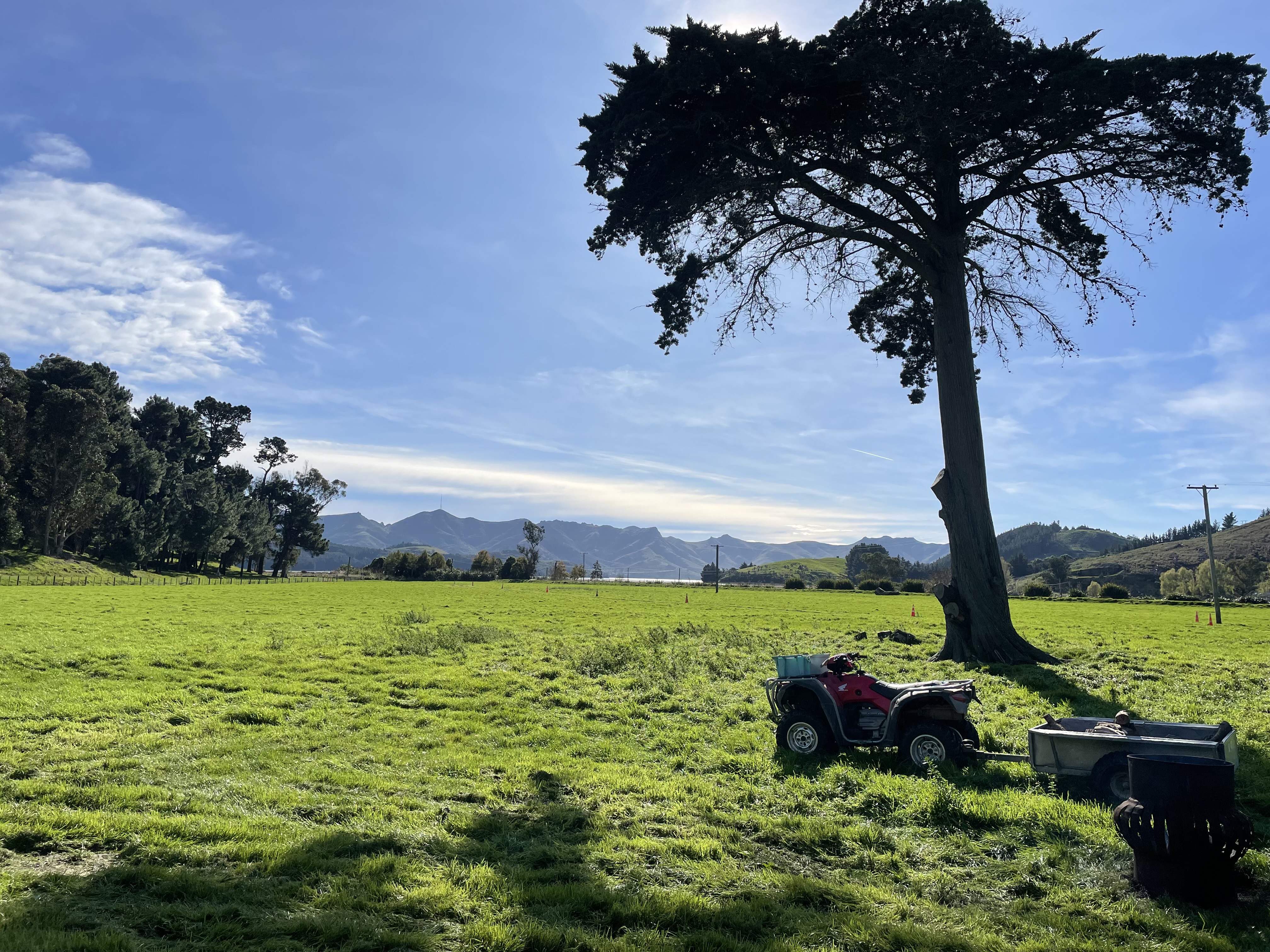
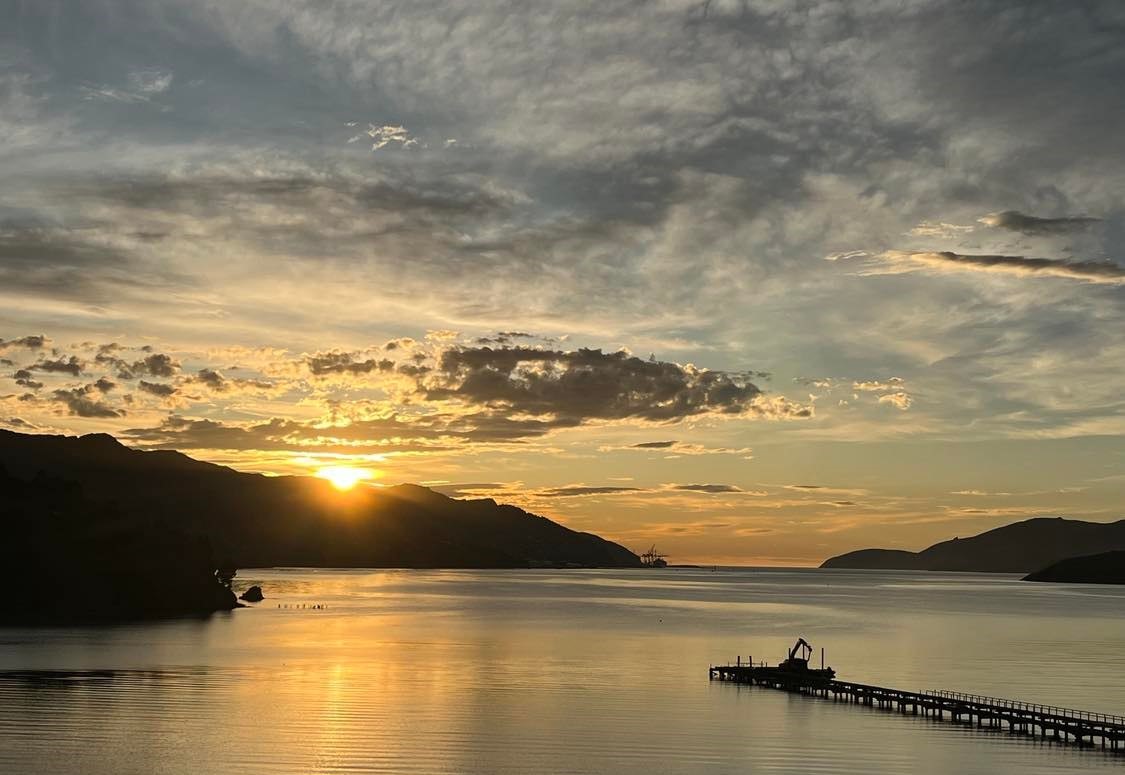
a photo from the funeral service venue, looking across Rose’s beloved water on a cracker day (add your own birdsong).
Catalyst extends aroha from our whole community to the whānau of Rose Collins, our fallen poet friend. We keep your words and our thoughts go swimming with you forever, Rose.
Ciaran Fox
Listening to the eulogies at Rose’s funeral, I thought how little I knew of her; then, how much… I knew the poet, and poetry seems to me about as close to the core of a person as we may come. In the monthly gathering of our Poet’s Group, though rarely in the past months, she tested new poems ‘upon the pulses’ (Keats). Invariably they seemed superb. Crafted yet fresh, intimate yet always a wide-open door. There, the world she loved dearly; here, the clear resonant soul. Paula Green’s recent review revealed all those qualities of clarity, perceptiveness, poignancy, and grace I knew in Rose. What is there to do now but ‘to carry on / and tend the hive.’ (from ‘Brace Comb’, p38-39 in My Thoughts Are All of Swimming).
John Allison
Rose combined grace, intelligence and strength with a kind of capaciousness, an ability to gather the world in around her. These qualities carried over into her writing. Gravity, too, and love. I admired her so much, and always will.
Amy Head
I was deeply, deeply saddened to learn of Rose’s death yesterday morning. I grieve for Rose herself – such a lovely presence, a friend and fellow writer, dying so young and with so much promise. I grieve for Pete and their young children, I grieve for her wider family and her community of friends. This will be such a devastating moment and an ongoing sadness for the many, many people who had close ties to Rose.
I also grieve for the loss to Aotearoa New Zealand letters. Rose’s recent poetry collection My Thoughts Are All of Swimming, chosen by Elizabeth Smither as the winner in the Inaugural John O’Connor poetry prize, was a perfectly judged collection. The poems were beautifully structured, layered, resonant and moving. In other words, the work of a poet sure of her craft and of what she wanted to say. Most poets would give their eye teeth to have written such a book. A collection written with such assurance is a rarity; that it was a first book is an astonishment.
So I grieve for what might have been, for the important poet Rose might well have become.
Rose faced her condition with courage and poise, with never a hint of self-pity. Rose was a fellow member of a small critique group who gathered monthly to share and discuss poems. She was a beautiful reader of her own work and I feel privileged to have been part of an audience as she shared the first drafts of many of the poems subsequently in her book. I am deeply saddened by her passing and that her voice has now been stilled.
James Norcliffe
Hey Rose
Ten of us entered the room Eleven grew Into the people we weren’t before A collection of cells Transformed
You composed the best piece of us all Human, curled and alight A listening love Woven (we liked to think) with our best Words
That battled towards A consciousness A brittleness, an eagerness To be a known Will
Hey Rose, every minute of you Polished something never said And then somehow said When you wrote to Say
The cells were at work again That they’d had a new, dangerous thought An arrangement of curious poetry None of us thought to Read through to the end
Come a bright Monday We sang for you In an old shed whose roof seemed Rattled at the thought of Goodbyes
There a woman fainted in the seat beside me She wore a red dress and soon came to To announce She once taught you Piano
I later saw her walking Smiling in the smoke waft Of fires lit to mark the way Now free of this Fact
David Coventry
Rose,
Because of you, I believe in friendship at first sight.
That’s why I took the seat next to you in that workshop where we learned to infuse our prose with poetry.
In the decade since, I came to see that you did the same for your life — you infused your life with poetry. Loving a husband poetry. Besotted by your newborn poetry. Building a home of sun and comfort poetry. Heirloom chickens out the back in the bush. Good food. Campfires and horses. Granddad poetry. Bashful delight in winning poetry. Writing prose and poetry, poetry. And more, and more. And more.
Vivid, strong, hushed, raucous, intrinsic poetry.
You made it so.
And you made it so not just for you, but for those blessed to call you friend, mother, sister, wife, teacher, daughter, granddaughter.
You gave ‘enough love to last a lifetime,’ your whānau said when celebrating your remarkable, generous life. And we are all the better for that love, your poetry.
Ngā mihi, Rose. Arohanui.
Brindi Joy
The morning of Rose’s funeral, I sat outside on my deck, coffee in one hand, Rose’s poetry collection in the other, watching the sun rise over Whakaraupō. And as I sat there, I thought about the spoonbills in the harbour and the way they move through the mud, sifting for nuggets of goodness in the same way a poet searches for the perfect combination of words. Rose managed to find the gold in the mud, and her poems shone. She was a wordsmith, a poet, a colleague, a neighbour, and a friend, and I realise that none of the words I have are beautiful enough to capture her warmth and energy. There are no words, dear friend.
First I want to thank the whanau for asking me to speak about Rose, the writer. It is a real privilege and I hope I pay due homage to her talent, as a poet, a short story and flash fiction writer, a tutor and a mentor to aspiring writers and a much loved and respected member not only of the Otautahi literary community but groups beyond Aotearoa.
Many of you will know that I first met Rose, and her family, when she was very young and so I have had the opportunity to see her grow into the formidably talented woman she became.
I also got to know some of the critical people who influenced and encouraged her writing – her Irish grannie, Terri, whose lovely lilting voice I can still hear in my head and her Pa, her grandfather, Ian who told marvellous stories and involved his granddaughters in his tales.
Siobhan is also an accomplished poet, a Jungian analyst who delves into dreams and the strange and marvellous mysteries of the mind, Dave is a fine singer, so it is no wonder that Rose’s work reflects this rich upbringing of story, song, myth and legend.
She was also greatly shaped by where she grew up right here in Whakaraupo, the harbour basin, on the crater edge – she said in a recent interview that ‘ I can’t really speak without the landscape being in the voice’ and that the volcanic nature of her surroundings ‘ has, since childhood, ignited my imagination”
This profound sense of living in such a dynamic place was also reinforced when she was studying in Dublin and, after attending a hedge school in Galway to study Yeats, she went on a pilgrimage to the places where Yeats had lived and worked and realised, as she said ‘ that the place a poet is speaking from can be so vital’ in their work.
After living in NY, Rose did a MA in Creative Writing at the IIML at Victoria University, Te Herenga Waka and had early success with her short stories, flash fiction and poems.
She was published in many local and international journals and anthologies and her work has been short and long listed for many prestigious competitions. I would love to read them all out for you but I would go well over my time – here are just a few – the UK Bare Fiction Prize, the Bridport Prize and the takahe Monica Taylor prize.
Rose shone especially in writing flash/micro/short short fiction/prose poetry, whatever you want to call it and over the years she was regularly in the short lists of many competitions
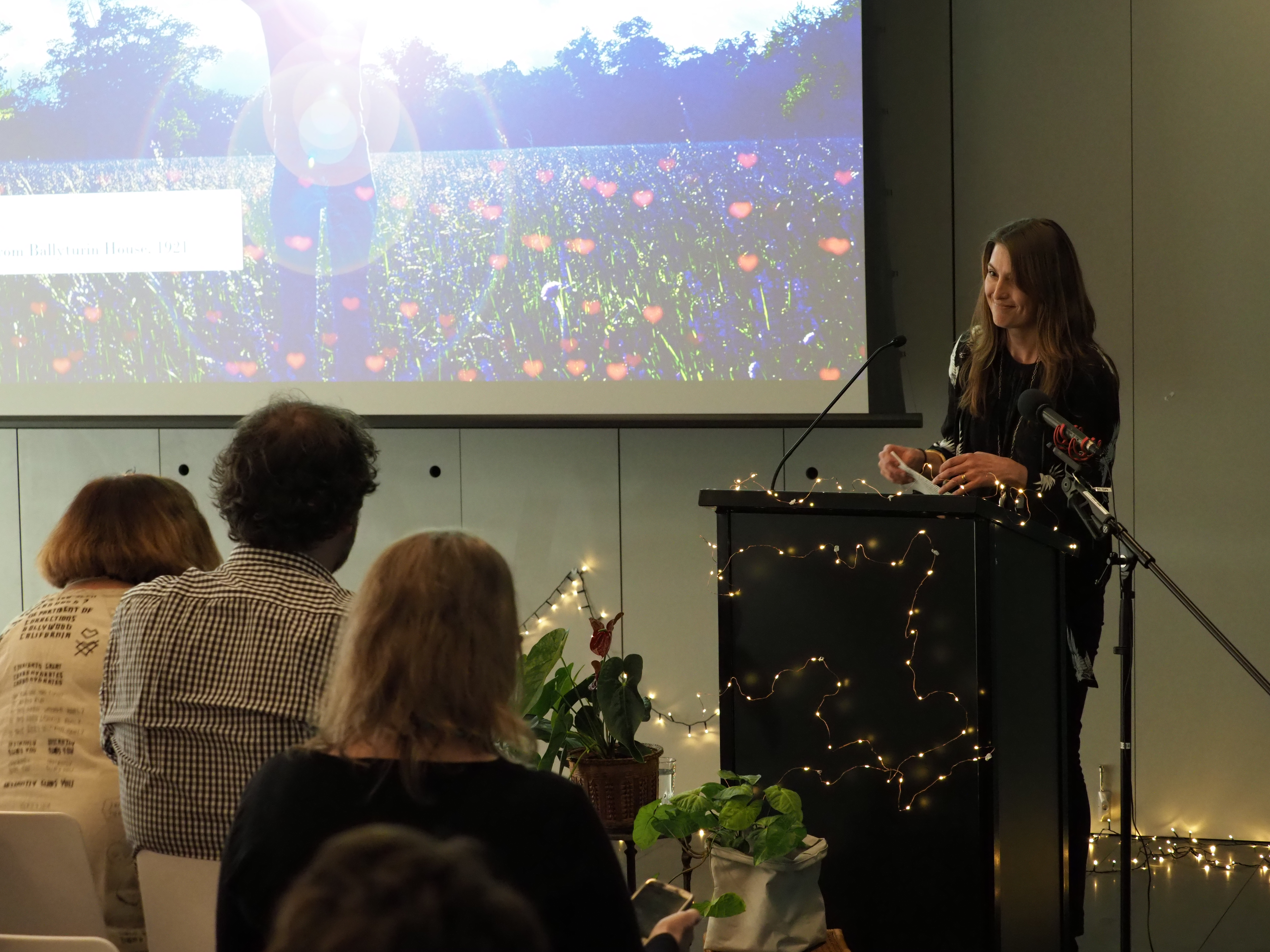
In 2019 her piece, Over the fields from Ballyturin was second in the NZFF competition and the Canterbury regional winner. In 2020 she won the Micro Madness competition and she was a co-judge of that in 2022.
She also spent time tutoring and mentoring with the School for Young Writers and the Hagley Writers’ Institute. Her empathetic and creative approach to encouraging young and emerging writers will be greatly missed. Erik Kennedy, poetry editor of takahe, a literary journal, said of Rose – ‘through her writing and her teaching, Rose Collins was helping to shape literature in Canterbury and beyond and it is heartbreaking that she didn’t get to do it for longer. Her work was generous and thoughtful about a fracturing world that didn’t always deserve the benefit of the doubt”
Her last great triumph, and it was a great triumph, was when she won the John O’Connor prize for her portfolio, which was judged by the renowned poet, Elizabeth Smither. This resulted in this remarkable collection, My Thoughts Are All of Swimming, being published by Sudden Valley Press last year. This book includes work written after her cancer diagnosis and while she was undergoing treatment. That she was able to do this in such debilitating circumstances is testament to her drive and commitment to her writing. It also reflects how writing allowed her to make sense of what she was being subjected to, the cruel randomness of this disease. It provided her a refuge, a place to escape to and be alone with her thoughts. She described it as a chance to go ‘slantwise’ and ‘tell stories that are difficult but not reveal too much’. Many of the poems deal with resilience and transport the writer and the reader away from the realities of what she was dealing with.
Elizabeth Smither called her portfolio a beautifully ordered collection of consistently stunning poems. Michael Harlow says that ‘despite all the darkness there is in this staggering world, this is a poetry that is alive with the music of dark hope’.
Several weeks ago, Paula Green, an Auckland poet who does a marvellous poetry blog on WordPress reviewed Rose’s book – she was entranced by it and talks about “ the use of understatement, where room is left for the reader to navigate ellipses, semantic clearings, things held back. There are poignant references, electric traces that signal illness, challenge, danger, and more illness” This comment reminded me of others made by the Flash Fiction judges, Siobhan Harvey and Lloyd Jones about Rose’s story that was runner up in 2019.
“We kept returning to this story because as much as it lets the reader in it keeps us out. We found it to be mysterious and gripping. At the same time, we feel as if we’ve only been permitted a glimpse. So much is held back which is why perhaps we kept returning to it.”
This seems to be one of the hallmarks of Rose’s writing – her ability to tell us just enough, to trust us to fill in the spaces, to invite us to be part of the work.
The voice we hear in the work reveals who she was in life – a wise, perceptive, fiercely intelligent and empathetic woman, one with whom we could share intimacies, gossip and laughter and know that she could reflect back to us the essence of what we experience and think in ways both magical and surprising.
Her legacy to us, as well as our precious memories, is her words which are to be discovered and enjoyed, celebrated and treasured.
Haere Ra, dear Rose – my thoughts will be all of you in the sea, the sky, the rocks, the hills, the wind and the rain, the full moon and the sunrise.
Morrin Rout
Review
and after, in the streak-pale sun, the welcome,
liberated hunk of sky – a tangle and comb
of wasted boughs, and still to come
the hum of absence – the loss of blue-glazed cornicing
or the blush of cupped gumnuts icing
outstretched stems – a ghost-shape for the wind to sing
from “Felling the Eucalypt”
Rose Collin’s debut collection, My Thoughts Are All of Swimming, was chosen by Elizabeth Smither as the inaugural winner of the John O’Connor Award. In conjunction with the Canterbury Poets’ Collective, the award offers publication to the best first manuscript of a local poet.
Rose’s collection is both elegant and physically present. I jotted down key words as I read, and realised they formed a provisional map of why I love reading and writing poetry. To begin, musicality. Every word-note is pitch perfect and forms a musical score for the ear: “Alan hears the / tide’s shingle-clatter, and closer in, his old dog’s chuffing / sighs” (from “Alan Recuperating on a Bed of Rabbits”). And:
Composing in this crackling southern light –
clinker lines, sail split, the hemp-warp flapping –
while you spun the anchor wider than geography,
a green-oak branch weighted with a stone
from “Returning North”
Secondly, the collection promotes breathing space. There is the space on the page in which a poem nestles, the chance for poems to breathe, for readerly pause and pivot. The internal design heightens this effect, with generous line spacing and a decent sized font.
I can catch a finger-full of salt and rub
it in the cuts: the aim is to avoid stillness.
I move like a blind woman baking sorrow cake
blindfold, following the recipe
spooning in what’s lost.
from “The Kitchen”
Thirdly, and intricately tied to “breathing space”, is the use of understatement, where room is left for the reader to navigate ellipses, semantic clearings, things held back. There are poignant references, electric traces that signal illness, challenge, danger, and more illness.
I am on the trapeze of a new cycle of investigations – I
walked here from the hospital, skirting the rim of a volcano
for my flat white.
from “Lion in Chains Outside Circus Circus Cafe, Mt Eden”
Fourthly, and I am searching for the best word here, there is an inquisitiveness on the part of the poet, as she ranges wide and deep in her curiosity and engagements; touching upon fairy stories, other modes of writing such as William Burroughs cut-up practice, a Kafka aphorism, sculptural installations, a Lydia Davis short story, music, other poets, Robert Falcon Scott’s diary.
My fifth word, and my handful of ideas could extend to become a catalogue, to a more substantial map of possibilities in this sumptuous poetry, is intimacy. I am musing on how you are drawn deep into the writing; how it feels exquisitely intimate. It feels compellingly close, as people and places resonate: from son to brother to friends, from Lyttelton to Ireland.
you are light as steam right now
high frequency, cloud-high
but when you are here, this side
of security, oh the things I have to tell you –
how your letter is the most valuable
thing I carry
how we have built a tower for the chickens
to roost in – kānuka poles frame the ceiling
from “While the radios are tuned you write letters home”
Rose has produced a debut collection to celebrate. It moves you to muse and be nourished, to inhabit and settle in poetry clearings. To dawdle and drift as you read. Close your eyes and absorb the music as though you have put on an album, a breathtaking album you want on repeat. There is darkness and there is light, there is the particular and the intangible. My Thoughts Are All of Swimming is a joy to read.
Paula Green, April 2023
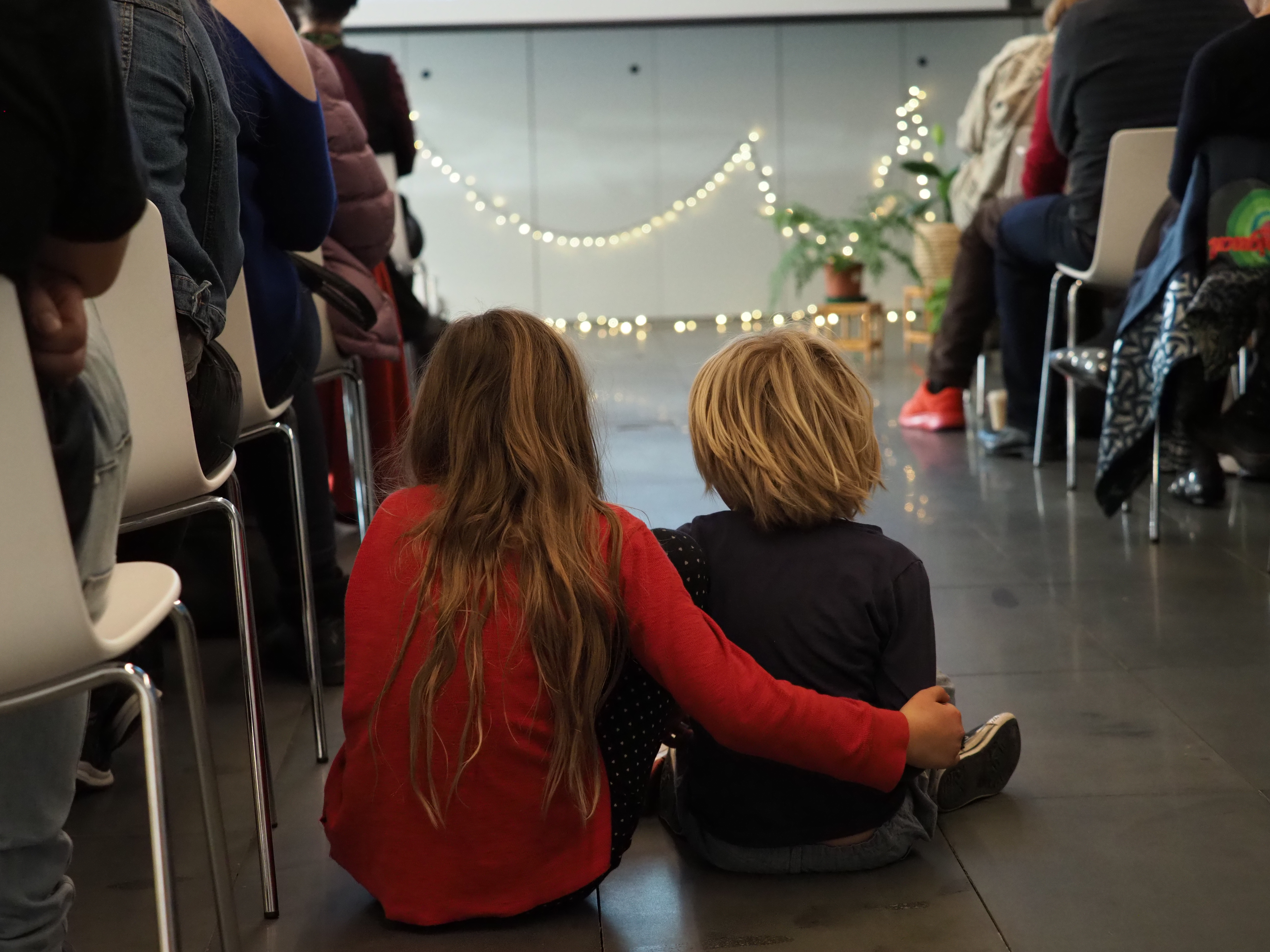
Rose’s two children listening to her read at a National Flash Fiction Day event in Christchurch
on the stone flags of the square outside the gallery —
patient in my red collar and tongue
all my love in waiting.
Chris Price from Husk (Auckland University Press, 2002)
Note on Poem
This poem holds a special place in my first book because I can remember so vividly the circumstances of its composition. It was a Sunday in spring 1997, and I’d just seen the big Hotere show Out The Black Window, ‘a literary take on the use of words and poetry in Ralph Hotere’s painting’ curated by Greg O’Brien, at City Gallery, Wellington. Hotere’s collaborators Hone Tuwhare, Cilla McQueen, Bill Manhire, and Ian Wedde had just given a reading in front of one of Hotere’s huge paintings: it may have been Dawn/Water Poem (1968). My eyes were full of Hotere’s powerful blacks and reds when I emerged blinking into a sunny Sunday afternoon in Civic Square, and the poets’ words were in my ears, when I saw a black Labrador with a red collar tied up outside the gallery, waiting for its owner. My partner Robbie was out of town at the time, so I too was in a kind of waiting state, and the poem started up in my head immediately.
Chris Price is based in Wellington, where she teaches the poetry MA at the International Institute of Modern Letters at Victoria University. Her first collection of poems, Husk (Auckland University Press, 2002), won the 2002 NZSA Jessie Mackay Award for Best First Book of Poetry and her next book, the genre-busting Brief Lives (Auckland University Press, 2006), was shortlisted in the biography category in the 2007 Montana New Zealand Book Awards. She has published two other collections with Auckland University Press: Beside Herself (2016) and The Blind Singer (2009).
Favourite Poems is a series where a poet picks a favourite poem from their own backlist and writes an accompanying note.
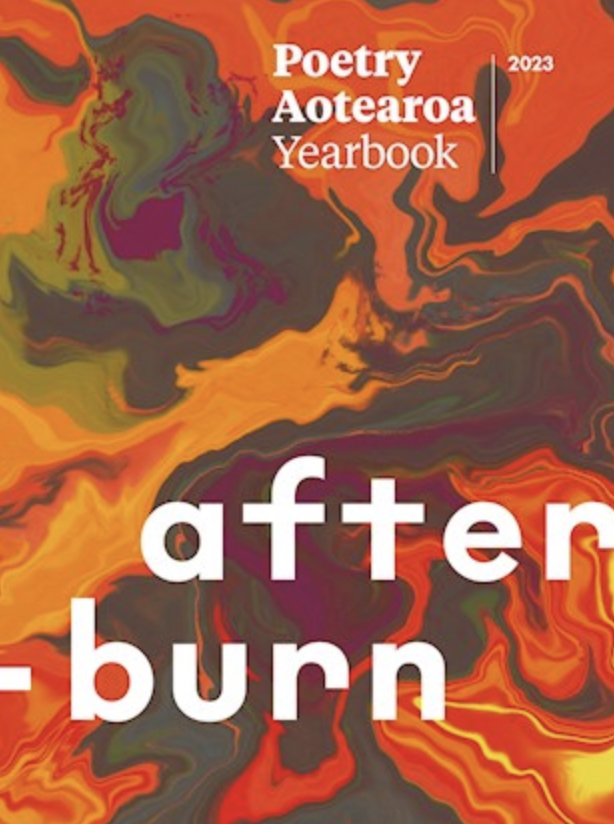
Poetry Aotearoa Yearbook 2023, ed Tracey Slaughter Massey University Press
Every day I point at something and ask how long has that been there and you always say forever.
Jane Arthur from ‘The Sky Is Bigger’
Reading poetry journals can be a prismatic and extremely satisfying experience. You reconnect with voices and familiar and discover those you want to read more of. Every time I dip into the latest Poetry Aotearoa Yearbook, I find different sparks and different connections.
Tracey Slaughter’s editorial got me musing on the way a poem is a form of “space”, which implies there is room to gather dialogue, connections, to be engaged in multiple ways, to be maverick and toastmaster, bricoleur or archaeologist, to harness profound or fleeting rewards. Tracey writes:
A poem is a space of encounter, a room of language that invites us to move our senses over its living surfaces, to brush our bodies against its echoes and pressures, visual, sculptural, sonic.
The new issue presents a generous gathering of poems, several essays and substantial book-review attention. Each issue features a particular poet, and on this occasion, Tyla Harry Bidois. Tyla is a Jewish author, illustrator and musician from Mt Maunganui who is interested in notions of womanhood and mixed race cultural identity. Her poetry is sharp edged, on sensory alert, word conscious, drawn to consumption and explosion. Wound and wounded, cuts and cutting, blood red strata, are an insistent refrain as you read.
Here is a tasting platter of my reading so far:
Brecon Dobbie’s “Chinese Medicine” underlines how a poem, through the power of anecdote, can be physically, poignantly and sensually present. Ana Maria King’s ‘nana’s kai’ is a feast of aural and visual richness, with a sublimely haunting ending. Danny Bultitude’s ‘A Town Between Two Highways’ and Cadence Chung’s ‘postcard’ satisfy on so many levels, especially the deft hook of rhythmic detail. essa may ranapiri’s ‘@hine: They never were don3 up like that’ electrifies. Jayne Ault’s ‘William II’, Victor Billet’s ‘Your move, again’ and Claire Orchard’s ‘Floral wallpaper’ pull you into enigma and the unsaid. Emma Neale, with characteristic musical flair, pulls you into a moment achingly real. Hebe Kearney’s ‘december 20th’, addressed to Carl Sagan, gets you musing with its offbeat links. With John Allison’s ‘How to sing sun light’, it is the way light catches you and drives the poem. Khadro Mohamed’s ‘Liars’ is unfolding mood that pierces, sharp and breathless. Melinda Szymanik’s ‘You are the reason you don’t feel better’ strikes a chord both political and personal. Tessa Keenan’s ‘Ōākura Beach’ refreshes the page, the glorious gap, the magnetic space between this noun and that noun, this verb and that verb.
The wind tucks its fingers into the space between an ocean and a home. I see it slide through the people I’ve imagined. It whispers an imperative.
Tessa Keenan from ‘Ōākura Beach’
Poetry Aotearoa Yearbook underlines how poetry is a glorious ripple effect across the length and depth of the country in contemporary settings, from the merging voice to the well established. The journal offers a space of encounters that is rich in scope and possibilities.
It’s winter Mid-July But I woke this morning with blooming palms and fruit trees bursting from the grooves of my spine.
Khadro Mohamed from ‘Liars’
Tracey Slaughter teaches creative writing at the University of Waikato, where she edits the journals Mayhem and Poetry New Zealand Yearbook.
Wairua: What is mauri? Mauri: Life force. Wairua: What is life force? Hinengaro: Is it like kinetic energy making the earth spin and the tides sway? Wairua: Or more of a latent energy, hard wired like a solar powered chip in your neck that still has the little plastic tab in it? Hinengaro: Or like a golden aura that floats around you, preventing your soul from bouncing into the ether? Wairua: Or a kind of tattoo that identifies you, like a rainbow fingerprint, in case the gods need to catalogue everyone quickly? Mauri: Mauri is an indigenous concept that connects all living creatures in a tapestry stretching through time. Wairua: So, a lycra. Mauri: But like, organic lycra.
Converngaro #898
Hinengaro: Good god please, won’t some empathetic politician prohibit factory farming finally making it illegal to squash animals into small awful spaces. Mauri: Excepting any owner who lives in the same sized cage. Wairua: Nice Mauri: I take it you’re going to sign petitions but you’re not personally going to be shifting away from meat then? Hinengaro: I could give the faux sausages a go? Wairua What a champ. Mauri: Yeah, that’s like barely on the board. Hinengaro: What board? Wairua: She means you can barely call yourself a Papatūānuku ally with that one. Hinengaro: What if I trade red meat for white? Mauri: And she’s off the board again. Hinengaro: How can I live without ice cream and cheese! Wairua: Yep, this one’s gonna need trickle down change.
Miriama Gemmell
Miriama Gemmell is a poet from Ngāti Kahungunu, Ngāti Pāhauwera and Rakaipaaka. Her kupu can be found in Awa Wahine, Te Whē, Sweet Mammalian and Landfall. In another time, Miriama was an English teacher in Kuwait, Kazakhstan and China. She currently lives in Ahuriri with her hoa rangatira Richard, and tamariki James Rewi (9) and Hana Tirohia (6). Miriama washes yoghurt pots and feels closer to her tīpuna.
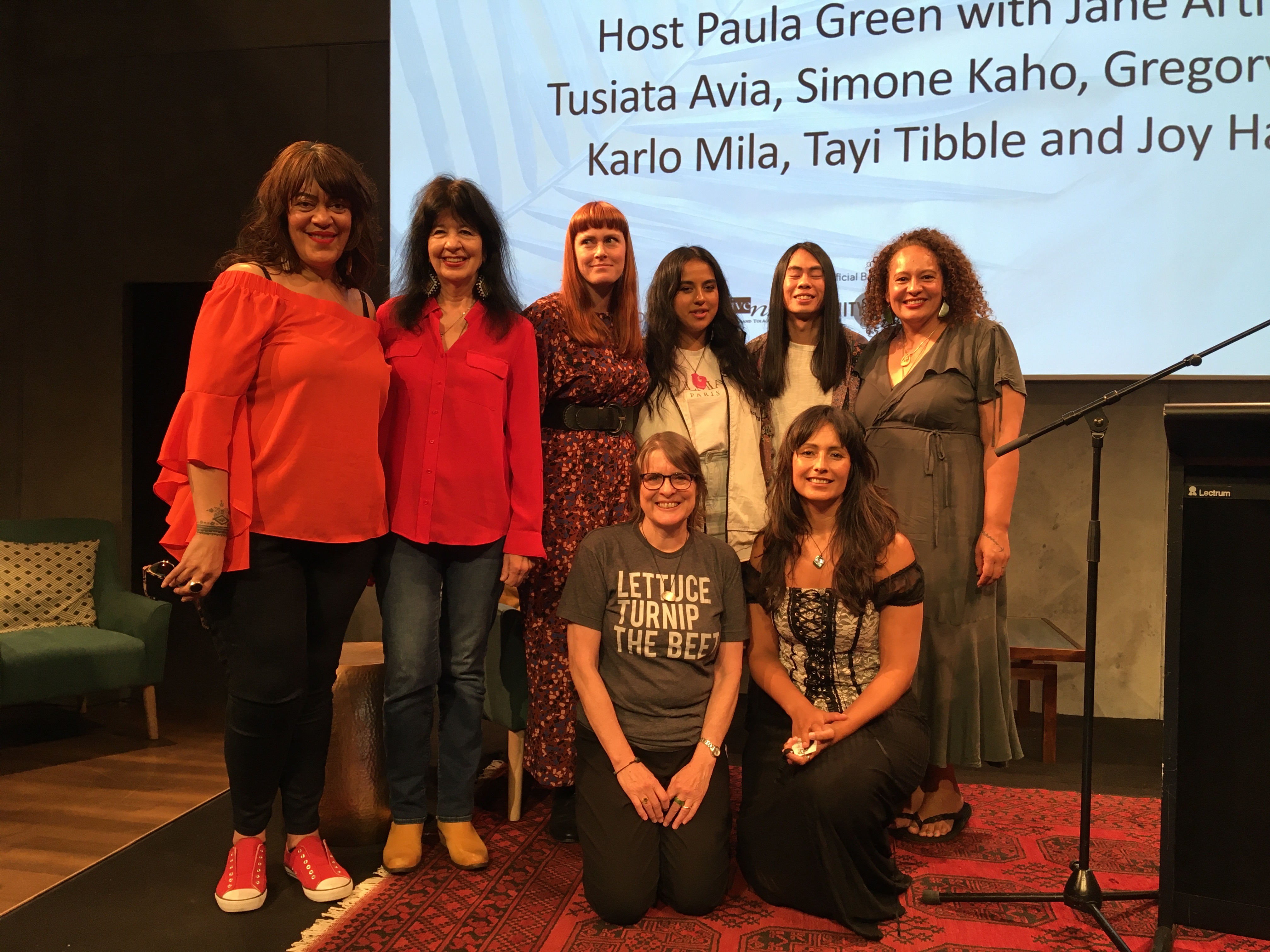
Poetry Shelf Live at VERB Festival: Paula Green with Tusiata Avia, Jane Arthur, Simone Kaho, Gregory Kan, Karlo Mila, Tayi Tibble and and special guest, US Poet Laureate Joy Harjo. Te Whanganui-a-TaraWellington, March 2020
Towns and Cities is an ongoing series that features clusters of poems with Aotearoa urban connections. I have started the series with the Kāpiti Coast and Te Whanganui-a-Tara Wellington because I have lived here on a number of occasions. I started primary school at Petone Central, and spent most of my twenties flatting in Central Wellington, Wadestown and Pauatahanui. Wellington etched hills, harbour and sky on my skin in ways that have stuck to me though London fog, Whāngarei’s tropical rain and the insistent pull of Tāmaki Makaurau Auckland.
Yet Wellington is not just iconic views: it is people, friends and family, creative communities, must-visit festivals, the buzz of books and performances, the delights of Cuba Street, excellent coffee and food, the Botanic Gardens, Tinakori hills, the lure of Kāpiti’s glorious coast. And yet always I return to the tug of hills, harbour and sky. I started with a handful of poems and soon the list felt like a potential book! An imagined book that steps off from Gregory O’Brien and Louise White’s inspirational Big Weather: Poems of Wellington (Mallinson Rendel, 2000) to form another tasting platter of new and familiar voices. The Wellington Writers Walk, and the accompanying little booklet you tuck in your pocket as you go walking, also comes to mind.
My tiny gathering of poems is not so much about Wellington as offering whiffs of place – at times, an anywhere place that may or may not have hidden attachments to Wellington’s coast and city. A fascinating particular is as important as a wider view. A memory, an experience, an imagining. There are so many more poets I could have included, sought permission from, poets who are living or have lived in Wellington, poems that would add dimension and life to a whole book. Ah, this is my first stop on my Aotearoa road trip. I am loading my bags and moving onto the next place!
Special thanks to those poets who contributed a poem. Please note one poem has a suicide reference.
I look forward to posting further clusters over the coming months. This has been a wonderful excursion to a city I love dearly – the last time I was physically there, was for the VERB event I hosted, just before lockdowns, pandemics and floods. It was a special occasion.
The poems
In our town
Sometimes I think you have to have a past to live in our town. Although some people move here because they think it’s a good place to raise children. Everyone’s past is different of course, like their dogs. The silent ones that sit and watch you, the ones that rush up to strangers and bark at them. When I picture the people in our town I see them walking the quiet streets or sitting on their verandahs, side by side with their pasts.
Alison Glenny
Angry Man
He has three barking dogs in the back of the car, old Silas and . . . I don’t know the others. He has parked the car up over the kerb outside the library and is standing nearby, waiting to see what will happen.
But nothing happens. He stands there all day and the dogs fall asleep, and he opens the car door and now the moon and stars are out in the sky and here is the light by which his children read their books.
Bill Manhire PN Review 265, May-June 2022
fermenting plums
We had become North Islanders and it felt weird, as if we had absconded to the other side, where mountains and blond grass had been replaced by arum lilies and nikau palms, where after rain, we could smell aniseed from wet feathers of wild fennel on stop banks.
We lived where the sliding shuttle of units into Wellington passed between the motorway and the golf course, rattling along the back of our section, the barrier arms’ ting-ting-ting a constant fret as commuters glided by fast enough not to see us through the branches of the plum tree,
eating toast and drinking instant coffee in our pastel-coloured, formulaic, wooden M.O.W. house at No. 2, living within our means, paying off a light-brown Vauxhall Viva Estate we could sleep in the back of, at Lake Wairarapa or on trips back south, by Lake Tekapo. There, in the north, our life was measured by the arrival of three babies
in four years, by the words from L.P.s borrowed from the Lower Hutt library; Badjelly the Witch, Buzz-o-Bumble and Grandpa’s Place, by the summer sizzle of cicadas, the mumble of magpies, the query of starlings on power lines, as we swayed on a hammock strung over a lawn so covered with the burgundy skins
of fermenting plums, the very air smelt like red wine. There, with a car port, a mail box, red geraniums, rotary clothes line, 2nd-hand flymo and the slow, old Hutt River at the end of the road; there on the other side of the Pomare rail-bridge; we lived, happily bunkered down right on the fault line.
Kay McKenzie Cooke
on Paekakariki Beach
night
like a watercolour print
with a smudge of misty cloud
soft rain falls
lines of waves trail like ribbons into the darkness
around the throat of the sea
the lights of Pukerua Bay and raumati
burn like cigarette stubs
‘we’ve had two youth suicides,’ she says
there is meaning here
moonlit leaves lap the wind
Apirana Taylor from a canoe in midstream, Canterbury University Press, 2009
walking to book club
early, even after looking at silverbeet through the community garden fence,
after breathing jasmine air near houses painted gold and cornflower blue,
on streets where a Shirley Barber fairy might guide lost rabbits home by the light of her bluebells,
I saw a man lead a small girl and her pink bicycle through a latched gate,
past a front-yard lemon tree and into the waiting arms of a woman
who steered her inside then turned back to the man, her face blooming as she held his
Leah Dodd from Past Lives, Te Herenga Waka University Press, 2023
Hills
Who put the el in the word world, changing things forever?
It must have been later: not in the beginning.
An old woman perhaps
in the days before writing when words dwelt in the body
resting her tongue a little sooner than usual, by chance and lovingly, on the roof of her mouth before sounding the d that is always ending the word word.
The roof of the world appeared. All along the horizon. Layers and layers of hills, lovely and potentially touchable.
Dinah Hawken from One Shapely Thing: Poems and Journals, Victoria University Press, 2006
Percival Street
The window is all harbour and clouds a tall house teeters between city and terrace with a thousand dark rooms and a thousand light windows the long kitchen table ingrained with rebellion and utopia the turntable plays Joni Mitchell’s Blue Doris Lessing is open next to the blue notebook, and even the wide open sky bulges with blue thoughts.
The little girl is back on Petone’s waterfront catching her father’s sermons the school windows out of eye reach. I am walking up the steps to get to the next set of steps and nowhere opens puff-breath somewhere, and then it’s back again to puff-breath nowhere, with long hair drifting, long skirt swishing.
Paula Green
Māori Uniform
The event is at Te Papa / it’s about wāhine Māori / there might be a karanga / should probably wear a skirt / I guess it should be black / I know / I know / that’s Queen Vic’s jam / but it’s just how we roll / it’s uniform.
What do urban Māori wear to something like this? / Yeah, it’s on the marae / but it’s Whiting’s whare / rules are guidelines / there’ll be Nannies there / nothing too boobie / if I wear a skirt I’ll have to wear stockings / Nan would kill me if i didn’t / it’s Māori.
Black jeans / rebel / but I’m wearing a tunic / technically it’s a top / but it’s long enough / to cover my teke / I couldn’t wear that dress / it clashes with red / lipstick / blood red / contrast against pounamu / pop / that’s the best part / uniform.
Nicole Titihuia Hawkins from Whai, We Are Babies, 2021
from Thirty-Three Transformations on a Theme of Philip
7.
Coming down off the spine of the botanical gardens onto the green flank of the dragon, shadows arch
under my feet. In the dell below, the shell-shaped stage is strewn with red camillias. November
and across the valley on the dense dark Tinakori Hill houses begin to light up like Guy Fawkes.
At the top of Patanga Crescent the pared-down villa trembles with young men thinking,
pens lost in the wide sleeves of their dead uncles. They are ecstatic and do everything extravagantly
in the last light: read, drink, fuck. On the windowsill – a stone, a leaf, a twig with buds,
and the black cat left behind mewling by the old lady now in the Home of Compassion. No change.
Anne Kennedy from Moth Hour, Auckland University Press, 2019
City Living
Two middle-aged goldfish tirelessly circle their tank
In the bars on Courtenay Place twenty-somethings text each other
Apartment-dwelling cats eye the trolley buses below
I cooked chicken for dinner but you didn’t come home
The beautiful open window admits moths, as well as air
Janis Freegard from An Exchange of Gifts, A selection of poems and haiku from the New Zealand Poetry Society’s International Poetry Competition, 2001
Wellington peonies
December 2020
There are gushy peonies outside the florists’ door. Don’t you just want to push your face into them? the florist says which is a kindness because I am already pushing my face into them.
So petalled. So inhabited. So pink. And bunched together in a zinc bucket like something cheaper, less luscious, more ordinary.
Mrs Dalloway said she would buy the flowers herself. Netted by light and breathing rivery London air. Oh to blossom into invisibility! To walk through the uncanny narrow glade between buildings, that sudden temperature drop. To see people in long coats at the bus stop undulate in late spring wind, like kelp forests.
Bliss. Katherine Mansfield has Bertha arrange green and purple grapes on a long, glossy table. Bertha is in a sudden ecstasy for a life she is about to lose. Of course, she doesn’t know it yet. She thinks only that the purple grapes bring the carpet up to the table.
Lynn Davidson from The Incompleteness Book II, Australasian Association of Writing Programmes, Recent Works Press, Canberra, 2021
The Simple Life
In this city you can be whoever you want and I’m still so much myself it’s disgusting
nothing else fits, nothing is comfortable, I just want comfort, I want, I want
poorly-aged fish-out-of-water celebrity voyeurism to remind me living can be so, um, uncomplicated
there’s nothing left for me here except reality sleep demons waving performance plans
mandatory psychometric pub quizzes where every answer is a ghost you’ve buried
and every competitor is an auditioning persona each more insufferable than the last
waving from the bar, shouting strangers shots dominating the karaoke machine
blowing each other in the bathroom scared of being wiped away like a bad pour
let’s show them all we can last, we can join a startup incubator as endurance art
double our screen time as endurance art develop imposter syndrome as endurance art
collectively dissolve into the void to protest my own expectations, but it’s alright,
I’m still a thing with a beginning, somewhere to return to, paddocks, bales and sheds for miles
I’ve got my roots, my boots and shovel. I’m ready to uhhhhh… work the soil… You hear that, soil?
no one is ready for this man of the earth, pulling up the best version of me, no one has seen a body so tireless
I mean tired, so tired, lying in bed, Amazon Prime night-light Paris and Nicole crawling out of my laptop screen
wet with manure and static, a weighted blanket of hair extensions smothering me soothing me
as I disappear into a peroxide swaddle, blonde follicles entering every orifice, kneading my brain making me happy
to disappear as they tell me I’m not cut out for this tell me sssshhh who’s a good boy? Who tries on the remains of others?
tell me to rest easy, and be comfortably forgotten
Jordan Hamel from Everyone is everyone except you, Dead Bird Books, 2021
Sunset
Low over Tinakori sky The west droops on the town. What if on Tinakori The blazing sky fell down!
Would all the folk float golden Like rocking fleets of Tyre, Or would they, felled by wonder, Fall wound in cloth of fire.
Eileen Duggan from New Zealand Poems, George Allen & Unwin,1940, also in Eileen Duggan: Selected Poems, Victoria University Press, 1994
Ode to a gallery on Ghuznee St, Te Aro
for Jenny Neligan and Penney Moir, on the fortieth anniversary of Bowen Galleries
A window, a corridor and a room. And beyond the well-furnished footpath
the No. 21 to Karori, the No. 18 to God-Knows-Where. Bowen Galleries, you are also
a form of public transport, taking us beyond ourselves and this valley of dry bones
and cellphones. You are a jewel by Warwick Freeman, yet rustic as a Jeff Thomson construction. You are
the wind blowing through a Wellington pedestrian as painted by Euan Macleod. Your stable of artists
might be more accurately described as a menagerie by Jo Braithwaite. Bowen Galleries, to whom exactly is it
you belong: to the homely and the homeless, the homeward bound; the vapid and the vapourised,
the self-made and the unmade, to the painter Geoff of Dixon St, the tangatawhenua of Te Aro,
pigeon-footed, sparrow-like. To the parking wardens and night cleaners, to the gallery regulars
god bless them. All here gathered beneath an inversion layer of aromatic coffee
from the fine roasteries of Ghuznee and Cuba, ‘the convivial hour’ overseen by high court judges and caffeinated
babies in prams; clouds and the otherwise upwardly mobile. I remember your street frontage as Maiangi Waitai’s universe interwoven
with angels, Hariata’s spirit world. Their otherworldly light you share with pedestrians and electrified cyclists, stray dogs, a cat up a cellphone tower
and the Slow Boat from Cuba, laden with Brooklynites and Mount Victorians. And the adjacent traffic
of whales in Cook Strait—fellow voyagers like you. It is upon all of us your window
casts its ever-youthful, restorative light. Early evening. Like you, we were
young once—like the greyhound pup sleeping on its rectangle of sunlit
pavement. Here at the round earth’s imagined corner, you are an ode
to the street laid out before you. On the side of the newly born, not
the dog at the wintry door, you have survived three National governments, a double murder
a few floors overhead in Invincible Building, crashes of sharemarket, quakes, pandemic…
Open all hours. Room, corridor and this window into which we peer, and which in turn
watches over us. Window, corridor, and room beyond, if your walls
had wings where would they fly? If your walls had wings. But they do.
Gregory O’Brien
The river bears our name
As the sun eases red over Pauatahanui You stand alone at the Huangpu River Layers of dust catch in our throat The water is brown with years of misuse
You stand alone at the Huangpu River Your card lies still open on the table beside me The water is brown with years of misuse I write out your name stroke upon stroke
Your card lies still open on the table beside me A white ocean breeze slaps at my face I write out your name stroke upon stroke My hand is deliberate like that of a child
A white ocean breeze slaps at my face You are more fluent in a foreigner’s tongue My hand is deliberate like that of a child I lick the sweet envelope, seal up my word
You are more fluent in a foreigner’s tongue The heat of exhaust swallows your breath I lick the sweet envelope, seal up my word I know you will tear it, one trace of your eyes
The heat of exhaust swallows your breath Layers of dust catch in our throat I know you will tear it, one trace of your eyes As the sun eases red over Pauatahanui
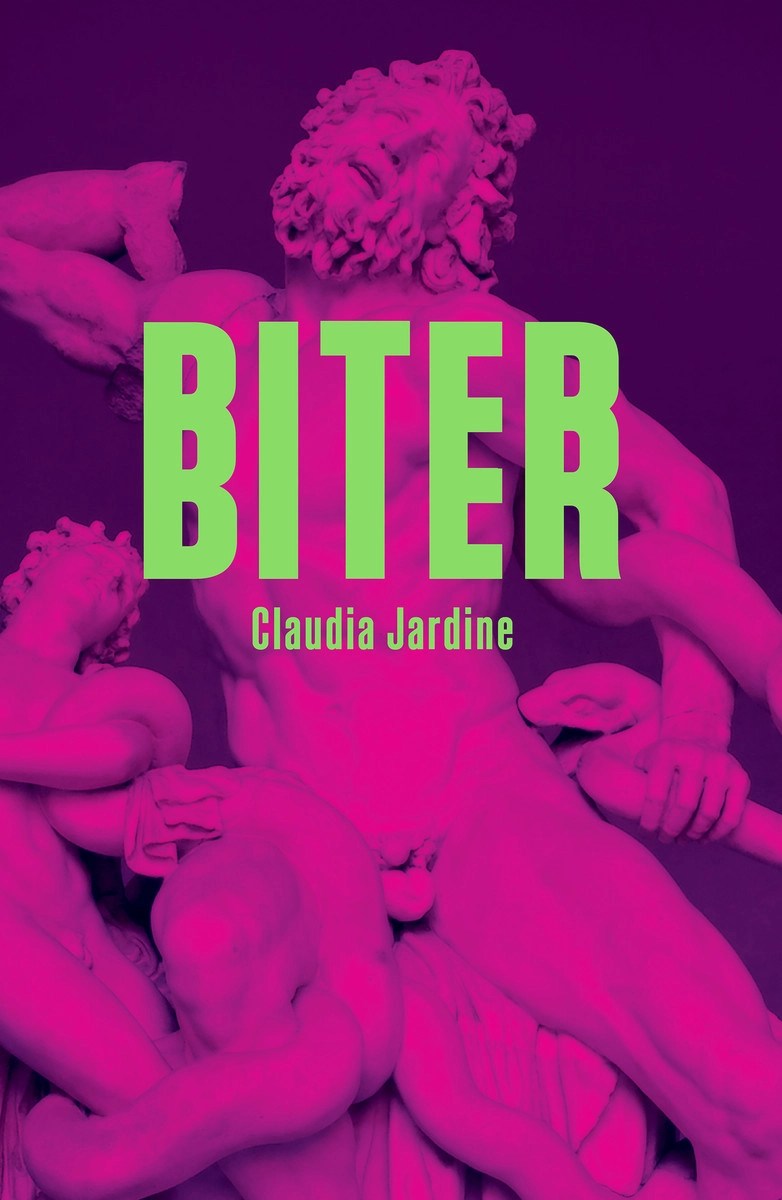
Poetry Shelf readings is a new series that celebrates recently published poetry collections with an audio performance. Claudia Jardine’s sublime debut collection, Biter, is published by Auckland University Press, April 2023. I will be posting a review of the book in the coming weeks. In the meantime take a listen:
‘Palatine Anthology Translations’
‘Passing Comment’
‘Power Cut at Hotel Coral’
Claudia Jardine has an MA in classics with distinction from Victoria University of Wellington, where she won the 2020 Alex Scobie Research Prize and a Marsden Grant for Masters scholarship. Her first chapbook, ‘The Temple of Your Girl’, was published in AUP New Poets 7. Her ancestors are from the British Isles and the Maltese Archipelago, and she lives in Ōtautahi.
Leicester at Millerton Absence of rapids on Ngakawau stream. Big Ditch and Little Ditch Creek – impious hand bisects the ‘D.’ Cobweb of raindrops in dragon sun. “Down, down, down from the high Sierras …” Electrical storms: intensity of affect. Fund-raising at the Fire Depot. Grey & white kitten, black robin, and black fantail. Huffing into an Atlas stove. “If you can see the hills, it’s going to rain.” Jack said: “A succession of inner landscapes.” Kiwi peck through sphagnum moss. Leicester said: “A community devoted to male play.” Millerton speaks – A Cannabis Landslide. Nature tips – gorse is choked by bush. Other landrovers get one wave. Proud grey donkey; manure in a sack. Quarrelling over the Fire Service. “Rain has a persistency of grades, much noted by the locals.” Siren: “I’m always free on Wednesday nights.” Twin side-logs set for smoke-alarms. Utopia St, Calliope Rd. Village hall stained with camouflage paint. White-packaged videos, too frank a stare. X of three rocks marks one rare tussock. “You have to say: Great! Awesome! Choice!” 668 – Neighbour of the Beast.
Jack Ross (10.7.98)
Note on poem
As a kid, I spent a good deal of time poring over the works of Edward Lear. I did like the limericks, but it was his illustrated alphabet poems that really tickled my fancy. This was my first – and to date only – attempt to compose one myself.
It records a visit I made in 1998, some 25 years ago now, to my friend the Rev. Leicester Kyle, who was living at the time in Millerton, a small bush-clad town on the West Coast of the South Island. Millerton is quite a mysterious place (or it was then) –very much off the grid. It was, however, the rather deadpan commentary on its inhabitants and traditions delivered by Leicester as we navigated its narrow roads in his bright red Land Rover which was the real prize for me.
I found myself jotting down some of his more quotable comments and thoughts, along with a few of my own observations, and ended up grouping them in this way to reduce the information overload I felt overtaking me at times.
Leicester himself was a fascinating character. He started off as a botanist, was then ordained as an Anglican priest, only to convert in his late fifties to a new faith: poetry. After his death in 2006, my friend David Howard and I collaborated on an online edition of his collected works which can still be consulted here.
The poem first appeared in a small magazine called Spin [#36 (2000): 51], which I was co-editing at the time. It was described in a review of the issue as “languid and oddly themed,” a tag I’ve always relished. I’ve often thought it could stand as an epitaph for most of my work.
Some ten years ago I used it as the title poem for my collection A Clearer View of the Hinterland: Poems & Sequences 1981-2014 (Wellington: HeadworX, 2014). The publisher, Mark Pirie, was kind enough to include it on his website as an incitement to purchase the book.
I still have a soft spot for it, I must admit. It brings back many memories of those times: of Leicester himself, of the wild West Coast, and the kindness of the people I met there. It makes me feel like jumping in the car right now and heading straight down to Buller and Karamea to try to locate some of the overgrown industrial sites and hidden green havens my friend revealed to me then.
I fear that it might have to be a journey through time as well as space, though. Much of the Buller Plateau has been devastated since then by strip mining.
Jack Ross (14.4.23)
Jack Ross’s most recent book is The Oceanic Feeling (2021). Last year he retired from his job teaching creative writing at Massey University to pursue his own writing fulltime. He lives with his wife, crafter and art-writer Bronwyn Lloyd, in sunny Mairangi Bay, and blogs here.
Favourite Poems is a series where a poet picks a poem from their own backlist and writes a short note to accompany it.



 NZ Poetry Shelf