Monthly Archives: April 2014

Autobiography of a Marguerite reached its Pledge-Me target– a note from Hue & Cry

This message from Hue & Cry


‘Thank you so much for supporting our campaign for Zarah’s book, Autobiography of a Marguerite. You’ll be happy to know that the manuscript is now with our designers. This means we’re on the home run and on the countdown to launch night.

And for those of you based in or near Wellington, we have a confirmed venue and date for the official launch event. This will take place at the City Gallery Wellington on Thursday 5 June, 5.30PM. So put it in your diary now, as you’re all invited. And you can collect your rewards at the event as well. We’ll also be holding an Auckland reading  a little later in June, so stay tuned for information about this.’

Chloe

Libby Hart is creating an international poetry book review journal, and is interested in receiving NZ titles

Call out: What the Bird Said

What the Bird Said will be devoted to online criticism of a diverse array of the best contemporary and international poetry and is especially keen to hear from authors and publishers of poetry collections and anthologies written in English.
Please send a query email to Libby Hart at libbyhartfile@gmail.com if you are interested in having your book reviewed.
Libby Hart is author of Fresh News from the Arctic (Anne Elder Award) and This Floating World (shortlisted for the Victorian Premier’s Awards and the Age Book of the Year Awards). Her new poetry collection, Wild, is forthcoming from Pitt Street Poetry in 2014. Please see libbyhartfile.blogspot.com for more details.


Libby Hart
Email :: libbyhartfile@gmail.com
Website :: http://libbyhartfile.blogspot.com
Postal mail :: PO Box 1289, Brighton Road LPO, Elwood 3184, Australia

Three Poets on Love

9781869797621

I was invited to contribute a piece on Love to Awkword Paper Cut blog run by Michelle Elvy (it draws in writers from NZ and USA to write on writing). Even though I edited an anthology of love poems (Dear Heart) and I feel I write primarily out of love, I don’t write many love poems.  It was a fascinating thing to do– to write the piece.

You can read the three pieces here.


Earlier this year, I read ‘Iambic pentameter’ by Patricia Sykes, a poem about voice and rebellion and learning to stand on one’s own two feet. In Sykes’ bio, I read of her collaboration with composer Liza Lim, and I was so intrigued by this project that I followed the links to Lim’s webpage and found myself lingering late one night over her piece called Love Letter, 2011’ – inspired and linked in various ways to James Tenney’s ‘Postal Pieces’. Tenney’s experiment is described as a “meditation on acoustics, form, or hyper-attention to a single performance gesture”. Lim’s ‘Love Letter’ is similarly experimental, something she describes as a mere “prompt, an invitation to the performer to participate in a process of honouring someone (‘their beloved’) [while] all the true work lies with the performer” – something which prompted me to reflect even more on ideas linking passion, voice, heartbeat and distances we traverse both physically and spiritually in the name of love.

– See more at: http://www.awkwordpapercut.com/13/post/2014/04/writers-writing-about-writing-about-love.html#sthash.Nnocbapg.dpuf


Gregory O’Brien in conversation with Kim Hill (on Alan Brunton) Just wonderful!

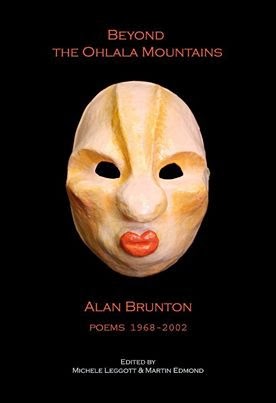
This is a wonderful discussion — Kim Hill and Gregory O’Brien talking about Alan Brunton and Alan’s new book, Beyond the Ohlala Mountains. It was terrific hearing archival material of Alan reading on the show. You can hear more of that here. You can also catch up with the splendid book launch here.

BEYOND THE OHLALA MOUNTAINS

Poetry with Gregory O’Brien: Alan Brunton  here.

Discussing the poems of Alan Brunton, as collected in Beyond the Ohlala Mountains: Alan Brunton Poems 1968-2002 (Titus Books, 2014) edited by Michele Leggott and Martin Edmond.

From Saturday Morning on 05 Apr 2014

Happy Birthday (belatedly) to Tuesday Poem

Tuesday Poem recently celebrated their fourth birthday and this is how they did it (follow the link below to find the poems). Michelle Elvy sums the blog up on the birthday entry:


Today marks the fourth birthday of Tuesday Poem. 
The series began on April 13 2010 after a casual start with a bunch of poems on Mary McCallum’s blog O Audacious BookFrom there, the group migrated to this site and grew in contributors and mission. Each week a different Tuesday Poet takes a turn at editing the main page here — selecting a poem, getting permission to run it, and writing up a response. A personal choice and response each week, and many more opportunities to share poetry at members’ blogs as well (see sidebar, left). 

We celebrate poetry every week, but birthdays are special because each year in March/ April we build something collaboratively in one giant poetry celebration. Each of our ‘birthday poems’ has been unique in its blend of voices and rhythms. In 2011, the first birthday saw an ode to Tyr in honour of Tuesdays and the way we celebrate poetry; in 2012 we wrote a collaborative poem line-by-line, each poet building on the previous poet’s cadence and image; last year, we chose a jazzy riff as our theme, with participating poets contributing entire stanzas to a poem that unfolded over weeks in rhythm, repetition and syncopation. 

This year, we tried something a little different. We asked contributing poets to send a line that included something about either birthdays or food or both, and to send the line blind — that is, without seeing any other contributions. We gathered the lines one by one and rearranged them into a whole. We tried several different approaches but we finally settled on four small verses, each creating something special. It was much much harder than we imagined when we set out to paste these lines together — how to fit blue cake with a clarinetist’s curls, or fairy bread with the explosion of candles? In the end, these four vignettes fitted together to form what feels like a whole and including a birth and a light, a cake and a secret, a moment and a memory, and anticipation and celebration.

We hope you are as delighted as we are with how this experiment turned out. What fun to have such rich images to work with. What a pleasure to glue pieces together and watch this poetry page take shape — this line moved from there to here; this image matched with this sound.

I should also add the note that only one of the three editors working on this birthday poem knew the identity of the poets submitting, so it’s a special birthday surprise as well to see who has contributed such delicious morsels to this sweet feast. Thank you all!  

Michelle Elvy, TP Hub sub-editor, with Mary McCallum and Claire Beynon

Three plus one: Four poems for a birthday

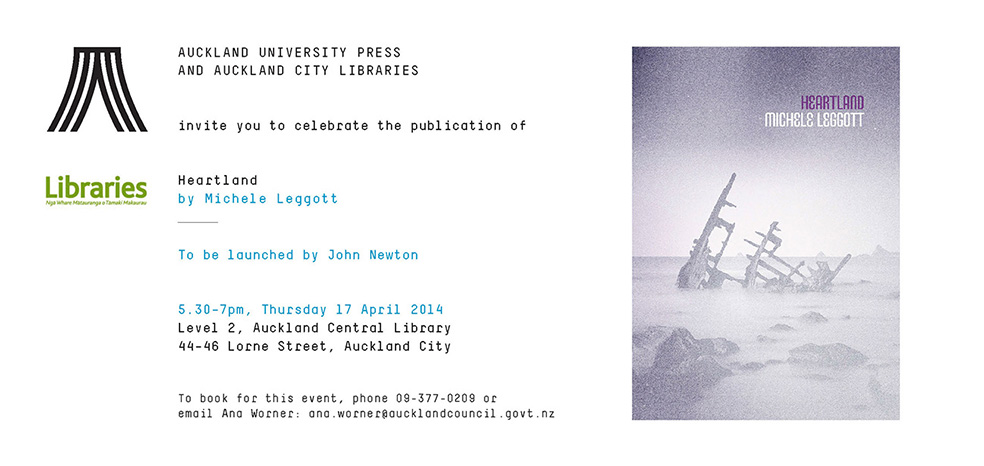
You are invited to the launch of Heartland, Michele Leggott’s new book

Poetry Shelf aims to celebrate the arrival of Michele Leggott’s new book with a review and an interview but meanwhile here are the details for her launch.


Heartland Ak City launch invitation

Brian Turner Wins Caselberg International Poetry Prize 2014

Brian+Turner+SST

Congratulations!

Brian Turner Wins Caselberg International Poetry Prize 2014

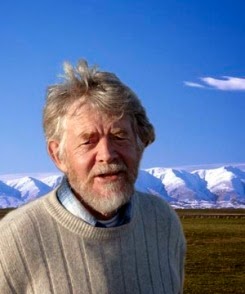
Otago poet Brian Turner has been awarded the $500 first prize for his poem ‘Mulching’, in the annual Caselberg Trust International Poetry Competition.

Second prize ($250) went to Dunedin-based writer Annelyse Gelman for her poem ‘Auden,’.

Poems by Mary Macpherson (Wellington), Lynley Edmeades (Dunedin) and Jessica le Bas (Nelson) were highly commended by this year’s competition judge, the distinguished poet Sue Wootton. Another entry from Brian Turner was also highly commended.

In her report, Ms Wootton said that each of the winning entries was ‘adeptly tuned, attentive to itself at every turn.  What is said is inseparable from how it’s said.’ Over 200 entries were received for this year’s Caselberg Trust International Poetry Competition, from writers working in several different countries. Entries are judged ‘blind’, with the judge being completely unaware of the author’s identity until after the final decisions have been made.

The prize-winning poems and the judge’s report will be published in the May issue of Landfall, and together with the highly commended entries, will be posted on the Caselberg Trust web-site next month. Awards will be presented at a function at the University Book Shop in Dunedin, in April.

Past winners of the Caselberg competition include Mary McCallum from Wellington, and Tim Upperton from Palmerston North (who won two years in succession). Previous judges have been poets Bernadette Hall, James Brown and Gregory O’Brien.

The Caselberg Trust was established seven years ago to buy and renovate the former home of writer John Caselberg and his wife, the painter Anna Caselberg. The Caselberg house is now a residence for writers and artists of all descriptions, and the Trust runs residencies, workshops, exhibitions, and innovative arts events for the wider Dunedin community.
Robert West

Secretary Caselberg Trust
PO Box 71 Portobello Dunedin

www.caselbergtrust.org
info@caselbergtrust.org

Alice Miller’s debut poetry collection liberates a way of reading that defies limits

IMG_8526    THE LIMITS_CONCEPTS_01


The Limits, Alice Miller (Auckland University Press, 2014)

Alice Miller, an award-winning author, has just published her debut poetry collection both in New Zealand (Auckland University Press) and in Britain (Shearsman, due May). Alice’s awards indicate the eclectic stretch of her writing: a Creative New Zealand Louis Johnson Bursary, the BNZ Katherine Mansfield Premier Award for Fiction, the Landfall Essay Prize and the Royal Society of New Zealand Manhire Prize. She was the Glenn Schaeffer Fellow at the Iowa Writers’ Workshop and graduated from the International Institute of Modern Letters at Victoria University with an MA with Distinction. Alice has also worked as an historian, studied music and taught creative writing. She held the recent Summer Residency at the Michael King Writer’s Centre in Auckland. She usually lives in Vienna where she is Associate Editor of The Vienna Review.

The Limits is a slender volume (37 poems) with widespread possibilities. The poems are quiet, spare and luminous. Each poem is like a marvellous vista—it is as though you keep returning to the same spot on a hill to contemplate a view because that view is in a glorious state of flux. Always on the move, sustaining, transcendental. This is what it is like to read an Alice Miller poem.

The poems sit in mist or silence or enigma, or puzzling and then rewarding fragments. This is not prosaic writing, the plain everyday lilt we find in much of our local poetry (nothing wrong with that!). If there is a story to be told, it is told in a poetic manner (but not ornate lines that strive for the Romantic or the Baroque). If there is a story to be told, it is told though the poetic art of concealment, of ellipsis: the white space on the page, the silent beat in the rhythm and the fertility of the gap. This shifts the manner of reading—no ambulatory beat here. Instead, as reader, you stall and you ponder, you concentrate and you backtrack. Most of all, and this is what I love about these poems, you drift in the poetic space, feeding both intellect and heart.

Alice also embraces the abstract. As you move through a poem, it is as though you are moving through the surreal, the unreal, the unearthy, a dreaminess that is one step back from the grit and grimy edge of the real, of everyday life with its bumps and hollows. Yet Alice does something extraordinary—she gives life to the philosophical, the dreamlike, the mist beyond limits and within limits. Enigmatic detail compounds. Things may be things and nothing more or they may shimmer and shine as metaphor or symbol.

The collection is divided into four parts: Skin, Steps, Earth, Body. It is fascinating to link these governing entities back to the title of the book; the way there are borders (inside/outside, corporeal/heavenly, containment/limitlessness), the way there is implicit movement and travel (the earth on its axis, the steps) and the way all roads lead back to what it is to be human (are there limits?).

Sometimes single lines leap out and then you leap with them:

‘Still the spaces keep growling for something.’

‘I may wander but my wonder’s still.’

‘You’ll always have life instead of art.

‘Tonight a scrunch of air between fingers/ what more do you expect?’

‘You are locked/ in the wing/ of history/ with blood still/ stuck in your veins.’

‘I look out, and the terms are still sloshing/ by our window, past cobwebs nestled/ in hedges like fog.’

‘I fashion some antlers/ to guard my brain.’


Alice’s poems are so beautifully crafted. ‘Apple’ is an earthquake poem and it is the strand of verbs that constitute a shudder and aching ripple through the poem (cracked, reaching, brush, crane, caress, wrench, rip, split, shudder, broke, tore). These verbs create a moving ripple effect through the poem that heightens the intensity and is matched by the shifting placement of lines upon the page. To me Alice’s poetic choices get to some kind of poetic essence (is this possible?) and then breaks out visually, semantically, emotionally to wider effect.

At times the syntax and vocabulary are fluent and reachable; at other times they seem deliciously out-of-kilter, quirky even. ‘In Season’ is a superb example of the latter. There are the trademark gaps, the points of ellipses, the dense accumulation of detail. It might be an unexpected verb choice: (‘Listen to waves mutter/ as sun butters the water’ or ‘A couple/ of boots stroke the road’). The overall effect, in my view, is a finely crafted stream-of-consciousness (yes, an oxymoron).

There are other ways to enter these poems. You can follow the deeply grooved tracks of love (poems are often addressed to a mysterious ‘you’ and the love felt is palpable). You can also follow in the steps of the historian and re-enter historical or mythical moments and figures (Troy, Caesar, Rome’s Senate, war, Brahms, Picasso).

Alice’s debut collection liberates a way of reading that defies limits, that poses limits and that makes dazzling connections. Each poem takes you to the top of the hill where you sit to behold the view, a view that shifts and settles, shifts and settles, in countless extraordinary ways.


See my interview with Alice here.

Alice Miller website

Auckland University Press page

Shearsman UK page

On Antarctica on New Zealand Book Council page

Alice Miller’s poetry duets — The Red Room page

Dylan Horrocks has no words in his mouth and makes poetry

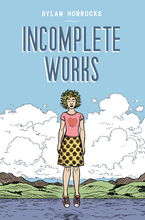
IncompleteWorks_frontCover__43649.1386021015.220.220   IncompleteWorks_frontCover__43649.1386021015.220.220

I went to hear Dylan Horrocks in conversation with Sarah Laing at Auckland Central Library the other night (it was to celebrate the arrival of Dylan’s Incomplete Works (Victoria University Press). It was a great conversation!

I was most intrigued to hear Dylan make strong connections between comics and poetry (he said he wasn’t surprised as both his parents were poets). He then said there were a number of cartoonists using poetry as comics (or comics as poetry).

Dylan introduced one of his pages by suggesting we think of it as a poem with no words (‘there are no words in my mouth’). He also said he felt intimidated trying to write a poem with words when pictures usually bear 50% of the load (my word) in a cartoon (graphic novel). It sidetracked me into thinking about the way a poem set to music becomes something completely different as the poem’s internal music (so important to some poets) gets lost, drowned out, diluted. So if a cartoonist makes a poem does it too become something different because the poem’s internal images are now coloured by the sketching pen? Fascinating! And is it simply the notion that a picture is a thousand words kind of poetry (no words in my mouth) and you enter a an image by way of a bridge of silence?

One of Dylan’s favourite NZ cartoonists, Rachel Jones (or is it Fenton?) (Rae Joyce?), has written a poem in comic form which I am keen to read. A whole new world opens before me! Wonderful!

Then … just as I am about to type this post in black font which I have zero control over on WordPress I see Rachel Fenton (Rae Joyce) has posted about the occasion herself (and picked up on the poetry references). And oh I get sucked into a vortex of names and identities unsure of what’s going on here.

Unlike me, Rachel has rendered the event with brush and colour and wit. A comic strip. See it here.

Here is an example of her graphic poetry.

And another.