
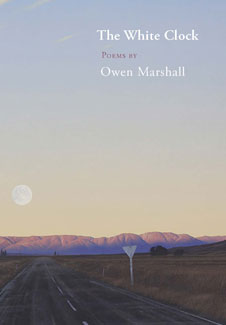
Owen Marshall, The White Clock, Otago University Press, 2014
In Owen Marshall’s third poetry collection, The White Clock, poems provide a frame for contemplation—for reflecting back into the hills and dales of memory and for musing upon the physical and metaphysical currents of the world and of living. The adept fiction writer is at work here, with his trademark economy and grace, but so too is the roving mind of a philosopher. There is also the bird watcher (I should say life watcher) as Owen trains his figurative binoculars upon detail that renders his lines lucid and vital. Not all poems work for me, but those that do (the majority), dig and delve into the essence of humanness. There is humour (wry and infectious) and there is tenderness. As a whole the collection provides lovely contours of thought and feeling.
The title poem takes us in all directions—from the ‘multi-limbed Leonardo man’ to the idea that ‘Time writ this large is discomforting.’ This sway between the transient and the concrete, the hard to pin down and the readily held, is a terrific vein throughout the book. Thus ‘Freeze Frame’ observes the fleetingness of time. The opening line, ‘In the spool that is my life,’ makes a nice link to the way photographs also share ‘the stabbing sadness/ of glimpsed transience.’
Owen embraces playfulness. ‘Dog Winds’ does just that. He links a season to a wind and that season to a dog.
Winter wind is the starving bitch
heeding no one’s whistle, baring
cold, white teeth if faced, with ribs
of adversity and a muzzle-up howl.
Or he returns to the fable of the tortoise and the hare and resists favouring the tortoise that is ‘commensurately wise’ and endures ‘an eternity of slow vegetative mastication.’ Instead:
Better a mad March dance before
a lover, the sprint with wind in
your hair, the ultimate exhilaration
within the headlights’ glorious flare.
In ‘Watcher on the Shore,’ Owen (or narrating voice) confesses he prefers ‘Brueghel’s/ trivial and persistent cruelties’ to ‘transcendent, uplifting paintings.’ Is the last line then a cue for us to see the darker line of thought in the collection?
Like old Jacques I find more sustenance
in melancholy than any other humour.
Sometimes the humour, though, is laugh out loud. When the poet-narrator is about to talk about ‘narrative point of view/ and psychic distance’ he looks into the crowd and spots a woman asleep. Disconcerting, hilarious:
[ ] Golf balls could
have been dropped into her mouth
and there was nothing I could say
that would add to her contentment.
What I particularly love about this collection is the way the poet opens himself up for inspection—through what he observes, experiences and thinks. It imbues the poems with an acute truthfulness (which goes against the grain of poetic game play and irony). One black coat (now a little shabby) was purchased in Menton and conjures up past memories in ‘Habit.’ It is the last verse that shows Owen at his perceptive best:
[ ] We
are a fit, and I cannot bear its
replacement with any companion
less familiar with my life and form.
The White Clock, like the Graeme Sydney image on the cover, provides a frame for shimmering contemplation.
Otago University Press page
New Zealand Book Council page
Owen Marshall web page
Christchurch City Library interview
Random House author page
 NZ Poetry Shelf