
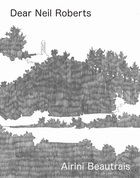
Airini Beautrais’s debut poetry collection, Sacred Heart was a little beauty and won Best First Poetry Book at the Montana New Zealand Book Awards in 2007. This was followed by the superb, Western Line. Her latest collection, Dear Neil Roberts, explores an inclination to prose-like poetry in a new way. You could say this is a long narrative poem or you could say this is a series of individual poems that contribute to a narrative arc.
Neil Roberts was a real person, an anarchist. In 1982, he blew himself up outside the Whanganui Police Computer Centre in the middle of the night. Airini’s new book has a central thesis at its core: history belongs to the shadows as much as it does to the great men and the great women. In other words, individuals who get misplaced and misremembered in the side lights of the grand historical narratives do have something to contribute to the way we view the past. The poetry is in part surrogate documentary but generic boundaries are blurred as the poet uses tools of invention and imagination as much as she uses tools of research and political inquiry. What gifts the book another fascinating layer is the way the poet steps into the narrative herself. She shows us how time and place and event affect her. This choice is reinforced in the title, ‘Dear Neil Roberts’; this poetry collection is also part epistle. Letter writers leave traces of their own lives as well as addressing the life of the recipient.
The poems draw upon story-telling techniques but these poems are primarily driven by poetic options: white space, building rhythms, terrific line breaks. Together the poem-pieces form a mosaic that you can step back from and view as an intriguing whole (exploring notions of history on one level, and the life of individual on another, along with the effect of an event like a stone rippling through time and place). ‘Time’ sets the scene with keen detail of a historical moment from the Falklands unrest to protests in Poland, from Rocky III to redundant clothing workers. Then, the ironic reference to a newspaper editorial that suggests fireworks will one day be banned.
If this book is a poetic mosaic, it is a mosaic sumptuous in detail and issues raised. Both moving and provocative. In ‘Clean-up’ the body never becomes more than the gory detail to wash away from the street. Or in ‘Monuments,’ testimonies from Pacificism and from war jostle (Norm wrote in jail, ‘What I have done with my spared life/ while better men lie dead?’; or the veteran war pilot, ‘War is useless and achieves nothing.’). Beneath the surface of this poem lies questions on the merits of war, the necessity or war, the cost of the dead. In ‘Investigation’ (this in 1982), the explosives Roberts used dominate the news, while the anarchist, ‘with razor blades in his ears’ and steel-capped boots’ is chiefly missing.
[ .. ] There is a dryness in the news,
like grief has been squeezed out,
As a mosaic, it is a glinting selection of points of view, invented, factual and personal. ‘By way of an explanation,’ for example, is composed of quotes from Senior Sergeant Rob Butler that Airini gleaned from various newspapers of the time. Brought together in the form of a poem they disturb.
He was one of those people whose human frailty
leads them to join a cult or sect like the punk rockers.
They do some very strange and unusual things by our standards.
He did not seem to have any great concern for his own life.
Another example is the poet’s confession to her own line crossing which in turn subtly rubs against the grain of Neil Roberts (in ‘Out the window’):
Here I am, with blond-haired child,
with my rounded belly, in my hand a set of car keys —
the remote-locking kind, which I never would have imagined.
It’s been awhile since I did anything subversive
with a can of spraypaint, with a billboard, with a naked human body,
with anything. But I’ve known Jonah since the days
when I did. I wonder out loud, what it would be like
if you kept living the same life you lived at twenty-one.
Or the way the contemporary writer makes room for different stories from the past in ‘History books’ in a way that recovery is uncertain, dangerous, shadowy, with faulty connections:
Room is made in the present.
The past is just left traces; paper, newsprint, film, tape, silicon.
The old lamp of the past clicks and crackles;
bald wires, an overheated bulb.
Or the way in ‘Waiting for death/ waiting for birth’, as the poet is waiting for the birth of her second child (‘The first time, I thought I was dying’), she retreats momentarily into her history of protest (‘Protests gave me something to exist within’). This complexly moving poem is aching with overlap:
and seeing cyanide pellets, or crossing an overbridge,
hearing trucks roar, thinking, ‘This is my chance.’
I am here because I didn’t take it.
On Pyramid Farm, you found your chance
in the back of a truck: the gelignite
and accessories. To go out with a bang.
Airini’s new book takes risks as it unstitches a sutured wound of the past, of self even, and dares to imagine grey lines, the long reach of historical events, small or otherwise. The poet is boundary crossing as she overlays historical transparencies, blurring this version upon that version upon that version and in that overlay getting deeper into who and how we are (humanity). You can admire the swing and shape of each poem, but the impression that makes the deepest most affecting mark is the book as a whole. Connections and disconnections forge poetic static that makes that lamp crackle, that bald wire hiss. This is narrative poetry at its very best.
Victoria University Press page
Airini’s thoughts On Poetry for Poetry Shelf

 NZ Poetry Shelf