
I decided it would be a great idea to share the occasional poetry launch speech. All kinds of things get in the way of attending book launches – distance, time, illness, work, double-bookings! So I thought it would be great to host a series of launch speeches and photos – if you go to a poetry launch and love the launch speech, well maybe the poet and the launcher will give permission to post on Poetry Shelf. Let me know!
First up is Helen Rickerby launching Anna Jackson’s Terrier, Worrier A Poem in Five Parts (Auckland University Press) at Unity Books in Wellington.
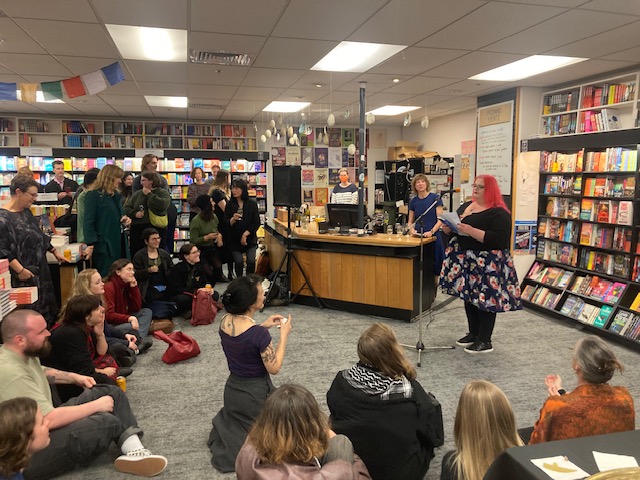
Wellington launch speech for Terrier, Worrier
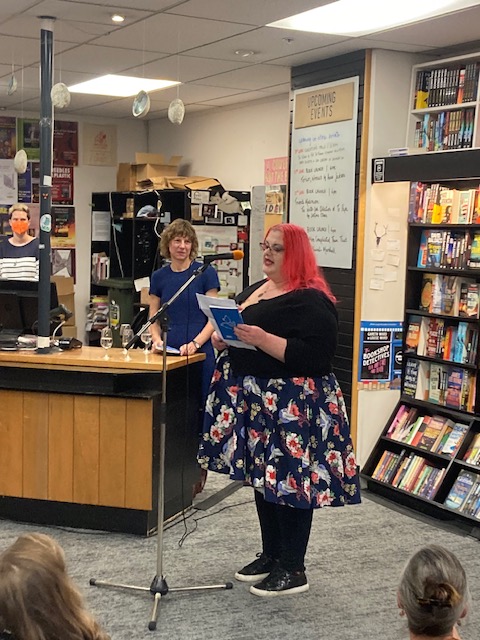
Kia ora kotou. Hi, I’m Helen Rickerby, and it’s an honour to be launching this new book by Anna Jackson – Terrier, Worrier. And lovely to see you all here to help celebrate.
I’ve been a big fan of Anna’s work since I first came across it, back sometime in the dark ages – the late 90s. She was living far away (Auckland) and submitted to a literary magazine I was editing. We got a lot of submissions, but Anna’s really stood out. I accepted it immediately, and that was the beginning of my friendship with Anna’s work.
I got to meet Anna herself not too much later, and then, conveniently, she got a job here in Wellington. She has become one of my dearest friends and her work and her self continue to be a big inspiration to me. She writes poetry that always makes me excited and inspired, which pushes me to be explorative and ambitious in my own poetry.
I know she’s been a great inspiration to many other people too, as a writer and teacher and as a person.
I’ve loved all of Anna’s books, so I don’t say this lightly – and I don’t really want the other books to hear me say this, I mean I don’t want to hurt their feelings and some of them are engraved on my heart – but I think Terrier, Worrier, is my favourite yet.
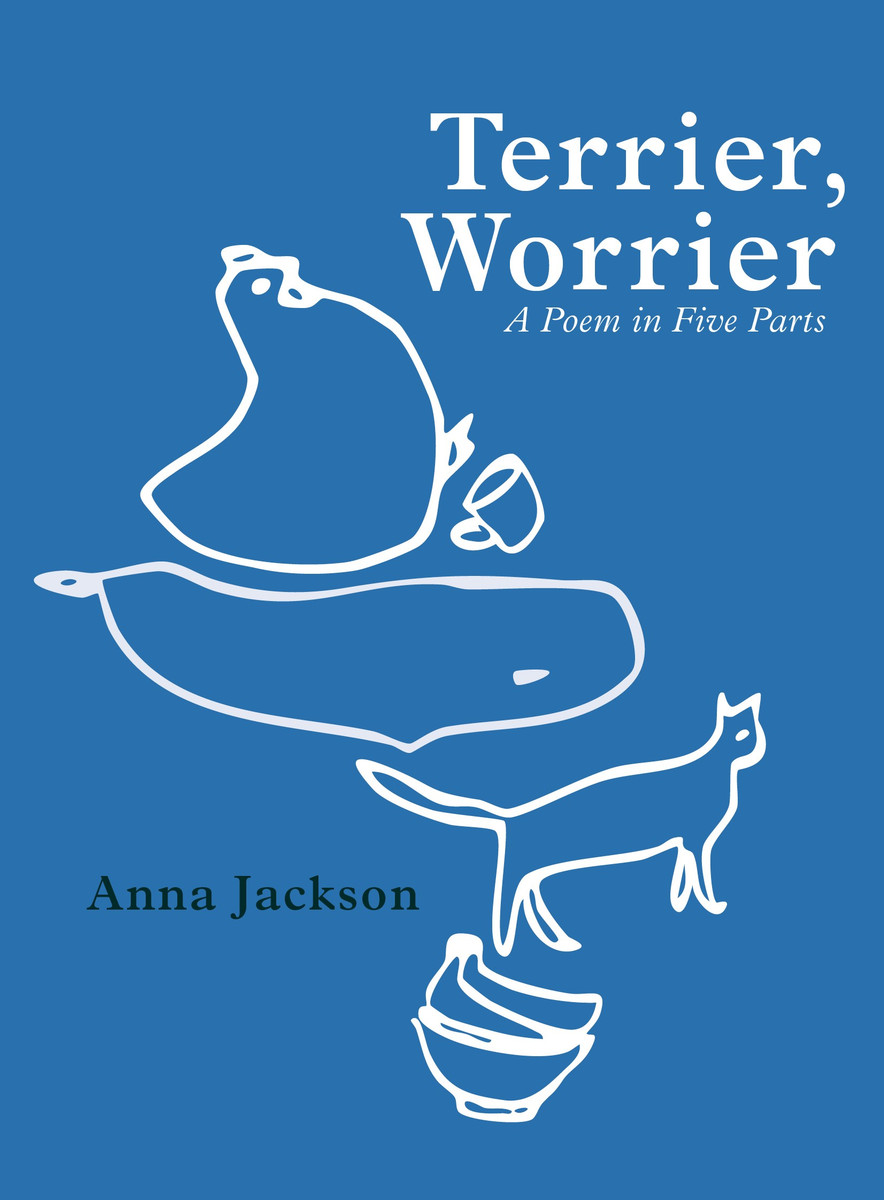
Auckland University Press, 2025 (page)
I got to see this book in various stages – when I read the first draft I remember thinking – and saying – that it was my favourite kind of thing to read. It’s sparky and fun and deep, it’s gorgeously written, with beautiful turns of phrase. It’s also quite educational – I learned a lot of things reading this. It’s like having a really really good conversation with Anna, and getting to watch her think in action.
This book is a thought diary in poem form – a hybrid prose poem form, which is my favourite.
Anna – or perhaps we should really say ‘the narrator’, because it is of course a composed and beautiful work of art; but while recognising that the voice of this poem is in fact a construct and not exactly or completely Anna herself, it also sounds so much like at least one version of Anna herself, that I am just going to call the narrator ‘Anna’. Anyway, Anna implies in the poem and the notes (I want to put in a plug for the notes – which are almost as rich, fun and conversational as the poem itself, and do feel to me like part of the poem itself): Anna says that she doesn’t think she has thoughts, or emotions. It is so clear to me that Anna is full of emotions, and full of thoughts – as proven by this book. I am someone who feels very full of both thoughts and feelings – when she began this project, I thought and felt that recording one’s thoughts would be quite overwhelming – I feel that I have a thought tumbling into another thought followed by another faster than I can even follow – I couldn’t comprehend how you could capture them all. But I’ve come to understand that one difference between Anna and myself is that she has higher standards of many things, including of what a thought is – and perhaps what a feeling is.
This is longish for a poem, but small for a book – however, in this small book there is just so much! A lot of thoughts and ideas per square inch. As well as her own thoughts, she argues with Ludwig Wittgenstein over language and beetles, questions Hannah Arendt over beauty, reads and considers scientific studies about time and perception – but despite all that dense deepness the experience of reading Terrier, Worrier, is easy, light, spacious, fun.
This is thanks to the beautiful, light, clever and funny way it is written.
And it isn’t just jumping from one profound thought to another – it circles back, revisits, reconsiders and sometimes disagrees with itself, makes connections with other thoughts and, aided by the fragmentary nature of this poem, there is space for us the readers to think and make connections too. For me it is the kind of writing that makes my brain spark.
This quote is from early on in the poem:
I heard birds and thought that although I am only hearing them,and I am not having a thought, it still feels like a thought, almost
like a thought of my own, or a conversation I am having, or
perhaps it is more like reading a poem, where the words, or the
movement of the thought, the song of the thought, is given to
you rather than coming from you, but still moves through you.
She begins by considering whether hearing is a thought, continues on to the nature of poetry and then you realise it’s doing exactly what it’s talking about – we’re following her thinking and the poem is making us feel like we’re doing the thinking, but then there is the space for us to actually think – if we want to – otherwise we can just go back to watching Anna’s brain.
One thing I love about Anna’s work, and actually about Anna herself, is her complete lack of concern with a hierarchy of culture. She mixes the high – classic and classical literature, philosophy etc – with the ordinary – the domestic space, family life, pets – but also treats both the ‘high’ and ‘low’ as much the same – or at least of equal importance. Or equal-ish – I think the pets might actually be more important than the philosophy.
And pets do make frequent appearances in Terrier, Worrier – mostly hens and also cats, as illustrated on the cover. There’s also a whale on the cover, and there are also whales in the book, but I don’t think even Anna could make a pet of a whale, though you never know.
While in some ways this poem is like a monologue, is really a conversation – as well as being in conversation with philosophers and scientists, she has conversations within the poem – or in fact arguments – such as with Simon about whether it would be better to leave doors open (apparently it is). And it also feels like a conversation with us.
I love how she says:
Whether including conversations
counted as cheating was another question. I decided it
probably was cheating, because it is almost impossible not
to have thoughts in conversation.
I have in fact had conversations where I have had trouble having thoughts, but never with Anna.
As I expect you have noticed, we are living in some pretty weird times. While this isn’t a book that engages directly in a political way, it is the kind of book I think we need in these times – the kind of book that stands in opposition to the values that are prominent right now among some of our so-called leaders.
This is a book that is full of curiosity, empathy with other humans and with animals. It is not interested in hierarchies of status, but in the beauty of all the things, big and small, that make an individual and collective life worth living. It values thinking deeply and is not content with the first knee-jerk idea or black and white solutions. It is a book that values connections and conversations, between ideas, between people and animals, and between people and people. These are the kinds of values that give me hope.
I don’t feel I’ve done this book justice – there are so many things that are wonderful about it, but I hope I’ve whet your appetite for it. And so now I declare Terrier, Worrier launched!
Helen Rickerby
 NZ Poetry Shelf