Tag Archives: Auckland University Press

Poetry Shelf review: In the Hollow of the Wave by Nina Mingya Powles

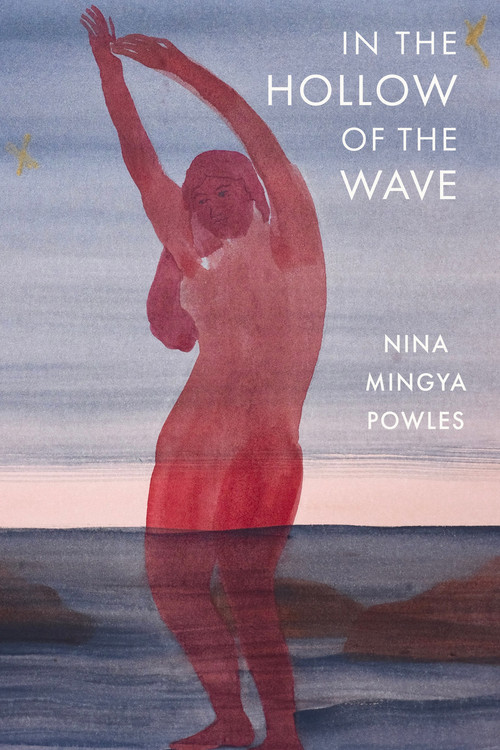
In the Hollow of the Wave, Nina Mingya Powles
Auckland University Press, 2025
first published, Nine Arches Press, UK, 2025

handiwork


People asked me where I learned
and I said I taught myself the slow work of making.

But memory is a house with scraped white walls.
I step inside and choose what to take, what to leave behind.

My hands feel their way through
the gathering, the careful pulling apart.

The work of particular poets can strike you so deeply, so resonantly. Poets who produce collections that satisfy your hunger to read so keenly, with books that take up residency in both your mental and physical poetry rooms. Nina Mingya Powles has been that kind of poet for me, from her terrific debut collection Magnolia 木蘭, through her various other published offerings. Her new collection, In the Hollow of the Wave, is one of the most gorgeous poetry books I have held this year – a sweet combination of heavenly paper stock, generous size, lovingly-tended internal design and vital breathing room. Nina has also created textile works that add to the visual beauty and allure of the book.

Textile is a key word. I experience the book as multiple loomwork: a weaving of memory, experience, language, cottons and fabric. Weaving as a way of observing the world, feeling the world, observing the object, feeling the object, observing the past, feeling the past. It might be the sewing machine upon which her grandfather stitched quilts from garments belonging to her siblings, mother and grandmother. It might be a gown, a pleat, or a sheet of white paper or fabric.

And now, with In the Hollow of the Wave, the granddaughter is herself stitching quilts; inside the stitched poem the stitched cloth, and inside the stitched cloth the stitched poem. I experience contemplation pockets tucked with memory pleats, and inside memory pleats, I threads of slow contemplation: andante, largo, adagio.

The book title is borrowed from a line in Virginia Woolf’s To the Lighthouse. It gains its own life as Nina ponders Virginia’s use of orientalism and Kitsushika Hokusai’s woodblock print, ‘The Great Wave off Kanagawa’. The poem haunts, the hollow in the wave haunts, the recurrent pulse of existence and non-existence haunt. The poem is skin-prickling reading:

beyond the frame I saw a distant city / a place I used to know / where rain
falls in the foreground / all day and all night / I took out my sketchbook /
sharpened my pencil / drew a line across the sea / asked the mountain /
what does it mean to see and be unseen / it did not answer

So many echoes across the collection. So many threads to follow and pause on(slip stitch, ladder stitch, cross stitch). There is the scent of plants and plantings, herbal remedies, the reminder of the women in poverty who stitched the garments we wear, the reflection of self in a stirred pan on the stove, the way dreaming seeps into making, the way the language, chores, hopes and the lives of women still matter. The way poetry can be a way of asking questions.

Inside the hollow of a wave is a poem. And inside that poem is a book. A book such as this one. Stitched with aroha and luminous threads. I want you to read it for yourself and get absorbed in its beauty and craft. It has already found spots in my poetry rooms.

Nina Mingya Powles is a poet and writer from Aotearoa New Zealand, currently based in London. Her debut poetry collection, Magnolia 木蘭, was published in New Zealand, the UK and the US, and was a finalist in the Felix Dennis Prize for Best First Collection and the Ockham New Zealand Book Awards. Powles won the inaugural Women Poets’ Prize in 2018 and the inaugural Nan Shepherd Prize for under-represented nature writers in 2019. Her resulting book of essays Small Bodies of Water was published in 2021 by Canongate. She has also published a short food memoir, Tiny Moons: A Year of Eating in Shanghai (The Emma Press, 2020).]

Auckland University Press page

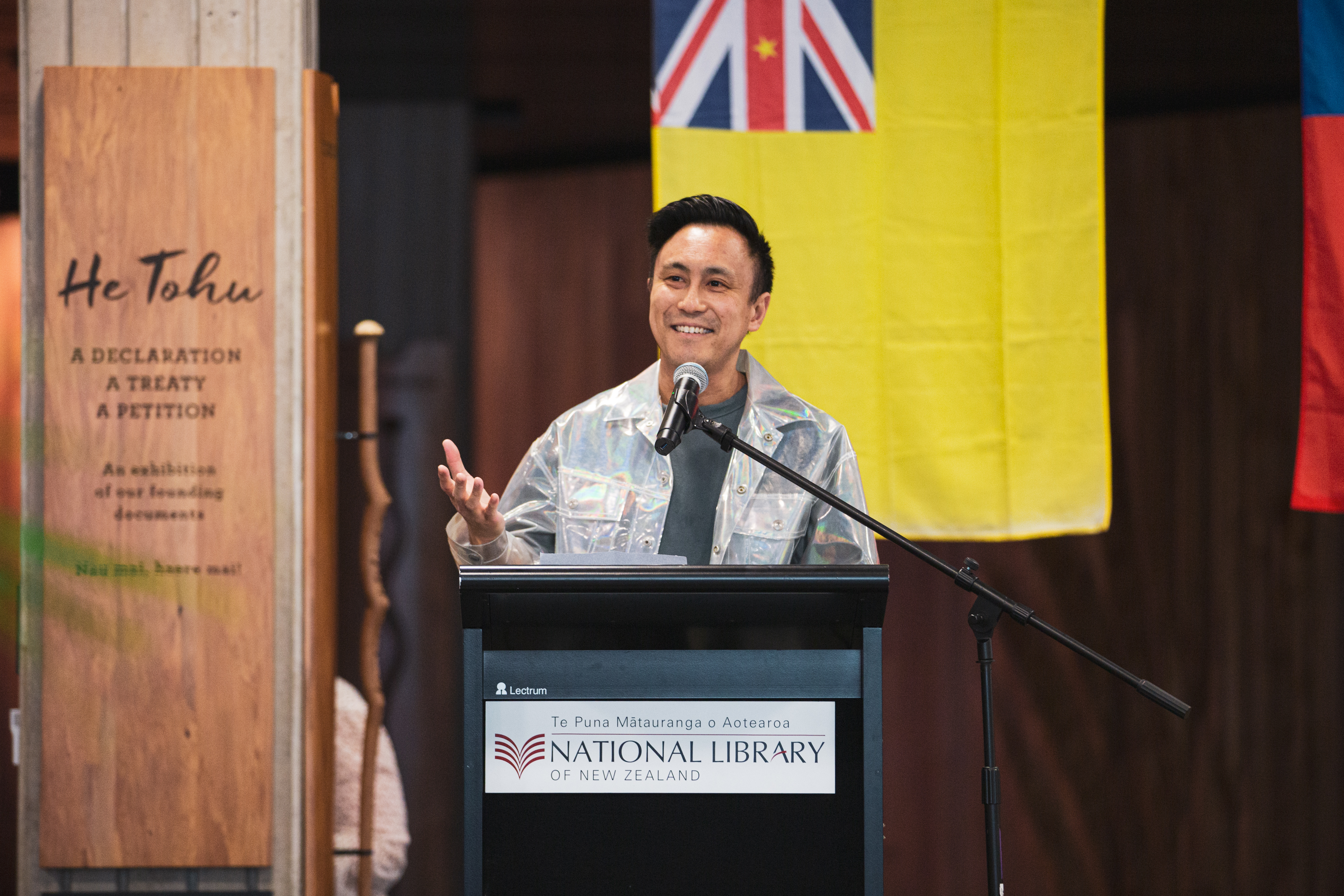
Poetry Shelf celebrates National Poet Laureate Chris Tse

photo credit: Celeste Fontein

Today Chris Tse is stepping down from his role as National Poet Laureate, and it felt extremely fitting to acknowledge his vital contribution to poetry in Aotearoa and overseas. He has staged a range of poetry events around the country, drawing in voices, inspiring younger writers, contributing to inspiring poetry conversations in various settings.

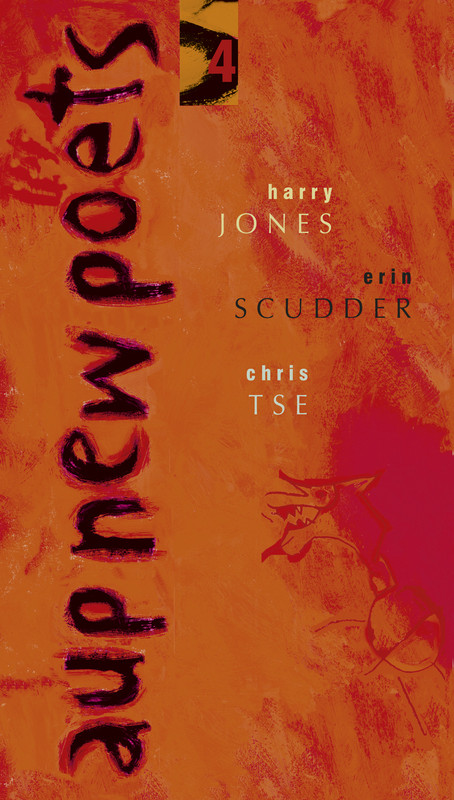
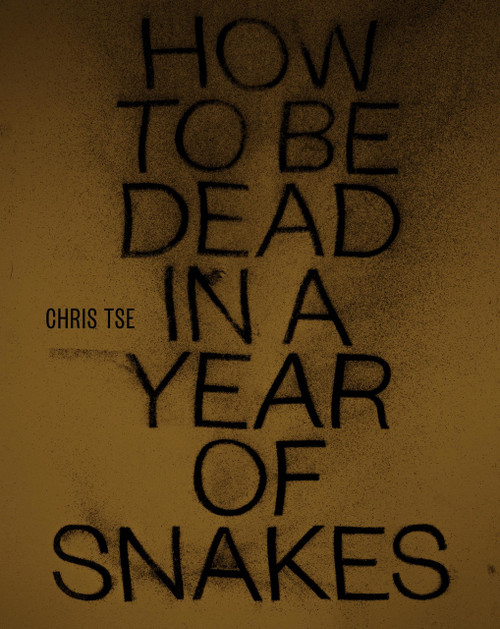
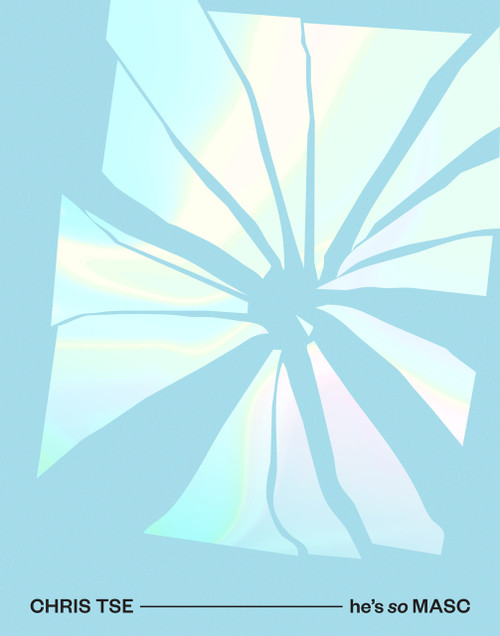
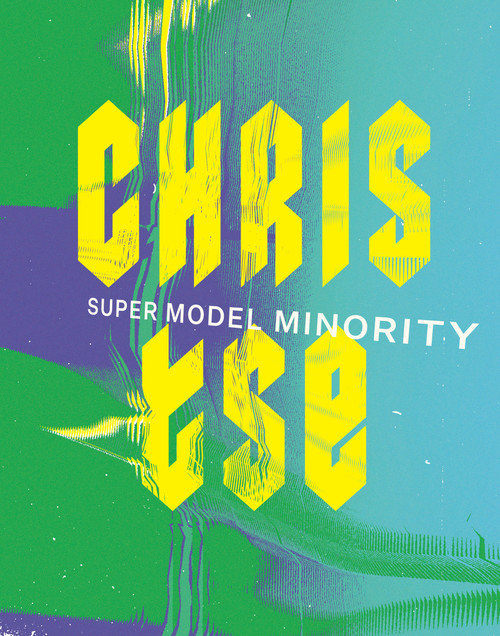
Having always been a big fan of Chris’s poetry — from his debut in AUP New Poets 4 (AUP 2011) to Super Model Minority (AUP, 2022) — I decided I would pick one poem from each of his books as a celebration of his tenure. Chris kindly answered a couple of questions from me and contributed a recent poem. To reread my way through his collections was utterly moving: from How to be Dead in a Year of Snakes (2014, AUP), a collection that returns to the tragedy of murdered goldminer, Joe Kum Yung, to his next two, he’s so MASC (AUP, 2018) and Super Model Minority (AUP, 2022). His books navigate sexuality and race, sky and mountain peaks, revolution and imagining, speech and peace. Ah, take the time and spend a long weekend absorbing his extraordinary poetic ink.

Thank you, Chris thank you.

five poems

Dig
     after Seamus Heaney

Our first back yard hugged
the prickled slopes
of Kelson.

I watched my father dig and
tear his way       through bush and clay
to find that richer soil.

That spicy scent of gorse, the path
                he zigzagged.

And beyond him, decades
              and oceans away,
his father stooping to dig
gathering ginger and spring onion;
               dreams of richer days.

                  •

Between my finger and my thumb
the sticks rest.

                  •

Below the surface lies
a history of chopsticks.
                                          In the days
of new sight we clung to comfort
as a sign of success.

Eight treasure soups,
the finest teas
            ivory and bone over
            wood and plastic.

                 •

I’ll dig
           with them.

from Sing Joe, in AUP New Poets 4, Auckland University Press, 2011

They peer through me as if I were dead.
My hands are tired now, fading to mist.

•••

I’ve held out for luck
and fortune like a stony fool,

•••

but sometimes the heart must
gracefully accept defeat.

•••

These days it feels like I am digging
my own grave.

from How to be Dead in a Year of Snakes, AUP, 2014

Heavy Lifting

Once, I climbed a tree
too tall for climbing
and threw my voice out
into the world. I screamed.
I hollered. I snapped
innocent branches. I took the view
as a vivid but painful truth gifted
to me, but did not think to lay down
my own sight in recompense.
All I wanted was someone to say
they could hear me, but he tree said
that in order to be heard I must
first let silence do the heavy lifting
and clear my mind of any
questions and anxieties
such as contemplating whether
I am the favourite son. If I am not,
I am open to being a favourite uncle
or an ex-lover whose hands still cover
the former half’s eyes. I’ll probably never
have children of my own to disappoint
so I’ll settle for being famous instead
with my mouth forced open on TV like
a Venus fly-trap lip-synching for its life.
The first and last of everything
are always connected by
the dotted line of choice.
If there is an order to such things,
then surely I should resist it.

from he’s so MASC, AUP 2018

Wish list—Permadeath

I wish I didn’t feel compelled to write about racism, but there it is
patrolling my everyday thoughts like a mall cop drunk with power.

I wish people didn’t ask me how to solve a problem like racism, as if
it is a cloud they cannot pin down. I am not an expert spokesman

holding an elusive truth. I wish I could predict when racism
would exit stage right to wherever bad things go to die rusty

non-biodegradable deaths, but I can’t predict the death of something
with a robust business continuity plan that involves moving from

host body to host body. I am not an exorcist—I am a sympathetic
vomiter. Is it predictable for me to write this poem? I suppose so.

What I really want to write about are things with promise, to offer up
whiskers on kittens when the outlook is for Nazis on Nazis. I wish

I could sing my way out of this while the man I love applauds from
the front row, our adorable Jack Russell terrier Rocket sat by his feet.

I wish I could start a love poem with a line like ‘He thumbs me
like the Oxford Dictionary‘ and consider it a job well done. I wish

I didn’t always feel this way—always tired of explaining why
I am tired and why writing this poem is more need that want.

I never felt the need to be the gunshot during a knife fight until they
told me there was no such thing as ‘let’s finish this once and for all’

from Super Model Minority, AUP, 2022

How to edit a poem

  1. Let the poem approach you first. Don’t point; don’t scare it.
  2. Encircle the poem with broken lines and half-hearted rhymes to reverse any spell that may cause the reader sorrow.
  3. Ask yourself: is the poem merely camouflage for the poet’s desires?
  4. All persons, real or imagined, are questions and aphorisms double-crossing each other in pursuit of a revelation.
  5. Inside this poem there are two poets: one is literal and the other is metaphorical.
  6. Ask yourself: is the poet a secret carried in a whale’s mouth?
  7. Capitalise every word that reminds you of your childhood.
  8. Strike out every verb that will make the reader feel guilty for not living a wholesome and virtuous life.
  9. Inside this poem there are two poets: one tells the truth and theother got away with it.
  10. Ask yourself: when did you last trust a poem?  
  11. Interrogate each line as if it were a co-ordinate plucked from a map.
  12. A crooked staircase halfway to the moon. A wolf cries in the dark.
  13. The margins seesaw as you pull yourself into the poem for a better view, to take it all in.
  14. (There is no way out.)
  15. Use the poem as a mirror.
  16. Use the mirror as a sucker punch.
  17. Attack the mirror with a mallet.
  18. Hide the broken shards in the feathers of birds and instruct them to land on rooftops when the night is at its softest.
  19. The townsfolk’s sleep is disturbed by the crackle of crystal rain.
  20. Record their reactions.
  21. Respond, respond, respond.

from Everything I Know About Books: An insider look at publishing in Aotearoa, edited by Odessa Owens and Theresa Crewdson (Whitireia Publishing, 2023)

three questions

What draws you into a poem, whether as writer or reader?

As a reader, I want to get a sense that the poet is writing from a place of curiosity and isn’t afraid to let the reader get a glimpse behind the curtain as they work through their thinking or daydreaming. I don’t necessarily need anything to be resolved – an open end is just as good as any. I try to apply this to my own work as well because a big part of my writing process is to seek understanding about myself or the world. The poem is the result of that exploration.

Have you discovered any poets new to you in the course of your physical or reading travels over past couple of years?

So many! Editing Ōrongohau | Best New Zealand Poems 2023 was a voyage of discovery of new-to-me poets, like John Allison, Isla Huia, Geena Slow and Marjorie Woodfield. This week I’ve been dipping in and out of the 2025 edition of Aotearoa Poetry Yearbook and there are lots of unfamiliar names, so I can’t wait to get to know these poets’ work. I’ve also had the good fortune of working or performing with poets from other countries, either online or in person. Some of the poets whose work I’ve really enjoyed are Hasib Hourani and Panda Wong from Australia, Péter Závada from Hungary, and Amanda Chong from Singapore.

Can you share a couple of highlights from your tenure as Poet Laureate?

For National Poetry Day 2023, I invited students from Te Whanganui a Tara for a day of poetry workshops and activities at the National Library. The poems that the students wrote that day were great and demonstrated how fearless and creative young minds can be. Another highlight was the Poetry International Festival in Rotterdam, where I appeared in an event with Poets Laureates from around the world. It was a really special performance bringing poetry and dance together. I was very proud to be able to represent Aotearoa on stage that night alongside some poetry legends.

National Poet Laureate page
Auckland University Press page

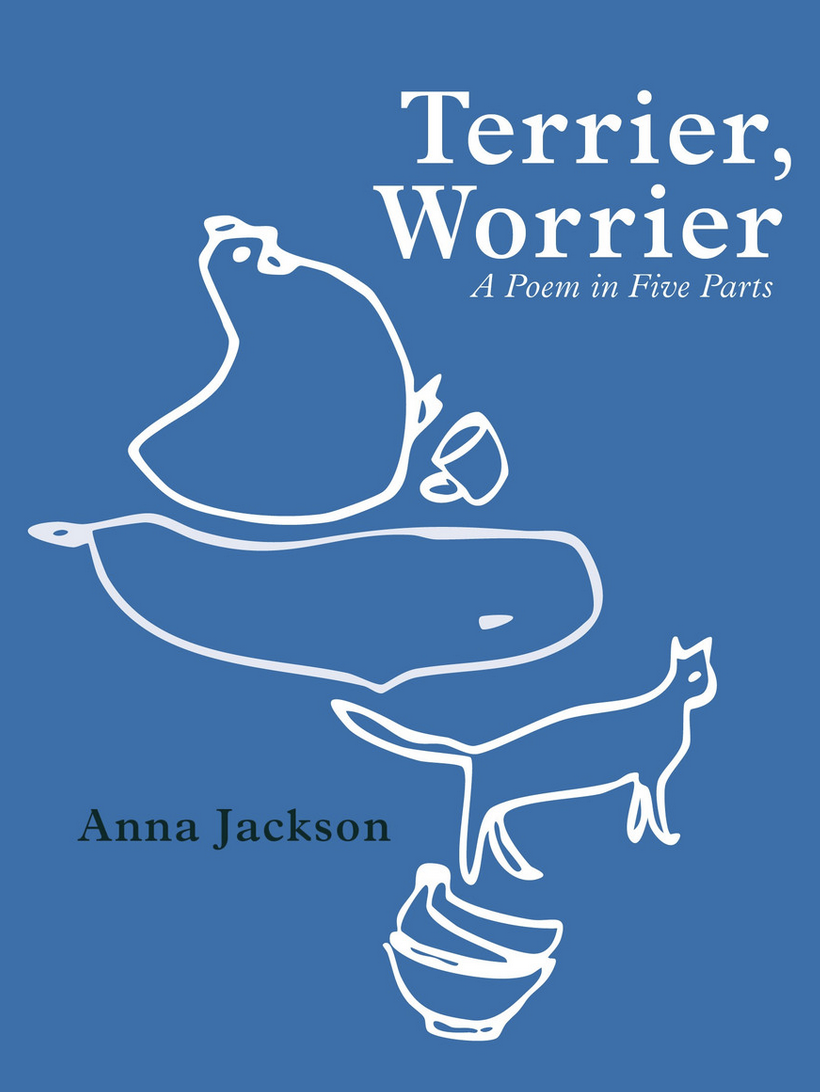
Poetry Shelf review: Terrier, Worrier A Poem in Five Parts by Anna Jackson

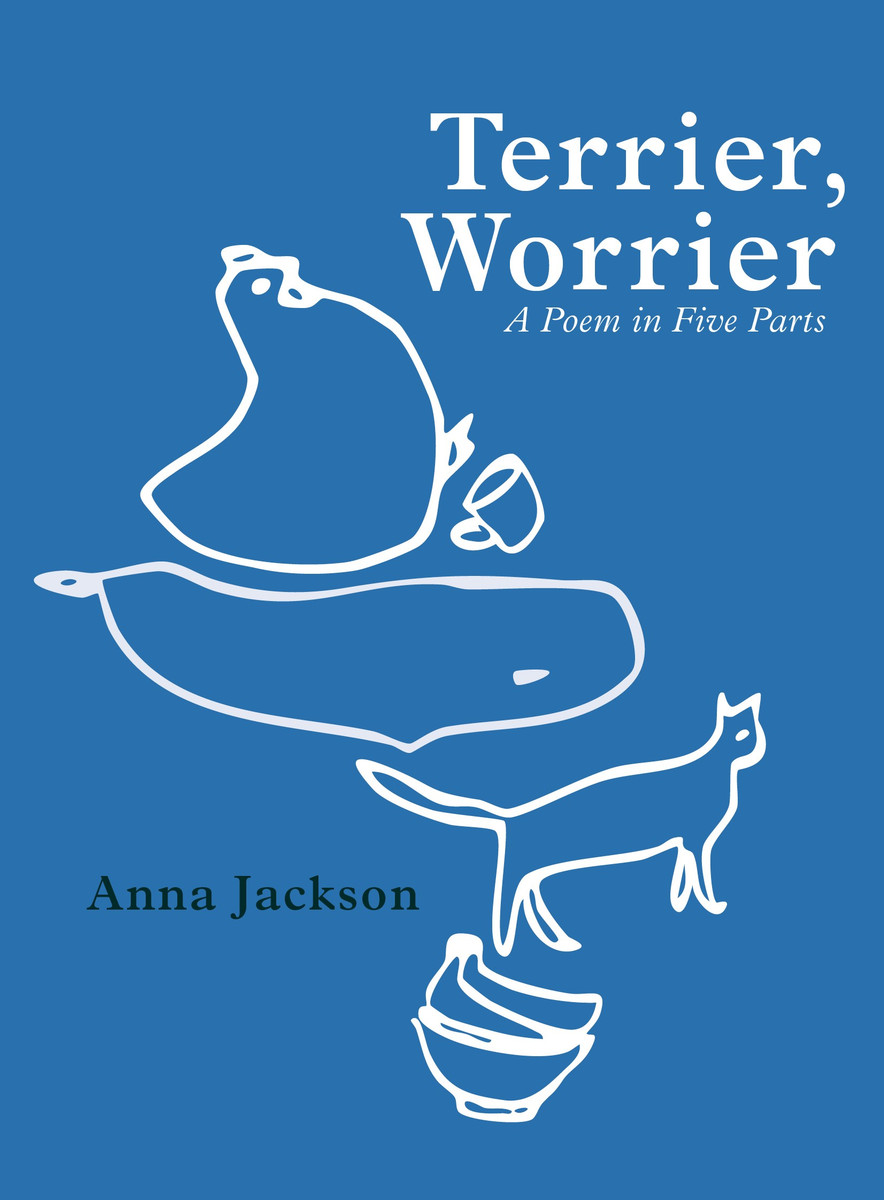
Terrier, Worrier A Poem in Five Parts, Anna Jackson
Auckland University Press, 2025

“She came upstairs looking more like a cloud than a silver lining.”

Loop: A Review in Nine Parts

LOOP

Anna Jackson’s glorious new collection, Terrier, Worrier A Poem in Five Parts, gets sunlight slipping through the loops of my thinking, reading, dreaming. The collection is offered as a seasonal loop as we move through summer, autumn, winter, spring, summer, and in this temporal movement, the loop regenerates, absorbing and delivering rhythms of living . . . mind and body . . . rhythms of writing . . . nouns, verbs, conjunctions . . . rhythms of thinking . . . and little by little . . . the compounding ideas, the feelings. It’s poetry as looptrack: overloop, underloop, throughloop.

I photographed a floor softly tiled in white and grey and
posted it with a quote from Emily Brontë’s diary: ‘Aunt has
come into the kitchen just now and said, “Where are your
feet Anne?” Anne answered, “On the floor Aunt.”‘

BREAKING THE FRAME

There is a long tradition of breaking the frame of poetry, or let’s say opening the frame, widening, nurturing, reinventing, rebooting, invigorating. And yes, there is sunlight drifting in through the gaps in these poetry weatherboards, lighting up what poems can do or be, both beyond the frame and within the frame. Subject, style, sensation. Anna writes:

Poetry can be a form of refusal as well as openness.

I am reading this poetry book at the kitchen table and it is a loop of ignition points. Anna also writes:

I thought, it tells us something about poetry that when we
need to talk to ourselves about something we don’t know
we know, we tell it to ourselves when we are sleep, in images
we struggle to remember when we awake, and often take
more than one reading to fully understand.

PRESENT TENSE

There’s a long black cloud streaking from the west coast to the backyard bush sprinkling salt and pepper rain. Terrier, Worrier is generally written in the past tense, with many stanzas beginning with ‘I thought’, yet for me, curiously, wonderfully, it carries the charismatic freight of the present tense, the sweet fluidity of the gerund, the present participle . . . where be-here-now fluency prevails regardless of gaps, rest-stops, hesitancy. Reading is to be embedded in the moment of the past as reader, so that what happened, and what was thought, becomes acutely present. Dive into the poetry currents in the collection, and along with the writer, you will might find yourself filtering, evaluating, experiencing, valuing, photographing, documenting, thinking. Savouring a moment.

I remember sitting in the car after work, not wanting to turn on the windscreen wipers because I felt like I needed rain on the windscreen to do the work of crying for me.

THOUGHT

Thinking. Yes Terrier Worrier is a poetic record of thought that offers anchors, the cerebral terrain of the philosopher say, an archaeology of ideas to dig for. Where testing the possibilities of what is matters along with what is not, along with everything in between. Poetry forms a thinking loop, a porous border between poem and idea, where meaning is organic, fertilised by nuance and shifting light. Sunlight say. Looping motifs and coiling thinking, like the surprise delight of letting thoughts carry you without planned itinerary. Where meaning ripples and slides. This is what happens as I read Terrier, Worrier.

Anna writes:

I thought, most of the time I, too, am a person not having thoughts but only having sensations, emotions, instincts, memories, anticipations.

Perhaps the poem becomes the vessel for ‘sensations, emotions, instincts, memories, anticipations’.

PRESENCE

Anna’s poetic record of thought (how ‘record’ resonates with the effects of tracks and music) is physically active. Thinking is anchored in a physical world, a yard of hens, a cat, partner, mother, father, daughter, son, friends. A tangible texture of dailiness that grounds the rhythm of thought in physicality. I love this.

Beside my bed there is a painting of a blue fish, floating high above a grey-blue sea, impaled on a grey-blue spike. On the back of the painting are written the words of the artist, my daughter, aged 3: ‘This is the fish. I painted it because it stuck in my mind.’

DREAMING

Dreaming becomes thinking becomes inventing becomes dreaming. Anna holds the idea of dreaming, like a prism on her palm, to question, revisit. Again I’m acutely aware how everything I have already said feeds into what I am saying here, and what I will say. How dreaming is the present tense, looping past and future, how the poet wonders her dream, with dream seeping into life and life into dream, into the threads of a poem in five parts. How do “sensations, emotions, instincts, memories, anticipations” slip into the dream texture, I wonder. Into the making of a poem.

When Amy told me she had dreamed about me, I felt as if my
own life were like that dream in which you climb some stairs
in your house and discover an additional room, or a whole
series of rooms, you didn’t know was there.

SPACE

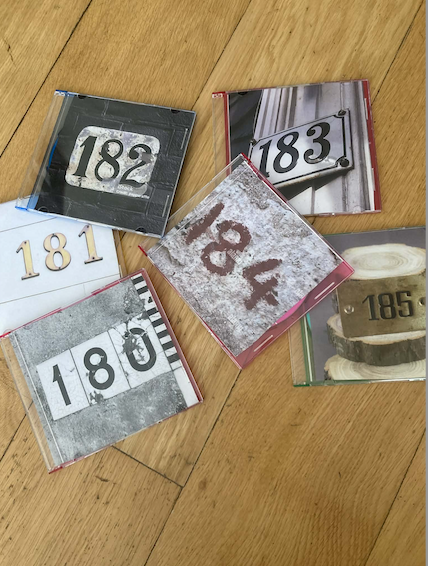
A word with myriad possibilities. There is space in the reading, in this nourishing process of reading that sends me looptracking and dawdling in a state of dream and wonder. Early in the sequence Anna is (and yes usually I am cautious about attributing the speaking voice to the author, but this book feels utterly personal so I think of the voice as Anna’s) – taking photographs of squares.

There is too the proximity of space and death, especially as both Anna’s parents and sister had had “a turn at death’s door”.

There are recurring motifs of rooms and buildings, and especially this thought:

I thought, every body is a memory palace.

And this:

I thought about the concept of ‘peripersonal space’, the idea
that your mental mapping of the self includes the immediate
space around you, and what you habitually keep about your
person, including for instance your bag, or your falcon.

READING LIST

Lately, I have been reading novels and poetry books that make a writer’s reading history visible. I love falling upon titles to be added to my must-read notebook, across genre, time, location, languages. Anna’s reading list at the back and the titles sprinkled throughout is incredible.

How may times do I return to Virginia Woolf! I must read Jan Morris’s thought-a-day diary, or Robert Wyatt’s irony of doing loads of minimalism, and how I too loved Susan Stewart’s magnificent On Longing: Narratives of the Miniature, The Gigantic, the Souvenir, Olivia Lang’s Crudo, Madison Hamill’s brilliant Specimen, Muriel Rukeyser’s poetry.

Worrier, Terrier is the kind of book you can’t put down. I keep giving myself another week to flow along its currents, neither to explain nor pigeonhole, but to embark upon the joys of reading poetry, of reading a book that feeds your mind, that sparks and startles your memory banks, that gets you revisiting your own secret feelings and thoughts. Because more than anything, I hold Terrier, Worrier as a book of self. This book of invigorating return, where you will find yourself expanding with both recognition and discovery. It feels like this is what Anna did as she wrote. Is the poetry a form of coping with the abysmal world, the drift thoughts and non-thoughts, the dailiness, the relationships?

I read another page. Then I reread this, a pulsating heartcore of the book:

Some feelings expand the self like a gas into the world and
some condense the self into the coldest matter.

And then this:

I wondered whether I could hear ‘terrier’ as a version of the
word ‘worrier’, a worrier being not someone who makes you
worry but someone who themselves worries, who worries away at things like a terrier might worry away at a sock. A terrier would be someone who allows themselves actually to indulge in the feeling of terror. I tell myself, ‘I am not okay, but I will be okay’, but maybe I need to stop saying that and release the terror, or maybe the terrier is not myself but represents someone else’s terror that needs to be heard.

Tomorrow I will pick up the book again, and find another gleam and thought spur. I want to sit in a cafe with you all, let our thoughts dream and drift and link, as we empty our coffee cups, pick up our pens, and catch both the dark and the sunlight slipping in . . . as we write through weeping, laughter, longing, with doors ajar and love strengthening. I utterly love this book of wonder.

Anna Jackson is the author of seven collections of poetry as well as Diary Poetics: Form and Style in Writers’ Diaries 1915–1962 (Routledge, 2010) and Actions & Travels: How Poetry Works (Auckland University Press, 2022). She lives in Island Bay, Te Whanganui-a-Tara, and is associate professor in English literature at Te Herenga Waka  Victoria University of Wellington.

Anna Jackson’s website
Auckland University Press page

Poetry Shelf launch speech series: Helen Rickerby launches Anna Jackson

I decided it would be a great idea to share the occasional poetry launch speech. All kinds of things get in the way of attending book launches – distance, time, illness, work, double-bookings! So I thought it would be great to host a series of launch speeches and photos – if you go to a poetry launch and love the launch speech, well maybe the poet and the launcher will give permission to post on Poetry Shelf. Let me know!

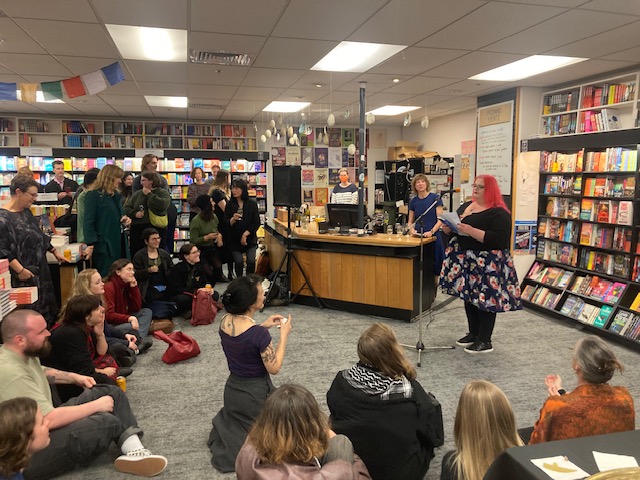
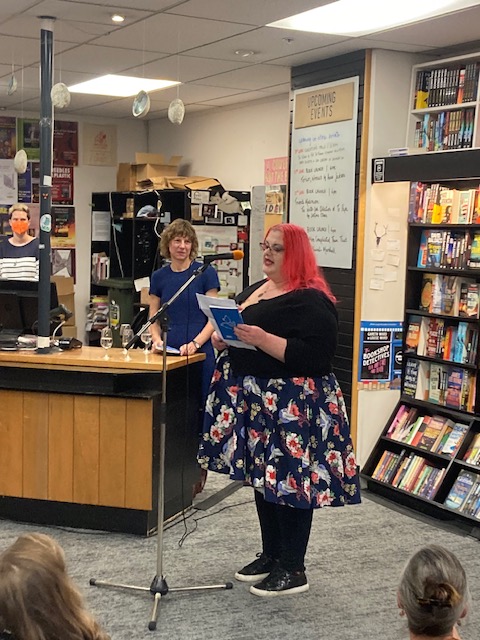
First up is Helen Rickerby launching Anna Jackson’s Terrier, Worrier A Poem in Five Parts (Auckland University Press) at Unity Books in Wellington.

Wellington launch speech for Terrier, Worrier

Kia ora kotou. Hi, I’m Helen Rickerby, and it’s an honour to be launching this new book by Anna Jackson – Terrier, Worrier. And lovely to see you all here to help celebrate.

I’ve been a big fan of Anna’s work since I first came across it, back sometime in the dark ages – the late 90s. She was living far away (Auckland) and submitted to a literary magazine I was editing. We got a lot of submissions, but Anna’s really stood out. I accepted it immediately, and that was the beginning of my friendship with Anna’s work.

I got to meet Anna herself not too much later, and then, conveniently, she got a job here in Wellington. She has become one of my dearest friends and her work and her self continue to be a big inspiration to me. She writes poetry that always makes me excited and inspired, which pushes me to be explorative and ambitious in my own poetry.

I know she’s been a great inspiration to many other people too, as a writer and teacher and as a person.

I’ve loved all of Anna’s books, so I don’t say this lightly – and I don’t really want the other books to hear me say this, I mean I don’t want to hurt their feelings and some of them are engraved on my heart – but I think Terrier, Worrier, is my favourite yet.

Auckland University Press, 2025 (page)

I got to see this book in various stages – when I read the first draft I remember thinking – and saying – that it was my favourite kind of thing to read. It’s sparky and fun and deep, it’s gorgeously written, with beautiful turns of phrase. It’s also quite educational – I learned a lot of things reading this. It’s like having a really really good conversation with Anna, and getting to watch her think in action.

This book is a thought diary in poem form – a hybrid prose poem form, which is my favourite.

Anna – or perhaps we should really say ‘the narrator’, because it is of course a composed and beautiful work of art; but while recognising that the voice of this poem is in fact a construct and not exactly or completely Anna herself, it also sounds so much like at least one version of Anna herself, that I am just going to call the narrator ‘Anna’. Anyway, Anna implies in the poem and the notes (I want to put in a plug for the notes – which are almost as rich, fun and conversational as the poem itself, and do feel to me like part of the poem itself): Anna says that she doesn’t think she has thoughts, or emotions. It is so clear to me that Anna is full of emotions, and full of thoughts – as proven by this book. I am someone who feels very full of both thoughts and feelings – when she began this project, I thought and felt that recording one’s thoughts would be quite overwhelming – I feel that I have a thought tumbling into another thought followed by another faster than I can even follow – I couldn’t comprehend how you could capture them all. But I’ve come to understand that one difference between Anna and myself is that she has higher standards of many things, including of what a thought is – and perhaps what a feeling is.

This is longish for a poem, but small for a book – however, in this small book there is just so much! A lot of thoughts and ideas per square inch. As well as her own thoughts, she argues with Ludwig Wittgenstein over language and beetles, questions Hannah Arendt over beauty, reads and considers scientific studies about time and perception – but despite all that dense deepness the experience of reading Terrier, Worrier, is easy, light, spacious, fun.

This is thanks to the beautiful, light, clever and funny way it is written.

And it isn’t just jumping from one profound thought to another – it circles back, revisits, reconsiders and sometimes disagrees with itself, makes connections with other thoughts and, aided by the fragmentary nature of this poem, there is space for us the readers to think and make connections too. For me it is the kind of writing that makes my brain spark.

This quote is from early on in the poem:

I heard birds and thought that although I am only hearing them,and I am not having a thought, it still feels like a thought, almost
like a thought of my own, or a conversation I am having, or
perhaps it is more like reading a poem, where the words, or the
movement of the thought, the song of the thought, is given to
you rather than coming from you, but still moves through you.

She begins by considering whether hearing is a thought, continues on to the nature of poetry and then you realise it’s doing exactly what it’s talking about – we’re following her thinking and the poem is making us feel like we’re doing the thinking, but then there is the space for us to actually think – if we want to – otherwise we can just go back to watching Anna’s brain.

One thing I love about Anna’s work, and actually about Anna herself, is her complete lack of concern with a hierarchy of culture. She mixes the high – classic and classical literature, philosophy etc – with the ordinary – the domestic space, family life, pets – but also treats both the ‘high’ and ‘low’ as much the same – or at least of equal importance. Or equal-ish – I think the pets might actually be more important than the philosophy.

And pets do make frequent appearances in Terrier, Worrier – mostly hens and also cats, as illustrated on the cover. There’s also a whale on the cover, and there are also whales in the book, but I don’t think even Anna could make a pet of a whale, though you never know.

While in some ways this poem is like a monologue, is really a conversation – as well as being in conversation with philosophers and scientists, she has conversations within the poem – or in fact arguments – such as with Simon about whether it would be better to leave doors open (apparently it is). And it also feels like a conversation with us.

I love how she says:

Whether including conversations
counted as cheating was another question. I decided it
probably was cheating, because it is almost impossible not
to have thoughts in conversation.

I have in fact had conversations where I have had trouble having thoughts, but never with Anna.

As I expect you have noticed, we are living in some pretty weird times. While this isn’t a book that engages directly in a political way, it is the kind of book I think we need in these times – the kind of book that stands in opposition to the values that are prominent right now among some of our so-called leaders.

This is a book that is full of curiosity, empathy with other humans and with animals. It is not interested in hierarchies of status, but in the beauty of all the things, big and small, that make an individual and collective life worth living. It values thinking deeply and is not content with the first knee-jerk idea or black and white solutions. It is a book that values connections and conversations, between ideas, between people and animals, and between people and people. These are the kinds of values that give me hope.

I don’t feel I’ve done this book justice – there are so many things that are wonderful about it, but I hope I’ve whet your appetite for it. And so now I declare Terrier, Worrier launched!

Helen Rickerby

Poetry Shelf reading: AUP New Poets 9 – harold coutts and Arielle Walker

Subscribe to continue reading

Subscribe to get access to the rest of this post and other subscriber-only content.

Poetry Shelf Monday Poem: Alice Te Punga Somerville’s ‘Written yesterday’

Written yesterday

It’s Valentine’s Day at this far edge of the Pacific
Clouds hang heavy, obscuring the shape of the land

Cook never made it here
But, according to Wikipedia, he made all of this possible:

I now live in the most livable city in the world
Named after a man who, they say, died in obscurity 

One Of Those White Men whose names are all most of us know
about places they barely touched

              Vancouver
              Vancouver
              Vancouver

Whose names have become lines we are forced to repeat to repent of our sins

Vancouver who was born in Norfolk
           (Pauline soaks aute on an Armidale afternoon –
           her work and her veins tying her family via Norfolk Island
           via Pitkern
           to Tahiti)
Vancouver who forty years later died in Petersham
           (my Sydneysider Ngāpuhi friend Carleen
           lived near Petersham
           on Gadigal country)
which is in Surrey
           there’s a Surrey here too –
           home of the fourth largest Indo-Fijian community in the world)

Vancouver mapped this Eastern edge of Oceania,
Becoming one of those white men who will never be obscure or forgotten

From here, when I look back towards home,
Hawai’i is in the middle distance –

Those complex supple islands where I repaired my waka
the other time I fled from home

Those staunch expansive islands
where love put Cook where he belonged  

It’s already the fifteenth of February in Aotearoa
And the annual jokes about Cookery and love for Hawaiians
are day-old tweets

While here, today, it’s still the fourteenth –
The day to march downtown for lives and deaths of Indigenous women

But we’ve moved too recently with a daughter
too young to be kept safe in a pandemic
            (As if this colony has ever been safe for Indigenous girls)

So I sit, scrolling, in a hired car and read
that New Zealand’s sixth highest mountain
           is also called Vancouver.

I am trying to guess which maunga his name has smothered
and for how long,

I am undone, again –

By how much I have yet to learn about the place I am from

And how much I have yet to learn about this lovely drizzly place

With all these names that hang heavy,
                                               obscuring the shape of the land.

Alice Te Punga Somerville

Alice Te Punga Somerville (Te Āti Awa, Taranaki) is a scholar, poet and irredentist. She researches and teaches Māori, Pacific and Indigenous texts in order to centre Indigenous expansiveness and de-centre colonialism. Alice is a professor in the Department of English Language and Literatures and the Institute for Critical Indigenous Studies at the University of British Columbia. She studied at the University of Auckland, earned a PhD at Cornell University, is a Fulbright scholar and Marsden recipient and has held academic appointments in New Zealand, Canada, Hawai‘i and Australia. Her first book Once Were Pacific: Māori Connections to Oceania (University of Minnesota Press, 2012) won Best First Book from the Native American & Indigenous Studies Association. A recent book is Two Hundred and Fifty Ways to Start an Essay about Captain Cook (BWB, 2020). Alice’s debut poetry collection, Always Italicise: How to Write While Colonised (Auckland University Press), is shortlisted for the 2023 Ockham NZ Book Awards.

Poetry Shelf Occasional Reviews – Alice Te Punga Somerville’s Always Italicise: How to write while colonised

Always Italicise: how to write while colonised, Alice Te Punga Somerville, Auckland University Press, 2022

And then you skype with me late one afternoon to practise your speech
which begins with your
pepeha as if that is the most ordinary way to start
when you’re eleven years old.

How were we to know – even to guess – that this language would be your weapon
Your strategy
Your bullet-proof vest

from ‘Anchor’

Alice Te Punga Somerville’s new collection offers four vital sections: reo / invisible ink / mahi / aroha. Sections in their own right but the discrete boundaries blur as movement and connections abound. The categories strike a chord, deep seated, poignant, as though this exquisitely designed book becomes a register of life – how we speak, how we are unseen and unspoken, how we work, and how we love. Importantly, how we become.

Alice was once told foreign words need to be italicised, to be rendered apart from standard English. This alienating process includes te reo Māori. Yet some words are adopted by English and slip off tongues without e-strange-ment: think pizza, pasta, cappuccino. Think haka and marae. Inconsistent. Alice puts the shoe on the other foot and italicises the English language leaving te reo Māori as notforeign. It is poem performance yes, but more importantly it is action.

The overturned italics convention, carried across the length of a book, is an insistence. It is personal, it is political and it is ancestral. We are what and how and why and where and who we speak. The historical and contemporary silencing, the historical and contemporary othering of language is inexcusable.

Alice’s poems are writing on the breath, breathpoetry, utterly fluid; it is writing on the breath of memory, story, change, ideas, feeling. Her poems carry the rhythm of life – of reo, invisible ink, mahi, aroha. There is the rhythm of prayer and the rhythm of waiata. The poetic rhythms and crafted fluencies carry the reader across eclectic subject matter.

Alice is spotlighting indigenous worlds, an indigenous presence, replying to colonised worlds. She is building a poem space and a poetry home. Many poems are dedicated to other people, underlying the idea we write within nourishing communities of readers, writers, thinkers, mentors. And for Alice, this includes the academic, acknowledging her poetry is in debt to her life as an academic. The academy is joy but it is also challenge, with settings that are racist, privileged, biased.

Books reach us at different times and in different ways. As readers we establish myriad travel routes through a book, we bring our own experience close or hold at a vulnerable distance. Books are my life rafts at the moment. With the road ahead still bumpy, still uncertain, I hold language and love close, I work and take little steps each day. I see Alice’s glorious, ground-establishing poetry collection as her mahi, her aroha. It is a book spiked with anger and it is a book stitched with love. It has made me smile and it has gripped my heart. It is the most affecting book I have read this year.

Pick up coffee cup and printed pages, open the screen door, walk back inside.

My eyes take longer to arrive than the rest of me:
they’re still adjusted for the brightness outside;
I bump into things, blind, while I wait for my whole self to arrive,
and realise this is the only worthwhile way to proceed anyway –

All of me, all at once:
anger, frustration, cynicism, hope
and, in the centre as well as the outer reaches, love.

from ‘Too’

Alice Te Punga Somerville, Te Āti Awa, Taranaki, is a scholar, poet and irredentist. She researches and teaches Māori, Pacific and Indigenous texts in order to centre Indigenous expansiveness and de-centre colonialism. Alice is a professor in the Department of English Language and Literatures and the Institute for Critical Indigenous Studies at the University of British Columbia. She studied at the University of Auckland, earned a PhD at Cornell University, is a Fulbright scholar and Marsden recipient and has held academic appointments in New Zealand, Canada, Hawai‘i and Australia. Her first book Once Were Pacific: Māori Connections to Oceania (University of Minnesota Press, 2012) won Best First Book from the Native American & Indigenous Studies Association. Her most recent book is Two Hundred and Fifty Ways to Start an Essay about Captain Cook (BWB, 2020).

Auckland University Press page
Poetry Shelf Occasional Reviews: No Other Place to Stand

No Other Place to Stand: An Anthology of Climate Change Poetry from Aotearoa New Zealand, Jordan Hamel, Rebecca Hawkes, Erik Kennedy and Essa Ranapiri, Auckland University Press, 2022

Auckland University Press is to be celebrated for its stellar poetry anthologies. No Other Place to Stand: An Anthology of Climate Change Poetry from Aotearoa New Zealand offers an eclectic, and indeed electrifying, selection of climate change poetry. The editors, Jordan Hamel, Rebecca Hawkes, Erik Kennedy and Essa Ranapiri, are all frontline poets themselves.

The dedication resonates and stalls your entry into the book because it is so apt: “To those fighting for our future / and those who will live it.”

A terrific foreword by Alice Te Punga Somerville establishes a perfect gateway into the collection. Alice wonders, when climate change is such a mammoth issue, “about the value of the particular, the specific, the local, the here, the now”. What difference will reading and writing make when the world demands action? Alice writes: “Every single poem in this anthology speaks to the relationship between words and worlds.” That in itself is enough of a spur to get a copy of the book, and open up trails of reading, wonder and challenge.

I am spinning on the title. I am turning the word ‘stand’ over and over in my mind like a talisman, a pun, a hook. I am thinking we stand and we speak out, I am thinking we stand because we no longer bear it, and I am thinking we stand together.

The poems selected are both previously published and unpublished. The sources underline the variety and depth of print and online journals currently publishing poetry in Aotearoa: Minarets, Starling, Spin Off, Mayhem, Pantograph Punch, Poetry NZ, Blackmail Press, Overland, Sweet Mammalian, Turbine | Kapohau, Takahē, Stasis, Landfall.

No Other Place to Stand is an essential volume. You can locate its essence, the governing theme, ‘climate change poetry’, yet the writing traverses multiple terrains, with distinctive voices, styles, focal points. I fall into wonder again and again, but there is the music, the political, the personal, the heart stoking, the message sharing. There is the overt and there is the nuanced. There is loud and there is soft. There is clarity and there is enigma. You will encounter a magnificent upsurge of younger emerging voices alongside the presence of our writing elders. This matters. This degree of bridge and connection.

Dinah Hawken has long drawn my eye and heart to the world we inhabit, to the world of sea and bush and mountain, stones, leaves, water, birds. Reading one of her collections is like standing in the heart of the bush or next to the ocean’s ebb and flow. It is message and it is transcendental balm. Her long sublime poem, ‘The uprising’, after presenting gleams and glints of our beloved natural world, responds to the wail that rises in us as we feel so helpless.

6.a.

But all I can do is rise:
both before and after I fall.
All I can do is rally,

all I can do is write
– I can try to see and mark
where and how we are.

All I can do is plant,
all I can do is vote
for the fish, the canoe, the ocean

to survive the rise and fall.
All I can do is plead,
all I can do is call . . .

from ‘The uprising’

I am reading the rich-veined ancestor currents of Tayi Tibble’s ‘Tohunga’, the luminosity of Chris Tse’s ‘Photogenesis’, the impassioned, connecting cries of Selina Tusitala Marsh’s ‘Unity’ and Karlo Mila’s ‘Poem for the Commonwealth, 2018’. Daily routines alongside a child’s unsettling question catch me in Emma Neale’s ‘Wanting to believe in the butterfly effect’. I am carried in the embrace of Vaughan Rapatahana’s ‘he mōteatea: huringa āhuarangi’ with its vital, plain speaking call in both te reo Māori and English.

Take this heart-charged handbook and read a poem a day over the next ninety days. Be challenged; speak, ask, do. I thank the editors and Auckland University Press for this significant anthology, this gift.

Auckland University press page

Jordan Hamel is a Pōneke-based poet and performer. He was the 2018 New Zealand Poetry Slam champion. He uses poetry and performance to create awareness and discourse about environmental and political issues. He is the co-editor of Stasis Journal and his debut poetry collection Everyone is everyone except you was published by Dead Bird Books in 2022.

Rebecca Hawkes is a poet/painter from Canterbury, living in Te Whanganui-a-Tara. Her chapbook ‘Softcore coldsores’ was published in AUP New Poets 5 in 2019. Her first full-length poetry collection, Meat Lovers, was recently unleashed by Auckland University Press. Rebecca edits Sweet Mammalian and is a founding member of popstar poets’ posse Show Ponies.

Erik Kennedy is the author of Another Beautiful Day Indoors (Te Herenga Waka University Press, 2022) and There’s No Place Like the Internet in Springtime (Victoria University Press, 2018), which was shortlisted for best book of poems at the 2019 Ockham New Zealand Book Awards. He lives in Ōtautahi Christchurch.

Essa Ranapiri (Ngāti Wehi Wehi / Ngāti Takatāpui / Clan Gunn) is a poet from Kirikiriroa. They are part of puku.riri, a local writing group. Their book ransack was published by Victoria University Press in 2019. Give the land back. It’s the only way to fix this mess. They will write until they’re dead. And after that, sing.

Poetry Shelf conversations: Helen Rickerby

How to live through this

We will make sure we get a good night’s sleep. We will eat a decent breakfast, probably involving eggs and bacon. We will make sure we drink enough water. We will go for a walk, preferably in the sunshine. We will gently inhale lungsful of air. We will try to not gulp in the lungsful of air. We will go to the sea. We will watch the waves. We will phone our mothers. We will phone our fathers. We will phone our friends. We will sit on the couch with our friends. We will hold hands with our friends while sitting on the couch. We will cry on the couch with our friends. We will watch movies without tension – comedies or concert movies – on the couch with our friends while holding hands and crying. We will think about running away and hiding. We will think about fighting, both metaphorically and actually. We will consider bricks. We will buy a sturdy padlock. We will lock the gate with the sturdy padlock, even though the gate isn’t really high enough. We will lock our doors. We will screen our calls. We will unlist our phone numbers. We will wait. We will make appointments with our doctors. We will make sure to eat our vegetables. We will read comforting books before bedtime. We will make sure our sheets are clean. We will make sure our room is aired. We will make plans. We will talk around it and talk through it and talk it out. We will try to be grateful. We will be grateful. We will make sure we get a good night’s sleep.

Helen Rickerby, from How to Live

I am stuck at home, not doing author trips, not catching up with friends in person, never hanging out in cafes, so I’ve been doing email conversations with poets whose work I have loved. A couple have sublime new books out, but with others it was an excuse to revisit writing I have carried with me.

Last up in this series is Helen Rickerby. Helen is a writer, editor and publisher. She has published a number of poetry collections, including Cinema (Mākaro Press, 2014) and How to Live, which won the 2020 Ockham New Zealand Book Awards – Mary and Peter Biggs Award for Poetry (Auckland University Press, 2019). Helen was co-managing editor of the literary journal JAAM from 2005–2015 and single-handedly runs Seraph Press, the boutique poetry press.

I have been a fan of Helen’s poetry for a long time, but she has also published a number of my own collections (The Baker’s Thumbprint 2013, New York Pocket Book 2016 and The Track 2019). I have loved working on each book with her.

Seraph Press’s list of publications include some of my favourite poets in Aotearoa: Anna Jackson, Bernadette Hall, Nina Mingya Powles, Anahera Gildea, Vana Manasiadis, Helen Llendorf, Maria McMillan, Johanna Aitchison, Vivienne Plumb – plus the terrific anthology, Tātai Whetū: Seven Māori Poets in Translation (2018).

It has been such a pleasure to touch base with books and poetry in email conversations..

Paula: In these tilted and jagged times diversions are so important. For me, reading and secret writing projects are essential. So many sublime books are being published in Aotearoa and around the world at the moment, of all genres. What has helped you? Any books that have lifted or anchored or transported you? I can so identify with your words in Chris Tse’s new Auckland University Press book, Super Model Minority (‘these poems cut my heart before warming it’).

Helen: Yes, I’m also sticking pretty close to home just now, and while I am still seeing my friends, mostly in our own homes, I am also needing to find my joys near at hand. Over the last week while I’ve been finding a lot of comfort and joy, and also a bit of challenge, in creative non-fiction – particularly in books that could loosely be described as memoir, but which are much more. There’s something about the mixture of narrative, life, ideas and poetic writing (if not actual poetry) that’s my thing right now. Recent highlights include Joan Didion’s The Year of Magical Thinking and Blue Nights, Daniel Mendelsohn’s An Odyssey: A Father, a Son, and an Epic, Patricia Grace’s From the Centre and especially Deborah Levy’s autobiographical trilogy.

During last year’s lockdown a friend left a care package of books in my letterbox. One of the books was Real Estate, the third (red) volume in Deborah Levy’s trilogy. It’s kind of about her making a new life for herself after her daughters leave home, but it’s so much more than a memoir, as are the other two books in the trilogy. It’s poetic and philosophical and, collage-like, full of quotes from other works of literature that she’s having conversations with – I felt an affinity, it felt allied with what I’ve been doing in poetry in recent years. I read my way backwards through the trilogy, borrowing the second (yellow) volume, The Cost of Living, from a friend who lives downstairs and, as soon as we got to Level 3, buying the first (blue) book, Things I Don’t Want to Know, from the lovely Volume bookshop in Nelson (because no Wellington bookshops had it and I knew Volume could get it to me quickly, and I needed it immediately). And then when I finished that, I started reading them all again, forwards this time. I found them so calming, like the eye of a storm. I was finding everything a bit hard at the time, mainly in my head, and I would just take a little bit of time with these books and I could feel myself calming down. Even though her experiences were very different to mine, I loved the way in these books she kind of rises up above her life and looks down on it, and writes about it, from a calm height. It made me feel like I could do the same.

I confess to being someone who is looking for quite a lot of comfort in life and literature, but I also know that growth doesn’t usually come from comfort, and a bit of discomfort is really important. Super Model Minority is a fabulous book, and one that did at times make me feel uncomfortable. Some of the things he’s writing about are uncomfortable and even painful, and there’s definitely anger. But the poems make you think, and make you see and appreciate, and in the midst of it all there’s humour and hope and beauty. I’m always keen on some humour and hope and beauty.

Paula: Ah – now I am dead keen to read the Levy trilogy. And yes! That’s exactly what Chris’s collection does. And you do come away with the word hope.

I want to talk about how I love your poetry, but first, which poets would you choose to have conversations with (let’s say dead or alive, home or abroad). Poets who have affected your travels and engagements as a writer and a reader.

Helen: Hmmm, that’s a tricky question. I have a bit of a fear of meeting my heroes, in case it’s terribly disappointing, or they don’t like me (or I don’t like them), or we had a mediocre conversation. So much pressure! Also, quite a few of my heroes are women I don’t think I would get along with very well: Katherine Mansfield, Sylvia Plath, Virginia Woolf, George Eliot, etc… I also feel that if I really love someone’s work, I don’t necessarily want to talk to them about it, I wouldn’t want to break the magic. So I would be very nervous to talk to Anne Carson, for example, even though her work has been very important and inspiring to me in showing the breadth of what poetry can do. I was reminded today of the wonderful book-length poem Memorial by Alice Oswald today, and I would be interested in talking to her about that. While it was Heather Cristle’s The Crying Book, which is not strictly speaking poetry, that really got me, she is a poet I might risk talking to. I have had great conversations about poetry with poets who are my actual friends, perhaps particularly with Anna Jackson, who I’ve run a few conferences with, though we talk about other things too. From the past, Sappho would be very interesting to converse with, though we’d need to use some kind of translator. I would be intrigued to meet Byron, but it might not be poetry we’d talk about.

Paula: Ha! I never thought of that. Yes, I feel nervous when I review a book as that feels like a conversation that could go terribly wrong on my part. I want to navigate the paths, corridors, alcoves, wide open windows of a book and make discoveries. No interest in listing all the things a poetry collection doesn’t do.

What matters to you when you write a poem? What do you want your poem to do or be or feel or activate (I keep coming up with more and more verbs)?

Helen: I probably have as many answers to that question as poems I’ve written  possibly more! And what matters to me changes over time, and maybe changes back. But some things that come to mind are to capture something   a thought, a feeling, an experience, the thinking through of an idea, an image, a memory. I want to communicate, but not too clearly or simply, I want to create layers and textures and possibly contradictions. I want the reader to get something out of my poem, but I don’t want them to necessarily be able to decode the whole poem. I don’t want to be able to decode the whole poem. I want the sound and language to feel right for the poem, and I want the words to be beautiful, even if only ugly beautiful. I want it to feel fresh to me and/or the reader, but I want it to feel true to them in some way, which is not the same thing as factual. I want the poem to be more than the sum of its parts, and I want the poem to be a bit bigger than me, maybe wiser?  I want to open some doors or windows in my own head, and the heads of at least some of my readers. I want to feel like the poem doesn’t have too much, or too little – I have a bit of a thing for a long, spacious poem, when appropriate. I want to feel that it’s a bit worthwhile, in some or other way. I don’t want to reread it and think ‘Yeah, and so?’ I want to have learned something, through writing the poem, even if only about myself. I’m not sure I can do all of these things at once!

from ‘How to Live’, in How to Live

Paula: How to Live (Auckland University Press, 2019) is one of my all time favourite poetry collections. It is a book I am taking to hospital with me. I so loved reviewing it on Poetry Shelf. Like many contemporary poets you are cracking open poetic forms – widening what a poem can do – as though taking a cue from art and its ability both to make art from anything and in any way imaginable. So richly layered. In fact everything you say above!

‘How to live’ is a question open to interpretation as it ripples through the poems; and it makes poetry a significant part of the myriad answers. I haven’t read a book quite like this and I love that. The writing is lucid, uplifting, provocative, revealing, acidic, groundbreaking. The subject matter offers breadth and depth, illuminations, little anchors, liberations, shadows. I am all the better for having read this book. I just love it. (Poetry Shelf)

If windows and doors open in your head as you write a poem they open in mine as I read the collection. Particularly in view of the presence of women. What did you discover writing this book?

Helen: Aww, thank you Paula! I learned a lot while writing this book, though I finished it more than three years ago, and so have forgotten a lot! It was definitely a book of thinking through –  and feeling through – and making connections. So there’s a lot of me in there, and my own thoughts and experiences and attempts at figuring things out, but there’s also a lot of research. I learned quite a bit about philosophy and about philosophers, and that got me thinking about why I didn’t really know of many, if any, women philosophers. Turns out the main reason is the same reason we don’t know about a lot of women from the past: because they’ve been erased and forgotten. I am always quite delighted to discover women from the past who have done cool things – there are lots of them. It was also while writing this book that I started thinking about the way my poetry, and the work of other poets that I’d been noticing, was crossing over with essay, and I got quite excited about that. I’m really interested in poetry that explores and thinks through ideas – that journey – I’m probably less interested in the destination. I love the way poetry can leap over gaps and fragments, happily hold contradictions and layers and non-binaries. Both/And.

Palimpsest is a word I have to look up every time
A palimpsest is a parchment from which the words have been scraped off so it could be used again
but the old words still show through

Earth / late summer

This is the place of intersection your life
my life
my time
and the little I know about yours the little I know about mine
the little I know

from ‘Ban Zhao’

Paula: I so love the title and the poem it references. I am wondering if poetry so often responds to this question, overtly or opaquely. It made me want to write my own version, borrowing your title. Did anything in particular prompt the poem?

Helen: It’s a question I think we all need to keep asking ourselves all the time, for our whole lives. There’s no one answer, and the answer for each of us keeps changing, but in order to be a good person in society and a happy person in our own lives, I think we need to think about this, and also to act. Everyone could write a book of this title, and I would love to read yours! Multiple books probably – I have continued developing my ideas about how to live since I finished writing this book. They now involve more fun and dancing.

My original idea for this book was quite different, but with the same title. About a decade ago Sean, my husband, was diagnosed with cancer. It turned out to be of a very treatable kind, which was very fortunate, but the whole dealing with the medical system, let alone mortality, was a bit of a thing. I was also becoming increasingly aware that I was no longer a youth, and of the finiteness of time, and wanting to make the most of that time. During all of this, especially during Sean’s treatment and recovery, I was writing poems about this experience and exploring the idea of living as in not dying, and living as in really living. These poems weren’t entirely successful, but they had something in them, and I ended up cutting them up and using them as the basis of the long title poem, which explores these same ideas, as well considering ideas about what poetry is, and, you know, everything!

Paula: Is there a poem (or two) which has fallen into charismatic place for you? Two longer poems are particularly magnetic: ‘Notes on the unsilent woman’ and ‘George Eliot: a life’. Both function as fascination assemblages. They allow the reader to absorb lyrical phrases, humour, biography, autobiography, insistent questions. Biography is enlivened by such an approach, as is poetry. Ah, really the whole collection, magnetic, eclectic, electrifying.

Helen: I’m not quite sure what you mean by this question. Of my own work? This might not be what you mean, but I had a similar experience with both the first poem in the book ‘Notes on the unsilent woman’ (which was the last poem I wrote for the book) and the last poem in the book ‘How to live’, where I had this idea of what I wanted to do in the poem, and I had all these fragments, but I didn’t know how to make the poem I wanted it to be. But with each, while feeling like I would NEVER get there, I had a kind of epiphany about the form, which gave me the tone, which made everything else fall into place. I have found this encouraging since – that you can feel completely hopeless, but if you keep on going you might be quite close to creating the thing you want to. I think this recent tweet by Heather Cristle evokes this beautifully: ‘I love it when form writes the book for you. It is like you are trying to screw something together and form is watching you impatiently until it says ‘just give it to me’ and you do and form puts everything together so fast while you lie down admiring its movement and shape.’

from ‘Notes on the unsilent woman‘ Hipparchia of Maroneia c. 350–c. 280 BC

Paula: I was over the moon when it won the 2020 Ockham New Zealand Book Awards – Mary and Peter Biggs Award for Poetry. Did the judges recognise something in the book you hadn’t seen? I love it when that happens – when you look through the open windows of a poem and things surprise you. And how was it winning the award?

Helen: It was all a bit of a blur! Google photos tells me it was two years ago this week. It was also at the end of the first lockdown – quite a nice way to end it. I was in complete shock – I was pretty certain that Anne Kennedy would win, and when they said my name there was quite a lot of screaming (and a little bit of swearing) at my house. Book awards are weird things. I’m fully aware that they’re never an objective ranking, which isn’t even possible, but are just what those three judges managed to agree on at that time, but it was still very lovely that it was my book they agreed on. I don’t think there was anything the judges said about my book that surprised me, but I appreciated that they got what I was exploring. And winning meant that more people sought out my book, which was also lovely.

Paula: I find myself drawn to poems of all lengths – for a while I favoured the long poem as I could carry it in my pocket and keep adding to it as I mothered and worked and cooked. Now I quite like small poems, sweet mouthfuls that are verging on stream of consciousness. What do you like about the long poem?

Helen: There is something nice about a little gem of a poem, but I do love a good long poem the most. I love the way it has space to breathe and move and meander and be a bit messy. To look at things from a bunch of angles and maybe not favour any of them. I have come to accept that I’m a digressive conversationalist, perhaps a digressive person in pretty much everything except my day job (I’m an editor/technical writer, which is all about plain-language, clear structure, unambiguity – basically the opposite of poetry), and I really enjoy interesting digression in what I’m reading, and what I’m writing. Though, it won’t be entirely a digression, because it will almost certainly connect to everything else in some kind of way. A long poem has enough time to set up resonances within itself, it can tell stories rather than just capture moments. Not that I don’t love a great poem that just captures a moment! And because I’ve been interested in the essay poem, longer poems have more space for the essaying, the thinking through, the exploration. And I guess they have the space to be about several things at once, and about the connections between those things. Probably I should give some examples, but I’m immediately struck by everything I would miss out! Possibly my all-time favourite long poem, and all-time favourite poem, is ‘The Glass Essay’ by Anne Carson, which isn’t quite book length (it comes in at 45 pages), but which manages to be about the end of a relationship, Emily Brontë, Wuthering Heights, a visit to the narrator’s mother, and the decline of a father with dementia, and some other stuff, and is all beautifully written.

Paula: I am delighted to see so many boutique presses springing up – bringing us such a wider range of voices. You have published a number of my poetry collections though Seraph Press, and it has been a special relationship. I have loved the look of each book, am grateful for your editing. The collections are all so different. I love that! And I discovered Nina Mingya Powles through you! How does publishing the work of poetry impact on your own writing? You put so much love in to the books you published. What matters to you when you make the book of someone else?  [do you think publishing is something you are moving away from now to give more time to your own work?] 

Helen: I do love making books, both as collections of words and ideas, and also as physical objects. And I have loved working with different writers to get their words out into the world. Some of them, like you, were fully formed poets when I started working with you, while others – such as Nina, who was only 21 when I published her first chapbook containing some of the very first poems she’d written – were just beginning and I’ve got to see them bloom in close quarters. I have made some great connections and am really proud of making books that I think are beautiful and worthwhile. I try to work with each author so we’re both happy with what we’re putting out, and happy with how it looks. Because it’s something that I do in my own time and almost entirely with my own money, I have had to basically be in love with the books to make it worthwhile. It has taken a bit of a toll on my own writing sometimes, because when I’m working on someone else’s book, that has obligations and deadlines, whereas my own writing doesn’t and gets pushed back. Especially as I’m not an especially great multi-tasker, am usually also working a day job or two, and am by nature quite lazy and so my inclination is generally to just muck around instead. As much as I love publishing, or rather some aspects of publishing (because I do pretty much everything, there are definitely things I’m less interested in and less skilled at – like marketing, for example), after getting a bit burned out I am having a hiatus on the publishing front, and focusing on my own writing, and my own life, for a while. I’m sure I haven’t published my last book though!

Meanwhile, I’m really excited to see the new publishers coming through, doing things their own way, getting important work out there, and increasingly being noticed by mainstream awards. This not at all an exhaustive list, but I’m thinking right now of Anahera Press, Compound Press, We Are Babies and new kid on the block Taraheke | Bushlawyer. Exciting times!

Paula: Indeed – so exciting to see the new presses supporting terrific new voices. I feel like we have had a very long lunch, with the most delicious food and roving conversation. It means a lot, to be part of wide stretching poetry communities.

Helen reads ‘How to Live Through This’

Poetry Shelf Monday Poem: Helen Rickerby’s ‘Mr Anderson, you heartbreaker you’

Poem ‘How to die’ at the Spin Off

Seraph Press

Auckland University Press page
Mākaro Press page

Poetry Shelf review: Robert Sullivan’s Tūnui | Comet

Tūnui | Comet, Robert Sullivan, Auckland University Press, 2022

6.

I’d written ‘Decolonisation Wiki Entries’
because it reminded me of buses in Honolulu

at the airport and Waikiki. The open-air buses
aren’t like decolonisation though. Decolonisation

is not worrying about cultural identity,
and not translating and not having to explain

things like a family and hapū do such as wānanga
because the wānanga is the explanation

or learning mōteatea by our ancestors,
or prophecies of our spiritual tūpuna, or sadness

at the fighting on the other side. These
decolonisations make up life.


from ‘Te Tāhuhu Nui’

Robert Sullivan belongs to the iwi Ngāpuhi Nui Tonu and Kāi Tahu. His debut collection, Star Waka (Auckland University Press, 1999), marked the arrival of a significant poet, and has been numerously reprinted. Robert has published a number of collections since, and with Reina Whaitiri edited Puna wai Kōrero, an anthology of Māori poetry, and with Reina and Albert Wendt, Whetu Moana and Mauri Ola, anthologies of Polynesian poetry in English.

Robert’s new collection, Tūnui | Comet, stands on the shoulders (hearts, lungs, mind) of everything he has written and edited to date. Voice has carried his poetry, his family, his whakapapa. Voice is the weave that remembers the touchstones of his previous collections: Tāmaki Makaura, the Far North, colonisation, Cook, family. I have never forgotten his premise that voice carries us. And voices carries this collection, all that it holds close, all that it challenges. It is there in ‘Kawe Reo / Voices Carry’:

Voice carries us from the foot of Rangipuke / Sky Hill / Albert Park
to the Wai Horotiu stream chuckling down Queen Street carrying
a hii-haa-hii story—from prams and seats with names and rhymes,
words from books and kitchen tables.

In writing poetry, Robert is speaking to for with from. He is conversing and he is voyaging, and his writing is the river flowing, the currency of water and air vital. Each poem sits in generous space on the page, each poem given ample room in which to breathe, in an open font, allowing space for the reader to pause and reflect.

The collection weaves in past, present, and future – who he is, was and will be – mythologies, histories. There is the drive to write in te reo Māori, to nourish the language’s roots, to write poems without English translations, to insist upon a need to speak and grow with his own language.

Robert acknowledges he writes within a community of poets who have shaped him. He carries a history of reading, of considering the work of others, particularly Māori and Pasifika poets. There’s a homage to Alistair Te Ariki Campbell. An imagined barbecue with Hone Tuwhare. A reminder the notDeclaration of Independence was actually yes, an assertion of mana by the rangatira (for Moana Jackson). There’s walking on Moeraki sand to remember Keri Hulme’s place names.

Voicing: colonisation decolonisation. The poem ‘Decolonisation Wiki Entries’ reminded me of the caution I bring to facts and figures, to encyclopaedic entries, to the way statistics can be hijacked, research findings manipulated. I am reminded of the hidden narratives, the misrepresented experiences, the sidelined voices.

2. Ruapekapeka

I have visited once and seen a hilly field
from memory—hard to take the scene in
without props. There was a church service
and worshippers fled out beyond. Never
swarmed the bunkers and trenches.
Flicked between ancestor Wynyard
and out neighbouring great chief Kawiti.
I do not know the buried knives. We gathered
in this hill of ash, dead bees and pollen.
We left carvings in the earth and flowers there.


from ‘Decolonisation Wiki Entries’

Tūnui | Comet is poetry of acknowledgement. It is poetry of challenge. And it is profoundly moving. In ‘A.O.U’, the poem sings a mihi for Ihumātao. In ‘Feather’s’, the speaker is wearing blood and mud splattered trousers at Parihaka (‘we’re a little band of brothers /marching hundreds strong’) and the feather is in flight:

Whiteness
of the mountain
the ploughs
and feathers
the children’s
singing
witness

I say challenge, do I mean voice? Voicing different versions. Wanting to wrap Old Government House in Treaty pages and lavalavas and knock on the door and ‘say open sesame’. Or stepping back into the sailing boots of Captain James Cook and twisting the eyeglass to imagine afresh the what if.

Or what if I stayed in Aotearoa
and shared our science,
our medical knowledge,
our carpentry and animal husbandry,
our love of books
and conservation values?
What if we had gained the friendship,
love and trust of the Natives,
and returned that equally
at the time, not needing
to constantly gaslight
and to make amends?


from ‘Cooking with Gas’

Reading Robert’s intricate, sweetly crafted poetry affects me on so many levels. There is aroha in the pen’s ink, there is fortitude and insight, there is history and there is future. There is uplift, and the need to refresh the eyeglass, the mouthpiece. Read the excellent reviews of Anton Blank and David Eggleton (links below); they celebrate the arrival of a new book by a significant poet in multiple ways, and how it inspires on so many levels. My head is all over the show now, and reviews are getting harder and harder to write, but I hold this book out to you. It is a beacon of light on the horizon, and I am grateful for its presence.

Auckland University Press page
Anton Blank review at ANZL
David Eggleton review at Kete Books