
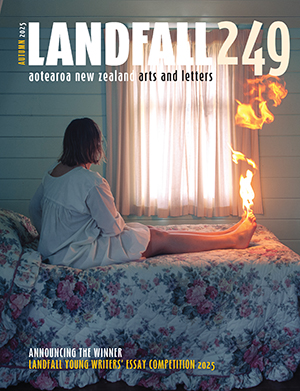
Landfall 249: aotearoa new zealand arts and letters
Autumn 2025, ed Lynley Edmeades
Otago University Press
Sometimes I pick up a literary journal such as Landfall and dip and dive in over a few weeks, but today I have decided to read it cover to cover. Yes, today I have booked myself in for a Landfall road trip, sundried-tomato muffins in the oven, oatmeal coffees lined up. The journal has been in existence for almost 80 years and maintained its consistent dedication to writing in Aotearoa New Zealand. I know my road trip will include poetry, nonfiction, fiction, art and reviews.
First up the spellbinding artwork on the cover: Tia Ranginui’s ‘Cold Feet’ (pigment ink on Hahnemühle Photo Rag). It’s a taster for the sequence inside, a taster that moves both symbol and personal narrative into a zone of extraordinary wonder. I am hooked.
The issue includes the winner of the Landfall Young Writers’ Essay Competition 2025, selected by Landfall editor Lynley Edmeades. Her judge’s report signals the record number of entries this year and offers a fascinating snapshot of the engagements and anxieties of young writers. The winner, Ava Reid, resists attempting to tell us how the world functions, choosing instead to use the essay as a space “for trying to work things out, to notice and to try to make sense of the world”. I love the essay, and am already sidetracked into slow travel reading, musing on the attraction to flotsam and jettson, discarded objects, those inherited, excavated, misplaced or abandoned. Ava is musing on the back story to the ‘artefacts’ in her fields of vision. For some reason I find myself returning to a still life by Giorgio Morandi, picturing the daily clutter beyond the frame of his orderly compositions. It is writing at its most sublime.
What if I were to write a tiny poem, a sweetly arranged still life where I show you the green leaf on the wooden deck, the wet pattern of winter rain, and then abruptly pull you away into a clamorous narrative beyond, that may or may not be true.
Let’s turn the page and absorb the volume of a vegetable in Rhian Gallagher’s sublime poem, ‘Potato’, crossing a bridge between Dunedin and Donegal, a father memory, the layers of soil as pungent as the layers of narrative held beyond the frame of revealing. On the opposite page, Rhian’s ‘Early Autumn’, is equally rewarding. wondering how place is also a narrative harbour, past and present. The listening, the observing, the recalling. Rhian writes with both economy and richness, thought and feeling, an autumnal view a hub of beginnings and endings and beginnings. I am backtracking back to reread Ava’s essay.
A duet of poems and I have pulled into a roadside cafe to linger, knowing Landfall is not a single day excursion for me. I am stalling on Ariana Tikao’s haunting lament, ‘Te Tārere a Hikaiti’. Then Riemke Ensing’s moving eulogy for Vincent O’Sullivan, ‘Blue’. Her final lines glue me to my chair. You need to read the whole poem.
No getting away from it. I am slow traveller whether reading or writing or blogging. I need a week at least to read this treasure-trove issue. I need to be taking side roads and overbridges, relishing pools of thinking, skipping to familiar voices, sparked by those new to me. Jodie Dalgleish’s ‘Skin-Water-Skin: Repeat’ is like fertilised word buds bearing incredible aural rewards.
Landfall is shaping up to be a perfect road trip – a plethora of surprises, points of wonder, comfort. I am a big fan of Wes Lee’s poetry, so what a delight to read ‘December’. It’s physical, it’s rich in absence as much as presence, it’s symbolic and so utterly fluent.
And then I pull into another cafe diversion where laughter is on the menu. Alistair Du Chatenier’s ‘But Will It Fly’ is a tongue-in-cheek poem that takes us into Bill Manhire’s workshop where he is building a flying saucer (a surrogate poem?). Ah what you can create from shredded journals and anthologies.
Oh and now it’s Zoë Meager’s ‘it one was one of those nights’, a prolonged moment of reading that hooks you with its opening words ‘when the moon kept getting out of bed just to have a look around’ and then upturns you with its final revelation. Ooh.
I am having overnight stays in the work of the two artists in the issue. Eliza Glyn’s contemporary gouache paintings offer table settings: a gathering of objects in muted colours, verging on the kinetic, with a hint of Cubism, Frances Hodgkins, a daily diary, a closely packed huddle of predilections, angles askew. I love them.
The cover artist, Tia Ranginui’s work forms a sequence entitled ‘Ahi Teretere’, with the title referencing the flickering flame. Her work I read, “plays on the complicated and nuanced emotions provoked by returning home, particularly the artist returning to her papa kāinga on Te Awa Whanganui”. She navigates both ice and flame, as she seeks home with both embrace and defiance, a hunger for warmth, and with the help of her daughters who appear in the artworks. Extraordinary.
I toast this issue. It inspires me to keep reading writing blogging looking art. Planning road trips, within the pages of books and out there in the real world. Thank you.
Lynley Edmeades is the author of two poetry collections, As the Verb Tenses (Otago University Press, 2016) and Listening In (Otago University Press, 2019), and a poetry and art picture book for adults, Bordering on Miraculous (Massey University Press, 2022), in collaboration with Saskia Leek. She has an MA in creative writing from the Seamus Heaney Centre for Poetry at Queen’s University of Belfast and holds a PhD in avant-garde poetics from the University of Otago. In 2018, she was the Ursula Bethell Writer in Residence at the University of Canterbury, and she currently teaches poetry and creative writing on the English programme at the University of Otago.
Landfall page
 NZ Poetry Shelf