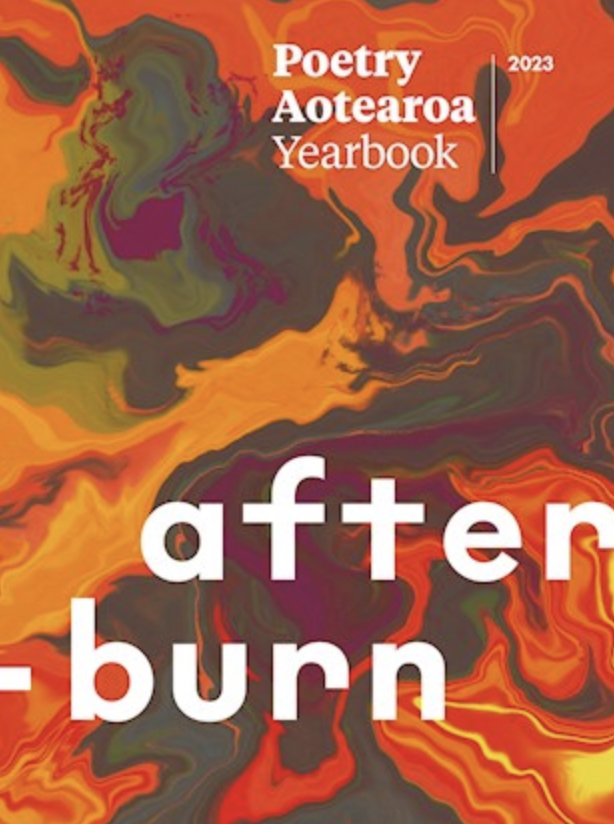
Poetry Aotearoa Yearbook 2023, ed Tracey Slaughter Massey University Press
Every day I point at something and ask how long has that been there and you always say forever.
Jane Arthur from ‘The Sky Is Bigger’
Reading poetry journals can be a prismatic and extremely satisfying experience. You reconnect with voices and familiar and discover those you want to read more of. Every time I dip into the latest Poetry Aotearoa Yearbook, I find different sparks and different connections.
Tracey Slaughter’s editorial got me musing on the way a poem is a form of “space”, which implies there is room to gather dialogue, connections, to be engaged in multiple ways, to be maverick and toastmaster, bricoleur or archaeologist, to harness profound or fleeting rewards. Tracey writes:
A poem is a space of encounter, a room of language that invites us to move our senses over its living surfaces, to brush our bodies against its echoes and pressures, visual, sculptural, sonic.
The new issue presents a generous gathering of poems, several essays and substantial book-review attention. Each issue features a particular poet, and on this occasion, Tyla Harry Bidois. Tyla is a Jewish author, illustrator and musician from Mt Maunganui who is interested in notions of womanhood and mixed race cultural identity. Her poetry is sharp edged, on sensory alert, word conscious, drawn to consumption and explosion. Wound and wounded, cuts and cutting, blood red strata, are an insistent refrain as you read.
Here is a tasting platter of my reading so far:
Brecon Dobbie’s “Chinese Medicine” underlines how a poem, through the power of anecdote, can be physically, poignantly and sensually present. Ana Maria King’s ‘nana’s kai’ is a feast of aural and visual richness, with a sublimely haunting ending. Danny Bultitude’s ‘A Town Between Two Highways’ and Cadence Chung’s ‘postcard’ satisfy on so many levels, especially the deft hook of rhythmic detail. essa may ranapiri’s ‘@hine: They never were don3 up like that’ electrifies. Jayne Ault’s ‘William II’, Victor Billet’s ‘Your move, again’ and Claire Orchard’s ‘Floral wallpaper’ pull you into enigma and the unsaid. Emma Neale, with characteristic musical flair, pulls you into a moment achingly real. Hebe Kearney’s ‘december 20th’, addressed to Carl Sagan, gets you musing with its offbeat links. With John Allison’s ‘How to sing sun light’, it is the way light catches you and drives the poem. Khadro Mohamed’s ‘Liars’ is unfolding mood that pierces, sharp and breathless. Melinda Szymanik’s ‘You are the reason you don’t feel better’ strikes a chord both political and personal. Tessa Keenan’s ‘Ōākura Beach’ refreshes the page, the glorious gap, the magnetic space between this noun and that noun, this verb and that verb.
The wind tucks its fingers into the space between an ocean and a home. I see it slide through the people I’ve imagined. It whispers an imperative.
Tessa Keenan from ‘Ōākura Beach’
Poetry Aotearoa Yearbook underlines how poetry is a glorious ripple effect across the length and depth of the country in contemporary settings, from the merging voice to the well established. The journal offers a space of encounters that is rich in scope and possibilities.
It’s winter Mid-July But I woke this morning with blooming palms and fruit trees bursting from the grooves of my spine.
Khadro Mohamed from ‘Liars’
Tracey Slaughter teaches creative writing at the University of Waikato, where she edits the journals Mayhem and Poetry New Zealand Yearbook.
Wairua: What is mauri? Mauri: Life force. Wairua: What is life force? Hinengaro: Is it like kinetic energy making the earth spin and the tides sway? Wairua: Or more of a latent energy, hard wired like a solar powered chip in your neck that still has the little plastic tab in it? Hinengaro: Or like a golden aura that floats around you, preventing your soul from bouncing into the ether? Wairua: Or a kind of tattoo that identifies you, like a rainbow fingerprint, in case the gods need to catalogue everyone quickly? Mauri: Mauri is an indigenous concept that connects all living creatures in a tapestry stretching through time. Wairua: So, a lycra. Mauri: But like, organic lycra.
Converngaro #898
Hinengaro: Good god please, won’t some empathetic politician prohibit factory farming finally making it illegal to squash animals into small awful spaces. Mauri: Excepting any owner who lives in the same sized cage. Wairua: Nice Mauri: I take it you’re going to sign petitions but you’re not personally going to be shifting away from meat then? Hinengaro: I could give the faux sausages a go? Wairua What a champ. Mauri: Yeah, that’s like barely on the board. Hinengaro: What board? Wairua: She means you can barely call yourself a Papatūānuku ally with that one. Hinengaro: What if I trade red meat for white? Mauri: And she’s off the board again. Hinengaro: How can I live without ice cream and cheese! Wairua: Yep, this one’s gonna need trickle down change.
Miriama Gemmell
Miriama Gemmell is a poet from Ngāti Kahungunu, Ngāti Pāhauwera and Rakaipaaka. Her kupu can be found in Awa Wahine, Te Whē, Sweet Mammalian and Landfall. In another time, Miriama was an English teacher in Kuwait, Kazakhstan and China. She currently lives in Ahuriri with her hoa rangatira Richard, and tamariki James Rewi (9) and Hana Tirohia (6). Miriama washes yoghurt pots and feels closer to her tīpuna.
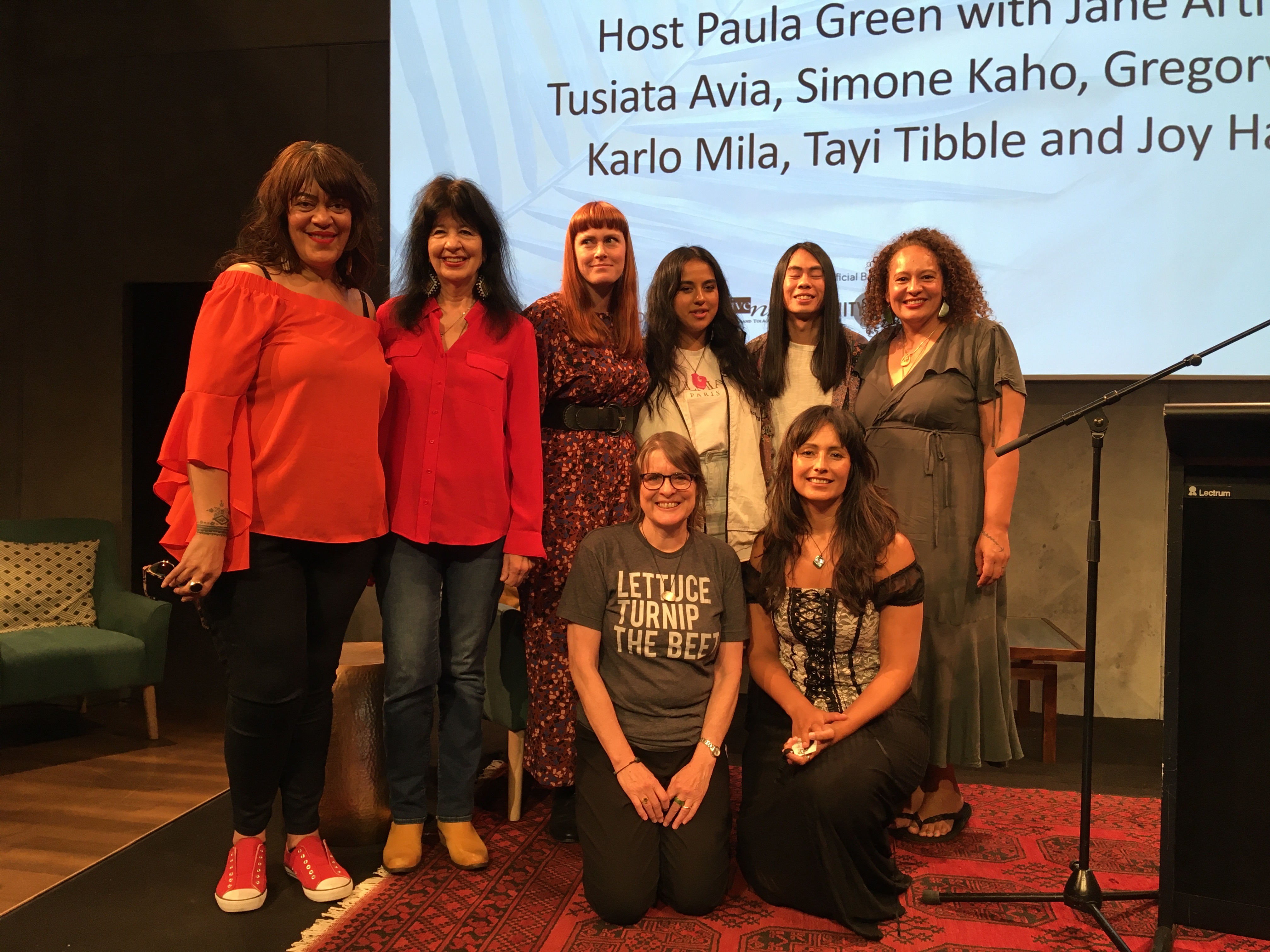
Poetry Shelf Live at VERB Festival: Paula Green with Tusiata Avia, Jane Arthur, Simone Kaho, Gregory Kan, Karlo Mila, Tayi Tibble and and special guest, US Poet Laureate Joy Harjo. Te Whanganui-a-TaraWellington, March 2020
Towns and Cities is an ongoing series that features clusters of poems with Aotearoa urban connections. I have started the series with the Kāpiti Coast and Te Whanganui-a-Tara Wellington because I have lived here on a number of occasions. I started primary school at Petone Central, and spent most of my twenties flatting in Central Wellington, Wadestown and Pauatahanui. Wellington etched hills, harbour and sky on my skin in ways that have stuck to me though London fog, Whāngarei’s tropical rain and the insistent pull of Tāmaki Makaurau Auckland.
Yet Wellington is not just iconic views: it is people, friends and family, creative communities, must-visit festivals, the buzz of books and performances, the delights of Cuba Street, excellent coffee and food, the Botanic Gardens, Tinakori hills, the lure of Kāpiti’s glorious coast. And yet always I return to the tug of hills, harbour and sky. I started with a handful of poems and soon the list felt like a potential book! An imagined book that steps off from Gregory O’Brien and Louise White’s inspirational Big Weather: Poems of Wellington (Mallinson Rendel, 2000) to form another tasting platter of new and familiar voices. The Wellington Writers Walk, and the accompanying little booklet you tuck in your pocket as you go walking, also comes to mind.
My tiny gathering of poems is not so much about Wellington as offering whiffs of place – at times, an anywhere place that may or may not have hidden attachments to Wellington’s coast and city. A fascinating particular is as important as a wider view. A memory, an experience, an imagining. There are so many more poets I could have included, sought permission from, poets who are living or have lived in Wellington, poems that would add dimension and life to a whole book. Ah, this is my first stop on my Aotearoa road trip. I am loading my bags and moving onto the next place!
Special thanks to those poets who contributed a poem. Please note one poem has a suicide reference.
I look forward to posting further clusters over the coming months. This has been a wonderful excursion to a city I love dearly – the last time I was physically there, was for the VERB event I hosted, just before lockdowns, pandemics and floods. It was a special occasion.
The poems
In our town
Sometimes I think you have to have a past to live in our town. Although some people move here because they think it’s a good place to raise children. Everyone’s past is different of course, like their dogs. The silent ones that sit and watch you, the ones that rush up to strangers and bark at them. When I picture the people in our town I see them walking the quiet streets or sitting on their verandahs, side by side with their pasts.
Alison Glenny
Angry Man
He has three barking dogs in the back of the car, old Silas and . . . I don’t know the others. He has parked the car up over the kerb outside the library and is standing nearby, waiting to see what will happen.
But nothing happens. He stands there all day and the dogs fall asleep, and he opens the car door and now the moon and stars are out in the sky and here is the light by which his children read their books.
Bill Manhire PN Review 265, May-June 2022
fermenting plums
We had become North Islanders and it felt weird, as if we had absconded to the other side, where mountains and blond grass had been replaced by arum lilies and nikau palms, where after rain, we could smell aniseed from wet feathers of wild fennel on stop banks.
We lived where the sliding shuttle of units into Wellington passed between the motorway and the golf course, rattling along the back of our section, the barrier arms’ ting-ting-ting a constant fret as commuters glided by fast enough not to see us through the branches of the plum tree,
eating toast and drinking instant coffee in our pastel-coloured, formulaic, wooden M.O.W. house at No. 2, living within our means, paying off a light-brown Vauxhall Viva Estate we could sleep in the back of, at Lake Wairarapa or on trips back south, by Lake Tekapo. There, in the north, our life was measured by the arrival of three babies
in four years, by the words from L.P.s borrowed from the Lower Hutt library; Badjelly the Witch, Buzz-o-Bumble and Grandpa’s Place, by the summer sizzle of cicadas, the mumble of magpies, the query of starlings on power lines, as we swayed on a hammock strung over a lawn so covered with the burgundy skins
of fermenting plums, the very air smelt like red wine. There, with a car port, a mail box, red geraniums, rotary clothes line, 2nd-hand flymo and the slow, old Hutt River at the end of the road; there on the other side of the Pomare rail-bridge; we lived, happily bunkered down right on the fault line.
Kay McKenzie Cooke
on Paekakariki Beach
night
like a watercolour print
with a smudge of misty cloud
soft rain falls
lines of waves trail like ribbons into the darkness
around the throat of the sea
the lights of Pukerua Bay and raumati
burn like cigarette stubs
‘we’ve had two youth suicides,’ she says
there is meaning here
moonlit leaves lap the wind
Apirana Taylor from a canoe in midstream, Canterbury University Press, 2009
walking to book club
early, even after looking at silverbeet through the community garden fence,
after breathing jasmine air near houses painted gold and cornflower blue,
on streets where a Shirley Barber fairy might guide lost rabbits home by the light of her bluebells,
I saw a man lead a small girl and her pink bicycle through a latched gate,
past a front-yard lemon tree and into the waiting arms of a woman
who steered her inside then turned back to the man, her face blooming as she held his
Leah Dodd from Past Lives, Te Herenga Waka University Press, 2023
Hills
Who put the el in the word world, changing things forever?
It must have been later: not in the beginning.
An old woman perhaps
in the days before writing when words dwelt in the body
resting her tongue a little sooner than usual, by chance and lovingly, on the roof of her mouth before sounding the d that is always ending the word word.
The roof of the world appeared. All along the horizon. Layers and layers of hills, lovely and potentially touchable.
Dinah Hawken from One Shapely Thing: Poems and Journals, Victoria University Press, 2006
Percival Street
The window is all harbour and clouds a tall house teeters between city and terrace with a thousand dark rooms and a thousand light windows the long kitchen table ingrained with rebellion and utopia the turntable plays Joni Mitchell’s Blue Doris Lessing is open next to the blue notebook, and even the wide open sky bulges with blue thoughts.
The little girl is back on Petone’s waterfront catching her father’s sermons the school windows out of eye reach. I am walking up the steps to get to the next set of steps and nowhere opens puff-breath somewhere, and then it’s back again to puff-breath nowhere, with long hair drifting, long skirt swishing.
Paula Green
Māori Uniform
The event is at Te Papa / it’s about wāhine Māori / there might be a karanga / should probably wear a skirt / I guess it should be black / I know / I know / that’s Queen Vic’s jam / but it’s just how we roll / it’s uniform.
What do urban Māori wear to something like this? / Yeah, it’s on the marae / but it’s Whiting’s whare / rules are guidelines / there’ll be Nannies there / nothing too boobie / if I wear a skirt I’ll have to wear stockings / Nan would kill me if i didn’t / it’s Māori.
Black jeans / rebel / but I’m wearing a tunic / technically it’s a top / but it’s long enough / to cover my teke / I couldn’t wear that dress / it clashes with red / lipstick / blood red / contrast against pounamu / pop / that’s the best part / uniform.
Nicole Titihuia Hawkins from Whai, We Are Babies, 2021
from Thirty-Three Transformations on a Theme of Philip
7.
Coming down off the spine of the botanical gardens onto the green flank of the dragon, shadows arch
under my feet. In the dell below, the shell-shaped stage is strewn with red camillias. November
and across the valley on the dense dark Tinakori Hill houses begin to light up like Guy Fawkes.
At the top of Patanga Crescent the pared-down villa trembles with young men thinking,
pens lost in the wide sleeves of their dead uncles. They are ecstatic and do everything extravagantly
in the last light: read, drink, fuck. On the windowsill – a stone, a leaf, a twig with buds,
and the black cat left behind mewling by the old lady now in the Home of Compassion. No change.
Anne Kennedy from Moth Hour, Auckland University Press, 2019
City Living
Two middle-aged goldfish tirelessly circle their tank
In the bars on Courtenay Place twenty-somethings text each other
Apartment-dwelling cats eye the trolley buses below
I cooked chicken for dinner but you didn’t come home
The beautiful open window admits moths, as well as air
Janis Freegard from An Exchange of Gifts, A selection of poems and haiku from the New Zealand Poetry Society’s International Poetry Competition, 2001
Wellington peonies
December 2020
There are gushy peonies outside the florists’ door. Don’t you just want to push your face into them? the florist says which is a kindness because I am already pushing my face into them.
So petalled. So inhabited. So pink. And bunched together in a zinc bucket like something cheaper, less luscious, more ordinary.
Mrs Dalloway said she would buy the flowers herself. Netted by light and breathing rivery London air. Oh to blossom into invisibility! To walk through the uncanny narrow glade between buildings, that sudden temperature drop. To see people in long coats at the bus stop undulate in late spring wind, like kelp forests.
Bliss. Katherine Mansfield has Bertha arrange green and purple grapes on a long, glossy table. Bertha is in a sudden ecstasy for a life she is about to lose. Of course, she doesn’t know it yet. She thinks only that the purple grapes bring the carpet up to the table.
Lynn Davidson from The Incompleteness Book II, Australasian Association of Writing Programmes, Recent Works Press, Canberra, 2021
The Simple Life
In this city you can be whoever you want and I’m still so much myself it’s disgusting
nothing else fits, nothing is comfortable, I just want comfort, I want, I want
poorly-aged fish-out-of-water celebrity voyeurism to remind me living can be so, um, uncomplicated
there’s nothing left for me here except reality sleep demons waving performance plans
mandatory psychometric pub quizzes where every answer is a ghost you’ve buried
and every competitor is an auditioning persona each more insufferable than the last
waving from the bar, shouting strangers shots dominating the karaoke machine
blowing each other in the bathroom scared of being wiped away like a bad pour
let’s show them all we can last, we can join a startup incubator as endurance art
double our screen time as endurance art develop imposter syndrome as endurance art
collectively dissolve into the void to protest my own expectations, but it’s alright,
I’m still a thing with a beginning, somewhere to return to, paddocks, bales and sheds for miles
I’ve got my roots, my boots and shovel. I’m ready to uhhhhh… work the soil… You hear that, soil?
no one is ready for this man of the earth, pulling up the best version of me, no one has seen a body so tireless
I mean tired, so tired, lying in bed, Amazon Prime night-light Paris and Nicole crawling out of my laptop screen
wet with manure and static, a weighted blanket of hair extensions smothering me soothing me
as I disappear into a peroxide swaddle, blonde follicles entering every orifice, kneading my brain making me happy
to disappear as they tell me I’m not cut out for this tell me sssshhh who’s a good boy? Who tries on the remains of others?
tell me to rest easy, and be comfortably forgotten
Jordan Hamel from Everyone is everyone except you, Dead Bird Books, 2021
Sunset
Low over Tinakori sky The west droops on the town. What if on Tinakori The blazing sky fell down!
Would all the folk float golden Like rocking fleets of Tyre, Or would they, felled by wonder, Fall wound in cloth of fire.
Eileen Duggan from New Zealand Poems, George Allen & Unwin,1940, also in Eileen Duggan: Selected Poems, Victoria University Press, 1994
Ode to a gallery on Ghuznee St, Te Aro
for Jenny Neligan and Penney Moir, on the fortieth anniversary of Bowen Galleries
A window, a corridor and a room. And beyond the well-furnished footpath
the No. 21 to Karori, the No. 18 to God-Knows-Where. Bowen Galleries, you are also
a form of public transport, taking us beyond ourselves and this valley of dry bones
and cellphones. You are a jewel by Warwick Freeman, yet rustic as a Jeff Thomson construction. You are
the wind blowing through a Wellington pedestrian as painted by Euan Macleod. Your stable of artists
might be more accurately described as a menagerie by Jo Braithwaite. Bowen Galleries, to whom exactly is it
you belong: to the homely and the homeless, the homeward bound; the vapid and the vapourised,
the self-made and the unmade, to the painter Geoff of Dixon St, the tangatawhenua of Te Aro,
pigeon-footed, sparrow-like. To the parking wardens and night cleaners, to the gallery regulars
god bless them. All here gathered beneath an inversion layer of aromatic coffee
from the fine roasteries of Ghuznee and Cuba, ‘the convivial hour’ overseen by high court judges and caffeinated
babies in prams; clouds and the otherwise upwardly mobile. I remember your street frontage as Maiangi Waitai’s universe interwoven
with angels, Hariata’s spirit world. Their otherworldly light you share with pedestrians and electrified cyclists, stray dogs, a cat up a cellphone tower
and the Slow Boat from Cuba, laden with Brooklynites and Mount Victorians. And the adjacent traffic
of whales in Cook Strait—fellow voyagers like you. It is upon all of us your window
casts its ever-youthful, restorative light. Early evening. Like you, we were
young once—like the greyhound pup sleeping on its rectangle of sunlit
pavement. Here at the round earth’s imagined corner, you are an ode
to the street laid out before you. On the side of the newly born, not
the dog at the wintry door, you have survived three National governments, a double murder
a few floors overhead in Invincible Building, crashes of sharemarket, quakes, pandemic…
Open all hours. Room, corridor and this window into which we peer, and which in turn
watches over us. Window, corridor, and room beyond, if your walls
had wings where would they fly? If your walls had wings. But they do.
Gregory O’Brien
The river bears our name
As the sun eases red over Pauatahanui You stand alone at the Huangpu River Layers of dust catch in our throat The water is brown with years of misuse
You stand alone at the Huangpu River Your card lies still open on the table beside me The water is brown with years of misuse I write out your name stroke upon stroke
Your card lies still open on the table beside me A white ocean breeze slaps at my face I write out your name stroke upon stroke My hand is deliberate like that of a child
A white ocean breeze slaps at my face You are more fluent in a foreigner’s tongue My hand is deliberate like that of a child I lick the sweet envelope, seal up my word
You are more fluent in a foreigner’s tongue The heat of exhaust swallows your breath I lick the sweet envelope, seal up my word I know you will tear it, one trace of your eyes
The heat of exhaust swallows your breath Layers of dust catch in our throat I know you will tear it, one trace of your eyes As the sun eases red over Pauatahanui
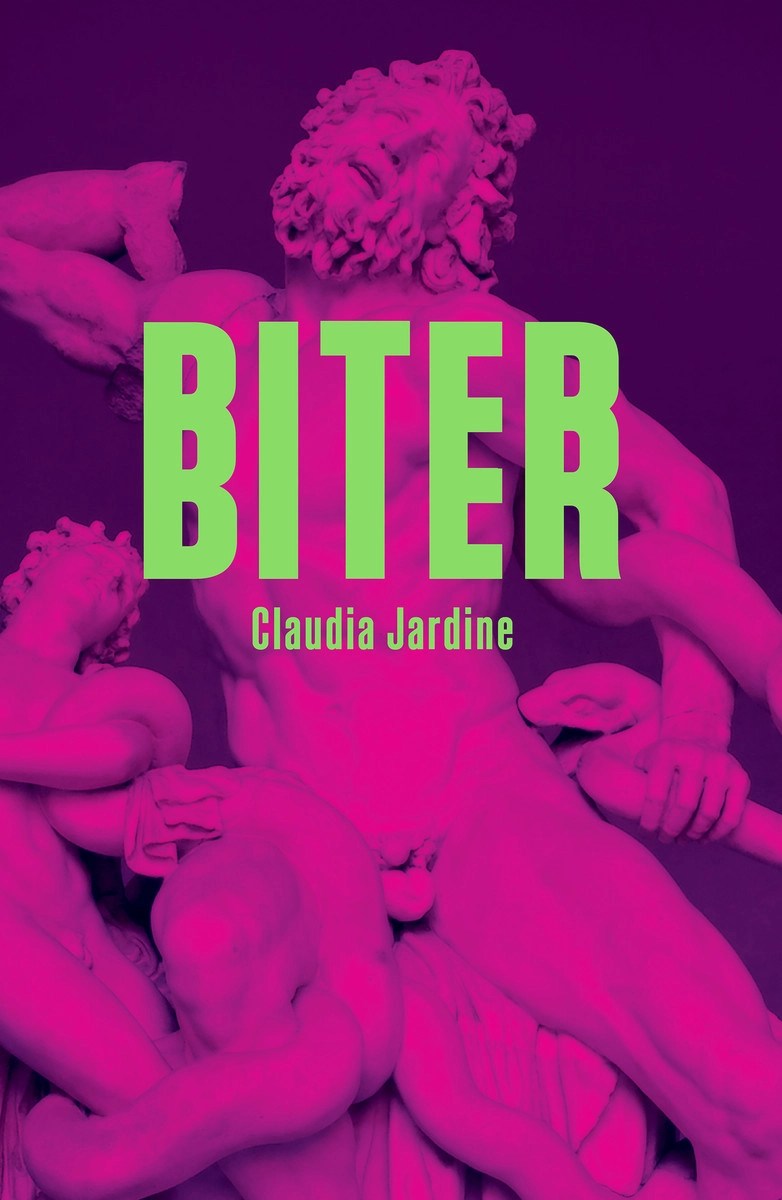
Poetry Shelf readings is a new series that celebrates recently published poetry collections with an audio performance. Claudia Jardine’s sublime debut collection, Biter, is published by Auckland University Press, April 2023. I will be posting a review of the book in the coming weeks. In the meantime take a listen:
‘Palatine Anthology Translations’
‘Passing Comment’
‘Power Cut at Hotel Coral’
Claudia Jardine has an MA in classics with distinction from Victoria University of Wellington, where she won the 2020 Alex Scobie Research Prize and a Marsden Grant for Masters scholarship. Her first chapbook, ‘The Temple of Your Girl’, was published in AUP New Poets 7. Her ancestors are from the British Isles and the Maltese Archipelago, and she lives in Ōtautahi.
Leicester at Millerton Absence of rapids on Ngakawau stream. Big Ditch and Little Ditch Creek – impious hand bisects the ‘D.’ Cobweb of raindrops in dragon sun. “Down, down, down from the high Sierras …” Electrical storms: intensity of affect. Fund-raising at the Fire Depot. Grey & white kitten, black robin, and black fantail. Huffing into an Atlas stove. “If you can see the hills, it’s going to rain.” Jack said: “A succession of inner landscapes.” Kiwi peck through sphagnum moss. Leicester said: “A community devoted to male play.” Millerton speaks – A Cannabis Landslide. Nature tips – gorse is choked by bush. Other landrovers get one wave. Proud grey donkey; manure in a sack. Quarrelling over the Fire Service. “Rain has a persistency of grades, much noted by the locals.” Siren: “I’m always free on Wednesday nights.” Twin side-logs set for smoke-alarms. Utopia St, Calliope Rd. Village hall stained with camouflage paint. White-packaged videos, too frank a stare. X of three rocks marks one rare tussock. “You have to say: Great! Awesome! Choice!” 668 – Neighbour of the Beast.
Jack Ross (10.7.98)
Note on poem
As a kid, I spent a good deal of time poring over the works of Edward Lear. I did like the limericks, but it was his illustrated alphabet poems that really tickled my fancy. This was my first – and to date only – attempt to compose one myself.
It records a visit I made in 1998, some 25 years ago now, to my friend the Rev. Leicester Kyle, who was living at the time in Millerton, a small bush-clad town on the West Coast of the South Island. Millerton is quite a mysterious place (or it was then) –very much off the grid. It was, however, the rather deadpan commentary on its inhabitants and traditions delivered by Leicester as we navigated its narrow roads in his bright red Land Rover which was the real prize for me.
I found myself jotting down some of his more quotable comments and thoughts, along with a few of my own observations, and ended up grouping them in this way to reduce the information overload I felt overtaking me at times.
Leicester himself was a fascinating character. He started off as a botanist, was then ordained as an Anglican priest, only to convert in his late fifties to a new faith: poetry. After his death in 2006, my friend David Howard and I collaborated on an online edition of his collected works which can still be consulted here.
The poem first appeared in a small magazine called Spin [#36 (2000): 51], which I was co-editing at the time. It was described in a review of the issue as “languid and oddly themed,” a tag I’ve always relished. I’ve often thought it could stand as an epitaph for most of my work.
Some ten years ago I used it as the title poem for my collection A Clearer View of the Hinterland: Poems & Sequences 1981-2014 (Wellington: HeadworX, 2014). The publisher, Mark Pirie, was kind enough to include it on his website as an incitement to purchase the book.
I still have a soft spot for it, I must admit. It brings back many memories of those times: of Leicester himself, of the wild West Coast, and the kindness of the people I met there. It makes me feel like jumping in the car right now and heading straight down to Buller and Karamea to try to locate some of the overgrown industrial sites and hidden green havens my friend revealed to me then.
I fear that it might have to be a journey through time as well as space, though. Much of the Buller Plateau has been devastated since then by strip mining.
Jack Ross (14.4.23)
Jack Ross’s most recent book is The Oceanic Feeling (2021). Last year he retired from his job teaching creative writing at Massey University to pursue his own writing fulltime. He lives with his wife, crafter and art-writer Bronwyn Lloyd, in sunny Mairangi Bay, and blogs here.
Favourite Poems is a series where a poet picks a poem from their own backlist and writes a short note to accompany it.
It is a rich, special evening, unexpectedly meaningful. We’re a community of six, nested together by the depth of our experiences, the age we are, the years we’ve lived through, and this particular year 2020 that has clarified what’s important to us: optimism, love, the deep meaning behind the apparently mundane. This is what matters. Our families are safe, for now anyway. We’re sitting in a circle of friends with whom we don’t have to explain ourselves. None of us knows what even the next day might bring to any of us. But tonight we’re here.
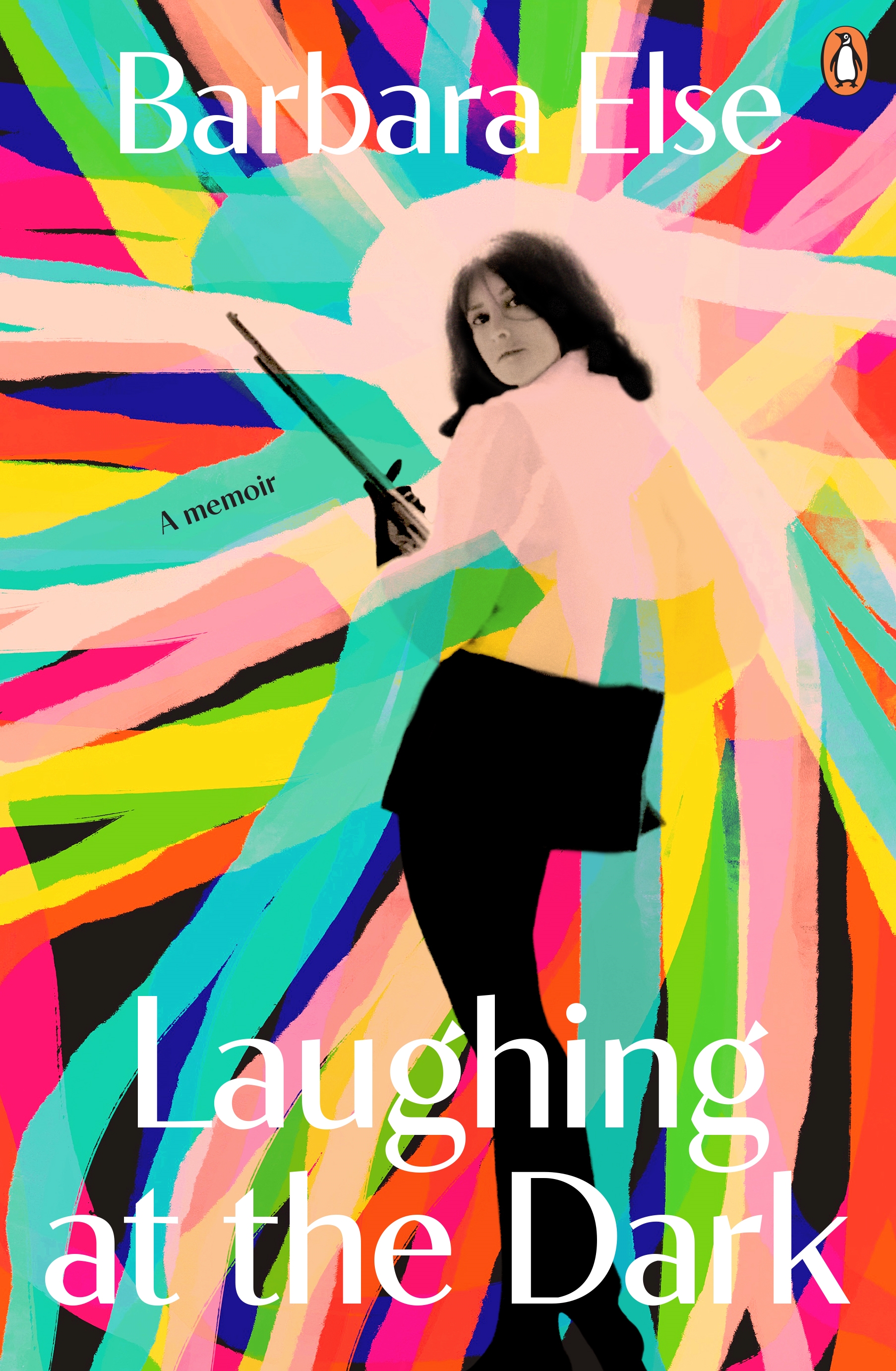
from Laughing at the Dark
The threshold of Barbara Else’s memoir, Laughing at the Dark, has me pivoting on notions of dark. Great title! I am skating from imagined childhood dread to personal challenges to the beauty of night to incongruity. When I close the book, having read it over the course of a weekend, I am savouring the final page. It describes an intimate poetry reading on National Poetry Day 2020, a time when public events were prohibited. Barbara is in her “community of six”, reading poems, sharing nibbles and drinks. I step from this exquisite moment into the glaring light and dark of my own world. It resembles stepping from cinema dark into the glaze and blare of a city street.
I loved reading this book, I feel completely wrapped in its unfolding disclosures, the fluent writing, the accumulation of personal connections. It is the first time I have read a memoir where I know some of the people, in this case two daughters, having walked along Te Henga’s black sand talking life with Sarah on many occasions, and having sat in cosy Dunedin cafes with Emma, also talking life. I bring to my reading the way Barbara’s imaginatively dexterous Travelling Restaurant series inspired me as a children’s author. The delight I felt when she was awarded the Margaret Mahy Medal for her services to children’s literature (her novels, her numerous anthologies, her agency and assessment work).
I cannot think of another memoir that has formed such poignant bridges between itself and my own life. There I am, back in a London lounge sitting for weeks and weeks, scarcely able to move, knowing I had to become a writer, and there I am, walking out for good into the dark night, parking under a London streetlamp, the street gleaming wet, every physical detail film-noirish, knowing I could not wait until I had had babies and bought a house with my unfaithful partner. This searing recollection makes Barbara’s narrative all the more acute, her writing fluency bringing me deep into the intimacy of her “dark”.
At a young age, Barbara falls in love, gets married, has babies, is a dutiful wife and follows her husband Jim wherever his medical studies, research and work pull him. This is a memoir of “becoming”, of becoming mother, writer, lover, woman. It is written in the present tense, an intricate and satisfying layering that renders each scene so much more powerfully. To say “she is sleeping” has far more semantic possibilities than the done-and-dusted “she slept”. I move between the present tense of the past and the present tense of the woman writing. She is at her keyboard, reflecting back, retrieving and censuring, highlighting and considering, but she is also facing a serious health issue. She is undergoing radical cancer treatment that leaves her fatigued, with scant appetite and joy in food, plagued with despair. She has shelved her next adult novel, picked up the bare bones of the memoir and, as she can, finds energy and focus to write. I am reminded of Michele Leggott and Sam Neill who have also faced tough cancer treatment and found writing solace in the littlest nooks and crannies, in the potent dark and restoring light. As I do too.
More than anything, the memoir affects me along the intricate threads and resonances of women “becoming”. The women’s lib movement in the 1960s and 1970s re-defined how, what and who a woman might be: in the kitchen and out in the world, perhaps as mother, writer, engineer, politician, doctor, rugby player. Barbara acknowledges Fiona Kidman, poet and fiction writer who debuted as a writer in 1975.Many women, like Barbara, were affected by Fiona’s groundbreaking example; women could write their own subject matter, in styles and plot structures of their own choosing, foregrounding the domestic world, an ordinary world if they chose and, above all, representing the lives and desires of women. It become very clear from this time forward that there was no single model or recipe for rebellion, for being a woman. Barbara’s memoir underlines this notion.
I am reading the memoir caught up in the entwined threads, reminded of the organic nature of being, of the way a state of becoming is alive to movement and possibility, as well as to challenge and self-doubt. Along one thread, it’s a handbook on becoming a writer, not dogmatic but provisional, on negotiating rejections and acceptances, on being both visible and invisible (not having ones’ books on a festival stand!), the thrill of speaking at festivals, the nourishment of doing writing courses, being in a writing group, having friends, peers, mentors and family. You get to follow Barbara’s progress through her choices and her experience of writing in a private unpublished testing-of-the-self setting to existing in the public arena, much awarded, widely published and sold, and notably esteemed.
Barbara’s story touches upon the stories of how many women have undone the shackles of thinking and being defined by men. This is her unique story but it will resonate with many readers. It is a story of rebellion and courage, of listening to one’s inner voice and finding ways to make the interior dream a physical and intellectual reality. It is a story of empathy and connection. I close the book, the intimate poetry reading a perfect image to hold as I make lunch, but I know we are not there yet. We are not yet fully liberated from societal behaviour that has represented and limited woman. I am reflecting back on the thought paths Laughing at the Dark has evoked: personal, literary, thought-prompting, heart-tugging. This is a gift of a book, and I am so grateful to have read it.
Barbara Else is an acclaimed writer and editor. She has written plays, short stories, novels for adults, children’s novels and a non-fiction work, and has edited collections of stories for children. She has held a number of fellowships and residencies: the Victoria University of Wellington’s Writer’s Fellowship 1999; the Creative New Zealand Scholarship in Letters 2004 and the University of Otago College of Education/Creative New Zealand Children’s Writer in Residence 2016. She was made a Member of the New Zealand Order of Merit in 2005. As a literary agent and assessor, she has discovered and mentored a number of emerging New Zealand writers, and helped establish the New Zealand Association of Literary Agents and New Zealand Association of Manuscript Assessors. Her awards for her children’s books include Storylines Notable Book Awards, Honour Awards and the Esther Glen Medal, and she has been internationally recognised at Bologna with a White Raven. She received the Storylines Margaret Mahy Medal (2016) for her services to children’s literature.
black skirts and shirts x are meant to be slimming x but the popular x taste is to show off x your belly x the important thing x is to go x against comfort x against well-being x nature x is at capacity and has been generous xx stop fretting aka x multi-tasking x to try x is to suffer and the work x isn’t only in x the evenings when x you have been blessed x with perfect reflexes x and expenses x that lend to bending xx mummy x they’ll call you which is lucky x when x you have no other name xx everyone says x it will be hard x to say goodbye x but you’ll always remember x lying looking x at the rest x of your body x the electric sensation pulsing x from x your family x tree
Louise Wallace
Louise Wallace’s fourth poetry collection, This Is A Story About Your Mother, is forthcoming from Te Herenga Waka University Press in May 2023. She is the founder and editor of Starling, an online journal for young New Zealand writers, and the editor of the 2022 issue of Ōrongohau | Best New Zealand Poems. She lives in Ōtepoti | Dunedin with her husband and their young son.
Past Lives, Leah Dodd, Te Herenga Waka University Press, 2023
last night I locked eyes with a possum its gaze moon-dark and gleaming through the bedroom window
it trying to get in me trying to get out
from “soulmates”
I am writing this review with Pink Floyd’s Ummagumma on repeat. The last time I had the album on repeat was in the 1970s. Having an album on repeat is a habit I have never discarded and it is a habit I apply to poetry collections. I highly recommend it. Leah Dodd’s Past Lives is a collection to put on repeat, and yes, it is there in a poem, the impetus for me to play Pink Floyd: “one night seventeen / got high listened to Ummagumma on repeat / then fell in a pool and floated away” (from “masterclass”).
Reading Past Lives is exhilarating, the poetry moving between the supercharged and the intimate. I have made a music playlist, a first while reading a poetry book, because the music references are so enticing: Miles Davis, Leonard Cohen, Big Thief, Joni Mitchell, Schumann, Jim Morrison, Fleetwood Mac, Nick Shoulder covering Blondie’s “Heart of Glass”, Cristina Aguilera, Shocking Blue. Throw in a youth group singing gospel songs, piano lessons, and you are in the heart of a collection steeped in music, that lifts you out of the thickness of daily routine and sets you afloat on a pool of reading bliss. Kind of like a version of high.
As I read, I am pulled between the domestic (a new baby, staying in, doing the washing, “kitchen scissor haircuts”) and the beyond: a history of reading, viewing, listening, going out, falling in love. The physicality of writing is mouthwatering, whether food or baby, whether “stale curry” or “too-bright billboards”.
in poems, babies are like snacks – doughy loaves, apple-cheeked, sweet as pie, sausage-toed
victim to the metaphor, I call my peach-fuzzed baby yummy because he is so tasty I could just toss him in olive oil and roll him into a kebab
from “clucky”
Here I go setting controls for the heart of the sun and I am back in the weave of the book. I am laughing out loud and I am holding back the tears. I would love to hear Leah read “the things I would do for a Pizza Hut Classic Cheese right now” because it is fast paced, a rollercoaster pitch of pang and laugh: “I would strip down to my knickers & slither around / on a backyard Warehouse waterslide coated / with cheap detergent on the coldest day of the year”. OR: “I would forgive the person / who hurt me when I was thirteen”. Ah, what you would do for a Pizza Hut classic cheese pizza!
Turn the page and fall into the sweet humour of conversing with the snails who insist on eating letters left in the letterbox before “shitting [them] out in long ribbons” (from “snails”). The poet and the snails get to talk TV, to talk Twin Peaks and Special Agent Dale Cooper, and what creamed corn stands for, and to ask if Josie is ok.
Put the collection on replay and you can hear music simmering in the bones of its making. This from “tether”:
I am a moonscape of blood and kitchen grit ultraviolet bone & blotted sleep one day we will be separate creatures I will give kitchen scissor haircuts tether balloons on a string to a wrist wrap birthday presents in the witching hour and become a different animal altogether
Sometimes I feel like I’m holding on with fingertips, legs outstretched, hair streaming behind, as the poem and I move along a blistering stream-of-consciousness trail and it is so darn thrilling. Take “this night’s a write-off” for example, a poem that riffs on the notion of ideas, on writing on the passion lip of inspiration where ideas get away on you. All I know is I yearn to hear Leah read this poem out loud too!
my ideas are full bunches of marigolds they are like a flock of Polish-Jew ghosts all set to haunt the local supermarket, spitting OY VEY on single-use plastic and individually wrapped organic energy bars they are like if canned meat was a person they get all dressed up in Brokeback Mountain cosplay just to sit around the house smoking and thinking about Linda Cardellini they are strong teas and dancing to Miles Davis in the kitchen
Fresh! So very fresh! That is what Past Lives is. Every poem and every line refreshes the page of what poetry can do – of how we move between what was and what is and what might be. It is bold and eclectic and full of verve. It is a single moment on the first page that sticks with you while it is your turn to hang the washing out or put an album on replay, say Lucinda Williams or Anoushka Shankar or Bach. Because there in the first poem is the way a particular moment can flip you up and over, and become poetry, and be physical and confessional and full of heart-yearn and self-awareness. The speaker in the opening poem, “soulmates”, is eyeballing a possum at the window and it as though she’s eyeballing herself. The poem is unexpected, visceral, with the unsaid as potent as the said.
Ah, gloriously happy poetry head zone! Set your sights on this book and let go. Let yourself go into the joy of reading poetry.
Leah Dodd lives in Pōneke. Her poetry has appeared in Starling, Stasis, Mayhem, Sweet Mammalian and The Spinoff. In 2021 she won the Biggs Family Poetry Prize from the International Institute of Modern Letters at Te Herenga Waka—Victoria University of Wellington.
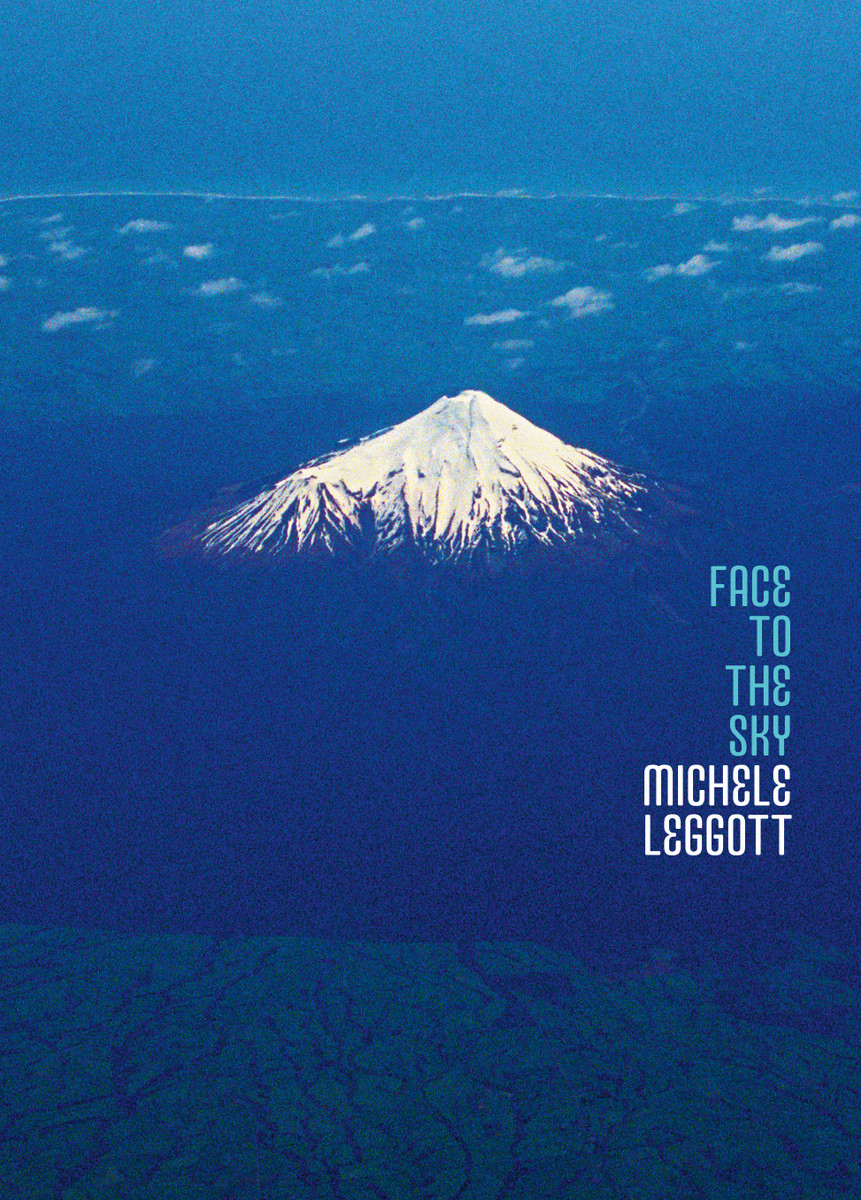
Face to the Sky, Michele Leggott, Auckland University Press, 2023
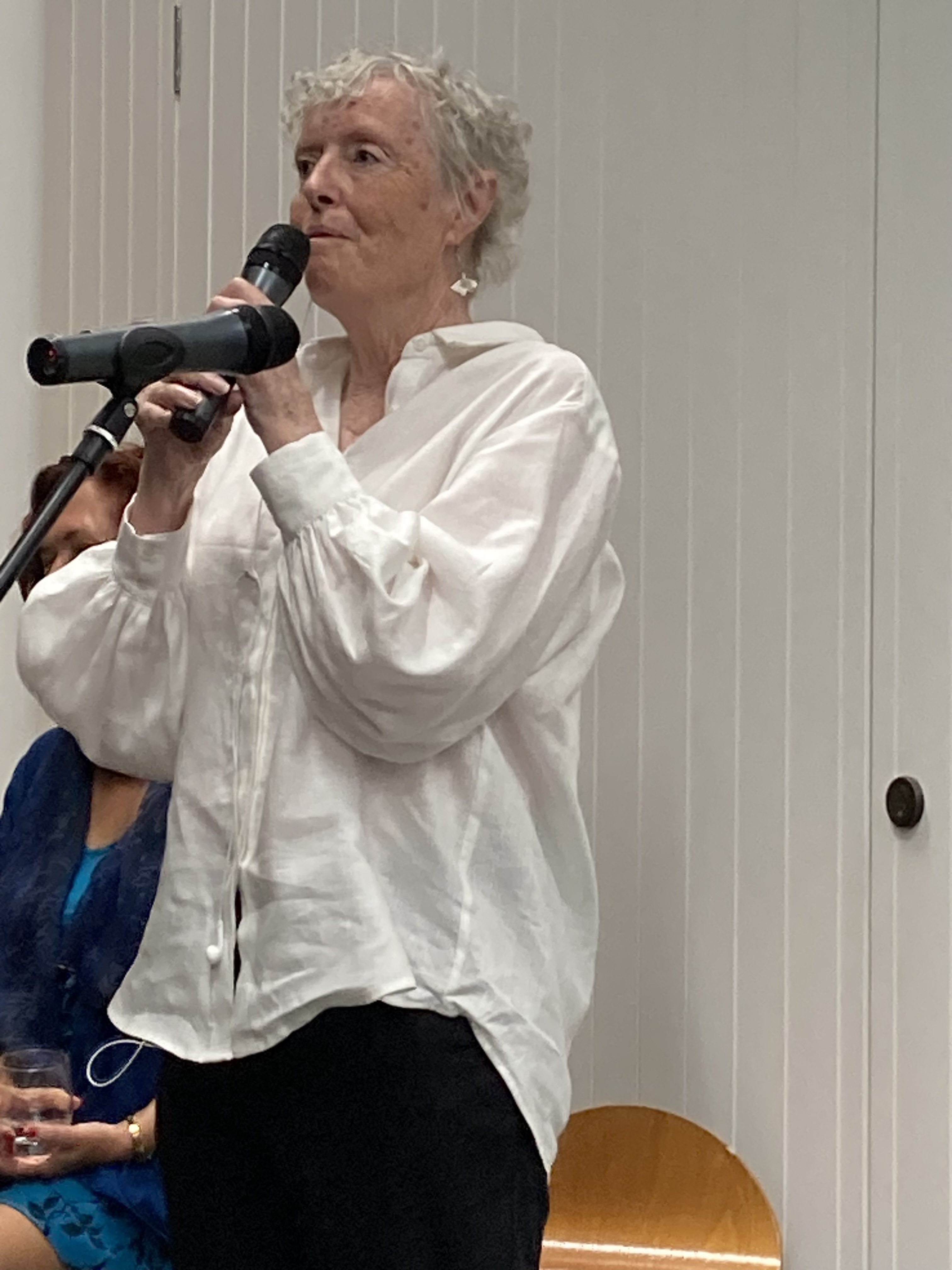
Launch talk Devonport Library for Michele Leggott’s Face to the Sky, AUP, 2023
Reading Face to the Sky is like finding oneself present at a freshly excavated site of human habitation –not in Pompeii, but in volcanic Taranaki. These poems address matters we would have believed permanently faded, or choked into silence, but here they are, the tones and colour of past lives, revealed anew – in ways never imagined.
Long-familiar monumental histories woven through with intimate scenes from daily life – the comforts, secrets, shocks and lies of family drama. And it is these intricately detailed personal narratives, which have the cumulative effect, in this collection, of making all too visible, the shakiness of the grand colonising myths in which Pākehā lives are embedded.
My family shifted to Taranaki when I was seven – Michele’s family has been resident for several generations. But even as the poems in Face to the Sky let the light into long ignored ocean vistas; forest-clearings; Taranaki dwellings; and extraordinary events – Michele’s excavations also point insistently to those yet older stories, which in this contested terrain, are waiting to be recovered.
The collection, with its delectable imagery, thematically echoes the forensic joie de vivre of Sydney Parkinson’s botanical watercolours. But equally, Michele stitches her own heretical impressions into the ‘natural history’ record. Her poems ‘give a sense of the British explorers’ utter intrusiveness – their presence made recognisable here – even in their own words– as evidence from an unfolding crime scene. One in which intrepid voyagers & travellers are paradoxically revealed as both victims and perpetrators. Michele’s reader made vulnerable in this to experiences formerly airbrushed out of our histories and herstories.
A scatter of now souvenir cartridge-cases testifies to the terror of flying bullets; the death of a negligible newborn is allowed to be a source of unassuageable grief; in the name of taxonomy there are casually merciless depredations of species; a rat runs across the children’s blanket; the photographic milestones of a beloved family are performed against the entropy of a long-vanished living-room wallpaper; two tall sons, one dark one fair, are caught in cherished meet-ups with their parents; tearing news – devastating to yet other families, unknown – is given to us of the suicide bomber at Kabul Airport; and Te Reo – yet to be ghosted – is heard, everywhere, throughout the land. While always, nipping at the reader’s heels, is the sheer inexplicability of an ongoing, near-death, health crisis.
In a series of micro-pauses centred on the heartfelt, these poems imaginatively reconnect a fearless traveller, abroad in the world, with past traumatic & jouissant events: inviting us to acknowledge, with equal fearlessness, our own buried and denied connections.
I now call on you, in defiance of suffering and disaster, in celebration of this beautiful book, to raise your voices in a toast to a formidable collection: to Michele Leggott and her Face to the Sky!
The lies we tell are part of the truth we live. Michael Holroyd.
If, out walking, we caught the scent of penny royal in the air, or watched a twig revolving in a circular eddy in the stream, listened, perhaps, to the shush shush shush of the trees in the gum belt, that is not surprising. We know how to watch, how to listen. We have always known.
But when we’re dressed for roll call, like girls aching for a party, M. turns and says, recant. We shared this past. This isn’t the first time we’ve set off for school together. How was it you came to see things so differently from me? What was I doing while you suffered so much? We were both there. Think on it.
Fiona Kidman from Wakeful Nights: poems selected and new, Penguin (Vintage), 1991
This poem, written about thirty-five years ago, still holds true for me. M. has been one of my closest friends for seventy-seven years. Some of the strength of our friendship lies in the fact that we can disagree about some things without altering the arc of this relationship.
When we were in our late forties we went to a school reunion up north, and as the narrative in the poem tells the reader, it was an occasion for exploring differences in our lives. I had just heard Michael Holroyd speaking at a writers’ festival and I was struck by what he said, the way memory is really a tangle of stories that become our truth, whether it’s exact or not. I put these two experiences against each other.
In hindsight, I see that although M. and I shared so much of our daily lives together when we were children, a great deal was going on behind the scenes for both of us that wasn’t stated or understood at the time. But what M’s question did for me was make me pay closer attention to the way I interpreted the past when I came to write memoir. She has continued to be an influence on the way I approach the genre.
And, at a very simple level, I enjoy the landscape and sensory experiences the poem yields, the onomatopoeia, the scents and sounds, as sharp when I read it as if I was back in that place.
Fiona Kidman
Fiona Kidman has been writing pretty much all her life, across several genre. Over the years she has written about 35 books, including six collections of poetry. Her novel This Mortal Boy won the Ockham New Zealand Book Award for Fiction in 2018. She has several awards for contributions and services to literature, including a Damehood in New Zealand and the French Legion of Honour (Legion d’honneur) from France.
Favourite poems is an ongoing series where a poet picks a favourite poem from their own backlist and writes a note about it.




 NZ Poetry Shelf