Welcome to an ongoing series on Poetry Shelf. I have been thinking a lot about the place of poetry in global catastrophe and the incomprehensible leadership in Aotearoa. How do we write? What to read? Do we need comfort or challenge or both? I am inviting various poets to respond to five questions. Today, poet Rhys Feeney.
1. Has the local and global situation affected what or how or when you write poetry?
The local and global situation has always been at the forefront of what and why I write. The climate crisis, social justice movements, & mental health awareness got me into writing poetry in the first place. The idea that poems are mostly published first online, where they sit next to fake news & propaganda, pushed me to be direct and honest in my poems. Now I’m nearly 30, that’s changed quite a bit. I’ve been writing more about the “situations” which impact me the most, e.g. the state of the education system & anti-trans politics. Looking at my draft manuscript, I can see repeated references to overwork and the physical cost of labour. Even if these are unintentional, they seem to slip in. When the government is cutting funding for education in the middle of what feels like a crisis in the profession, it’s hard to ignore.
As for “when” I write: I don’t. My creative energies are funnelled entirely into helping my tauira.
2. Does place matter to you at the moment? An object, an attachment, a loss, an experience? A sense of home?
Place matters very much. I’m about to move back to the UK, which is where I was raised as a kid. So, I’ve been thinking about how the environments of these two countries are so similar; how colonisation has made Aotearoa a cookie-cutter version of Welsh farmland. It’s strange to place yourself in a settler-state simulacrum and call it your home. Yet, I really do love Aotearoa – the wide sky, hugging wind, and the deep stars at night. So, I’m worried about how it will have been hurt (more) by time I’m back. For instance, with more mines on conservation land.
At the same time, now I’m fully into my transition, it’s frightening moving to the TERF motherland. I suppose I’ve been questioning my sense of home and nationality – how to love a homeland that actively legislates against your existence?
3. Are there books or poems that have struck a chord in the past year? That you turn to for comfort or uplift, challenge or distraction.
Audition by Pip Adam, which I read over the summer, left a deep mark on me. It’s a beautiful SF book which made me reflect a lot on the roll of the education system, and the imported British-style pedagogy, in the justice system. How do I avoid being part of a school-to-prison pipeline?
The Remembrance of Earth’s Past (Three-Body)series by Liu Cixin. At first a comfort read, but then a challenge. It’s incredibly refreshing reading Liu’s take on alien-human conflict, which avoids or re-writes almost every trope that SF authors have been using since the ‘60s. It got me thinking a lot about the history of the human race as a whole and the forces which shape our histories.
“0800 SEA ORCA” by Leah Dodd – which I swear I think about every week. A poem which so much grief and also orca-hotline-phone-sex (!): incredible.
4 What particularly matters to you in your poetry and in the poetry of others, whether using ear, eye, heart, mind – and/or anything ranging from the abstract and the absent to the physical and the present?
I’ve been focusing a lot on the senses and having a concrete basis for imagery when I’ve been helping my junior students write poetry. My favourite poems by other people tend to have a moment of direct honesty from the heart buried in images for the mind. It’s great to think about things; but better just to feel.
5 Is there a word or idea, like a talisman, that you hold close at the moment. For me, it is the word connection.
Narrative. It reminds me that everything is a story, and language always has a purpose. It reminds me of why I do my job and why I write.
I suppose it’s comforting to know that perhaps the trans narrative might change, and we might be loved.
Here’s a poem which I think touches on a lot of the things I’ve talked about here. It was written for an exhibition my sister had down in Ōtautahi.
Today, we are learning how to read the landscape.
First, follow the track to ridgeline & try to imagine the whenua without people. Plant trees deep & pour life back into the wetlands. Turn the clock back until before you could smell the industrial estate. See how the light lands on the hillsides, picture the plants reaching for its power, growing & dying & growing from the death. Take heed from the coelacanths – those living fossils found millions of years after they were thought to be extinct & lengthen your gaze. Skim over the billion livestock bones, melt the plastic back into oil. Then, notice the rocks. The lithosphere is an exercise in memory. Kick over smooth beach stones & investigate the ammonite archives of the world. Go back further than Antarctic lead & atmospheric carbon, fractures of pottery & handprints in caves – before healed femurs, damaged molars & discarded seeds. Before the dinosaur imagination & the apes coming down from the trees. Descend through the Permian, the Carboniferous, the Devonian, let retrospect heal your brain of its rot. Before there was rot, there were trees piling up & burning for weeks. Giant insects fleeing to the coasts. Their cries trapped in coal. Before there were trees, there were mushroom forests, pteridohytes & anthropods spreading over the land. Before the mushrooms, there was only soup & a thousand forgotten extinctions. The land cooling & waiting to remember.
Rhys Feeney
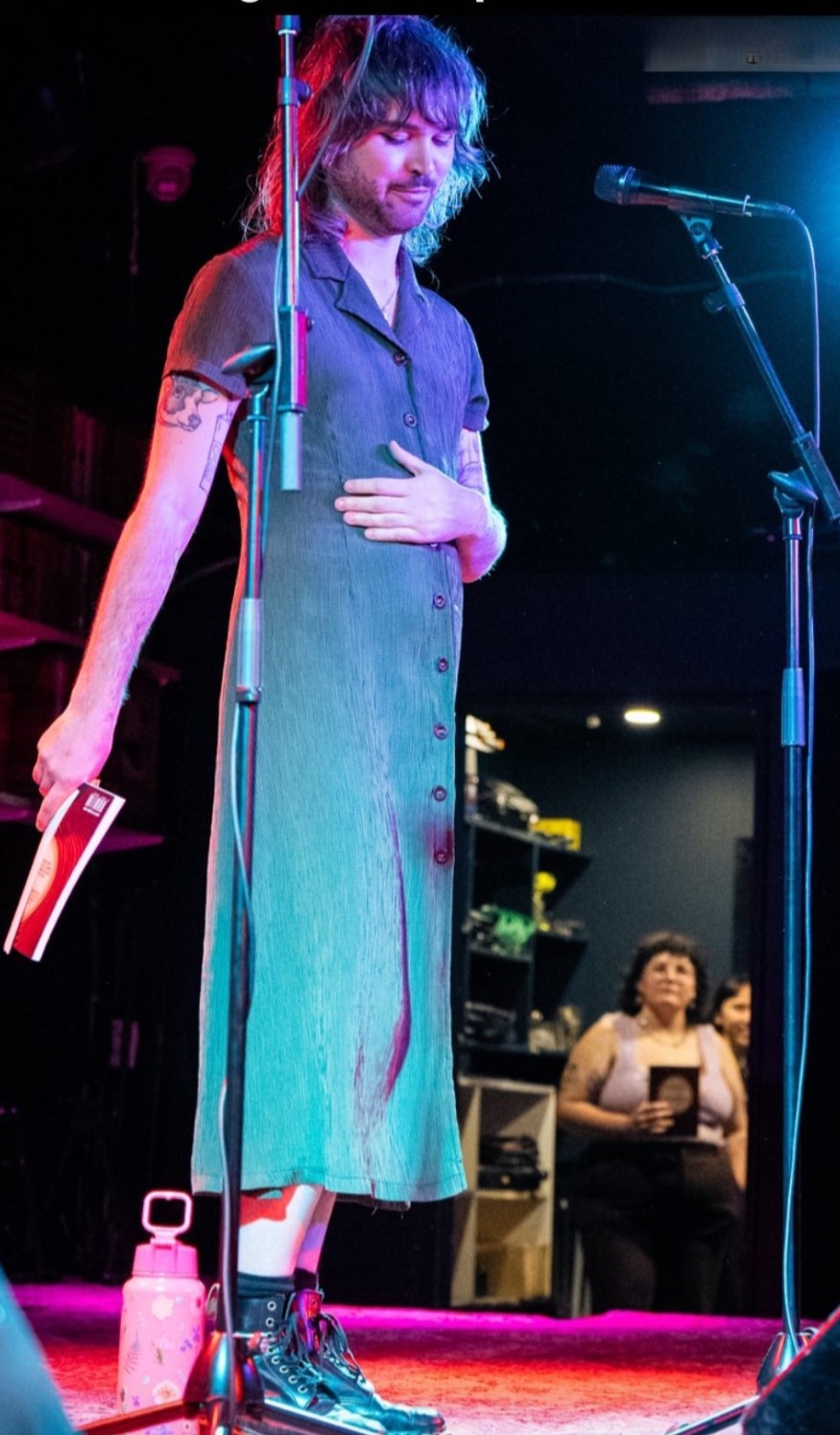
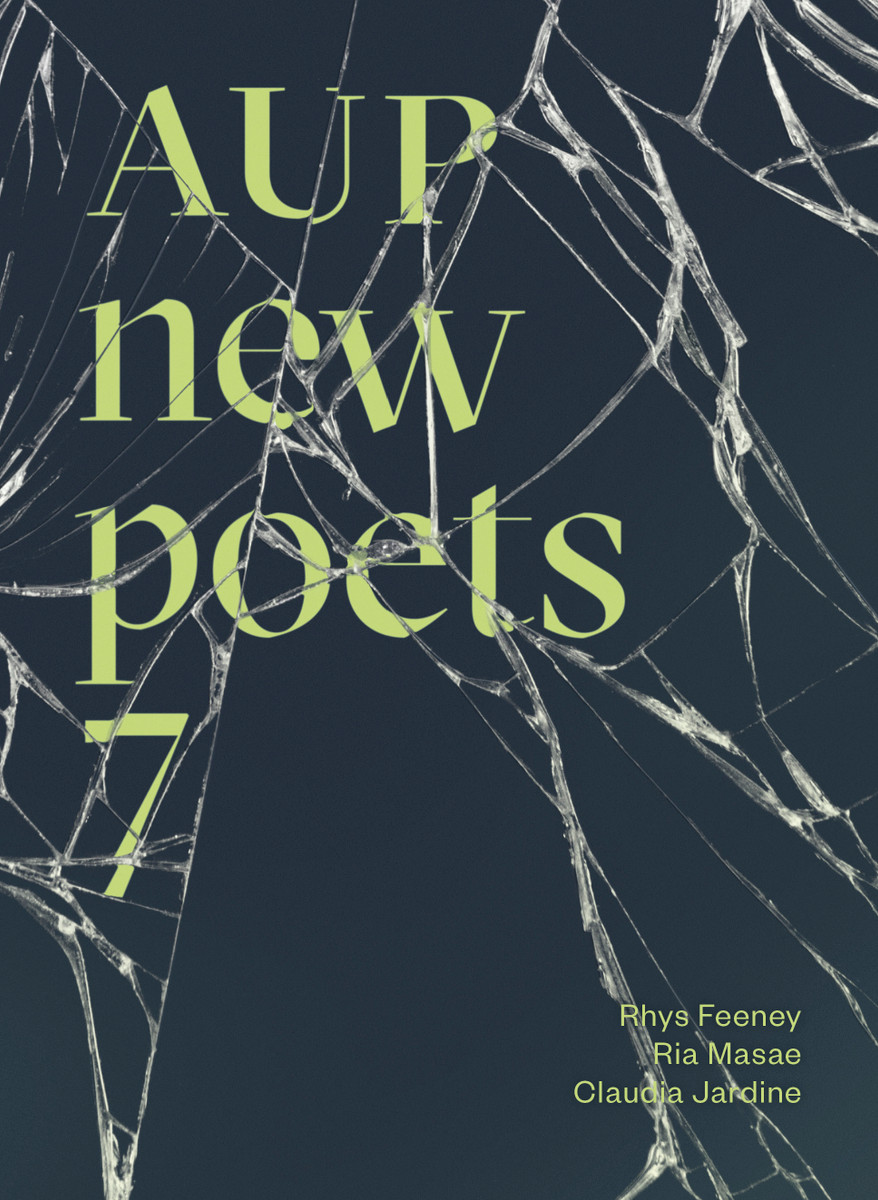
Rhys Feeney (she/they) is a high school teacher in Te Whanganui-a-Tara. Their debut chapbook “soyboy” was published in AUP New Poets 7 (2020). They’re currently finalizing their first full collection manuscript (they’ve been saying this for two years.)
The Auckland Writers Festival Waituhi o Tāmaki (14 – 19 May) drew record breaking crowds, with more than 85,000 attendees, 25 sellout events, and 167 events featuring 240 participants from across Aotearoa and overseas. The festival included multiple genres, ranging subject matter and captivating voices. Over 25% of the programme was completely free and unticketed. Over 6000 school students were inspired by authors in the days leading up to festival, and Level 5 of the Aotea Centre became Pukapuka Adventures at the weekend, with story, song, dance, art and play events for young book lovers. The pop-up bookstalls, run by The Women’s Bookshop, reported their biggest year for book sales in the Festival’s history.
The new Festival team included Artistic Director Lyndsey Fineran, who joined the team in August 2023 after a successful tenure at the UK’s Cheltenham Literature Festival. Catriona Ferguson came on board as Managing Director in January 2024. Plus there were three guest curators: Michael and Matariki Bennett (Ngāti Pikiao, Ngāti Whakaue) whose innovative programming celebrated storytelling in all its forms, and Professor Damon Salesa who brought a strong Pacific-focus to his line-up.
I live streamed the book awards. It was a terrific occasion that honoured sixteen books shortlisted in the four categories, and the three best first books. This year included Te Mūrau o te Tuhi, a special award given for a book written originally and entirely in te reo Māori. Watch online here.
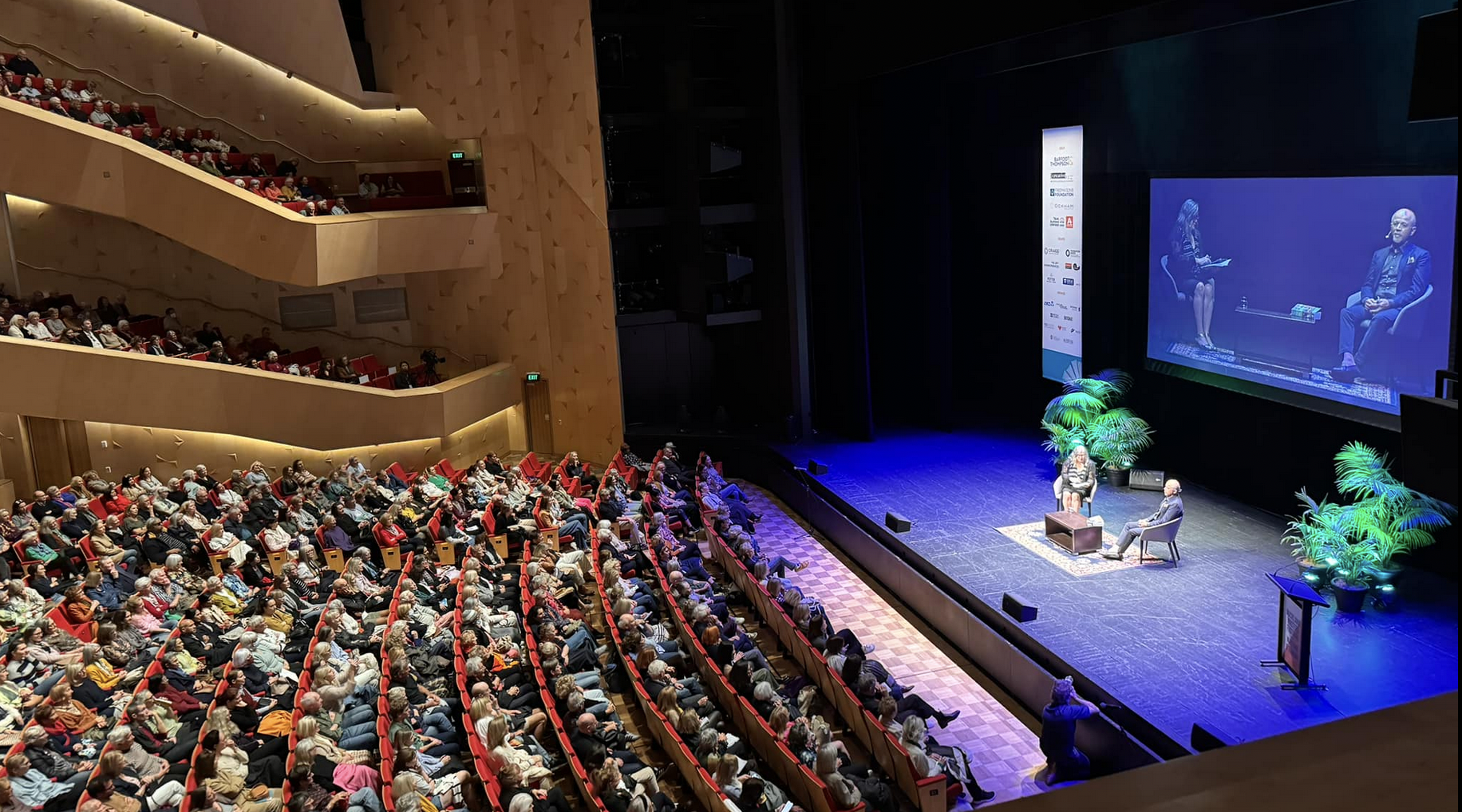
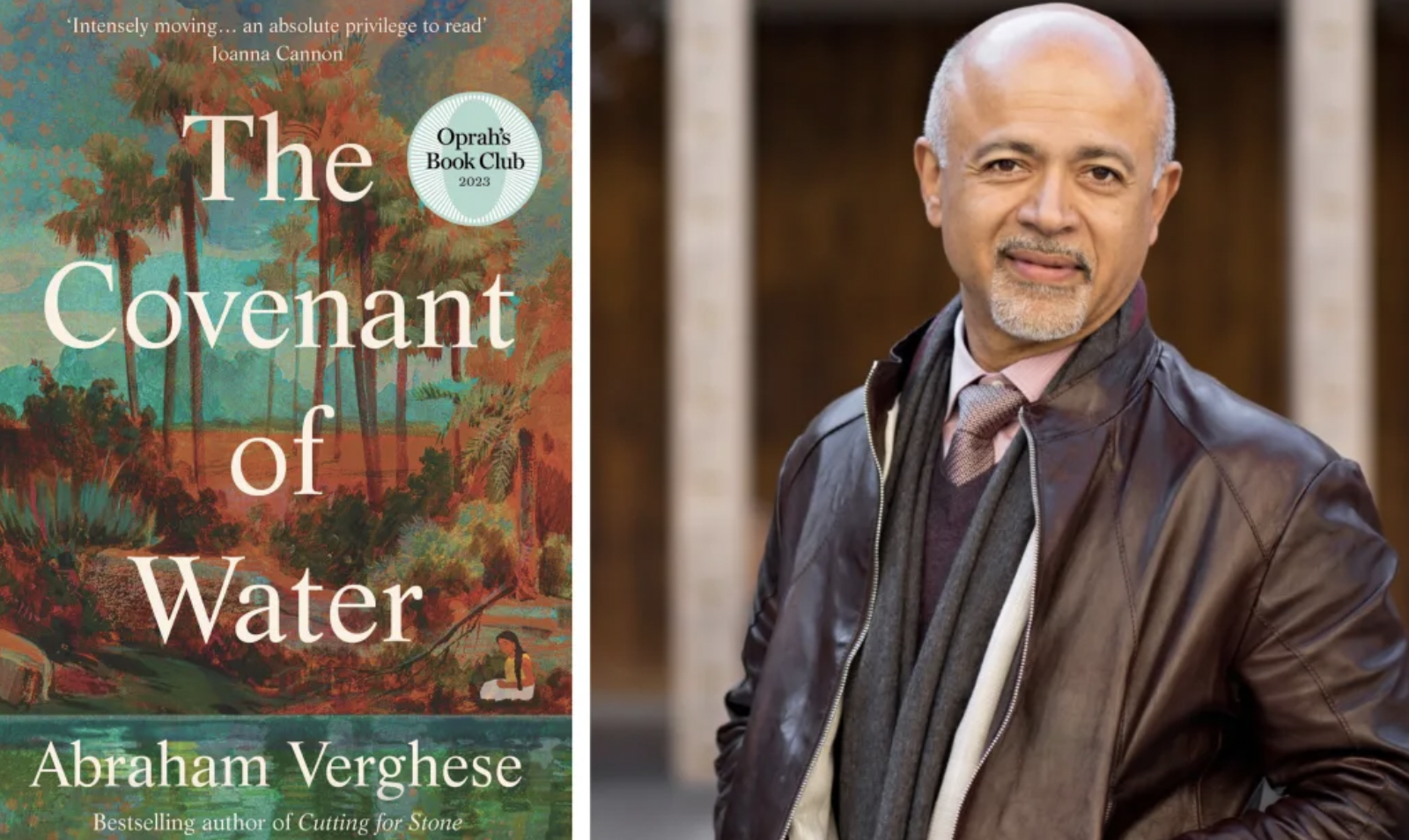
From afar, it felt like the festival was buzzing with ideas, stories, connections. I love how festivals reconnect you with books you have read and loved, and introduce those unfamiliar to you. I invented a pop-up festival at home, reading and loving Rachael King’s novel Gremlings, listening to Sinéad Gleeson’s wonderful Hagstone, catching a few interviews with participants that had aired on Radio NZ National (see links below), ordering some books online. Madeleine Slavick had posted a photo of the poetry table at Unity Books in Wellington and I snapped up a few collections I had not heard of. (Ah! Do send me photos of poetry book tables in your favourite bookshops!) A highlight? I was blown away by Abraham Verghese in conversation with Kathryn Ryan, as he spoke of the joys of medicine and writing, such empathy and wisdom. So resonant for me. Would loved to have gone to his session, crossing fingers it appears in podcast form.
What I was loving in the festival snippets I read on social media was how writing, whatever the genre, was bound by neither rules nor pigeon holes, but was an open ticket to self and world travel, to storytelling with vibrant threads to past, present and future, to building multiple melodies and rhythms, reading tracks and side roads, to challenging dogma and ignorance, to forging sustaining relationships with the books we produce.
I mention this because I am heartened by the way the Auckland Writers Festival celebrates and connects multiple writing communities. We are still drawing hidden voices from the shadows, but I am absorbing such a satisfying richness of books, poetry, storytelling, documentation, essay writing, children’s writing. And I am all the better for it.
Abraham Verghese, photo courtesy of AWF
Some RNZ National links
Best-selling author and Stanford University medical school professor Abraham Verghese in conversation with Kathryn Ryan RNZ National on the joys of medicine and writing
Viet Thanh Nguyen in conversation with Susie Ferguson RNZ National
Leslie Jamison in conversation with Kathryn Ryan RNZ National
Kiran Dass, Jenna Wee, Michael Bennet and Matariki Bennett discuss Best of the Fest on RNZ National’s Culture 101.
Poetry Shelf invited a number of readers and writers to share a takeaway highlight, a special event, quotations they jotted in their notebook. Thank you all, especially in post festival tiredness, to contribute to this collage. Thank you.
A festival collage
Kiri Piahana-Wong
I enjoyed the session ‘Still Wanted: A Room of One’s Own’ with Anna Funder, Leslie Jamison and Selina Tusitala Marsh interviewed by Paula Morris. Leslie said that being a mother artist has challenged the notion that art has to be produced in pure spheres of time, rather she now has a messier more ragged idea of where art comes from. She believes her art/writing is more complex, layered and interesting as a result. She said: ‘Don’t be afraid to embrace scattered hectic time as full of the richness of the layers of living. Your life is not ‘on pause’ when you are engaged in all those domestic tasks.’
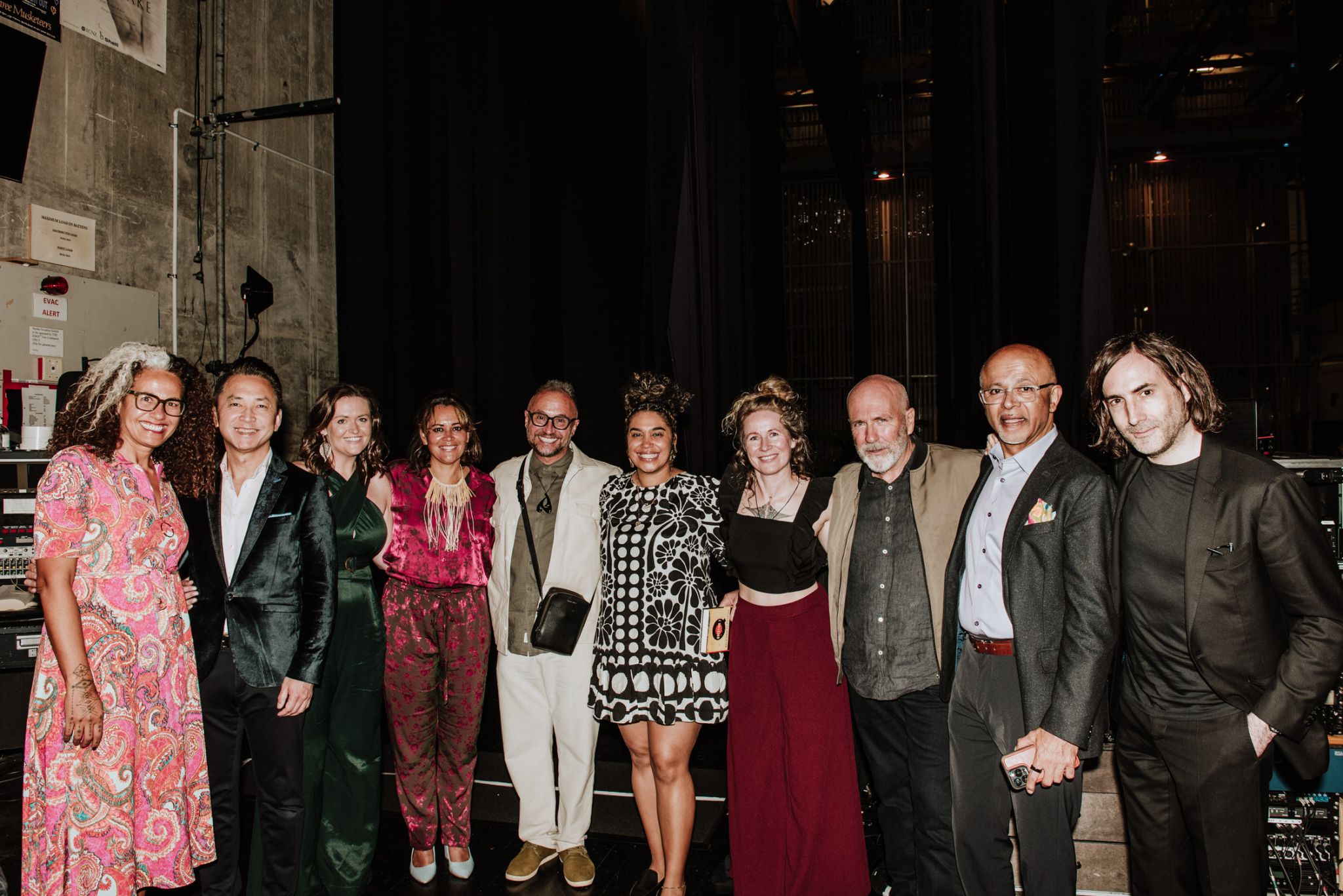
Leslie was asked if she uses affirmations. She said no, but said she might start using Selina’s poetry as her morning affirmations in the future And she expressed a wish that Selina speak to her students.
I found Viet Thanh Nguyen’s session profoundly moving and I cried a few times. He said a reviewer said his work was giving ‘a voice to the voiceless’ or that he should ‘be the voice for the voiceless’. He challenged that, saying that people are not voiceless, rather when this word is used it means ‘the deliberately silenced or the preferably unheard’. He said that what is most important is abolishing the conditions of voicelessness.
Carole Beu, The Women’s Bookshop
What a buzz! I was inspired, exhausted and utterly invigorated by the festival. I attended a total of 19 brilliant sessions while my gallant staff ran the festival bookstall (We employed a total of 40 booksellers over the week!)
I was thrilled by Bonnie Garmus, Anna Funder, Celeste Ng, Anne Salmond, Lauren Groff, and finally Ann Patchett in a witty, spontaneous, enthralling conversation with Meg Mason that was a stunning closing event.
I also encountered some truly lovely men. Trent Dalton made 2200 people weep as well as roar with laughter. Richard Flanagan, Abraham Verghese, Paul Lynch, and Viet Thanh Nguyen were intelligent, sensitive and aware.
The whole event was sensational. The best line – ‘Fiction is the lie that tells the truth’.
photo courtesy of AWF
Nat Baker
“All books are political, and if they say they’re not then they’re political in the worst way”, from Lauren Groff at her awesome session on Friday. I’ve been too sick to attend more than two sessions, but this one was wonderful.
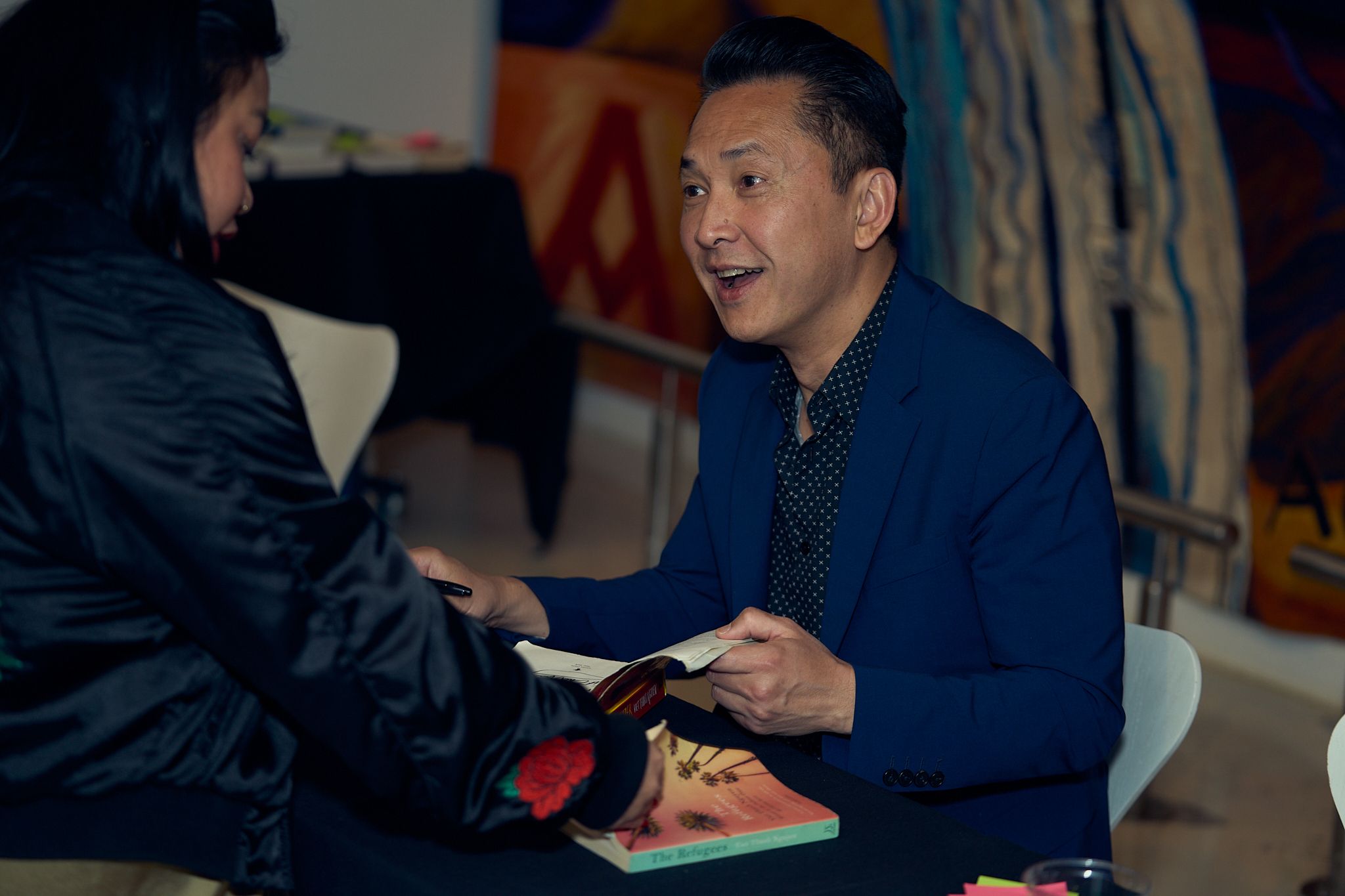
Viet Thanh Nguyen, photo courtesy of AWF
Susanna Andrews
Viet Thanh Nguyen at Thursday’s Gala night: ‘being a refugee has given me the requisite trauma to become a writer’.
Carl Shuker
Leslie Jamison with always excellent chair Noelle McCarthy on how you can fold the chaos of life RIGHT NOW – whether it’s kids or whatever your particular chaos – into your art practice and it can enrich and deepen the work. Nietzschean radical acceptance rather than living in frustration and a sense of distraction.
Noelle McCarthy
‘I know a man who knew a man who knew a locksmith,’ a line by Janet Frame, referring to the doctor who is a dedicatee of many of her books, who opened up her writing life.
Read aloud by Peter Simpson, from the beautiful session on Janet Frame with Meg Mason and Pamela Gordon.
Chair Kiran Dass with Noelle McCarthy and Sinéad Gleeson (Ireland) for the session ‘Ireland: Small Island, Literary Powerhouse’. Photo courtesy of AWF
Kiran Dass
Wow, what an absolutely sensational festival the 2024 Auckland Writers Festival was. A glorious and happy dream of minds and hearts coming together. Everywhere I looked I just saw smiling faces. I loved being in conversation on stage with such talented, thoughtful and smart writers, and loved the many off stage chats with old friends and new. The writing community really is the greatest. I feel so energised, brain-fed, heart-filled, and fired up. Congratulations to Lyndsey Fineran, Catriona Ferguson and their amazing team for delivering a remarkable festival. I’m so grateful to have been included. Putting on a festival is a huge amount of work! So much thinking, care, and mindmelting logistics go into putting on the seemingly effortless magical sessions audiences see take place on the stage.
Lynn Davidson
A special AWF highlight for me (among many highlights) was the fire and energy and humour in the room during the ‘If Not Now, When: Midlife Realisations and Rebellions’, event. Sharing the stage with Emily Perkins and Claire Mabey as we talked midlife shifts and the possibilities they can open up felt like being part of a necessary and welcome conversation.
Pip Adam
The highlight of my week was Emma Wehipeihana’s acceptance speech for best first book. She spoke directly about working in a stretched health system, I was so glad the Prime Minister was there to hear this. And this quote made me cry: “As a doctor, I’ve seen the inside of most orifices of the human body and held the viscera of the living and the dead and I can tell you without a doubt that it’s the arts and artists who elevate our existence from being sacks of meat circling a dying star to something magical …”
Claire Mabey
I loved what Jane Campion said about writing which was ‘writing is being in a relationship with the subconscious’. And I also really loved the banned books session — some books can be dangerous and troubling but those books help us think — we can’t eliminate ideas that trouble us, we just have to think against them and talk about them
Amber Esau
In The Science Behind Science Fiction session Dr. Octavia Cade asked ‘Are we still going to be the same kind of human without them’ on leaving behind kākāpō, kauri trees, and the environment we already have a relationship with in pursuit of a new planet. This echoed back to me when Sascha Stromach, in the We Can Be On Other Planets: Māori Speculative Fiction session, said, “So much sci-fi is inherently colonial… a Māori approach would be learning to be a kaitiaki of another planet.” There was something sparked for me from these kōrero about the implications of ownership, our responsibilities to who and what gets left behind, and our ethical considerations for exploring new worlds in fiction.
Catherine Chidgey
I’ve loved being in amongst the buzz of this bumper festival…and I was delighted to have a very dedicated 12-year-old taking part in my workshop on writing child narrators.
Harriet Allan
I hadn’t consciously planned it this way, but I went to a string of events by lively, intelligent, talented women, starting with Rebecca Vaughan performing Virgina Woolf’s A Room of One’s Own (it was terrific to be reminded of this work). Other books I had loved and were featured included Anna Funder’s Wifedom and Sarah Ogilvie’s Dictionary People, and neither author disappointed in person. Anne Salmond, Roimata Smail and Katy Hessel all shone, and there were several stimulating line-ups, including three lots of three women, two of which featured authors I have worked with – Patricia Grace and Lauren Keenan – so of course I am biased in loving hearing them. There were a few other (also enjoyable) sessions I attended, and many more I wished I could have seen if money, time and brain-fatigue hadn’t had to be allowed for, but I came away thinking Virginia Woolf might well have felt pleased with the plethora of excellent books now being written by women.
Rachael King
photo courtesy of AWF
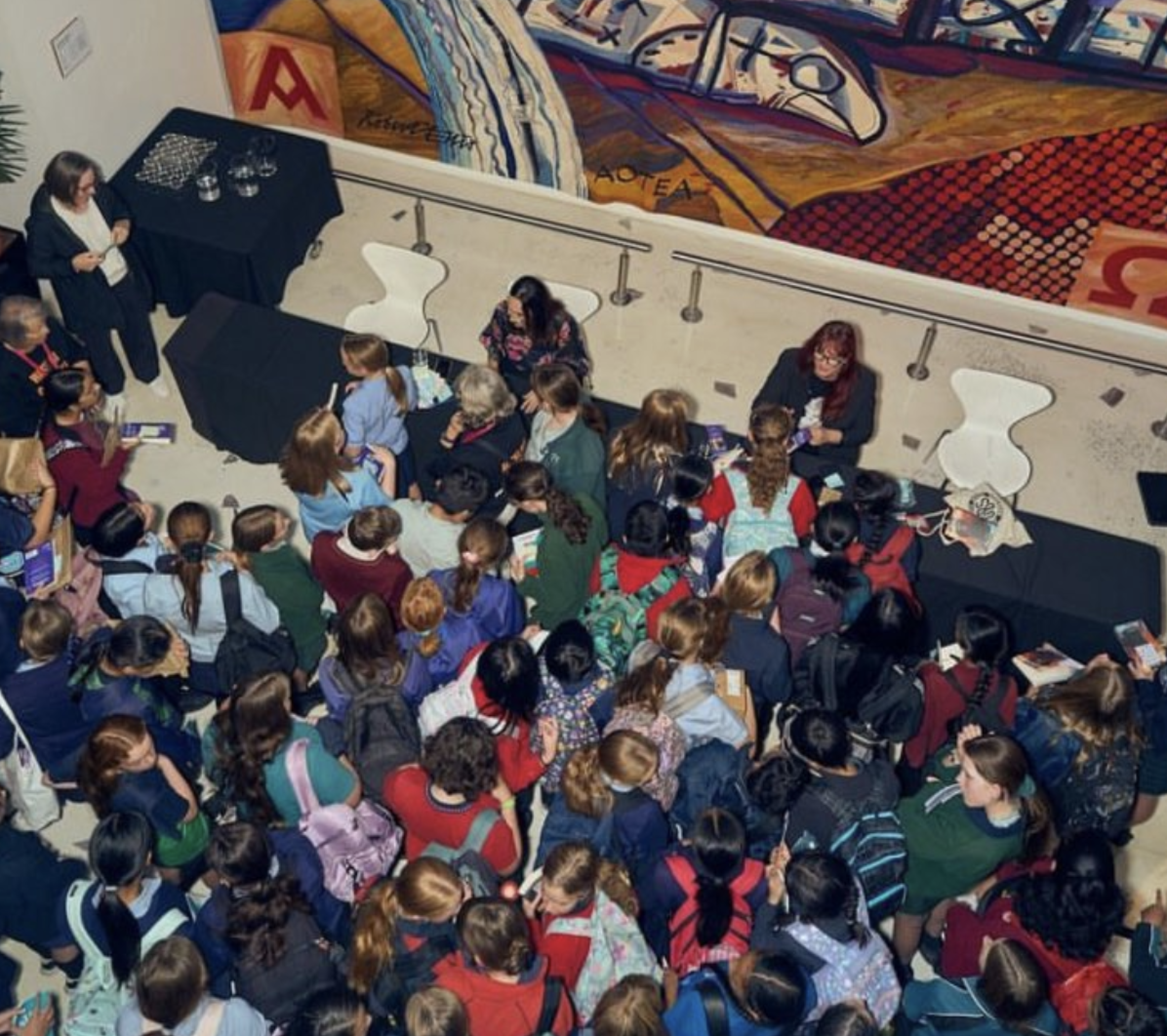
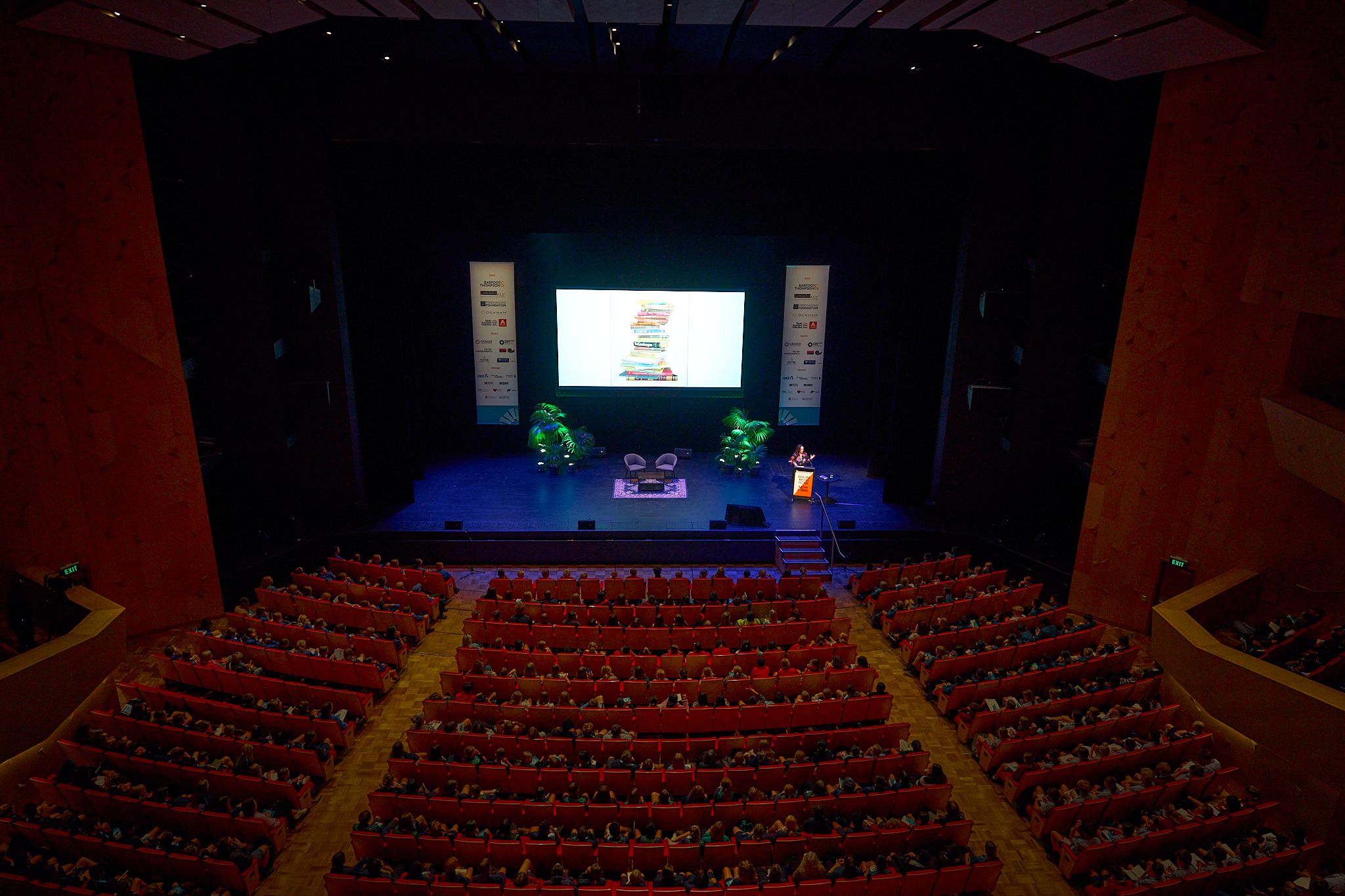
The schools days were incredible! So many hungry young minds, eager to meet writers. This photo says it all.
A school session, photo courtesy of AWF
Eileen Merriman
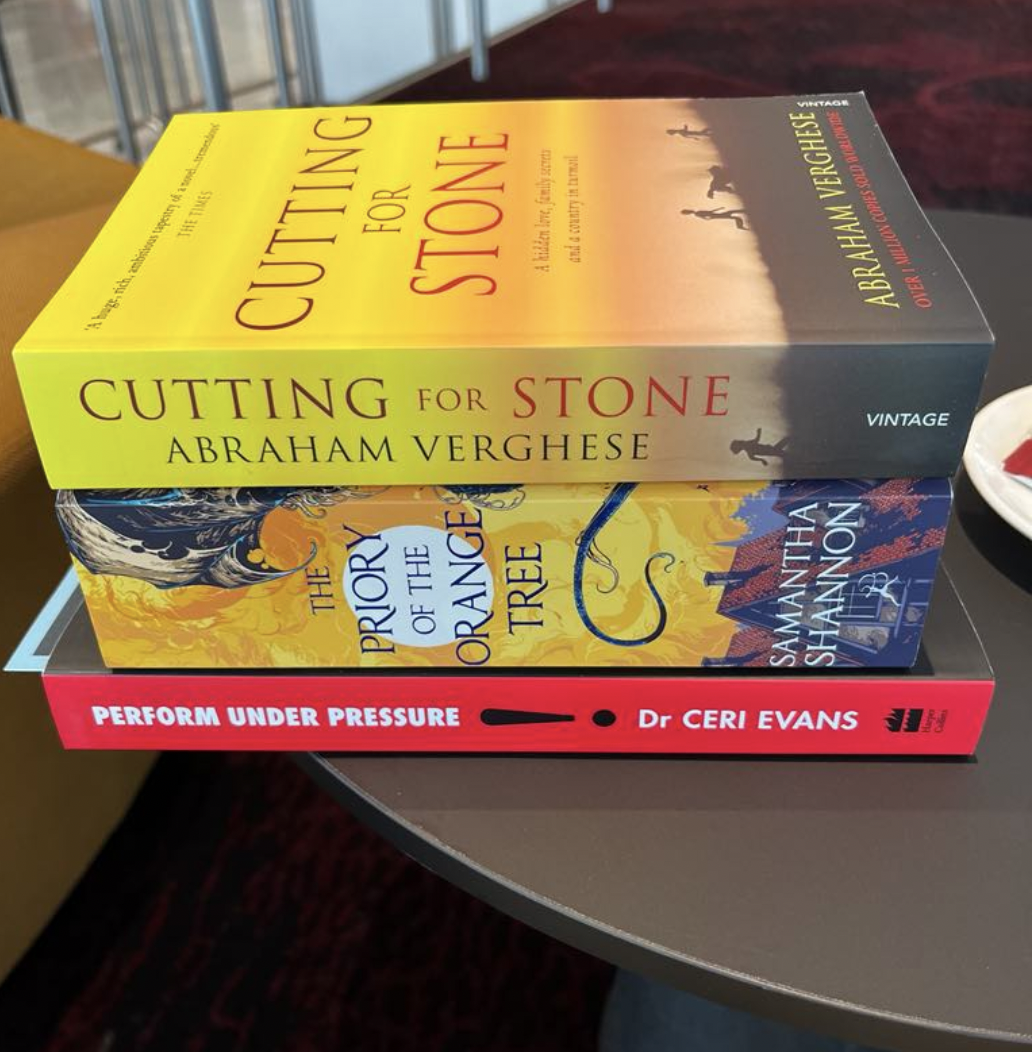
Sadly I didn’t have long at AWF this year but purchased these three beauties on my way to chair a Crime Writers Panel featuring the fantastic Michael Bennett, Paul Cleave and Gavin Strawhan. The book on the bottom helped soothe the nerves beforehand!
Mary McCallum
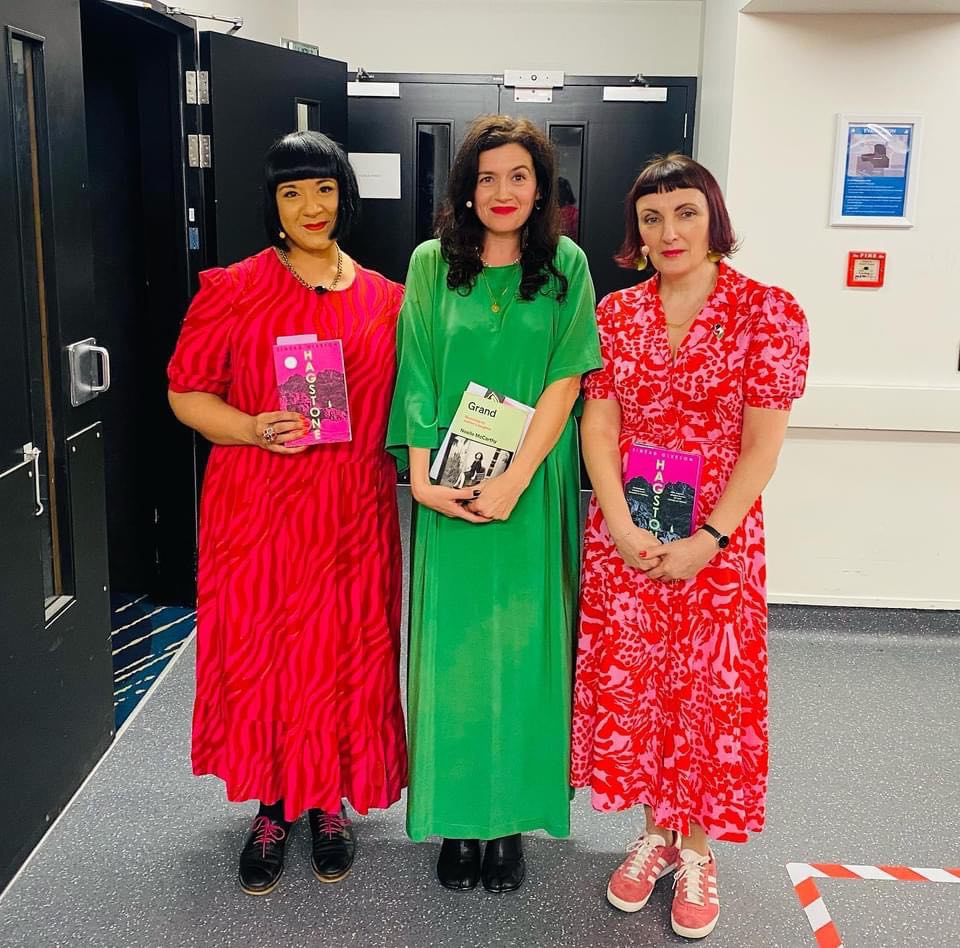
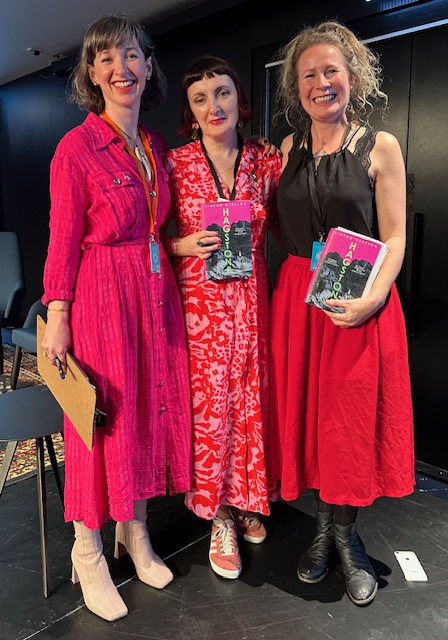
Jenna Todd, Sinéad Gleeson, Becky Manawatu
Auckland and the Auckland Writers Festival were in the pink yesterday on my first full day at this huge, exciting and at times overwhelming event — Becky Manawatu, Irish writer Sinéad Gleeson and bookseller Jenna Todd matched up with Sinéad’s glorious book to talk about it and Becky’s Auē and upcoming Kataraina (and oh so much about speaking Irish and Māori, living on islands and women finding their best selves, beautifully steered by Jenna). The sky tower pinked in sympathy and so did one of the thousands of people filling the Aotea Centre looking for a literary fix.
Anna Funder was a joy talking with Susie Ferguson about her extraordinary book Wifedom, which tells the life of the “invisible” woman who was the wife of George Orwell and brilliantly dissects the patriarchy as it goes. No pink on her! The book, though, is a pink-adjacent bright orange.
Becky talked about seeing Ana Scotney’s play ‘Scattergun’ in her Gala Night speech:
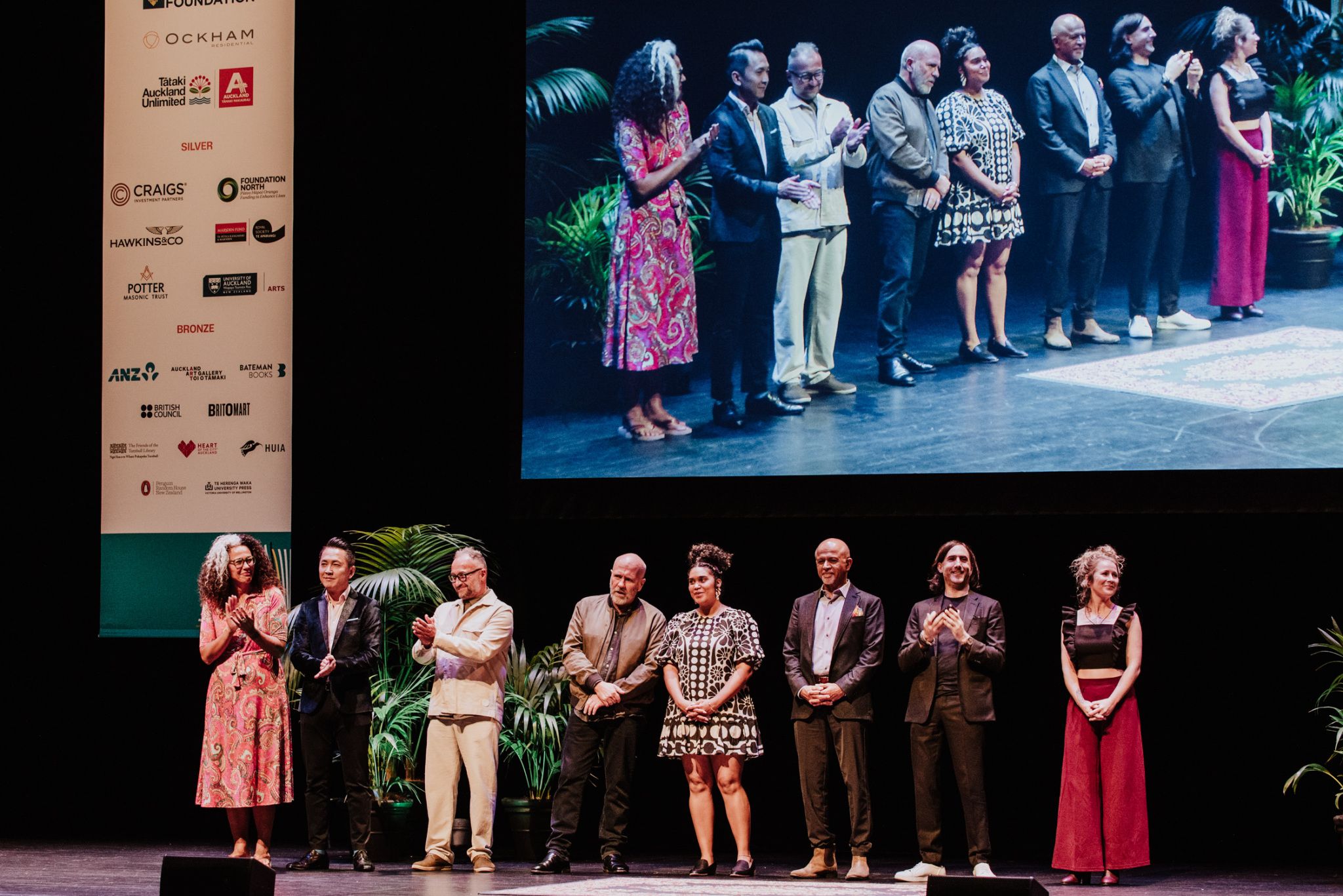
“Ana Scotney’s Scattergun was not one woman. She was a room of women, a room of people. But I did not know that yet.I was not prepared for how expansive, detailed, how wild, forested, rivered and wholly alive, Scattergun’s world would be. Gorgeous defibrillate your heart, bring-you-back-to-life art. Art. What a wasteland this world would be without it.”
The Gala Night, photo courtesy of AWF
Melinda Szymanik
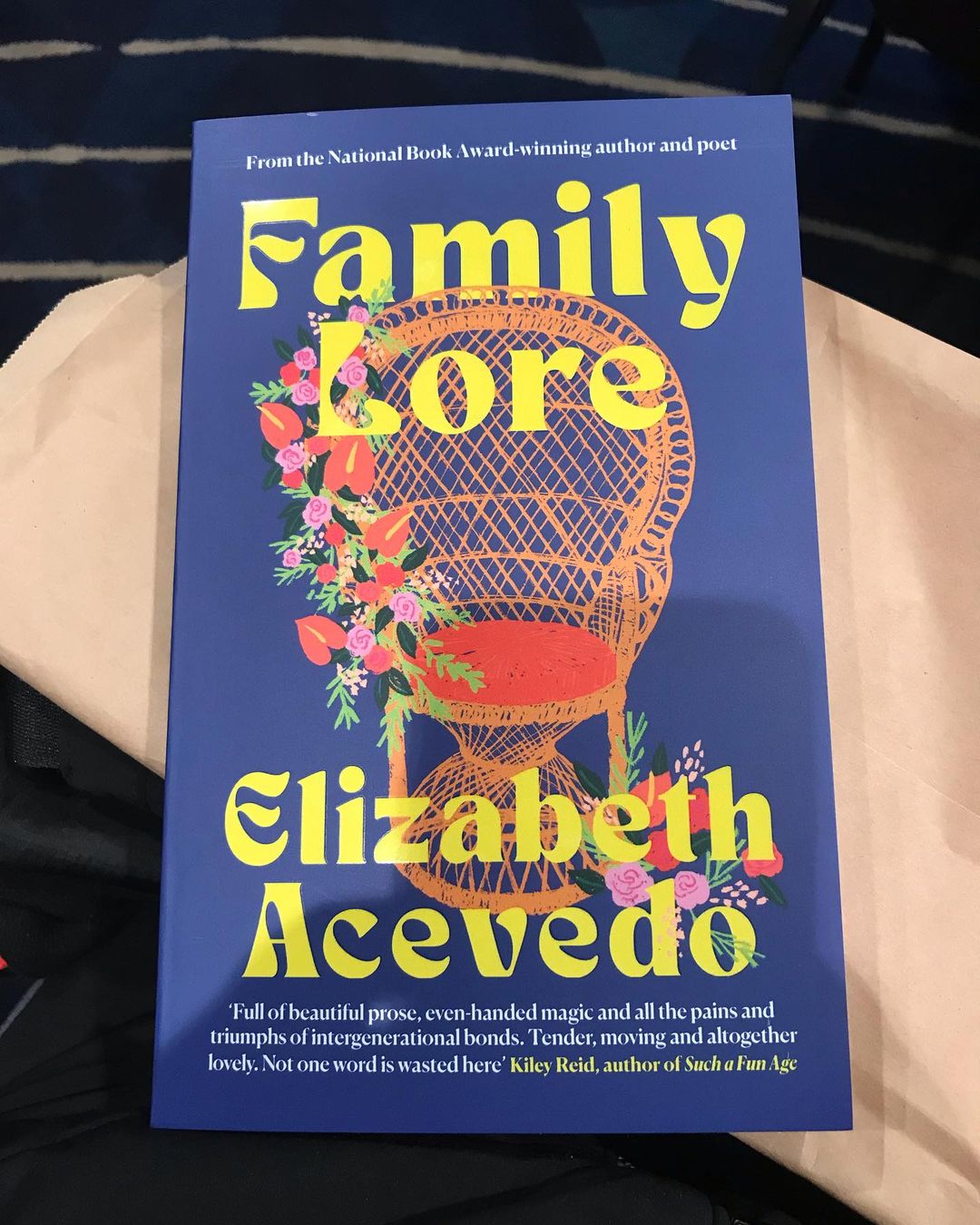
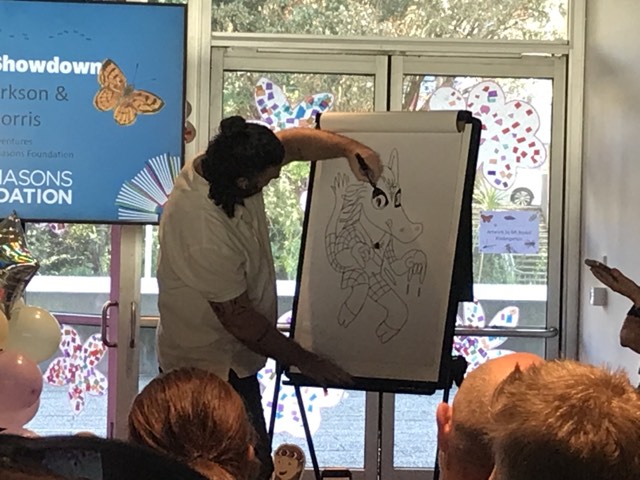
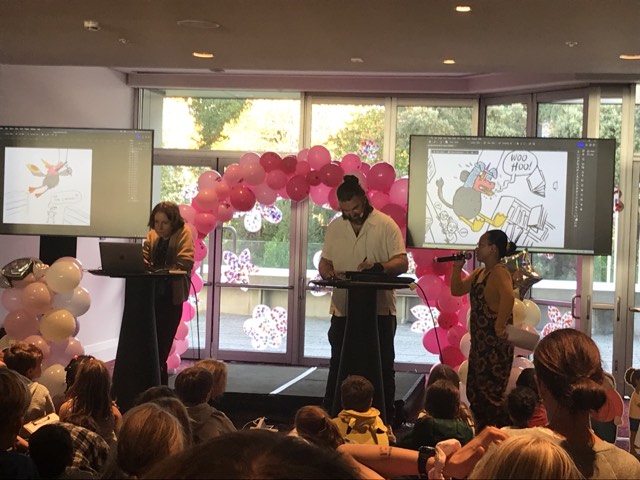
On my way to my Saturday session with Elizabeth Acevedo, Saraid de Silva and Tsitsi Mapepa – ‘Writing across Generations’ – I spotted Gareth and Louise Ward and stopped to say hi because this is one of the best things about the Festival – connecting with other passionate book folk. Louise proceeded to demonstrate her bookselling skills and I went straight off to buy Acevedo’s new book Family Lore. The session was wonderful, all three writers sharing generously on family and their fab books. Later I met up with fellow writer Jane Bloomfield for a good natter and then I was off to the Illustration Duel between Toby Morris and Giselle Clarkson. This theoretically was for the younger set but the adults in the audience were enjoying it just as much as the children. So much talent, so much networking, so much fun.
Jenny Powell has published six poetry collections, two chap books collections and two collaborative collections. She has been a finalist in the UK Plough Poetry Prize, two times finalist in the Aesthetica Creative Arts Award, finalist in the Lancaster one minute monologue competition, runner-up in the Plough Poetry Prize, runner-up in the Mslexia Poetry Competition, short listed in the Welsh Poetry Competition, shortlisted in the New Zealand Society of Authors Janet Frame Memorial Award and in the inaugural NZ Book Month ‘Six Pack’ Competition. In 2020 Powell was the RAK Mason Writing Fellow.
This is breath. The orchard shadows laddering an Autumn way out. I follow the windfall of dead sparrows, to an evening where Time’s vapours wet their little bones. I tell my dog that I have seen grief come small as birds. You were one thing. And people come and go. In the orchard I am king to the passages of persimmon and fig, and the dog finds me worthy. This is a music video where I look sad in technicolour and women dance at my hips and the petals come away. If I am lonely, it is loneliness that I am cool blooded and blued as the hills. At the gallery someone will say the blue hills represent the fever dream of somebody so distant he touches love in its purist form. But I am not that person. This is breath. The dog watches my palms for happiness. I let him down. We collect sparrows like they might ripen into laughter, two by two. My dog and I guard them, little maybes.
Elizabeth Morton
Elizabeth Morton is a yarn teller, poem maker, and neuroscience enthusiast from Tāmaki Makaurau. Her latest collection of poetry is Naming the Beasts (Otago University Press, 2022).
It feels like a year ago we stood on the back deck and peered into the dark, bewildered, bemused, until our camera showed us this. I spiralled into thoughts on staring into the dark fruitlessly, and on how surprisingly, like a miracle, what I am reading, the poem, the novel, the essay, sometimes reveals what I couldn’t see.
It’s been a week of smash and uplift. Let’s focus on the uplift. Listening to Isla Huia read at the Ockham NZ Book Award ceremony (I live streamed it). I loved Isla’s book so what a treat to hear her read. It was indeed a treat to hear all the authors read, and to absorb the ongoing insistence on why books matter. Yes, we are all reading and writing and liking different things, but books matter. They can make a difference in our lives. Emily Perkins nailed it in her acceptance speech.
New books in the post: Meantime, Majella Cullinane (poetry, Otago University Press) Brown Bird, Jane Arthur (children’s novel, Penguin). A Bunch of Family Poems by Adrienne Jansen. Ooh! Exciting package from THWUP of books out in a few months:Slim Volume by James Brown, Tarot by Jake Arthur, Still Is by Vincent O’Sullivan.
The past weeks have been the toughest since my transplant for various reasons and I am so grateful to the nurses, doctors, and my dentist who, no matter how stretched or underpaid they are, are infinitely patient, kind and helpful. Why isn’t this a frontline issue for those in ‘power’? Why do I feel the gap between the privileged and the less so widens? I am sharing this with you because together we are imagining and working towards a country that is equitable, humane, welcomes all cultures, genders, disabilities, languages, is willing to share and support.
Sadly, I can’t accept poem submissions. I do accept books to review.
Week’s links
Monday: Poem: ‘Skeletal‘ by Megan Kitching aga pukapuka pekapeka open for submissions Majella Cullinane launchesMeantime
Tuesday: book review and reading: Hopurangi -Songcatcher Poems from the Maramataka by Robert Sullivan
The Dunedin City of Literature team is excited at the recent announcement of a special collaboration with SuperGrans and renowned poet Jenny Powell.
Earlier this year on World Poetry Day, it was announced that Jenny will be running a series of free poetry workshops for SuperGrans, Dunedin staff, volunteers and their community.
Jenny is the Dunedin UNESCO City of Literature South D Poet Lorikeet and is a teacher and award-winning poet. The series of free workshops over six weeks is a way of saying thank you to the SuperGrans group for their great mahi in the community. SuperGrans staff and volunteers provide free holistic support to individuals and whānau to learn new skills to thrive in the modern world.
Jenny will lead the workshops wearing her bespoke ‘chain of office’, which was handcrafted by Dunedin local Jill Bowie of the Dunedin Public Libraries. Jenny, who also delivers free City of Literature poetry workshops to five-year-olds, is thrilled to be working with the SuperGrans.
For Jenny, giving a poetic voice to seemingly impossible ideas is accompanied by joy and wonder. She wants to encourage and share these qualities through the energy of poems and sees this as a crucial part of her role.
The collaboration was revealed on World Poetry Day, 21 March, as part of an international campaign with all the Cities of Literature around the globe. The workshops will be held over six weeks from June.
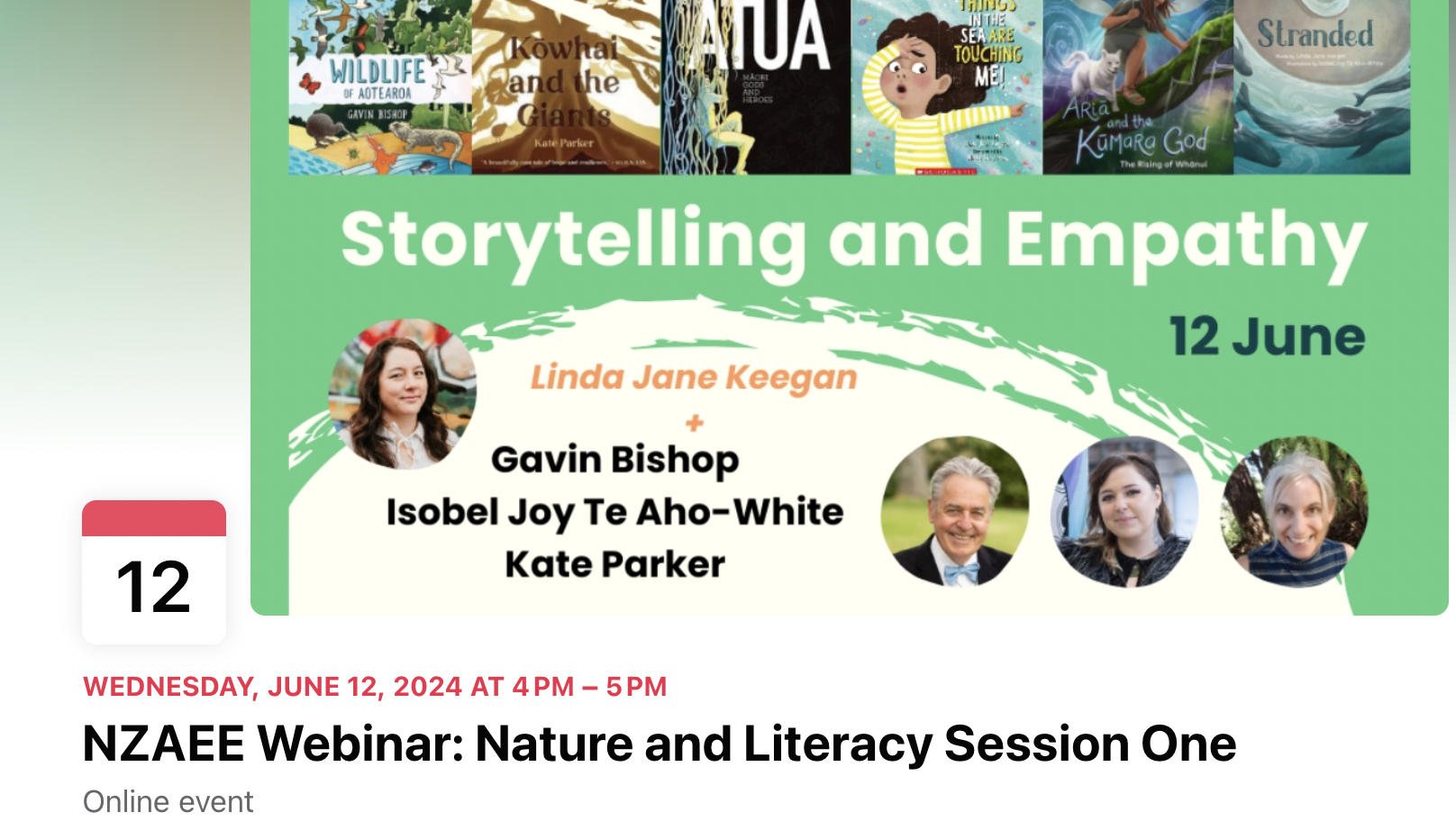
Facilitated by Linda Jane Keegan Guest speakers: Gavin Bishop, Isobel Joy Te Aho-White and Kate Parker
Join us for this free webinar exploring the importance of storytelling and empathy within environmental education and literacy learning. Our panel of speakers are children’s book authors and illustrators and each bring a unique perspective.
We will include some time for questions at the end and you can add your questions to the registration form beforehand if you like. We also have free books to give away to some lucky participants who attend live or who complete our survey after attending or watching the recording.
Note this webinar is the first in a series of two panel discussions, with the second webinar on June 18th.
There’s a complex trough of grief. There’s a ridge of missing hearts.
Paula Green
I love couplets, and love the look of a single couplet on the page, how it catches my attention like a solitary cloud in a bright blue sky. I love how it can unfold in a breath, and you get awe or surprise or sweet wit, with or without rhyme, near rhyme, off rhyme, slant rhyme. Enjambment or a picnic stop. Regular beats or irregular stutters. You might meet the commonplace or the complicated, the uncanny or a confession. Truth or lies. You might veer off to unexpected gulleys and crevices. And of course couplets might gather together in clusters; threading ideas, experience, motifs, mood. My early book, Chrome, was an entire book of couplets on the page. I was drawn to how, on first glance you encounter sameness and routine (one critic loathed this banality), but how the more you look, the more nuances and differences are exposed. A bit like looking at the same view of the Waitākere ranges from our lounge window for the past decades.
For a number of years, I have delighted in Bill Manhire’s flair with couplets, the unsaid, the mysterious, the hinted-at anecdote, humour. His deft touch with rhyme. Here is a favourite:
Talking to the Moon
But the moon has drifted out to sea. It doesn’t know what will make me happy.
Bill Manhire from Victims of Lightning, THWUP, 2010
James Brown emailed me: “Your request has got me pondering couplets – when is a couplet not a couplet etc. I’ve written poems in rhymed couplets as a challenge to myself and because it’s not the done thing (for good reasons – I’m not advocating for rhymed couplets). Poets can be contrary people and because the prevailing form is free verse, rhymed couplets are a challenging temptation. ‘Peculiar Julia’ and ‘Shrinking Violet’ from Floods Another Chamber were turned into songs on a recent album Please Go Wild, that will be released by Polite Company next week. Another poem I wrote using rhyming couplets is ‘Winston Peters’ (The Tip Shop), whom I’ve no time for, so the poem also disrupts the common perception that a poem always conveys the poet’s truth.”
Ah. I have been musing on couplets a lot lately, on why I love them, and why I keep writing them, especially in the middle of the night, occasionally publishing them on Twitter (X). Writing a couplet in my head can be such a satisfying diversion in the midst of pain or doubt or melancholy or 3 a.m. wakefulness. The other night, when I was listening to a BBC programme on seaweed, I decided to post a suite of couplets on Poetry Shelf, both new and unpublished, by local poets, rhyming or not rhyming. And then I slipped into musing on ‘The troubled crocodile cloud / says peace not war out loud.’
A Suite of Couplets
Marriage
His hands in the sink, he felt his loneliness like a tide pulling him out to sea. She came back up the stairs, more a cloud than a silver lining.
Anna Jackson
The Joke
Each poem an astonishment that breath has once more entered and then left —
a sneeze, a hiccup, laughter at the joke. Inside each joke the fear of death.
Chris Price
from ‘Stone by Stone’
they saw in the north a glimmer a whisper of light from the fissure a promise of better
elbowing like atua cramped between their olds trying to prise the lid off to break the mould
Ariana Tikao
Sediments
sediments in the earth rock and dirt we are the same
looking back looking forward time collapsed we are the same
Ariana Tikao
Tell You What
One bird explains the sky to another. That’s the way they operate.
+
In the 1950s all the boys had big ears. Those were embarrassing years.
+
Every boy with his book. Every sheep with its showground.
+
We used to call the stove the range. I don’t see why that should have had to change.
+
Raewyn keeps in touch. I never liked her much.
Bill Manhire
Unrushed Light
Something sparks at the end of the wire. I have a memory like a flour sifter.
Paula Green
How to Age
Don’t panic. Just keep going.
Cilla McQueen
Mixed Messages
Do you like yourself? I do.
James Brown
Entwined
*
We are the perfect couple, like a headache and Panadol.
*
The real myth of Cinderella is that the order is first the drudgery, then the prince.
*
When he sees the new baby, the child says to his mother ‘Now you’re not just my mum, you’re my brother-er.’
*
In her room, the child talks on a toy phone playing the game of not being alone.
Emma Neale
Syrinx
He blew hot stupid breath through me and called it music. My mind watched my body from up in the sky, could only think how beautiful the reeds look reflected in the river.
Lily Holloway
Inside
Inside the city of longing is the city of bare feet. Inside the city of fear is the city of cumin seeds.
Paula Green
Dawn
It’s just shy of dawn. There’s a pheasant on the lawn.
Paula Green
A Suite of Autumn Couplets
[ . . . ]
Chronic pain like lemon juice rain.
Alpinecore
A toxic man-thought in the brilliant light: that I could beat a mountain in a fight.
Four Months in Four Regrets
That paisley shirt. Benching my leading scorer. Excessive drinking. Missing the aurora.
Mujaddara
I know. I know what’s happening elsewhere. While I mess around with my kitchenware.
Diary, 2024-05-10
Friday. I wrote another first line of a book. I’m now at one ten-thousandth of 10,000 books.
Braided Rivers
I also look dried-up if you’re passing by. I also suddenly flood if you ask why.
Warfare
In short, emotional asymmetry. I think of you and you don’t think of me.
[ . . . ]
As much charm as a factory farm.
Processing
Consider the empty networks of grief working like the veins in a dry leaf.
60 Cathedral Square, Christchurch Central City, Christchurch 8011, New Zealand
Celebrate International Biodiversity Day with an amazing line-up of guest speakers sponsored by RSNZ.
Lindsey Conrow – geographer at UC, talking about black-billed gulls
Gail Ingram – local poet, author of: anthology (n.) a collection of flowers (Pūkeko Publications 2024)
Sara Kross – ecologist / conservation biologist at UC speaking on opportunities and risks for wildlife in our urban jungle
Rebecca (Bex) Le Grice – entomologist and curator at Canterbury Museum, talking about flies
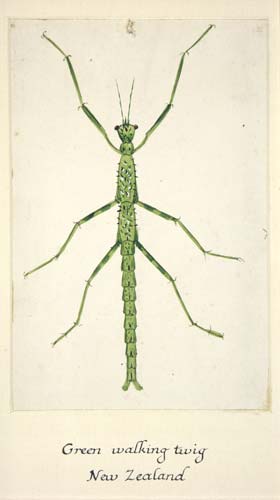
Morgane Merien – entomologist and science communicator at Canterbury Museum, talking about stick insects (and yes, there will opportunities to get a selfie with a stick insect)
Food and drink will be available to purchase.
Photo credit: John Backhouse (1845–1908) on Te Ara

 And she expressed a wish that Selina speak to her students.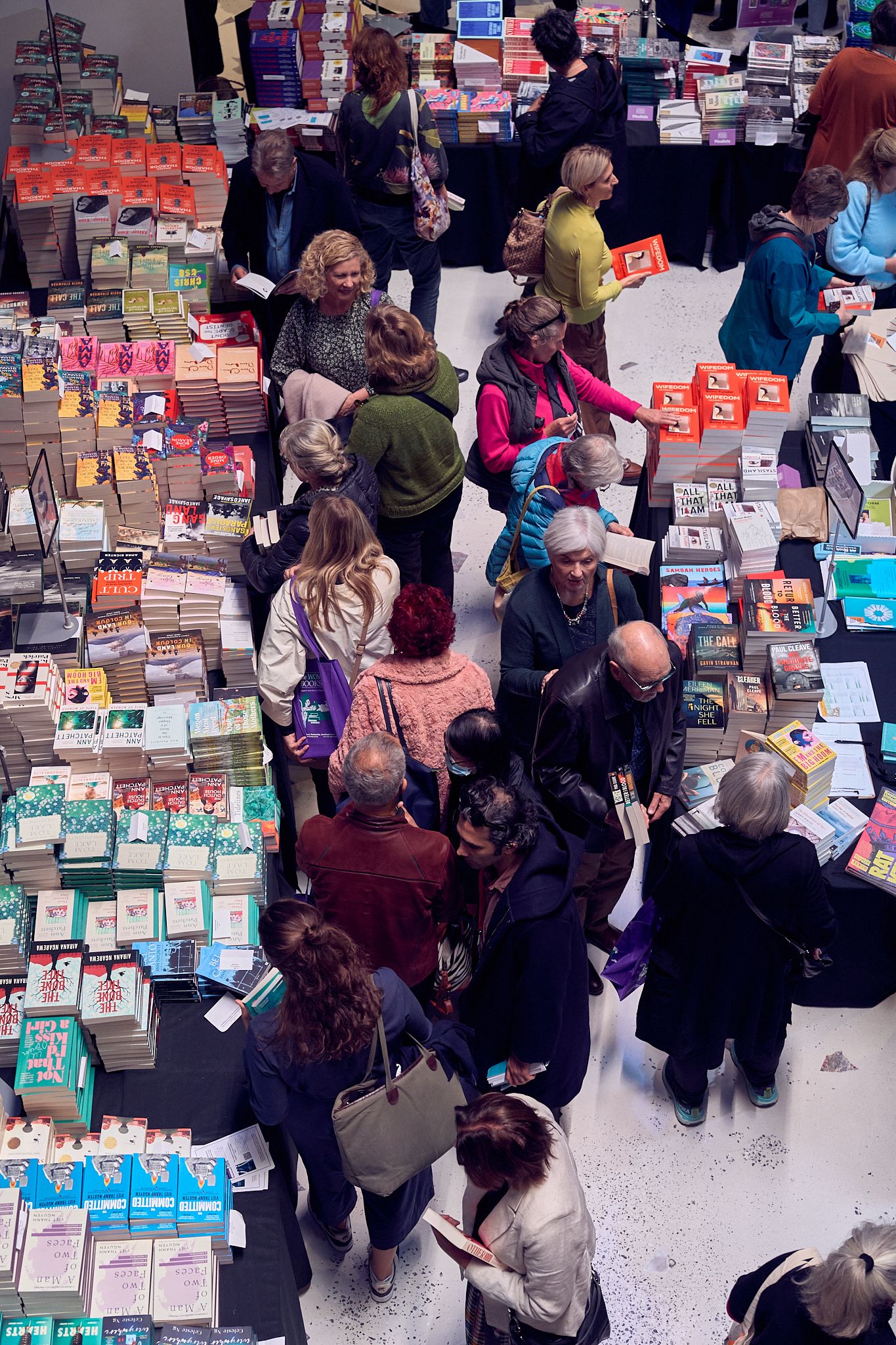



 NZ Poetry Shelf