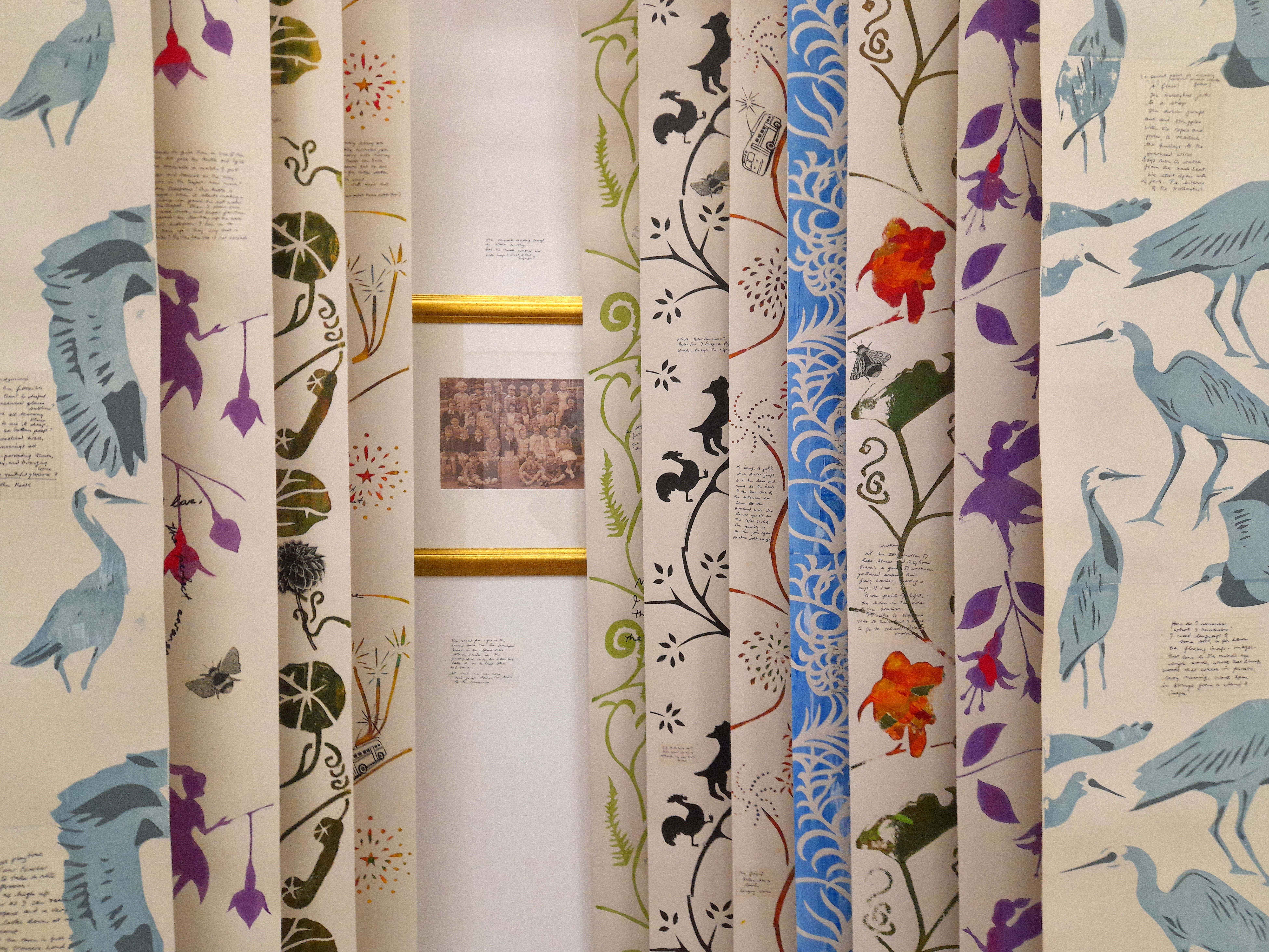
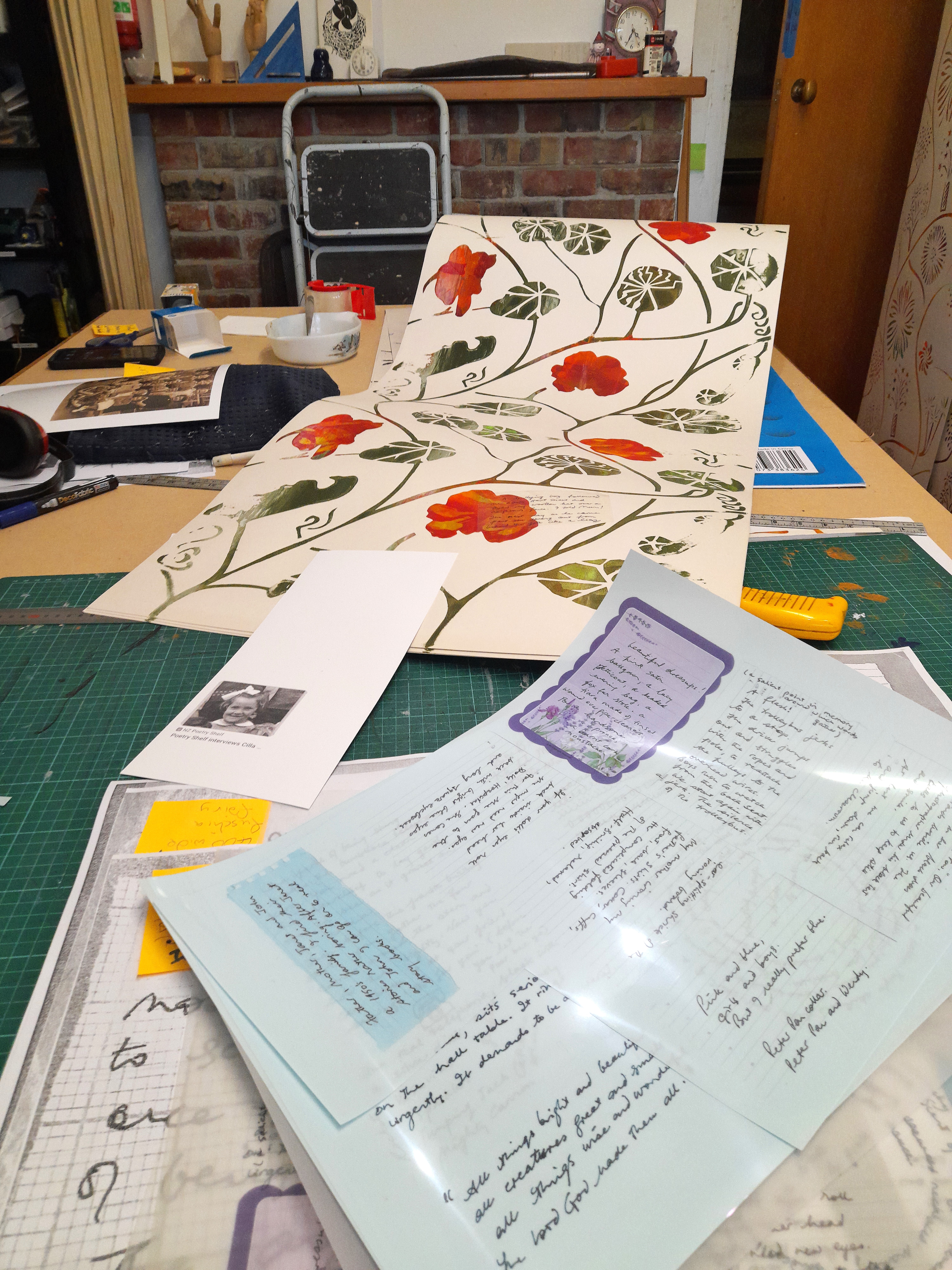
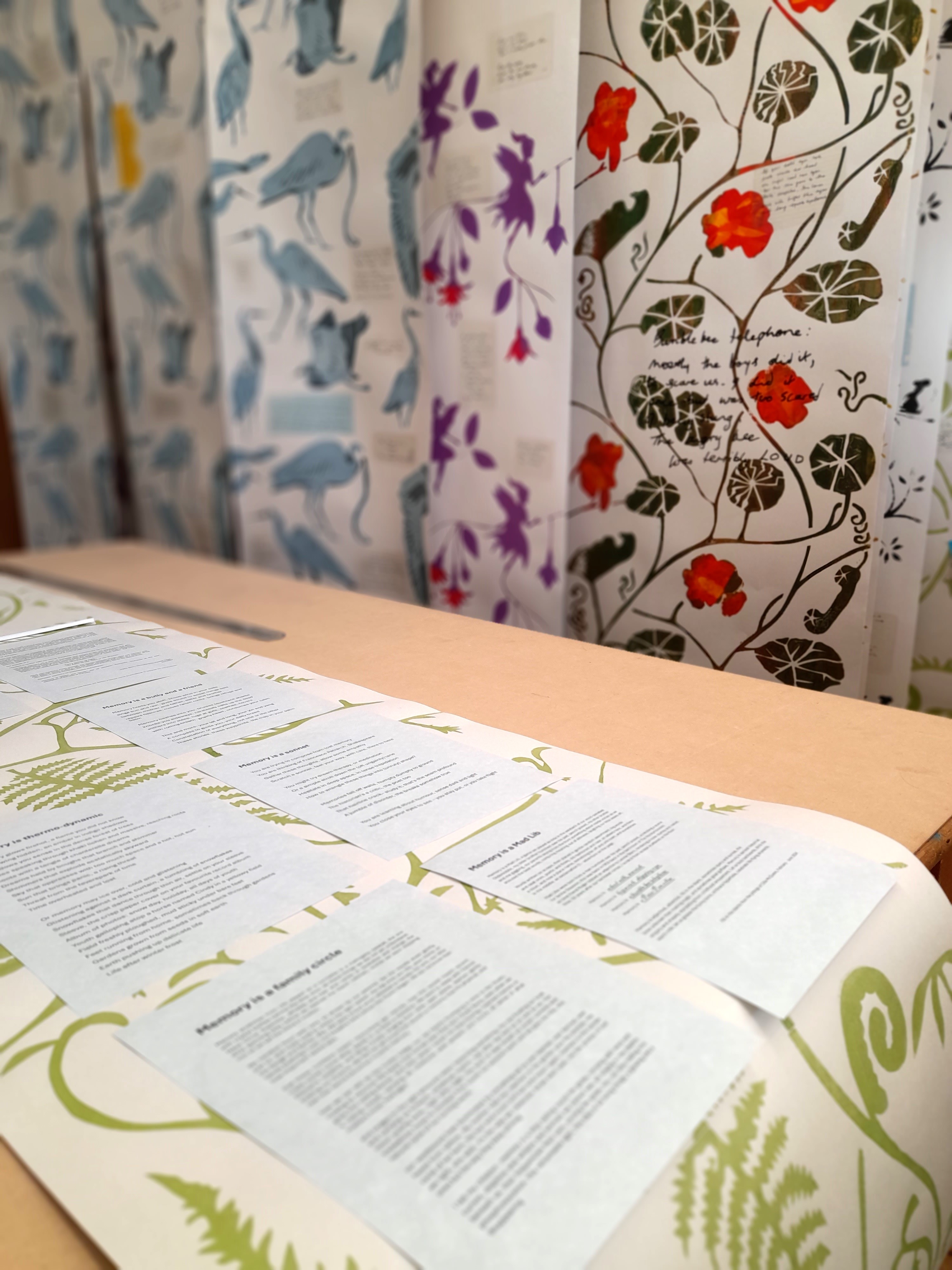
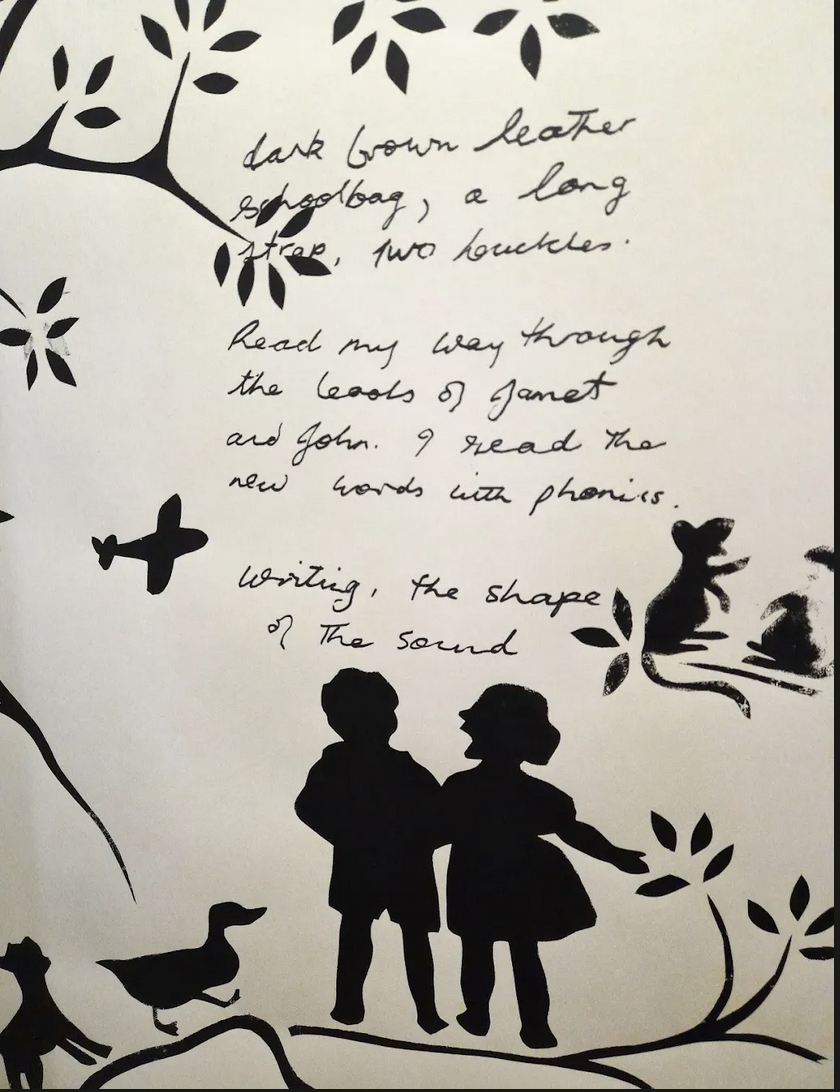
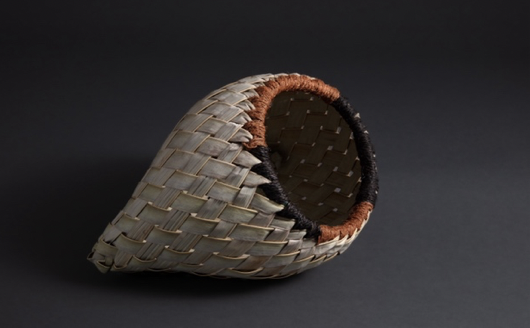
A GOWN IS A GLACIER, RECEDING, Nina Mingya Powles, handbound chapbook, 2024
A gown can be a peony
a gown can be a kelp forest
a gown can hold vast quantities of water
from A GOWN IS A GLACIER, RECEDING
I have Nina’s zine playlist on as I write this, having had boygenius and Phoebe Bridgers albums on replay this past week. If you go to Nina’s website you will find playlists she has created for her essay and poetry collections.
I am reading Nina’s new chapbook as though it is a gown, a glacier receding, following the top thread of lines, eyes dropping to the hem, the second narrow thread at the bottom of the page, stitched between place and fabric, ‘the cotton poplin of my dress / the changing colour of an island in the harbour’, caught in the texture and tissue of the endless possibilities of gown, ‘a gown can trace an outline of a field from one’s childhood’
to the loose threads, ‘the white scholar’s dream to touch the distant place / with his own hands’ to the the sharp needle, ‘”80% of apparel is made by young women / between the ages of 18 and 24 earning under the poverty line”‘, to
‘a departure of Said’s theory of orientalism’, stalling on pleat when ‘a pleat is a sentence written by hand on folded paper’, and there I am, pleated and stitched and folded within a gown of my own making
on the occasion of reading this exquisite chapbook, sweet sharp shine falling from museum archive to faultline to documentary to stretched jeans to grandmother stories to secondhand fabric to Sally Wen Mao’s book The Kingdom of Surfaces that responds to ‘China though the looking Glass exhibition at the Met in NYC in 2015 and the documentary The First Monday in May (2016) that chronicled its making and the accompanying Met Gala.
‘I wash the dress by hand and let it become waves, I hang it to dry by the window and touch the sea through the fabric.’
Guo Pei: Fashion, Art, Fantasy 郭培 :时装之幻梦 “In this Aotearoa New Zealand exclusive exhibition, experience the extravagant, breath-taking fashions of globally renowned Chinese designer Guo Pei. Drawing on influences from around the world and incorporating extraordinary fabrics and bejewelled embroidery, Guo Pei’s striking ensembles of clothing, shoes and jewellery are truly wearable works of art.” Auckand Art Gallery Toi o Tāmariki
Nina Mingya Powles is a poet and writer from Aotearoa New Zealand, based in the UK. Her debut poetry collection, Magnolia 木蘭, was shortlisted for the Forward Prize for Best First Collection and was a finalist in the Ockham New Zealand Book Awards. She is also the author of several poetry pamphlets and zines. In 2018 she was one of three winners of the Women Poets Prize, and in 2019 won the inaugural Nan Shepherd Prize. Her resulting book of essays Small Bodies of Water was published in 2021. She has also published a short food memoir, Tiny Moons (2020). Nina is a pamphlet selector for the Poetry Book Society and is on the editorial committee of Starling magazine.
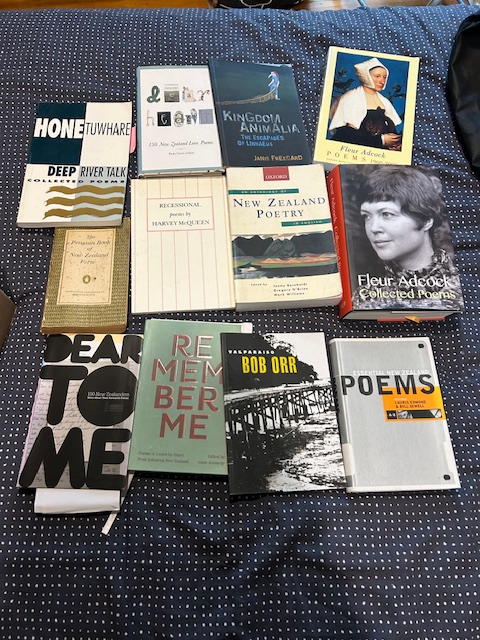
Note: I spotted a copy of Nina’s chapbook in a photograph of the Unity Books poetry table in Wellington. I see they still have one in stock.
For a while the landlady kept a zebra in the kitchen and this zebra was always there when we came down for breakfast, most often standing with its rump to the fire, no doubt dreaming of the lost lands of the savannah and though none of the neighbours believed in the zebra, saying it was an optical illusion, that all changed when bald patches appeared in their lawns, the trampled grass flecked with zebra spittle. It was unnerving to know there was a zebra out there the neighbours said, pulling their dressing gowns tighter around their waists. Ah, so, said the landlady, we must embrace the changing order, an order I might add that has nothing to do with the fires. At that some neighbours crouched, to inspect the ground for hoof prints. Others turned their thoughts to the striped pyjamas they’d seen on sale at the mall. The sun rose, hotter than ever.
Frankie McMillan
Frankie McMillan is a poet and short fiction writer. In 2016 her collection, My Mother and the Hungarians and other small fictions(Canterbury University Press) was long-listed for the Ockham New Zealand Book Awards. In 2019 The Father of Octopus Wrestling and other small fictions ( CUP) was listed by Spinoff as one of the ten best New Zealand fiction books of 2019. In the same year it was shortlisted for the NZSA Heritage awards.
In 2013 and 2015 she was the winner of the New Zealand Flash Fiction Day competition. She has won numerous awards and creative writing residencies including the Ursula Bethell residency in Creative Writing at the University of Canterbury (2014) the Michael King writing residency at the University of Auckland ( 2017) and the NZSA Peter and Dianne Beatson Fellowship (2019). Her latest book, The Wandering Nature of Us Girls ( CUP) was published in 2022.
The Caselberg Trust will soon be calling for entries for the 2024 Caselberg Trust International Poetry Competition. Now in its 14th year, the Trust is delighted to announce that Dunedin’s finest book shop – the University Book Shop is supporting the poetry prize again this year, and will also host our awards night to coincide with the publication of Landfall 248 Spring 2024. Thank you to everyone at the University Book Shop for your ongoing support.
The competition opens Saturday 1 June and closes on Wednesday 31 July 2024. Entries are judged blind. First Prize is $500 (plus one-week stay at the Caselberg house at Broad Bay, Dunedin). Second Prize is $250; and there are up to 5 Highly-Commended awards (no monetary prizes).
The first- and second-placed poems will be published in the November issue of Landfall, and all winning and highly-commended entries will appear on the Caselberg Trust website (copyright remaining with the authors).
Performance, David Coventry, Te Herenga Waka University Press, 2024
Please join us to celebrate the launch of Performance, the new novel by David Coventry, to be launched by Tracey Slaughter.
Thursday June 13 6pm Unity Books 57 Willis Street, Wellington. View more info here
All welcome! Drinks and refreshments provided.
For Coventry, ME radically overturns the rules of time, thought and embodiment – an experience which has shaped the writing of this book. Through an illuminating blend of life transcription and deep imaginative projection, he shows how placing fiction into the stories of our damaged lives can remind us of who we are and who we might have been, even when so much of us has been taken away by illness.
From a mountaineering disaster in Kaikōura to a literary encounter in Austria, a country mansion to a volcanic archipelago, this novel is a strikingly vivid, at times disorienting series of journeys, stopovers and emergencies that take in the world, one in which Coventry is often an outsider, even when at home in Wellington. With purposeful unreliability and flashes of humour amid pain and searching, Performance takes us into a space where ‘reading’ itself fails as a description of how we meet the text. This is a generous, unforgettable vista of life within illness.
Hopurangi Songcatcher, Robert Sullivan, Auckland University Press, 2024
Auckland University Press and Scorpio Books invite you to celebrate the launch of Robert Sullivan‘s new poetry collection Hopurangi—Songcatcher. Inspired by the cyclical energies of the Maramataka, these poems see the poet re-finding himself and his world – in the mātauranga of his kuia from the Ngāti Hau and Ngāti Kaharau hapū of Ngāpuhi; in his mother’s stories from his Ngāti Manu hapū at Kāretu; in the singing and storytelling at Puketeraki Marae, home of his father’s people of Kāti Huirapa, Kāti Māmoe, Waitaha and Kāi Tahu Whānui in Te Tai o Āraiteuru; and in the fellowship of friends on Facebook.
All welcome, light refreshments provided. Arrive from 5.30pm for a 6pm start.
Tarot, Jake Arthur, Te Herenga Waka University Press, 2024
Join us on the eve of the solstice to celebrate Tarot, a new poetry collection by Jake Arthur.
Thursday June 20 6pm Moon Bar 167 Riddiford Street, Newtown, Wellington View more info here
All welcome!
Here are the cards. Put your hand on them, Close your eyes. You don’t want to? But you are blind with them open.
Tarot, Jake Arthur’s beguiling second poetry collection, opens with a tarot reader coaxing us into a reading over a cup of tea. And in a rush of vivid scenes and impressions, we begin to imagine episodes from different lives – a woman tries to train a robin; parents anxiously attend a teacher–parent interview; a man is cast overboard and wonders if he will ever be found. Each card prompts a new character to mull over their uncertainties, hopes, obstacles and joys.
Loosely inspired by the illustrations of the famous 1909 Rider-Waite tarot deck, with its riotous depictions of magicians, occultists, lovers, fools and angels, these poems have us grappling our way towards a clear path.
Poetry Shelf is taking a short nap for the coming week. After a tough few months navigating a stretched health system, it feels like a mountain has lifted. But sometimes when a mountain lifts you get a smash of tiredness. This is a long slow recovery road. No change there. Today I am feeling for everyone who is struggling to cope with health challenges, overdue bills, overwork and low pay, racism, homophobia, concern about nature and the state of our planet, war and its inhumane effects upon innocent people.
I love furnishing Poetry Shelf, establishing connections, spotlighting new books, showcasing authors, ideas, writing of all genres, coming up with new series. I know that more than anything, in these turbulent times, whether personal, local or global, we need to find ways to tend and build our daily joy, our self comfort, and to reach out to the person standing next to us. Poetry Shelf, for me, is solace, diversion, inspiration, heart. And it only works because you are part of it.
Poetry Lane
It leads down to the river where you can sit all day contemplating the slow walk home.
‘I just want my old life back,’ you said one evening, already fluent in the secret grammar of grief.
Out there, the sea wrinkles and slides; a kererū wobbles in the cabbage tree; clouds pile up; leaves catch fire in autumn light.
In here, the music and the books distract; friends serve coffee and sympathy; stray lines gather coincidence.
Meet somebody; complete some task; fill the unforgiving minute etc This warm hand reaches for yours.
‘I just want my old life back,’ you said one evening, already fluent in the secret grammar of grief.
Harry Ricketts
Harry Ricketts lives in Te Whanganui-a-Tara/Wellington. He has published around 30 books. His memoir First Things has just appeared from Te Herenga Waka Press, and a new collection of poems Bonfires on the Ice is due out from the same press next year.
an alchemy of distance: your absence, sisters, stirs longing your telephone talk/ raking embers from the muses’s fire. the spirit rises to the task, & I from the couch/ awake now to take up the story where the last daughter left off/ giving voice to the silence/ inside green mountains looming/ from a warm sea & voice/ to the insides of calderas/ cooled volcano’s tilted cup half-sunken to carve harbor from expanse of ocean
Caroline Sinavaiana-Gabbard, from ‘soiree’ in Alchemy of Distance, Tinfish Press, 2002
As things tip and slide and the gap between the moneyed class and the disenfranchised widens, catastrophic wars continue to rage, our nurses and doctors are stretched to breaking, our founding treaty is under heartbreaking threat, the wellbeing of everyone is hijacked into the wellbeing of the elite ….
….. furnishing a hub for local writing, books and authors, with love and celebration, is so important. This is the imperative of Poetry Shelf.
A highlight: a poet whose debut collection I adore, Isla Huia, answered my ‘5 Questions’, and I was moved by her responses. So open and honest and thoughtful. So resonant.
“For my own writing, I aim more for heart, mind and wairua than ear or eye. I want my writing to physically move me back to the place, circumstance or perspective I was in when I wrote it. I want it to feel entirely tika, and raw, and I want to understand myself better for having written it. Sometimes, that doesn’t translate onto the page, or feel palatable or decipherable to an outside audience; but it’s always the place I write from, regardless. How my readers interact with my work is secondary to whether or not I feel like I am entirely, uncompromisingly myself, within it.” Isla Huia
A highlight: I spent much of the last few weeks reading my way through Vincent O’Sullivan’s poetry collections, and again, was moved and boosted by his writing. Various people selected one of Vincent’s poems that has touched them and wrote a few comments for my tribute post.
Today my heart goes out to all the friends, whanau, academics and writers who are mourning the death of Dr Caroline Sinavaiana-Gabbard, acclaimed poet, retired professor, environmentalist, historian, in tragic circumstances in Apia. She became a professor of creative writing and Pacific literature at the University of Hawaiʻi at Mānoa. In 2002, she published her collection of poetry, Alchemies of Distance and in August 2020, she was named by USA Today on its list of influential women from US territories. Selina Tusitala Marsh has written a piece and a poem for her beloved friend on The Academy of New Zealand Literature. You can read the piece and poem here.
“Sinavaiana fearlessly confronted the painful legacies of colonialism and diaspora that have shaped our communities. Her poetry wove together deeply personal reflections with sharply political messages, inspiring us to find courage and resilience in the face of adversity. With every line, she affirmed the beauty, strength and mana of our Samoan heritage.
‘Though we mourn Sinavaiana’s passing as a profound loss, her spirit and impact live on through the many lives she touched. She reminded us that we all have a voice to stand up for our beliefs, speak truth to power, and work towards a more just, equitable future for Pacific peoples everywhere.”
Community feels so important at the moment, and yes we must question and challenge our current government, but it is also vital to connect through self and mutual care. We need, more than ever, to cherish the daily miracles, the good in the world, to be kind to ourselves, and to say ‘no’ as often as we need to.
Friday: A Vincent O’Sullivan gathering, a suite of poems with comments – A reading to launchStill Is, by Vincent O’Sullivan, THWUP
A musing and a poem
Attention spans. I read an article in The New Yorker this week on our shrinking attention spans, our addiction to multi-tasking. It got me musing on rhythms of haste, on sound bites and headline snatching, on opting for playlists over albums. On how I keep questioning my penchant to post longer gatherings on the blog. To write a review of a book and add in an audio and a conversation with the poet. To create a gathering of voices for weekend sojourns. To offer poetry as a place to slow linger, accumulate ideas, feelings, sideweavings.
Not that I am not drawn to the snapshot. Heck! There was so much love for my couplet feature, by both poets and readers, I am working on a sequel.
I am also slow-pace working on a children’s book feature at the moment, and I am thinking a lot about working with children, sparking and holding their attention, and how our books, stories, poetry, can open vital portals on themselves and the world, whether imagined or actual. And how my primary aim as teacher and children’s author is to get the child to fall in love with learning, to want to walk over the threshold of the classroom, to itch to pick up a book and read, to hold a pen and write, to open mouths and speak or sing. In both sweet short snaps and in longer discovery-unfoldings.
This week, I had my specialist checkup at hospital, and we were early so had a coffee in the foyer. As we waited, a bloke picked up his guitar and sang a waiata; people joined in, people stopped in their tracks and sang. Faces glowed warm. It was a gift and I am still feel warmth from it.
Hospital
A dude guitar-strumming, everyone singing sweet aroha in the hospital foyer, hands on hearts, and it was the shuffle runner running into the wind, the gull atop the motorway lamp post eyeing the slow traffic crawl, the fickle flash of blue sky, the news bulletin’s dark clouds, the poster asking us to mask up but not a mask to be seen, the ‘no RAT tests needed anymore’, everyone with back stories in their pockets and noxious nettles stinging their eyes, the oat milk latte hitting the spot, the bloke on the radio telling me Louis Braille invented his system at the age of fifteen, and I am on the hospital bench listing ways to travel from A to Z, as happy as Lucy and Larry, the barista swaying to the waiata beat.
Vincent O’Sullivan with Philip Mann at the site of the military internment camp outside Featherston, photographed by Robert Cross during rehearsals for Shuriken in August 1983.
Sarah Therese we call you, A name that is only yours- Although ‘only yours’ is the gift of that small pause
In time when we and you Are as close as this, To say your name, to say “She comes, our girl, she goes.”
Yet we have been together. Known each other’s touch. We know to speak of little Or of much
Are not the words to use For what you give. With love you came, our Sarah. Now go with love.
Vincent O’Sullivan
Selected by Dominic O’Sullivan and the family. Dominic writes, “As far as I am aware, this untitled poem is unpublished. It is inscribed on the headstone of my daughter Sarah at Newstead in Hamilton. She died at birth in 2006. Vince read the poem at her funeral.”
LaunchStill Is of at National Library of New Zealand, Wellington, June 21
Born in Auckland in 1937, Vincent O’Sullivan was one of New Zealand’s leading writers, acclaimed for his poetry, plays, short stories, and novels, which include Let the River Stand, Believers to the Bright Coast, and the Ockham-shortlisted All This By Chance. He was joint editor with Margaret Scott of the internationally acclaimed five-volume Letters of Katherine Mansfield, edited a number of major anthologies, and was the author of widely praised biographies of John Mulgan and Ralph Hotere. He taught at Waikato University and Te Herenga Waka—Victoria University of Wellington, and was the New Zealand Poet Laureate for 2013–2015. In 2000, Vincent was made a Distinguished Companion of the New Zealand Order of Merit, and in 2021 he was redesignated as a Knight Companion of the New Zealand Order of Merit. He died in April 2024.
To clear a string of days, to put cello or piano or violin on the turntable, to gather Vincent O’Sullivan’s poetry collections from my shelves, is to embark on an autumn vacation, to savour the views, to let poetry simmer and sing as I read. Lines and phrases, images and circumstances, stall me. I am charting my own reading pathways, predilections, gathering touchstones that resonate. On a different occasion, I might savour the presence of story, the characters, so often unnamed, the girl boy woman man goddess god, but in this sweet autumn sojourn, I am entranced by a weave of ‘being’. Perhaps it is arcing back to the 1970s and reading Be Here Now, and then returning, again and again, to the miracle of now, to the joy of looking and pausing. I am remembering Vincent’s collected poems published in 2015, is entitled Being Here.
Reading the poetry of Vincent O’Sullivan, I am pausing and I am looking.
‘Still at your window,’ they say, ‘can’t you give it a rest?’ Not on your life, tell them, not on your earthly.
from ‘Still waiting are we?’ in Nice Morning for it Adam, Te Herenga Waka University Press, 2004
Across all the collections, Vincent’s writing encourages us to slow down and absorb a moment, an object, a setting, a gesture, and to let that shimmer and settle within and beyond the frame. The titles so often underline the tiny tremors, the unfixed, the degree of surprise, the arrival of anchor. I could use the word philosophical to signpost the strands of thinking. An early collection, Bearings (Oxford University Press, 1973), foreshadows a future of pathfinding, of residing and expanding ‘the spaces we have no words for’. And yes, so exquisitely yes, poetry that is finding the words to silhouette and map such spaces.
An acknowledgement of the ephemeral enlivening the physical is a steady refrain, as Vincent keeps returning to ‘this and this, nothing is quite lost’. The world, large and miniature, is still this. It is garden, weather, birds, nature, orchards. It is picking the succulent apricot and sharing with a beloved. It is relishing both fruit and single moment.
Vincent’s acute awareness of the indeterminacy of writing, of how poetry is this, and this, and this, heightens the delight of reading his work. It sitting under a tree by the museum, or on an evening with friends, musing on the thought that ‘something will happen after every poem for a long / time yet’. It is ‘the colour of going’ and ‘how things are’.
As often as a vein ticks, the commodious promise between each tick, the fat stars dangle their colossal order, the heart swirls its small time pander
that Now adds up: for longer than the mind knows its trawl can manage, to something out there with design that takes us in, in language’s jigging bucket hoisted
into light.
from ‘as is, is’ in Lucky Table, Te Herenga Waka University Press, 2001
So often Vincent invites us into exquisite poetry clearings, whether as reader, friend, loved one, drawing us into his conversations, his reckonings, his thinking, his concern. Listen to some of his titles: ‘All right then, are we?’, Things OK with you?, Seeing You Asked. There are multiple ways to find our bearings in the scope and depth of his work: multiple vantage points, elevations and uplifts, arrivals and returns, ways back into a luminous moment. I am imagining one of Vincent’s utterly precious poetry books in your hands, as you set sail reading, in awe and in love with what words can do. Looking, listening, pausing.
Not much, but can do better
Every day the century failed a boy woke and knew beyond all doubting, there were fish in a river only he had wind of.
Each morning statistics piled in their parody of a baker’s window, a girl knew for certain there was a horse
she’d ride before the day was out. There were rooms all over where good things were said, excellence achieved , even on evenings
when the sentences were passed and the magazines loaded. In the palest edging of dawn ribbons billowed out
as a child dreams them and hands moved across each other as surely as ice cracked outside. These are things slipped
into books, uneventful scraps—a leaf from a tree, a stalk from an August paddock, a brittle violet.
But show them to someone, say, in a hundred years, the book freakishly opened as it’s never been, you’ll hear the afternoon lean
across a forest, smell harvest as high as your chest, almost feel the fingers brushing along the page. ‘This is the story, isn’t it,
in a book, making it seem all right?’ But so it was, that day, that afternoon. So it was, before tomorrow.
from ‘Not much, but do better‘ in Blame Vermeer, Te Herenga Waka University Press, 2007
I invited a group of Vincent’s friends to select a poem of his they loved, and to include a few comments on why they are drawn to the poem. I am grateful to Fergus Barrowman and Bill Manhire for help in creating this tribute, and to those who have participated. My thoughts are with friends, family and fellow poets. Thank you. I offer you this gathering, a slow weekend gathering, so that you too may pause and listen.
Photo by Grant Maiden, 2017
A suite of poems by Vincent O’Sullivan
The thinker in the greenhouse
Philosophy has so helped me over the years. The kind where the words fight the things the things insist they are. There is little I am not receptive to, once ‘receptive’ is defined. How can one not accept the demand to be exact?
I change flowerpots about in the small conservatory my wife speaks of as though Kew isn’t in the running. She tells me the pretty yellow speckled pillows are calceolaria. She advises never to question the Latin of those with green fingers, the quality of garlic depends on its grower speaking French. In the light of the conservatory we seem to touch more often. We are less likely to regret.
As though a boy, my popping the fuchsia buds to a little war of their own. True gardeners deplore, quite rightly, this inventing allegory as fun. Nature intends. There are no limits to pleasure.
My wife instructs, too, certain plants that sting one has no right to speak of unless one has been stung. In late afternoon, there is something cloistered to a greenhouse. There is the faintest chanting one all but hears. Something is winging through. You are part of the wing.
Vincent O’Sullivan from Things OK with you?, Te Herenga Waka University Press, 2021
Lynley Edmeades: Many of Vincent’s poems hold the sound of his voice, and I can hear him speaking this poem as I read it as if we’re having a cup of tea together. The slightly syncopated rhythm; the Irish lilt in the use of ‘so’ in the opening line that sings the songs of his ancestors; the immense skill he had of bringing the existential into the quotidien. And always, that incredible way that Vincent had of reminding us, with such grace, that for all our egos and posturing, we are not the world, but part of it: “There is the faintest chanting one all but hears./ Something is winging through. You are part of the wing.”
Morning
This morning I have shifted two goats tangled under a feijoa, given them a bank half blackberry, half rusty clover-like weed they prefer to ignore, I have given them pretty much what life does.
Then I look at my birch whose almost falling leaves are curled, as though matches were held near them until green shrank brown.
There is mist along the river, the three cats loll after feeding, the mown grass sticks to my shoes, brings the morning inside.
That is all my morning comes to, April morning, autumn— goats on a lush bank, three cats indulged, wet lawn, a birch ready to lose its leaves, let leaves drop, dry leaves. Birch showing through like a woman, a word that matters, a guitar string streaming white against the morning.
Morning.
Vincent O’Sullivan from Bearings, Oxford University Press, 1973, and in Being Here: Selected Poems, Te Herenga Waka University Press, 2015
Anna Jackson: In the end, I couldn’t go past ‘Morning,’ the first poem in Being Here, Vincent O’Sullivan’s Selected Poems. It is a poem that lingers on the details of a day, as if a little puzzled at its own lingering, when the morning has after all amounted to nothing more than this – moving the goats, indulging the cats, looking – and then looking again – at the birch leaves. In a later poem, ‘The Monastic Life,’ a man is obsessed by elephants – seeing one elephant starts him off on a quest to see more, every new elephant only fuelling the desire for a greater understanding, the particularity of the individual only taking him further and further from the elephant as concept. It ends with the wonderful line about the elephant as a theology that sways. I love that line! But while the man in ‘The Monastic Life’ insisted that only the grandeur of the elephant was worthy of his attention, a Vincent O’Sullivan poem can make anything shine – this too is a very moving kind of theology.
The child in the gardens: winter
How sudden, this entering the fallen gardens for the first time, to feel the blisters of the world’s father, as his own hand does. It is everything dying at once, the slimed pond and the riffling of leaves, shoes drenched across sapless stalks. It is what you will read a thousand times. You will come to think, who has not stood there, holding that large hand, not said Can’t we go back? I don’t like this place. Your voice sounds like someone else’s. You rub a sleeve against your cheek, you want him to laugh, to say, ‘The early stars can’t hurt us, they are further than trains we hear on the clearest of nights.’ We are in a story called Father, We Must Get Out. Leaves scritch at the red walls, a stone lady lies near the pond, eating dirty grass. It is too sudden, this walking into time for its first lesson, its brown wind, its scummed nasty paths. You know how lovely yellow is your favourite colour, the kitchen at home. You touch the big gates as you leave, the trees stand on their bones, the shoulders on the vandaled statue are huge cold eggs. Nothing there wants to move. You touch the gates and tell them, We are not coming back to this place. Are We, Dad?
Vincent O’Sullivan from Nice morning for it, Adam, Te Herenga Waka University Press, 2004
Bill Manhire: ‘The Child in the Gardens: Winter’ does exactly what Emily Dickinson once mentioned as proof that poetry is present: it makes your whole body feel so cold that no fire can ever warm you. For me it’s the voice of the child at the end – that sudden, trusting, troubled question: ‘Are we, Dad?’ – that’s truly devastating. Here’s the instructive note Vincent wrote about the poem for the 2002 edition of Best New Zealand Poems: “So many poems and stories are about being tossed out of the garden (usually Eden) that I was interested in one where people actually wanted to leave. And instead of it being a good place to be (the beginning of all) it was rather a grim place, a place where things ended. Perhaps the son and the father might be taken in different ways, but I didn’t want them to be at odds as they are in the Eden story, but close and trusting before and after they pass the gates. A dead myth is good to leave behind; and winter of course is where so many myths die – at least for a while.”
Listen to Vincent reading the poem on The Poetry Archive.
Right on
A dead overturned beetle can look as if it’s feeling in several fob-pockets at once, checking the beetle version of time when the ticking stopped on cue. A dead beetle looks as though there’s nothing left to do, supposing it stayed alive. Dead and complete. While the squashed face of a bog-man like a school satchel run over and over never looks, does it, as though that’s it, as though this is exactly what Ending had in mind? Even untainted saints in their glass pods outsmarting conclusion are ‘sleeping’, as we say, that’s as far as words take us, this time round. A trite thought on a sunny morning, the tiny carapace rainbowing as your finger flips it over. It was alright being a beetle, the sun says off the still bright back, there was nothing round here not actually done.
Vincent OSullivan from Lucky Table, Te Herenga Waka University Press, 2001, originally published in I’ll Tell You this Much, Pemmican Press, 2000
Chris Price: A poem about the big things – time, mortality – wrapped up in close attention to the extraordinary nature of a small creature that’s often overlooked, or considered (if it’s considered at all) as insignificant. The poet reminding himself, perhaps, with that capacious brain of his, full of the sardonic laughter and restless intellection found throughout his work, that this beetle is the real deal – when all’s said and done, a beetle, or (as in other poems) an apple or an apricot, is the self-sufficient and untainted thing, its being its own reason for being. Its life and death taking the whole over-complicated human enterprise down a peg or two: a classic O’Sullivan manoeuvre.
Check-out
The librarian I was brought up to admire, ‘sir’ I called him as I did no one else, he called me ‘sir’ back, looking across his half-moon glasses with what people liked to call ‘the innocence
of a lamb’. (It is always good if the best read man you can think of goes a beat behind ourselves in worldly cunning.) He was known for mild jokes and good humour, for a certain
staleness if you stood too close, for turning up appropriate verse at a moment’s notice for the unexpected wedding or passing on. He said, the one time we spoke as two adults,
‘I have been reading for a lifetime in the hunt for evidence that humans are less than vile, that good persists.’ He looked at me as when he called me ‘sir’. ‘I should have closed the first book and collected stamps.’
Vincent O’Sullivan from Further Convictions Pending, Te Herenga Waka University Press, 2009
Michael Hulse: Vincent possessed the ability to sink a sudden plumbline down through the everyday into horror. This unprepossessing poem appears to be talking casually about the transition from childhood to adulthood, about social attitudes and stereotyping, and above all about one man everyone imagined they knew. All of this is deftly in the poem, but in a devastating moment of openness the librarian reveals himself to be intimate with evil, despairing of ever finding evidence that humanity has a better side, fearing that his life’s pursuit has been without meaning. I imagine his words finding their place in Vincent’s notebook, Vincent knowing that they raised the hairs on the back of the neck as surely as anything in Housman or Sebald. Knowing what to do with a donnée, how to throw it into relief, is a crucial skill in anyone who works with words. In the case of one as well-travelled as Vincent in the dark as well as bright places of heart and mind, poems such as ‘Check-out’ act as a penumbra, the necessary shadow-realm against which the fine celebratory poems such as ‘Still waiting, are we?’ or ‘Being here’ can be understood as full joyful daylight.
Michael Hulse is an English poet and translator with long-standing ties to New Zealand writers
8
On the day my father died a flame-tree with its stiff immaculate flares cupped over the leafless branches outside the hospital window said for us several things voice could not get round to,
yet not only and not foremost the riding of life above the stark branches nor the perfect Fin once the work is done, as though time’s shining is when the match is struck and is over, so.
It spoke, each opening red fist only feet from dying, of small errors, of mornings forgotten by afternoon, of words taken or words put down lightly as a glass, or laid like a single log on a fire,
or touched as the head of a child absently while other words moved on; the looks, brushings, immediate treasure, the cusps of morning lifting as sky lightens the withholding tree.
Vincent O’Sullivan from Brother John, Brother Kafka, with prints by John Drawbridge, Oxford University Press, 1980 also published in Being Here, Selected Poems, Te Herenga Waka University Press, 2015
Kirsty Gunn: I have had a photocopy of this poem – taken from the collection, and the sequence of which it is a part – in the drawer of my study desk ever since it was published. There it lies, the single leaf of paper, beneath a whole lot of other papers and letters and bank statements…A single poem that seems to contain all of this world and everything beyond it: An image, a set of gestures underpinned by loss, the sense of absence set at the heart of the world… And yet life ever present. How I love it.
All right then, are we?
We’d been walking across farmland to the coast, the sea-lions you’ve warned to keep at a distance, the cliffs that sensibly you imagine are most to be avoided by solitary walkers, the weird glance
that at times can make you wonder, ‘Should I ask if he feels all right?’, although we never do and then forget we’ve thought it, and the stiff plod on the dunes, collars turned at the southerly blow-
ing in from the scoured ice, the furthest sea. ‘It’s the loneliness I love,’ sometimes one of us says, ‘the appalling edge, the vast extremity of whatever we care to imagine beyond the haze.’
On the way back, the dog raging at gulls raucous and out of range, at a rabbit’s breaking cover close to the pines, the forecast squalls smudging the edged-in horizon, the hacking
of a motor on the estuary’s dull reflected cloud. Then, ‘Is there anything sadder?’ you say, seeing a dead tractor tilted by a stack of collapsing wood. Once back on the road we put the dog on its lead,
find the car, drive in from the always deceiving coast. And later, ‘It was bitter all right out there,’ the storm following us in, its slanted, flailing sleet. And the loneliness out there; back here.
Vincent O’Sullivan from Being Here: Selected Poems, Te Herenga Waka University Press, 2015
Majella CuIinane: I love this poem for its sense of wonder, for its subtle and vivid evocation of landscape that intensifies over its six stanzas. The scene is familiar to me – Aotearoa’s deep South, very possibly a beach on the Otago peninsula, or somewhere in Ōtepoti Dunedin, Aramoana or Tunnel Beach perhaps, or maybe even Southland, with that reference to the ‘scoured ice, the furthest sea.’ The rhythm is mellifluous, the tone beguiling as the reader is invited into the scene with the kind of question that many of us think to ask strangers we momentarily encounter, but for whatever reason don’t: ‘Should I ask if he feels alright?’ And then, that bold admission in the third stanza: ‘It’s the loneliness I love,’ and of course it is that loneliness and absence that draws the poet’s sensibility in, deeper and deeper and into ‘whatever we are to imagine beyond the haze.’ The repetition of sound and action in the 4th stanza – ‘the dog raging’, ‘the rabbits breaking,’ ‘squalls smudging,’ leads to the surprising, unexpected question in the 5th – ‘is there anything sadder?’ But no, not in terms of life per se, but rather the specificity of a ‘tractor tilted,’ an object abandoned and forgotten. The poignant final stanza sums up the memory of the experience and how “it was bitter all right out there,’ which is what many of us might say as we return from a ‘southerly blowing in’ to the warmth and safety of a car or the indoors. The knowledge too that something of the place: ‘the storm following us in’ lingers – lingers in the loneliness of the landscape, which echoes the loneliness that resides within us, and inspires us to ask ourselves: ‘All right then, are we?’
Ida Valley
The paddocks iced over for weeks, sky scoured each morning, the frost even at noon thickening with intent.
Hawks tracking the warm highway count on a smeared rabbit as lucky strike. Ignoring traffic, a persistent beak
hauls at a red thread from the splattered gift, draws a quote declaring how God looks after his own, which
this day he does. Guts laden with kill lift deftly. Sun flares its wingspan. Night nails down.
Vincent O’Sullivan from The movie may be slightly different, Te Herenga Waka University Press, 2011
Sue Wootton: Reading the title of this poem, and embarking on its first words, you might be thinking, ah, how sweet, a lovely landscape poem, a pastoral. Perhaps some memory of a Graham Sydney on a gallery wall springs to mind. You keep reading, and are swept through the sing-song metre of the first line so swiftly that you might be slow to catch on that you’re not being offered a behind-glass tourist view of the Ida Valley. Maybe what pulls you up short is the abrupt change of metre in the second line, the way the full bleakness of the scene suddenly hits ear and eye – bang, bang – with ‘sky scoured’. Now you hear them you can’t unhear them: the ‘s’ and ‘k’ sounds that slip and crackle through this deadly poem. Reading ‘Ida Valley’ with an ear on the sounds, a finger on the rhythms and an eye on the images is a mini master class in how to weave a satisfying poem.
Another reason I love ‘Ida Valley’ is that I can hear another poem nesting, so to speak, within it. The ‘red thread’ in ‘Ida Valley’ leads me back decades to one of Vincent’s Butcher poems, ‘Still Shines When You Think of It’. A hawk is central to that poem too, ‘closing sweet on something, / death, that perfect hinge’. When I read ‘Ida Valley’, Butcher is there with me. His assessment? Succinct, blunt, absolutely nailing it: ‘ah! feathered guts!’
Honoured writer at the Auckland Writers Festival, 2016. Photo by Marcel Tromp.
Just finding the day
The thrushes are back. The blackbirds too are back, already worrying the thrushes, filching their choice worms. The gorse is running the hills along the Aramoana Road, spills the slopes yellow; the broom, so much more politely, you call it gold. Look again, the gorse walks prickling against the skyline. This is September. Today would have been my father’s birthday, were 126 thought a reasonable lifespan. The black swans with their necks carved into questions, take over the shallows round from Deborah Bay. Further, at the ocean’s rim, oystercatchers busy as door-knocking Adventists, time’s surf certain behind them, soon moving inland. There’s nothing extraordinary about this. With us, and the dogs, and the ceremonious sea, as if there need be. Just finding the day.
from forthcoming Still Is, Te Herenga Waka University Press
Fergus Barrowman: ‘Just finding the day’ comes very near the end of Still Is (due June 2024), and was the poem that stayed with me most strongly after my first reading of the manuscript in late February.