Because there was a poster of a hot air balloon in your room
and because its rainbow stripes enchanted you and perhaps because your mum was up to her elbows in laundry for other people’s kids again, your sister decided to jump into that hot air balloon when it appeared for real—a ball of triumph in the soggy sky. You got close to her face as she hurried your mum’s plum lipstick over her mouth and swiped swimming-pool blue around her eyes. It makes your freckles look way oranger, you said, but she said I don’t care, hot air balloons are made up of every colour and flounced out the backdoor, her clip-on earrings winking, her outfit of lace and ribbons laughing in the ice-block air. And because the days are long in winter, and because there was more adventure in you than a jungle gym, and perhaps because your mum was on the phone again going I am paying soon, really soon, couldn’t you just give me another couple of days? you followed your sister into the garden, even as the mud squelched over your ankle socks, and you climbed after her, even though the tree was dark with rot, and the hot air balloon got so bright, so close, so low above the tree that it was not just a game anymore and you shouted Wait up! and only then realised, once again, that you’d forgotten to ask if there was room enough for two. So you just stayed there, alone in those branches that were just like your own mother’s arms, so thin and so hard from smacking away every blasted gale that ever tried knocking you down.
Zoë Meager
Zoë Meager’s work has been published in Cheap Pop, Ellipsis Zine, Granta, Hue and Cry, Landfall, Lost Balloon, Mascara Literary Review, Mayhem, Meniscus, North & South, Overland, Splonk, and Turbine | Kapohau, among others. She’s a 2024 Sargeson Fellow.
Staring up into the sky my feet anchor me to the ground so hard I’m almost drowning, drowning in air, my hair falling upwards around my shoulders, I think I’ll hug my coat closer. I’m standing on hundreds of blades of grass, and still there are so many more untrodden on. Last night, in bed, you said, “you are the sheet of linen and I am the threads,” and I wanted to know what you meant but you wouldn’t wake up to tell me and in the morning you didn’t remember, and I had forgotten till now when I think, who is the blades of grass, who is the pasture? It is awfully cold, and my coat smells of something unusual. It almost seems as if it is the stars smelling, as if there were an electrical fault in the sky, and though it is almost too dark to see I can see the sheep moving closer, and the stars falling. I feel like we are all going to plunge into the sky at once, the sheep and I, and I am the sheep and I am the flock, and you are the pasture I fall from, the stars and the sky.
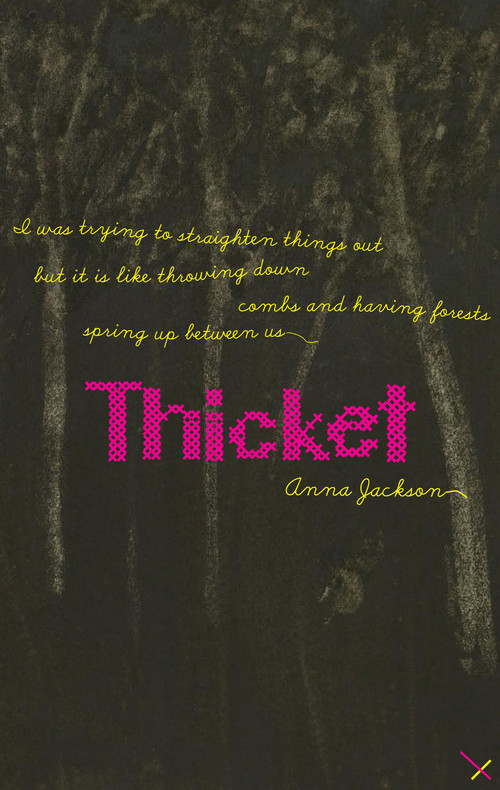
Anna Jackson from Thicket, Auckland University Press, 2011
I have been thinking a lot about the place of poetry in global catastrophe, violence, indifference, greed and the incomprehensible leadership in Aotearoa. How and what do we write? Read? Do we need comfort or challenge or both? This week Anna Jackson.
5 Questions
Has the local and global situation affected what or how or when you write poetry?
Yes. It doesn’t feel possible to write. When I would have been writing, I have been going on protest marches. Agnes Callard asked if I would go on protest marches even if I knew it would not be instrumental in bringing about the change that the protest march was demanding, and I answered yes, in the same way I would go to a funeral even if I did not think it would restore the dead to life. But I do think that protest marches can be instrumental, and I do think writing can be instrumental. And, to be honest, there are many marches I didn’t go on, even though I thought that I should. On one of those times, I even found myself writing.
Does place matter to you at the moment? An object, an attachment, a loss, an experience? A sense of home?
I just want to stay home with the hens. For a while I had no hens and I was free to go anywhere, but now I have hens again.
Are there books or poems that have struck a chord in the past year? That you turn to for comfort or uplift, challenge or distraction.
There are two poems that I have been particularly affected by. One of them, “The Quiet,” by Jorie Graham, I found literally hair-raising – truly, the hairs were standing up on my arms. It seems almost impossible to write about the climate crisis – though equally almost impossible not to – but this poem captured the uncanny horror of it. And then the other poem is Ilya Kaminsky’s “We Lived Happily During the War.” This is also a strange kind of horror, to not be affected by events that are causing others such trauma. This poem doesn’t offer any absolution. I don’t want it to.
What particularly matters to you in your poetry and in the poetry of others, whether using ear, eye, heart, mind – and/or anything ranging from the abstract and the absent to the physical and the present?
I think it is finding a rhythm, and then the feeling comes out of that. It is the rush of “The Quiet,” and the right-justified margins, and it is the quiet of “We Lived Happily During the War.” I don’t know. I don’t feel as if I’ve written a poem unless the rhythm is doing something interesting, and unless it has some kind of emotional effect.
Is there a word or idea, like a talisman, that you hold close at the moment? For me, it is the word connection.
Open.
I love that word too. Resonant, vital, connecting.
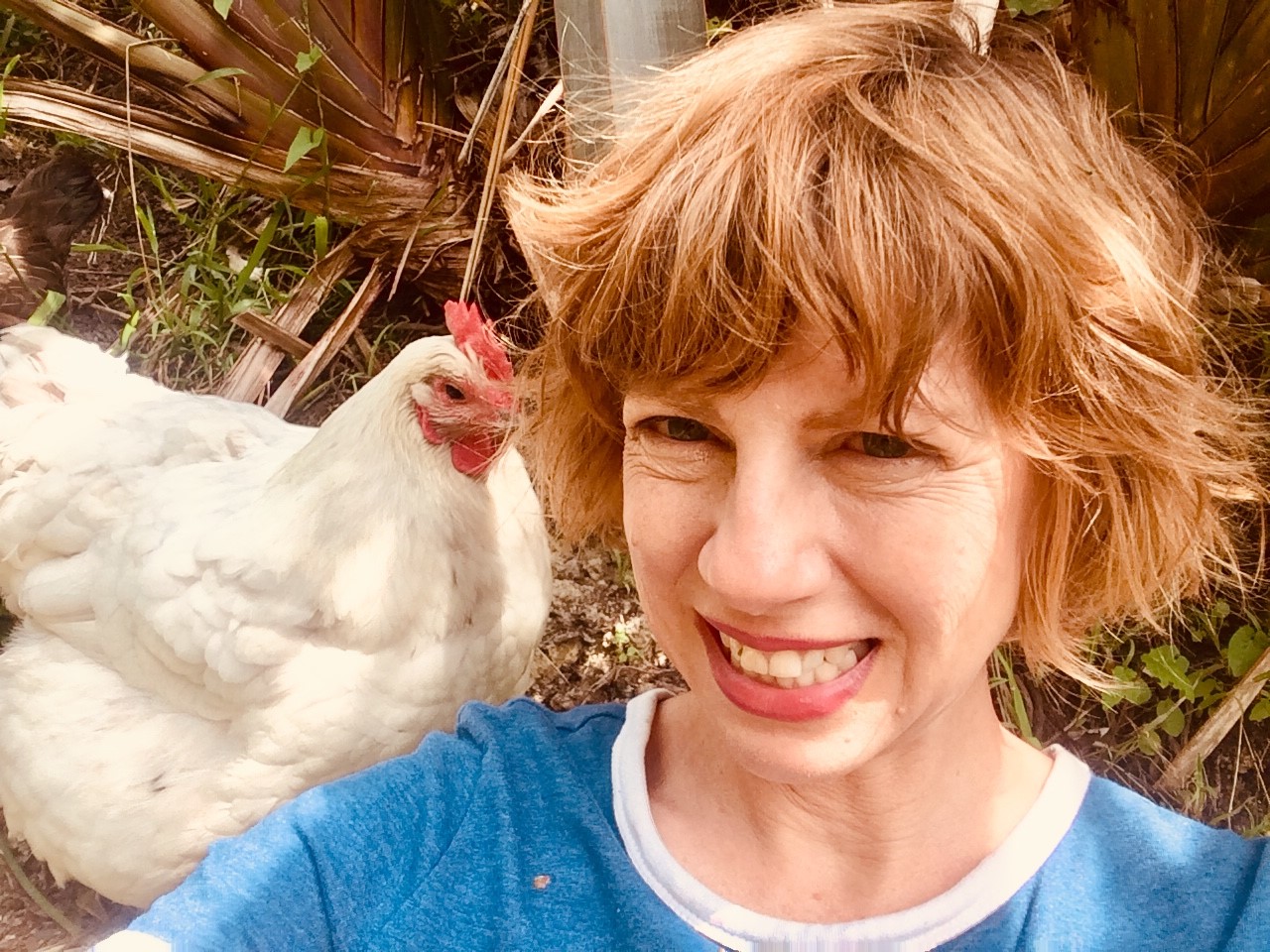
Anna Jackson is a New Zealand poet who grew up in Auckland and now lives in Island Bay, Wellington. She has a DPhil from Oxford and is an associate professor in English literature at Victoria University of Wellington.
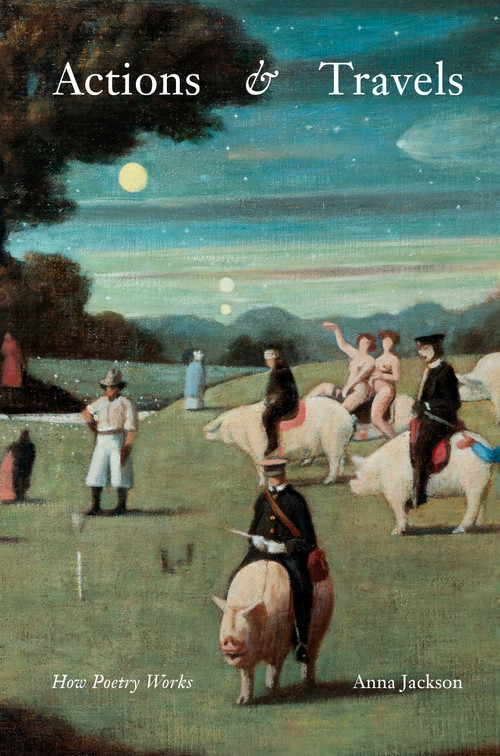
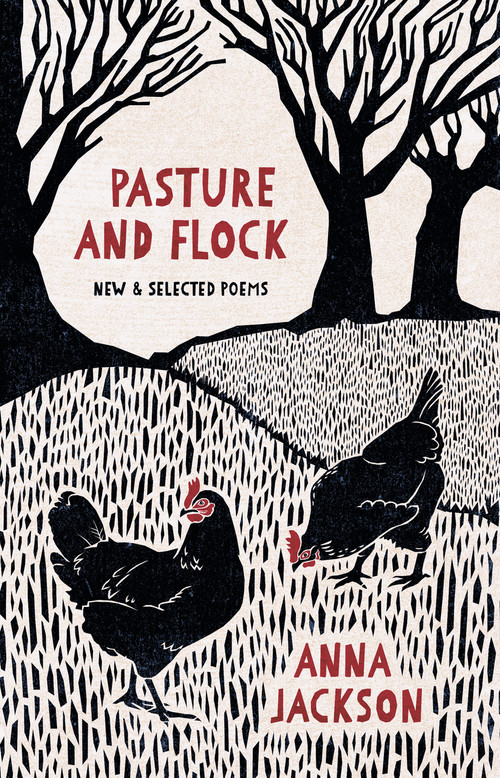
Anna made her poetry debut in AUP New Poets 1 before publishing six collections with Auckland University Press. Her most recent book, Pasture and Flock: New and Selected Poems, gathers work from her previous collections as well as twenty-five new poems. As a scholar, Anna Jackson is the author of Diary Poetics: Form and Style in Writers’ Diaries 1915–1962 (Routledge, 2010) and, with Charles Ferrall, Juvenile Literature and British Society, 1850–1950: The Age of Adolescence (Routledge, 2009). Her volume Actions & Travels: How Poetry Works (AUP, 2022) considers poetry through 100 poems.
I begin with a poem by Jenny Bornholdt that lives in the go-to-poetry-room in my head, my storage place for poems that haunt and linger and delight. I follow it with poems by writers whose bodies of work give me continued pleasure.
Gathering poetry with various gleams and sun glints is a perfect tonic at a time when we shudder at a sustained climate of greed and violence and neglect.
The next theme will be up in a few weeks . . . plus on Poetry Day I launched a new series with a feature on Janet Frame. I am spending time with individual poets whose work I have deeply loved over my years of reading, writing and reviewing poetry. One poet at a time. One slow nourishing month at a time.
the poems
Mrs Winter’s jump
We’re coming out from under dismal. The sun is up and so are the children, mucking about with skateboards. He’s out the back playing ‘Mrs Winter’s Jump’. And jump she does. She gathers up her rusty skirts and crosses all the crooked space between us.
Jenny Bornholdt from Mrs Winter’s Jump, Godwit Random House, 2007
The world is an orange and the sun. Today that’s all there is and all I need. The baby’s a bohemian, the world is an orange and the sun’s a skein from which all life is spun. The baby’s a banshee. The world is an orange. And the sun? Today that’s all there is and all I need.
Janis Freegard from The Glass Rooster, Auckland University Press, 2015
sunlight
sunlight maps the shadows of leaves
defined by light
like the shadows of my heart
Apirana Taylor from te ata kura: the red-tipped dawn, Canterbury University Press, 2004
Portland Crescent
Waking to the smell of frying bread, the spiders on the ceiling,
that overhang of corniced roses.
The sun shines through baize curtains
past your hips bowing them in radiance, like a martyr’s.
The whole city’s here for us; there’s a New World round the corner.
And I am here at last and lying with you in this room
through the still and perfect morning of the afternoon.
Anna Smaill from The violinist in Spring, Te Herenga Waka University Press, 2005
A Dream
I dreamed there was a stone wall, and a sun, shaped like Humpty Dumpty, round and fat, sitting there; but no warmth came from the sun. He smiled, opening a cold yellow mouth. Ha Ha, he said. I am in the centre of things but I shall not keep you warm for ever.
Just then a black cat with its face burned walked slowly and delicately along the wall. The sun lashed at it with a stick made of ice and covered with snow. —Be off, he said sharply.
I woke then, and it was morning, with a long bird-note falling down and down like a long long sigh of surprise.
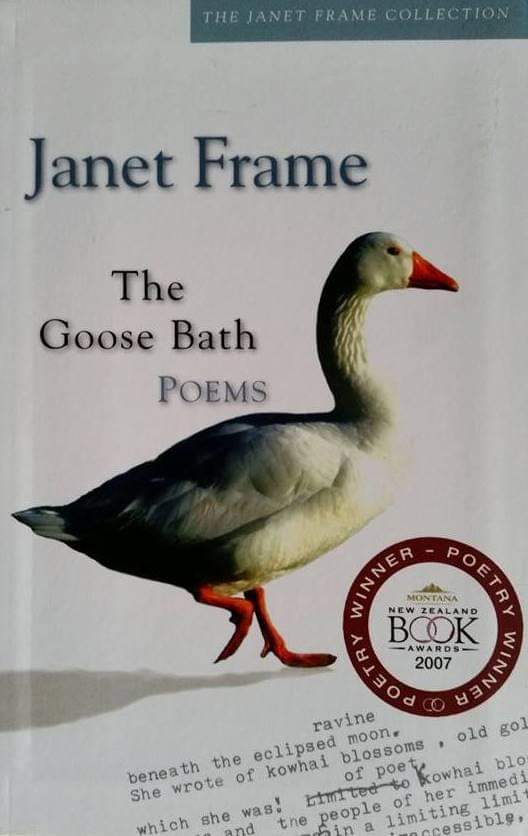
Janet Frame from The Goose Bath, Vintage, Penguin Random House, 2006
Beside the lake
The dog, as always, was keen to go on but we could not see a path around so stopped on the edge and looked at the water, the reflection of the trees symmetrical and neat. Half your face, the half turned towards me, was in darkness. The other half, on the other side of your nose, was glowing in the lowering rays of the sun. The dog sat at your feet, perhaps even on your feet, leaning into your legs, one fluffy ear cocked, as if he could hear something we couldn’t moving between the trees. You rested your hand in the deep, soft fur at his neck.
Claire Orchard from Liveability, Te Herenga Waka University Press, 2023
Rondo
and I’m crying bitter as hell & the sun streams in thru the window over the loud yellow jonquils catching the scarlet tablecloth & music pours out of the window embroiders the sunshine & I’m crying I’m bitter as hell
Joanna Margaret Paul from like love poems, Te Herenga Waka University Press, 2006
Primrose
It is the sun made of flower, The pale spring sun, Clean and continent, Its passion not begun.
Winter sums up the strength To strike its face. Life has set a sword Between a dream and peace.
Its flower disdains to close, But in its need, Sealing up its core, It saves the secret seed.
Outer for inner pays, Body for heart, So the song be saved; That is the rune of art.
Eileen Duggan from Selected Poems, Te Herenga Waka University Press, 1994
From this hill
Light dapples tin roofs red and brown Mitre 10 blazing orange a klaxon in early pink of day
Sands still hold memory of dead cattle and imagine in their unbounded optimism they might somehow hold back the tide
Beyond, a yawning shimmer this new day from this hill
Michelle Elvy
After the sun
After the sun has set, it seems impossible that it could ever rise again.
Night sinks into the bones.
The cliff face looks weary. The sand is hard and cold. The ocean curls around its secrets.
Kiri Piahana-Wong from night swimming, Anahera Press, 2013
the poets
Anna Smaill is the author of Bird Life (2023), The Chimes (2015), which was longlisted for the Man Booker Prize and won best novel in the World Fantasy Awards in 2016, and the poetry collection The Violinist in Spring (2005). Born in Auckland, Anna has spent several years in Japan and the United Kingdom and holds a PhD from the University of London. She lives on Wellington’s south coast with her husband, novelist Carl Shuker, and their two children.
Apirana Taylor from the Ngati Porou, Te Whanau a Apanui, and Ngati Ruanui tribes, and also Pakeha heritage, is a poet, playwright, novelist, short story writer, story teller, actor, painter, and musician. His poems and short stories are frequently studied in schools at NCEA and tertiary level and his poetry and prose has been translated into several languages. He has been Writer in Residence at Massey and Canterbury Universities, and various NZ schools. He has been invited several times to India and Europe and also Colombia to read his poetry and tell his stories, and to National and International festivals. He travels to schools, libraries, tertiary institutions and prisons throughout NZ to read his poetry, tell his stories, and take creative writing workshops.
Claire Orchard studied English and history at Massey University and completed an MA in Creative Writing at the International Institute of Modern Letters. She lives in Te Whanganui-a-Tara and is the author of two poetry collections: Cold Water Cure (2016) and Liveability (2023).
Eileen Duggan (1894–1972), of Irish ancestry, was born in Marlborough and grew up in Tuamarina, near Blenheim. Duggan graduated from Victoria University of Wellington with an MA First Class Honours in History in 1918. She briely taught as a secondary-school teacher, and as an assistant lecturer, before devoting herself to writing full-time. She wrote essays, reviews, articles, a weekly column for the New Zealand Tablet (from 1927) and published five collections of poetry. Three collections were published in the United States and Britain to international acclaim. She left a substantial body of unpublished material, which Peter Whiteford drew upon for Eileen Duggan: Selected Poems (Victoria University Press, 1994). Duggan was awarded an OBE in 1937 and was made an Honorary Fellow of the Royal Society of Literature in 1943. She lived most of her adult life with her sister, in Wellington.
Janet Frame (1924-2004) is one of New Zealand’s most internationally acclaimed authors. She won numerous prizes and accolades for her poetry, fiction and non-fiction, and was awarded Aotearoa’s highest civil honour the Order of New Zealand. In 1990 her bestselling autobiography An Angel at My Table was adapted for cinema by Jane Campion. Janet Frame bequeathed her ongoing royalties to the Janet Frame Literary Trust and directed that the fund be used to support New Zealand authors.
Janis Freegard is a poet and fiction writer. Her first full-length poetry collection, Kingdom Animalia: The Escapades of Linnaeus, was published by Auckland University Press in 2011. She is also the author of a chapbook, The Continuing Adventures of Alice Spider (Anomalous Press, 2013. Her poetry has appeared in a wide range of journals and anthologies in New Zealand and overseas. In 2014, she held the inaugural Ema Saiko Poetry Fellowship at New Pacific Studio in the Wairarapa. She writes fiction, is a past winner of the BNZ Katherine Mansfield Award and published her first novel with Makaro Press in May 2015.
Jenny Bornholdt has published 12 books of poems including The Rocky Shore (Montana New Zealand Book Award for Poetry, 2009), Selected Poems (2016), and Lost and Somewhere Else (2019). In 2005 she became the fifth Te Mata Estate Poet Laureate, and in 2013 she was appointed a Member of the New Zealand Order of Merit for services to literature. Her most recent book is A Garden is a Long Time, a collaboration with photographic artist Annemarie Hopecross, published in 2023 by Te Herenga Waka University Press.
Joanna Margaret Paul (1945-2003), poet, painter and experimental filmmaker, was born in Hamilton. She graduated from the University of Auckland with a BA in Philosophy and English, and Elam School of Fine Arts. She was awarded the Frances Hodgkins Fellowship (1983) and the Rita Angus Residency (1993). During her lifetime she published several poetry collections while a range of her poems were showcased in the posthumous like love poems, edited by Bernadette Hall. Her debut collection Imogen was awarded the PEN Best First Book Award for Poetry. (1978). After her death the Wellington City Gallery exhibited her artwork in Beauty, even 1945-2003 with an accompanying book of poems.
Poet and editor Kiri Piahana-Wong is of Maori (Ngāti Ranginui), Chinese, and Pākehā (English) ancestry. She is the author of the poetry collection Night Swimming (2013) and Tidelines (2024), and she is the publisher at Anahera Press. Her work has appeared in over fifty journals and anthologies, and Kiri has performed at numerous literary festivals across the motu. In 2023 Kiri co-edited Te Awa o Kupu alongside Vaughan Rapatahana.
Michelle Elvy is a writer and editor in Ōtepoti Dunedin. Her work examines intersections in our natural world, from the novel the everrumble to the anthology she co-edited last year with Witi Ihimaera, A Kind of Shelter: Whakaruru-taha.
Against all odds Janet Frame and Frank Sargeson have ended up in a dinghy on Lake Pupuke in the middle of the night under a milky moon. Their eyes have become accustomed to the eerie light the way shadows loom and fade the way sounds hit an unfamiliar pitch the way the boat drifts fancy free.
To be awake when everyone else is sleeping puts the world in sharp focus even in the dark on the lolloping waves.
Janet and Frank Catch a Ferry
Janet Frame and Frank Sargeson have caught the ferry over to Rangitoto for the day in a fit of spontaneity with a picnic basket full of vegetables from Frank’s garden (tomatoes lettuce radishes red peppers cucumber) to go with the home-baked bread a friend had dropped off some gingercake and some date scones a hip flask of Frank’s brew and a flask of tea.
Janet is entertaining Frank with wordplay. The sea’s cape is green today, she says. To score we are a drifting, she adds.
They take the path towards the baches and find a shady tree for the picnic blanket. The water is like a dog’s tongue at the shore. The sky is like an empty tropical fish tank. It ought to be the perfect setting to read a novel that takes you some place else, but Janet and Frank are content looking up at the sky and waiting for the tropical fish to appear.
Paula Green These two poems appeared in my collection The Baker’s Thumbprint (Seraph Press, 2013).
Poetry Shelfcelebrates Janet’s Frame’s poetry with the help of Pamela Gordon and Bill Manhire
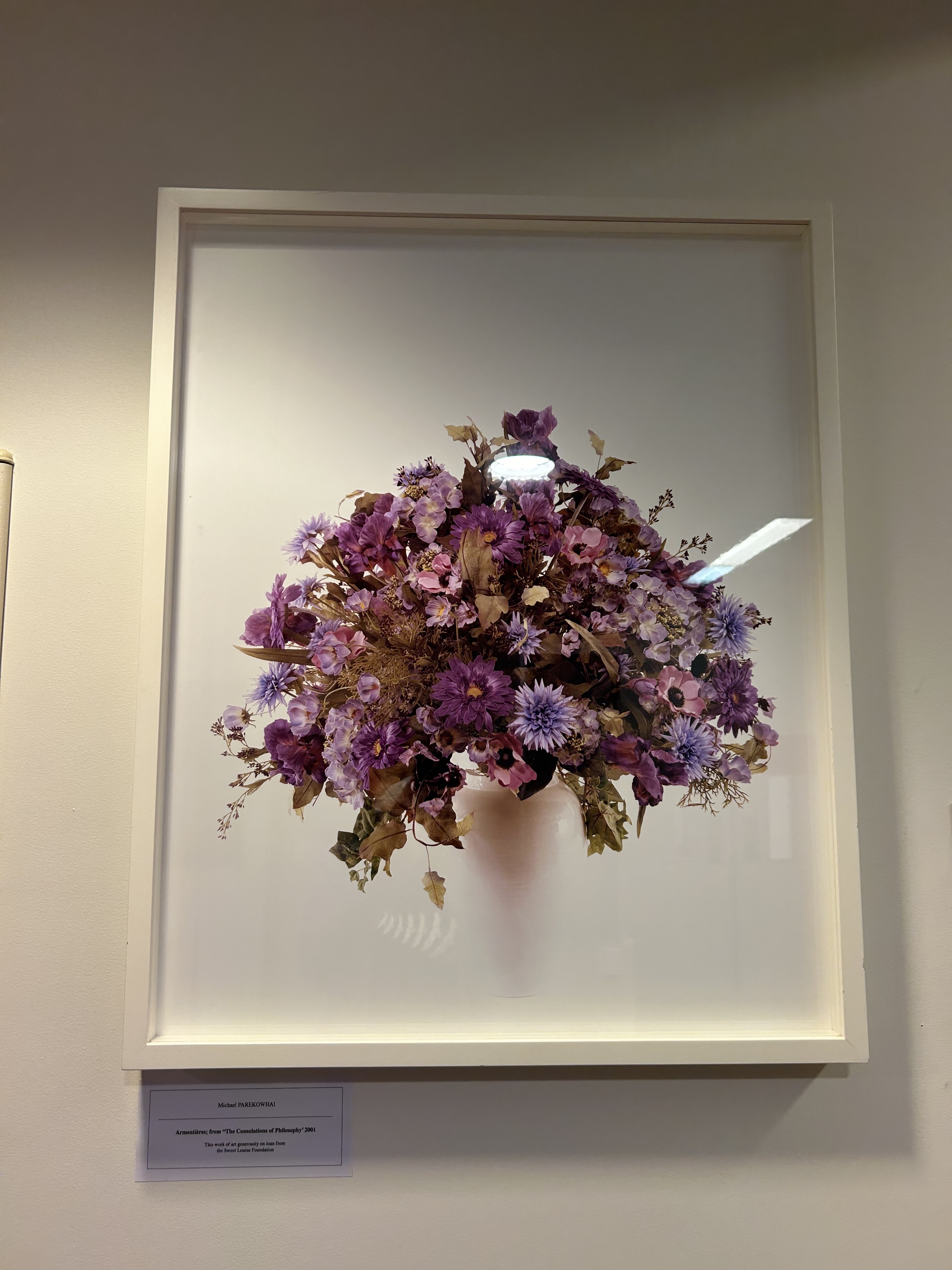
‘The Consolations of Philosophy’, Michael Parekowhai (20021) at Auckland Hospital
Thank you for the kind comments on my Poetry Shelf post yesterday. I wrote a personal response to a news item on Morning Report on the bone-marrow transplant queues and impact on patients, whānau, medical staff. My heart was breaking at this further example of a health system in crisis.
I have felt incredibly grateful for the transplant care I have had since June 2022. I was prompted to write because behind every number and name there is a story, in fact a cluster of stories, lives that are being, and will be, adversely affected by Government choices.
I know speaking publicly about personal matters is draining, from the well-known figures (for example, Sam Neill and Dai Henwood and their cancer stories) to the barely known (the person with the RNZ familial link). But it can make a difference.
Maybe we try and live as normal life as possible, do as much as possible, live life to enjoy life. But yesterday made a difference to me. I am so lucky to have myriad things I choose to do that make hurdle navigation so much easier.
And speaking openly to you made a difference. I am holding onto the hope that we can make a difference to cancer care in Aotearoa, to the well being of our planet and our people, and to how we educate, guide and inspire our children to be caring, multi-skilled, creative human beings.
For the first time in a long time, I have had two good sleep nights in a row, each with two solid sleep patches. I might not be able to change my health challenges immediately but I can always nourish how I respond to them.
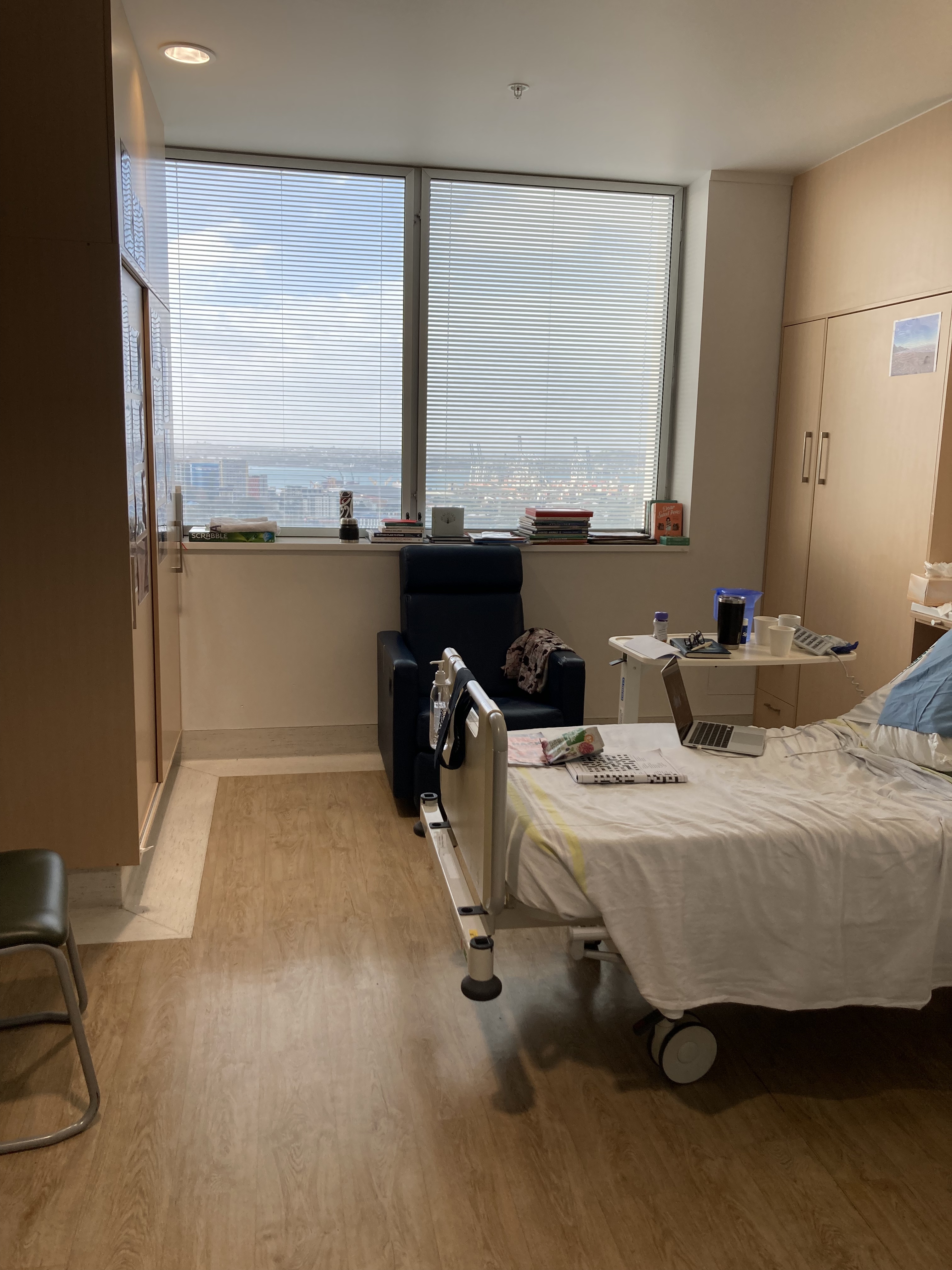
Today the world arrives in skinny bands that I can barely process so I drop into harbour beauty to block out the pain
A nurse changes the dressing and the clouds gather roads and garden gates I lip read the cloud stories and remember the comfort points
Paula Green from ‘The Venetian Blind Poems’
Today blood cancer treatment is on RNZ Morning Report, specifically bone marrow transplants and a particular case, because the prolonged waiting time is putting more and more lives at risk.
Heartbreaking.
In 2022 I received a bone marrow transplant at Auckland Hospital, within the ideal time. For over five weeks, I stayed in my single isolation room, and saw my two nominated family members each day. I was cared for by an extraordinary team of doctors, registrars and nurses. A young anonymous donor had gone through the necessary procedure to gift me some of their healthy stem cells. Yes, this was a physically challenging time, but I look upon it as incredibly special, a time that showed me life through the gift of kindness, skill, care, patience, aroha. I know it sounds weird, but I loved this time, this life-gifting time.
Bone marrow transplant patients need ongoing care, especially those, such as myself, who develop Graft versus Host Disease, when your cells go into battle with the donor’s incoming cells. It is tough, it is tiring, it is often hard to diagnose clinically, and there is no clear end date. It may last years. I continue to take a strong immune-suppressant drug that comes with its own downsides as well as vital life-saving benefits. So yes, I am still dependent on the expert and caring support of an extraordinary haematology team. But as someone who has been visiting the day ward for over two years now, I am witnessing a system stretched to the limit.
Heartbreaking.
The past four or five months have been the toughest since my time in hospital. Not because of the daily nausea, pain, weight loss, fatigue and three or five hour sleeps. I manage well. I have developed ways to do this, ways to best use my tiny energy jar and to find joy each day. Especially through my connecting blogs, my own writing, by cooking nourishing meals that I eat like a sparrow, by falling asleep to audio books every afternoon. But when three months of antibiotics and treatment from my dedicated and caring dentist didn’t fix a chronic dental infection, I needed molars removed at Greenlane. And it felt like tipping over my coping edge.
Ah, the tipping edge. Creating my Janet Frame feature helped. Creating my next poem theme (Sun) helped. Talking with my partner, daughters and a dear friend helped. Sending an email to another dear friend helped. Zooming with my psychologist helped. It was spilling the beans on my dark time. Usually I want to celebrate books, writing, poetry, children’s writing . . . not blather on about health challenges.
Last week I had several important hospital appointments, and again, I am mindful of a stretched to the limit health system, and how I am still dependent upon it. After all this time, when I am in a miracle remission, I am still needing help, and I am still getting it. I am still getting this incredible help.
I hear the story on Morning Report, and how tough it is for patients, whānau and staff now, and my heart is breaking.
My heart is breaking.
I don’t want to hear a Government fudging numbers, dodging hard questions, having questionable priorities. Put your words where our breaking hearts are and do something for our vulnerable people, make a difference to our wellbeing, and most importantly, place the wellbeing of our planet at the foremost of your doing.
My heart is breaking.
Catastrophe and calamity slip through like fettucine but I close my eyes to the unbearable pain of humanity and picture myself on Te Henga’s tideline
A nurse asks if I need anything even when she is rushed off her feet I sip Chia Sisters ginger and turmeric juice hoping beyond hope for world peace
Cancer Control Agency regional manager Cushla Lucas said: “We’re very concerned that people aren’t getting the treatment in a timely way. We’ve spoken with many people with blood cancer and whānau and heard stories of the impact, both emotionally and on their health, as well as on the staff working in transplant units.”
Leukaemia and Blood Cancer NZ chief executive Tim Edmonds said there had been nearly 15 years of under-investment in transplant capacity, “while also knowing that this increased demand was coming”. With the current financial headwinds, he feared Health New Zealand was even less likely to sign off on the full business case, which would cost “tens of millions of dollars. We understand they’re looking at a proposal to partially increase resourcing. Such a piecemeal approach was not good enough, because the queue would just get longer and longer. “We’re used to the term ‘wait list’ being used for elective surgery and hip replacements or cataracts, but this is a matter of life or death for blood cancer patients. They’re having to wait months, and in the meantime they’re relapsing, their cancer is returning and it’s putting their lives at risk.”
In the early mornings we crossed each other’s paths lightly. When I looked through the banister, down to where you sat, loose papers on your knee, I didn’t ask what you were reading. The moment was as tranquil and full of possibility as morning meditation. I was enfolded in its stillness.
Sunlight touched the bushes that screen the windows. I watched it splash off wooden sills and the air in the kitchen brighten, welcoming you up. You came, carrying a sheaf of poems. Your conversation was a set of quiet questions so gentle that the silence seemed to stay unbroken.
We followed where they led, those still, exquisite, end-of-summer days. We savoured them as if we knew they were the final carefree hours the two of you, the four of us, had left. We took them as they say you should take time – freely, without trembling.
Diana Bridge
Wellington poet Diana Bridge’s eighth collection of poems, Deep Colour, came out from Otago University Press in 2023. A collection of her ‘China-based’ poems’ was included in Encountering China, an anthology of personal experiences of China also published last year to mark the 50th anniversary of diplomatic relations between China and New Zealand.
‘In the early mornings‘ remembers one of our closest Australian friends. Australian Foreign Minister, Penny Wong, said of Allan Gyngell: He is the definitive historian of Australian foreign policy. He is the finest writer about Australian foreign policy … And possibly also the smallest ego in Australian foreign policy.” Ten weeks before he died, Allan was sitting in our living room reading the final draft of Deep Colour.
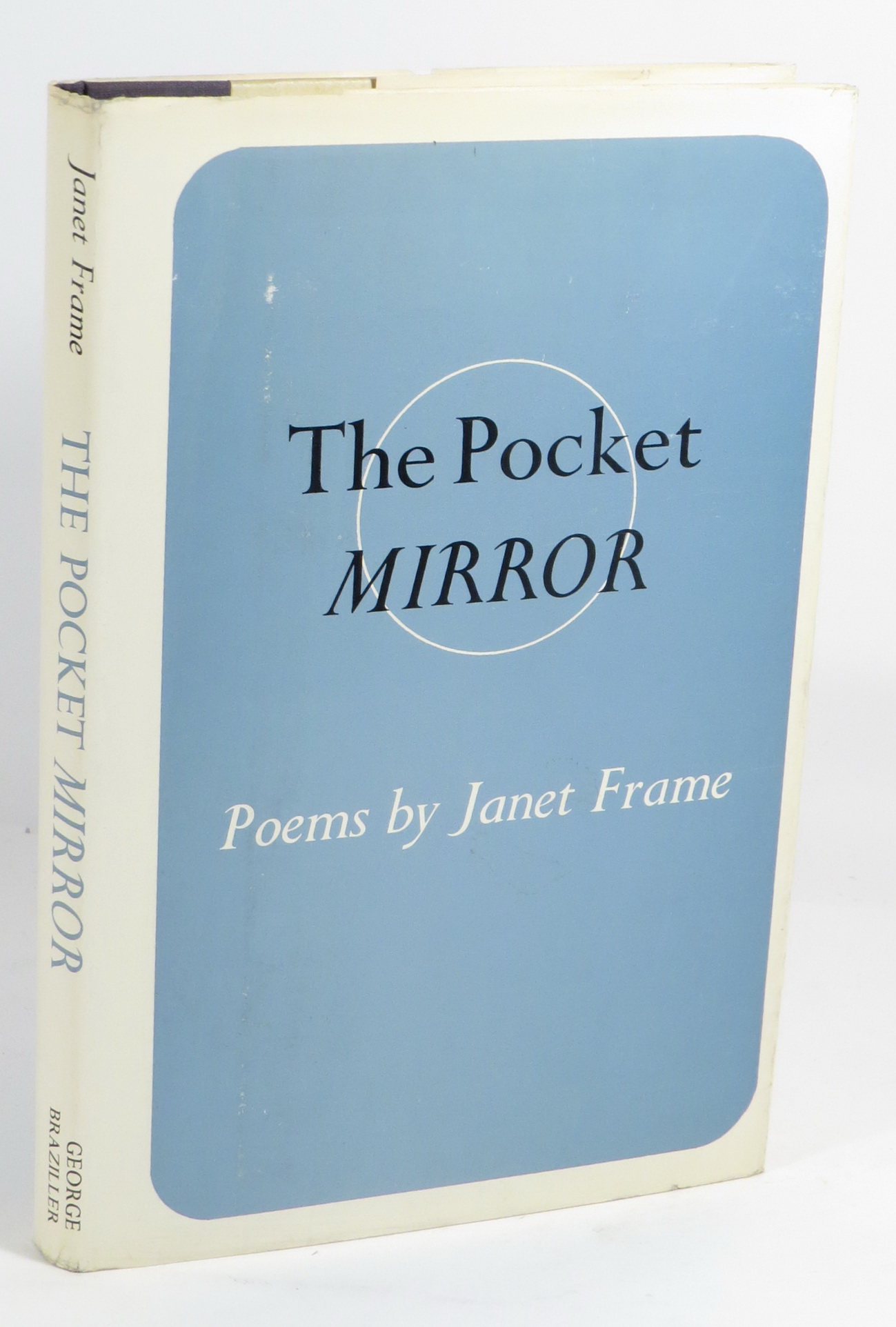
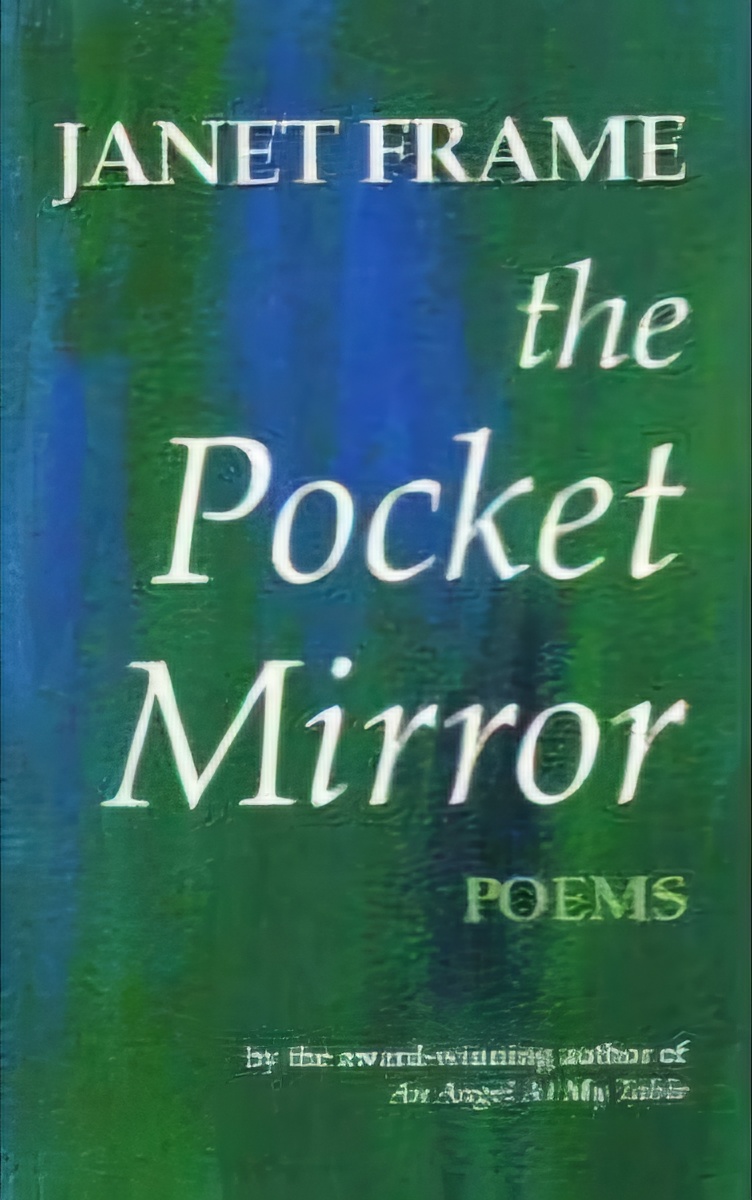
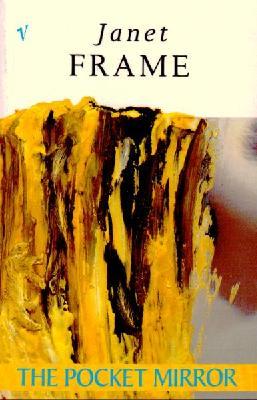
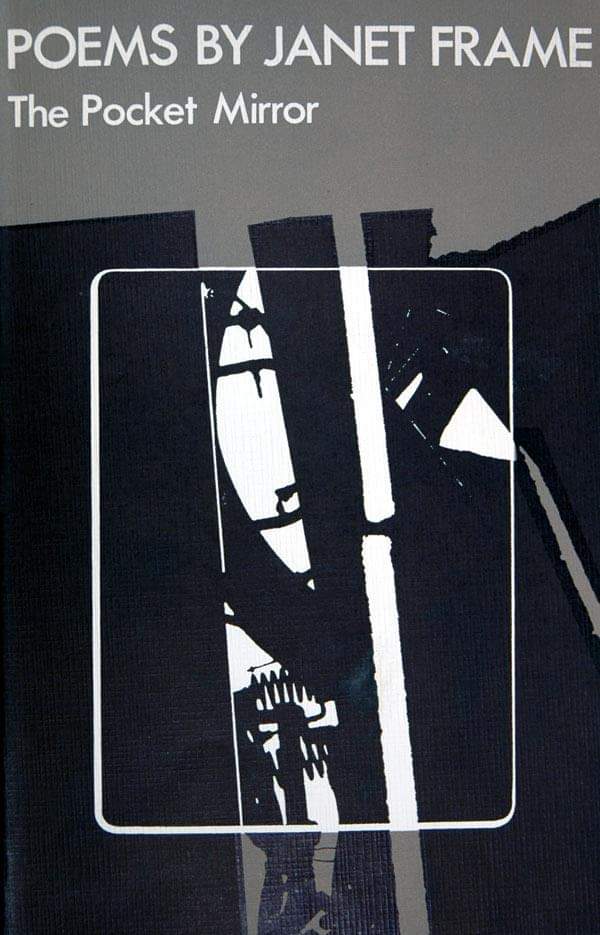
I put all the names in a hat and will be sending my spare copy of The Pocket Mirror to Heather Haylock. Thanks for all the lovely Janet Frame comments in her special birthday month.
“Poetry is attendance upon the world.” Janet Frame
∗ an intro and three poems chosen by Paula Green ∗ a poem written by Bill Manhire for Janet ∗ three poems chosen by Pamela Gordon with comments
The sweet daily bread of language Smell it rising in its given warmth taste it through the stink of tears and yesterday and eat it anywhere with angel in sight
Janet Frame, from ‘I Write Surrounded by Poets’ in The Goose Bath, Random House, 2006
Usually on Poetry Day I organise a suite of audios, bringing together voices that inspire move surprise . . . that fill us with the joy and delight of poetry. On this occasion however, I showcase a poet whose writing has travelled with me for decades. I have been hankering to do this for ages . . . to revisit the work of writers whose work has affected me deeply, in multiple ways, on repeat occasions, offering heart, surprise, daring, comfort, wit. I begin with Janet Frame.
Janet Frame (1924-2004) is one of New Zealand’s most internationally acclaimed authors. She won numerous prizes and accolades for her poetry, fiction and non-fiction, and was awarded Aotearoa’s highest civil honour the Order of New Zealand. In 1990 her bestselling autobiography An Angel at My Table was adapted for cinema by Jane Campion. Janet Frame bequeathed her ongoing royalties to the Janet Frame Literary Trust and directed that the fund be used to support New Zealand authors.
Pamela Gordon, Janet’s literary executor, has kindly picked three favourite poems by Janet and included some comments, and Bill Manhire has contributed a poem he wrote for Janet for An Inward Sun, ed Elizabeth Alley. It was a book of tributes that was published in 1984 to mark Janet Frame’s 70th birthday. This month we are mindful it is one hundred years since her birth.
The poems Pamela and I have chosen appear in: The Goose Bath: Poems, Janet Frame, eds Pamela Gordon, Denis Harold and Bill Manhire, Random House, 2006 The Pocket Mirror, George Braziller, New York, 1967
When I was an awkward teenager devouring Hone Tuwhare, Doris Lessing, Richard Brautigan, Joni Mitchell, Sylvia Plath, Emily Dickinson, reading Janet Frame was an electric and vital charge.
Now, all these decades later, when I am reflecting on how much I love Janet’s poems, I am curious as to why some critics have sidelined her poetry. Maybe it’s because there is a resistance to writers who cross borders, who write novels and poetry, or writers who resist the constricting paradigm of model novelist or model poet. I am thinking immediately of the astonishing Anne Kennedy whose novels and poetry both inspire and delight me. And of Emma Neale, Anna Smaill, Keri Hulme, Elizabeth Smither, Vincent O’Sullivan, Robin Hyde.
But today I am musing on why I love the poetry of Janet. Let’s start with the idea of alchemy, a practice of transformation, the recasting of base ingredients into something precious, awe-inspiring, succulent. In this case, in the case of poetry, words are the base elements: nouns, verbs, adjectives, ellipses. With Janet there’s a metamorphosis into a poetry of feel, sound, stretch, freshness.
More than anything I feel Janet’s poetry. I feel it on the level of texture, heart, self and joy. The physical detail is a sweet tang on the tongue as I read. Take the opening stanza of ‘Moss’ for example:
The Spring moss the plush lining of the jewel-box rediscovered beneath the snow. Fever-green surfacings. Ice with its edges smoothing shaping in the lick-tongue of the sun transparent white-green sweet
from The Goose Bath
To that I add the sound of poetry, the deft step of words on the line that spring and spin in the ear as I listen, as I read the moss stanza with its aural rewards for example. More than anything, there is a revelation of self across the writing: as a woman, a child, a poet, though living, writing, moving in the world. One of the three poems I picked below, ‘Child’, is a poem I feel on so many levels: the lyrical flow, the physical presence, the portrait of both child and grandmother.
How I love the stretch of Janet’s poetry. There is the eclectic subject matter, the diverse locations; we move from a tourist in Mexico City to Baltimore streets, from layered snow to dandelions in the grass, from not being able to write to the ink flowing. The motifs are equally ranging, with sun and rain, light and sky, wind and poetry making, incandescent gleams as you read. Yet more than anything, there is the sweet prismatic stretch of what poetry can do, how it might describe sing pirouette confess dance mourn ponder reflect light and dark explore . . . multiple fluencies. There is a sense of this stretch when Janet writes of poetry making, as in ‘Some of My Friends Are Excellent Poets’:
Poetry has not room for timidity of tread tiptoeing in foot prints already made running afraid of the word-stranger glimpsed out of the corner of the eye lurking in the wilderness. Poetry is a time for the breaking habits good or bad, a breaking free of memory and yesterday to face the haunting that is.
from The Goose Bath
Finally, the words ‘fresh’ ‘original’ ‘invigorating’ come to mind. Janet sometimes speaks of the practice of poetry making. Sometimes she will hold out the most ordinary thing, offer a moment of self doubt, trace multiple dimensions, the flashes and the fancies that arrive as she writes, and as I read, I am transported, inspired, itching to create poems. I am viewing the world, and indeed, poetry afresh.
On NZ Poetry Day, I am offering you three of Janet’s poems I particularly love, that demonstrate so beautifully how her poetry is a poetry of feel, sound, stretch and freshness . . . poems for you to find your own reading trails within.
Child
When I was a child I wore a fine tartan coat that my grandmother, woman of might, magnificent launcher of love and old clothes, had set afloat on a heaving relative sea of aunt and cousin and big enfolding wave of mother down to small wave of me.
Oh happily I stood that day in the school playground near the damp stone wall and the perilous nine o’clock wind grabbed at my coat-sleeve, waving it in a bright wand of yellow and green and blue —all colours, and the other children loved me and the little girls pleaded to lend their skipping-rope and the boys their football.
But the spell soon broke in my hand. Love and sleeve together fell. The wind blew more perilous when the world found my tartan coat was not even new.
from The Goose Bath
The Birch Trees
Mysterious the writing on the birch-bark a tune of growth with hyphenated signature, coded rolls a pianola might play, a computer accept as mathematical formulae, surrendering the answer, the question lost.
They tell me the birch tree is delicate they tell me so often I believe it. I have seen birches like grey rainbows washed of colour arched beneath the storm backbending not breaking, and the young trees their stick-limbs announcing all deficiencies beside the one prolonged nourishment of survival.
Birch trees never ask: Why are we here? They know. Opportunity trees, their business is the beautiful disposal or draping of weather especially of snow distributed across their grey branches in such a way their bark becomes a calligraphy of scars and stars.
Reading it suddenly in the woods one is astonished to find engraved on pages of birch-bark the fiction and fact of men in their cities.
from The Goose Bath
How I Began Writing
1 Between myself and the pine trees on the hill Thoughts passed, like presents. Unwrapping them, I found words that I, not trees, knew and could afford: lonely, sigh, night. The pines had given me my seven-year self, but kept their meaning in the sky.
Now, in exchange of dreams with this remote world I still unwrap, identify the presents; and always tired recognition gives way to hope that soon I may find a new, a birthday shape, a separate essence yielded without threat or deceit, a truthful vocabulary of what is and is not.
2 Vowels turn like wheels: the chariot is empty. Tall burning consonants light the deserted street. Unwrapping the world, unwrapping the world where pine trees still say lonely, sigh, night, and refuse, refuse, and their needles of deceit drop in my eyes. I began to write.
from The Goose Bath
Remarkables
for Janet Frame
Mountains in boxes,
years of people.
And then she smiles.
‘Let me look.’ Look up
and over and under
while the blue apple-paper,
the peaks and snow, those
eyes that still gaze and water
once again
get themselves ready.
Bill Manhire from An Inward Sun, ed Elizabeth Alley, Daphne Brasell Associates, 1994
Pamela Gordon’s three poem choicesand comments
Here are some thoughts about three of my favourite Janet Frame poems. I love each one for very personal reasons.
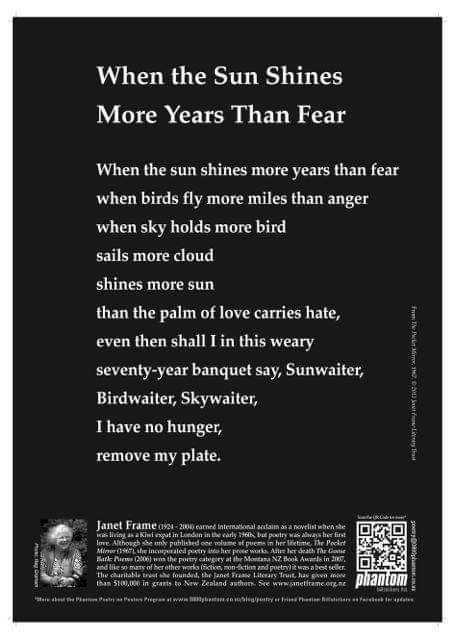
When the Sun Shines More Years Than Fear
When the sun shines more years than fear when birds fly more miles than anger when sky holds more bird sails more cloud shines more sun than the palm of love carries hate, even then shall I in this weary seventy-year banquet say, Sunwaiter, Birdwaiter, Skywaiter, I have no hunger, remove my plate.
fromThe Pocket Mirror: Poems by Janet Frame
This magical multi layered piece has always been my favourite. I do think this is one of Janet’s best, and she herself counted it among the ones she was most proud of. When she was planning her funeral she chose this to be read aloud and it was her bff Jacquie Baxter (JC Sturm) who did the honours at the service. Jacquie was my friend and mentor and so now the poem carries extra emotional freight for me.
For me the metaphors speak of Janet’s remarkable strength and perseverance in the face of adversity and disappointment. In a literal sense it is amusing because one of our family catchphrases was “Baby Frame is hungry”, from a comment written down by New Zealand’s first female medical graduate, Dr Emily Siedeberg, who delivered Janet at St Helen’s Hospital in Dunedin, 100 years ago this week. Janet had such an enormous appetite for life. As she said once in an interview: “Every thing I do, I want to do to the full.” She was NEVER going to say “remove my plate”, and that is what this poem embodies for me.
Small Farewell
Writing letters of goodbye we are inclined to say because we have read or heard it said or knew someone who likewise went away that small details pester the memory.
In the corner closet of your eye in the back room of seeing that looks out on the backyard of yesterday who can pretend to say what you will muffle in moth balls or soak with insect spray to stop the spread of memory’s decay? I think all I can say from hearing a ghost speak in a Shakespeare play is, if you were Hamlet, and I your father’s ghost, –Remember me.
fromThe Goose Bath
In late 2003, when she was dying, Janet asked Bill Manhire to agree to help me edit a selection of her unpublished poems. And she tasked me with getting them published. It meant a lot to her. Poetry was her first love.
After she died, I ventured alone, grieving, into her study. There was a tidy pile of cardboard folders stacked on the edge of the desk. They were from the stock of poems she had named ‘The Goose Bath’ after a previous storage container. I opened the top folder, and the first poem I saw was this one. A ‘Small Farewell’. Since she had appointed me her literary executor, it was hard not to take that as a message. The study was in a back room looking out over her backyard, and while I read the words “in the back room of seeing / that looks out on the backyard of yesterday” I felt a shock of the weight of responsibility I now carried.
It can never be predicted what traces of a person and their work will remain, and the poem speaks to me of that letting go of ego and control as one approaches death. You do your best and let the winds blow as they will. You just have to trust that your loved ones will make good decisions, but accept that nobody can determine the outcome. There are so many random factors, accidents as well as felicities. And in the end, it’s all about love.
Before I Get into Sleep with You
Before I get into sleep with you I want to have been into wakefulness too.
fromThe Goose Bath
I love this punchy and wise little piece, and I have enjoyed promoting it vigorously, because it confounds the widespread misconceptions about who Janet Frame was as a person. Janet Frame said of the “myth that some people in New Zealand have created to represent me”: “I resent this myth. I have even contemplated legal action to subdue it.”
As her niece and close friend, I was lucky enough to have been one of Janet’s confidantes from my teenage years onwards, and party to intimate details about the various relationships that she had engaged in over her lifetime. She did make a conscious and difficult decision to sacrifice her personal happiness in order to devote herself to her writing. She deliberately chose not to marry or to have children. That does not mean she was averse to or incapable of human connection and the claim that she was socially inadequate is just another of the injustices that she endured. Some members of the New Zealand chattering classes still perpetrate malicious gossip and this delightful poem, already a classic, is her riposte from beyond the grave.
Pamela Gordon
Pamela Gordon is Janet Frame’s literary executor. She was appointed to this role by the author, who was her aunt, close friend and travelling companion. They lived near each other in several locations around New Zealand. Since 2004 Pamela has co-edited and overseen the posthumous publication of ten new Janet Frame titles: novels, stories, poetry, non-fiction and correspondence. Pamela is also chair of the charitable trust that Frame founded in 1999. The Janet Frame Literary Trust makes financial awards to New Zealand writers from Frame’s ongoing royalty income as funds allow.
Poetry is Pamela’s first love just as it was Janet Frame’s, and she is the most proud of having been able to fulfill Frame’s dying wish that the collection of poems she had named THE GOOSE BATH should be published. It was also very satisfying to bring two new Frame novels to light and to publish many new stories.
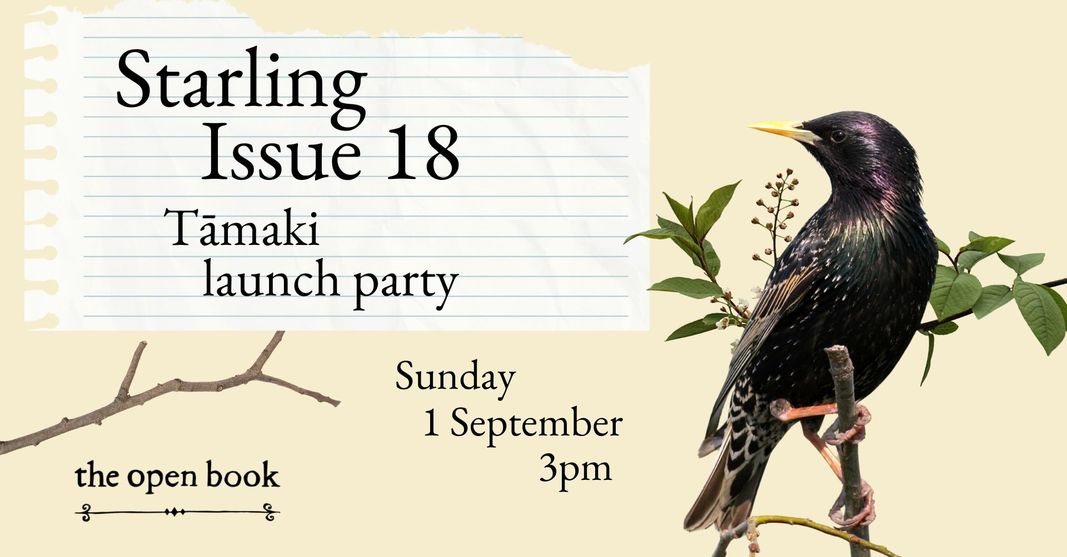
The Open Book is thrilled to welcome back Starling for the Issue 18 Tāmaki launch party at 3pm on Sunday 1 September!
201 Ponsonby Road, Auckland, New Zealand 1011
We’ll be celebrating the new issue with readings from several of its authors – come along and join us in hearing new work from young Aotearoa authors, and have a browse of the Open Book shelves while you’re at it. We look forward to seeing you there!


 NZ Poetry Shelf