
Thursday 11 June
Writers turn the page this Matariki
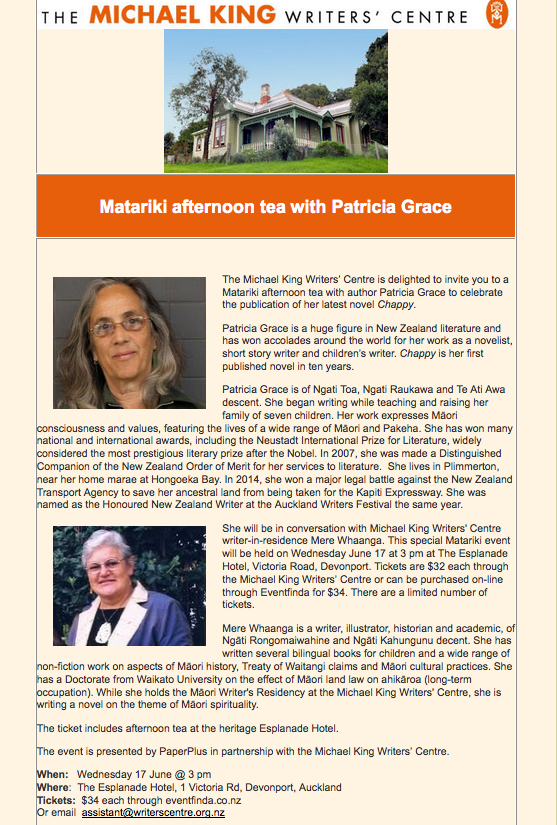
A literary celebration of Matariki will take place at Museum of Wellington City and Sea’s Third Thursday event on 18 June from 6.00pm to 8.30pm.
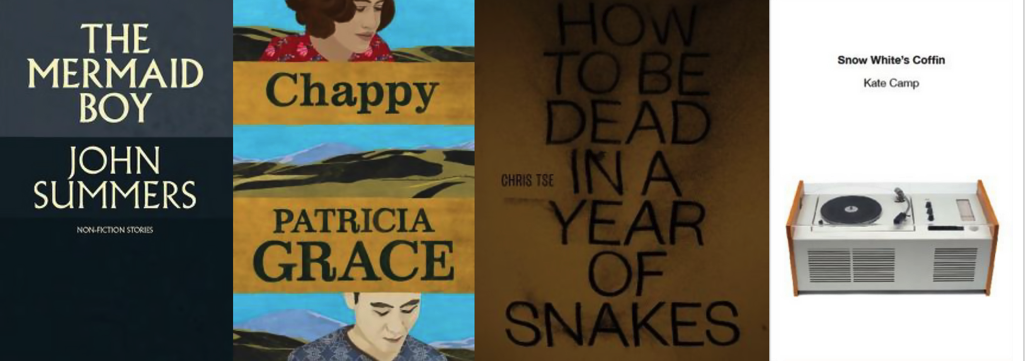
Kiwi authors Patricia Grace, Chris Tse, Kate Camp and John Summers will read from their published works and discuss their stories, poetry and thoughts on Matariki with award-winning writer and Museums Wellington Curator Māori, Tina Makereti.
“Matariki is a time of reflection and acknowledgement, when we mourn those who have passed away, farewell the year and plan for the year to come,” says Makereti. “It’s an opportunity to think about our history, and understand how it guides us in our potential futures. This will provide the starting point for what promises to be a lively discussion with these great writers.”
Patricia Grace’s new book Chappy tells of a young Māori man sent home to New Zealand from a privileged youth in Europe. Here, he learns of his family, and most importantly of the love affair between his Māori Grandmother and deceased Japanese Grandfather.
Chris Tse’s anthology How To Be Dead In a Year of Snakes brings life to one of New Zealand’s notorious hate crimes, when on a Sunday in 1905 Lionel Terry killed the Chinese gold miner Joe Kum Yung on Haining Street, Wellington.
Snow White’s Coffin is a collection of poetry by Kate Camp, a book that was finalist in the 2013 New Zealand Post Book Awards. A skilled poet, Kate wrote Snow White’s Coffin while on her Creative New Zealand Berlin residency.
John Summers will be reading from his first book The Mermaid Boy – an appealing book of true short stories telling of his travels from Christchurch to China, spanning from the outlandish to the ordinary, and of his friendship with “a boy who dressed as a woman who was also a fish”.
After the readings and discussion, the audience will have the opportunity to ask questions, get books signed and create their own handmade booklet of readings to take home.
Third Thursday is a monthly late-night event at Museum of Wellington City and Sea, showcasing the performers, people and stories which make our region unique. Entry to these events is by koha.
For further information on these events or high res photos, please contact Museums Wellington Communications Coordinator, Juliet Thomas.
04 471 0514| juliet.thomas@wmt.org.nz
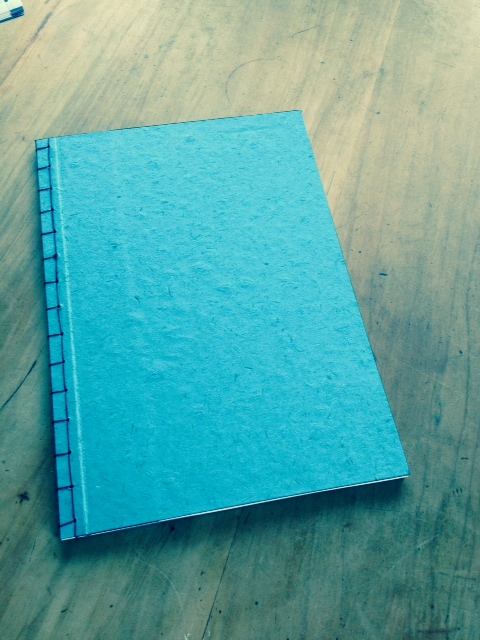
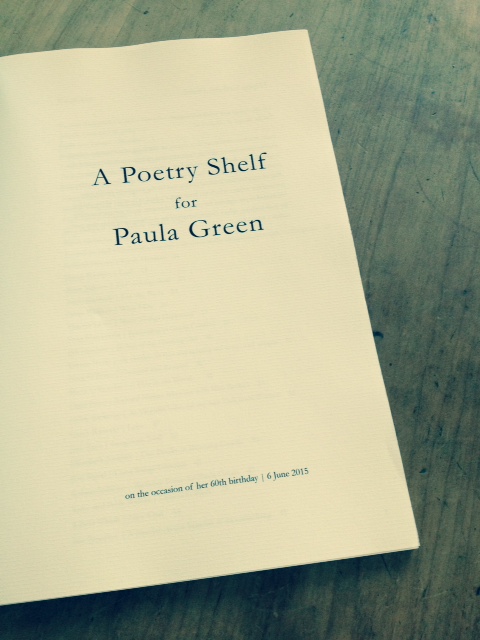
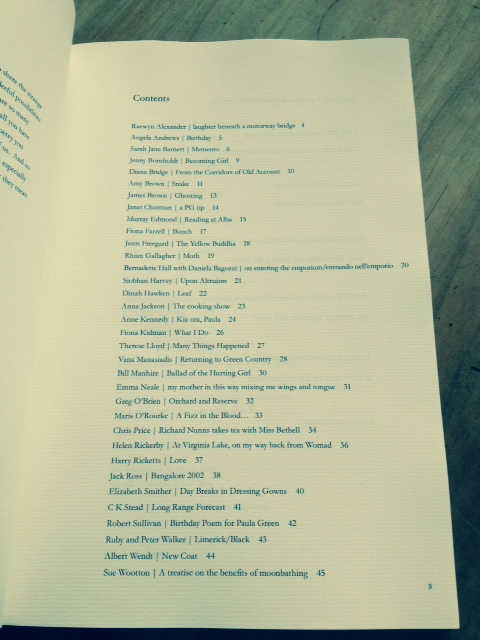
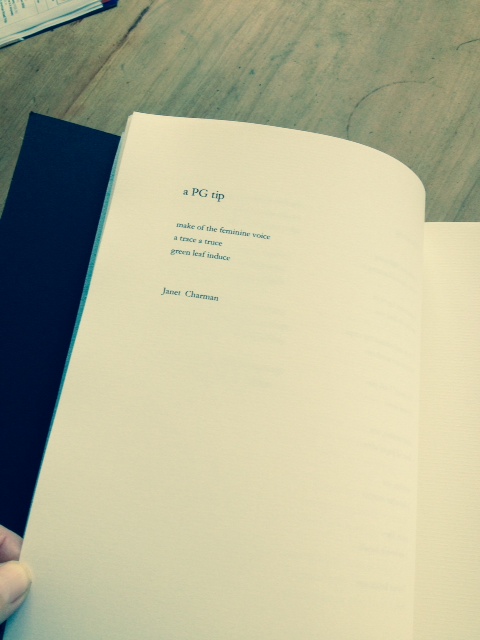
Anna Jackson (and Helen Rickerby) presented me with this yesterday. Utterly gorgeous.
divine shade of blue, exquisitely hand stitched, heavenly end papers, internal design ever so sweet
Festival
(for Edwin Thumboo)
I sizzle to your poems –
last seen in Singapore
I duck into a hole in the wall café
only a short walk up Queen Street
where in styrofoam containers
hot and spicy prawns
have made it here
all the way from
the coconut palm coast of southern India.
Is this where poems come knocking?
As the kitchen door swings open
I glimpse an
old man
subterranean and
beat
amid his world of woks and hard working pans.
© Bob Orr 2015
Sunday:
Yesterday I got sent a link to a web page where NZ poets had gifted me poems for my 60th birthday. I had a lovely day with my family but I ducked in and out of the poems when I was home. I haven’t had a chance to read all the poems and notes but I am quite speechless.
The poems have struck and stuck with me. The way they have caught something of my own poetry or obsessions or experiences. That glistening glinting mesmerising expanse that we call New Zealand poetry. That has neither border nor limitation. That is steeped in an ingrained love of words and what they can do.
To have taken time out of your busy lives and placed a poem on the shelf is extraordinary.
I can’t tell you how much this means to me, and to many family.
I encourage poetry fans to delve into this treasury box and make their own discoveries.
Love to all,
Paula
Saturday June 6th:
This morning, after breaking my rule of not talking about my private life on social media, I wrote about my strange and marvellous last day in my 50s on Facebook.
Then this link arrives. I burst into tears. You just do what you do. But to have this gift of poems to read on my first day in my 60s is extraordinarily moving.
For the web page go here. The driving force was my dear friend Anna Jackson. Beautifully designed by Helen Rickerby, idea for a web page conceived by Harry Ricketts. This is a beautiful birthday gift I will always treasure.
Thank you friends and fellow poets. Thank you.
Love
Paula
The Best of Edwin Thumboo – reduced from $35 to $15
X by Vona Groarke – from $25 to $15 and from $35 to $15
This seems too good to miss!

Starling takes flight
Showcasing New Zealand’s Best Young Writers
A new opportunity for young writers has emerged today. Starling (www.starlingmag.com) is an online literary journal that will be published twice yearly, accepting poetry and prose from only New Zealanders under 25 years of age.
The founder and editor is poet, Louise Wallace, author of two collections of poetry and the current Robert Burns Fellow at the University of Otago. The journal will be an opportunity for young writers to showcase their work in a professional environment to a national audience. “There is nothing quite like this out there at the moment in New Zealand – certainly not with the national focus we hope to cultivate,” Wallace says. “It can be difficult for young writers to find publication with our more established print journals when they are competing for space with writers who have twenty or thirty or forty year’s experience. Starling levels the playing field.”
Wallace is keen to convey that the quality of the work will still be there. “Just because a writer is under a certain age, does not mean the quality of the work is any less. The journal has a high standard for acceptance and we are committed to presenting our contributors and their work seriously – in that way the submissions we receive and the writing we publish will be the best of the best.”
Starling is also focused on a community approach. Each issue of the journal will open with new work from an established New Zealand writer and will close with an interview with a person of note from the literary industry. Wallace says there are a few things that are crucial to the journal’s success. “The first is obviously getting young writers to submit. But we also need support from readers. We have a selection of posters available on our website that people can download and put up out in the real world to encourage submissions, and the website also allows supporters to sign up for email updates. Without these people taking that extra step, there will be no community.”
Submissions are now open for Issue 1, with a deadline of 20 October 2015, the issue to be published January 2016.
Wallace is joined by Co-editor, Francis Cooke, and Schools Coordinator, Marty Smith, who like Wallace, are graduates of the International Institute of Modern Letters MA programme. Cooke’s short stories have been published in a number of national journals, and Smith’s first collection of poems, Horse with Hat, won the Jesse Mackay Award for Best First Book of Poetry at the 2014 NZ Post Book awards, and was a finalist in the poetry category. Smith is also a high school teacher, and will work with Wallace to deliver the journal as a resource for New Zealand teachers in the classroom.

