Poetry Shelf review: Terrier, Worrier A Poem in Five Parts by Anna Jackson

Terrier, Worrier A Poem in Five Parts, Anna Jackson
Auckland University Press, 2025

“She came upstairs looking more like a cloud than a silver lining.”

Loop: A Review in Nine Parts

LOOP

Anna Jackson’s glorious new collection, Terrier, Worrier A Poem in Five Parts, gets sunlight slipping through the loops of my thinking, reading, dreaming. The collection is offered as a seasonal loop as we move through summer, autumn, winter, spring, summer, and in this temporal movement, the loop regenerates, absorbing and delivering rhythms of living . . . mind and body . . . rhythms of writing . . . nouns, verbs, conjunctions . . . rhythms of thinking . . . and little by little . . . the compounding ideas, the feelings. It’s poetry as looptrack: overloop, underloop, throughloop.

I photographed a floor softly tiled in white and grey and
posted it with a quote from Emily Brontë’s diary: ‘Aunt has
come into the kitchen just now and said, “Where are your
feet Anne?” Anne answered, “On the floor Aunt.”‘

BREAKING THE FRAME

There is a long tradition of breaking the frame of poetry, or let’s say opening the frame, widening, nurturing, reinventing, rebooting, invigorating. And yes, there is sunlight drifting in through the gaps in these poetry weatherboards, lighting up what poems can do or be, both beyond the frame and within the frame. Subject, style, sensation. Anna writes:

Poetry can be a form of refusal as well as openness.

I am reading this poetry book at the kitchen table and it is a loop of ignition points. Anna also writes:

I thought, it tells us something about poetry that when we
need to talk to ourselves about something we don’t know
we know, we tell it to ourselves when we are sleep, in images
we struggle to remember when we awake, and often take
more than one reading to fully understand.

PRESENT TENSE

There’s a long black cloud streaking from the west coast to the backyard bush sprinkling salt and pepper rain. Terrier, Worrier is generally written in the past tense, with many stanzas beginning with ‘I thought’, yet for me, curiously, wonderfully, it carries the charismatic freight of the present tense, the sweet fluidity of the gerund, the present participle . . . where be-here-now fluency prevails regardless of gaps, rest-stops, hesitancy. Reading is to be embedded in the moment of the past as reader, so that what happened, and what was thought, becomes acutely present. Dive into the poetry currents in the collection, and along with the writer, you will might find yourself filtering, evaluating, experiencing, valuing, photographing, documenting, thinking. Savouring a moment.

I remember sitting in the car after work, not wanting to turn on the windscreen wipers because I felt like I needed rain on the windscreen to do the work of crying for me.

THOUGHT

Thinking. Yes Terrier Worrier is a poetic record of thought that offers anchors, the cerebral terrain of the philosopher say, an archaeology of ideas to dig for. Where testing the possibilities of what is matters along with what is not, along with everything in between. Poetry forms a thinking loop, a porous border between poem and idea, where meaning is organic, fertilised by nuance and shifting light. Sunlight say. Looping motifs and coiling thinking, like the surprise delight of letting thoughts carry you without planned itinerary. Where meaning ripples and slides. This is what happens as I read Terrier, Worrier.

Anna writes:

I thought, most of the time I, too, am a person not having thoughts but only having sensations, emotions, instincts, memories, anticipations.

Perhaps the poem becomes the vessel for ‘sensations, emotions, instincts, memories, anticipations’.

PRESENCE

Anna’s poetic record of thought (how ‘record’ resonates with the effects of tracks and music) is physically active. Thinking is anchored in a physical world, a yard of hens, a cat, partner, mother, father, daughter, son, friends. A tangible texture of dailiness that grounds the rhythm of thought in physicality. I love this.

Beside my bed there is a painting of a blue fish, floating high above a grey-blue sea, impaled on a grey-blue spike. On the back of the painting are written the words of the artist, my daughter, aged 3: ‘This is the fish. I painted it because it stuck in my mind.’

DREAMING

Dreaming becomes thinking becomes inventing becomes dreaming. Anna holds the idea of dreaming, like a prism on her palm, to question, revisit. Again I’m acutely aware how everything I have already said feeds into what I am saying here, and what I will say. How dreaming is the present tense, looping past and future, how the poet wonders her dream, with dream seeping into life and life into dream, into the threads of a poem in five parts. How do “sensations, emotions, instincts, memories, anticipations” slip into the dream texture, I wonder. Into the making of a poem.

When Amy told me she had dreamed about me, I felt as if my
own life were like that dream in which you climb some stairs
in your house and discover an additional room, or a whole
series of rooms, you didn’t know was there.

SPACE

A word with myriad possibilities. There is space in the reading, in this nourishing process of reading that sends me looptracking and dawdling in a state of dream and wonder. Early in the sequence Anna is (and yes usually I am cautious about attributing the speaking voice to the author, but this book feels utterly personal so I think of the voice as Anna’s) – taking photographs of squares.

There is too the proximity of space and death, especially as both Anna’s parents and sister had had “a turn at death’s door”.

There are recurring motifs of rooms and buildings, and especially this thought:

I thought, every body is a memory palace.

And this:

I thought about the concept of ‘peripersonal space’, the idea
that your mental mapping of the self includes the immediate
space around you, and what you habitually keep about your
person, including for instance your bag, or your falcon.

READING LIST

Lately, I have been reading novels and poetry books that make a writer’s reading history visible. I love falling upon titles to be added to my must-read notebook, across genre, time, location, languages. Anna’s reading list at the back and the titles sprinkled throughout is incredible.

How may times do I return to Virginia Woolf! I must read Jan Morris’s thought-a-day diary, or Robert Wyatt’s irony of doing loads of minimalism, and how I too loved Susan Stewart’s magnificent On Longing: Narratives of the Miniature, The Gigantic, the Souvenir, Olivia Lang’s Crudo, Madison Hamill’s brilliant Specimen, Muriel Rukeyser’s poetry.

Worrier, Terrier is the kind of book you can’t put down. I keep giving myself another week to flow along its currents, neither to explain nor pigeonhole, but to embark upon the joys of reading poetry, of reading a book that feeds your mind, that sparks and startles your memory banks, that gets you revisiting your own secret feelings and thoughts. Because more than anything, I hold Terrier, Worrier as a book of self. This book of invigorating return, where you will find yourself expanding with both recognition and discovery. It feels like this is what Anna did as she wrote. Is the poetry a form of coping with the abysmal world, the drift thoughts and non-thoughts, the dailiness, the relationships?

I read another page. Then I reread this, a pulsating heartcore of the book:

Some feelings expand the self like a gas into the world and
some condense the self into the coldest matter.

And then this:

I wondered whether I could hear ‘terrier’ as a version of the
word ‘worrier’, a worrier being not someone who makes you
worry but someone who themselves worries, who worries away at things like a terrier might worry away at a sock. A terrier would be someone who allows themselves actually to indulge in the feeling of terror. I tell myself, ‘I am not okay, but I will be okay’, but maybe I need to stop saying that and release the terror, or maybe the terrier is not myself but represents someone else’s terror that needs to be heard.

Tomorrow I will pick up the book again, and find another gleam and thought spur. I want to sit in a cafe with you all, let our thoughts dream and drift and link, as we empty our coffee cups, pick up our pens, and catch both the dark and the sunlight slipping in . . . as we write through weeping, laughter, longing, with doors ajar and love strengthening. I utterly love this book of wonder.

Anna Jackson is the author of seven collections of poetry as well as Diary Poetics: Form and Style in Writers’ Diaries 1915–1962 (Routledge, 2010) and Actions & Travels: How Poetry Works (Auckland University Press, 2022). She lives in Island Bay, Te Whanganui-a-Tara, and is associate professor in English literature at Te Herenga Waka  Victoria University of Wellington.
Anna Jackson’s website
Auckland University Press page

Poetry Shelf noticeboard: Nafanua Purcell Kersel is 2025 Emerging Pasifika Writer in Residence

Nafanua Purcell Kersel, photo credit: Ebony Lamb, 2024

The University’s International Institute of Modern Letters (IIML) is delighted to announce the appointment of Nafanua Purcell Kersel as the Emerging Pasifika Writer in Residence for 2025.

Nafanua, a Sāmoan writer and performer, is based in Heretaunga, Te Mātau-a-Māui (Hawke’s Bay). She will use the residency to work on a stage adaptation of her debut poetry collection Black Sugarcane, as well as a new book of poems.

Her aspiration is to create work that creates more. “More alofa, more creativity, more understanding in our communities and worlds,” says Nafanua.

Nafanua has a background in facilitation and community storytelling, including her role with Nevertheless NZ, where she leads the storytelling programme and runs creative writing workshops with Māori, Pasifika, and Rainbow+ communities. Her creative work includes poetry, theatre and spoken word, often centring on themes of intergenerational memory and Pasifika knowledge systems.

Black Sugarcane, published in 2025 by Te Herenga Waka University Press, grew out of Nafanua’s Master of Creative Writing at IIML, for which she won the 2022 Biggs Family Prize in Poetry. Her poetry has appeared in anthologies and in various literary journals including Cordite, Landfall and Turbine l Kapohau.

Nafanua says it is a privilege and an honour to receive this award.

“I admire each of the previous recipients, and feel humbled to have been chosen to follow on from them.

“My wish is to write work which offers an insight into the complexity of community and the subtle work of shared stories, through my own experiences, dreams, and observations. My goal for the residency is to produce work which is mana-enhancing and unapologetic in its cultural depth. Fa’afetai, fa’afetai, fa’afetai tele lava mo le avanoa.”

Nafanua will receive a stipend of $15,000 to write her new work at the IIML for three months. She will also work with a mentor during the residency.

Damien Wilkins, Director of the IIML, says Nafanua’s wonderful first book of poems shows her to be a highly skilled writer with new things to say.

“We’re excited to see her work develop. The IIML is also very appreciative of the support of the University and Creative New Zealand.”

Poetry Shelf Monday Poem: ‘#2 (This just doesn’t happen here … but it did)’ by Helen Rickerby

#2 (This just doesn’t happen here … but it did)

I’m a bit afraid, and resistant, to go back to my essay. Though
that doesn’t mean I’m not constantly checking my emails –
hoping. Turned out the shooter had filmed it all with a
go-pro – like a first-person shooter game. Very often S will
tell me he loves me, and quite often I will ask him ‘Why?’ – or
sometimes ‘Why do you say that just now?’ That was where I
started reading Brighton Rock. The way forward is unknown –
we don’t even know if it’s a good idea. I had been sitting
reading on my phone – actually Paula Green’s interview with
Anne Michaels – I think I’d just read how for her poetry was
reaching out to hold another person – which is kind of
appropriate because I moved over in my seat – she was across
the aisle from me, and I touched her on her arm and looked
concerned and said ‘I’m so sorry, I’m so sorry.’ The one
moment while we were talking and I felt a charge – and shied
away – was when he was talking about blu and azzurro, and
he said azzurro is used for sea and sky and eyes – and I looked
at his blue eyes and I think he looked at mine. Ah good, I’ve
got the fire blazing again. That was the Christmas S bought
me the Roboraptor, and I wondered if he really even knew
me, but I still have Fluffy and am actually very fond of him.
There are too many things and I am behind with all of them –
hence the panic. Thinking about why reading books can be so
calming compared to reading on the internet – and I think it’s
the linearity – a novel doesn’t have to be linear in terms of
chronological, but you know where you are with it. This isn’t
the kind of thing that happens here. We sat on the couch, we
hugged, we held hands, we cried a bit – but not enough. I
expect to be a bit inflamed and disrupted. I sent him a short
email on Tuesday night – after I’d seen him that morning –
telling him two alternative translations for my motto – Dignity
at all times (Dignità sempre and Dignità a ogni momento),
which are both nice. I went to bed worried that I would wake
up to find that there were more attacks around the world. V
said that in Greek the word for progress is connected to the
word for doubt – I’ve been thinking a lot about doubt and the
positive side of doubt – doubt that isn’t crippling, but that stops
you from thinking that you’re right about everything all the
time – the confidence to doubt. Anyway – today there are two
minutes of silence – a call for prayer at 1.30 and then two
minutes of silence at 1.32. The book we lost last time we were
here is still here – the travel guide to Sicily. Love to me, until
now, had not been a thing of wanting but of having.

Helen Rickerby
from My Bourgeois Apocalypse

Helen Rickerby lives in a cliff-top tower in Aro Valley, Te Whanganui-a-Tara (Wellington). She’s the author of four and a half collections of poetry, most recently How to Live (AUP, 2019), which won the poetry category in the 2020 New Zealand Ockham Book Awards. Her recently completed new poetry collection, My Bourgeois Apocalypse, (AUP, forthcoming) is part fragmentary poetic essay, part collage memoir, constructed from (mostly) randomly selected sentences from her journals between 2019 and 2024.

Poetry Shelf launch speech series: Helen Rickerby launches Anna Jackson

I decided it would be a great idea to share the occasional poetry launch speech. All kinds of things get in the way of attending book launches – distance, time, illness, work, double-bookings! So I thought it would be great to host a series of launch speeches and photos – if you go to a poetry launch and love the launch speech, well maybe the poet and the launcher will give permission to post on Poetry Shelf. Let me know!

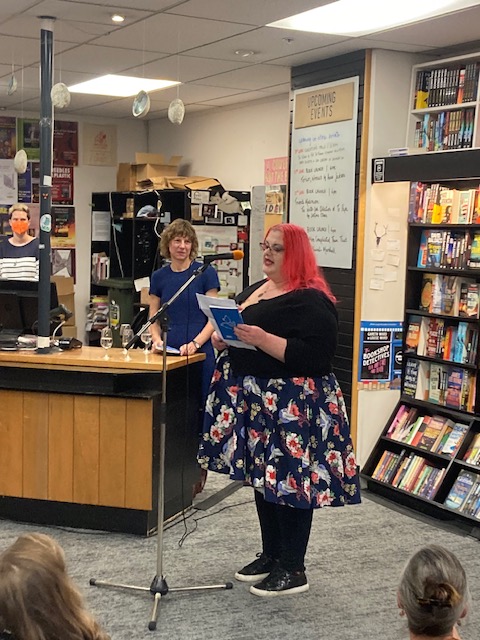
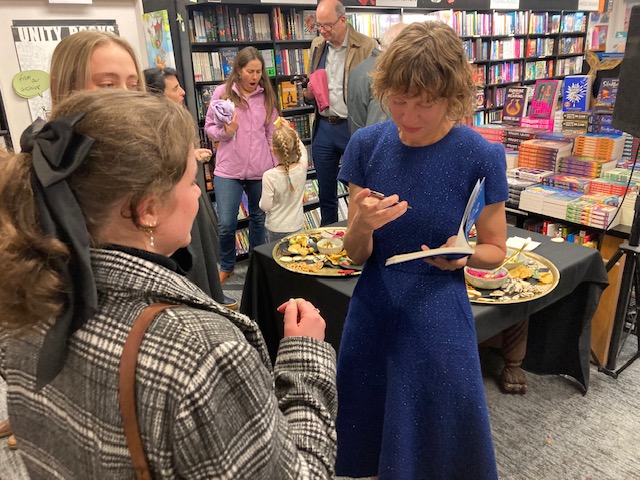
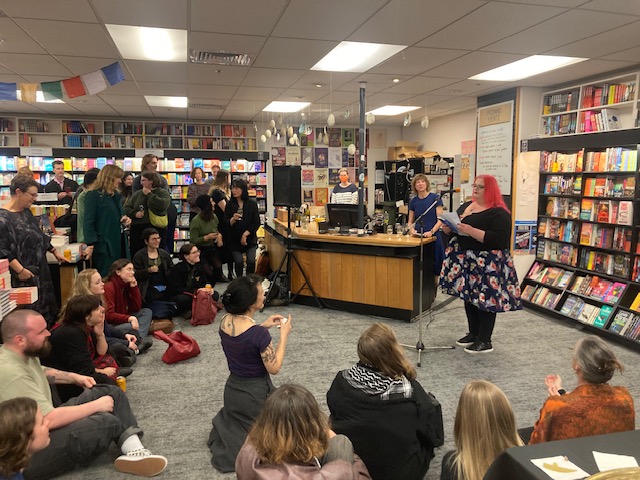
First up is Helen Rickerby launching Anna Jackson’s Terrier, Worrier A Poem in Five Parts (Auckland University Press) at Unity Books in Wellington.

Wellington launch speech for Terrier, Worrier

Kia ora kotou. Hi, I’m Helen Rickerby, and it’s an honour to be launching this new book by Anna Jackson – Terrier, Worrier. And lovely to see you all here to help celebrate.

I’ve been a big fan of Anna’s work since I first came across it, back sometime in the dark ages – the late 90s. She was living far away (Auckland) and submitted to a literary magazine I was editing. We got a lot of submissions, but Anna’s really stood out. I accepted it immediately, and that was the beginning of my friendship with Anna’s work.

I got to meet Anna herself not too much later, and then, conveniently, she got a job here in Wellington. She has become one of my dearest friends and her work and her self continue to be a big inspiration to me. She writes poetry that always makes me excited and inspired, which pushes me to be explorative and ambitious in my own poetry.

I know she’s been a great inspiration to many other people too, as a writer and teacher and as a person.

I’ve loved all of Anna’s books, so I don’t say this lightly – and I don’t really want the other books to hear me say this, I mean I don’t want to hurt their feelings and some of them are engraved on my heart – but I think Terrier, Worrier, is my favourite yet.

Auckland University Press, 2025 (page)

I got to see this book in various stages – when I read the first draft I remember thinking – and saying – that it was my favourite kind of thing to read. It’s sparky and fun and deep, it’s gorgeously written, with beautiful turns of phrase. It’s also quite educational – I learned a lot of things reading this. It’s like having a really really good conversation with Anna, and getting to watch her think in action.

This book is a thought diary in poem form – a hybrid prose poem form, which is my favourite.

Anna – or perhaps we should really say ‘the narrator’, because it is of course a composed and beautiful work of art; but while recognising that the voice of this poem is in fact a construct and not exactly or completely Anna herself, it also sounds so much like at least one version of Anna herself, that I am just going to call the narrator ‘Anna’. Anyway, Anna implies in the poem and the notes (I want to put in a plug for the notes – which are almost as rich, fun and conversational as the poem itself, and do feel to me like part of the poem itself): Anna says that she doesn’t think she has thoughts, or emotions. It is so clear to me that Anna is full of emotions, and full of thoughts – as proven by this book. I am someone who feels very full of both thoughts and feelings – when she began this project, I thought and felt that recording one’s thoughts would be quite overwhelming – I feel that I have a thought tumbling into another thought followed by another faster than I can even follow – I couldn’t comprehend how you could capture them all. But I’ve come to understand that one difference between Anna and myself is that she has higher standards of many things, including of what a thought is – and perhaps what a feeling is.

This is longish for a poem, but small for a book – however, in this small book there is just so much! A lot of thoughts and ideas per square inch. As well as her own thoughts, she argues with Ludwig Wittgenstein over language and beetles, questions Hannah Arendt over beauty, reads and considers scientific studies about time and perception – but despite all that dense deepness the experience of reading Terrier, Worrier, is easy, light, spacious, fun.

This is thanks to the beautiful, light, clever and funny way it is written.

And it isn’t just jumping from one profound thought to another – it circles back, revisits, reconsiders and sometimes disagrees with itself, makes connections with other thoughts and, aided by the fragmentary nature of this poem, there is space for us the readers to think and make connections too. For me it is the kind of writing that makes my brain spark.

This quote is from early on in the poem:

I heard birds and thought that although I am only hearing them,and I am not having a thought, it still feels like a thought, almost
like a thought of my own, or a conversation I am having, or
perhaps it is more like reading a poem, where the words, or the
movement of the thought, the song of the thought, is given to
you rather than coming from you, but still moves through you.

She begins by considering whether hearing is a thought, continues on to the nature of poetry and then you realise it’s doing exactly what it’s talking about – we’re following her thinking and the poem is making us feel like we’re doing the thinking, but then there is the space for us to actually think – if we want to – otherwise we can just go back to watching Anna’s brain.

One thing I love about Anna’s work, and actually about Anna herself, is her complete lack of concern with a hierarchy of culture. She mixes the high – classic and classical literature, philosophy etc – with the ordinary – the domestic space, family life, pets – but also treats both the ‘high’ and ‘low’ as much the same – or at least of equal importance. Or equal-ish – I think the pets might actually be more important than the philosophy.

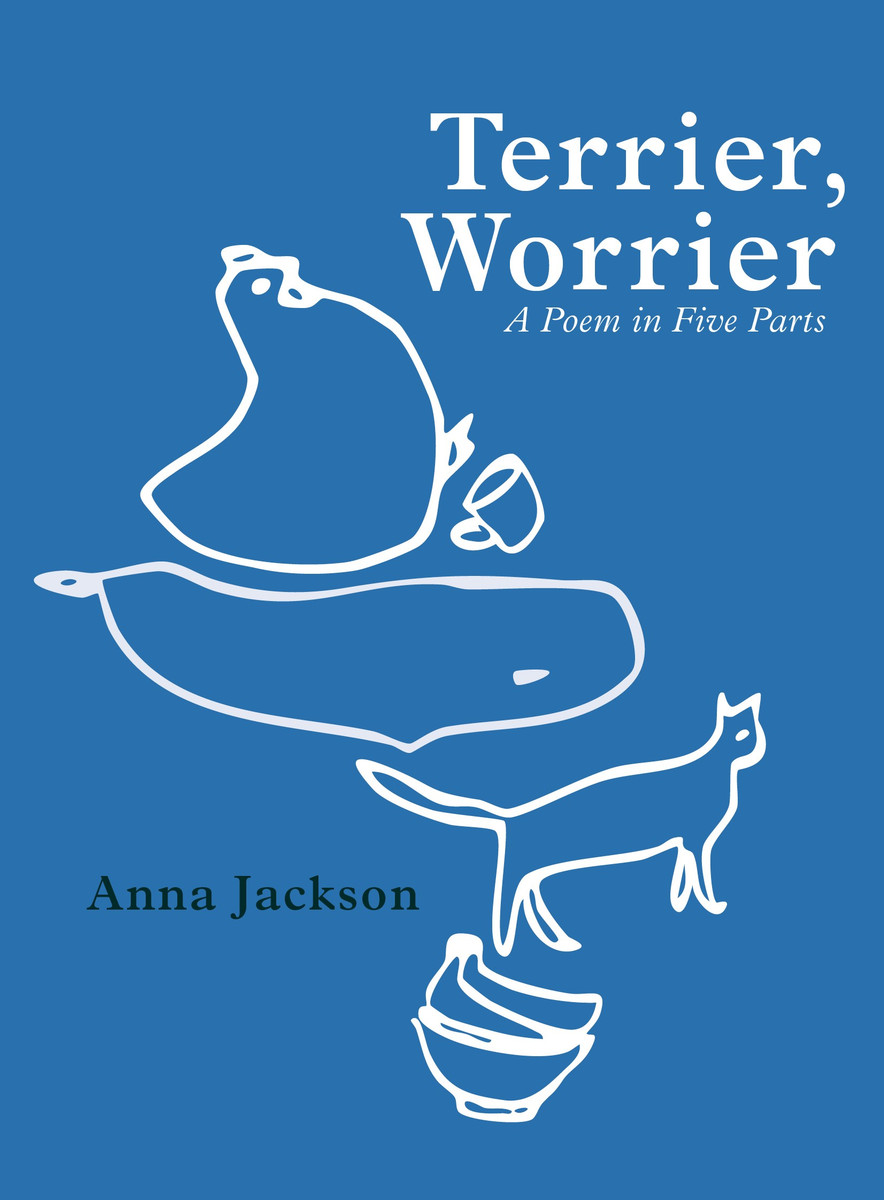
And pets do make frequent appearances in Terrier, Worrier – mostly hens and also cats, as illustrated on the cover. There’s also a whale on the cover, and there are also whales in the book, but I don’t think even Anna could make a pet of a whale, though you never know.

While in some ways this poem is like a monologue, is really a conversation – as well as being in conversation with philosophers and scientists, she has conversations within the poem – or in fact arguments – such as with Simon about whether it would be better to leave doors open (apparently it is). And it also feels like a conversation with us.

I love how she says:

Whether including conversations
counted as cheating was another question. I decided it
probably was cheating, because it is almost impossible not
to have thoughts in conversation.

I have in fact had conversations where I have had trouble having thoughts, but never with Anna.

As I expect you have noticed, we are living in some pretty weird times. While this isn’t a book that engages directly in a political way, it is the kind of book I think we need in these times – the kind of book that stands in opposition to the values that are prominent right now among some of our so-called leaders.

This is a book that is full of curiosity, empathy with other humans and with animals. It is not interested in hierarchies of status, but in the beauty of all the things, big and small, that make an individual and collective life worth living. It values thinking deeply and is not content with the first knee-jerk idea or black and white solutions. It is a book that values connections and conversations, between ideas, between people and animals, and between people and people. These are the kinds of values that give me hope.

I don’t feel I’ve done this book justice – there are so many things that are wonderful about it, but I hope I’ve whet your appetite for it. And so now I declare Terrier, Worrier launched!

Helen Rickerby

Poetry Shelf noticeboard: Robert Lord 80th birthday celebration

Robert Lord would have turned 80 this year – to mark the occasion, the Robert Lord Writers Cottage Trust and Friends of the Cottage are throwing a party on his birthday.

Friday, July 18, 2025
5:30 PM

Dunningham Suite,
Dunedin City Library,
230 Moray Place
Dunedin

A line-up of special guests will read from works by and about Robert, followed by a celebration of his life and legacy with drinks and nibbles.

Tickets are $20 and include refreshments.

Book tickets here

All proceeds go to the Writers Cottage Trust to help keep the residency programme running in the way Robert intended.

If you can’t attend the celebration but would like to support the Writers Cottage Trust, donations of any size are welcomed here.

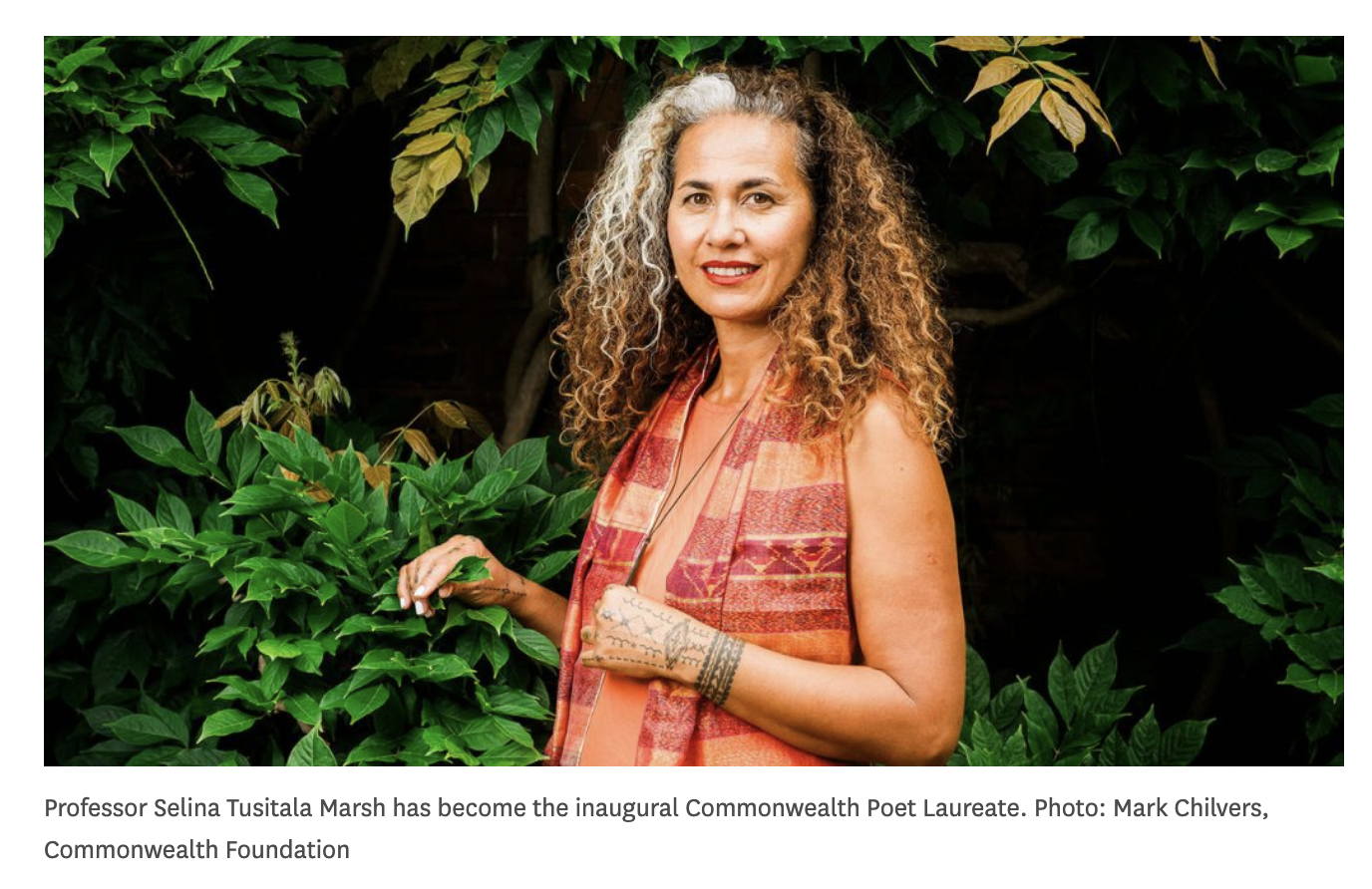
Poetry Shelf noticeboard: Selina Tusitala Marsh – first ever Commonwealth Poet Laureate

Poetry Shelf warmly congratulates Selina Tusitala Marsh

Notable New Zealand poet and academic Selina Tusitala Marsh ONZM, FRSNZ has been announced as the first Commonwealth Poet Laureate.

The professor of English at Waipapa Taumata Rau, University of Auckland is a former New Zealand Poet Laureate and award-winning writer, known for her three collections of poetry and, most recently, her best-selling children’s graphic memoir series Mophead.

The appointment, the first in the 75-year history of the Commonwealth of Nations, will run until 31 May 2027 and involve Marsh crafting original poems for flagship Commonwealth events, including Commonwealth Day, the Commonwealth People’s Forum, and Ministerial and Heads of Government Meetings.

She will also advise on the Commonwealth Foundation’s creative programming – the principal agency for Commonwealth culture – and will appear in person at the Commonwealth People’s Forum and Heads of Government Meeting in Antigua & Barbuda in 2026.

Marsh, who is of Sāmoan, Tuvaluan, English, Scottish and French heritage, says she is “deeply honoured” to accept the role.

“In Samoan, we say, O le tele o sulu e maua ai figota. ‘The more torches we have, the more fish we can catch.’ Poetry is our torch, illuminating paths between our diverse cultures and histories.”

More here

Poetry Shelf pays tribute to Rae Varcoe (1944-2025) with Jo Emeney

INVENTORY

this is my bed
these are my sheets
here is my clock
on unsteady locker

my pillow fixes my scalp
restraining my
fears from flight
my thoughts turn in

in the locker are my books
my hands, too weak
to hold them now
hold instead, your hand

the morphine comes
between me and thought
between me and pain
between you and me

the nurses do not say
how long, or when
the god who might say why
has long since gone

this is my bed
this is my body
this is my life
these are my letters


Rae Varcoe,
from Tributary, THWUP, 2007

In 2019, I wrote about women who are both doctors and poets in Wild Honey: Reading NZ Women’s Poetry. I wrote this: Rae Varcoe’s Tributary examines relations between medicine and poetry, her poems net physiological detail, regimens, procedures, grief, death, near death, diagnosis. Medical information is laid along the line, just as it is relayed to the patient, but there are little leakages of self, less likely on the ward, that suture poet and physician.  I am no stranger to hospital wards, and this collection upturns me, in its fractured medical stereotypes. The overtones and undertones are multihued, and Varcoe carries us in the wake of the personal.

Today, I return to Tributary to acknowledge Rae’s passing, wondering how it will be reflecting upon poems that have connections to the wards at Auckland Hospital that I have frequented since my blood cancer diagnosis (2010) and bone marrow transplant (2022). How do we speak of death and illness? How do we share grief and difficulty and love, a love of friends and family, work, writing, reading? To return to this precious book, with hairs on end, heart beating faster is extraordinary. I feel like I am on the ward with Rae, we are talking poetry and illness, and I am stepping into her poems and feeling what it is to be doctor. I am stepping into the grief she feels at the loss of her mother. And death is rippling down my skin.

Rae’s poetry navigates light and dark, but a lingering gift for me is the incredible lyricism – her deft ear produces music that haunts and delights and advances the subject matter. I don’t think I ever write things on Poetry Shelf – reviews or tributes – without a degree of vulnerability, without letting the personal slip. And this morning, as I contemplate Rae’s passing, I am holding her book close, thinking about the way poetry is so connecting, so illuminating. How Rae’s writing has opened multiple pathways (tributaries) for us into experienced life, into illness and death. It is a grey sky beyond the window frame today, and I am taking this moment to pause, to offer you two of Rae’s poems so you too may pause and linger and reflect. To pay tribute.

With love to Rae’s friends and family, her publisher and fellow writers.

INSCRIPTION

for:
the newly dead, the book unread
the vicious, the vacant, the complacent

the doctor whose stethoscope stopped
the priest unfrocked, the unheard muse

the plane wrecked, the toxin struck
the space shuttle burned to a cinder
and the mother who watched

the spin doctors, the office gossip
the adulterer, the shocked
the bit on the side, the man who cried

the kid with worms, the scholarly
the restless, the resented, the demented
the elderly teacher who couldn’t do sums

the nurturers, the murdurers
the hate-filled heart, the lovers apart
the man whose mower won’t start

the bored, the lauded
the ignored, the sated
and the imploring patient

the hexed message, the answered prayers
the toddler who swears
and the blackness about the shocked electrician

the agnostic, the caustic
the critic, the failure
and the e-mail trail to the genitalia

the pea-green leaves, the munted trees
the vexed, the next door neighbour
and the religious text with blank pages

I make this paper plane

and watch it dip, flip, swoop
then circle back again


from Tributary

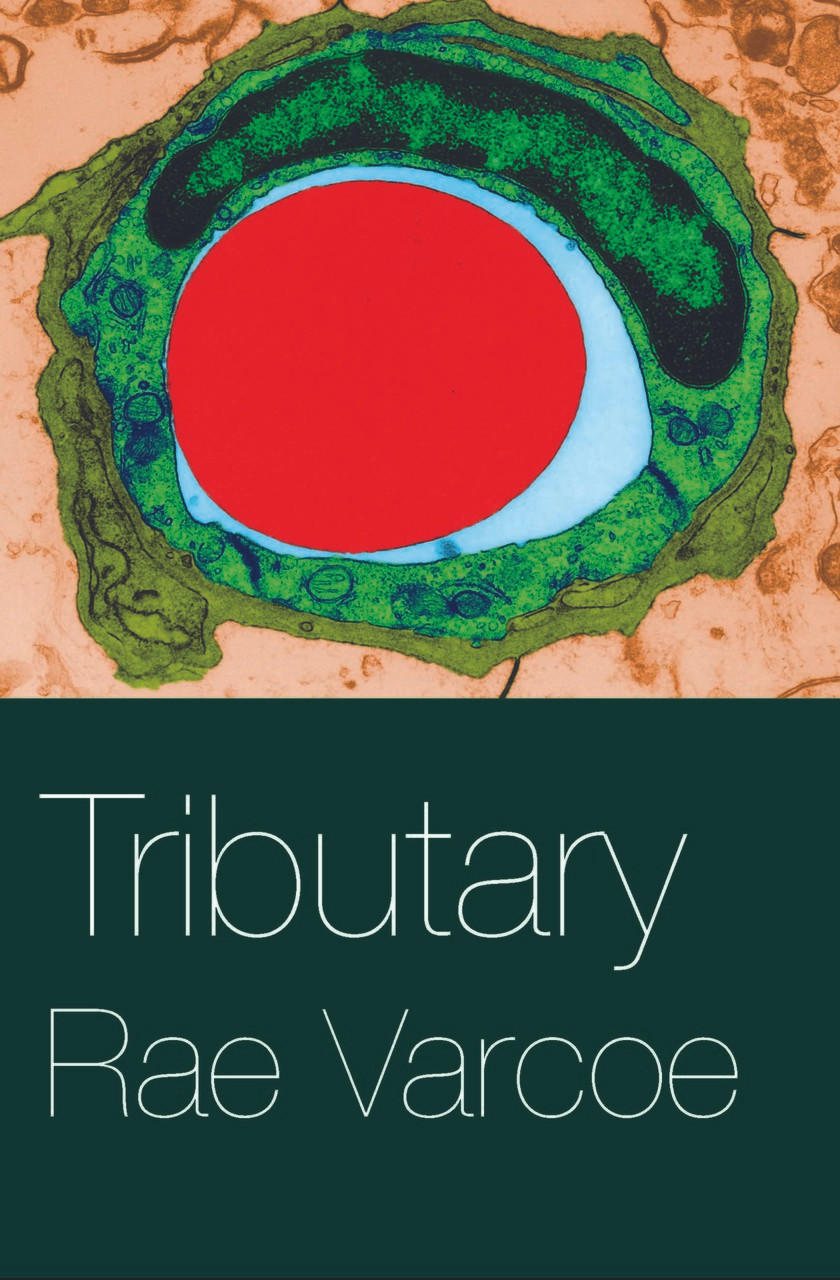
Tributary, Rae Varcoe
Victoria University Press (THWUP link), 2007

Tribute by Jo Emeney

Rae Varcoe (1944-2025) was a haematologist specialising in leukaemia and lymphoma at Auckland Hospital for 30 years. She was also a very fine poet whose formal practice began at Bill Manhire’s inaugural MA class in 1997.

Rae’s medical training informed her poetry, and her collection, Tributary, features many poems which reflect on her medical experience. Ranging from the satirical to the solemn, the Tributary poems explore the relationship between lay language and medical language, often relying on the holes in meaning which lie between the two to highlight inequality, miscommunication, and the mysteries of life and death. Even the collection’s title works in this way: A tributary vein is one that empties into a larger vein, much as a branch of a river or lake is called its tributary. Historically, a tributary is a person who travels from one land to pay homage to another, often bearing gifts. Perhaps this is what Rae’s doctor-personae enact on her behalf.

One poem from Tributary was selected for Best NZ Poems 2002:

Plot 608, The Old Balclutha Cemetery

how deep grief is

how insubstantial this sand
to hold these
the fleshless remnants
of our parents

all our ancestral DNA

exons to earth
introns to dust

who will read you now
my brave wee mother

and who decode
your silence, Dad

and what will we
the messengers
say to the world

What the combination of medical and lay language — and the conversation between the personal and the scientific — gave Rae’s poetry was complexity and originality. It also moved her poems towards the transcendent and universal. As one of “the messengers”, she brought us knowledge from another land.

Vale, Rae. Your contribution to both poetry and medicine will be lasting.

Poetry Shelf Monday Poem: Song by Jackson McCarthy

Song

I was licking the moon like
a streetlamp before the water
razed the city — people, jobs,
lovers, I feel your movements
glowing and reckoning with me.
Some people say the loss I felt

with you was inevitable, a foregone
conclusion, but I can still breathe
the air around the dark
shape of your body.

The life I’ve felt has been
larger only than this tide;
tonight, messages from family reach
me, surreal, on my phone.

My cousins in Beirut can feel
the terror in the air, I go on
with so little left to speak; listen
to my heart, these songs
of loss I write while I
cannot hear the bombs.

Jackson McCarthy

Jackson McCarthy is a poet and musician from Auckland currently studying in Wellington. He is of mixed Māori and Lebanese descent. His work has been published in Ōrongohau | Best New Zealand Poems, Landfall, Starling, The Spinoff, and elsewhere, and he currently serves as an editor at Symposia. You can read more of his work here.