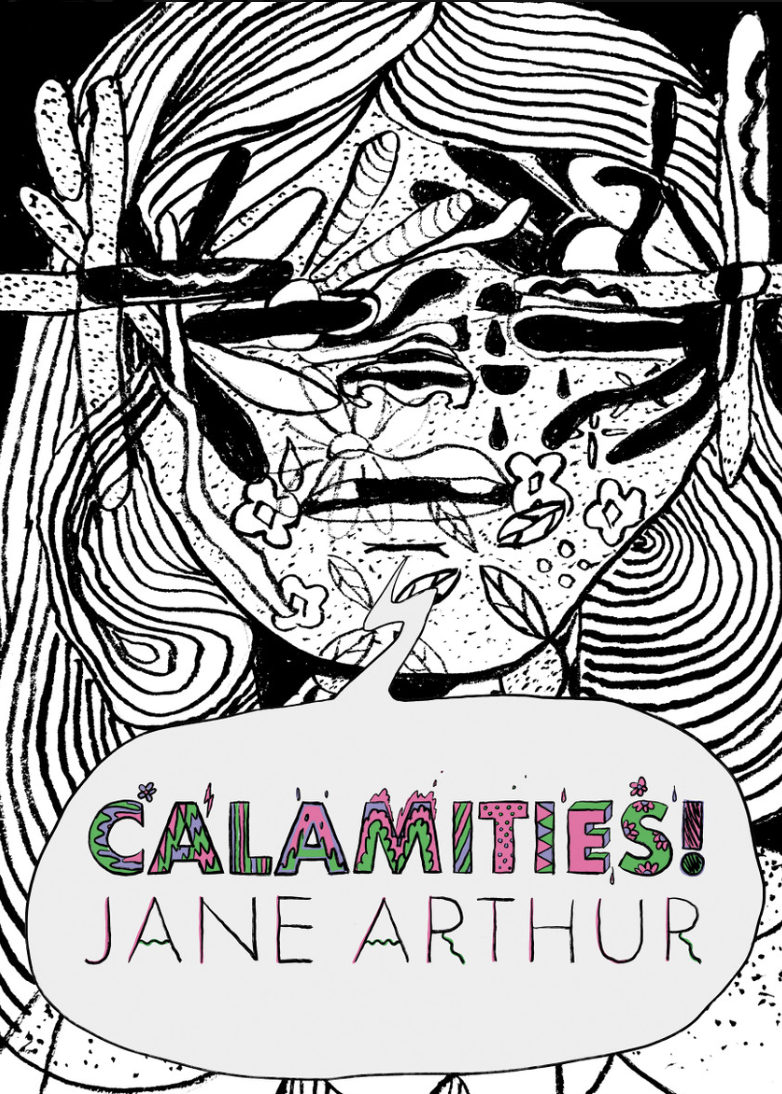
Calamities! Jane Arthur, Te Herenga Waka University Press, 2023
Jane Arthur’s second collection, Calamities!, is a glorious translation of being, of existence in an unsettled world. Think comfort and discomfort, the physicality and elusiveness of being, its poetry and its prose. Big questions surface, little questions simmer. Conundrums hover and anxiety lurks. This is poetry of tilt and tremor and one reading wasn’t enough. I dived back in for more.
The opening poem, ‘The Better to See You With My Dear’, is a declaration for the poetry to come. The title draws the ubiquitous and macabre fairy-tale threat of bad things into a present tense, into the tension of apocalyptic views and warnings, into the tug between closing eyes and speaking out, between body worry and body action. And already as reader you are making a stand, ticking the boxes: action and/or speaking out, writing, deferring, addressing, more writing.
Add the imperative of awe, a need to feel the world: ‘I tried / to place myself in the context of the size / and the history of the universe’ (from ‘Meteorite’). Joy is elusive, elation is slippery. I come back to the notion of poetry as being. I have entered a book of ideas and of feelings, experience and thought. This is what Jane’s poetry does: it offers multiple paths, entrances and exits, pulling you into both the unimaginable and the imagined, the concrete and the elusive. It brings the tilt of the world within reach, so as reader, you can feel the heat and hit of anxiety, the unsettled.
A single poem can be so complex, so simple, so piercing, so affecting. Take ‘Dodge’, for example, where ‘each day is each of us / carving through space/ using our bodies’. Then, in the next stanza, we are divided into groups depending on how we answer the listed questions. The last stanza is a throb-of-the-heart moment, a “wow”, a stop-you-in-the-tracks-of-reading:
Do we live only to the limits of our comprehension? We will never know what we don’t. Alack. Some of us carry shame and others of us probably should.
Move from domestic life to philosophy, from dead flies in cups on kitchen shelves, to the prospect of heroism and couch hugging. Climate change is there in ‘Alien’, an ode to once was, to what ‘is kind of like / getting cooked alive but so slowly you’ll / probably barely notice it’. World fret meets individual fret meets world fret. Ah. Such friction. Such knowing that leads to less knowing that leads to knowing hunger in the fabulous poem ‘How, All Right’. And then, in travels though calamity, in the poem ‘Autumn’, the writer speaks of autumn light, where the nag of cheesy thoughts is nothing compared with bigger issues. This is a solace branch, this beauty moment, this invitation to pause and restock:
(….) Not us, not when there are bigger things to worry about –
and not when it’s still possible to put them aside to look at the low shadows, the glow
of evening sun across the branches of trees that refuse to be anything but green.
The core of Calamities! contains a longer sequence, ‘The Bear’, and it’s mesmerising: part fable, part magic, part analogy. The speaker lives in a cave with no heating or sanitation but a hibernating bear for company, yet the visiting sisters don’t see the animal. Ah. The bear begins fierce and blazing, then shrinks and sags, and remains a vital source of heat, for the speaker is cold. So many paths through this sequence.
Jane produces the kind of poetry that haunts, that clings with mystery and mood, with a mise en abyme effect of story and storytelling, personal, global, affecting. How to get warm in the calamity of cold? How to find the bear and the cave and the point of rescue? I am rereading the collection, and writing becomes a key, reading and writing, this twinned joy, this survival.
The book’s final poem, ‘Imaginary Den’, makes a touching bridge back to ‘The Bear’. The poem begins with dogs nestling in close and then ends with an image of comfort and security. Such a perfect note to finish the collection, and indeed my review, a review that barely scratches the surface and depths of the book’s making, with its sweet craft and its intricate layering. Calamities! is a collection to spend extended time with, to nestle in close to the power of poetry to move and to comfort and to speak.
(…) The dogs want to be near me, seek safety and comfort in numbers,
which is no new concept but one that gets eroded as the world devises ways
to wring value out of its inhabitants (and inhabitants wring value out of their world).
Let me dig my little hole. Let me settle down into it, feigning safety, let me.
You can listen to Jane read ‘The Better to See You With My Dear’ here
Jane Arthur is the author of Craven, which won the Jessie Mackay Prize for Best First Book of Poetry in 2020. She received the Sarah Broom Poetry Prize in 2018 and has a Master of Arts in Creative Writing from the IIML at Victoria University of Wellington. Born in New Plymouth, she manages and co-owns a small independent bookshop in Wellington, where she now lives with her family.
A puff of air like a lover’s sweet speech bubble, blue as sky. A brown horizon turning fast into tomorrow and tomorrow, etc. Mud and leather and a man who runs like rubber drawn from itself over mud born from its muddy mother field. A kick-off and the howl of a moon’s dog. They kick the tender thing and kick and kick the tender thing and wail and sing. Five-nil to them. Fuck. And fuck the conversion too. More points for them. The ball sings. The wind sings a hymn down the Saint Patrick’s Day parade-length of field and the wind blows the ball where it shouldn’t go. You have to hope these idiots grasp softness the idea of it its air and innocence. Twelve-nil to the other side. Conversion? No. A rose blooms. The fullback there he goes into a scrum. He’s in the scrum for his girlfriend the girl he loves. A torn ear a red rose the love-song of the fullback a big man a fucking giant look at him run. A lot of blood. He runs for the invisible woman. He’s a moving tree a flowering tree. The Aussie should be sin-binned. Oh. He is. Penalty. Twelve- three. Tenderness and the terrible wind-sound necessary for play. They kick the tender thing and kick and kick the tender thing and wail and sing. A man jumps to his feet throwing the hand of his girl into the sky. He flails and beseeches. Go go go go go! It’s her envoi. A guttural call Moss has never heard before coming from here and here a beating on the edge of seagull i.e. clarinet. There’s a rolling maul, players scragging faces with sprigs. The referee runs and blood runs like tears. Penalty. Twelve-six. Go man boot the groaning air cradle it as your child. Don’t fucking drop it idiot. A moan goes up. It rests in the bodied stadium staying there, living on among the people as damage. They kick the tender thing and kick and kick the tender thing and wail and sing. Rain starts. Good for the home team (used to it). The visitors gnash their teeth. Mud sprays men into fossils memento mori. They’re covered in the game head to foot. Outrageous penalty fifteen-six. Fuck. A scrum in mud and more rain. The field is ankle-glass sometimes shattered as a dance once seen moved in water a splish and trail like scarves. Half time (FW).
2.
The land shaved of trees made useful by its nakedness and water. Men stand as if cattle mirrored at a trough. A whistle like a cast in a roving eye roving over the field. The men swarm towards the ball flicking earth and sky. The Centre’s butchering down the field as a lion hunts prey in the late afternoon. As a boy he loved animals. Off-side. Fuck. Blood and sweat and blood and the crack of bones. They kick the tender thing and kick and kick the tender thing and wail and sing and wail and sing. A man is carried off by St John’s Ambulance. Ah well Fifteen-eleven but missed the conversion the egg. Another kick-off and before long a line-out whatever that is. A player hurling himself into infinity running and falling and not caring his body everything and nothing hovering on the brink of his death, death of a small nation. He is a carcass or palace. He’s carried off by St John’s Ambulance. But there’s a penalty. Fifteen-fourteen. They kick the tender thing and kick and kick the tender thing and wail and sing. Howl and a face coated in the season and the game is a season imperative compulsory gone again and a girl who walks into a woman. And rain drums length of rain drumming. It’s late and the sun dips below the cap of cloud touching the heads of the crowd limning a moment blue. They kick the tender thing and kick and kick the tender thing and wail and sing. On the field blood squelches underfoot. Twenty-fourteen. Paul weeps on her shoulder. They’ve lost. If they’d won there’d be just the same weeping like a well a stream or cataract. She holds his bones under her hands his back where wings might once have been. A good man full of tenderness giant i.e. a lot of tenderness. The small mercy of no conversion. A minute to go. A man runs down the field like a doctor in a field hospital. A try to us! Forty seconds to go. The half-back lines up the wet egg of the universe and after some deliberation kicks the tender thing. And wails. And sings. Converted. The sun sinks The whistle blows. They won! (i.e. We won apparently) Paul and his mates leap to their feet. Hell we won. They leap one by one. Fintan leaps to his feet. Look even Forest is leaping to his feet. Moss carried away with the win and Paul weeping and giants leaping and without thinking she stands. She looks down at the long body her old favourite. And glances up at the great giant there beside her a head taller (no matter, he will soon go away now the game is over and there is just Finnegans Wake to read or whatever tall tale it was). Light from the tall lamp casts the giant shadow of the girl over Paul. He is bathed in a quick new coolness, as dusk falls suddenly in the Tropics and feels it and stares up at the girl and backs and backs (the love song of the full-back).
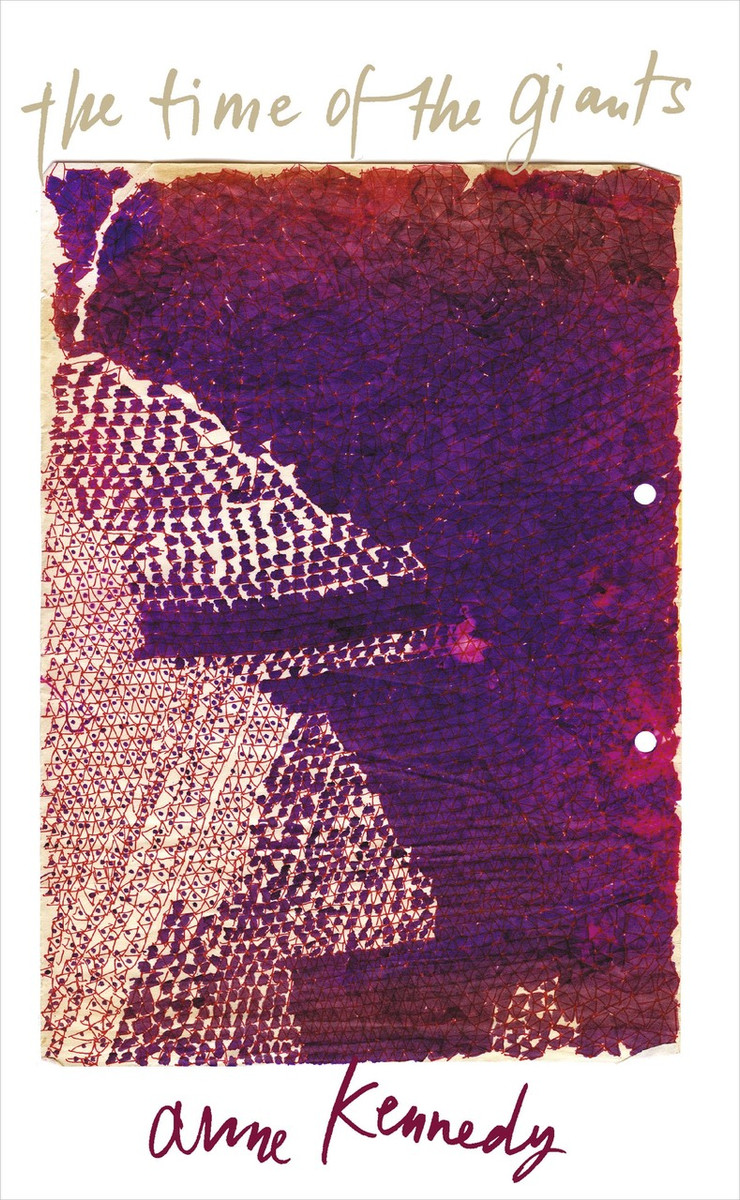
Anne Kennedy from The Time of the Giants, Auckland University Press, 2005
Note: The reason I’ve thought about that poem lately is that when I wrote it, in the early 2000s, rugby was the preserve of men. The voice in the poem is a woman who knows nothing about rugby and doesn’t really want to know because it’s not for her. But that’s all changed now that women are forging ahead so mightily with rugby and are being acknowledged for it. We need some new rugby poems!
Listen to Anne read the poem at Ōrongohau | Best NZ Poems
Anne Kennedy’s recent books are The Sea Walks into a Wall and The Ice Shelf. Awards include the Prime Minister’s Award for Poetry and the Montana NZ Book Award for Poetry. Remember Me: Poems to Learn by Heart from Aotearoa New Zealand, edited by Anne, will appear later this year from AUP.
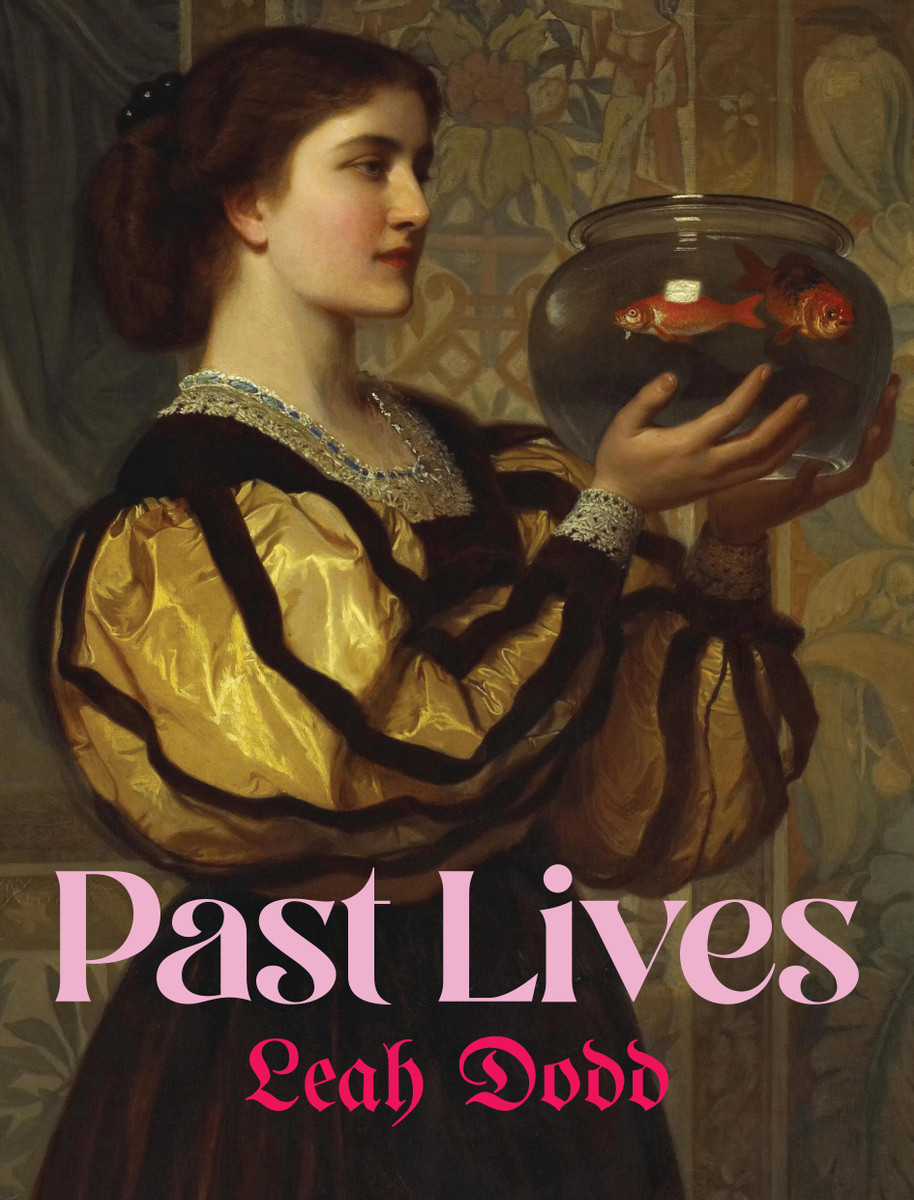
Leah Dodd reads from Past Lives, Te Herenga Waka university Press, 2023. You can read my review here.
Leah reads ‘the sun is out so why am I still depressed?’
Leah reads ‘tether’
Leah reads ‘revolution’
Leah reads ‘muscle memory’
Leah reads ‘domestic goddess’
Leah Dodd is a poet and writer based in Pōneke/Wellington. Her first collection of poetry, Past Lives, was published in March 2023 by Te Herenga Waka University Press. Leah holds an MA with distinction in Creative Writing from the IIML, and won the Biggs Family Prize for Poetry for her work there. She has been published in various journals and places, including Sweet Mammalian, Starling, The Pantograph Punch, The Spinoff, and Mayhem Journal. More can be found collated on Leah’s website.
The sun hangs half-hearted in the face of another post- modern ending and I’m driving home, and that’s that—another day down. The clouds stumble across my eyeline, like I wrote them there. In this light, that night seems distant somehow, like the dried-up cleaner fluid that haunts the corners of my windscreen. How we were in Kingsland—how you talked only about yourself. And I let you. I’ve been mid-way out my body for the last couple of months, pooling in a quiet, little stupor. When you asked me to be honest and I couldn’t. Not with you. Not with myself. I keep driving. None of this is what I was hoping for—not really. But, on Thursday night, M and I scoured the aisles of Tai Ping and I let myself unwind amongst the spring onions and coriander. The fluorescent lights hummed and buzzed in a kind of symphony. Inside the green basket, all my uncomfortable thoughts, swinging back and forth as we walked. And I thought, for the first time, here, right now—I am seriously so tired. Tired of nestling myself amongst these minutes just to watch them pass me by, of talking and not being heard. The way you erased me in conversation, trivialising my pain. You spoke and I didn’t exist. Now, M is putting the ramen in the basket, and when we drive home, Lizzy is on the radio. I feel at peace. And somehow, I’m older, too. I settle in. And tomorrow—
Brecon Dobbie
Brecon Dobbie finds poetry to be her place of solace. She writes to make sense of things, often without meaning to. Some of her work has appeared in Starling, Minarets Journal, and Poetry New Zealand Yearbook.
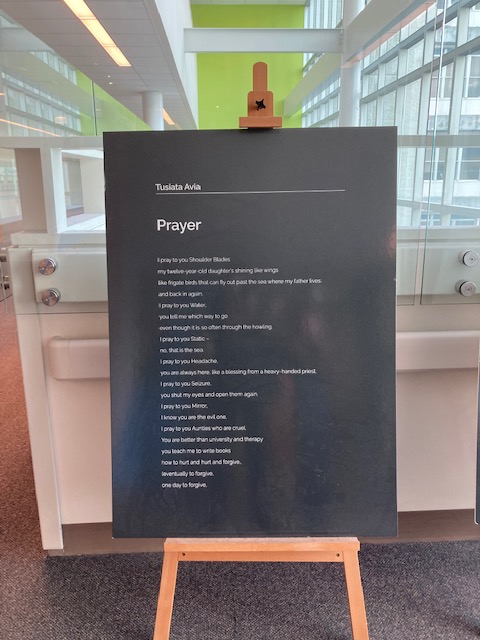
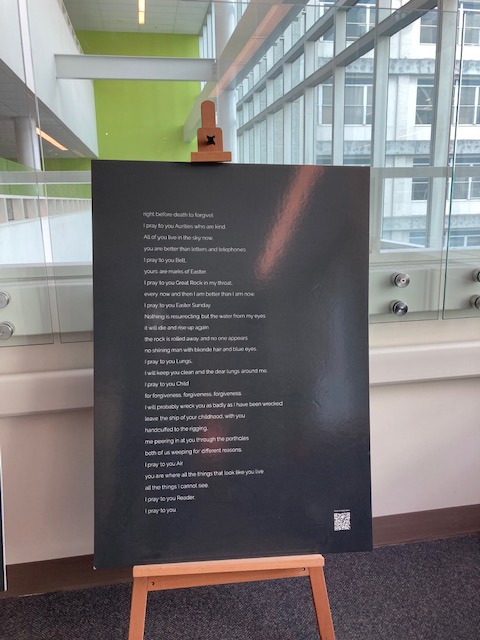
‘Prayer’ by Tusiata Avia, Auckland Hospital, 9 March 2023
Saturday 17th June and it is one year since I had my bone marrow transplant at Auckland Hospital. If I hold the past year out to you, inside that year is another year, and inside that another, and then another, and then another. There is the year of miracle happiness, of finding joy in reading writing blogging. Of finding joy in looking out of my hospital room window to the harbour and sky and volcanic island. There is the joy of being cared for by extraordinary nurses and doctors over five weeks on Motutapu Ward.
Each day was one small step up a very steep and difficult mountain, but no matter how steep and how difficult, and how far away the peak seemed, there was always time to savour beauty, the view, the cleansing air. There was always one small step.
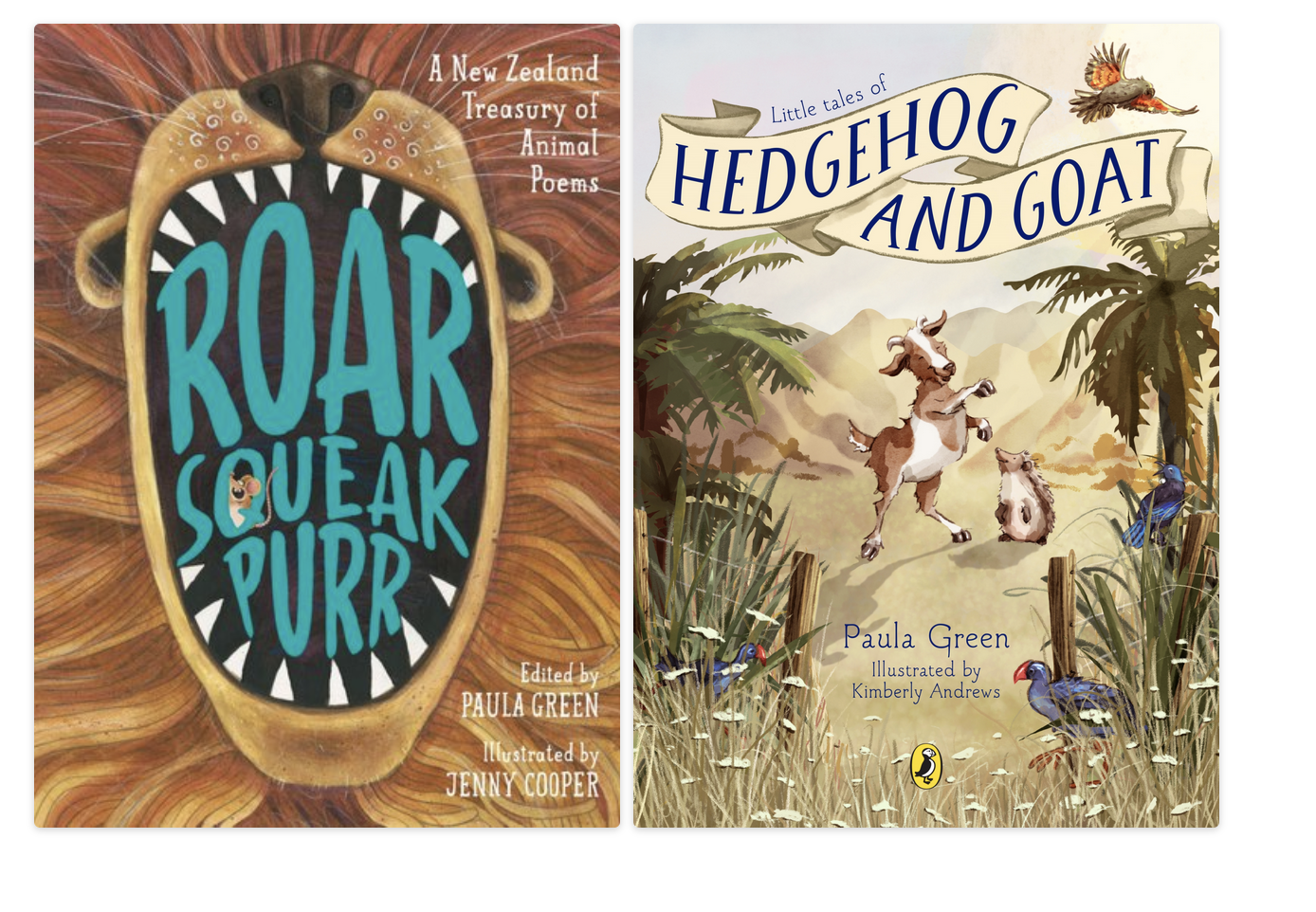
Ah. Inside the year of mountain climbing is the year of books, even in hospital where I had little towers of children’s picture books and junior novels to delight in, to consume in the tiniest of bites. I say books have the power to nourish, to keep you grounded, to fill you with awe comfort delight. It was so special to have two children’s books out in 2022, under the careful guidance of Catherine O’Loughlin and her team at Penguin Random House.
Inside the year of books is the year of support, from family friends and people I have never met in person. The year of kind emails you sent and send, the understanding when I don’t answer the phone or emails or say yes to all the wonderful things I normally say yes to. Even though I have made extraordinary progress on my mountain climb, I still haven’t reached the top. I am running on half a cup of energy a day, sometimes less, but I am also fuelled with awe and wonder and aroha.
And you help. You have all helped enormously.
Some days I feel sad that I am not out zooming and zipping doing school visits and author visits and poetry readings and book tours. Or hanging in the shadows at poetry events to feed off that goosebump zing of live poetry. I feel sad that I haven’t yet managed to do monthly poem challenges on Poetry Box as it is a big thing emailing every child that sends me a poem. I feel sad about this.
But to have both blogs up and running is a lifeline. To post almost daily reviews of children’s books on Poetry Box is sustenance. When you are zapped, a picture book is the perfect vitamin, and then writing on the uplift of reading an extra vitamin dose.
To post audio readings by poets with new books on Poetry Shelf is like staging live events in a cafe for me – so invigorating. I reach for my notebook and scrawl another poem. AND what joy to post new poems from you along with my slow-coach book reviews – equally satisfying.
Over the coming months my blogs will carry on as they are now – I will barely make a dent in the books waiting for me to review, I will say no to almost everything, I may not answer emails promptly, and the Poetry Shelf noticeboard will rarely have a presence. But slowly and surely I will keep the new series going that I have started. Hoping to assemble the next place on my poem road trip! Plus! I am going to do a few clusters of poems by children on Poetry Box with the help of a kind librarian poet.
To celebrate my year I have purchased a copy of WHAKAWHETAI: Gratitude – A Daily Bilingual Journal by Hira Nathan (Allen & Unwin, new edition 2023).
Recently I was at Auckland Hospital for my regular checkup and I stalled by Tusiata Avia’s magnificent awe-rich body-hugging poem, ‘Prayer’. I realised in my prolonged contemplation, what gratitude I felt for Tusiata’s words, and within that gratitude for your words, for friends and family, for our magnificent writing and reading communities, for supportive booksellers, for the exceptional hospital care by Richard, Tom, Sarah, Rosie, Hannah and the nurses, people who were and are consistently patient and kind and attentive, no matter how tired or overworked they are. No matter how tired or sizzled my brain is!
Today I celebrate one miracle year. I thank my anonymous young donor and I thank you. I offer special thanks to my dear friend Tusiata, who has given kind permission to post ‘Prayer’. Breathe this poem in and savour the day slowly. It is precious.
Prayer
I pray to you Shoulder blades my twelve-year-old daughters’ shining like wings like frigate birds that can fly out past the sea where my father lives and back in again.
I pray to you Water, you tell me which way to go even though it is so often through the howling.
I pray to you Static – no, that is the sea.
I pray to you Headache, you are always here, like a blessing from a heavy-handed priest.
I pray to you Seizure, you shut my eyes and open them again.
I pray to you Mirror, I know you are the evil one.
I pray to you Aunties who are cruel. You are better than university and therapy you teach me to write poetry how to hurt and hurt and forgive, (eventually to forgive, one day to forgive, right before death to forgive).
I pray to you Aunties who are kind. All of you live in the sky now, you are better than letters and telephones. I pray to you Belt, yours are marks of Easter.
I pray to you Great Rock in my throat, every now and then I am better than I feel I am now.
I pray to you Easter Sunday. Nothing is resurrecting but the water from my eyes it will die and rise up again the rock is rolled away and no one appears no shining man with blonde hair and blue eyes.
I pray to you Covid I will keep my mask on, and the loved ones around me.
I pray to you Child for forgiveness, forgiveness, forgiveness. I will probably wreck you as badly as I have been wrecked leave the ship of your childhood, with you handcuffed to the rigging, me peering in at you through the portholes both of us weeping for different reasons.
I pray to you Air you are where all the things that look like you live all the things I cannot see.
I pray to you Reader, I pray to you.
Tusiata Avia from The Savage ColoniserBook, Te Herenga Waka University Press, 2020
Here too the city will help, hill tree and tower by sunlight or by starlight assembled into a setting for something to take place in, a place to go on from.
Iain Lonie from ‘The Entrance to Purgatory’ from The Entrance to Purgatory (McIndoe, 1986)
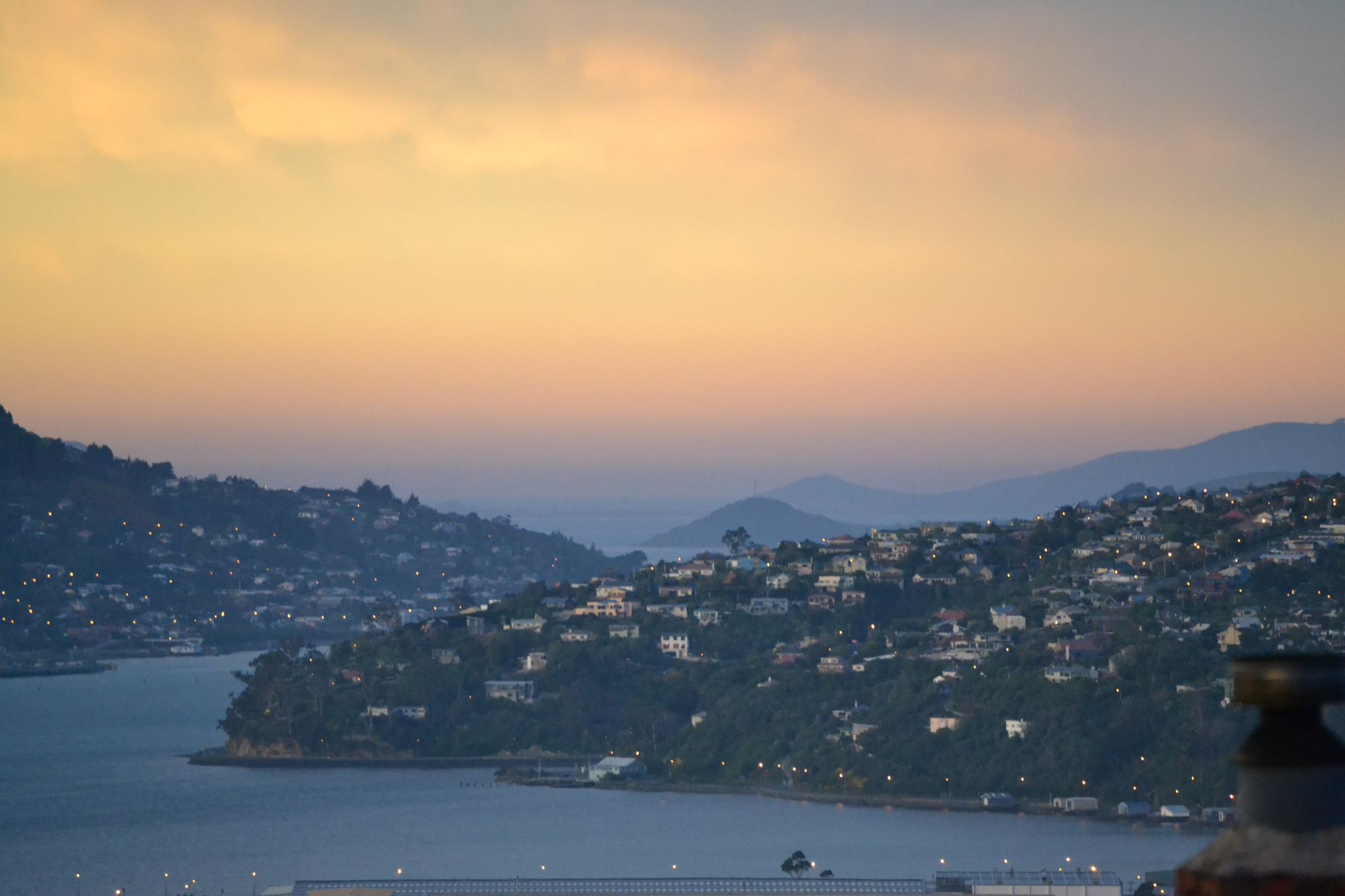
The first stop on my poetry road trip was the Kāpiti Coast and Te Whanganui-a-Tara Wellington. Second stop is Ōtepoti Dunedin. A fitting place to linger as I have spent extended sojourns in poems with Dunedin connections. I am thinking of all the poets who have lived in Dunedin at different points, poets who have captivated readers with their poetic verve across decades: from Ruth Dallas and Janet Frame through to Cilla McQueen and Vincent O’Sullivan, David Eggleton and Emma Neale. Many of these poets have lived and written elsewhere but have also been a vital part of the city’s writing pulse, this beloved City of Literature. I am thinking too of the explosion of new voices, of younger poets enriching the performance spaces, the poetry collectives, with appearances in the Otago Daily Times, literary journals and their own publications.
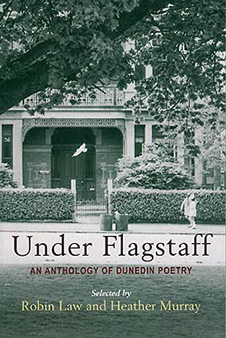
I am thinking of Charles Brasch founding Landfall in Dunedin in 1947, and how after time elsewhere, the journal has returned to its home place. It is now published by Otago University Press under the astute editorship of Lynley Edmeades and David Eggleton (reviews). I am thinking of the Robbie Burns Fellowship that supports writers. I am musing on how Otago University Press is led by poet and publisher Sue Wootton, and how OUP bestowed such loving attention on David’s recent NZ Poet Laureate collection (my review here). There is the eclectic and lovingly assembled Under Flagstaff: An Anthology of Dunedin Poetry (eds Robin Law and Heather Murray, Otago University Press, 2004). And I am thinking of Jenny Powell and Kay McKenzie Cooke’s touring duo: J & K Rolling! Finally I am thinking of the vital mentor of our younger poets, co-founder of The Starling, poet Louise Wallace (also with a fabulous new book out).
When I visit Ōtepoti in person, hang out in the cool cafes, scour the bookshops, visit the galleries, take a trip along the headland to see the albatrosses, stand in the Octagon and breathe in the crisp southern air, I feel alive with a vibrant and vital city. And that is how Dunedin poetry is for me – whether it’s a hint of city connections or full immersion. Dunedin poetry is prismatic, it moves and gleams in multiple ways, there is no single southern recipe or voice, there is sustenance and substance.
Such a pleasure hanging out in this splendid city courtesy of poets I have lingered with over time and those I have only just met in print. Grateful thanks to all the contributors. I also toast the much loved poets who are not part of this particular mix! I needed a book! I begin the Dunedin stopover with the much loved voice of Cilla McQueen and conclude with the equally loved Vincent O’Sullivan and Ruth Dallas.
Thank you. Next up I am heading to North Island towns and small cities.
The Poems
Joanna
I visit my friend’s kitchen. There are roses on the floor
and a table with pears. Her face is bare in the light.
She smiles. She has hung a curtain. I like the darkness
inside our Dunedin houses even in summer, the doors
that open into the hall, the front door that opens into the sun.
Cilla McQueen from Homing In, John McIndoe, 1982 and in poeta: selected and new poems, Otago University Press, 2018
Called
It is October in Dunedin. Rhododendrons fan out flounced skirts; magnolias, magnanimous with their moon-cool glow, light the path south so the sun stirs us early; although the river, the creek boulders, the city’s cinched green belt, still hold the cold like an ice store’s packed-down snow.
The days shiver with filaments of ua kōwhai: soft rain that dampens paths, shakes loose carpets of white stamens, yellow flowers bruised and trodden like flimsy foil cornets. School holidays send out falling, silvery arcs of children’s sky-flung laughter; our bodies drink it in as if love’s parched ground sore needs this watering.
Yet the radio stays hunched in the kitchen corner hard grey clot in the light’s fine arteries muttering its tense bulletins; and as if they sense this late spring still harbours frost’s white wreck, or some despotic harm abroad seeps too near, our sons more than anything want their old games: secret codes, invisible ink, velvet cloaks; hide ’n’ seek in public gardens’ clefts and coves—
and again, again, can we tell them again
the chapters of how they first appeared in the long, blurred myths we are entangled in; kingfisher-blue wells of their eyes a-gleam as if they know how much all adults withhold. They want us to go back deeper, to when we both were star-spill, sea-flume, spirits, only belatedly woman, man, climbing up from a shore feathered in sand black and soft as ash, driven by some gravid magnetism towards each other
in case we changed to birds, lizards, trees, or back to sea-salt borne by wind; an urge clear as hunger coursing the cells’ deep helix to complete this alteration, half-bury and re-germinate the fleet molecules of self, so we could run our mortal hands the small, kind way along the children’s plush skins, learn, pulse on pulse, their true, human names. Yes, we must go back and back; as if to swear even to this dread epoch’s wild, original innocence.
Emma Neale from To the Occupant, Otago University Press, 2019
Dune din
grain upon grain grain gains upon grain upon grain upon grain upon grain up on grain rain rains upon grain shifts grain up on grain lifts grain up on grain upon grain upon grain shhhh whispers grain hisses grain and again grain gains upon grain booms grain upon grain sings grain again grain
Sue Wootton from The Yield Otago University Press, 2017
Dunedin
The city is not asleep, It’s burning and I’m burning too.
Not my motherland, so I try to find resemblance in the foreign bodies-in-faces that glisten with sweat under the confusing weather.
Follow the path of statues that takes me to my favourite fish and chip store.
Ruins of nostalgia are the aftertaste of my childhood. I don’t remember resting.
Years later when I traced back the roads I travelled, akara and fufu always resembled my motherland and I never had anyone to hold hands with.
Today the city is asleep, and I’m not burning.
I hold onto the space between your fingers even though I know when I return,
all I will have is the ruins of nostalgia.
But this time it will be of a friend’s and maybe Ōtepoti doesn’t feel so foreign after all.
Tunmise Adebowale
Mornington
A morning rain of muslin, hardly there except in the pinprick flicker, a thickening of the air. Far then farther the cars down watery tunnels shrink while every branch and blade swells into closer green. The leaves, poised, tuck the mist between crease and rib, now and then bouncing to shed a drop with a quiver. In such twitches and glints the rain gathers, finds runnels and nubs in concrete that coil clear water into guttered dark. What remains, drifts: the road a stippled mirror of a hushed and hooded suburb whose colours through wet hours deepen, become more patient.
Megan Kitching from At the Point of Seeing Otago University Press, 2023
Dunedin, October
Broken bottles like diamonds ground into pavement. The sun slants through leafless trees, lost in the gloom, gives up.
Ducks tuck their heads in the shade. The heat bakes pink blossoms, scent rising, beer and burnt coffee.
Shereen Asha Murugayah
South D Poet Lorikeet
Born in the heart of South Dunedin, too soon, too light, the Home too full, the Doctor too late. Night falls away, early sun climbs into play.
It’s baby city in Melbourne Street, Rawhiti Maternity’s over-crowded, no rooms left, no time left. The mother lies on a bed of boards.
Rawhiti. East, direction of dawn, day born in the waking of bellbirds, tuis, thrushes and finches, calling, cajoling, comforting.
Bed for the Mother made over a bath. ‘Don’t throw the baby out with the bath water,’ she said. ‘Blood is thicker than water,’ they said.
Born in the heart of South Dunedin where still waters run deep, a Rawhiti songbird breaks into memory. Her call haunts bedraggled trees.
Jenny Powell from South D Poet Lorikeet Cold Hub Press, 2017
Poet makes a useless round-trip journey
Walked around City Rise from home to the Warehouse, above the Exchange, to look
for notebooks & scribble-pads. Quite a hike for me these days . . . Out of Prestwick, past Sim,
down Drivers Road, into Queens Drive, Royal Terrace, up London Street, across Stuart, into Arthur (at
Otago Boys’ High), over the top of York & down Rattray to Maclaggan, & on to the Warehouse
where I bought 3 DVDs but no notebooks––Oh! ––& an icecream . . . Then on again to Queens
Gardens for a pee at the public toilets next to the brothel, & on past the Leviathan Hotel
around the corner from the old Police Station to the new Bus Hub opposite the new Police Station
where I caught a bus back home.
Peter Olds from Sheep Truck and other poems, Cold Hub Press, 2022
Octagonal
A Cento
Drop down to roofs and that gray documentary harbour. See those houses on Lookout Point ambiguously glitter. Steer the car like a life-raft down Cumberland to this and slide down towards St Kilda, as if that’s where breakfast is. I never remember the sun in North East Valley steamed open like a cockle this morning in mid-July. I’ve gone down with the sun, written syllables till time has surprised me and driven home through the bright lights of George Street.
Dad took us up Flagstaff and we slid on tea-trays down a field, from the far side of Phar Lap’s ribcage. Dunedin—grey as thinking grey on the greyest days, crossing High Street for the last time—without looking both ways. Dunedin—it snaps you awake quicker than smelling salts and the dead can get good housing—Thomas Bracken, McLeod, McColl, where the south sea burns the cliff-edge bushes to bent bare sticks and there are no afternoon newspapers for insomniacs.
Always a loud grumbler after a feed of high-country rain the Leith, like an Emerson’s Bookbinder, cold as an eel’s nose. On the graceless branches of Queen’s Gardens, parables of winter burn, a susurrus of wind is moving the fallen leaves on the ground by the museum. A thick scattering of crushed amber glass spilt by the recycling truck, the Leith, sloshed, certain, in time to upset scholastic bedrock. The city spreads her nets by thought’s knife, the creek. I smoked, drank, cursed, and dipped my wick in Castle Street. the Leith, sloshed, certain, in time to upset scholastic bedrock. The city spreads her nets by thought’s knife, the creek. I smoked, drank, cursed, and dipped my wick in Castle Street.
A moon hangs a wafer above Saddle Hill like a bullock’s skull hanging on the scrub fence of Mt Cargill. Dunedin—catching the green the length of the One Way, the poplars march down in flame, as to a new Dunsinane. Houses home to new lives with no knowledge of that time. If there is any culture here it comes from the black south wind. Note after note after note of the Richter scale at the edge of the universe, the city seems to fail.
Lynley Edmeades from Listening In Otago University Press, 2019
steepest street
She’d heard that the reason roses are so popular is because they remind men of women’s breasts. Okay. Didn’t know that Mum. And cabbages too, she said. Okay … didn’t know that either. We’re at Dunedin’s Botanical Gardens where she needs a sit down. She wants to sit under the tree by the frisbee throwers, but I say, No, let’s push on to another seat over in the shade under the oaks. I don’t trust those frisbees.
Progress is slow and when we finally get there we find that the seat nearby is occupied by an old man in a schoolboy’s hat, shorts, long school-socks and a scarf. He’s eating sandwiches and drinking tea from a thermos. “Happy New Year!” he says.
Breather over, we head for the steepest street and a cafe out that way that might be open or might not. It wasn’t. Mum has never seen the steepest street before. But now she’s feeling a little dizzy. It’s the heat. “I’d love a Big Mac and a milkshake,” she says. She eats it in the car on John Willie Drive with its ocean views and the car windows wound down so that we can hear the waves.
My sister texts You made our 80-year old mother walk in 28 degree heat?! Tomorrow she’s going to Beaumont to stay with my brother and his wife. They’ve put a couch on their verandah for Mum to sit in the sun and read. There’s also mention of a hammock. However, we all agree that Mum in a hammock might be a bit of stretch.
Kay McKenzie Cooke
Summer Hum
Knock softly on a plum. Is anyone there? If the golden fruit at your fingertip has an occupant, you’ll be told. If inside the taut skin a honey bee is gorging on pulp, her first-comer’s claim will be snarled, instant warning. Stand still. Then slowly, slowly, tap your question on the next plum. No harm done. This tree sings abundance all summer long.
Bowls overflow. Your empty jam jars line up and wait. Bucket handles groan and bags split on the way to neighbours, friends and strangers who may have a need of plums they had not known.
More! In unison, more! These bees are drunk. Plums ferment on the ground with a sour after-party smell that bewitches bumbling inebriates falling over their own six feet. Mind where you step; they’re too mellow to get out of your way.
Their throaty hum weaves again a soft summer spell, a wing-whirred hymn of giving that comes honeyed, tipsy, spun from the rhythms of our sun-held world.
Carolyn McCurdie
School Run
Yellow leaves catch in the talons of the holly hedge
Evergreen, bar red berries saved for another season
A dark backdrop against the golden poplars’ loss
A dark foreground before Olveston’s gingerbread cladding
At 3pm an ice-white Tesla arrives I want to say:
Its shine is eclipsed by the bright autumn light.
Hayley Rata Heyes
Salt Marsh
Though I can’t see beyond the entrance there’s a honeycomb of housing below past crab burrow to ghost shrimp and worm
sparking in the wet catacombs of vitality, so busy down there, small mouths on which this world leans.
* * *
What the body might feel before thought: to inhabit skin as a girl can, without meaning to.
Provisional, perishing, not solid ground crossing the saltwort meadow fossicking the ragged seam:
cast and carapace, small bird bones a floating harvest of eelgrass – weed pasted in like a poultice.
* * *
I’ve walked the salt marsh in sunlight come back in the depths of night to listen to geese at their pillow talk
the moon holding on to what it can’t have brings the sea to my ear; a boundary found then lost again – on this waterlogged map
my whereabouts is ‘almost’ or ‘maybe’.
Rhian Gallagher from Far-Flung Auckland University Press, 2021
Shark Bell
Shark bell on the beach but the waves ring louder
out we paddle out, out
follow, follow focus, focus every hair, fibre, muscle, cell
move move move move now now now now catch live
everything is gold everything is silver in the fast butter eyes closed churn everything is here life, death
all the doors are open.
Kirstie McKinnon first published in the Otago Daily Times, 30 December 2013
4am
Shits. Two of them. I behold the magenta faces. Simultaneous simmering grunts. The felt sound of clay sinking into the hills that lap the harbor.
Milk dribbles down Purushottam’s chin, leaks out the corners of Vayu smiling around the bottle’s teat. We named you after the divine. On my right, the Bhagavad Gita says
you are a spirit “who-alone-knows-what-they-are.” And to my left: you are breath itself, once incarnated as the devoted leaping monkey God who lifted
a mountain to build a bridge across the ocean. In some incarnations the two of you worked together to bring peace. In others, war. Some say you fought
so that good could triumph over evil. Some say. Dear infants attached by the branch this twin feeding pillow extends, like poetry, I speak to you beyond the report
of comprehension. “Don’t burn up the city!” “You pooped out your butt!” “Here’s a kiss.” “Let me change your brother first.” In just a few months, this all has become easy. Endless laundry,
detaching wings, wiping the autumnal remainder of milk filched of goodness, the rhubarb rank string of scent wafting through the room. Vayu, they say you, God of wind,
were the first to drink soma and know the body. You begat ritual. Puru, they say you are milk itself, and shit alike. Someday we will wind down the peninsula and walk the path lined
with bright yellow lupins to Allan’s beach where all the baby sea lions grow up, where the waves are “powerful as a horse that yanks off pegs in the ground to which he’s bound.” Wait
until you smell blubber bathing in the harsh southern sun and the creatures’ own excrement. No. I don’t, anymore, fuss. I don’t hurry. A year ago, you were corpuscular. Now corporeal,
your cries slide into this crepuscular coloratura. “I’m glad you still see the cuteness in their cry,” Natalie says. And yes. Wind itself is the most sacred syllable. Carrying on it, the spirit.
Lupins bloom behind my closed eyes each time I open the bin.
Rushi Vyas
French kissing on Princes Street while the red man beeps
time idles one foot on the traffic why wait for end of day I love you’s when we can say it with tongues at the lights
five roads converge on this spot and I I have my eyes closed because she says she’s got a sense of when the green man will arrive
for the war effort we ought (for it is always war) (and it is always an effort) to get all the people to kiss on all
the corners
all the time and in France they call orgasms petites morts and though this poem has no French pretensions (except
for the kissing) (which is very not pretend) this is the kind of fight to the death I could really get behind
Liz Breslin from in bed with the feminists, Dead Bird books, 2021
I’ve been here long enough to watch the coastline change
The ocean The sandbags pile up and people say How will we deal with this? and What can we put in its way?
No one ever indicates or picks up their dog shit I have come to believe these are the same decision
The sand falls away in great cliffs We sink into the ocean and keep sinking
Nothing to weigh us down but our own bodies collected sacks of decisions and things Cleaved without notice then everything sucks
Great cliffs of sand with a couch atop them Broken glass remnants of a party of people trying to get closer to god
No one notices sea lions cause they’re the same colour as the sand when they’re covered with it
No one thinks to keep their dog on a lead because no one would ever hurt anyone and no one knows how anyone gets hurt
Sand is just glass ’til it’s blunted and the couch on the cliffs will get wet with no one to care
Eliana Gray
Midday/autumn
The clouds clear at noon, or nearly. A beam of light: pear tree, tauhou’s stage.
I take my coffee outside, turn my face skyward. Tūī bleats; I spill.
Pears plonk. Soft sun sets the coffee stain on my shirt. Who cares? Not the birds.
Claire Lacey
‘Hotere’ By Tuwhare on the Big Wall at Dunedin Public Art Gallery 14.10.20
I feel like I know you, man it’s like lines shooting through time they pierce my eyeballs and I follow forward to the past and your hands swipe new lines in paint and your hands swipe new lines on pages and your hands sit cigarettes in knuckle dents blue lines stripe up away pulled into the ether to disappear But you’re here our public wall stacked of your lines black on white but there’s orange here and purple too If I let my mind shift I feel like I know you, man you inhale and the embers glow your faces I smell lacquer and fresh pencil shavings ghost tobacco and fireplace smokes sting my inner eye damn, this is art and I’m hungry
Jasmine Taylor
The road over Three Mile Hill
is dark and winding bordered by dense forest —
possums, abandoned roosters and the odd wild pig prone to scamper in the path of a vehicle
On black-ice nights you take the hairpins slowly, thankful for ordinary blessings
like the ribbon of cat’s eyes blinking through fog
lighting the way to somewhere
Sophia Wilson from Sea Skins, flying islands, 2023
Warming
Up here, seagulls float like kites on thermals. Down there, a car canters like a racehorse through pasture, towards Aramoana. The giant wharf cranes of Port Chalmers stand like steel giraffes in a story book, and time is reluctant to turn the page.
A fishing boat’s wake is carving a V in the freckled salty skin of the sea, furrowing its calm green translucence, until the sun squeezes juice from quarter of a lemon onto the veiling, foam-white, dissolved wings of a billion butterflies. Pick up that foam, pick it up and drape it across the dry riverbeds of the skies.
David Eggleton from Time of the Icebergs: Poems, Otago University Press, 2020
News from out the Heads
A bereaved albatross, its mate unreturned from weeks of oceanic scoop and drift, will up, at some point, relinquish its nest, go down and join the partying juveniles, clack beaks, make like its youth again all over. It seems it works.
I talk with a widowed friend who loathes heavy metal, rap, facebook, texting. ‘I’m too old,’ she says, ‘to learn not to spell, to pretend I have never heard decent music.’ Well, I console her, it’s hardly as though you’re obliged to assume the skies, to join the rout. No, she says, but the wind roars for all that, the sea heaves. It is not just albatross know about what they’ve lost.
Vincent O’Sullivan from Us Then, Victoria University Press (Te Herenga Waka University Press) 2013
Calm Evening, Dunedin
9 p.m. and the sun still shining. The city deserted.
The construction cranes Make no more gestures in the blue sky.
The builders are far away In their holiday houses.
The old year nods its head, The new year not yet come.
Sparrows, who have no calendar, Chatter in the linden trees.
My shadow grown tall as a telegraph pole Slants across the quiet streets.
Tonight I should like to go on walking Forever.
Ruth Dallas from Collected Poems, Otago University Press, 2000 with recent poems, and originally 1987)
We talk at a cellular level swift flashing twsits late at night:
I miss u. LOVE.
I am sleeves of jersey knotted around waist. I embrace you.
I am the welcome swallow darting up to you from the Tairua River.
I am da nerves.sensing.da.pressure between yr thumb and pen as yr ink flows for da next 7 days. Union.
I bought orange and blue flowers today. Swoop flit fly riverkiss.
***
You are gone for seven days so dreaming sends me the last two
in an overnight courier package stickered International and Fragile.
Inside I find backpacks, skis, bikes, take me backs in plangent echoes.
The Swede liked his snus brown gloop dripping from glazed gums:
tobacco, arsenic, glass shavings for fast uptake and keen avian focus;
the Swiss liked to toke up on a mix of sweet dazing weeds:
a smokescreen of ganja and tobacco to conceal angst and access to heart.
***
Without the glister one may expect after a night with two foreign men,
I send them back to the glory hole: thick filings, diaries and photographs—
a valued record of hearts in flight now tidier for their revisiting slumber.
***
But you, you have no Yerba Buena, just Dairy Milk, psi-trance and body cherishings.
You are the brightest light-emitting diode in this world of race-through red light cycling.
***
For breakfast I eat a small soft-boiled egg
whose bedraggled yolk is pale and overcast.
Five more twittering sleeps to go.
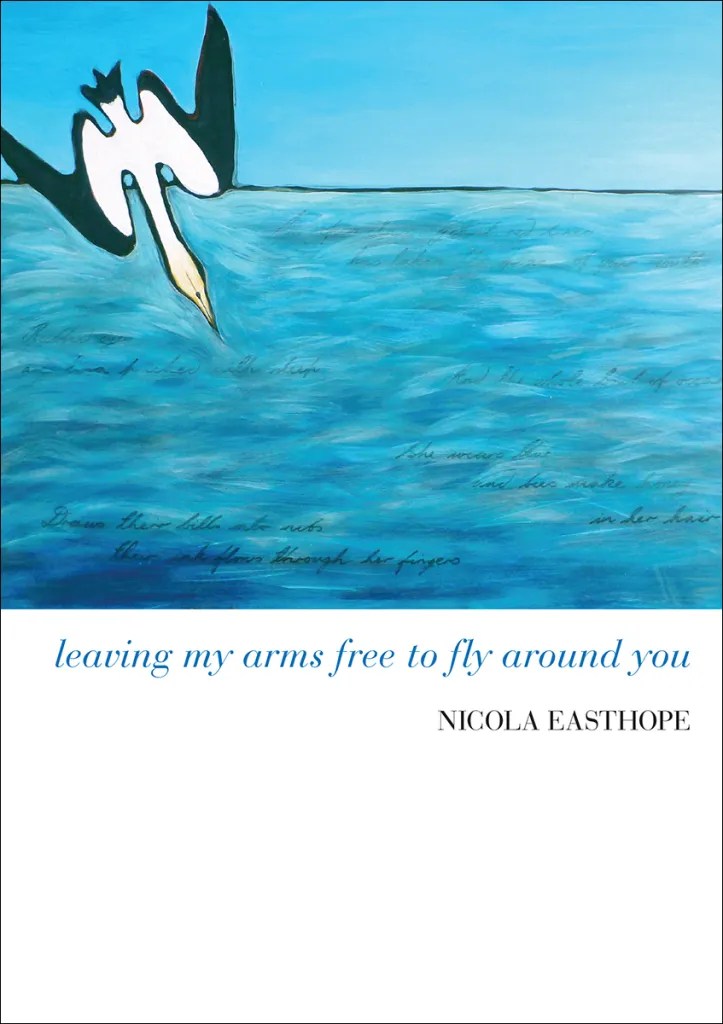
Nicola Easthope from leaving my arms free to fly around you, Steele Roberts, 2011
Note
‘Free-range men’ is one of my favourite poems because I wrote it when I was a “young” poet (38!) during a year under the terrific tutelage of Renée at Whitireia. From the very first lesson, Renée bust the myth of “waiting for the Muse to strike” and said we could already call ourselves writers but, “it’s hard work, darlings, treat it like a job”. Renée’s warmth, wit, humour and high expectations helped my shy, dammed up poet-self burst her banks (I wrote 120+ poems that year). Another, more obvious reason this poem is a fave is because I was quite freshly in love with a creative man who gave me nothing but support for my poetry compulsions—he’d send me poetic texts, wrote me his first two (non-high school English class) poems ever, and let me write lines of Rumi on his arm (lol). We’ve been together for nearly 19 years. Lastly, this poem won second prize in the (now defunct) Bravado International Poetry Competition out of over 600 entries, in 2005. I couldn’t believe it – winning $250 and getting it published in the Bravado 5 magazine was the biggest buzz and only encouraged me to keep following those impulses. He mihinui hoki to Roger and Roger of Steele Roberts Aotearoa who guided this poem amongst the others in my first collection, leaving my arms free to fly around you (2011).
Nicola Easthope (Tangata Tiriti) is a Pākehā poet with ancestral roots in the Orkney Mainland, Kelso, Holyhead and Shropshire (UK). She lives on Te Atiawa ki Whakarongotai whenua of Raumati South. Currently studying post-colonial literature and poetry through Massey, she hopes to start a Master of Creative Writing in July. Her second collection of poetry Working the tang was published in 2018 with Mary McCallum and team at The Cuba Press. Nicola has appeared as a guest poet at the Queensland and Tasmanian poetry festivals, LitCrawl in Pōneke, and the Manawatū Writers Festival.
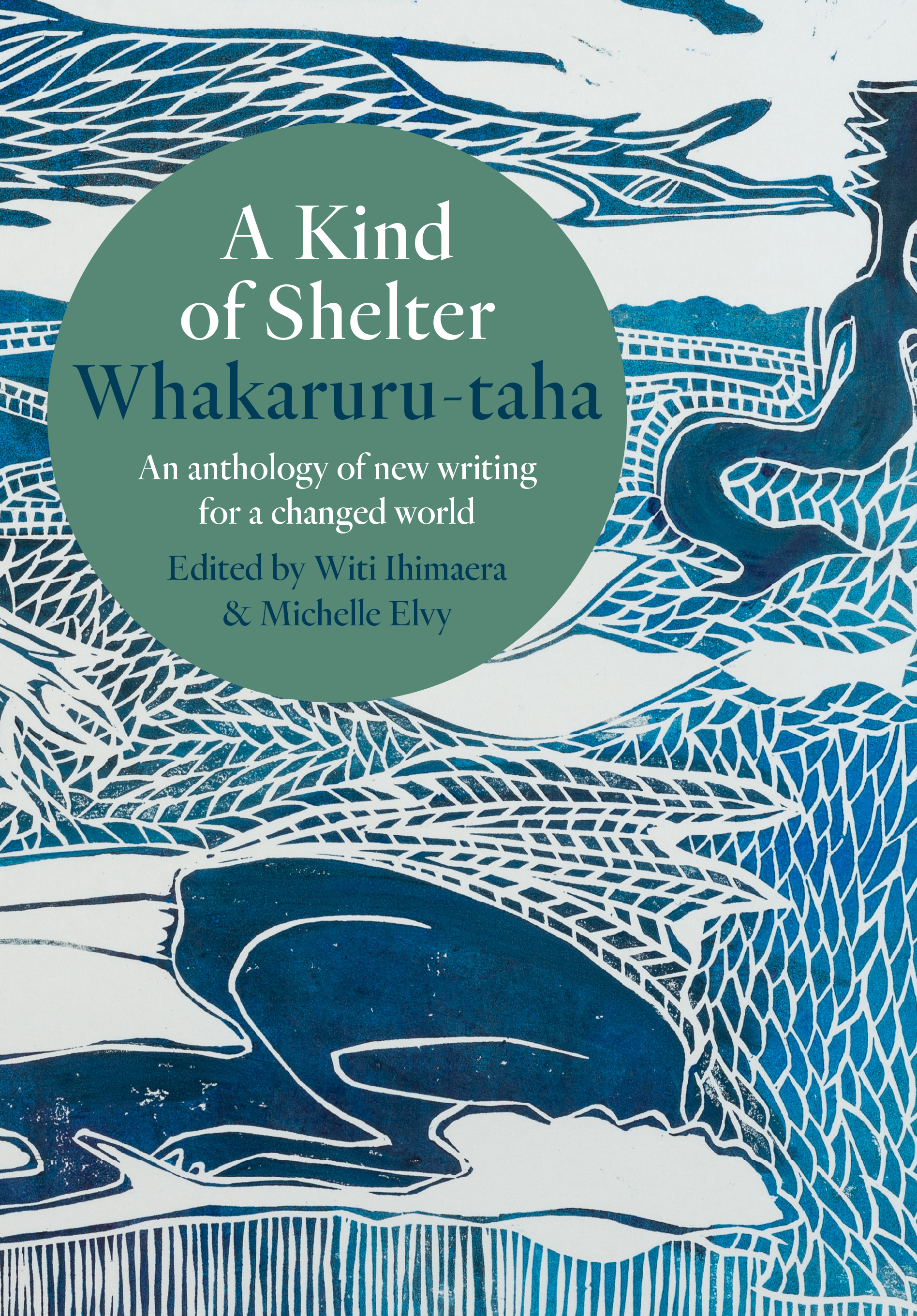
A Kind of ShelterWhakaruru-taha: an anthology of new writing for a changed world edited by Witi Ihimaera and Michelle Elvy, Massey University Press, 2023
The blurb of A Kind of ShelterWhakaruru-taha (edited by Witi Ihimaera and Michelle Elvy), suggests the book is a ‘luminous hui between 68 writers and eight artists’, and it is exactly that. It’s an anthology of precious connections, copious and fertile returns, sweet and thoughtful rewards. It is a book to savour and to reside within, to share and to step out from. It is a book I will review for you in the winter months but, in the meantime, nine poets have kindly read their poems in the book for you.
Chris Tse reads ‘How am I going to make it right?’
Vana Manasiádis | Βάνα Μανασιά
Vana Manasiadis reads ‘If we give up flying it doesn’t mean we can’t speak to each other as if countries or scan our genomic sequences for travel to the flats’
Reihana Robinson
Reihana Robinson reads ‘Inside / Outside’
Hinemoana Baker
Hinemoana Baker reads ‘House at Staytrue Bay’
Michelle Elvy
Michelle Elvy reads ‘Arrival in Fatu Hiva’
Diane Brown
Diane Brown reads ‘Not Feeding the World Today’
Ian Wedde
Photo credit: Mischa Malane
Ian Wedde reads ‘Back in Action’
Sudho Rao
Sudho Rao reads ‘Coracle at a confluence’
Kiri Piahana Wong
Kiri Piahana-Wong reads ‘Ka mua, ka muri’
Chris Tse is New Zealand’s Poet Laureate for 2022-24. He is the author of three collections of poetry published by Auckland University Press: How to be Dead in a Year of Snakes (winner of the 2016 Jessie Mackay Award for Best First Book of Poetry), HE’S SO MASC, and Super Model Minority. He and Emma Barnes edited Out Here: An Anthology of Takatāpui and LGBTQIA+ Writers from Aotearoa (AUP, 2021).
Vana Manasiádis | Βάνα Μανασιάδη was raised in Te Whanganui-a-Tara and Ātene Greece. She is the author of two narrative works of hybrid forms: Ithaca Island Bay Leaves: A Mythistorima (2009) and The Grief Almanac: A Sequel (2019). She was Ursula Bethell Writer in Residence in 2021, held the early summer residency at the Michael King Writer’s Centre in 2022, and now teaches Creative Writing at Te Whare Wānanga o Waitaha Canterbury University.
Following a career in teaching and art education in Wellington, ReihanaRobinson threw it all away for a life of homesteading, writing, art and environmental research, and living off grid in the Coromandel. She was the inaugural recipient of the Te Atairangikaahu Poetry Award and was selected for AUP’s New Poets 3 in 2008. Reihana has held artist residencies at the East West Center in Hawaii and at the Anderson Center, Minnesota. Reihana’s published poetry books are Aue Rona (Steele Roberts, 2012), a reimagining of the Māori myth of Rona and the moon; and Her Limitless Her (Mākaro Press, 2018). She is also author of The Killing Nation, New Zealand’s State-Sponsored Addiction to Poison 1080 (Off the Common Books, 2017).
Hinemoana Baker (Ngāti Tukorehe, Ngāi Tahu, Kiritea) is a poet, songwriter, sound, artist and performer from Aotearoa currently living in Berlin, Germany. Her 2021 collection ‘Funkhaus’ (Te Herenga Waka Press) was shortlisted for the Ockham New Zealand Book Awards. It will be launched as a bilingual German/English edition in the September 2023 (Voland & Quist). Hinemoana is currently completing a PhD at the University of Potsdam.
Michelle Elvy is a writer and editor in Ōtepoti Dunedin. She edited, with Witi Ihimaera, A Kind of Shelter: Whakaruru-taha (Massey University Press, 2023). She has also co-edited, most recently, A Cluster of Lights: 52 Writers Thenand Now (2023), Breach of All Size: Small stories on Ulysses, love and Venice (2022) and Ko Aotearoa Tātou | We Are New Zealand (2020). Her books include the everrumble (2019) and the other side of better (2021). Website
Diane Brown is a novelist, memoirist, and poet who runs her own creative writing school, Creative Writing Dunedin. Her publications include two collections of poetry – Before The Divorce We Go To Disneyland, and Learning to Lie Together; a novel, If The Tongue Fits, and verse novel, Eight Stages of Grace, a travel memoir, Liars and Lovers, a prose/poetic memoir, Here Comes Another Vital Moment and a poetic family memoir, Taking My Mother To The Opera. Her latest book is a long poetic narrative, Every Now and Then I Have Another Child, Otago University Press, 2020. She is currently working on a collection of poetry.
Ian Wedde is a poet, novelist and essayist. He’s published sixteen collections of poetry, nine novels, a collection of stories, two collections of essays, a memoir, several art catalogues and monographs, and two Penguin anthologies of poetry. He was New Zealand Poet Laureate from 2011 to 2013. A new book of essays is in preparation with Te Herenga Waka/Victoria University Press.
Sudha Rao lives in Wellington and her first collection of poems On elephant’s shoulders was published in July 2022.
Kiri Piahana-Wong (Ngāti Ranginui, Chinese, English) is a poet, editor and the publisher at Anahera Press. Her first full-length collection, Night Swimming, was released in 2013 and a second, Give Me An Ordinary Day, is forthcoming. Kiri’s most recent project is two companion anthologies of contemporary Māori writing, Te Awa o Kupu and Ngā Kupu Wero, co-edited with Vaughan Rapatahana and Witi Ihimaera, due out from Penguin Random House in September.
Leonardo the oldest of the fishing fleet blessed with holy water good weather/the sea’s bounty/grace
Leonardo a scapula of half-mast Italian flags still hearing the sea swallow Vincenzo/Gennaro/Paolo/Ronaldo
Leonardo circling like a wreath where they disappeared circling like a plughole begged back by priests/with candles/with lanterns
Leonardo overwhelmed even in Rita’s painting Boats Island Bay even on the postage stamps and posters Leonardo/half/hearted
half his mast now finials on the roof of a boatshed guiding like wooden stars mothers/of wanderers/here below
Kerrin P Sharpe
Kerrin P Sharpe has published four collections of poetry (all with Te Herenga Waka University Press, Wellington, NZ). Her 5th book Hoof, also to bepublished by Te Herenga Waka University Press, is forthcoming in October 2023. She has had poems published in a wide range of journals both in NZ and overseas, including Oxford Poets 13 (Carcanet Press), Blackbox Manifold, Poetry (USA), PN Review and Stand.
I came out of the Manukau City shopping Centre doing the Manukau Mall Walk — the shoeshine shuffle, the hotfoot floogie, the baby elephant — doing the Manukau Mall walk, to discover the Great South Road. So, I said, Great South Road, where you headed? A hikoi went past, marching for poetry, marching to Mercer, Meremere, or the Coromandel. A platoon of Hussars on horseback went past, their plumed helmets galloping towards Verdun, towards Papatoetoe. The Three Graces went past chasing aesthetic pleasure. The Virgin in a Condom went past (saw you on the TV last night Madonna), and I began walking along the Great South Road, like a train of thought entering a certain state of mind. As I walked, I recalled the aura of other more earnest eras. I remembered the sepia photographs of the Colonial Ammunition Company. I remembered the worm-eaten histories of the bloodstained ground, under sprig-studded boots and kegs of legs in slanting rain. I remembered those early explorers who pushed the boundaries out into ever more mystic territories — those explorers who navigated the fur and the dust, the tumbling tumbleweeds, of the vast carpet plains of the empire of the frivolous. I walked by horse troughs hurriedly filled with cut flowers. I walked by closets of dark personal secrets. I walked by gardens, where shadowy shrubbery those explorers who navigated the fur and the dust, the tumbling suddenly gave way to pockets of blazing light. I walked by the mystery of a bridge wrapped in light, the spokes of light a sunburst tiara, beneath which whales swam to a radiant future. I walked by grain and grape, by bread and wine, by Sunday to Sunday. Winged yachts were dancing like sandalled Mercury over the foam on Sunday; sails burgeoned on the Gulf. Some of us were elbow-deep in the kitchen sink, others knee-high in vanishing Auckland, there where the real yearns to be unreal, and people are always much worse than you think. Some were seeking the true identity of the land, the original pristine quiddity smothered beneath layers of modern modification. Was it to be found in geology, or geomorphology, or did it lay in the very mantle of vegetation, or in the profusion of microclimates, or was its essence unknowable, forever modified by the attempts at discovery, the way an idea once dismissed as useless one day suddenly gains currency and moves out into the general population, both changing and being changed as it goes? By now I had reached Auckland, jet-lag city jutting into the sky, town of dark towers, town of cool waterfalls, deep atriums and skirted walkways, town of smoothly efficient escalators and rocket fuel filling stations. Town like a Las Vegas impersonator; town where locks snick and razors draw blood; where wristy whizz-kids are able to make timetables tick and grandfather clocks chime and bong; where fastidious bouncers obsessively address dress codes before applying the disdainful cold shoulder. Town of my birth, branded on the cerebellum. How amazing that sense of optimism is, filtering through the ozone of Auckland to its blue spurs which glitter like a split-open geode. How amazing that here where happy endings begin, at the gateway to a South Pacific Fun Day, the pōhutakawa is flowering scarlet as a maraschino cherry, scarlet as the fingernails of Elsa Schiaparelli, scarlet as a bonfire of old books surrounded by bishops in soutanes sipping sherry. Bible verses are ascending in blackened flakes, whirling scraps of ash above Lord Concrete’s Domain. Whatever next, whatever next, as the wind flicks over text; flicks over characters from God’s hotel condemned by religious intoxication to the delusion of ongoing happiness before their last merciful release; flicks over medicine men quivering in their sleep, doing a little light mall walking to a tune by Henry Mancini. So, I’m out here, too, on the Great South Road in this pandemonium under the basilica of stars, under the Hubble, doing the Manukau Mall Walk – the shoeshine shuffle, the hotfoot floogie, the baby elephant — doing the Manukau Mall Walk.
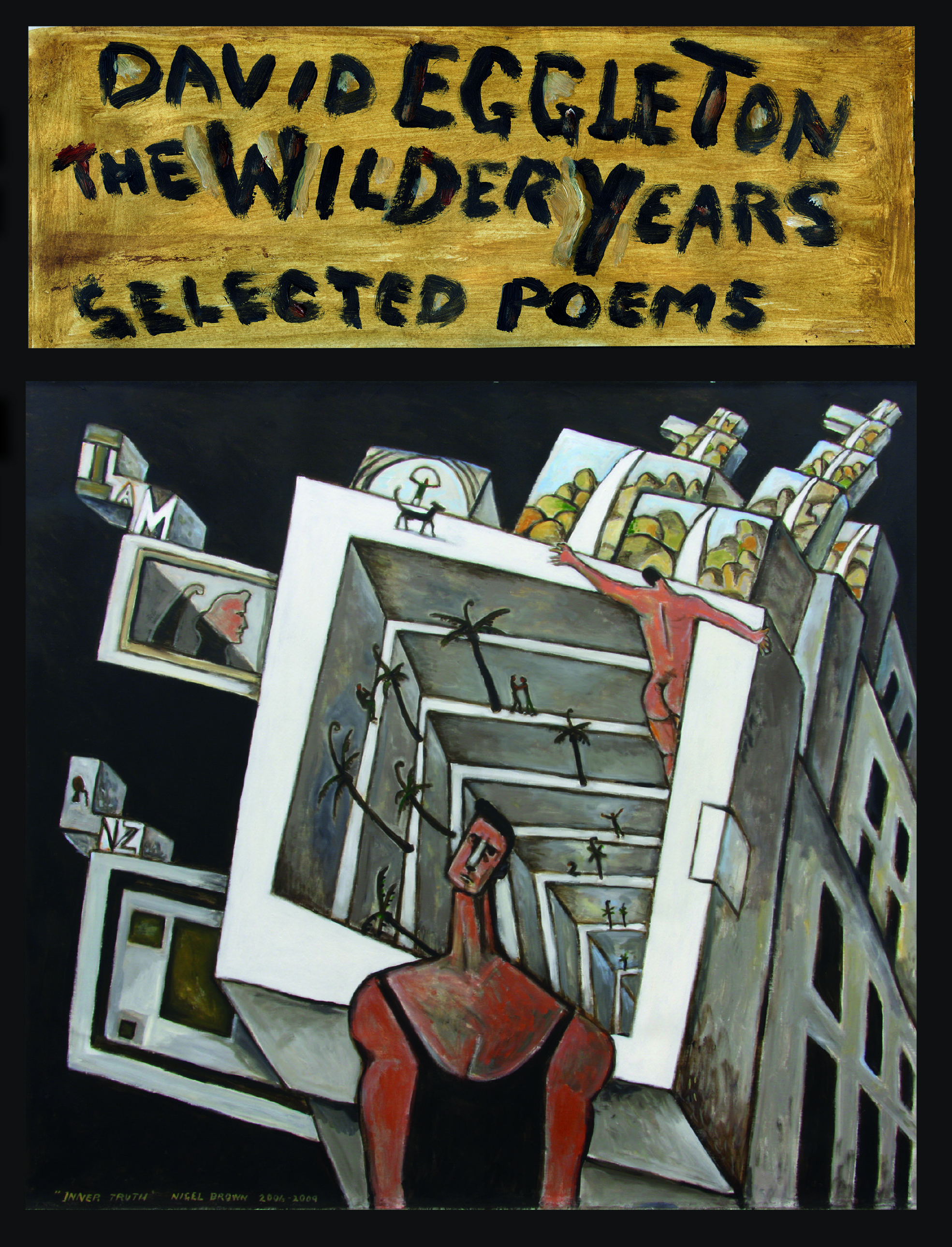
David Eggleton from The Wilder Years: Selected Poems, Otago University Press, 2021
For a long while I was obsessed with trying to capture a sense of what it felt like to live in South Auckland when I was going to high school there, to Aorere College, and after, as South Auckland began to grow and transform. To me the growth felt organic and holistic and energetic, though in reality it was probably all about developers seizing opportunities as the population exploded. So this poem is made up of memories, disguised autobiography in a way, that are also memories of working-class South Auckland turning into Manukau City, into Urbanesia, and the bright new shopping malls with their air of optimism and calculation, but also there was another side to that: an air of drama and urgency, as city planners tried to figure it all out, funnelling and channelling growth. All a bit crazy, a bit absurdist, but papered over by Granny Herald and the other media of the day.
And the other thing is the exhilaration I used to feel walking along parts of Great South Road with the multicultural goings-on; the sense of unity. Much of that has been lost pretty much, or become something else, because the traffic has grown monstrous and snarled-up, and things seem more jaded and jumbled and isolated rather than unified. Or perhaps my perspective has changed.
But to walk into the CBD was a thing I used to day-dream about, travelling through suburb after suburb, each with its own atmosphere, its place in the class system, its history, its illusions, its characters, friendships and scandals and hopes for the future. So it os partly a collage of treks I made, back in the day. And beyond that there is the rhythm of this poem which picks up on the soundscape of urban Auckland. It’s a patchwork, a collage, a mural poem, held together by the thread of the Road. I like the fly-by, catch-as-catch-can quality: everything is grist for the great windmill of time and circumstance, and the clouds above.
David Eggleton is a poet and writer who, before settling in Dunedin, lived in various suburbs in Auckland, and went to school there. He is the former editor of Landfall and he has published a number of poetry collections, as well as a collection of short fiction and several books on Aoteara New Zealand cultural history. His stories have appeared in a number of anthologies, including Best New Zealand Fiction. His poems have appeared in a wide variety of publications, including Whetu Moana: Contemporary Polynesian Poems in English. His most recent book is Respirator: A Poet Laureate Collection 2019–2022, published by Otago University Press in March 2023.
Favourite Poems is a series where poets select a favourite poem from their own backlist and write a note to go with it.





 NZ Poetry Shelf