
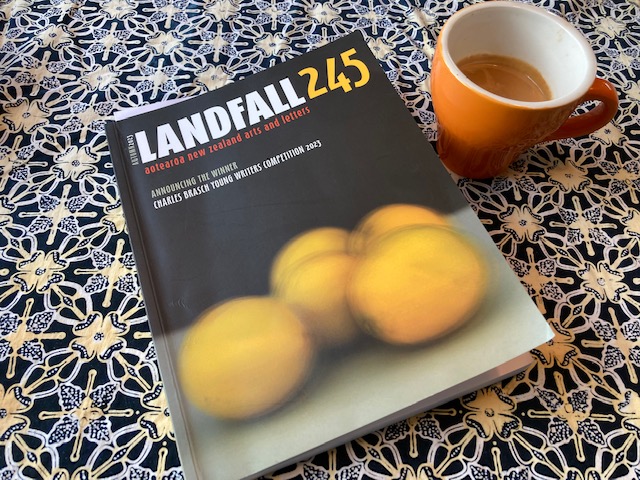
Landfall 245, edited by Lynley Edmeades, reviews editor David Eggleton
Otago University Press, 2023
Landfall 245, edited by Lynley Edmeades, is rich in reading, from poetry through fiction to nonfiction and reviews. What better way to celebrate its arrival than a suite of readings in the online Poetry Shelf Cafe. Grateful thanks to all the participants – this is a treat indeed!
my review here
Otago University Press page
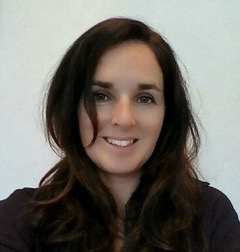
Medb Charleton
‘Letter to the Editor’
Medb Charleton is originally from Sligo, Ireland. Her poetry has been published in Landfall, Sport, Poetry New Zealand and Turbine | Kapohau.
Ruben Mita
‘No Good’
Ruben Mita is a poet, musician and ecology student in Pōneke. He has been published in multiple outlets and won the 2022 Story Inc. IIML Poetry Prize. He likes fungi, fires and some noises.
Alexandra Fraser
‘Love Was Not on the Programme’
Alexandra Fraser lives in the west of beautiful Tāmaki Makaurau surrounded by kauri and tree-fern. She has been published in magazines and anthologies in Aotearoa and internationally, and has been highly placed in many poetry competitions. Alexandra is a member of the Isthmus creative and critique group of poets, whom she met while completing the Master Creative Writing at AUT. She has published two poetry collections through Steele Roberts (‘Conversation by Owl-Light’ (2014), ‘Star Trails’ (2019)) and is working on two more – one on history and ecology, the other on networks.
Brett Reid
‘White Irises’
Brett Reid lives in Tāmaki Makaurau. When he’s not reading or writing, or having a beer, Brett is likely to be cycling, swimming or walking the latest greyhound he and his wife Helen are fostering. As well as Landfall, his poems have previously appeared in takahé, a fine line, the fib review, and Sentinel Literary Quarterly.
Jodie Dalgleish
‘The Edge of the Sea or Sea Rose (1977)’
Jodie Dalgleish is a New Zealand writer, curator, and sound artist living in Luxembourg. Her poetry has been published in Landfall, Poetry Aotearoa Yearbook, Shearsman, Long Poem Magazine, Poetry Salzburg Review, Azure and Les Cahiers Luxembourgeois. She holds a master’s in creative writing from Auckland University of Technology Te Wānanga Aronui o Tāmaki Makau Rau.
Link to ‘Sea Rose’, the painting by Joanna Margaret Paul
Bill Nelson
Photo credit: Ebony Lamb
‘Bird Life’
Bill Nelson is the author of Root Leaf Flower Fruit (2023) and Memorandum of Understanding (2016). His poems have appeared in anthologies and journals in New Zealand and overseas, as well as in dance performances, art galleries and on billstickers. In 2009 he won the Biggs Family Prize in Poetry from the International Institute of Modern Letters, and he is a founding editor of Up Country: A Journal for the NZ Outdoors. He lives in Te Whanganui-a-tara Wellington with his partner, two children and his dog, Callimachus Bruce.
Tim Grgec
Photo credit: Ebony Lamb
‘Swimming to Australia’
Tim Grgec is a writer and public servant based in Te Whanganui-a-tara | Wellington. His first book, All Tito’s Children, was published by Te Herenga Waka Press in 2021.
Evangeline Riddiford Graham
‘Treatment Plan’
Evangeline Riddiford Graham is the author of the poetry chapbooks Gineshoi (hard press) and La belle dame avec les mains vertes (Compound Press). Her recent writing can be found in Landfall, Art News, Sweet Mammalian, and The Spinoff. She lives in Lenapehoking New York City, where she hosts the poetry podcast Multi-Verse.
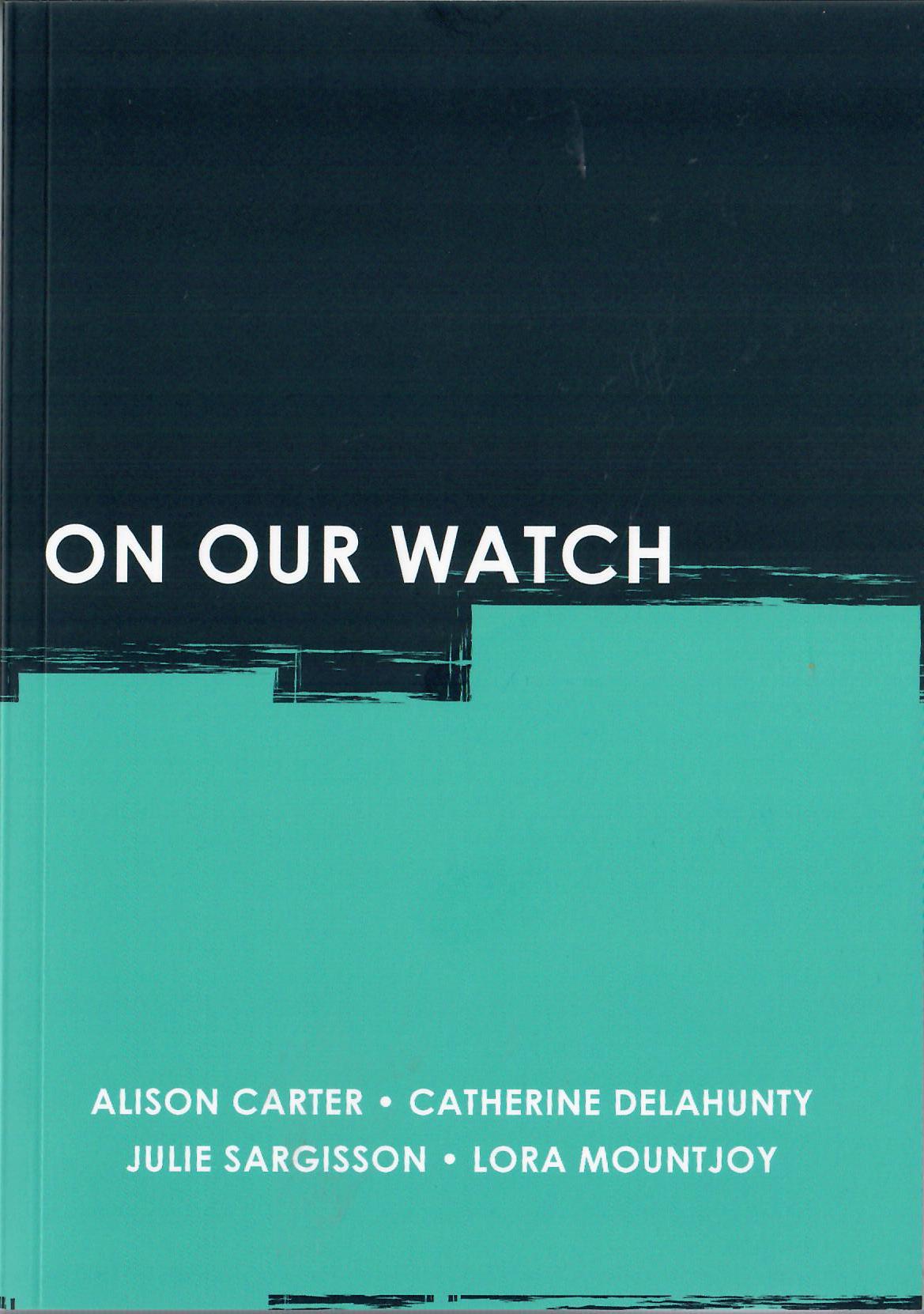
On Our Watch, Alison Carter, Catherine Delahunty, Julie Sargisson, Lora Mountjoy
Outwatch Press, 2023
Four Coromandel poets who meet regularly to share and talk poetry, have published an inviting collection of their writing. The poems navigate a world close at hand and our world under threat. You enter the intimate and the personal alongside a deep-seated concern for our environment and the choices we make. This is poetry at its most connective, both celebratory and challenging.
So settle back into the Poetry Shelf Cafe and have listen to Alison Carter, Catherine Delahunty, Julie Sargisson and Lora Mountjoy read.
Alison Carter
‘Captured’
‘Victorian Fantasy’
‘Piwakawaka’
Alison Carter is a journalist, writer and documentary maker who lives on a native restoration block at Kikowhakarere Bay in Hauraki. She wrote and performed poetry in her twenties and has found returning to it, after many years in the world of fact, to be creatively and emotionally liberating.
Catherine Delahunty
‘Tax is Love’
‘The Detectorist’
‘Leaving Te Moehau’
Catherine Delahunty ( Pākehā) writes columns, fiction and poetry and is active in environmental campaigns and Te Tiriti education work. She lives in the Kauaeranga Valley in Ngāti Maru lands in Hauraki. She writes about the place she lives, adventures in politics and people who have touched her life. She notes that poetry is harder to write than opinions but also more liberating and random. She likes having a group to give feedback and set deadlines so that she had to stop pretending to do housework and actually write something!
Lora Mountjoy
‘Everything Beeps’
‘Three-year-old Girls Love Pink’
‘Papatuanuku’
Lora Mountjoy is the author of two novels and has contributed poems to many publications over the years. She has raised a family, worked as a journalist and taught creative writing in a community setting. From the late 1980s and into this century Lora enjoyed reading and performing her poetry, both in Wellington and Coromandel. She had been focussing on other writing projects when Julie encouraged her back into poetry and is really delighted to have the chance to share writing with other women and to be part of On Our Watch.
Julie Sargisson
‘Tidal’
‘Inheritance’
‘It’s Time’
Julie Sargisson lives on the outskirts of Kapanga above a tidal salt marsh. She replants wetland areas and bare hillsides to help restore this environmental treasure. She walks the hills and shore lines, writes articles, poetry and essays. Julie is “often inspired to write by this wild finger of land, the Coromandel. The seasons, the light, the birds. But also the microcosm of tragic history; forests and people who were here before us and the long term consequences played out here. I’m also fascinated by how poetry can go beneath the surface and echo ideas.”
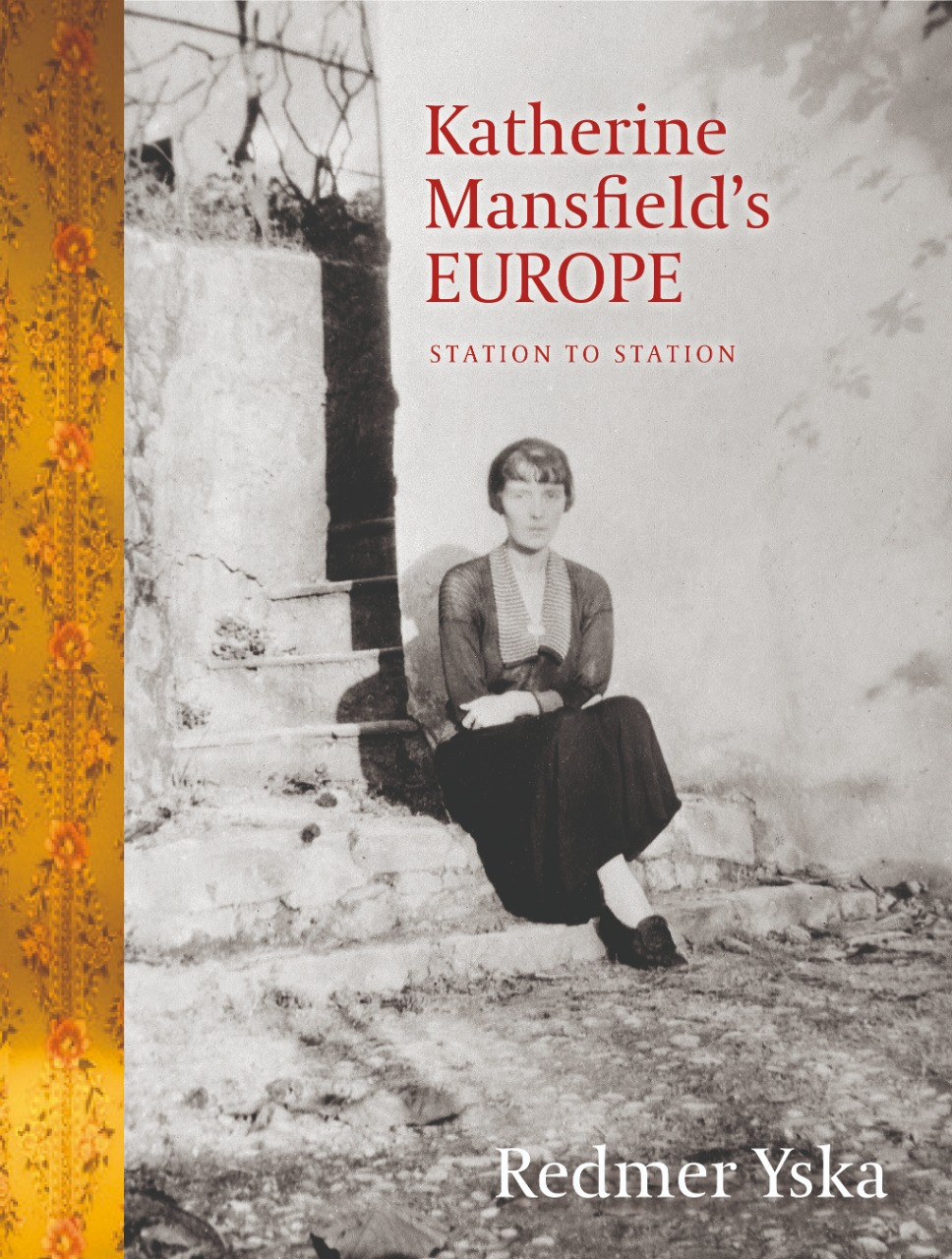
Katherine Mansfield’s Europe – Station to Station, Redmer Yska
Otago University Press, 2023
Redma Yska’s Katherine Mansfield’s Europe – Station to Station is pitched as part travelogue, literary biography, detective story, ghost story. It is a postcard compendium, an intriguing homage to Katherine’s work, a heartrending navigation of the latter stages of her life. Redma travels in Katherine’s footprints, tracks, pit stops, he travels though France, Germany and Switzerland in particular, he voyages though the distortions, the myths, the sanitisations. He steps into the shoes of another by way of letters, short stories, notebooks, stations, cafes, hotels, train journeys, sanitoriums. He travels to Europe, he travels through the archives, especially when Covid prevents return visits to physical destinations. He journeys through the archives.
I read the book when ferocious winds had taken out our power, the cold was biting and the hail slammed against the windows. I read it when my long slow recovery road had been extended indefinitely and I was trying to remap my weeks and days. Reading Katherine Mansfield’s Europe made me intensely curious. What is the relationship between Illness and writing? Writing for oneself and writing for the public? Writing within a private hermit life, writing as social being who moves in the world? I am fascinated by how authors appear in pieces in letters, diaries, fiction, poetry, biographies, memoir, essays, criticism, reviews, photographs, word of mouth. The hardest question to ask is who is she? I think Redmer draws close to versions of Katherine by exploring how is she? and where is she?
This book gets under my skin, gets me thinking and gets me feeling. For the last six years of her life, Katherine endured, let’s say suffered, from TB and lung pain. She underwent a steady stream of ‘cures’ and health resorts, all the time taking the toxic, mind-altering cough medicine concocted by her London doctor. But no matter how challenged she was physically, she was drawn to writing, and it feels like writing was the greatest escape from pain and suffering:
‘My wing hurts me horribly this morning: I don’t know why. And I don’t care, really. As long as I can work – as long as I can work.’ The Collected Letters of Katherine Mansfield
When she was staying at the Beau Rivage Hotel, Katherine would go walking along the coast, along the rocky promontory – walking drew her closer to writing, and writing drew her closer to the world, whether remembered or observed:
‘My work is shaping up for the first time today – I feel nearer it. I can see the people walking on the shore & the flowery clusters hanging on the trees – if you know what I mean. It has only been a dim coast & a glint of foam before.’ The Collected Letters of Katherine Mansfield
Katherine Mansfield’s Europe is a remarkable book of openings rather than closures. Redmer presents links between Katherine’s short stories, biographical information, the letters and notebooks that evoke people, places, situations. He writes in the animated present tense of research and travel. He includes photographs and postcards that enhance his narrative, his reckonings, his discoveries, his challenges. He rebuffs the sanitising myths. He stays in places Katherine stayed. He undergoes the cold water cure that she endured at a treatment spa. He fires a pistol similar to the one Katherine used. He walks along the same promontory.
I am deeply moved by this book, by the way I become embedded in place, and how that place, through Redmer’s astute observations, draws me closer to Katherine. The book activates all your senses as you read, from the view from a window to food placed upon a table, from a hotel’s crisp bed linen to the lush garden in Menton, to his conversations with Katherine’s fans in Germany and France. This terrific writing feat, this ability to navigate and re-present versions of a life, is an essential addition to the wealth of material that critics, historians, biographers and fans have produced. Glorious.
Redmer Yska is an award-winning writer and historian based in Wellington. He has published books on a range of subjects, including New Zealand youth culture, Dutch New Zealanders (like himself), a biography of Wellington City and a history of the tabloid newspaper, NZ Truth. This is Yska’s second book about Katherine Mansfield. His first, A Strange Beautiful Excitement: Katherine Mansfield’s Wellington (Otago University Press, 2017), was longlisted for the 2018 Ockham New Zealand Book Awards.
Otago University Press page
The Magic Show
Owhiro Bay School Fair, first show 1pm.
The little kids sat on the floor
but I scored a front-row chair.
We sat staring at a small round table
with a dark red tablecloth while
mysterious music played from somewhere.
Mr Winkle swept in from the storeroom.
He had a red cape and drawn-on moustache.
He made balls appear and disappear so swiftly
there was no time to be impressed.
He joined and separated silver rings.
But it wasn’t magic – it was a clever trick.
Then he removed his top hat and showed it
empty. Reaching in, he pulled out a
softtoy rabbit, which he presented to
Ruben’s little sister. He reached in again and
– ‘Hippity-hiphop’ – tipped out a real rabbit.
Everybody gasped. What if it hopped away?
As it trembled on the table, Mr Winkle passed
a small box to me, tapped it, and asked me to
open it. Cushioned inside was a white furry thing.
I didn’t know what it was. He pointed to the rabbit
and we saw it was missing a paw. ‘I wish to all of you
good luck,’ said Mr Winkle and bowed.
James Brown
James Brown continues in Wellington. ‘The Magic Show’ and ‘Love Poem’ will appear in a new collection of poems, provisionally titled Leadership Material, to be published by Te Herenga Waka University Press in 2024
Regret
I’m in the stunt business and I just want to fall down.
But that’s not the way it works.
It’s storytelling, but I have comfortable roots.
And I was still trying to learn and define who I was.
And you’re waiting eight hours for a giant stunt.
And you don’t understand the reason.
Went through a character shift
from the ruthless aggression guy, to the rap guy,
to the non-rap guy, to the superman guy.
Feel free to be open with me.
I have no ego.
My ego is making an awesome movie.
These were the prime years
when things were catching fire, and the place
I really wanted to be was on that canvas.
No ego. Let’s make great moments
and how can we do that?
My ego lies with the finished product.
Life is always good no matter what.
We tell stories sometimes that are real close to the vest.
I learn from every single situation.
If this thing doesn’t fly I’m putting it on my shoulders
and I’m gonna figure out why and I’m hopefully
gonna get another chance to attack it again.
Man I don’t have a single regret in my life.
I’ve been on such a crazy ride.
I don’t regret a single thing man not one thing.
Airini Beautrais
Airini Beautrais‘s work has appeared in a range of journals and anthologies in Aotearoa and elsewhere. She is the author of four collections of poetry, most recently Flow: Whanganui River Poems (VUP, 2017). Her first collection, Secret Heart (VUP, 2006), won the Jessie Mackay Award for Best First Book of Poetry at the 2007 NZ Book Awards. In 2016 she won the Landfall Essay Prize. She has also been a judge for a number of awards, including the 2018 NZ Book Awards. Her most recent book is the short story collection Bug Week (VUP, 2020). She lives in Whanganui with her two sons and two cats.
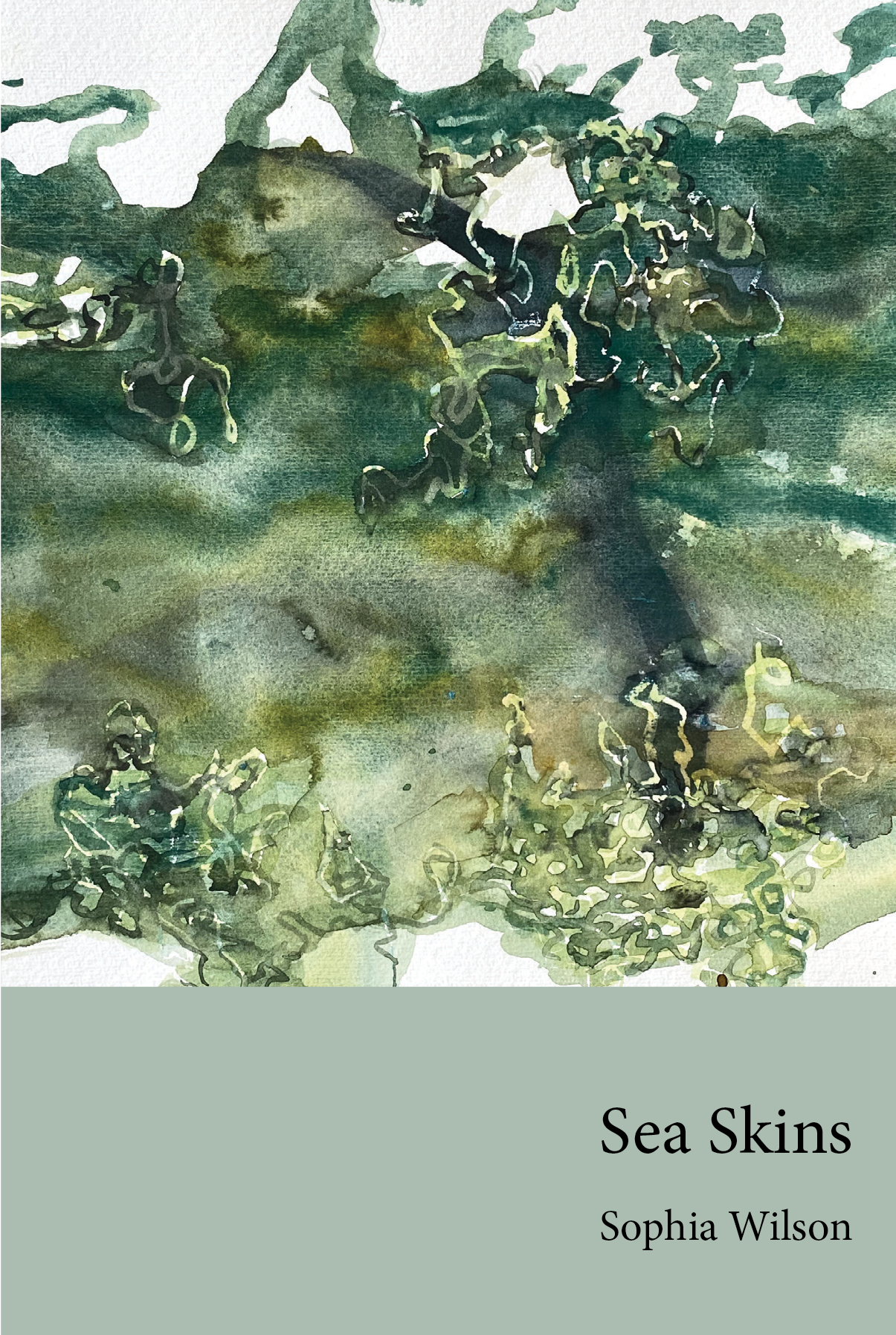
Sea Skins Sophia Wilson, Flying Island Books, 2023
In 2022 Sophia Wilson was the joint winner of the Flying Islands Manuscript Prize for Emerging Poets. That manuscript, or a version, now appears as Sea Skins. The poetry is a rich, layered offering for both ear and eye.
The title poem navigates multiple skins, along with tongues and teeth, ruins and ruination, illness and family, a spinning wheel, and a new poem that sets sail. It is the last poem in the collection but it is a perfect window onto poetry that builds bridges between the domestic and the wider world, the remembered and the uncertain, the catastrophic and the sad.
Notions of spinning feature in ‘Amygdaloid Knots’ where ‘we’ become yarn, raw fibre, neuroses, the smell of fleece. And it feels like the pronoun spins and shapeshifts through the collection as a whole, with the poet reflecting and refracting to embody we I or you or I. And always, there is the underlay of uncertainty and devastation:
We are bundles of raw fibre
spinning
uncontrollably
from ‘Amygdaloid Knots’
The word that resonates more than any other for me is ‘tongue’: as a motif, a theme, a vibrant idea. Sophia is a translator and a poet so language is significant. We are what we speak, I am musing. We are teeth and we are talk and we are tongue. Multiple languages make an appearance, especially te reo Māori and Italian. The children’s father’s tongue atrophies as he loses touch with his native dialect, the linguistic bridge between parent and offspring impaired. Sadly. Achingly. And then, yes, the writer is dreaming in multiple languages, like foreign mouth pieces on the page that we may or may not hear.
I dream in diverse languages
and when I wake
my tongue is like a map.
from ‘My tongue is like a map’
Take the word teeth: another connecting motif as it links nourishment to wound to weapon to food to chewing to body. Like tongue. Like poetry. Like I am musing the poem is teeth and tongue, like I am musing the poetry is also map.
In a section entitled ‘Medical Records’, disease becomes unease becomes procedure and diagnosis, in whiffs and hints, and then spins and speaks and recollects to draw in family, at the level of intimacy and divergence. I am so moved by ‘A Family History in Porridge’ where the narrator places the bowl of porridge on the figurative table in the form of a list poem, and we move from porridge that is detested to porridge that is prescription to China, fortune, aunt, eco and more. We move from this family member to that family member, from this wisdom to that ritual:
Celebration porridge:
raise yer parritch-bicker
lift yer kilt chopsticks!
Sun-rain-sky porridge:
Peace in the oat
and in the Earthly Bowl
from ‘A Family History in Porridge’
The terrific mother poem, ‘Taking my mother to the beach,’ is intimate, moving, sad. It is luminous with physical detail and has the incantatory drive that builds poetry. It is illness, it is connection, it is loss – both at a personal level and a wider global level. ‘Heritage’ can be maternal and it can be the beloved valley. Again there is the yarn (life? poetry? the world?) unravelling: the poem in which ‘the yarn unravels / along with we / will / when‘. And how crucial it feels when I read the poem embraces and presents ‘the heart of the family’. So poignant, so resonant, so touching.
This is the poem that chose to end in a coma;
the poem resisting sterile light
and the unbearable silence of asystole
This is the poem that conjures the long beach
we loved to walk; the poem in which I take my
mother’s arm and we face the ocean together
The land. How can we not speak of and for the land. How can we not write of and for the land? In this damaged and on-the-brink world? How can we write and speak of green fields and daffodils when our contemporary choices are unsustainable? Sophia weaves the thread, the weft and weave, of environmental challenge.
Sea Skins is a poetry collection that reveals and conceals, sings and mourns, challenges and lingers … long after you have put it down.
Sophia Wilson is an Australian-born writer and translator based in Aotearoa New Zealand where she runs a rural property and animal refuge with her partner and three daughters. Her poetry has appeared in journals and anthologies in Australasia and internationally, and won awards including the Robert Burns Poetry Competition, the Hippocrates Prize, and the Caselberg Trust International Poetry Prize. In 2022 she was joint-winner of the inaugural Flying Islands Manuscript Prize. More at here
Flying Island Books page
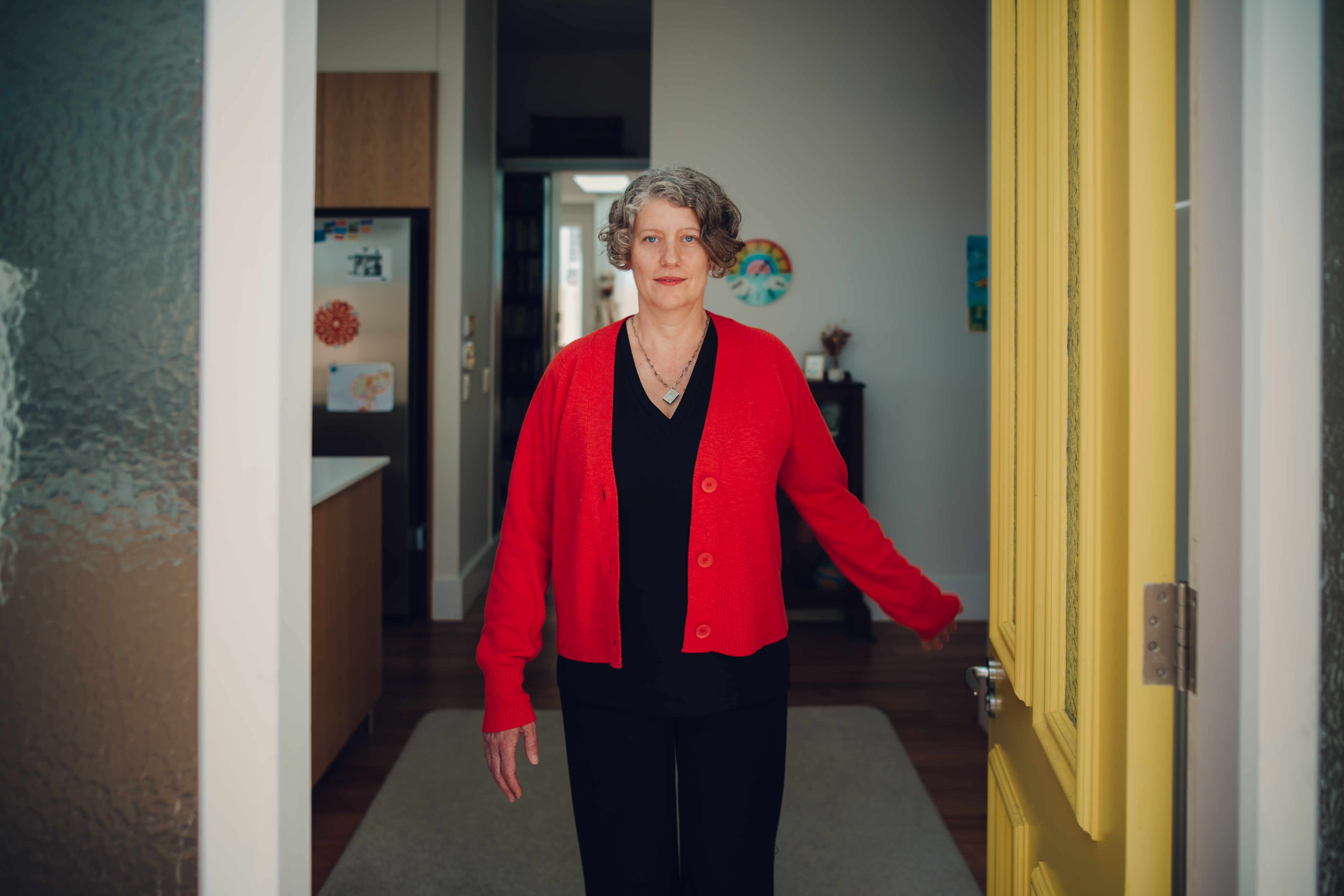
Photo credit: Ebony Lamb
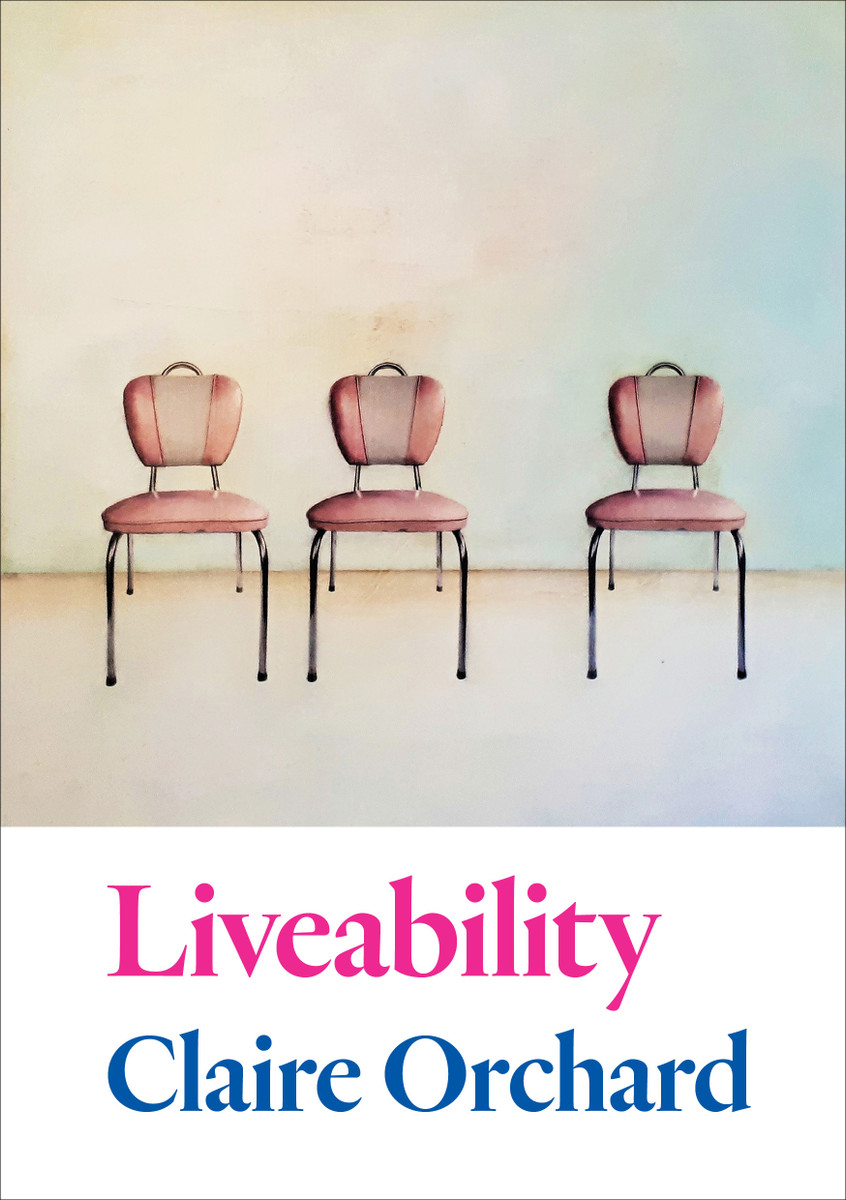
Claire Orchard reads from Liveability, Te Herenga Waka University Press, 2023
‘Where duty lies’
‘December’
‘Our son of eighteen summers’
‘When I bring up advance care planning’
Claire Orchard (she/her) lives in Te Whanganui-a-Tara. Her second poetry collection, Liveability is now available from your local independent bookstore or direct from the publisher Te Herenga Waka University Press.
Te Herenga Waka University Press page
Bonfires on the ice
It’s getting colder as the flames
rise from the bonfires, real and virtual.
See how they flicker in the darkling air.
What’s sending up such enormous sparks?
Lines that once lasted a lifetime.
Look, they show up clear, then disappear.
Here’s one: I have measured out my life with coffee spoons.
And another: A squirt of slippery Delight.
Now they’re coming thicker, faster.
Which watch not one another out of fear.
The art of losing isn’t hard to master.
You don’t want madhouse and the whole thing there.
A charred scrap settles on my hand
(Belinda smiled and all the world was gay)
flares for a second, is whirled away.
Eventually the ice will calve and dissolve;
the bonfires fade and crash.
Harry Ricketts
Harry Ricketts has published around 30 books, including literary biographies, personal essays and twelve collections of poems (most recently, Selected Poems, Te Herenga Waka Press, 2021).
 NZ Poetry Shelf