Category Archives: Uncategorized

Poetry Shelf Readings for Rose Collins from My Thoughts Are All of Swimming

Our thoughts are all of Rose this beautiful morning in Whakaraupo – next week on Bookenz we will be replaying the interview I did with Rose after she won the John O’Connor award for this poetry collection which has now been reprinted.

Morrin Rout, 3 May, 2024

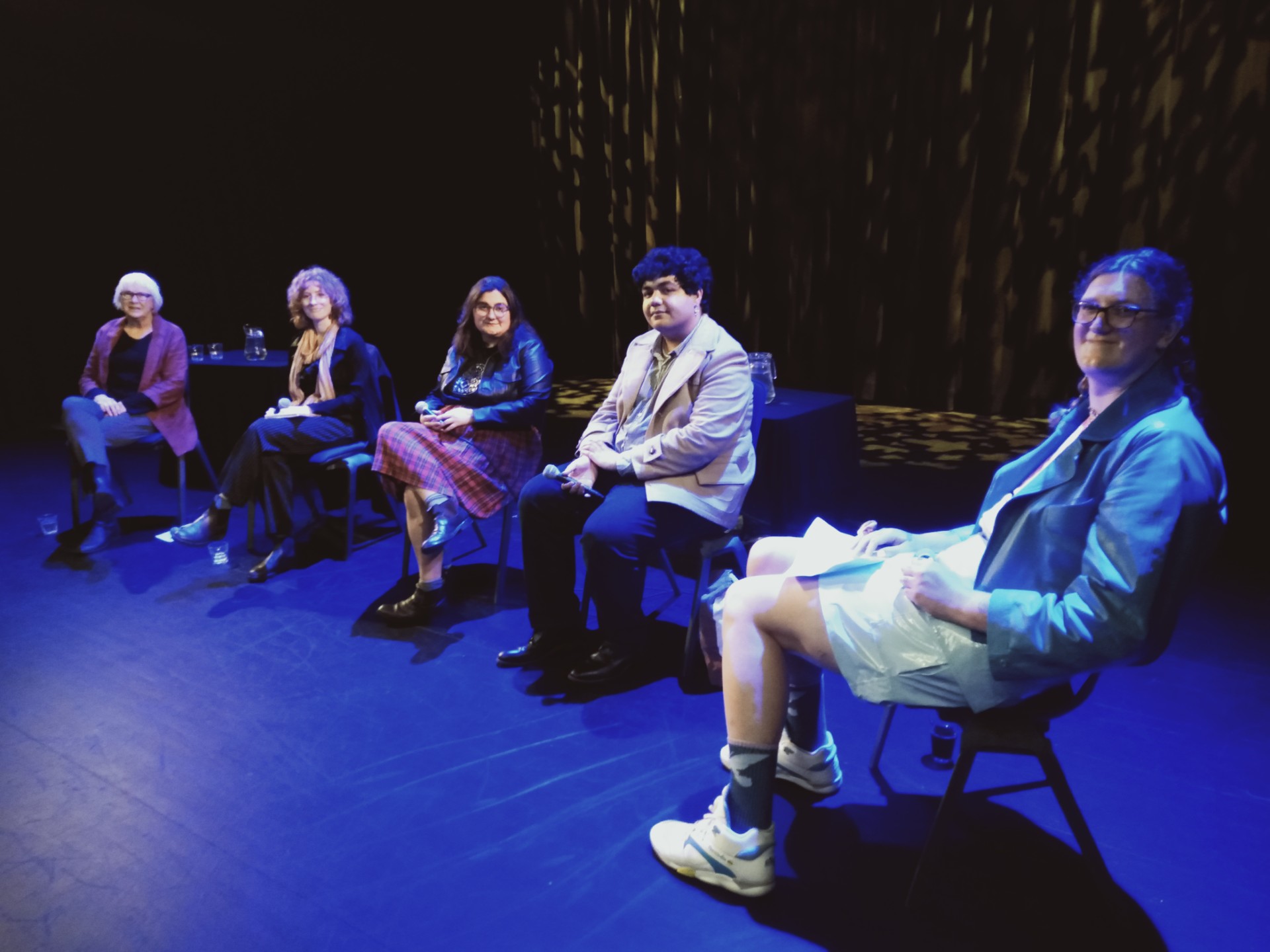
To celebrate the reissue of My Thoughts are all of Swimming by Rose Collins (Sudden Valley Press), ten poets each read a poem from the collection. The new edition also has a foreword by Rose’s mother, Siobhan Collins.

James Norcliffe has written a response to the collection’s title poem.

My review posted in 2023.

A series of written tributes paid by friends and authors in 2023.

Rose Collins (1977 -2023), born in New Zealand and of Irish descent, was a poet and short fiction writer. She worked as a human rights lawyer before completing the MA in Creative Writing at the IIML in 2010. She won the 2022 John O’Connor Award and the 2020 Micro Madness Competition, and has been shortlisted for the UK Bare Fiction Prize (2016), the Bridport Prize (2020) and the takahē Monica Taylor Poetry Prize (2020). Rose was the 2018 Writer in Residence at Hagley College. She was a some-time litigation lawyer, a beekeeper and a mother of two. She lived in Te Whakaraupō Lyttelton Harbour with her family.

Sudden Valley Press page

The readings

James Norcliffe reads ‘My thoughts are all of swimming’

Siobhan Collins reads ‘The Port Hills hare considers rock fall risk’

Morrin Rout reads ‘Over the Fields from Ballyturin’

Zoë Meager reads ‘The weeping of the women and children is a lamentable scene’

Lynn Davidson reads ‘Everything that we are afraid of’

Frankie McMillan reads ‘She hoped that Jack would come up the stairs and hold her.’ 

Síle Mannion, Síle Ní Mainnín reads ‘The Squid and the Whale Send Alan a Piece of Ambergris’ in Irish / Gaeilge and in English

Joanna Preston reads ‘Telling the Bees’

David Gregory reads ‘Five Eggs’

Jeni Curtis

Jeni Curtis reads ‘Brace Comb’

The readers

James Norcliffe is an award-winning writer of poetry and fiction and an editor. His eleventh collection of poetry Letter to ‘Oumuamua was published this year by Otago University Press. He has also written novels for young people and his novel for adults. In 2022 he was awarded the Prime Minister’s Award for Literary Achievement for Poetry and tin 2023 was awarded the Margaret Mahy Medal.

Siobhan Collins lives on the Lyttelton Harbour where she practices as a Jungian Psychoanalyst in between snatching moments to write poetry. She is a graduate of the Hagley Writers Institute and is a busy grandmother to seven grandchildren. She chose this poem of Rose’s as both she and Rose lived in the aftermath of the Christchurch earthquakes and she is appreciative particularly in this poem of Rose’s wit and clever juxtaposition of poet and hare, the hare speaking for the poet and the poet for the hare.

Morrin Rout has spent 30 years organising literary events and festivals and producing and presenting book programmes on national and local radio. She is the former Director of the Hagley Writers Institute and has just retired from the WORD festival trust board.

Zoë Meager’s work has appeared in Cheap Pop, Ellipsis Zine, Granta, Hue and Cry, LandfallLost Balloon, Mascara Literary Review, Mayhem, Meniscus, North & South, OverlandSplonk, and Turbine | Kapohau, among others. She’s a 2024 Sargeson Fellow.

Lynn Davidson’s memoir Do you still have time for chaos? was published by Te Herenga Waka University Press, Wellington, in 2024. Her latest poetry collection Islander was published by Shearsman Books, Bristol,  and Te Herenga Waka University Press in 2019.

Frankie McMillan is a poet and short fiction writer.  Her poems have been selected for Ōrongohau / Best New Zealand Poems 2012, 2015 and 2022. In 2009 she won first prize in the New Zealand Poetry Society International Poetry Competition. In 2023 she was short listed for the international Bridport Poetry Prize. Her latest book, ‘ The Wandering Nature of Us Girls,’ was published by CUP Press in 2022. 

Síle Mannion is a proud Irish woman/Bean na hEireann, and citizen/tauiwi, of Aotearoa/New Zealand. Published variously and widely, on this side of the world and the other, she reads everything and writes anything; poems and bits and pieces of small fictions, short stories, songs, essays and the odd odd review.

Joanna Preston is a Tasmanaut poet, editor and creative writing tutor. Her second collection, tumble (OUP, 2021), won the Mary and Peter Biggs Prize at the 2022 Ockham New Zealand Book Awards. She teaches at Hagley Writers’ Institute, runs The Poetry Class, and stares guiltily out at her overgrown garden in semi-rural Canterbury.

David Gregory is an established New Zealand poet with three books to his credit and a fourth on the way. His poetry has appeared in many NZ publications and a number of anthologies. David is a founder member of the Canterbury Poets Collective and the manager for Sudden Valley Press.

Jeni Curtis is a Christchurch/ Ōtautahi writer with short stories and poetry published in various publications in New Zealand and overseas, including literary journals and anthologies. Her poem “come autumn” was shortlisted for the Pushcart Prize 2020. She was chair of the takahē trust and co-editor for poetry from 2017-2021. She was co-winner of the Heritage New Zealand poetry award 2021, and runner up in the Canterbury Poets’ Collective John O’Connor Award, 2022. Her collection of poems stone men was published in August 2023 by Sudden Valley Press and she is now an editor at Sudden Valley Press.

Poetry Shelf review: Poetry Aotearoa Yearbook 2024 – a review and eight readings

Poetry Shelf congratulates Poetry Aotearoa Yearbook editor Tracey Slaughter who is the 2024 Calibre Essay Prize winner. Congratulations also to contributor, essa may ranapiri, who has been selected, along with Jenni Fagan, as the inaugural Island to Island Residency residents, courtesy of Moniack Mhor, Scotland and VERB Wellington.

she takes the bark and dyes it
into the strands
a feather plucked from a sacred
bird to replace a shell
hinged by turmeric lengths
reshaping the metaphor and
moving it into a forest I’ve never been to
but want to go

essa may ranapiri, from ‘love as a verb’

The readings

Anuja Mitra

Anuja reads ‘Reprise’

Anuja Mitra lives in Tāmaki Makaurau Auckland. As well as Poetry Aotearoa, her poetry has been published in places liketakahēTarot, Turbine | Kapohau, Landfall, and international journals. She is currently trying to write more prose and feeling anxious about it. Her Twitter and linktree can be found @anuja_m9.

Tunmise Adebowale

Tunmise reads ‘A Little Grace’

Tunmise Adebowale is a Nigerian-born New Zealander currently studying at the University of Otago. She is the winner of the 2023 Poetry Aotearoa Yearbook Student competition in the Year 13 category, and the 2023 Sargeson Short Story Award for the Secondary Schools Division. Her work has been published in takahē magazine, Pantograph Punch, Turbine-Kapohau, Newsroom, NZ Poetry Shelf and Verb Wellington. She was also featured in Canadian theatre company, Theatrefolk’s 2021 collection: BIPOC Voices and Perspectives Monologue. You can find her on Substack

Charles Ross

Charles reads ‘Hilaroroa’

Charles Ross is a year 13 student who lives next to a tidal estuary in Waitāti, just outside Ōtepoti Dunedin. Charles’s poems ‘Hikaroroa’ won first prize in the 2023 Poetry Aotearoa Yearbook student poetry competition in the year 12 category. 

Adrienne Jansen

Adrienne reads ‘Five am among the pine trees’

Adrienne Jansen writes fiction and non-fiction for adults and children, but poetry is at the heart of it all. For her poems are often like photographs, recording a small moment, like this poem. She has published four collections of poetry, and is part of Landing Press, a small Wellington publisher of accessible poetry that particularly includes voices not often heard. She lives in Tītahi Bay, north of Wellington.

essa may ranapiri

essa reads ‘love as a verb’

essa may ranapiri (Ngaati Raukawa, Te Arawa, Ngaati Puukeko, Clan Gunn, Horwood) is a person who lives on Ngaati Wairere whenua. Author of ransack and ECHIDNA. PhD student looking at how poetry by taangata takataapui enhances our understanding of atuatanga. Co-editor of Kupu Toi Takataapui | Takataapui Literary Journal with Michelle Rahurahu. They have a great love for language, LAND BACK and hot chips. Thanks as always goes to their ancestors, who are everything. They will write until they’re dead.

Shaun Stockley

Shaun reads ‘Autumn (onset)

A museum storyteller by day, Shaun Stockley draws on a lifetime of poetic ambition to explore the stillness and beauty of our everyday world. First published in Young Writers (UK, 2004), his recent works have appeared in the Poetry Aotearoa Yearbook(2023, 2024) and the Given Words Poetry Competition (2023). He has also contributed several war poems to the National Army Museum Te Mata Toa in Waiouru.

Aimee-Jane Anderson-O’Connor

Aimee-Jane reads ‘Gorse’

Aimee-Jane Anderson-O’Connor is a Kirikiriroa writer, collage maker and dabbler. She believes in the power of community, collaboration, and imagination. 

Medb Charlton

Medb reads ‘Wairēinga /Bridal Veil Falls’

Medb Charleton is originally from Ireland. Her poetry has been published in journals in Aotearoa New Zealand including LandfallPoetry Aotearoa YearbookSport and Turbine|Kapohau. 

The review

Poetry Aotearoa Yearbook 24 is again edited by Tracey Slaughter. It features poetry by Carin Smeaton, reviews of 29 books, includes two essays (one by Erena Shingade and one by John Geraets) and 123 new poems. You’d be hard pressed to find greater review attention paid to local poetry books from a range of reviewers.

Tracey’s introduction is the perfect introduction to a selection of poetry that is eclectic, acidic, honeyed. She discusses the first poem she ever wrote, aged twelve, in a house and with a patriarch she loathed. Her internal wounds flooded into the lines, sparking, fierce, non-deferential, and it seems that this first poem propelled her into the complicated, necessary and wonderful currents of writing. She is placing the personal before us, inviting us to reassess what a poem ought to be, and whether navigating the dark, the pain, or personal trauma is to be dismissed, or whether various forms of bleeding on the page can be vital facets of poetry, avenues into ‘feeling deeply’, for both reader and writer. She makes poignant reference to the loss of Paula Harris and Schaeffer Lemalu. For all kinds of reasons, I found the introduction a source of light, a reason to pick up my pen, to open another book, to let ideas simmer.

Tracy writes:

And reading this year’s poems, I felt that weight, that toll. If the imagery of end-days was ever-present, so too was the echo of how much our poets pay to speak for it. It can be a tough haul from our first poem to our last one, and after long-term exposure to the system we are so often eroded into poetry, hollowed, ground-down, exhausted into it – poem after poem that came in this year sounded voiced from the “end of the rope”, uttered “right up against this precipice”, hanging on by a “whimper blight a slow sapping”, a statement of precarity, struggling to preserve in the lines the frailest shred of hope.’ from ‘Writing from the red house’

night fell and never got up
so many floors of sediments ago
the sun forgot all signposts
as the rainbow sank past the last bar
of reception, nightshade
photons relinquishing blue.

Megan Kitching, from ‘In the Midnight Zone’

Tracey’s introduction was especially apt as I struggle with what to post on Poetry Shelf – as the toxic and difficult world collides with the way poetry offers delight, writing it, reviewing it, reading it. New blog ideas simmer in the middle of the night and I keep returning to the idea that Poetry Shelf is a meeting place, a way to exchange ideas and poetic forms, new directions and old enchantments.

I betake myself to my mattress, fold my
t-shirts in neat little rows. Dream of different
houses, of black cattle running below my
levitating body. Tend to get so submerged in
my own despair, an exponentially multiplying
occupying force. The rain has bought the
vermiform of my guts to the mud-slicked surface.

Elliot McKenzie, from ‘Small heights’

Poetry Aotearoa Yearbook 24 is both sharp edges and warm embrace. It is curve and skid and sinkhole. It is open window and bleeding wound. It is echoing motifs and themes, shifting tenor of voice, variable forms. Enter this poetic thicket and you will fall upon: clouds origami hallucinations rose-bushes illness birds light ghosts death streams kitchens angels coffee vanishing points the weather whanau love supermarkets hospitals the moon the sun a first kiss time-passing.

Carin Smeaton, the featured poet, brings voice into sharp searing brilliant focus, with shifting voices, with everyday vernacular, with conversational pepperiness. You are in the embrace of whanau, the land, experience, life and death, tough circumstances, the after and ongoing effects of a pandemic, a cyclone. In an interview with Tracey, Carin acknowledges Tracey’s characters and narratives have inspired her ‘to write more from the fire in my belly’. Carin writes for herself, from herself, to weave the damaged, the difficult, the challenging out into the open space of her poems. She also, importantly, writes within and because of communities: aunties, friends, wāhine, poets, especially Māori poets.

You will find other writers in the shadows of the 123 poems: Mary Oliver Paula Harris Gregory Khan Dylan Thomas Michel Foucault TS Eliot Eleanor Catton. You will find an eclectic range of poets, from Adrienne Jansen, James Norcliffe, Kerrin P Sharpe, Erik Kennedy, Jan FitzGerald, Anuja Mitra, Aimee-Jane Anderson O’Connor, Riemke Ensing and Elizabeth Morton to alana hooton, Alice Hooton, Amanda Joshua, Devon Webb, Keith Nunes and to the winners of the Secondary School Poetry Competition.

Tracey Slaughter with Carin Smeaton at launch

and I run run run run run run run run through every movie scene
where one of the main characters has realised they can’t live without
your love and they’re about to miss their last possible chance to tell you that and to be happy and so we all, all of us movie characters, all of
us afraid to be loveless for the rest of our lives, all of us afraid we’re
about to miss our one chance, we run run run run run

Paula Harris, from ‘If you have ever had a delayed flight …’

The poems might get you in the gut or heart or stomach, perhaps even your bones. The issue is entitled revelations, a fitting title for a gathering that gets you musing on what poetry can do, on the connections it might forge, the experiences it can negotiate, and yes, the wound and the stitching, the pain and the hope. Find your own pathways through this engaging thicket.

Tracey Slaughter teaches creative writing at the University of Waikato, where she edits the journals Mayhem and Poetry New Zealand Yearbook.

Massey University Press page

Poetry Shelf Noticeboard: AUP New Poets launches

Auckland University Press and Unity Books Wellington invite you to celebrate the launch of AUP New Poets 10, featuring Tessa Keenan, romesh dissanayake and Sadie Lawrence

***

6pm
Wednesday, 29 May 2024 

Unity Books Wellington
57 Willis Street
Wellington

***

About the book

Thanks to the Unity Books for hosting and bookselling on the night!

Poetry Shelf noticeboard: 2024 winner for the John O’Connor Award for Best First Book

The 2024 winner for the John O’Connor Award for Best First Book is Philomena Johnson. Congratulations Mena!

Judge Harry Ricketts describes it as “an extremely resonant, well-turned collection, quick with observation and insight… These are poems which will make you pause and reflect as you read, and will continue to work on you long after you’ve closed the book.”

The Sudden Valley Press John O’Connor Best First Book Award is awarded to a Te Waipounamu South Island resident poet who has not previously published a full-length collection of poetry. Johnson’s collection will be published on National Poetry Day, 23 August 2024.

PHILOMENA JOHNSON graduated from The Hagley Writers’ Institute in 2017, where her portfolio was short-listed for the Margaret Mahy Award. Her poetry has appeared in The Quick Brown Dog, The London Grip, takahē, Fuego, a fine line, and in the anthologies broken lines / in charcoal and Voiceprints 4. Philomena tutors at WRITE ON: School for Young Writers.

Poetry Shelf review: Stones and Kisses by Peter Rawnsley

Stones and Kisses, Peter Rawnsley, The Cuba Press, 2024

Waiting

Let a room wait
and sing with emptiness.
Let windows look in to touch
the stillness with sky light
and distant sounds of a city.
Let a table wait to be set
and candles to lift their spearheads.
Let a cup wait for wine and
bread wait to be broken, shared.
Let chairs wait for those who wait
and words rise from waiting pages
to speak in the mouths of proclaimers.
Let the air hold its breath and wait
for song and exaltation.

Peter Rawnsley

Picking up a poetry collection by a poet new to me, I always feel like I have an open-ended train ticket, not sure what I am going to view on my travels, where I will travel, what conversations will percolate as I read. Stones & Kisses is Peter Rawnlsey’s second collection, but this is my first sojourn with his work. The writing is melodic, contemplative, detail rich. He can move from a degree of mystery (what is behind the door?) to gentleness (the blessings to loved ones) to eclectic travel at home and abroad. He moves from reverie and contemplation to the rescue of a soldier in the desert to a first date. He can evoke a scene, a state of mind, a situation with deft and melodic use of language.

There are overlapping themes and motifs but the collection as a whole is infused with nature and with love. When I say ‘nature’, I am thinking of flora and fauna, especially birds, godwits, sea eagles, gulls, pied shags, tūī. But I am also thinking of human nature, where the contemplation of the ‘subdued slap and seethe / of a quiet sea’ or how ‘[t]he disturbed flight of gulls / knits together shore, sea and sky’, might also represent, across the collection as a whole, a contemplation of self. There is grief and death, the pain of loss, and there is love, there is ‘I’, ‘you’ and ‘she’. Love is there in the passing of time, as memory, as photograph, as presence. Love in ‘I’ and ‘you’ and ‘she’.

Reading the collection, I am reminded that poetry, like some art, is a form of transcendence. And indeed, there are several poems where the speaker stands absorbed before an artwork:

Scatter on the water’s surface.
Become the canvas’s painted surface.
hide within yourself a secret waviness.
Be filled with an inpouring of light.

from ‘ At the Monet exhibition’

I am particularly drawn to the list poems, to the enchanting and entrancing effect of repetition. One poem begins, ‘The word spoken is tree‘, and then builds a portrait through eclectic and poetic detail. You become embedded in the scene.

Attentiveness to the world versus immunity to the world is infectious. The way, despite its toxic canvas, we can lean into the world sideways, lean slantwise into a poem, into what is there before us and gain nourishment is imperative. Resist immunity. The opening lines of the opening poem of this terrific collection resound until the final page. Stones & Kisses is a delight.

Today I am a different me than I was yesterday.
I can feel it in how I hold myself and look about.
Something has changed, everything leans a little sideways.

from ‘ Leaning sideways’

Peter Rawnsley is a retired public servant living in Porirua, New Zealand. Stones & Kisses is his second collection of poems, following Light Cones (Mākaro Press, 2018).

The Cuba Press page

Poetry Shelf review: Mythos, edited by Cadence Chung

Jackson McCarthy and Cadence Chung at
Wellington launch, the Hunter Council Chamber

“As submissions rolled in, the collection began to grow into itself, cataloguing the wide variety of mythologies we take into our lives. It speaks of rituals, of deeply engrained stories, of the ‘canon events that develop us as people and as artists. There are a lot of similar experiences, such as the childhood nostalgia of the first section, stories of skimmed knees and beach days and siblings. Other experiences are deeply unique. In particular, I noticed a focus on legacies and canons — the poems I personally wrote for this collection both reference the dusty backrooms of Western literary pasts. In Aroha Witinitara’s poem Archaeology, they sum this all up with the simple phrase, ‘I want a turn with the shovel.’ We all want to dig into pasts — cultural, personal, imagined – and get the satisfaction of uncovering the unexpected.”

Cadence Chung, from ‘Editorial’, Mythos

“I love the interdisciplinary nature of the book, that the poetry sits alongside visual art and musical scores. I’ve always thought of poems as being like scores for a voice. They’re silent on the page; they morph and change when read aloud. The accompanying album, with poets reading their own work, highlights the poetry’s verbal qualities. 

So of course it was really special to have Cadence set my poem Mahuika as a boy to music, to give it a literal musical score. I’d like to say we worked on it together, but really she just went ahead and wrote such a sensitive treatment of what for me was a very very early work. I suppose she kind of saved it — and I get to swoop in and claim some of the glory. In that sense it’s so typical of Cadence and her generosity that she’s spent her residency making this book, uplifting the work of her friends and contemporaries.”

Jackson McCarthy on being a contributor

Mythos, ed Cadence Chung, Wai-te-ata Press, 2024

When Cadence Chung was the inaugural Ruth and Oswald L. Kraus Innovator-in-Residence at Wai-te-ata Press in late 2023, she imagined an anthology that would bring together the work of young creatives. She invited her peers to produce poetry, visual art, songs, musical compositions in response to the theme, ‘mythos’. The book includes artwork, musical scores, lyrics and poems. You can use the QR code to listen to the work.

The book itself is lovingly produced, and that’s not surprising when you consider Wai-te-ata Press has a history of producing gorgeous books. Cadence used the physical letterpress to achieve the book’s aesthetic and then collaborated with Erin Dailey to design it digitally. It is the kind of book you hold in your hand with utmost admiration before you begin reading, the paper stock heavenly to touch, the internal design so sweetly crafted.

The contributors: Jackson McCarthy, Zia Ravenscroft, Anna Praill, Pippi Jean, Cassie Tenebaum, Maia Armistead, Hannah Hitchcok, Weichu Huang, Xiaole Zhan, Aroha Witinitara, Amelia Kirkness, Cadence Chung, Anne Amber, Mallory Elmo, Josh Toumu’a, Mira Clove Patel, Kassandra Wang

I read the book and then I listened to the soundtrack, to each poem, song and composition. I always listen to a poem on the page as I read, catching its internal melodies, its rhythms and rhymes, but hearing a poem in the voice of the poet or songwriter can be transformative, and hearing a poem as part of a musical collaboration equally enriching.

More than anything, Mythos is a collection of openings; the contributors move through the theme in multiple directions, producing work that is both spare and rich, light and dark. You encounter beginnings, love, adolescence, childhood, rituals, wound, emptiness, fullness, connectedness, death, dream, desire, intimacy. The contributors re-view both past and present, questioning the throttle-tendencies of canons, revisiting who has spoken, who is speaking, who will speak.

In her introduction, Cadence underlines the vital motivation of the book: ‘I’m constantly inspired by the art I see my peers creating and love to uplift it in any way I can. I think it is so important to encourage our young artists, especially in this era.’ Mythos, is indeed an inspirational project, with an inspirational end result. This divine anthology makes my skin tingle, and is a vital reminder of how connecting and significant creativity is when the world is falling. Here is the gift of hope. Thank you.

Listen at Bandcamp
Wai-te-ata Press page
Ruth and Oswald L. Kraus Innovator-in-Residence page

‘The World XX1’ by Cassie Tenebaum

by Hannah Hitchcock

Poetry Shelf Monday Poem: Anna Jackson’s ‘oh’

oh

Adrift on a shallow insomnia
I am lapped by a message
from the deep – your body
is an open letter. 
O
I am wooden, a kind
of thrumming
all through me, nerves
singing.           I have signed
the petition
I have turned down
the offer          I have tied
myself to the mast.     
I am a forest
and every tree a bracket
of missing words
I think I know [tired
though].           Every move
I make
is a trespass    
no one is watching.
Between the trees        I travel
like snow, an open
letter
melting before [                      ]

nerves a tight
song. 

Anna Jackson

Anna Jackson’s Pasture and Flock: New and Selected Poems (Auckland University Press, 2018) gathers together poems from seven previous collections, along with 25 new poems. She recently released Actions and Travels, a book on poetry (Auckland University Press, 2022). She also edited the AUP New Poets series from Volume 5 to Volume 9. She is based in Wellington. 

Poetry Shelf newsletter

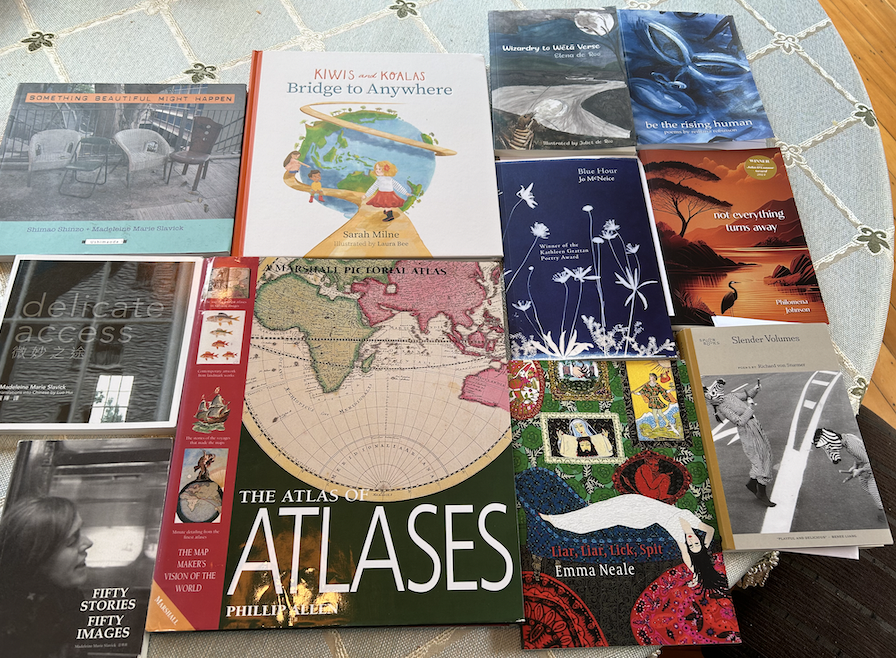
Poetry Shelf has felt touch and go this week, as my energy jar slips to tablespoons, with a few early morning appointments, leaving in the pitch dark, watching the light lift in patches, catching sight of the early runners, dog walkers, paddle boarders, swimmers, the traffic at treacle crawl, the rhythm of slow a steady heartbeat. But Poetry Shelf is necessary travel, and it wouldn’t function without your glorious and thoughtful contributions. In the post this week, I was delighted to get Robert Sullivan’s new collection, Hopurangi -Songcatcher (AUP, AUP New Poets 10 ed Anne Kennedy (AUP), Mythos ed Cadence Chung (Wai-te-ata Press) and Madeleine’s Slavick’s Town (The Cuba Press). I was also delighted to see the number of poets appearing in AWF Streetside | Britomart events.

Links to the weekly posts

Monday: Jack Ross poem

Tuesday: Megan Kitching Ockham Book Award shortlist feature

Wednesday: Stacey Teague review
Miriam Sharland book launch (May 9th)

Thursday: Poetry Shelf on ANZAC Day

Friday: List poems and a homage to Frances Hodgkins
Majella Cullinane book launch (May 23)

Saturday: AWF Streetside – Britomart events with poet poetry link

A poem

Some days I turn from the new books on my desk to the expanse of poetry on the wall shelves. I reach in a choose a book by an author I love, pick a single poem, and then linger between and beyond and within the lines; it is physical, it is elevation, it is the heart beating faster. This week it was Cilla McQueen’s ‘City Notes’ from poeta: selected and new poems (Otago University Press, 2018).

City Notes

How much does the city weigh?
The earth beneath it shudders.

Thunderstorm kicking around.
They go on making concrete.

Rain’s over – sun, cloud, wet air –
magpies, sparrows, parrots: expats.

The land is under concrete, lest it rise.
What lies beneath this leafy foreign park?

Inside the whispering fall of a Japanese
maple, I spy an Australian lorikeet.

A baby runs full-tilt across the scene.
Rangitoto appears remote.

Oh Lord, so remote, it seems
of a different timescale.

Cilla McQueen

Poet, teacher and artist CILLA McQUEEN has published 15 collections, three of which have won the New Zealand Book Award for Poetry. Her most recent work is Poeta: selected and new poems (Otago University Press 2018). She has also published a poetic memoir, In a Slant Light (Otago UP, 2016). In 2008 Cilla received an Hon. Litt.D. from the University of Otago, and was the New Zealand National Library Poet Laureate 2009–11. In 2010 she received the Prime Minister’s Award for Literary Achievement in Poetry. Cilla lives and works in the southern port of Motupohue, Bluff.

A musing

I ponder the word ‘weight’ after my sojourn with Cilla’s ‘City Notes’. Musing, dreaming, puzzling. I am wondering how a poem bears weight, delivers weight, dodges weight, describes weight. I am wondering if, along with my current craving for light, weight can also be a source of reward rather than burden. Whether substance and seriousness are as alluring as space and luminosity. My drift-thoughts form a fascinating knot, light and weight become inseparable. A poem might hold a serious thought and then radiate light, a poem might privilege light, but embed weight deep within. Not either or, but a series of conjunctions. Ah. A poem might navigate the weight of the world and in doing so signpost vital rays of hope.

Paula Green

Poetry Shelf Noticeboard: Streetside – Britomart events at AWF with a poetry | poet connection

STREETSIDE is our surprising, hilarious, profound, and a little bit wild fringe evening! For one night only, writers, musicians and artists take to the streets of Britomart for an extravaganza of creative shenanigans. From intriguing performers to captivating conversations to enchanting activities, STREETSIDE is for everyone — whether you’re a reader, writer, both, or neither…

It’s fast, it’s fun, and it’s full of surprises. Expect the unexpected and get ready to experience a night of literary mayhem. No ticket or registration required — just turn up and join the ride.

CLICK HERE TO DOWNLOAD THE FULL MAP AND SCHEDULE.

Check out the programme but here are some poetry / poet picks:

Poetry Shelf Friday Feature: List poems and a homage to Frances Hodgkins

Gow Langsford Gallery booth at Auckland Art Fair 2024

Wings Over Water

Hold the shell to my ear and I hear the life of the hermit crab.
Hold the bird to my ear and I hear the waterways and the windmills.
Hold the drape to my ear and I hear the treachery of March.
Hold the steps to my ears and I hear the blessings of Providence.
Hold the vase to my ear and I hear the frugal life and the teeming rain.
Hold the water to my ear and I hear the mist and the mud.

Paula Green
from Making Lists for Frances Hodgkins, Auckland University Press, 2007

At the weekend, a Gow Langsford Gallery booth at the Auckland Art Fair featured a 1930s work by Frances Hodgkins, ‘Still Life in Front of Courtyard’. They invited three of their gallery artists – Sara Hughes, Grace Wright and Virginia Leonard – to produce a work in response. I have only seen the works on the gallery website but even on a distancing screen the effect is mesmerising. Three distinct and poignant homages to an extraordinary artist. I list three words in my notebook: vessel, colour, movement. But in the prolonged contemplation, I am moving beyond words to the way – perhaps a little like music – an artwork becomes elevator, suspension bridge, mental and body sway, absolute pleasure.

And then the words simmer and settle.

The still life of Frances Hodgkins, with its sensual curves and earthy colour, is like a charismatic poem that rhymes, pulses, holds the intangible within the physical, and resists any measure to be still. And here I am both transfixed and turning in the intimate moment of looking. Sara Hugh’s homages, equally charismatic, resemble the power of poetry to deliver the physical and the abstract. Overlapping bands of colour and motifs, where definitive meaning dissolves, as flower becomes swirl becomes vase becomes kiss, where the botanical becomes domestic and the domestic is a colour wash of recollection. Ah, the pleasure of looking.

Grace Wright also produces a sublime viewing experience. Again I look at these paintings as poems, with colour harmony and deft rhythms, and then find myself musing on artwork as music – such a vital ingredient of poetry. Is it an oxymoron to say that art triggers music, whether as melody, movement, chords, counterpoints, cadence? I don’t want to explain these sublime paintings, I just feel them, the enigma, the connections, the resonance. Grace’s paintings carry poetic titles: ‘Opening the Way’, ‘Cradle in the Moment’ and ‘Breath of Life’.

I had not seen the work of Virginia Wright before, and it is the perfect addition to this suite. The titles are apt: ‘Still Life with Plate’, ‘Still Life’ and ‘Crochet Legs’. The exquisite works summon the domestic, Frances’ ubiquitous vessels, with intricacy, with the pleasure of colour. They are like miniature poems on a ledge, with undulations of meaning and possibility, with harmonies and textures. Again feeling overrides thinking, feeling settling into drifting thought, the prismatic connections reminiscent of the white space on a poem’s page.

And then the looking shifts and startles.

This is a leap. I am fascinated by how each artwork prompts lists, simmering, shadowy lists, lists that step off from Frances’ still life, that might include lists of things on the table, what I see out my window, every vase in every poem (I begin with Ursula Bethell). Art that might hint or evoke or proclaim, that might reclaim or refresh the feminine, light-up the pioneering women, their painting and writing, their lexicons and grammars, whether literary or visual, without rules and regulations and limitations.

My life is full of lists. A daily list on the kitchen table, weekly lists for Poetry Shelf, shopping lists, dream lists, word lists. List poems. Ah, such a soft spot for reading and writing list poems. In 2006, I wrote a poetry collection called Making Lists for Frances Hodgkins, which I named an autobiography in the light of art. I wrote of the artists in my family tree, my youthful desire to paint, my ongoing pleasure in encountering art of all descriptions and my long and loving relationship with a painter.

Why list poems? I am drawn to the everyday and the ordinary, to the melody of repetition, the enchantment of pattern, the twang of surprise, the delight of humour, endings that swivel, a refrain of awe. Intricacy and economy. Whispers and shouts. The way the found might nestle alongside the imagined. The way myriad stepping stones might offer routes through a cracked maze of myriad things. The way a poem might signpost a shadow list, perhaps evoking memory, daydreams, objects, vistas, the ordinary.

I have selected five poems, gleaned from a solar system of list poems that I have particularly loved, with satisfyingly different approaches. Dinah Hawkens’ ‘Leaf’ is like an incantation, and is part of an awe-inspiring sequence of ‘page leaf stone’ poems. She draws me deep into prolonged contemplation, leaf reverie, poem drifts, to the way I might go full circle, to the way Frances’ vase might be the voice of my grandmother, the sunlight on the kitchen table, Sara’s vase motif, and back to the vase again.

‘Calabash Breakers’ by Selina Tusitala Marsh resonates in her voice as I read, both voice and poem charismatic, with the repeating pattern a form of insistence, a vital signal in these turbulent times, for yes, we need resistance to toeing the line, we need the storytellers, the singers, the artists, the poets. James Brown’s ‘The Time of Your Life’ is a list of adages, sayings so often repeated they can hollow out in meaning, but gathered here, linked by theme, assemble a witty portrait of time. And then, and then I am catapulted into thoughts of this life, this lifeline, this death, this silence . . . and whoosh, I am back at Frances’ vase, and it’s spiked with the uncanny, an emptiness, time passing.

Ashleigh Young, like the other four poets, has crafted lists into several of her poems. I have picked ‘Going rafting with my uncles’, because the list is the spine of her poem, a shadow list poem that is family. First the uncles, physically present, as though I’m holding a family snapshot. And then the poem viewfinder switches to include the mother, pulling her from outside the photo frame, an imagining. And at the acute heart of the poem, the lines that muse on love, the lines that pierce me, every time.

I find myself stalling on the artworks in the booth on numerous occasions, just as I find myself reading and rereading these five poems, refusing to limit them to tidy explanations, to close readings, to conforming to my expectations of what a list poem might do. Arielle Walker’s ‘a poem is a fluid thing all wrapped up in fish skin’ opens out what a poetry can be, how it might need liquid and mountain currents and salt water and fluidity. How it might be tangle and skeleton and swell. And here I go drifting again, musing on how an artwork might be tangle and skeleton and swell. How a poem gains momentum and wonder in the form of a list.

To finish, this sweet week of meander, I have included a second poem from Making Lists for Frances Hodgkins, a poem with a trace of list, a poem that is for me, both love poem and a miniature manifesto on absorbing art and poetry.

Poems

Leaf

Leaf as one of many.
Leaf as incredible colour.

Leaf as silence, and silence
as a cave and the wall of a cave.

Leaf as an invitation: as a screen
to come leafing through.

Leaf as leafy machine. From water and light
you have breathable air!

Leaf as a life partner, a moveable feast.
Leaf, a soft whisper. Leaf as leaf.

Dinah Hawken
from Ocean and Stone, Te Herenga Waka University Press, 2015

Calabash Breakers

we all know
the calabash breakers
the hinemoas
the mauis
the younger brother
the only sister
the orphan
the bastard child
with rebellious blood

we all know
the hierarchies
the tapu
the boundaries
always crossed
by someone
petulant

we all know
the unsettled
the trouble makers
the calabash breakers
they sail the notes of our songs
stroke the lines of our stories
and reign in the dark hour

we should know them
we now need them
to catch bigger suns

Selina Tusitala Marsh
from fast talkin PI, Auckland University Press, 2009

The Time of Your Life

The turn of the century.
The dawn of the decade.
The year of the cockerel.
The winter of our discontent.
The summer of love.
The age of Aquarius.
The ides of March.
The moment of truth.
The nick of time.
The knell of parting day.
The twilight of the gods.
The end of an era.
The twinkling of an eye.
The chance of a lifetime.

A night of it.
A term of endearment.
A momentary lapse of reason.
A fraction of a second.
A stitch in time.
A minute of silence.
An hour of darkness.
A day of shame.
A period of mourning.
A month of Sundays.
Oh season of mists . . .
Two shakes of a lamb’s tail.
Fifteen minutes of fame.
One hundred years of solitude.

James Brown
from Selected Poems, Te Herenga Waka University Press, 2020, originally published in The Year of the Bicycle, 2006

Going rafting with my uncles

No help comes, and night is closing in
on me and my uncles. Some of us
dangle our legs in the water –

all of our heels are shaped like mallets, see,
or like they’ve been beaten with mallets.
Uncle David sits apart, drafting a group email. 

Uncle Neil has lost both our oars, and I find myself
looking at his hands, his carpenter’s hands
from the 70s. How good he was at everything, how tall,

how hungry we were for little cabinets and salad bowls.
Uncle John bundles his swanndri around me,
the one he goes eeling in. I once saw him kill an eel with a spade

while wearing it. We knew he was going to do it.
It’s in how an uncle moves, it’s in how cosy he is, it’s in
how you haven’t seen him for eighteen years and may not again,

and I wonder if I love these men – the sort of love
that is said to be deep down,
like sand that turns into a fish all of a sudden.

Oh someone save us, but do it without speaking.
Oh, something happen, something happen –
a house with lights on at the corner,

or moonlight, too beautiful to speak of, or rain,
or, on a bank, the sound of my mother’s voice
saying how glad she is to see us, 

how she had to walk for hours through the swamp.
Let us see her, holding a little dog
in one arm and a video camera in the other.

Ashleigh Young
originally published in Turbine | Kapohau 2022

a poem is a fluid thing all wrapped up in fish skin

How can I write a poem that isn’t first a body of water?

How can I write a poem unless its surface is formed
from the borrowed skins of seals and salt and seaweed
and its blood runs in the swell and roll of waves and
moon-pull of tides and its bones are pieced together
from the calcified skeletons of a million
                                                                tiny
                                                              fish?

I cannot write a poem in a drought

How can I write a poem unless it rolls (a ready-made
river) out of the side of a mountain and runs gleefully
forward in a rush of eddying currents towards the sea
          so that all I have to do is hold out a hand to unravel
                            the slightest fraying edge of its fluidity, and
                                                   spin a new yarn from its depths?

Arielle Walker
from her ‘river poems‘ section in AUP New Poets 9, Auckland University Press, 2023

But What Do You See in It?

I see the sun humming or
the yellowness of gold
and if I could hold your hand
we would lie in the gold meadow
gilding with words
to describe the mountains inside
outside in the time you took
to collect the hives.

Paula Green

from Making Lists for Frances Hodgkins