Category Archives: Uncategorized

Poetry Shelf Noticeboard: Compound Press Book Launch – Schaeffer Lemalu

Please join us to celebrate the publication of ‘the prism and the rose and the late poems’ by Schaeffer Lemalu (1983-2021).

Readings by confidants and collaborators.
Books available for purchase.
Refreshments provided.

Hosted by Compound Press and Lamplight Books.

Poetry Shelf on Claire Mabey’s Domestic Animals at Substack and doing a blog

I subscribe to Claire Mabey’s Domestic Animals at Substack and love it so much I want to share the link with you – Check it out as a free or paid subscriber. Claire is the Founder of Verb Wellington and the books editor at The Spinoff. Her first novel is out in July 2024.

On her posts, Claire discusses books she has read, festivals she has been to, people she has met, sometimes films, a birthday gift. Many of the books she reads are books I have also loved immensely – so am always keen to check out the ones new to me.

The latest arrival, ‘An Autumnal Roundup and banging my drum’ (April 9th), struck multiple chords with me because it nails exactly what I have been thinking over the past weeks, especially in the middle of the night. Every morning when I press ‘publish’ on a new Poetry Shelf post, and then get stuck into writing and assembling the next one, I shudder. There is such unbearable stuff going on in the world and here in Aotearoa, it feels off-key to celebrate poetry and books, from comfort poems to the melancholic, from beauty to the challenging, from food to climate change. Ah. This is what Claire writes:

I feel like crying. Like Claire, I am so grateful to the journalists and (some) politicians who are challenging how the wellbeing of people and the planet itself are under threat from deplorable decisions and actions. At a time of mounting injustice and inhumanity, it is indeed a time to speak up and out. Loudly. Together.

And I am also grateful to Claire because I savour the book, the poem, the email, the blog, the piece of writing, the music and the movie that gets me through the day. I am in the middle of assembling a tribute feature for John Allison, a poet who recently died. It feels important to bring together a community of voices, some of his poems, some poets reading his poems, written tributes, photographs. And I have reviewed The Long Road Trip Home that came out in 2023 with Cold Hub Press. In my patchwork sleep last night – yes it is on trend but two plus two is not filling my energy jar – I felt grief that I hadn’t managed to do the review late last year.

So I reread Claire’s post at 4 am.

And here is the epiphany. Here is the impulse to continue. We need Claire’s voice along with voices such as John Campbell, Helen Clark, Philip Matthews, Miriamo Kamo, Sharon Murdoch, The Spinoff, Simon Wilson, Chlöe Swarbrick to name a few. This morning I heard Ash Maindonald, the Principal at Western Heights School in West Auckland, speak with Nathan Rarere on RNZ National about the traffic light system being brought in by government to track school attendance. It was commonsense, it was empathy, it filled me with hope.

We need to challenge and we need to celebrate. In order to do the tough stuff, whether on a private level or a public one, whether as frontline worker stretched to breaking point (health workers, teachers, police, aid workers, emergency crews) or as critic across all media, we need to tend our daily energy jars. To replenish them with sources of comfort, nourishment, joy.

Thank you Claire, your writing and your mahi matters.

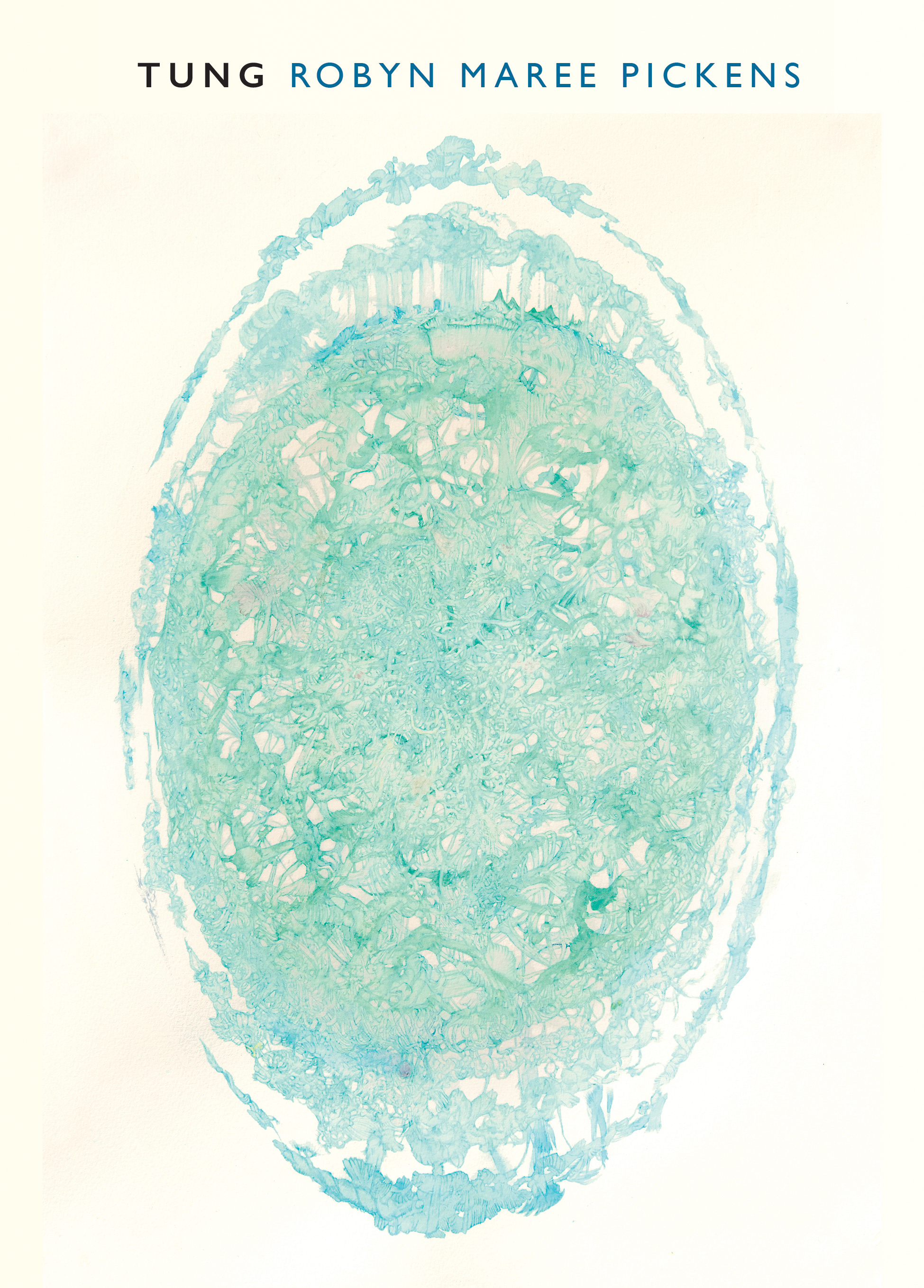
Poetry Shelf Review: Robyn Maree Pickens – Tung

Robin Maree Pickens, Tung, Otago University Press, 2023

/throwing a shimmer of tongue / this moment now / this pinch / this short gasp / this no escape / this not empty / this sky-wheat / this red earth / this sped through / this gnawing / this harvest / this dissolving shell of sky / this ocean / this not mine

from ‘Pinch’

Robyn Maree Pickens’ debut collection, Tung, draws us into a multifaceted contemplation of the natural world, the peopled world, the longed-for world. She carries us to darkness, she transports us to lightness. We move from the sensual traces of a bat, honeybees, a magnolia tree to myriad global risks. She weaves strands of love and tenderness, she faces the vast and falls upon the miniature.

Robyn is unafraid of words, of the ability of words to flip stutter pulse fizz. She shifts from prose-like paragraphs to musical phrasing to syncopated lines. Words scatter and curve, hug either margin, accumulate fascination for both eye and ear. She omits letters, doubles up, inserts Finnish or Japanese within the English currents, plays with suffixes and prefixes. She embraces concrete poetry, typographical playfulness, agile forms. Her linguistic dexterity replays a world that, whether abstract or physical, is both stuttering and harmonious.

The poetry builds threads to multiple sources: a painting by Joanna Margaret Paul, dwindling butterfly numbers in the USA, a book by Yukio Mishima, a botanist’s use of ‘ki’ and ‘kin’ because ‘Nature needs a new pronoun’. There is the tension between speaking to a lover or loved one and speaking publicly, of contesting and confessing. There are signposts to dark and pathways to light.

‘Tung’ is the flowering Chinese tree that bears oil-producing seeds, but the word also has roots in Old and Middle English – meaning ‘tongue’ and ‘language’. And yes, Robin has created fertile poetry that offers multiple rewards. A kinetic poetryscape for us to navigate. A repository for hope.

Robyn Maree Pickens is a poet and art writer who lives in Ōtepoti Dunedin. Her work has been published in numerous online and print publications in Aotearoa and beyond, including Landfall, Empty Mirror, Into the Void, SAND Berlin, Cordite and the Brotherton Poetry Prize Anthology (Carcanet Press, 2020). In 2018 she won the takahē Monica Taylor Poetry Prize, and was also a finalist in the Sarah Broom Poetry Prize judged by Eileen Myles. In 2020 she was longlisted for two US-based poetry prizes: the Palette Emerging Poet Prize and the 92Y Discovery Poetry Contest. That same year she was shortlisted for the Fish Poetry Prize (Ireland). In 2021, Robyn was placed second in the Vallum Poetry Award (Canada), and won the IWW Kathleen Grattan Prize for a Sequence of Poems. In early 2020, Robyn was awarded the Saari Residence in Finland. Robyn Maree Pickens has twice – in 2019 and 2021 – been a runner-up for the Kathleen Grattan Poetry Award for a complete manuscript. She holds a master’s degree in art history and a PhD in English (ecopoetics). Tung is her first published collection.

Otago University Press page

Robyn Maree Pickens reading ‘Eridanus the river’ for National Poetry Day Watch

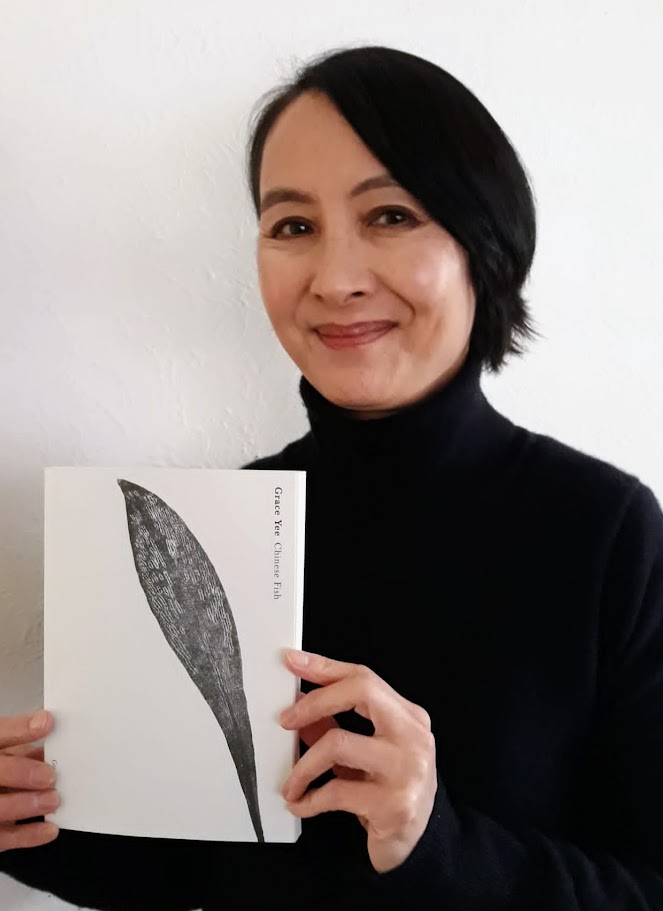
Poetry Shelf Ockham NZ Book Award Feature: Grace Yee – a reading and a review

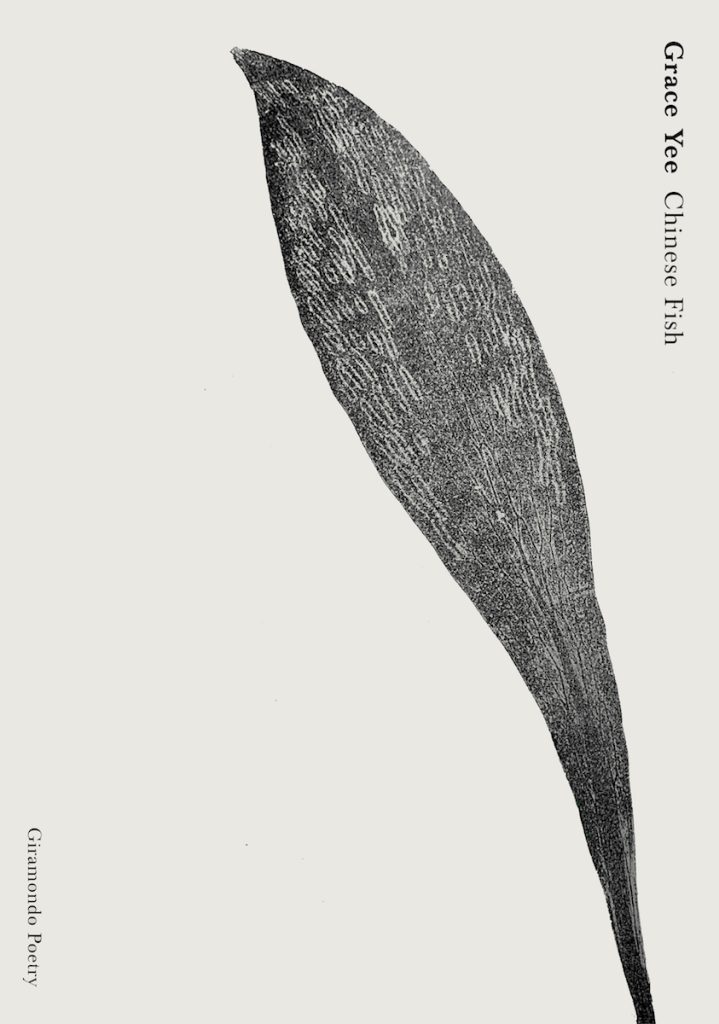
To celebrate the inclusion of Chinese Fish by Grace Yee (Giramondo, 2023) on the Ockham NZ Book Award Poetry short list, Grace has read three extracts from the collection and I have written a short review. Her debut collection is a book to be celebrated. The awards will be announced at an Auckland Writers Festival Event on May 15th. In the meantime here is a taste of this sublime book.

The reading

from ‘Paradise’

from ‘Chinese Fish’

from ‘For the Good Husband’

Grace Yee is the author of Chinese Fish, winner of the Victorian Prize for Literature and the Victorian Premier’s Poetry Award in 2024. Her poetry has been widely published and anthologised across Australia and Aotearoa, and internationally, and has been awarded the Patricia Hackett Prize, the Peter Steele Poetry Award, and a Creative Fellowship at the State Library Victoria. Grace has taught in the Writing and Literature Program at Deakin University, and in the Creative Writing Program at the University of Melbourne, where she completed a PhD on settler Chinese women’s storytelling in Aotearoa New Zealand. She lives in Melbourne, on Wurundjeri land.

Giramondo page

Grace Yee website

Grace in conversation with Susana Lei’ataua Radio NZ National

The review

Grace Yee’s debut collection Chinese Fish demonstrates the power of poetry to move and delight you on many levels. The foundation stone of the writing is family, and the writer’s ink is rich in multiple voices, braided narratives, cultural inheritances. It is a rendition of immigration, hierarchies, overt and covert racism, and emerges from daily living, experience, feeling, reflection, research and a tremendous love of words.

Grace has adapted her collection from the Creative Writing and Cultural Studies PhD thesis that she completed at the University of Melbourne. Her writing draws upon and borrows from diverse sources: New Zealand archives including newspapers; nonfiction works on gender and women; songs, radio documentary. Seven poem sequences gather the overlapping subject matter, the motifs, the linguistic melodies.

I begin with the strength and magnetism of voice, and am reminded of Robert Sullivan’s Voice Carried My Family (Auckland University Press, 2005). Voice is the back bone, the navigation tool, the crevice of vulnerability, the ache of cultural conflict that drives the polyvocal narrative. It is personal, it is political, it is infused with thought as much as feeling. We hear the voice of a grandmother, a mother, an aunty, offspring. As the poetry travels across decades, from the 1960s to the 1980s, we hear the barbs and the blessings of experience, in English and in Grace’s hybrid use of Cantonese and Taishanese phrases (Hoisan-wa), the languages she grew up with. There is a glossary at the back of the book with the English translations. And yes, voice carries this family.

Ping and Stan, emigrate from Hong Kong to Aotearoa New Zealand where they raise four children, own a fish and chip shop, navigate racial abuse, negotiate unfamiliar food and customs that mark one as ‘English / New Zealander’. Across several visual pages, repeated rows of identical figures reinforce the habit of pigeonholing a non-white race as all the same – whether in how someone looks or what they choose to be or do.

Hybridity enriches the dough of writing if you forgive my food pun. Dialogue sits alongside the newspaper borrowings, lyricism alongside more scholarly lines. Historical and cultural facts, along with additional comments, arrive in a faint grey font, little disruptions like a persistent shadow that hovers behind every we line we read, every voice we hear. We read for example: ‘1898: / Old Age Pensions Act. Chinese and other “Asiatics”, / including those who have been naturalised, ineligible.’ And yes food is a succulent presence, a visibility that heightens both the sense of belonging and not belonging: from roast lamb, brussel sprouts and white bread to steamed rice and wontons in soup.

At one point an authorial intrusion lifts me from the poetry. I reminded of the insidious under(and over)currents of ideology, the slipperiness of face value, of how we become accustomed and immune to the effects of power and dogma:

What is the point of this anecdote? Is this a story
about assimilation
or – god forbid – miscegenation? This
Cherry character
doesn’t seem very … Chinese.
Could you put her in a chong-sam
or have her wipe a few grains of rice
from her mouth…or explore the Pākeha boy’s point of view
perhaps? How does he feel kissing this exotic
Chinese girl? Does she taste like
soy sauce?

from ‘For the Good Husband’

Grace has produced a remarkable poetry collection that speaks to who we are and who we have been. It is a vital reminder that we need to do better, that we need to listen and forge connections, celebrate and welcome, make and enact laws that are just, acknowledge the richness of all cultures. Poetry has the power to reflect and speak to humanity. It is essential. To have spent time with this book is a gift.

Paula Green

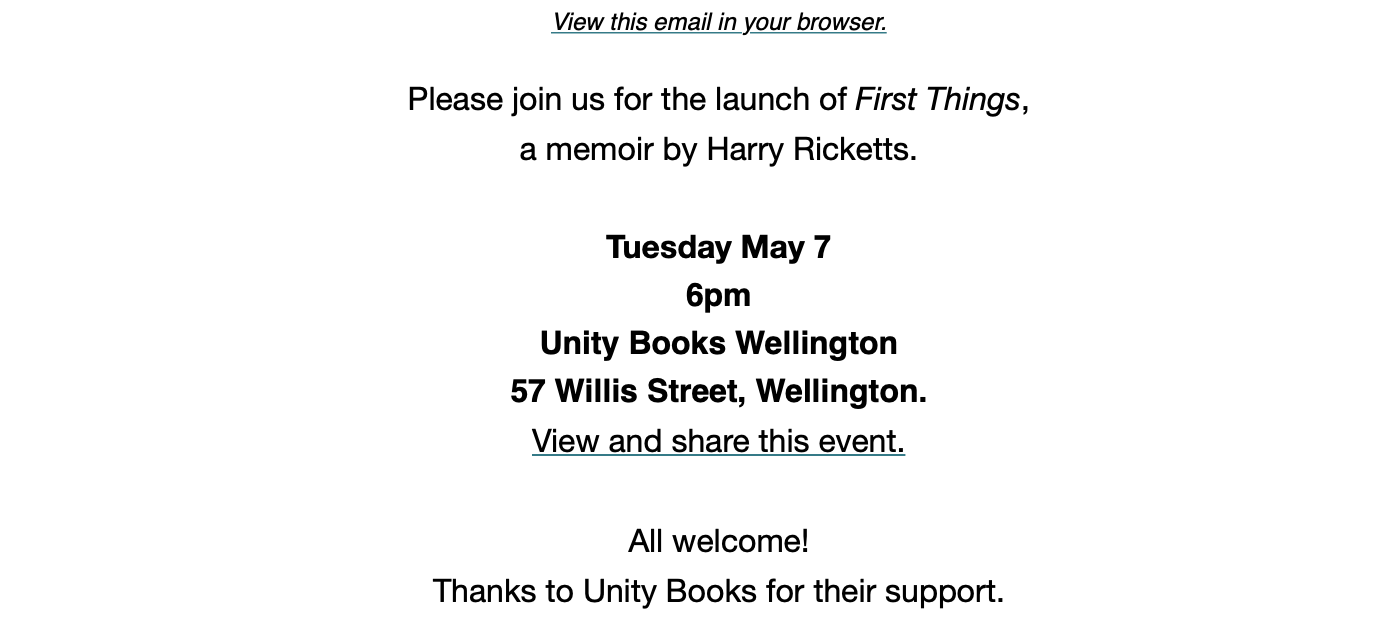
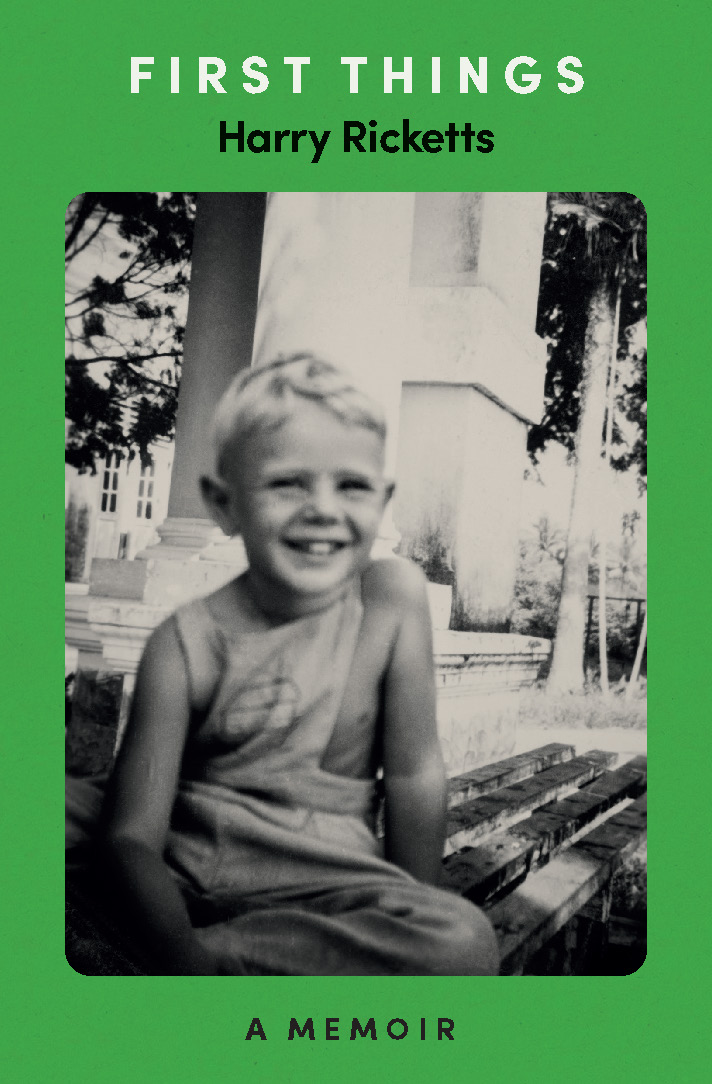
Poetry Shelf Noticeboard: Harry Ricketts launches First Things – A memoir

First memory. First going hitchhiking.

First seeing my father angry. 

First shotgun. First poem.

In First Things, Harry Ricketts chronicles his early life through the lens of ‘firsts’: those moments that can hold their detail and potency across a lifetime. Set mostly in Hong Kong and Oxford, these bright fragments include the places, people, writers, encounters and obsessions that have shaped Ricketts’ world, from his first friends and rivals to his first time being caned by a teacher and his first time dropping acid. There are other, more enigmatic firsts here too, like the first time he realised what really mattered, and the first time he began doubting God. ‘I wanted to believe in God and, even more, wanted God to believe in me.’

Who really were we, back then? Which parts of ourselves get to be remembered and carried along with us, and which parts are gone forever? In First Things, the gaps in between shine as brightly as the memories themselves.

Te Herenga Waka University Press page

Poetry Shelf Monday Poem: Fiona Kidman’s ‘My daughter makes quilts’

My daughter makes quilts

That first quilt was a storm at sea
pattern, dark green and grass
green and milky blue, curling cream
breakers like surf and here and there
salty-brown streaks of log jetsam
and sand; I sheltered under the ocean
when we slept, your inscription to
Mum and Dad  Feb 2006, I let
the waves roar over me

until another one arrived years later.
Frost over Franconia, 2010, read
the words in the corner, which might
seem at odds with the joyous harvest
colours of the quilt, the flaming gorgeous
manifestations of an autumn on the other
side of the world. Well, that was a weekend
you were on a Fulbright in America
and I’d promised to join you only
your dad’s long illnesses had begun;
I never made it there for the trip to pay
homage with you at Robert Frost’s writerly
house, the road not taken that time.
It was cold at the house you said, and closed,
and it was an awful weekend and why
wasn’t I there?

And, here beside me, is one more quilt:
Propeller Man Ian’s 6 year quilt March 2018
finished when his birthday had been
and gone, time of death unexpected after
all the years spent, your silver hair falling
across each careful hand stitch, rendering
the planes your father loved so much,
the ones in the sky and the ones
he carved from balsa in the shed
at the end of the garden. It’s all the colours
of light in the sky, like each quilt it covers dreams
when I sleep, keeps nightmares at bay. I am warmed.

Fiona Kidman

Fiona Kidman lives in Wellington and has been writing and publishing poems, from the same house perched on Mt Victoria, overlooking the sea, for just on fifty years. She and Lauris Edmond released their first collections together in 1975. The poems occupy what she thinks of as the ‘free creative’ side of her brain while craft has made its own winding progress over the years. She also writes novels and memoirs.

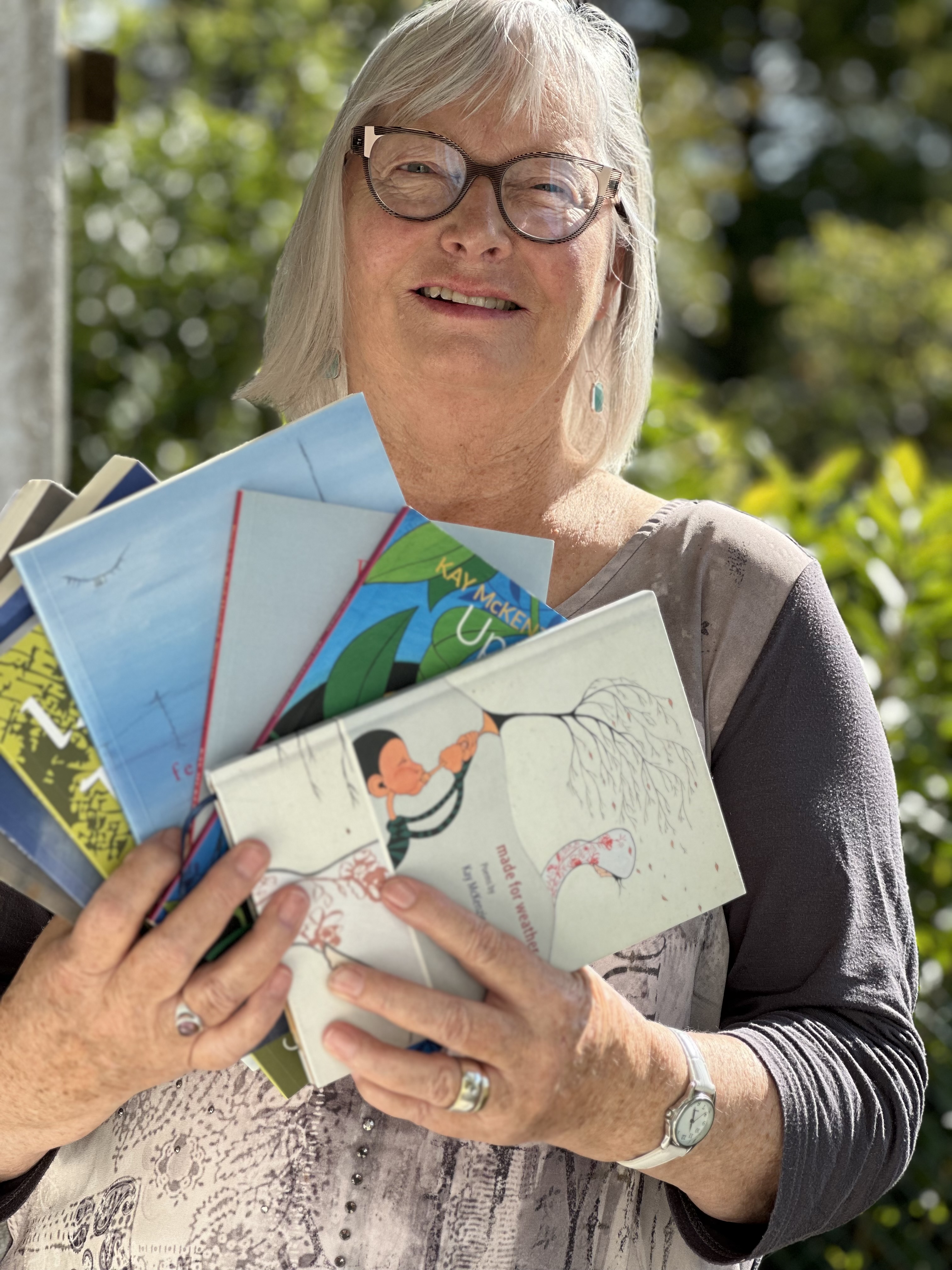
Poetry Shelf Musings: Kay McKenzie Cooke – Give a Book Time

Give a Book Time

In order to be true to yourself, it’s best to know who you are.

For someone like me, fascinated by quizzes on personality types, this pursuit is endless. I am well acquainted with my Myers Brigg type, my Eannegram number, my star sign, my Chinese zodiac sign and how compatible I am with other types. However, I’d argue that for me it is writing that really sorts me out. As a writer, I don’t think there’s any other choice but to be true to yourself. As you work at your writing, it’s working out you.

The 21st century writing world I am increasingly picturing is one that hums and bristles before me like a clip from a movie digitally mastered to teem with hordes of writers armed with outrageous writing nous. Majorly unsettling stuff, to be fair. I try not to keep on with the images, however, these cavalier beings equipped with slick writer profiles and a distaste for the semi-colon, riding in on the inky backs of fire-breathing dragons through a world that looks like a Bruegel painting and smells like duende, continue to manifest. I need to leave off drinking so much tea. I picture the turnover of Paper Plus paperback displays lit up like Vegas, spinning as fast as a Gore A&P Show’s Lucky Dip plastic windmill in a mean old easterly. In this nightmare of the imagining, a book that was a top seller in June, is binned by Christmas.

Sometimes I wonder if I’m not just imagining these things after all. Thank God for libraries where books go to never die. Little libraries, free ones, school ones and quirky ones. Books are survivors, whether back-catalogued, shared, borrowed, swapped, shelved, maligned, fondled, spurned, boxed, stored, sold, given away, returned, kept, forgotten or revered. Books will always find their readers. It may not happen overnight, but it will happen. Just give a book time.

Recently I went along to Dunedin’s annual 24 Hour Regent Book Sale. Bliss! An array of thousands of books laid out row upon tantalising row. What’s not to like? A balm for writers and an Aladdin’s cave for bookworms. A stadium-size book regatta afloat with books- ancient, old-old, old and new-ish – where a crush of hazy, right brainers high and dizzy on book dust, jostle each other in quiet, passive aggressive lean-ins for an old Dennis Wheatley or Judith Krantz. Or in my case, a Ruth Park. Yesss. Score!

The truth of who I really am in order to be true to myself, is proving to be an ongoing, lifelong quest. Luckily I’m still having fun finding out as I continue to write and forge my way through what throughout all seven decades of my life has never stopped being a terrifying, brave new world.

I draw upon my tīpuna, my ancestors, as a way of finding the truth of who I am and why I happen to be here in this particular place at this particular time in history. They ground me. From them I get that I am part of a whole and meaningful line of significance, a truth that emboldens me with a confidence I treasure.

I am painfully aware that no matter how much time passes, the world will keep on moving into the future. Faster than a bullet train. Faster than a Bugatti in the fast lane of an autobahn. My mokopuna are testament to that. I only need to turn my back for a minute and they’ve grown like something captured in a time lapse camera.

Kia whakatōmuri te haere whakamua (I walk backwards into the future with my eyes fixed on my past) is a whakataukī (proverb) that speaks to a Māori concept of time, where past, present and future are interwoven and life is an ongoing process underpinned by whakapapa, the ancestral line. I believe this and embrace it whole heartedly. It is how I remain true, not only to myself but also to my whakapapa, to my whānau, my family.

This art of remaining connected to a present that disappears into the past as fast as the future arrives, is a form of time management I struggle to perfect. Yet I wouldn’t be me, or true to myself, if I didn’t keep trying. The lyf so short, the craft so long to lerne (Geoffrey Chaucer). How true.

Kay McKenzie Cooke

Kay McKenzie Cooke (Kāti Māmoe, Kāi Tahu) lives and writes in Ōtepoti between the harbour and the beach. Her interests include reading, walking, baking and blogging. She is the author of four poetry collections and three novels. She is currently collecting poems for a fifth collection and just for the moment, fending off ideas for a fourth novel.

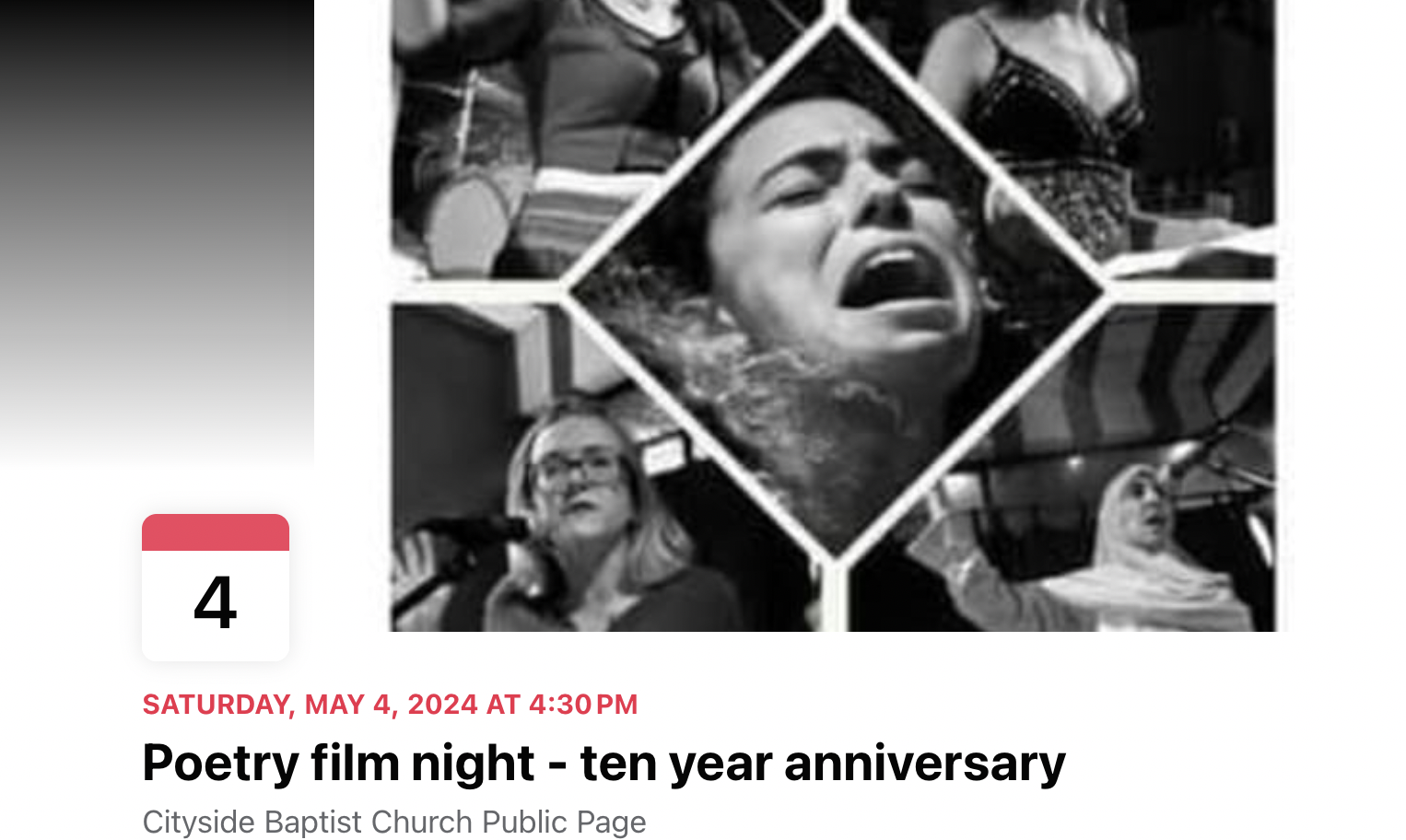
Poetry Shelf Noticeboard: Poetry Film night – Girls on Key ten year anniversary

Poetry Film Night, Girls on Key ten year anniversary

Cityside Baptist, 8 Mt Eden Road, Auckland

4th May, 4.30pm

A showcase of freshly produced international poetry short films and animations to celebrate the ten year anniversary of Girls on Key.

Poetry Shelf Poets on Poems: Airini Beautrais excerpt from The Beautiful Afternoon

On Thursdays, Poetry Shelf will post a series entitled ‘Poets on Poems‘. The poets and invited guests will muse on a favourite poem, especially New Zealand examples, and the poem will be included with permission. I love the idea of drawing poems out of the shadows, of underlining how we can be readers as much as writers, how poetry can evoke such diverse responses, epiphanies, pleasures. How it might comfort but also might challenge. How it underlines the sublime and satisfying reach of words.

Bill Manhire has a regular column in North & South where he writes about poems and poetry. His latest piece (April issue), considers witty lines: swerves, teasings, humour, the sizzle of the ordinary, ‘a deflation effect which is sometimes called monostich’. He includes a terrific poem by Jessie Mackay and a musing on the brilliance of James Brown (James has a new book out in June or July).

To launch the Poetry Shelf series, Airini Beautrais has contributed an excerpt from The Beautiful Afternoon, her new book of essays, a book that engages with life and difficulty, resolve and multiple fascinations, including poetry and reading, on so many levels.

From ‘Silent Worship’

In a 1966 ‘fragment’ poem, Rachael Blau DuPlessis writes:

I, Lady, you are my true love’s lady.
You stand in the middle of the room,
Sunlight streaming around you.
Sunlight takes hold of the seeds in you
And wets them.
I want to hold myself to you,
But you are myself. Can I?

In considering the coexistence of ‘I’ and ‘Lady’, DuPlessis asks questions about who is allowed to speak. In her essay ‘Manifests’, in which this fragment is quoted, she asks: ‘Am “I” forbidden to poetry by one – but one key – law of poetry, the cult of the idealized female?’ DuPlessis goes a step further into botanical imagery by incorporating ‘the seeds’, implying both ova and semen. Wetting one’s own seeds, holding oneself to oneself, could allude to masturbation, but more is going on here. If we can’t speak in poetry, the oldest literary language of the world, in what medium can we speak? If we can’t speak for ourselves, all we can be is spoken to, or spoken of.

Where do women go when we are no longer deemed physically attractive by dominant beauty standards? When our boobs droop and our waists thicken, our spines curve? Where do women go who have never been perceived as attractive? Who no longer want to be attractive, or have never wanted to be? Where do people beyond the gender binary, beyond heterosexuality go? The centring of heterosexual romance leaves out a lot of people and a lot of possibilities, pushed to the edges, the wilderness beyond the garden. In the literary canon, there are ghosts, whispers, occasional glimpses. In the gardens made by men, uncertain shapes glimmer underneath the trees, or flash briefly across the sun. Who was also, always there? Whose seeds were always planted?

One day, recently, I was talking to my science students about sand, how sand is a mixture of broken bits of shell, rocks, organic matter. Sand looks like it’s uniform if you hold it in your hand, but if you look at it under a microscope, you can see all the different parts. I thought about the William Blake poem ‘Auguries of Innocence’:

To see a World in a Grain of Sand
And a Heaven in a Wild Flower 
Hold Infinity in the palm of your hand 
And Eternity in an hour

After my separation, it took me some time and legal wranglings to get back into the house I had left. Once I returned, I had a sense that things that had happened there needed to be exorcised. There was a bad smell and a bad energy in the house. It was mostly empty of furnishings, and it hadn’t been cleaned in several months. The garden had not been tended. Anything motorised or stereotypically masculine had also gone, including the lawnmower and the weed-eater. I was on a tight budget and had a number of appliances to replace. I decided not to replace the mower or weed-eater. I would turn the entire lawn into garden. While a family court psychologist interviewed my children inside the house, I worked outside, moving rocks. Big lumps of shellrock had been piled into a large mound in the corner of the section by previous owners of the house. Now I was clearing this mound. The rocks were sharp to the touch, filled with the fragments of million-year-old shells. I wore gloves. One by one, I carried the rocks, placing them in the shape of a heart, in the centre of the front lawn. Later, I filled in the heart with cardboard and mulch, made other shapes around it. I lifted heavy chunks of broken concrete, set them in a circle, built a fire pit, surrounded it with river pebbles. I planted fruit trees. I made a pond, which sat green and murky in the corner. I hung wind-chimes in the trees. Gradually, the suburban lawn gave way to what felt like a magical space. For my thirty-fifth birthday, my seven-year-old enlisted the help of his grandmother to buy me six rose bushes. I planted them within the rocky heart.

In 2022, a couple of days past the winter solstice, I walk around the lake. The first magnolia buds are opening on the same trees, revealing white petals. Looking at the trees, I remember the spring six years ago, when the sight of the flowers seemed synonymous with the emotional pain that physically ached inside my chest, and churned my guts, when I projected body dysmorphia and internalised misogyny and ageism onto an annual botanical event. Now, feeling no pain or heartbreak, I feel an immense sense of freedom. I am walking with no concerns other than walking. On the top path I pass two women in their sixties, with dyed hair and bright pink lipstick. We are strangers but we greet each other warmly. A trail of scent remains behind them. Pink camellias are bursting with flowers. Bees are working the stamens. The sun is out and I turn my face towards it, feel its warmth enter my skin. The spring belongs to no one, signifies nothing human. A tree is not a person: it comes into leaf, fruits and sets seed annually, following its own cyclical rhythms.

Turned away from the lecture on sexual economics
she goes down into the sexual garden, under its dark spread
and into its detail: ecstatically branching magnolia, tuberous
roots thrusting up huge leaves. Fuck the tulips in their damned
obedient rows. Stop. They’re finally opening their throats!
They have dark purple stars! They have stigma! They have style!

Hawken’s description of the tulips in their ‘damned obedient rows’ suggests feminine submissiveness. But then, she abruptly changes tack. Stop. The tulips, so evocative of genitalia, are opening, and are finally able to speak. The puns on floral parts put a humorous twist on what is a call to power. The garden has been filled with female sexuality, with all sexualities, with female power, with humanity, all along. Nothing is silent, the garden worships itself. We are all able to go down through it.

Airini Beautrais
from The Beautiful Afternoon, Te Herenga Waka University Press, 2024

Airini Beautrais lives in Whanganui. Her collection of short stories, Bug Week, won the Jann Medlicott Acorn Foundation Prize at the 2021 NZ Book Awards. She is also the author of four collections of poetry and the essay collection The Beautiful Afternoon (THWUP 2024).

Te Herenga Waka University Press page