Category Archives: Uncategorized

Poetry Shelf noticeboard: Emma Neale book launch

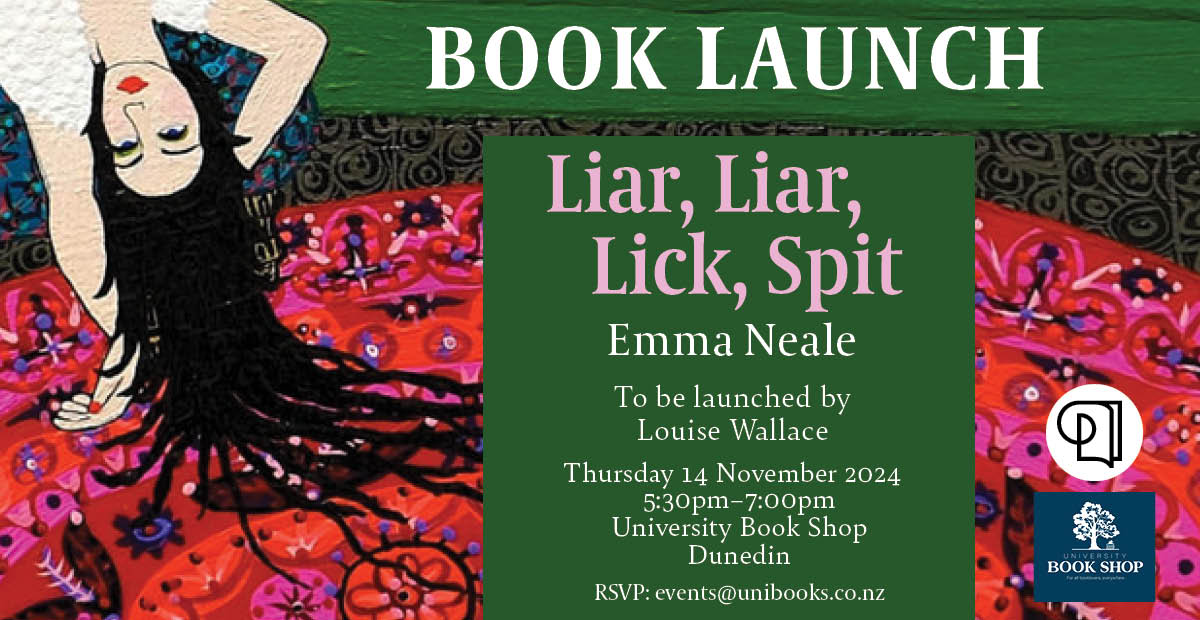
Emma Neale, University Book Shop Otago and Otago University Press warmly invite you to the launch of Liar, Liar, Lick, Spit, the new poetry collection by Emma Neale. To be launched by Louise Wallace.

5:30pm–7:00pm
Thursday 14 November 2024
University Book Shop Otago
Dunedin
All welcome!
Please RSVP to events@unibooks.co.nz for catering purposes

ABOUT THE BOOK:
Fibs, porkies, little white lies, absolute whoppers and criminal evasions: the ways we can deceive each other are legion.

Liar, Liar, Lick, Spit, the new collection by Ōtepoti poet and writer Emma Neale, is fascinated by our doubleness. Prompted by the rich implications in a line from Joseph Brodsky — ‘The real history of consciousness starts with one’s first lie’ — it combines a personal memoir of childhood lies with an exploration of wider social deceptions.

From the unwitting tricks our minds play, to the mischievous pinch of literary pastiche; from the corruptions of imperialism or abuse, to the dreams and stories we weave for our own survival, these poems catalogue scenes that seem to suggest our species could be named for its subterfuge as much as for its wisdom. Yet at the core of the collection are also some tenets to hold to: deep bonds of love; the renewal children offer; a hunger for social justice; and the sharp reality that nature presents us with, if we are willing to look.

ABOUT THE AUTHOR:
Emma Neale is a novelist and poet. Liar, Liar, Lick, Spit is her seventh poetry collection, following To the Occupant(Otago University Press, 2019). Recognition for her work includes the 2008 NZSA Janet Frame Memorial Award for Literature and the 2011 Kathleen Grattan Award for Poetry for The Truth Garden (Otago University Press, 2012). In 2020 Neale was awarded the Lauris Edmond Memorial Prize for a Distinguished Contribution to New Zealand Poetry. A former editor of Landfall, she lives in Ōtepoti Dunedin and works as a freelance editor for publishers in New Zealand and Australia.

Poetry Shelf noticeboard: Laurel Prize 2024 poetry winners includes 2 New Zealanders

Warm Congratulations to:

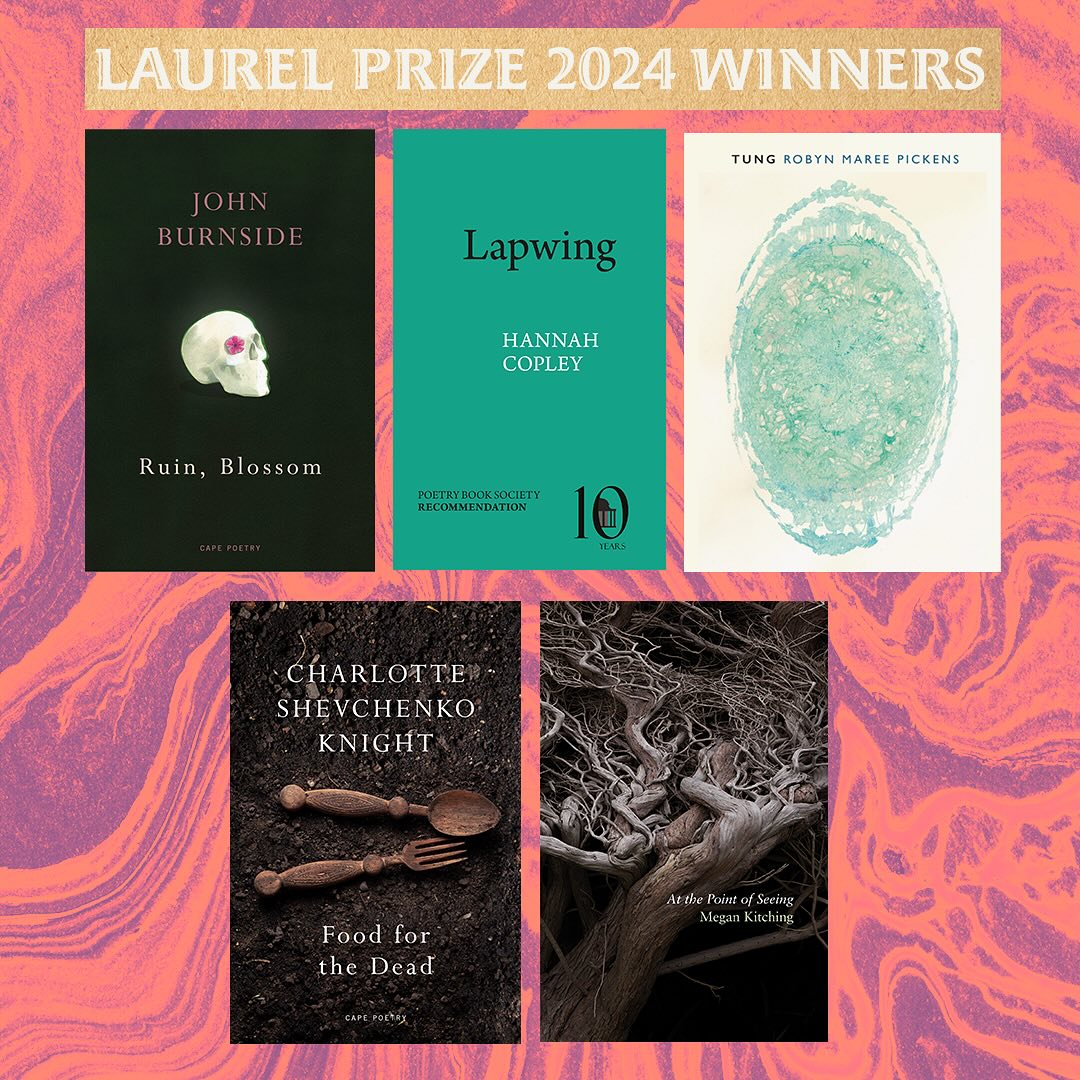
We’re delighted to announce the winners of the 2024 Laurel Prize. This year’s prize was judged by Chair Mona Arshi, Caroline Bird, and Kwame Dawes

🌿First Prize: John Burnside, Ruin Blossom(Jonathan Cape)

Second Prize: Hannah Copley Lapwing (Pavilion Poetry)

Third Prize: Robyn Maree Pickens, Tung (Otago University Press)

Best First Collection UK: Charlotte Shevchenko Knight, Food for the Dead (Jonathan Cape)

Best International First Collection: Megan Kitching, At the Point of Seeing (Otago University Press.

Poetry Shelf review of Tung

throwing a shimmer of tongue / this moment now / this pinch / this short gasp / this no escape / this not empty / this sky-wheat / this red earth / this sped through / this gnawing / this harvest / this dissolving shell of sky / this ocean / this not mine

Robyn Maree Pickens, from ‘Pinch’, in Tung

Poetry Shelf review of At the Point of Seeing

In that wavering horizon,
where the merest snap loomed
I found a dull, sedate beauty,
an abundance of swans.

Yes, despite the red fire flush
tipping the succulent wort
and a stilt’s elegant flight
the marsh was flat, almost poetry.

Megan Kitching, from ‘The Inlet’s Shore’ from At the Point of Seeing

Poetry Shelf review: Liveability by Claire Orchard

Liveability, Claire Orchard
Te Herenga Waka University Press, 2023

Liveability came out in 2023, and joined a wee pile of poetry collections I read and loved last year, but ran out of energy to review. Claire Orchard’s collection stuck with me, certain poems in particular, and I am posting one of them in my Monday Poem spot on November 4th. I am currently selecting poems that I have especially loved over a period of time, along with occasional new ones.

You can hear Claire read here.

Today, the sun is shining, the wind is on leave, the power is on, and in this rare miracle moment, I am sitting on the side of my recovery mountain at an intersection of equilibrium, beauty and peace. The perfect time to return to a book that resembles an ode to life, to the intricate lacework of being.

Claire writes with sublime fluency: the sweet aural currents carry physical detail, multiple voices, epiphanies, observations, declarations, tenderness and edge. Think of a collection with multiple notes, myriad bridges to the world outside, whether a world experienced or a world imagined, a world read or a world remembered. I find myself crossing footbridges into my own memory, my own ambulations, liveability.

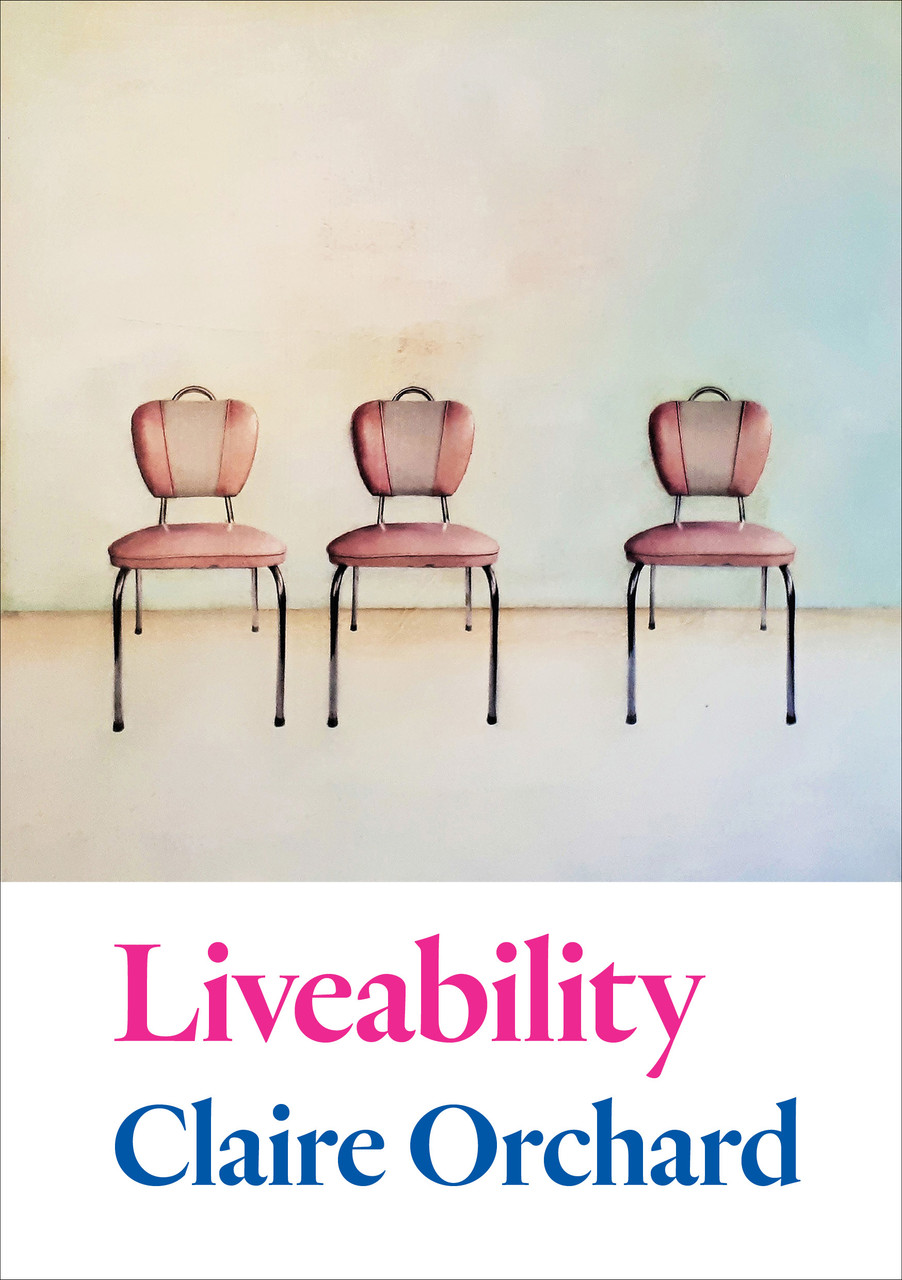
Ah, the cover. I love the marriage between the title of the book and the cover image, a painting by Deb Fuller of three empty chairs, so carefully positioned, so haunting ot the degree of the uncanny. It struck a chord, not just as an entry point into the collection, but in terms of my own writing and what I have been thinking about poetry. Let’s say the making of a poem. Let’s say the poem as empty chair. Let’s say the poem with its physical detail and careful placements, wear and tear, relationships with other chairs, attached and detached memories. This week I was writing poems as empty chairs for the reader to sit in and make their own. An oxymoron because, of course a poem, is never empty.

And yes, Claire’s poetry achieves a satisfying fullness of effect. She might begin with a winged chair or Main Street, an aging mother, a family choosing pizza, feeding the pigeons, entries in a dictionary, the window display in a china shop. It is writing slowing down, a heavenly slowing down to retrieve memory, absorb what is seen through the window, in the street, what is read. Detail and mood are carefully gathered and assembled to the point they become pulse on the page. Throb. Vibration. Movement. That empty chair is rich in layers. In ‘Charms’, I get to drive Main Street in the car of the poet, a nostalgic trigger of past and present. The childhood bedroom in the family flat, in ‘Furnace’, is an equally nostalgic tripwire to a chipped tooth and chipped memories, imbued with the undulations and slippage of recall. Then there is swivel memory in “Xanadu summer album’:

Remember the derelict, one-room schoolhouse,
its empty playground cracking with weeds,
its small playing field unmown. We peered
through the windows at dark-stained wooden chairs
and desks in disarray, textbooks scattered across the floor,
the last lesson still chalked up on the blackboard.
Hmmm, you say. What about the way
the last of the daylight would turn
the iron roof of the long drop into silver?
And I wonder how you even remember things like that.

Ah, perhaps we can might of this as a season album, with its exquisite array of moods, framings, point of views. I am never sure what will be on the next page and I love this. The T-shirt in the poem, ‘If you take one piece of advice this year let it be’, declares ‘Impossible is nothing’, as the grandmother swears by ocean dips, spitting on insect bites and one stair at a time, and the children dash and scratch and tumble. In ‘Shooting rats’, we’re in Uncle Jim’s ute flying through the paddock with sheep scattering, the poem moving to an ending that sticks:

reaching the top felt like flying
and when we looked we saw

through limbs of thinned macrocarpa
the sky, too, was planning something big.

In ‘Herd’, poet becomes reader, and the idea that zebras don’t feel stress arrests us both, reader and writer. Again, Claire delivers a poem ending that prompts pins and needles:

If only the survivors could tell us
how they’re feeling. Recently captured footage
shows them glancing obliquely at one another
before hurriedly looking away again.

Ah, so many poems to share and highlight, from the everyday to the awe-some, from Wilson Alwyn Bentley, a cloud physicist, to family settings, from Ernest Rutherford to a rain precipitation room experience. Perhaps I will leave you with another skin-prickling ending. In ‘Thursday night’, everyone is in the family sitting room (those were the days!) watching Star Trek at 7.30 pm (appointment viewing!). At one point, it feels like Leonard Nimoy is speaking through the screen to the avid viewers. So many bridges and layers and possibilities:

it’s as if he’s speaking directly to us,
as if when he turns his attention to the way
these same features confine and confound us,
he’s seeing through the glass screen into
our sitting room as he laments the bleakness
of such an existence. As if he observes
the widening of our eyes, poor lonely creatures,
perpetually at opposite ends of the couch,
and our mother, in her chair next to the couch.

Pull up a chair, regardless of what the weather is doing, and nestle into the glorious, life-rich experience of reading Liveability. I have barely scratched the surface of what these poems do, with their weave of lightness, fascination, craft, vitality and wonder.

Claire Orchard (she/her) studied English and history at Massey University and completed an MA in Creative Writing at the International Institute of Modern Letters. She lives in Te Whanganui-a-Tara and is the author of two poetry collections: Cold Water Cure (VUP, 2016) and Liveability (THWUP, 2023).

Te Herenga Waka University Press page

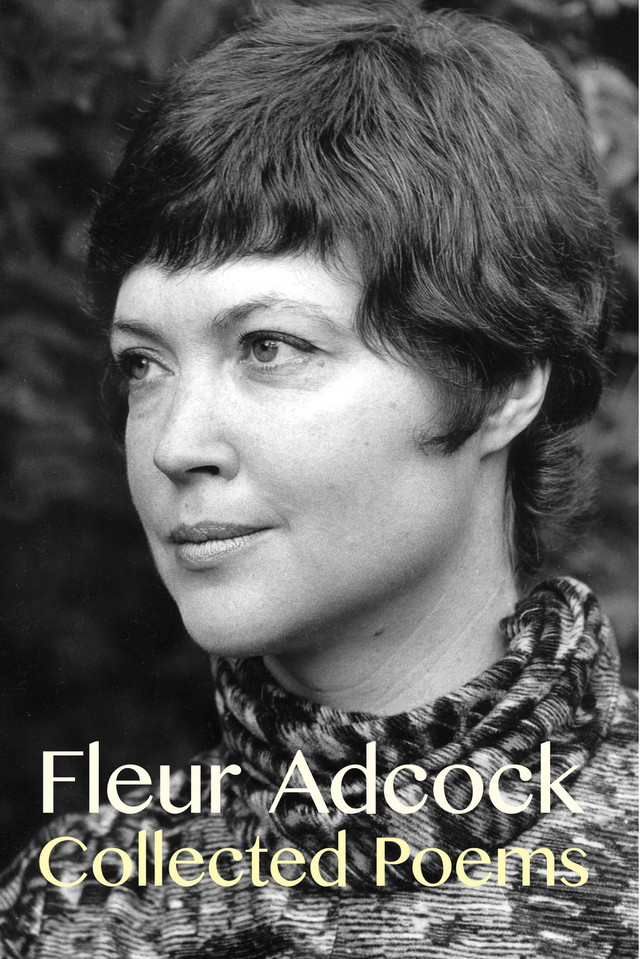
Poetry Shelf Fleur Adcock giveaway

Victoria University Press, 2019
(resissued Te Herenga Waka University Press, 2024)

I put the names in the hat and picked out Ruth Arnison to gift a copy of Fleur Adcock’s Collected Poems.

Ruth included this delightful note:

I first wrote to Fleur in 2006 after coming across her poem, “Flight, with Mountains,” in memory of my uncle Dave Herron.

I thought a portion of Fleur’s response might interest you, –

” It was very significant for me: it was one of the first major, mature poems I ever finished, and it won the Wellington Festival Poetry Prize (£50, a huge amount at the time — I bought a tricycle for my son Andrew and a suit to wear to the prizegiving in Wellington, and still had £25 left over).  More significantly, it restored my faith in the possibility that I might become a real poet, which was pretty shaky at the time (I think it always is).”

You can read the Poetry Shelf tribute here, which includes my slowly unfolding email conversation with Fleur.

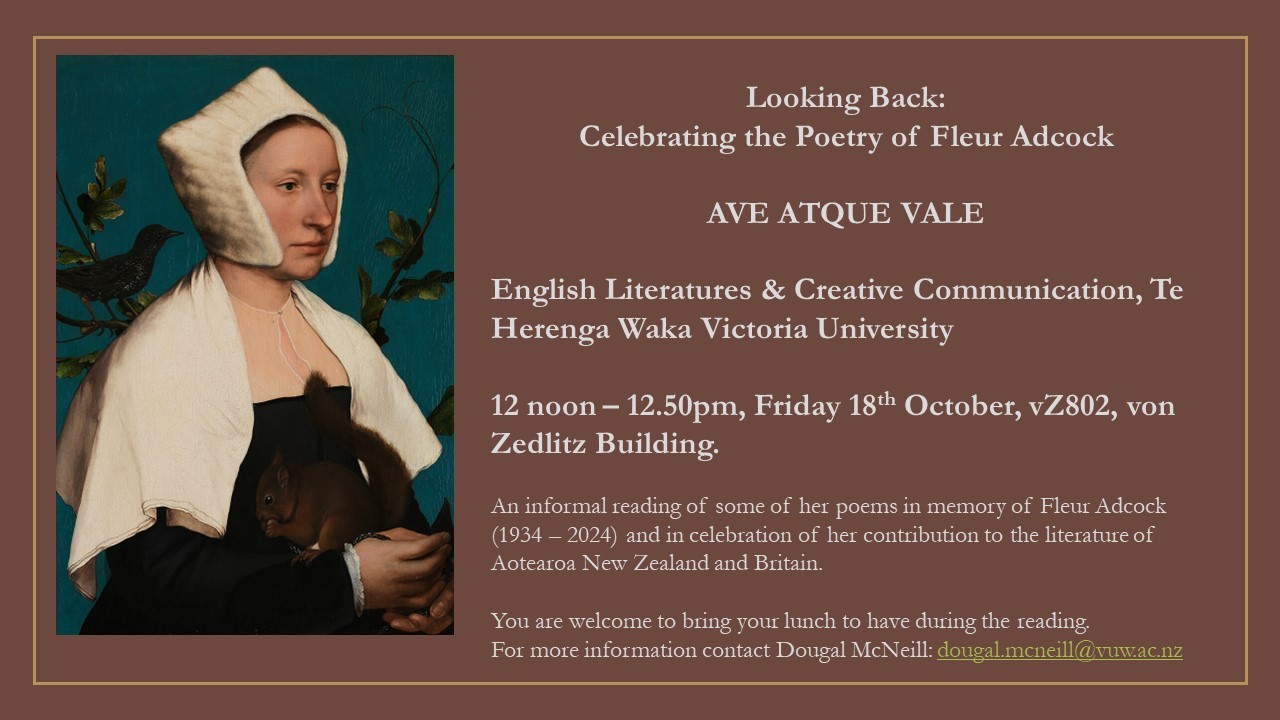
There will be an informal reading of Fleur’s poetry at Te Herenga Waka Victoria University on Friday 18th October, with readings from Tru Paraha, Harry Ricketts, Chris Price, more. Details here.

Poetry Shelf Noticeboard: South Asian Voices Event: Stories Beyond Borders

South Asian Voices Event, 24 October 2024: Curated by romesh dissanayake and Sudha Rao

Dinithi Nelum Bowatte is a Sinhala Sri Lankan New Zealander from Te Papaioea Palmerston North. She has written essays for various zines and the Pantograph Punch. Her short story ‘Three gigs’ is featured in ‘Visible Cities,’ a collection of writing published by the Cuba Press in 2023. 

Rajorshi Chakraborti was born in Kolkata and grew up there and in Mumbai, and now lives in Wellington with his family. He has published a collection of short fiction and six novels for adults. His latest book is The Bad Smell Hotel, a novel for children co-written with his daughter Leela.

romesh dissanayake is a Sri Lankan and Koryo Saram writer, poet and chef from Te Whanganui-a-Tara Wellington. His work explores ideas of identity, decolonisation and place. romesh’s poetry, fiction and essays have appeared in various print and online publications. His chapbook poetry collection, Favourite Flavour House, is featured in AUP New Poets 10 published by Auckland University Press. His first novel, When I open the shop, was the winner of the 2022 Modern Letters Fiction Prize and is published by Te Herenga Waka University Press.

Brannavan Gnanalingam is an award-winning novelist based in Pōneke. He is the author of Sprigs (winner of the Ngaio Marsh Award for Best Novel and shortlisted for the Jann Medlicott Acorn Foundation Prize for Fiction at the Ockham New Zealand Book Awards), Sodden Downstream (also shortlisted at the Ockham New Zealand Book Awards), and A Briefcase, Two Pies and a Penthouse (longlisted at the Ockham New Zealand Book Awards). He is also a former columnist for the Sunday-Star Times, and winner of a Qantas Media Award (as it was then known) as a film reviewer for The Lumière Reader. The Life and Opinions of Kartik Popat is his eighth novel.

Janaye Kirtikar is a Marathi Indian and Pākehā writer from Pōneke. She reads, she writes, and she stares at the ocean.

Rupa Maitra is a fiction writer born in New Zealand to Bengali parents. Her book of short stories, Prophecies, was published in 2019. 

Katya Mokha is a mixed Punjabi/English writer who grew up in various places, though she most closely identifies with Whanganui. While Katja feels new to the writing world, she has previously written short stories for personal enjoyment and, on a few occasions, for anthologies and competitions. Currently, she is an MA student at Te Herenga Waka and is just weeks away from submitting a full manuscript.

Nipuni Ranaweera is an academic and poet from Sri Lanka who is currently based in Wellington, New Zealand where she is reading for her PhD in English and Poetry at Massey University.

Nipuni has published two collections of poetry which were nominated for major awards in Sri Lanka.  Her work has also appeared in several local and international journals.

Sudha Rao is originally from Karnataka, South India, migrating to New Zealand. She trained in classical South Indian dance and established Dance Aotearoa New Zealand. Sudha completed an MA in Creative Writing at the International Institute of Modern Letters and published her first collection of poems On elephant’s shoulders, Cuba Press in 2022. Sudha’s poems other works have appeared in several anthologies including in Landfall and Best Poems New Zealand. Sudha was invited to participate in the International Bengaluru Poetry Festival.