Category Archives: Uncategorized

Poetry Shelf poems: Freedom by Paula Green

                                                 A Freedom Song


Freedom to love       
not to wage war                                                               

                           A tūī still sings
                          The manukā trembles

Freedom to listen
not to mislead

         A kererū glides
         The broad beans ripen

Freedom to feed
not to starve

          It’s heart to heart
          It’s the kumarā roasting

Freedom to heal
not to wound

           It’s lightness at dawn
           It’s the ruru calling

Freedom to care
not to ignore

                   It’s a song and dance
                   because our world is broken


Paula Green


Poetry Shelf Monday Poem: Tangihanga by Hinemoana Baker

Tangihanga

at the pā
nō rātou te mana
nō ngā wāhine
e mau panekoti ana

my father
stands to speak

I am a needle of bone
on my aunty’s knee
I have cut my hair

handled gently
I am a thatched weapon
a flake of obsidian

something skirting
the boards of the house
as if it were property

what he says is like
bread or a bruise

there is a rushing to the edges
the scent of kawakawa releases
into the dark-fleshed home

Hinemoana Baker
from mātuhi | needle, Te Herenga Waka University Press, 2004

Over the coming months, the Monday Poem spot will include poetry that has stuck to me over time, poems that I’ve loved for all kinds of reasons. Poems that comfort or delight or challenge. Poems that strike the eye, ear, mind or heart.

I have loved this poem for twenty years, the first poem in Hinemoana’s debut collection, mātuhi | needle, a book that sings and weaves with aroha, agility and self navigation. I think of this poem welcoming us to the poetry that follows, and indeed, to the sublime collections that follow. Here, on the first page, whanua. Here in the first lines, wahine. Te reo Māori, the first breath. The healing balm of kawakawa, a wafting scent for speaker and reader. This layered poem is heart, the kind of vital heart that travels with you, as bridge, as anchor, lifeblood. Here the notes of an agile musician poet draw us into the chorded melodies to come, aural economy and aural richness, the sweet and sour intricacies of the world, the magnetic pull of story, memory, ancestors, home. Ah, such joy, returning to this poem and this collection, this poet.

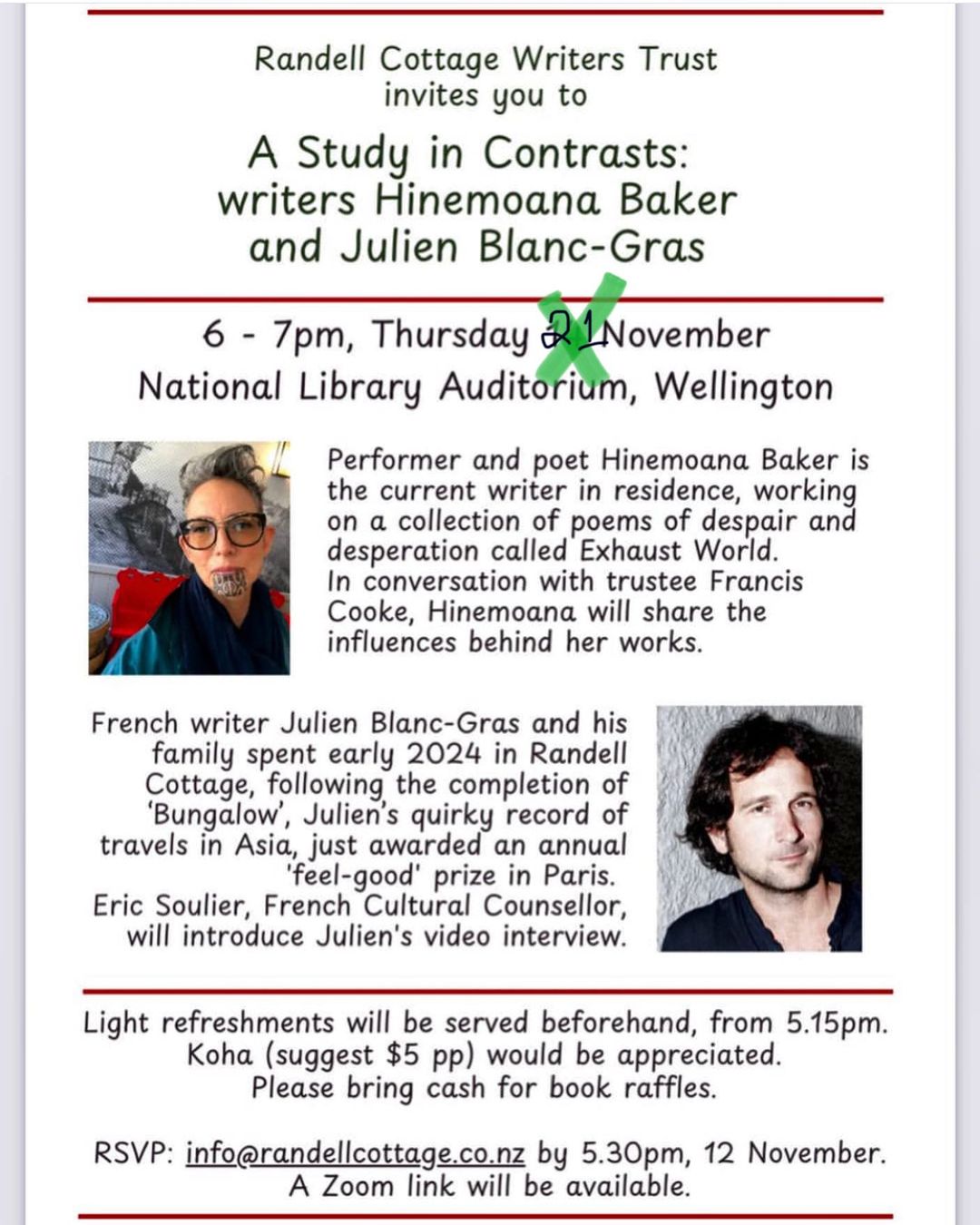
Poet and performer Hinemoana Baker traces her ancestry from Ngāti Raukawa, Ngāti Toa Rangatira, Te Āti Awa and Ngāi Tahu, as well as from England and Germany. Her four poetry collections, several original music albums and other sonic and written work have seen her on stages and pages in many countries around world for the last 25 years. With Maria McMillan, she co-edited Kaupapa: New Zealand Poets World Issues (2007). Her most recent poetry collection, Funkhaus (THWUP 2021) was shortlisted for the Ockham New Zealand Book Awards. It was published in German translation (AZUR Voland & Quist) in 2023 and in Polish (Wydawnictwo Ha!art) in July 2024.

Hinemoana was the Arts Queensland Poet in Residence (2009); one of thirty-eight writers in residence at the University of Iowa International Writing Programme (2010); the writer in residence at Victoria University in Wellington (2014); the Creative New Zealand Berlin Writer in Residence (2016). She is currently Randell Cottage Trust’s writer in residence at the historic homestead at the base of Ahumairangi in Te Whanga-nui-a-Tara.

Hinemoana Baker’s website

Poetry Shelf conversation with Hinemoana

Te Herenega Waka University page

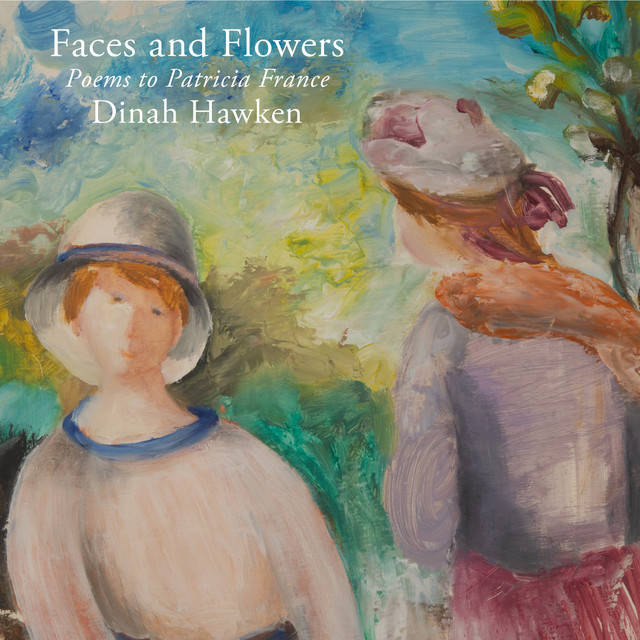
Poetry Shelf review: Faces and Flowers Poems to Patricia France by Dinah Hawken

Faces and Flowers Poems to Patricia France
Te Herenga Waka University Press, 2024

I search your paintings of flowers
and see nothing fragile in their colours.

Flowers are delicate by nature, in their opening selves.
But you added to that. You added ferocity

and strength. Orange, blue, yellow, white, rising
from a dark vase and a dark past.


Dinah Hawken
from ‘Consider the future and the past with an equal mind’

Dunedin artist, Patricia France (1911 – 1995), was a cousin of poet Dinah Hawken’s father. I have long admired and loved the work of both women, the paintings of one, the poems of the other, so to hold this book is precious.

After self-admission to the psychiatric hospital, Ashburn Hall, Patricia began to paint, and from that point, continued to paint and develop her career as an exhibiting artist. As Dinah’s collection title suggests, Patricia was known for painting women, girls and flowers. A number of artworks are included in the book. The paintings and poems form an exhibition at Waikanae’s gallery, Toi Mahara, from 20 September to 8 December 2024.

I begin with the production of the book – the shape, the layout, the font size, the paper stock, because each choice serves the paintings and poems beautifully. I think of the book’s design as a breathing space, because here the art and poetry have room to breathe, and that makes all the difference for both reader and viewer. Sublime.

Books are often dedicated to loved ones, and there is a long tradition of poems written for named or unnamed recipients. With Faces and Flowers, Dinah underlines that these poems are written to Patricia. Writing in this context is a way of speaking to someone, and out of that speaking, a loving portrait of a woman emerges, the artist, the relation. Dinah assembled her portrait through research and delving. She drew upon Patricia’s letters in the Hocken Library and by viewing her artwork, by listening to T. S. Eliot’s Four Quartets as Patricia did when she painted. Contemplation and memory are working in tandem. By placing these paintings and poems together as an exhibition, the fecundity of conversation between poem and painting, past and present, is heightened.

The poet as portrait artist works on multiple levels. Dinah’s poetic pen is infused with family history but it also includes the ink of contemporary circumstances. She cannot speak to Patricia without signalling a world awry, without acknowledging the tragedy of climate change, the impact of Covid, how the world tetters and topples. Today I could add the war in Gaza and Lebanon.

I am musing on how this book fills me with both wonder and comfort, concern and discomfort. To linger upon the faces and flowers is transfixing: the extraordinary eyes of the women and girls mesmerise as transmitters of emotion and guardians of experience. Dinah considers the enigma, the building questions, in these faces that haunt and endure. She decides, she declares for the first time publicly, that colour has been her ‘silent, / vital, lifelong partner’ (‘Colour’). And yes, Patricia is much admired for her colour palette, the balance, harmony, softness, mood shimmer. When Dinah writes that ‘vowels are my colours’, I want to reach back through her collections and see how her poetry exudes colour as it draws the natural world close. I delight in this colour. This vital bloom. In both the paintings and the poems.

Ah. Comfort and discomfort. Reading Dinah’s collection returns me to an issue that unsettles me every day: how to write, and indeed how to blog, in a world plagued with catastrophe? What to write, what to blog? I hold this book and I savour so deeply the comfort it delivers, the wonder and delight, and then, at the same time, I recognise how important it is to speak up and to speak out, to use our pens and our voices to shine light upon and to help our wounded planet and people. When Jacinda makes an appearance in the poem, ‘The two girls’, I am aching. I am thinking yes, we will lift each other up, yes we have lifted, and yes we will continue to lift. I am thinking how writing poems and making art and maybe even creating blogs is a vital lift, for ourselves and for each other.

Now I think of the prime minister. For me
she is a breakthrough. For her, kindness is not

a sweet, or exhausted, word: it is naturally
entwined with acuity and strength.

Faces and Flowers underlines the necessity of conversation. Of memory. Of creativity. Of connections. Of care. Last week I posted a cluster of harbour poems, much loved by Poetry Shelf readers, and here in Dinah’s new collection is a heart-in-the-mouth, hold-your-breath harbour poem, ‘The still point, there the dance is’. Ah. This poem. It touches so exquisitely on why the harbour is vital as a physical presence, as a metaphor, as an idea. Dinah’s poem is like the heart of the book, in its pulse, its reverberations. As she has done across all her collections, she creates moments of stillness where we might enjoy miniature residencies. She writes with such craft and wisdom, with such nuances, richness, quietude. Every book she writes, reminds me why poetry matters. And this gift of a book is no exception.

The still point, there the dance is


Now I’m in the boatshed. On a calm Otago harbour.
Even in winter, even in wind,

the glass walls will protect whoever is here
and still give warmth and light. In time present

the harbour is the source of any creative act.
It’s as if each artist waits like an upturned boat

for their season and their oars. There is nothing other
than waiting. Waiting alone is boat and breath and venture.

An albatross flies overhead on motionless wings.
Bellbirds gather round a feeder and forget to sing.

I sit over a sheet of water and, while in time future
the harbour is quietly, disruptively rising,

in the waiting room, in the meantime,
water itself is the vital and telling element.


Dinah Hawken

I would like to gift a copy of this book to a reader – leave your name here, or on my social media feeds with the name of a poetry book you love by Tuesday November 5th. I will draw names out of a hat on Wednesday 6th.

Dinah Hawken is one of New Zealand’s most celebrated poets. She was born in Hāwera in 1943 and trained as a physiotherapist, psychotherapist and social worker in New Zealand and the United States and has worked as a student counsellor and writing teacher at Te Herenga Waka—Victoria University of Wellington. Of her ten collections of poetry, four have been finalists for the New Zealand Book Awards. Her first book, It Has No Sound and Is Blue (1987), won the Commonwealth Poetry Prize for Best First Time Published Poet. Her latest poetry collection is Faces and Flowers: Poems to Patricia France (2024), and other recent collections are Sea-light (2021), longlisted for the Ockham New Zealand Book Awards, There Is No Harbour (2019), and Ocean and Stone (2015). Dinah lives in Paekākāriki.

Te Herenga Waka University Press page

Toi Mahara gallery page

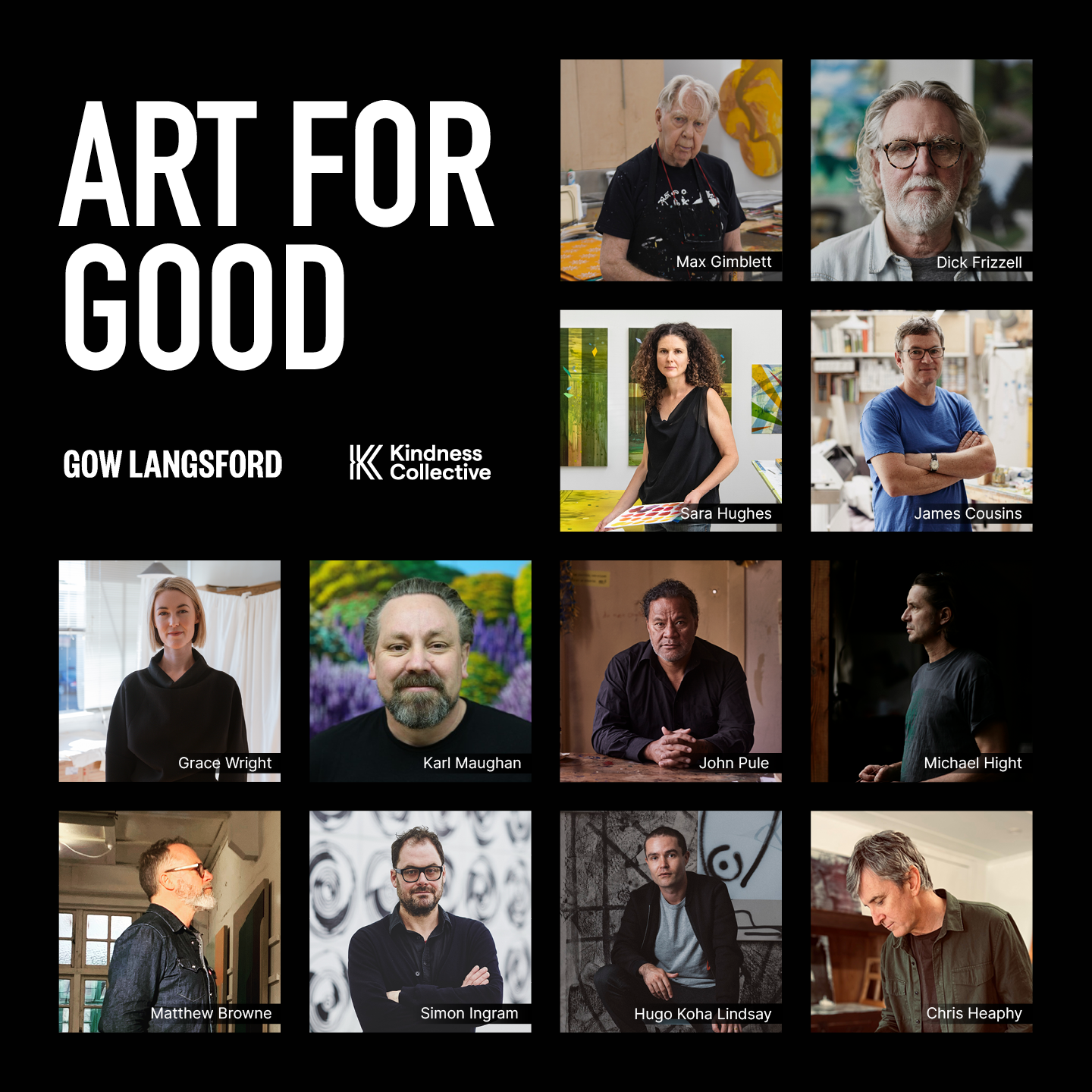
Poetry Shelf Noticeboard: Art for Good Kindness Collective auction

Kindness Collective is a nationwide charity that spreads kindness by connecting children and families with the things they need (from everyday essentials to moments of joy). They support thousands of people living in poverty every year through nationwide programmes. The Collective aims to promote a kinder New Zealand, tackling inequity from the ground up, creating long-term, positive social impacts where everyone has the chance to thrive.Works will be on show at Gow Langsford Onehunga during business hours (Thursday-Friday 10-5pm; Saturday 10-4pm) or by appointment from Thursday 31 October – Thursday 7 November. The auction is now live and biddable online with thanks to Art + Object. Ben Plumbly will conclude the sale with a live auction event on Thursday 7 November at 7pm at Gow Langsford Gallery, Onehunga. RSVP for this special evening to info@gowlangsfordgallery.co.nz
Bid Online Now

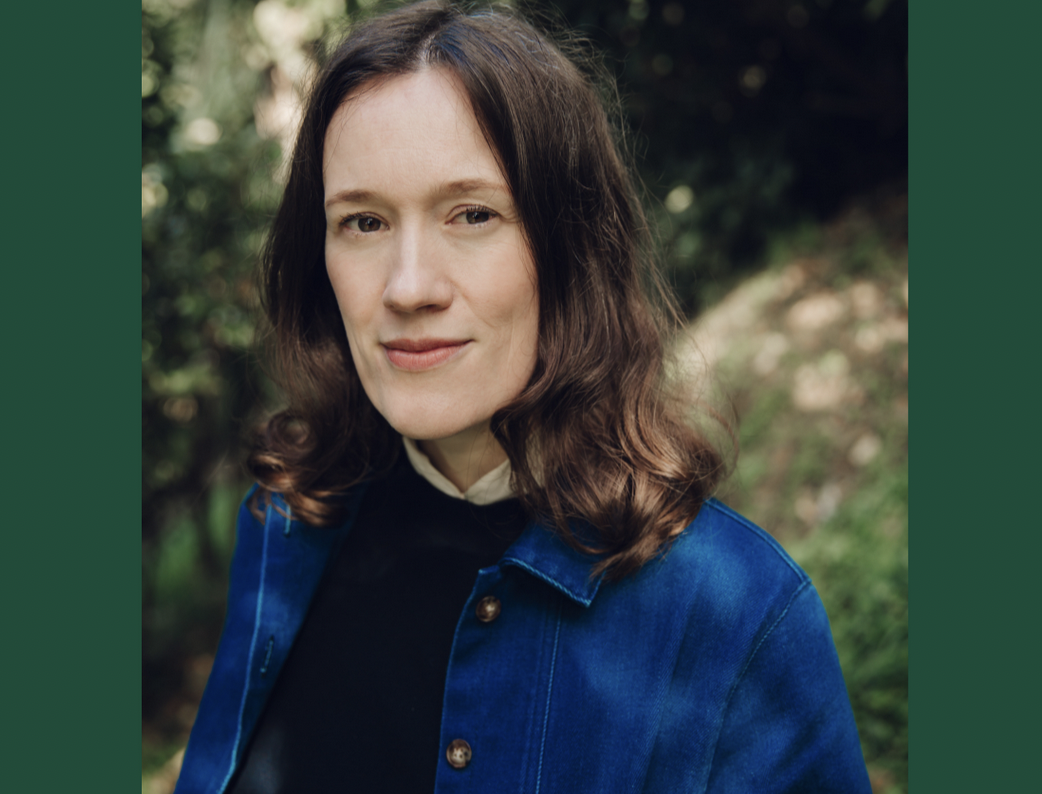
Poetry Shelf noticeboard: Anna Smaill is 2025 IIML Writer in Residence

Anna Smaill named as 2025 International Institute of Modern Letters Writer in Residence

Acclaimed novelist Anna Smaill has been appointed as Te Herenga Waka—Victoria University of Wellington International Institute of Modern Letters (IIML) and Creative New Zealand Writer in Residence for 2025. 

Anna began her publishing career with a volume of poetry, The Violinist in Spring, which was released in 2005 by Te Herenga Waka University Press. Her first novel The Chimes won the prestigious award for Best Novel at the 2016 World Fantasy Awards. It was also longlisted for the Booker Prize and translated into four languages. Her second novel Bird Life was published in 2023 in the US, UK, and Australia to excellent reviews, with The Times (UK) calling it “a deeply affecting novel [that] transcend[s] cultural barriers while reaching through them to the essentially human”. Locally, it was longlisted for the Ockham Book Awards.

While holding the residency at the IIML, Anna will work on a novel tentatively titled The Blazing, which she describes as “part archival thriller, part coming-of-age story”. Set in both the US and UK, the novel will be “an examination of the value and worth of art and history in the midst of cultural collapse, and will explore ideas of provenance and whakapapa. In testing how individual stories can ripple outward to effect historical change, it will follow a path back to Aotearoa New Zealand,” said Anna.

Director of the International Institute of Modern Letters Damien Wilkins said, “Anna’s two novels put her in the front rank of writers in this country and we’re thrilled to have her in Bill Manhire House next year”.

Commenting on the appointment, Anna said, “I am so grateful for the chance to work on my next book at the International Institute of Modern Letters in 2025, the place where I first started to take myself seriously as a writer. The residency position represents time and creative freedom. But even more it represents the collective mana of the institute and all the writers it has fostered. I feel very lucky to be part of it”.

Anna takes up the residency at the IIML on 1 February 2025.

In 2001, Anna completed an MA in Creative Writing at the IIML. She subsequently lived and studied overseas, receiving a PhD in English Literature from University College, University of London. She has worked as an academic and as a senior communications advisor. Most recently she was the team leader of Te Papa’s English writing team. Anna is also an accomplished literary critic, having published articles on writers such as Janet Frame and Bill Manhire.

In 2015, Anna was a finalist in the Wellingtonian of the Year, Arts category. She also received a New Generation Award that year from the Arts Foundation.

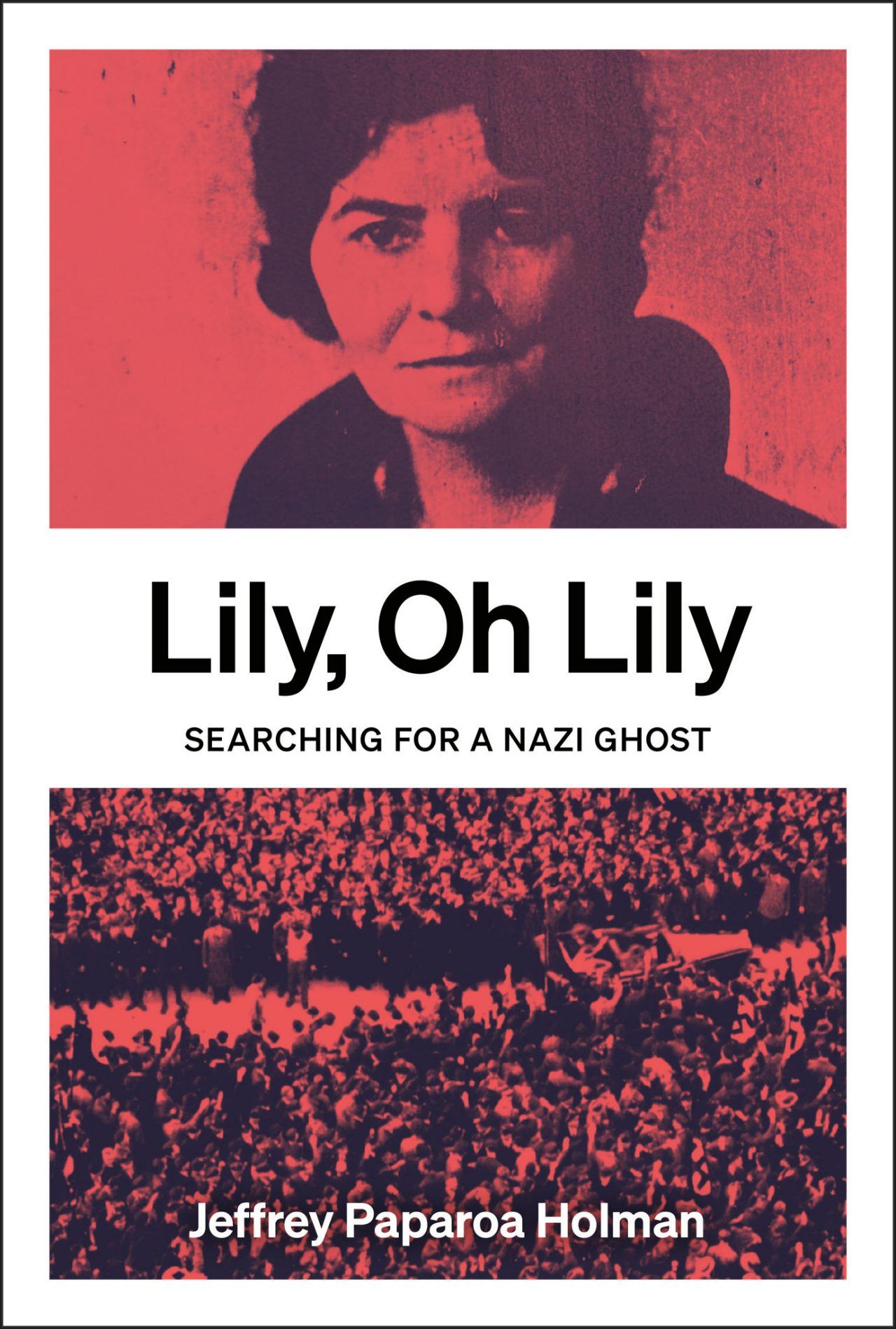
Book Launch: Lily, Oh Lily by Jeffrey Paparoa Holman

Book Launch: Lily, Oh Lily by Jeffrey Paparoa Holman30 Oct – 6pm, Unity Books, Wellington

Book Launch: Lily, Oh Lily by Jeffrey Paparoa Holman

About the event

Join us in the shop to celebrate the launch of Jeffrey Paparoa Holman’s new book, Lily, Oh Lily published by Canterbury University Press.

Lily Hasenburg was just such a figure in Holman’s growing years. She was whispered into his ear by grandmother Eunice – in memorable stories of her older sister, who married and moved to Germany at the turn of the 20th century, and was later caught up in the Nazi web spun by Adolf Hitler. Unable to shake loose this story, Holman pursued her to Berlin, Hamburg and Dresden. Here, we have an account of his pilgrimage; the kind of family history we might bury, and forget – to our loss.

Jeffrey will be in conversation with Dylan Horrocks about the book.

‘Holman travels, learns German, encounters the lost who were always right there … Lily, Oh Lily is family memoir at full stretch, made with love, yearning and just a hint of reproach. A wise, timely, beautiful read.’ —Diana Wichtel

‘Lily, Oh Lily is a thriller, a search for a particular person caught in the events of Nazi Germany – not a whodunnit, but a where-is-she?’ —Patrick Evans

Lily, Oh Lily by Jeffrey Paparoa Holman

Poetry Shelf Monday poem: A Lullaby by Bill Manhire

A Lullaby

Here is the world in which you sing.
Here is your sleepy cry.
Here is your sleepy father.
And here the sleepy sky.

Here is the sleepy mountain,
and here the sleepy sea.
Here is your sleepy mother.
Sleep safe with me.

Here is pohutukawa,
here is the magpie’s eye,
here is the wind in branches
going by.

Here is a heart to beat with yours,
here is your windy smile.
Here are these arms to hold you
for awhile.

Here is the world in which you sleep,
and here the sleepy sea.
Here is your sleepy mother.
Sleep safe with me.

Bill Manhire
The Victims of Lightning, Te Herenga Waka University Press, 2010

Over the coming months, the Monday Poem spot will include poetry that has stuck to me over time, poems that I’ve loved for all kinds of reasons. Poems that comfort or delight or challenge. Poems that strike the eye, ear or heart.

So many of Bill Manhire’s poems have taken up residency in the poetry room in my head, poems that make the hairs on the back of my neck stand on end, poems that deliver an exquisite interplay of music, surprise, wit, observation, invention. How hard it has been, choosing a single poem for this occasion. At first I sought permission to post ‘Hotel Emergencies’, a poem that has resonated deeply over the years, and that still pierces acutely. How heartbreaking, almost twenty years later, that it reflects a version of our current catastrophic world. You can listen to Bill read the poem here.

But today I have chosen ‘A Lullaby’, a tender poem I also return to, so moving, so comforting. It’s poetry gold, a poem that holds me in a warm embrace. I have had it open on the kitchen table, all week, poem as balm, praying against all odds the world will sleep safe, stay safe. Bill is our poet musician extraordinaire, the way he makes a poem sing, whether he is writing of dark or light, difficulty or love, Buddhist rain or garden gates. Today I need to take this one quiet moment, and let these lullaby lines soothe my aching heart.

Bill Manhire’s most recent books, all published by Te Herenga Waka University Press / Victoria Press, include Wow (2020), Some Things to Place in a Coffin (2017), Tell Me My Name (with Hannah Griffin and Norman Meehan, 2017) and The Stories of Bill Manhire (2015). He was New Zealand’s inaugural poet laureate, and founded and until recently directed the International Institute of Modern Letters at Victoria University of Wellington. He has edited major anthologies, including, with Marion McLeod, the now classic Some Other Country: New Zealand’s Best Short Stories (1984).